IBDP Business & Management
(an overview)


                    Paul Hoang
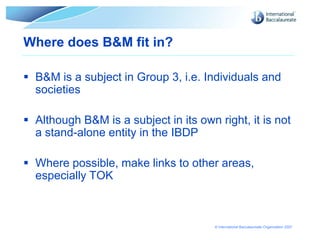
Where does B&M fit in?

 B&M is a subject in Group 3, i.e. Individuals and
  societies

 Although B&M is a subject in its own right, it is not
  a stand-alone entity in the IBDP

 Where possible, make links to other areas,
  especially TOK


                                       © International Baccalaureate Organization 2007
What else is offered in Group 3?

   Economics
   Geography
   History
   ITGS
   Islamic History

                                  www.canadorec.on.ca/ProgramInfo/FullTime/Business/images/businessWelcome_4.jpg
    Philosophy
   Psychology
   Social and cultural anthropology
   World religions
   Environmental systems and Societies – transdisciplinary

                                                        © International Baccalaureate Organization 2007
Growth in B&M
         9000
         8000
         7000
         6000
         5000
         4000
         3000
         2000
         1000
            0
                 2002   2003   2004   2005   2006   2007           2008             2009

         Source: IBCA

Page 4                                               © International Baccalaureate Organization 2007
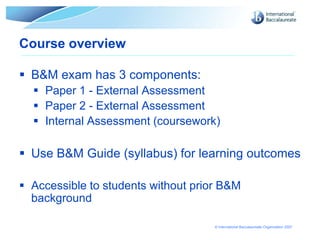
Course overview

 B&M exam has 3 components:
   Paper 1 - External Assessment
   Paper 2 - External Assessment
   Internal Assessment (coursework)

 Use B&M Guide (syllabus) for learning outcomes

 Accessible to students without prior B&M
  background

                                     © International Baccalaureate Organization 2007
Syllabus outline

    Business organization and environment
    Human Resources
    Accounting and Finance
    Marketing
    Operations management

 Business Strategy (HL Only)


Page 6                               © International Baccalaureate Organization 2007
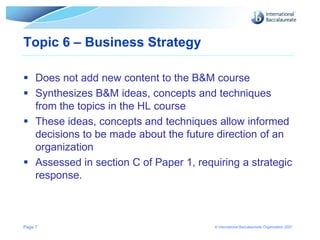
Topic 6 – Business Strategy

 Does not add new content to the B&M course
 Synthesizes B&M ideas, concepts and techniques
  from the topics in the HL course
 These ideas, concepts and techniques allow informed
  decisions to be made about the future direction of an
  organization
 Assessed in section C of Paper 1, requiring a strategic
  response.


Page 7                                  © International Baccalaureate Organization 2007
Topic 6 – Strategy framework

 Useful as a tool for synoptic assessment and revision
 Strategy is about asking questions: what, why, when,
  how, where and who?


Page 8          © IBO, 2007            © International Baccalaureate Organization 2007
Topic 6 – the three-stage process

 Stage 1: Strategic analysis – where is the business
  now?

 Stage 2: Strategic choice – where is the business
  aiming to be?

 Stage 3: Strategic implementation – how is the
  business going to achieve its objectives?


Page 9                                  © International Baccalaureate Organization 2007
How do you manage the syllabus?

 There is a lot to get through(!)

 Important that you start as soon as you can

 The learning outcomes are very clear – avoid
  including more material than you need to

 Draw up SOW and be strict with yourself

                                     © International Baccalaureate Organization 2007
Teaching order (at STC)

            Year 12                   Year 13
2. Human Resources           3. Accounting & Finance
4. Marketing                 5. Operations Mgt

          1. Business organization and environment
               6. Business Strategy (HL Only)


Page 11                                 © International Baccalaureate Organization 2007
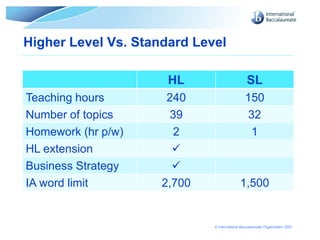
Higher Level Vs. Standard Level

                      HL                        SL
Teaching hours        240                      150
Number of topics       39                      32
Homework (hr p/w)       2                       1
HL extension           
Business Strategy      
IA word limit        2,700                  1,500


                             © International Baccalaureate Organization 2007
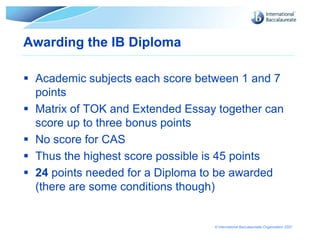
Awarding the IB Diploma

 Academic subjects each score between 1 and 7
  points
 Matrix of TOK and Extended Essay together can
  score up to three bonus points
 No score for CAS
 Thus the highest score possible is 45 points
 24 points needed for a Diploma to be awarded
  (there are some conditions though)


                                  © International Baccalaureate Organization 2007
The IB Diploma Vs. Certificate programme
 Students can take individual certificates rather
  than embark on the full Diploma programme of
  study

 A certificate can be awarded for each subject
  studied

 Individual certificates are recognised by
  universities and institutes of further education

                                      © International Baccalaureate Organization 2007
Expectations

 IB encourages positive attitudes to learning in our
  students

 The IB ethos embraces a continuum in terms of
  international education

 TOK is integral to all aspects of the IBDP


                                       © International Baccalaureate Organization 2007
Promoting internationalism

 What does internationalism mean to you?

 How can we promote internationalism in our B&M
  teaching?


                                  © International Baccalaureate Organization 2007
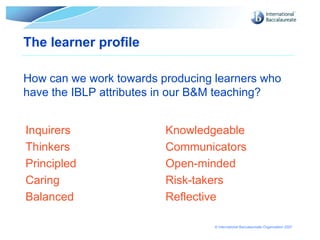
The learner profile

How can we work towards producing learners who
have the IBLP attributes in our B&M teaching?


Inquirers                Knowledgeable
Thinkers                 Communicators
Principled               Open-minded
Caring                   Risk-takers
Balanced                 Reflective

                                  © International Baccalaureate Organization 2007
B&M education outside the classroom
• Educational visits


Page 18                    © International Baccalaureate Organization 2007
B&M education outside the classroom
• Competitions


Page 19                    © International Baccalaureate Organization 2007
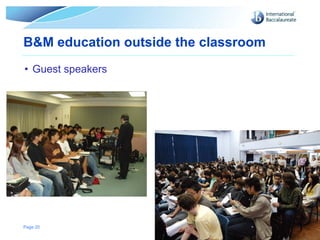
B&M education outside the classroom
• Guest speakers


Page 20                    © International Baccalaureate Organization 2007

B&M Course Overview

  • 1.
    IBDP Business &Management (an overview) Paul Hoang
  • 2.
    Where does B&Mfit in?  B&M is a subject in Group 3, i.e. Individuals and societies  Although B&M is a subject in its own right, it is not a stand-alone entity in the IBDP  Where possible, make links to other areas, especially TOK © International Baccalaureate Organization 2007
  • 3.
    What else isoffered in Group 3?  Economics  Geography  History  ITGS  Islamic History  www.canadorec.on.ca/ProgramInfo/FullTime/Business/images/businessWelcome_4.jpg Philosophy  Psychology  Social and cultural anthropology  World religions  Environmental systems and Societies – transdisciplinary © International Baccalaureate Organization 2007
  • 4.
    Growth in B&M 9000 8000 7000 6000 5000 4000 3000 2000 1000 0 2002 2003 2004 2005 2006 2007 2008 2009 Source: IBCA Page 4 © International Baccalaureate Organization 2007
  • 5.
    Course overview  B&Mexam has 3 components:  Paper 1 - External Assessment  Paper 2 - External Assessment  Internal Assessment (coursework)  Use B&M Guide (syllabus) for learning outcomes  Accessible to students without prior B&M background © International Baccalaureate Organization 2007
  • 6.
    Syllabus outline  Business organization and environment  Human Resources  Accounting and Finance  Marketing  Operations management  Business Strategy (HL Only) Page 6 © International Baccalaureate Organization 2007
  • 7.
    Topic 6 –Business Strategy  Does not add new content to the B&M course  Synthesizes B&M ideas, concepts and techniques from the topics in the HL course  These ideas, concepts and techniques allow informed decisions to be made about the future direction of an organization  Assessed in section C of Paper 1, requiring a strategic response. Page 7 © International Baccalaureate Organization 2007
  • 8.
    Topic 6 –Strategy framework  Useful as a tool for synoptic assessment and revision  Strategy is about asking questions: what, why, when, how, where and who? Page 8 © IBO, 2007 © International Baccalaureate Organization 2007
  • 9.
    Topic 6 –the three-stage process  Stage 1: Strategic analysis – where is the business now?  Stage 2: Strategic choice – where is the business aiming to be?  Stage 3: Strategic implementation – how is the business going to achieve its objectives? Page 9 © International Baccalaureate Organization 2007
  • 10.
    How do youmanage the syllabus?  There is a lot to get through(!)  Important that you start as soon as you can  The learning outcomes are very clear – avoid including more material than you need to  Draw up SOW and be strict with yourself © International Baccalaureate Organization 2007
  • 11.
    Teaching order (atSTC) Year 12 Year 13 2. Human Resources 3. Accounting & Finance 4. Marketing 5. Operations Mgt 1. Business organization and environment 6. Business Strategy (HL Only) Page 11 © International Baccalaureate Organization 2007
  • 12.
    Higher Level Vs.Standard Level HL SL Teaching hours 240 150 Number of topics 39 32 Homework (hr p/w) 2 1 HL extension  Business Strategy  IA word limit 2,700 1,500 © International Baccalaureate Organization 2007
  • 13.
    Awarding the IBDiploma  Academic subjects each score between 1 and 7 points  Matrix of TOK and Extended Essay together can score up to three bonus points  No score for CAS  Thus the highest score possible is 45 points  24 points needed for a Diploma to be awarded (there are some conditions though) © International Baccalaureate Organization 2007
  • 14.
    The IB DiplomaVs. Certificate programme  Students can take individual certificates rather than embark on the full Diploma programme of study  A certificate can be awarded for each subject studied  Individual certificates are recognised by universities and institutes of further education © International Baccalaureate Organization 2007
  • 15.
    Expectations  IB encouragespositive attitudes to learning in our students  The IB ethos embraces a continuum in terms of international education  TOK is integral to all aspects of the IBDP © International Baccalaureate Organization 2007
  • 16.
    Promoting internationalism  Whatdoes internationalism mean to you?  How can we promote internationalism in our B&M teaching? © International Baccalaureate Organization 2007
  • 17.
    The learner profile Howcan we work towards producing learners who have the IBLP attributes in our B&M teaching? Inquirers Knowledgeable Thinkers Communicators Principled Open-minded Caring Risk-takers Balanced Reflective © International Baccalaureate Organization 2007
  • 18.
    B&M education outsidethe classroom • Educational visits Page 18 © International Baccalaureate Organization 2007
  • 19.
    B&M education outsidethe classroom • Competitions Page 19 © International Baccalaureate Organization 2007
  • 20.
    B&M education outsidethe classroom • Guest speakers Page 20 © International Baccalaureate Organization 2007