BLU-5937 Update and Chronic
Cough Key Opinion Leader Event
September 20, 2017
Forward Looking Statements
Certain statements contained in this news release, other than statements of fact that are independently verifiable at the
date hereof, may constitute “forward-looking statements” within the meaning of Canadian securities legislation and
regulations. Such statements, based as they are on the current expectations of management, inherently involve numerous
important risks, uncertainties and assumptions, known and unknown, many of which are beyond BELLUS Health Inc.'s
control. Such risks factors include but are not limited to: the ability to obtain financing, the impact of general economic
conditions, general conditions in the pharmaceutical industry, changes in the regulatory environment in the jurisdictions
in which BELLUS Health Inc. does business, stock market volatility, fluctuations in costs, changes to the competitive
environment due to consolidation, achievement of forecasted burn rate, potential payments/outcomes in relation to
indemnity agreements and contingent value rights, achievement of forecasted pre-clinical and clinical trial milestones
and that actual results may vary once the final and quality-controlled verification of data and analyses has been
completed. In addition, the length of BELLUS Health Inc.’s drug candidates development process, their market size and
commercial value, as well as the sharing of proceeds between BELLUS Health Inc. and its potential partners from
potential future revenues, if any, are dependent upon a number of factors. Consequently, actual future results and events
may differ materially from the anticipated results and events expressed in the forward-looking statements. The Company
believes that expectations represented by forward-looking statements are reasonable, yet there can be no assurance that
such expectations will prove to be correct. The reader should not place undue reliance, if any, on any forward-looking
statements included in this news release. These forward-looking statements speak only as of the date made, and BELLUS
Health Inc. is under no obligation and disavows any intention to update publicly or revise such statements as a result of
any new information, future event, circumstances or otherwise, unless required by applicable legislation or regulation.
Please see BELLUS Health Inc.’s public filings with the Canadian securities regulatory authorities, including the
Annual InformationForm, for further risk factorsthat might affect BELLUS HealthInc. and itsbusiness.
2
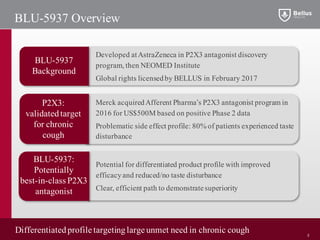
Differentiatedprofile targetinglarge unmet need in chronic cough
BLU-5937 Overview
3
P2X3:
validatedtarget
for chronic
cough
Developed atAstraZeneca in P2X3 antagonist discovery
program, then NEOMED Institute
Global rights licensedby BELLUS in February 2017
BLU-5937
Background
BLU-5937:
Potentially
best-in-class P2X3
antagonist
Potential for differentiated product profile with improved
efficacyand reduced/no taste disturbance
Clear, efficient path to demonstratesuperiority
Merck acquiredAfferent Pharma’s P2X3 antagonist program in
2016 for US$500M based on positive Phase 2 data
Problematic side effect profile: 80% of patients experienced taste
disturbance
A Review of Chronic Cough
Prof Jacky A. Smith MB, ChB, FRCP, PhD
University of Manchester
r
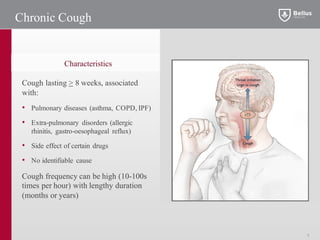
Chronic Cough
5
Characteristics
Cough lasting > 8 weeks, associated
with:
• Pulmonary diseases (asthma, COPD, IPF)
• Extra-pulmonary disorders (allergic
rhinitis, gastro-oesophageal reflux)
• Side effect of certain drugs
• No identifiable cause
Cough frequency can be high (10-100s
times per hour) with lengthy duration
(months or years)
5
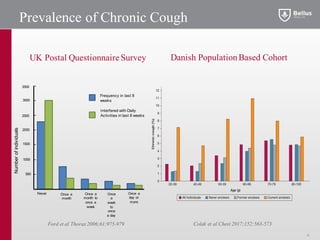
UK Postal Questionnaire Survey Danish PopulationBased Cohort
Prevalence of Chronic Cough
6
Ford et al Thorax2006;61;975-979 Colak et al Chest 2017;152:563-573
3500
3000
2500
2000
1500
1000
500
Never Once a
month
Once a
month to
once a
week
Once
a
week
to
once
a day
Once a
day or
more
Numberofindividuals
Frequency in last 8
weeks
Interfered with Daily
Activities in last 8 weeks
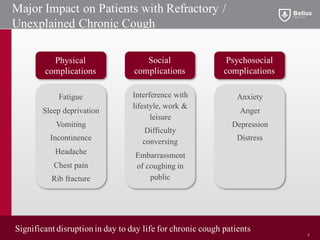
Major Impact on Patients with Refractory /
Unexplained Chronic Cough
7
Social
complications
Physical
complications
Significant disruptionin day to day life for chronic cough patients
7
Fatigue
Sleep deprivation
Vomiting
Incontinence
Headache
Chest pain
Rib fracture
Psychosocial
complications
Interference with
lifestyle, work &
leisure
Difficulty
conversing
Embarrassment
of coughing in
public
Anxiety
Anger
Depression
Distress
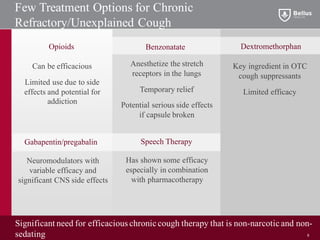
Few Treatment Options for Chronic
Refractory/Unexplained Cough
Can be efficacious
Limited use due to side
effects and potential for
addiction
Anesthetize the stretch
receptors in the lungs
Temporary relief
Potential serious side effects
if capsule broken
BenzonatateOpioids Dextromethorphan
Key ingredient in OTC
cough suppressants
Limited efficacy
Significant need for efficacious chronic cough therapy that is non-narcotic and non-
sedating
Gabapentin/pregabalin Speech Therapy
Has shown some efficacy
especially in combination
with pharmacotherapy
Neuromodulators with
variable efficacy and
significant CNS side effects
8
P2X3
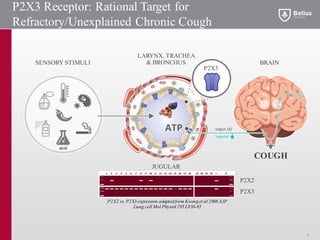
P2X3 Receptor: Rational Target for
Refractory/Unexplained Chronic Cough
9
SENSORY STIMULI BRAIN
LARYNX, TRACHEA
& BRONCHUS
JUGULAR
P2X2
P2X3
P2X2 vs. P2X3expression adaptedfrom Kwonget al 2008AJP
Lung cell Mol Physiol 295L858-65
COUGH
acid
P2X3 Receptor: Clinically Validated Target
Targeting P2X3 is an efficacious strategyfor treatingchronic cough
Merck & Co., Inc. (2017). Merck Announces Presentation of Phase 2 Results for MK-7264, an Investigational, P2X3 Receptor Antagonist, Being Evaluated for the Treatment of Chronic Cough. [Press Release]. Retrieved from
http://www.mrknewsroom.com/news-release/research-and-development-news/merck-announces-presentation-phase-2-results-mk-7264-inve
Merck’s MK-7264 - P2X3 Antagonist
Reduction in Awake Cough Frequency
(from Baseline Compared to Placebo)
* p<0.05 vs. placebo
0%
20%
40%
60%
80%
Placebo 7.5 mg 20 mg 50 mg
*
Phase IIb (253 patients; 12
week study) showed
reduction in awake cough
frequency of
84% vs baseline
37% vs placebo
at 50mg dose
10
MK-7264: Significant Adverse Taste Effect
Taste effect likelydue to low selectivityfor P2X3; MK-7264 also inhibiting
P2X2/3, particularlyat 50mg dose
0%
10%
20%
30%
40%
50%
60%
70%
80%
90%
Placebo 7.5mg 20mg 50mg
Taste Disturbance Complete Loss of Taste
At therapeutic dose (50 mg BID):
~80%
of patients
reported taste
alteration
~40%
of patients reported
very/extremely
bothersome taste
effect
Merck & Co., Inc. (2017). Merck Announces Presentation of Phase 2 Results for MK-7264, an Investigational, P2X3 Receptor Antagonist, Being Evaluated for the Treatment of Chronic Cough. [Press Release]. Retrieved from
http://www.mrknewsroom.com/news-release/research-and-development-news/merck-announces-presentation-phase-2-results-mk-7264-inve
Phase IIb: Percent of Patients Reporting Taste
Side Effect
11
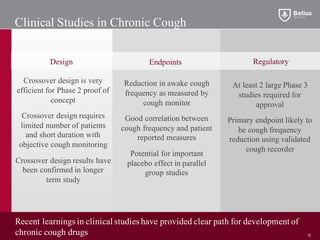
Clinical Studies in Chronic Cough
Crossover design is very
efficient for Phase 2 proof of
concept
Crossover design requires
limited number of patients
and short duration with
objective cough monitoring
Crossover design results have
been confirmed in longer
term study
Reduction in awake cough
frequency as measured by
cough monitor
Good correlation between
cough frequency and patient
reported measures
Potential for important
placebo effect in parallel
group studies
EndpointsDesign Regulatory
At least 2 large Phase 3
studies required for
approval
Primary endpoint likely to
be cough frequency
reduction using validated
cough recorder
Recent learnings in clinical studies have provided clear path for development of
chronic cough drugs 12
13
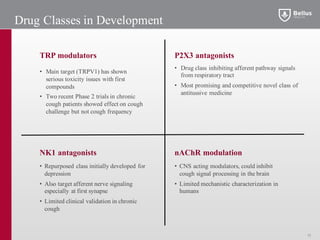
TRP modulators
• Main target (TRPV1) has shown
serious toxicity issues with first
compounds
• Two recent Phase 2 trials in chronic
cough patients showed effect on cough
challenge but not cough frequency
NK1 antagonists
• Repurposed class initially developed for
depression
• Also target afferent nerve signaling
especially at first synapse
• Limited clinical validation in chronic
cough
P2X3 antagonists
• Drug class inhibiting afferent pathway signals
from respiratory tract
• Most promising and competitive novel class of
antitussive medicine
nAChR modulation
• CNS acting modulators, could inhibit
cough signal processing in the brain
• Limited mechanistic characterization in
humans
Drug Classes in Development
13
BLU-5937 for Chronic Cough
Dr. Denis Garceau
BELLUS Health
r
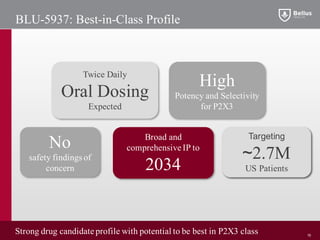
Strong drug candidate profile with potential to be best in P2X3 class
BLU-5937: Best-in-Class Profile
15
Targeting
~2.7M
US Patients
Broad and
comprehensive IP to
2034
High
Potency and Selectivity
for P2X3
Twice Daily
Oral Dosing
Expected
No
safety findings of
concern
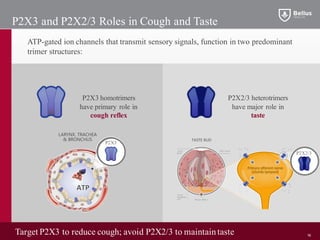
P2X3 and P2X2/3 Roles in Cough and Taste
Target P2X3 to reduce cough; avoid P2X2/3 to maintaintaste 16
P2X2/3 heterotrimers
have major role in
taste
P2X3 homotrimers
have primary role in
cough reflex
ATP-gated ion channels that transmit sensory signals, function in two predominant
trimer structures:
P2X2/3
P2X3
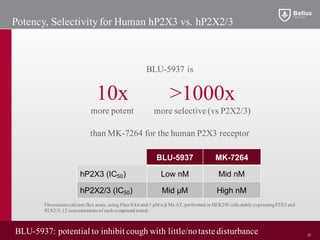
Potency, Selectivity for Human hP2X3 vs. hP2X2/3
BLU-5937 MK-7264
hP2X3 (IC50) Low nM Mid nM
hP2X2/3 (IC50) Mid µM High nM
Fluorescent calcium flux assay, using Fluo-8 kit and 3 µM α,β Me AT, performed in HEK293 cells stably expressingP2X3 and
P2X2/3; 12 concentrations of each compound tested.
BLU-5937: potential to inhibit cough with little/notaste disturbance 17
BLU-5937 is
than MK-7264 for the human P2X3 receptor
10x
more potent
>1000x
more selective (vs P2X2/3)
0
5
10
15
20
25
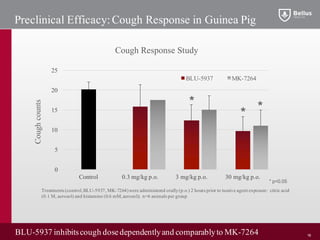
Control 0.3 mg/kg p.o. 3 mg/kg p.o. 30 mg/kg p.o.
BLU-5937 MK-7264
Preclinical Efficacy:Cough Response in Guinea Pig
BLU-5937 inhibitscough dosedependentlyand comparablyto MK-7264 18
Treatments (control,BLU-5937, MK-7264)were administered orally(p.o.) 2 hours prior to tussive agent exposure: citric acid
(0.1 M, aerosol) and histamine (0.6 mM,aerosol); n=6 animals per group
* **
* p<0.05
Coughcounts
Cough Response Study
0
5
10
15
20
25
30
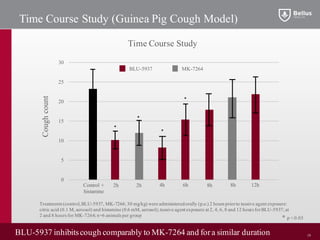
Time Course Study (Guinea Pig Cough Model)
BLU-5937 inhibitscough comparably to MK-7264 and fora similar duration
4h 6h 8h 12h2h
BLU-5937 MK-7264
*
*
* p < 0.05
*
*
Coughcount
19
Control +
histamine
2h 8h
Treatments (control,BLU-5937, MK-7264; 30 mg/kg) were administeredorally (p.o.) 2 hours priorto tussive agent exposure:
citric acid (0.1 M, aerosol) and histamine (0.6 mM, aerosol); tussive agent exposure at 2, 4, 6, 8 and 12 hours forBLU-5937; at
2 and 8 hours for MK-7264; n=6 animals per group
Time Course Study
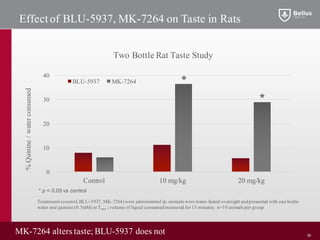
Effectof BLU-5937, MK-7264 on Taste in Rats
0
10
20
30
40
Control 10 mg/kg 20 mg/kg
BLU-5937 MK-7264
MK-7264 alters taste; BLU-5937 does not 20
%Quinine/waterconsumed
Two Bottle Rat Taste Study
Treatments (control,BLU-5937, MK-7264)were administered ip: animals were water-fasted overnight andpresented with one bottle
water and quinine (0.3mM) at Tmax ; volume of liquid consumedmeasured for15 minutes; n=10 animals per group
*
*
* p < 0.05 vs control
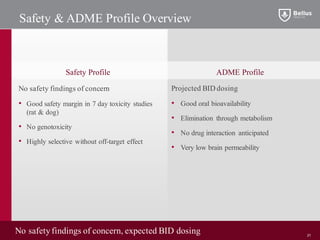
Safety & ADME Profile Overview
No safetyfindings of concern, expected BID dosing 21
No safety findings of concern
• Good safety margin in 7 day toxicity studies
(rat & dog)
• No genotoxicity
• Highly selective without off-target effect
Projected BID dosing
• Good oral bioavailability
• Elimination through metabolism
• No drug interaction anticipated
• Very low brain permeability
Safety Profile ADME Profile
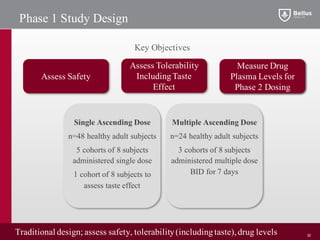
Phase 1 Study Design
Traditional design; assess safety, tolerability(includingtaste),drug levels
Measure Drug
Plasma Levels for
Phase 2 Dosing
Assess Tolerability
IncludingTaste
Effect
Assess Safety
Key Objectives
22
Single Ascending Dose
n=48 healthy adult subjects
5 cohorts of 8 subjects
administered single dose
1 cohort of 8 subjects to
assess taste effect
Multiple Ascending Dose
n=24 healthy adult subjects
3 cohorts of 8 subjects
administered multiple dose
BID for 7 days
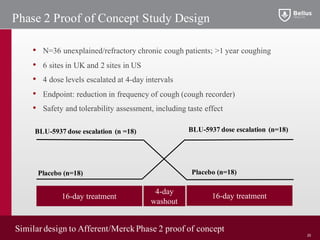
Phase 2 Proof of Concept Study Design
BLU-5937 dose escalation (n =18)
Placebo (n=18)
BLU-5937 dose escalation (n=18)
Placebo (n=18)
• N=36 unexplained/refractory chronic cough patients; >1 year coughing
• 6 sites in UK and 2 sites in US
• 4 dose levels escalated at 4-day intervals
• Endpoint: reduction in frequency of cough (cough recorder)
• Safety and tolerability assessment, including taste effect
16-day treatment 16-day treatment
4-day
washout
Similar design to Afferent/MerckPhase 2 proof of concept
23
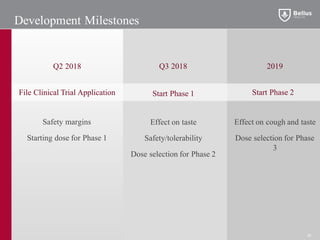
Development Milestones
Safety margins
Starting dose for Phase 1
24
Effect on taste
Safety/tolerability
Dose selection for Phase 2
Start Phase 1File Clinical Trial Application Start Phase 2
Effect on cough and taste
Dose selection for Phase
3
24
Q3 2018Q2 2018 2019
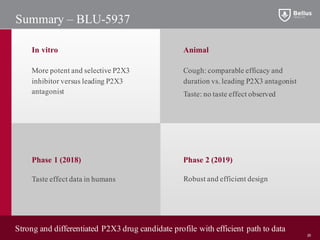
Summary – BLU-5937
Robust and efficient design
More potent and selective P2X3
inhibitor versus leading P2X3
antagonist
In vitro
Phase 2 (2019)Phase 1 (2018)
Animal
Strong and differentiated P2X3 drug candidate profile with efficient path to data
Taste effect data in humans
Cough: comparable efficacy and
duration vs. leading P2X3 antagonist
Taste: no taste effect observed
25

Blu 5937 kol event sept 20 v final

  • 1.
    BLU-5937 Update andChronic Cough Key Opinion Leader Event September 20, 2017
  • 2.
    Forward Looking Statements Certainstatements contained in this news release, other than statements of fact that are independently verifiable at the date hereof, may constitute “forward-looking statements” within the meaning of Canadian securities legislation and regulations. Such statements, based as they are on the current expectations of management, inherently involve numerous important risks, uncertainties and assumptions, known and unknown, many of which are beyond BELLUS Health Inc.'s control. Such risks factors include but are not limited to: the ability to obtain financing, the impact of general economic conditions, general conditions in the pharmaceutical industry, changes in the regulatory environment in the jurisdictions in which BELLUS Health Inc. does business, stock market volatility, fluctuations in costs, changes to the competitive environment due to consolidation, achievement of forecasted burn rate, potential payments/outcomes in relation to indemnity agreements and contingent value rights, achievement of forecasted pre-clinical and clinical trial milestones and that actual results may vary once the final and quality-controlled verification of data and analyses has been completed. In addition, the length of BELLUS Health Inc.’s drug candidates development process, their market size and commercial value, as well as the sharing of proceeds between BELLUS Health Inc. and its potential partners from potential future revenues, if any, are dependent upon a number of factors. Consequently, actual future results and events may differ materially from the anticipated results and events expressed in the forward-looking statements. The Company believes that expectations represented by forward-looking statements are reasonable, yet there can be no assurance that such expectations will prove to be correct. The reader should not place undue reliance, if any, on any forward-looking statements included in this news release. These forward-looking statements speak only as of the date made, and BELLUS Health Inc. is under no obligation and disavows any intention to update publicly or revise such statements as a result of any new information, future event, circumstances or otherwise, unless required by applicable legislation or regulation. Please see BELLUS Health Inc.’s public filings with the Canadian securities regulatory authorities, including the Annual InformationForm, for further risk factorsthat might affect BELLUS HealthInc. and itsbusiness. 2
  • 3.
    Differentiatedprofile targetinglarge unmetneed in chronic cough BLU-5937 Overview 3 P2X3: validatedtarget for chronic cough Developed atAstraZeneca in P2X3 antagonist discovery program, then NEOMED Institute Global rights licensedby BELLUS in February 2017 BLU-5937 Background BLU-5937: Potentially best-in-class P2X3 antagonist Potential for differentiated product profile with improved efficacyand reduced/no taste disturbance Clear, efficient path to demonstratesuperiority Merck acquiredAfferent Pharma’s P2X3 antagonist program in 2016 for US$500M based on positive Phase 2 data Problematic side effect profile: 80% of patients experienced taste disturbance
  • 4.
    A Review ofChronic Cough Prof Jacky A. Smith MB, ChB, FRCP, PhD University of Manchester r
  • 5.
    Chronic Cough 5 Characteristics Cough lasting> 8 weeks, associated with: • Pulmonary diseases (asthma, COPD, IPF) • Extra-pulmonary disorders (allergic rhinitis, gastro-oesophageal reflux) • Side effect of certain drugs • No identifiable cause Cough frequency can be high (10-100s times per hour) with lengthy duration (months or years) 5
  • 6.
    UK Postal QuestionnaireSurvey Danish PopulationBased Cohort Prevalence of Chronic Cough 6 Ford et al Thorax2006;61;975-979 Colak et al Chest 2017;152:563-573 3500 3000 2500 2000 1500 1000 500 Never Once a month Once a month to once a week Once a week to once a day Once a day or more Numberofindividuals Frequency in last 8 weeks Interfered with Daily Activities in last 8 weeks
  • 7.
    Major Impact onPatients with Refractory / Unexplained Chronic Cough 7 Social complications Physical complications Significant disruptionin day to day life for chronic cough patients 7 Fatigue Sleep deprivation Vomiting Incontinence Headache Chest pain Rib fracture Psychosocial complications Interference with lifestyle, work & leisure Difficulty conversing Embarrassment of coughing in public Anxiety Anger Depression Distress
  • 8.
    Few Treatment Optionsfor Chronic Refractory/Unexplained Cough Can be efficacious Limited use due to side effects and potential for addiction Anesthetize the stretch receptors in the lungs Temporary relief Potential serious side effects if capsule broken BenzonatateOpioids Dextromethorphan Key ingredient in OTC cough suppressants Limited efficacy Significant need for efficacious chronic cough therapy that is non-narcotic and non- sedating Gabapentin/pregabalin Speech Therapy Has shown some efficacy especially in combination with pharmacotherapy Neuromodulators with variable efficacy and significant CNS side effects 8
  • 9.
    P2X3 P2X3 Receptor: RationalTarget for Refractory/Unexplained Chronic Cough 9 SENSORY STIMULI BRAIN LARYNX, TRACHEA & BRONCHUS JUGULAR P2X2 P2X3 P2X2 vs. P2X3expression adaptedfrom Kwonget al 2008AJP Lung cell Mol Physiol 295L858-65 COUGH acid
  • 10.
    P2X3 Receptor: ClinicallyValidated Target Targeting P2X3 is an efficacious strategyfor treatingchronic cough Merck & Co., Inc. (2017). Merck Announces Presentation of Phase 2 Results for MK-7264, an Investigational, P2X3 Receptor Antagonist, Being Evaluated for the Treatment of Chronic Cough. [Press Release]. Retrieved from http://www.mrknewsroom.com/news-release/research-and-development-news/merck-announces-presentation-phase-2-results-mk-7264-inve Merck’s MK-7264 - P2X3 Antagonist Reduction in Awake Cough Frequency (from Baseline Compared to Placebo) * p<0.05 vs. placebo 0% 20% 40% 60% 80% Placebo 7.5 mg 20 mg 50 mg * Phase IIb (253 patients; 12 week study) showed reduction in awake cough frequency of 84% vs baseline 37% vs placebo at 50mg dose 10
  • 11.
    MK-7264: Significant AdverseTaste Effect Taste effect likelydue to low selectivityfor P2X3; MK-7264 also inhibiting P2X2/3, particularlyat 50mg dose 0% 10% 20% 30% 40% 50% 60% 70% 80% 90% Placebo 7.5mg 20mg 50mg Taste Disturbance Complete Loss of Taste At therapeutic dose (50 mg BID): ~80% of patients reported taste alteration ~40% of patients reported very/extremely bothersome taste effect Merck & Co., Inc. (2017). Merck Announces Presentation of Phase 2 Results for MK-7264, an Investigational, P2X3 Receptor Antagonist, Being Evaluated for the Treatment of Chronic Cough. [Press Release]. Retrieved from http://www.mrknewsroom.com/news-release/research-and-development-news/merck-announces-presentation-phase-2-results-mk-7264-inve Phase IIb: Percent of Patients Reporting Taste Side Effect 11
  • 12.
    Clinical Studies inChronic Cough Crossover design is very efficient for Phase 2 proof of concept Crossover design requires limited number of patients and short duration with objective cough monitoring Crossover design results have been confirmed in longer term study Reduction in awake cough frequency as measured by cough monitor Good correlation between cough frequency and patient reported measures Potential for important placebo effect in parallel group studies EndpointsDesign Regulatory At least 2 large Phase 3 studies required for approval Primary endpoint likely to be cough frequency reduction using validated cough recorder Recent learnings in clinical studies have provided clear path for development of chronic cough drugs 12
  • 13.
    13 TRP modulators • Maintarget (TRPV1) has shown serious toxicity issues with first compounds • Two recent Phase 2 trials in chronic cough patients showed effect on cough challenge but not cough frequency NK1 antagonists • Repurposed class initially developed for depression • Also target afferent nerve signaling especially at first synapse • Limited clinical validation in chronic cough P2X3 antagonists • Drug class inhibiting afferent pathway signals from respiratory tract • Most promising and competitive novel class of antitussive medicine nAChR modulation • CNS acting modulators, could inhibit cough signal processing in the brain • Limited mechanistic characterization in humans Drug Classes in Development 13
  • 14.
    BLU-5937 for ChronicCough Dr. Denis Garceau BELLUS Health r
  • 15.
    Strong drug candidateprofile with potential to be best in P2X3 class BLU-5937: Best-in-Class Profile 15 Targeting ~2.7M US Patients Broad and comprehensive IP to 2034 High Potency and Selectivity for P2X3 Twice Daily Oral Dosing Expected No safety findings of concern
  • 16.
    P2X3 and P2X2/3Roles in Cough and Taste Target P2X3 to reduce cough; avoid P2X2/3 to maintaintaste 16 P2X2/3 heterotrimers have major role in taste P2X3 homotrimers have primary role in cough reflex ATP-gated ion channels that transmit sensory signals, function in two predominant trimer structures: P2X2/3 P2X3
  • 17.
    Potency, Selectivity forHuman hP2X3 vs. hP2X2/3 BLU-5937 MK-7264 hP2X3 (IC50) Low nM Mid nM hP2X2/3 (IC50) Mid µM High nM Fluorescent calcium flux assay, using Fluo-8 kit and 3 µM α,β Me AT, performed in HEK293 cells stably expressingP2X3 and P2X2/3; 12 concentrations of each compound tested. BLU-5937: potential to inhibit cough with little/notaste disturbance 17 BLU-5937 is than MK-7264 for the human P2X3 receptor 10x more potent >1000x more selective (vs P2X2/3)
  • 18.
    0 5 10 15 20 25 Control 0.3 mg/kgp.o. 3 mg/kg p.o. 30 mg/kg p.o. BLU-5937 MK-7264 Preclinical Efficacy:Cough Response in Guinea Pig BLU-5937 inhibitscough dosedependentlyand comparablyto MK-7264 18 Treatments (control,BLU-5937, MK-7264)were administered orally(p.o.) 2 hours prior to tussive agent exposure: citric acid (0.1 M, aerosol) and histamine (0.6 mM,aerosol); n=6 animals per group * ** * p<0.05 Coughcounts Cough Response Study
  • 19.
    0 5 10 15 20 25 30 Time Course Study(Guinea Pig Cough Model) BLU-5937 inhibitscough comparably to MK-7264 and fora similar duration 4h 6h 8h 12h2h BLU-5937 MK-7264 * * * p < 0.05 * * Coughcount 19 Control + histamine 2h 8h Treatments (control,BLU-5937, MK-7264; 30 mg/kg) were administeredorally (p.o.) 2 hours priorto tussive agent exposure: citric acid (0.1 M, aerosol) and histamine (0.6 mM, aerosol); tussive agent exposure at 2, 4, 6, 8 and 12 hours forBLU-5937; at 2 and 8 hours for MK-7264; n=6 animals per group Time Course Study
  • 20.
    Effectof BLU-5937, MK-7264on Taste in Rats 0 10 20 30 40 Control 10 mg/kg 20 mg/kg BLU-5937 MK-7264 MK-7264 alters taste; BLU-5937 does not 20 %Quinine/waterconsumed Two Bottle Rat Taste Study Treatments (control,BLU-5937, MK-7264)were administered ip: animals were water-fasted overnight andpresented with one bottle water and quinine (0.3mM) at Tmax ; volume of liquid consumedmeasured for15 minutes; n=10 animals per group * * * p < 0.05 vs control
  • 21.
    Safety & ADMEProfile Overview No safetyfindings of concern, expected BID dosing 21 No safety findings of concern • Good safety margin in 7 day toxicity studies (rat & dog) • No genotoxicity • Highly selective without off-target effect Projected BID dosing • Good oral bioavailability • Elimination through metabolism • No drug interaction anticipated • Very low brain permeability Safety Profile ADME Profile
  • 22.
    Phase 1 StudyDesign Traditional design; assess safety, tolerability(includingtaste),drug levels Measure Drug Plasma Levels for Phase 2 Dosing Assess Tolerability IncludingTaste Effect Assess Safety Key Objectives 22 Single Ascending Dose n=48 healthy adult subjects 5 cohorts of 8 subjects administered single dose 1 cohort of 8 subjects to assess taste effect Multiple Ascending Dose n=24 healthy adult subjects 3 cohorts of 8 subjects administered multiple dose BID for 7 days
  • 23.
    Phase 2 Proofof Concept Study Design BLU-5937 dose escalation (n =18) Placebo (n=18) BLU-5937 dose escalation (n=18) Placebo (n=18) • N=36 unexplained/refractory chronic cough patients; >1 year coughing • 6 sites in UK and 2 sites in US • 4 dose levels escalated at 4-day intervals • Endpoint: reduction in frequency of cough (cough recorder) • Safety and tolerability assessment, including taste effect 16-day treatment 16-day treatment 4-day washout Similar design to Afferent/MerckPhase 2 proof of concept 23
  • 24.
    Development Milestones Safety margins Startingdose for Phase 1 24 Effect on taste Safety/tolerability Dose selection for Phase 2 Start Phase 1File Clinical Trial Application Start Phase 2 Effect on cough and taste Dose selection for Phase 3 24 Q3 2018Q2 2018 2019
  • 25.
    Summary – BLU-5937 Robustand efficient design More potent and selective P2X3 inhibitor versus leading P2X3 antagonist In vitro Phase 2 (2019)Phase 1 (2018) Animal Strong and differentiated P2X3 drug candidate profile with efficient path to data Taste effect data in humans Cough: comparable efficacy and duration vs. leading P2X3 antagonist Taste: no taste effect observed 25