
Copyright © 2009 englishteaching.co.uk
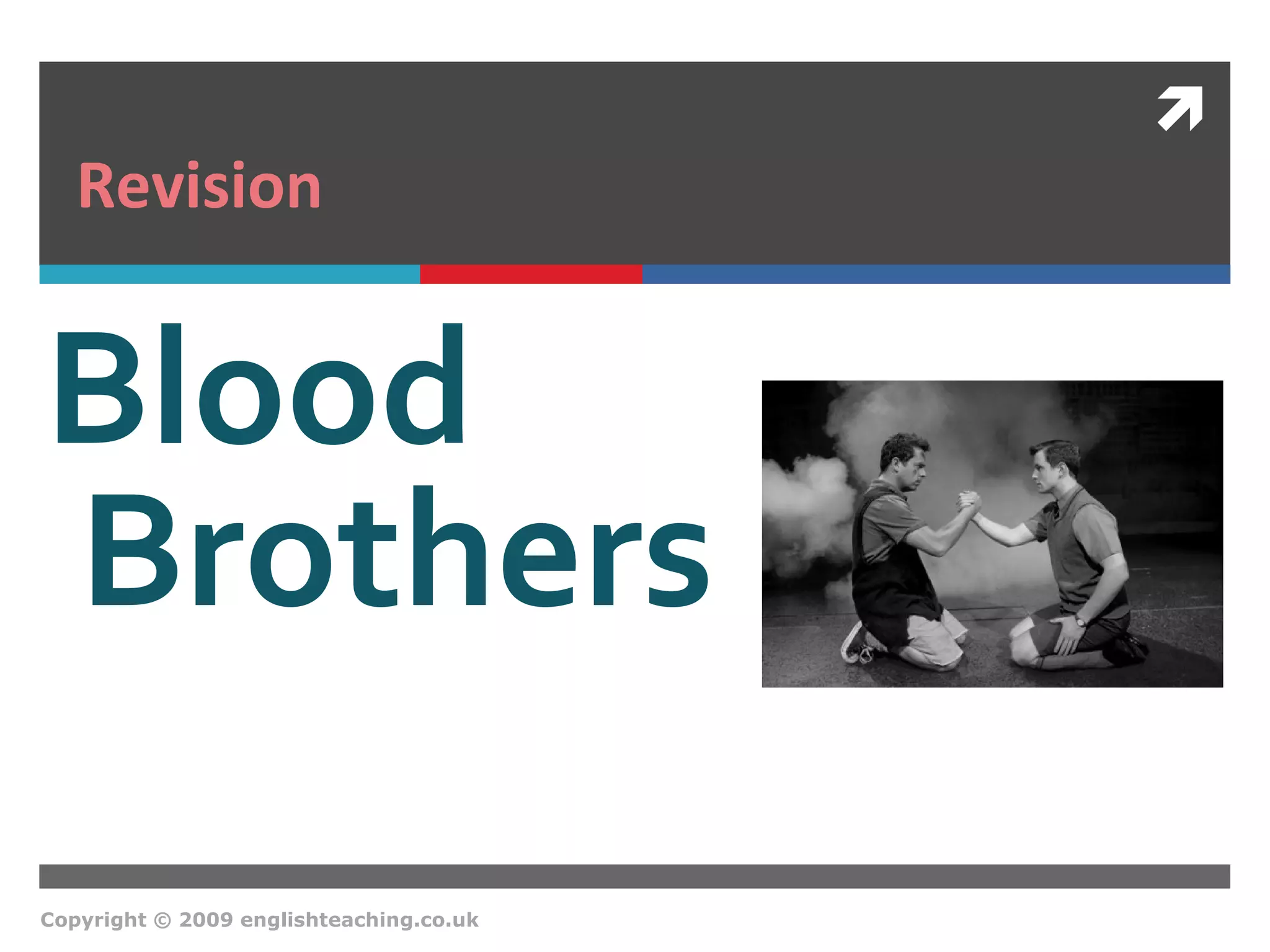
Blood
Brothers
Revision
Themes
 Class divide
 Family
 Growing up
 Superstition and Fate
 Hopes and Dreams
 Nature versus Nurture
 Love and Marriage
Copyright © 2009 englishteaching.co.uk
Characters
 Mrs Johnstone
 Mickey
 Other children including Sammy
and Donna-Marie
 Linda
 Mrs Lyons
 Mr Lyons
 Edward Lyons
Copyright © 2009 englishteaching.co.uk
Narrator
Chorus to play minor roles such as
Miss Jones
Motifs
Marilyn Monroe
Guns - toy and
real
The idea of games
Dancing
Copyright © 2009 englishteaching.co.uk
Techniques
 Parallel scenes to bring out class differences
 Use of key episodes to give a flavour of life,
since play covers a long period of time
 Use of songs
 Use of motifs
 Narrator and chorus
 Flashback – starts with final scene
Copyright © 2009 englishteaching.co.uk
Language
 The working class characters speak in Liverpool
dialect, which makes them sound natural, warm
and likeable.
 The middle class characters speak in standard
English, with Received Pronunciation. This is a
cause of humour when the boys first meet.
Copyright © 2009 englishteaching.co.uk
The Role of the Narrator
 Comments on the action
 Tells the story and involves the audience
 Links episodes together
 Warns of danger by appearing on stage at crucial times
 Points out themes
 Asks audience questions
Copyright © 2009 englishteaching.co.uk
What do the songs add to the Play?
 Link scenes and draw parallels
 Remind the audience of key themes
 Link the two halves of the play by using some of the
same words / tunes, such as ‘Easy Terms’
 Mood and atmosphere
 Humour and pathos
 Fill in parts of the plot
Copyright © 2009 englishteaching.co.uk
The tragic outcome is inevitable from the very
start. Discuss.
 Theme of Superstition and Fate
 Starting with final scene
 Continual warnings from the narrator
 The Marilyn Monroe motif
 The gun motif
 Nurture – Johnstone family are in trouble from the start. E.g.
Sammy’s behaviour and Mrs Johnstone’s fears for Mickey
 Class divide
Copyright © 2009 englishteaching.co.uk
To what extent do you feel sympathy for Mrs
Johnstone?
 At the start, very little: ‘a stone in place of a heart’, but
gradually, as the story unfolds, we feel much more:
 Husband walks out leaving her with little money
 Mrs Lyons pushes her into it
 She does it ‘for the best’
 She’s a loving mother to all her children
 She stays cheerful and makes the best of things
 But do we also feel she could have controlled her children
better, been harder on them?
Copyright © 2009 englishteaching.co.uk
What does this play have to say about class?
 The class divide is unfair
 Russell shows that two people with identical DNA can
be so different in what they achieve because working
class people were denied the chances to develop
 Russell poses the question: ‘could it be what we, the
English, have come to know as class?’
 Money can’t buy love but it can buy power.
Copyright © 2009 englishteaching.co.uk
Now you try…
 What has this play to say about mother / child relationships?
 How is the theme of love presented? You may consider family love,
romantic love and married love.
 How far do you think Russell presents the working class characters
in a more favourable light than the middle class characters?
Canyouthinkofanyotherquestions?
Copyright © 2009 englishteaching.co.uk

Blood brothers -_revision

  • 1.
     Copyright © 2009englishteaching.co.uk Blood Brothers Revision
  • 2.
    Themes  Class divide Family  Growing up  Superstition and Fate  Hopes and Dreams  Nature versus Nurture  Love and Marriage Copyright © 2009 englishteaching.co.uk
  • 3.
    Characters  Mrs Johnstone Mickey  Other children including Sammy and Donna-Marie  Linda  Mrs Lyons  Mr Lyons  Edward Lyons Copyright © 2009 englishteaching.co.uk Narrator Chorus to play minor roles such as Miss Jones
  • 4.
    Motifs Marilyn Monroe Guns -toy and real The idea of games Dancing Copyright © 2009 englishteaching.co.uk
  • 5.
    Techniques  Parallel scenesto bring out class differences  Use of key episodes to give a flavour of life, since play covers a long period of time  Use of songs  Use of motifs  Narrator and chorus  Flashback – starts with final scene Copyright © 2009 englishteaching.co.uk
  • 6.
    Language  The workingclass characters speak in Liverpool dialect, which makes them sound natural, warm and likeable.  The middle class characters speak in standard English, with Received Pronunciation. This is a cause of humour when the boys first meet. Copyright © 2009 englishteaching.co.uk
  • 7.
    The Role ofthe Narrator  Comments on the action  Tells the story and involves the audience  Links episodes together  Warns of danger by appearing on stage at crucial times  Points out themes  Asks audience questions Copyright © 2009 englishteaching.co.uk
  • 8.
    What do thesongs add to the Play?  Link scenes and draw parallels  Remind the audience of key themes  Link the two halves of the play by using some of the same words / tunes, such as ‘Easy Terms’  Mood and atmosphere  Humour and pathos  Fill in parts of the plot Copyright © 2009 englishteaching.co.uk
  • 9.
    The tragic outcomeis inevitable from the very start. Discuss.  Theme of Superstition and Fate  Starting with final scene  Continual warnings from the narrator  The Marilyn Monroe motif  The gun motif  Nurture – Johnstone family are in trouble from the start. E.g. Sammy’s behaviour and Mrs Johnstone’s fears for Mickey  Class divide Copyright © 2009 englishteaching.co.uk
  • 10.
    To what extentdo you feel sympathy for Mrs Johnstone?  At the start, very little: ‘a stone in place of a heart’, but gradually, as the story unfolds, we feel much more:  Husband walks out leaving her with little money  Mrs Lyons pushes her into it  She does it ‘for the best’  She’s a loving mother to all her children  She stays cheerful and makes the best of things  But do we also feel she could have controlled her children better, been harder on them? Copyright © 2009 englishteaching.co.uk
  • 11.
    What does thisplay have to say about class?  The class divide is unfair  Russell shows that two people with identical DNA can be so different in what they achieve because working class people were denied the chances to develop  Russell poses the question: ‘could it be what we, the English, have come to know as class?’  Money can’t buy love but it can buy power. Copyright © 2009 englishteaching.co.uk
  • 12.
    Now you try… What has this play to say about mother / child relationships?  How is the theme of love presented? You may consider family love, romantic love and married love.  How far do you think Russell presents the working class characters in a more favourable light than the middle class characters? Canyouthinkofanyotherquestions? Copyright © 2009 englishteaching.co.uk