San Andreas Fault

   I.   Subject Area: Applying Geography in Geology

  II.   Grade Level: 6th Grade

 III.   Science Standard:Plate Tectonics and Earth’s Structure

        Plate tectonics accounts for important features of Earth’s surface and major geologic

        events. As a basis for understanding this concept: a) Students know how to explain major

        features of California geology (including mountains, faults, volcanoes) in terms of plate

        tectonics

 IV.    Time Sequence of Lesson: One class session

  V.    Learning objectives:

           o Identify the three general categories of plate boundaries recognized by scientists:

               convergent, divergent, and transform

           o Understand how transform boundaries occur.

 VI.    Assessment: World Map and Boundaries worksheet

VII.    Materials, Resources, and Equipment:

               Computer, Projector, worksheet.

VIII.   Guiding Questions

 IX.    Instructional Strategies: Procedures and Activities:

           1. Explanation of our Science Standard

           2. Warm-up: Ask the class what they know about plate tectonics and plate

               boundaries.

           3. Inform class that we will be learning about Plate Tectonics but focusing on the

               plate boundary, Transform Boundary.
4. Use the website: http:/www.kidsgeo.com.

        5. Plate Tectonics: Will provide definitions and maps of the plate tectonic around the

            world.

        6. Divergent Boundaries:Move away from each other.

        7. Convergent Boundaries: Come together.

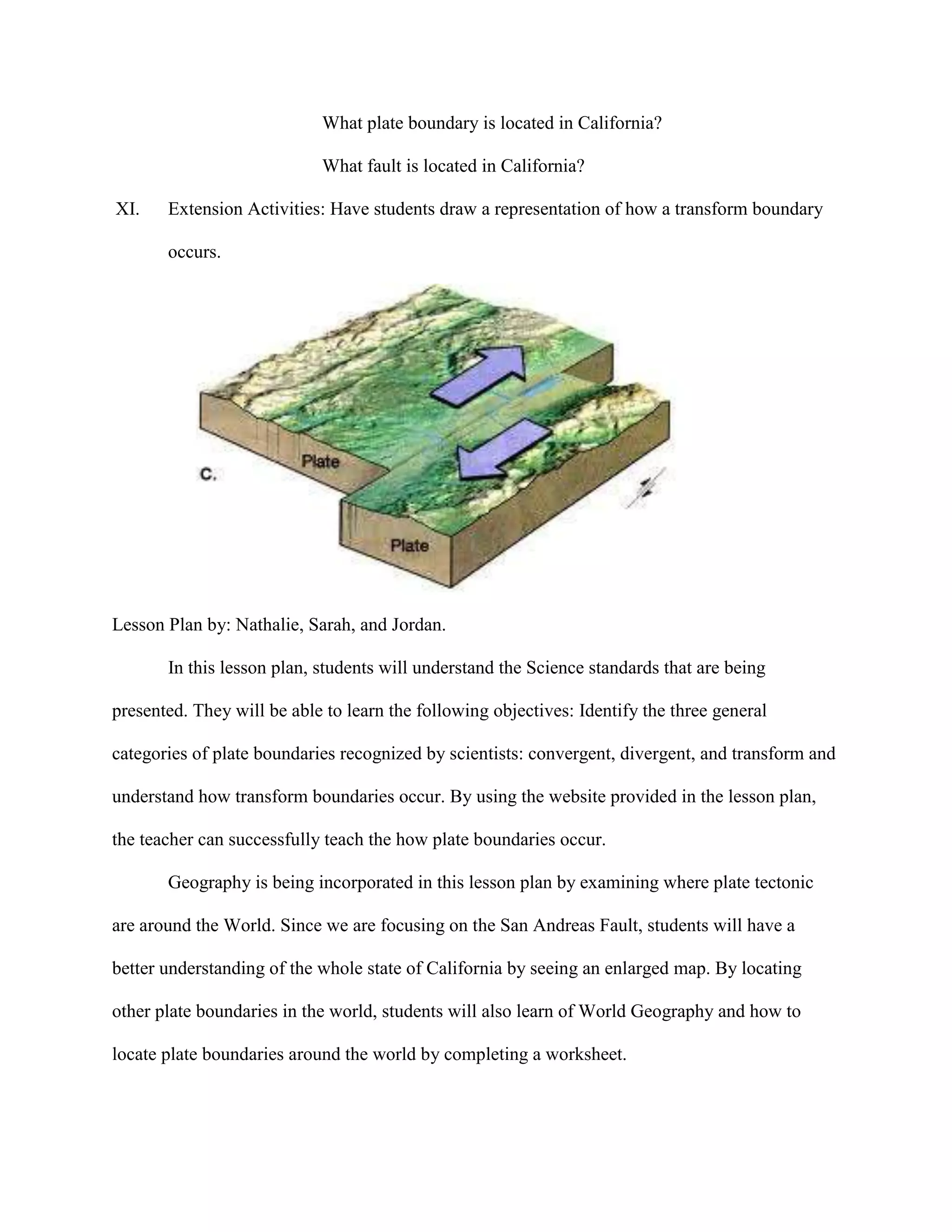
        8. Transform Boundaries: Slide against one another.

        9. Explain how California has a transform boundary known as the San Andreas

            Fault.

        10. Google Map of where the San Andreas Fault is located. http://geology.com/san-

            andreas-fault/

        11. Have students draw the San Andreas Fault on their blank map.

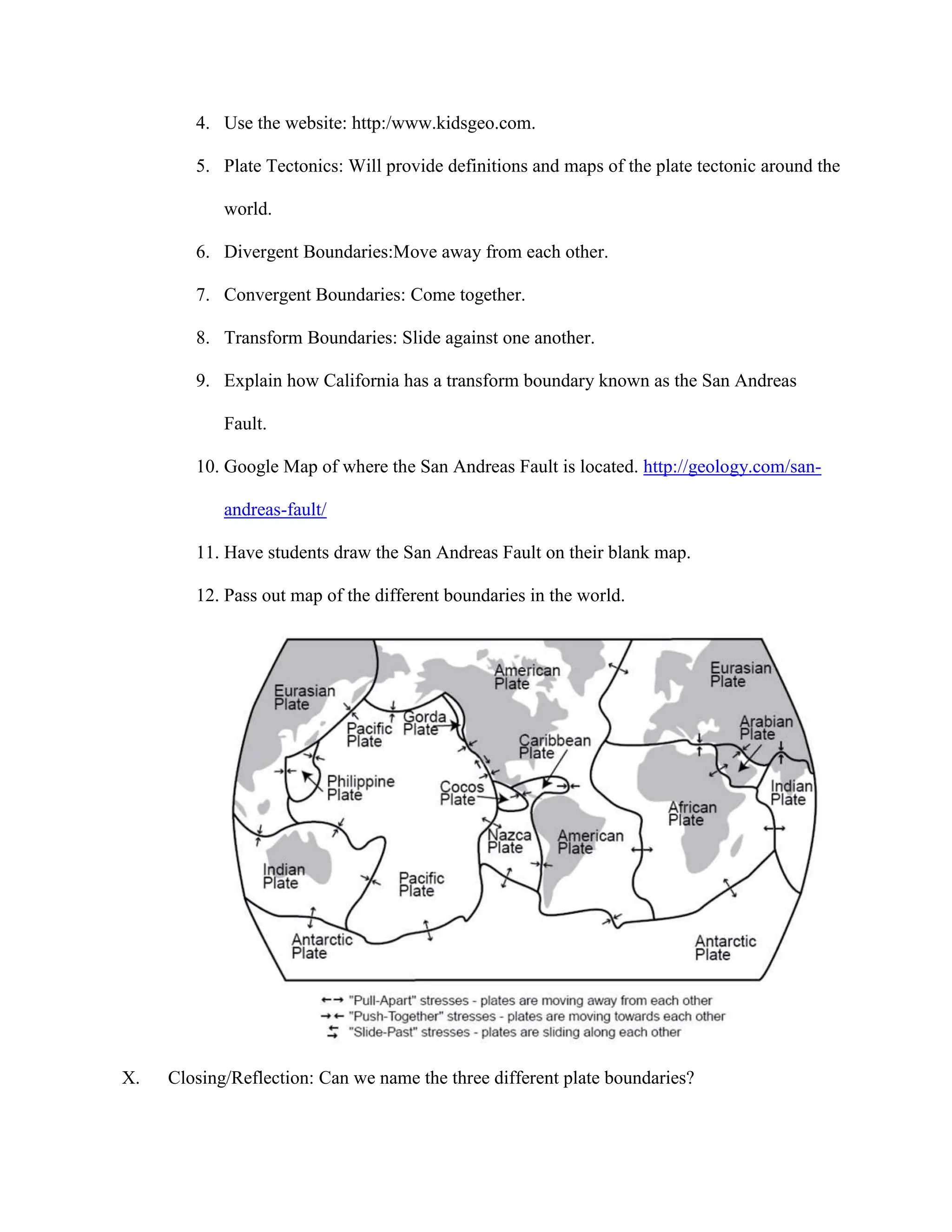
        12. Pass out map of the different boundaries in the world.


X.   Closing/Reflection: Can we name the three different plate boundaries?
What plate boundary is located in California?

                            What fault is located in California?

XI.    Extension Activities: Have students draw a representation of how a transform boundary

       occurs.


Lesson Plan by: Nathalie, Sarah, and Jordan.

       In this lesson plan, students will understand the Science standards that are being

presented. They will be able to learn the following objectives: Identify the three general

categories of plate boundaries recognized by scientists: convergent, divergent, and transform and

understand how transform boundaries occur. By using the website provided in the lesson plan,

the teacher can successfully teach the how plate boundaries occur.

       Geography is being incorporated in this lesson plan by examining where plate tectonic

are around the World. Since we are focusing on the San Andreas Fault, students will have a

better understanding of the whole state of California by seeing an enlarged map. By locating

other plate boundaries in the world, students will also learn of World Geography and how to

locate plate boundaries around the world by completing a worksheet.

Blog 4

  • 1.
    San Andreas Fault I. Subject Area: Applying Geography in Geology II. Grade Level: 6th Grade III. Science Standard:Plate Tectonics and Earth’s Structure Plate tectonics accounts for important features of Earth’s surface and major geologic events. As a basis for understanding this concept: a) Students know how to explain major features of California geology (including mountains, faults, volcanoes) in terms of plate tectonics IV. Time Sequence of Lesson: One class session V. Learning objectives: o Identify the three general categories of plate boundaries recognized by scientists: convergent, divergent, and transform o Understand how transform boundaries occur. VI. Assessment: World Map and Boundaries worksheet VII. Materials, Resources, and Equipment: Computer, Projector, worksheet. VIII. Guiding Questions IX. Instructional Strategies: Procedures and Activities: 1. Explanation of our Science Standard 2. Warm-up: Ask the class what they know about plate tectonics and plate boundaries. 3. Inform class that we will be learning about Plate Tectonics but focusing on the plate boundary, Transform Boundary.
  • 2.
    4. Use thewebsite: http:/www.kidsgeo.com. 5. Plate Tectonics: Will provide definitions and maps of the plate tectonic around the world. 6. Divergent Boundaries:Move away from each other. 7. Convergent Boundaries: Come together. 8. Transform Boundaries: Slide against one another. 9. Explain how California has a transform boundary known as the San Andreas Fault. 10. Google Map of where the San Andreas Fault is located. http://geology.com/san- andreas-fault/ 11. Have students draw the San Andreas Fault on their blank map. 12. Pass out map of the different boundaries in the world. X. Closing/Reflection: Can we name the three different plate boundaries?
  • 3.
    What plate boundaryis located in California? What fault is located in California? XI. Extension Activities: Have students draw a representation of how a transform boundary occurs. Lesson Plan by: Nathalie, Sarah, and Jordan. In this lesson plan, students will understand the Science standards that are being presented. They will be able to learn the following objectives: Identify the three general categories of plate boundaries recognized by scientists: convergent, divergent, and transform and understand how transform boundaries occur. By using the website provided in the lesson plan, the teacher can successfully teach the how plate boundaries occur. Geography is being incorporated in this lesson plan by examining where plate tectonic are around the World. Since we are focusing on the San Andreas Fault, students will have a better understanding of the whole state of California by seeing an enlarged map. By locating other plate boundaries in the world, students will also learn of World Geography and how to locate plate boundaries around the world by completing a worksheet.