Blockchain Technology
What is blockchain?
Blockchain is a system of recording information in a way that makes it difficult or
impossible to change, hack, or cheat the system.
A blockchain is essentially a digital ledger of transactions that is duplicated and distributed
across the entire network of computer systems on the blockchain. Each block in the chain
contains a number of transactions, and every time a new transaction occurs on the
blockchain, a record of that transaction is added to every participant’s ledger. The
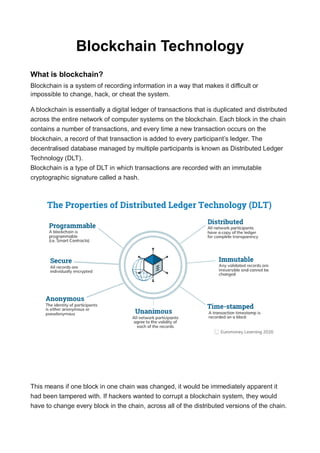
decentralised database managed by multiple participants is known as Distributed Ledger
Technology (DLT).
Blockchain is a type of DLT in which transactions are recorded with an immutable
cryptographic signature called a hash.
This means if one block in one chain was changed, it would be immediately apparent it
had been tampered with. If hackers wanted to corrupt a blockchain system, they would
have to change every block in the chain, across all of the distributed versions of the chain.
Blockchains such as bitcoin and Ethereum are constantly and continually growing as
blocks are being added to the chain, which significantly adds to the security of the ledger.
Why is there so much hype around blockchain technology?
There have been many attempts to create digital money in the past, but they have always
failed.
The prevailing issue is trust. If someone creates a new currency called the X dollar, how
can we trust that they won't give themselves a million X dollars, or steal your X dollars for
themselves?
Bitcoin was designed to solve this problem by using a specific type of database called a
blockchain. Most normal databases, such as an SQL database, have someone in charge
who can change the entries (e.g. giving themselves a million X dollars). Blockchain is
different because nobody is in charge; it’s run by the people who use it. What’s more,
bitcoins can’t be faked, hacked or double spent – so people that own this money can trust
that it has some value.
Difference between blockchain and Bitcoin
Blockchain is the technology that underpins the cryptocurrency Bitcoin, but Bitcoin is not
the only version of a blockchain distributed ledger system in the market. There are several
other cryptocurrencies with their own blockchain and distributed ledger architectures.
Meanwhile, the decentralisation of the technology has also led to several schisms or forks
within the Bitcoin network, creating offshoots of the ledger where some miners use a
blockchain with one set of rules, and others use a blockchain with another set of rules.
Alongside the original Bitcoin, Bitcoin Cash, Bitcoin Gold and Bitcoin SV exist as their own
cryptocurrency. With smaller networks, these cryptocurrency blockchains are more
vulnerable to hacking attacks, one of which befell Bitcoin Gold in 2018.
Risks with public blockchains
Where blockchains have consensus rules based on a simple majority, there is a risk that
malign actors will act together to influence the outcomes of the system. In the case of a
cryptocurrency, this would mean a group of miners controlling more than 50% of the
mining computing power can influence what transactions are validated and added (or
omitted) from the chain. On a blockchain that uses the Proof of Work (PoW) consensus
protocol system, a 51% attack can also take the form of a “rival” chain – including
fraudulent transactions – being created by malicious parties.
Through their superior mining capacity, these fraudsters can build an alternative chain
which ends up being longer than the “true” chain and therefore – because part of the
Bitcoin Nakamoto consensus protocol is “the longest chain wins” – all participants must
follow the fraudulent chain going forward.
In a large blockchain like Bitcoin this is increasingly difficult, but where a blockchain has
‘split’ and the pool of miners is smaller, as in the case of Bitcoin Gold, a 51% attack is
possible.
A 51% double spend attack was successfully executed on the Bitcoin Gold and Ethereum
Classic blockchains in 2018, where fraudsters misappropriated millions of dollars of value.

Blockchaintech

  • 1.
    Blockchain Technology What isblockchain? Blockchain is a system of recording information in a way that makes it difficult or impossible to change, hack, or cheat the system. A blockchain is essentially a digital ledger of transactions that is duplicated and distributed across the entire network of computer systems on the blockchain. Each block in the chain contains a number of transactions, and every time a new transaction occurs on the blockchain, a record of that transaction is added to every participant’s ledger. The decentralised database managed by multiple participants is known as Distributed Ledger Technology (DLT). Blockchain is a type of DLT in which transactions are recorded with an immutable cryptographic signature called a hash. This means if one block in one chain was changed, it would be immediately apparent it had been tampered with. If hackers wanted to corrupt a blockchain system, they would have to change every block in the chain, across all of the distributed versions of the chain.
  • 2.
    Blockchains such asbitcoin and Ethereum are constantly and continually growing as blocks are being added to the chain, which significantly adds to the security of the ledger. Why is there so much hype around blockchain technology? There have been many attempts to create digital money in the past, but they have always failed. The prevailing issue is trust. If someone creates a new currency called the X dollar, how can we trust that they won't give themselves a million X dollars, or steal your X dollars for themselves? Bitcoin was designed to solve this problem by using a specific type of database called a blockchain. Most normal databases, such as an SQL database, have someone in charge who can change the entries (e.g. giving themselves a million X dollars). Blockchain is different because nobody is in charge; it’s run by the people who use it. What’s more, bitcoins can’t be faked, hacked or double spent – so people that own this money can trust that it has some value. Difference between blockchain and Bitcoin Blockchain is the technology that underpins the cryptocurrency Bitcoin, but Bitcoin is not the only version of a blockchain distributed ledger system in the market. There are several other cryptocurrencies with their own blockchain and distributed ledger architectures. Meanwhile, the decentralisation of the technology has also led to several schisms or forks within the Bitcoin network, creating offshoots of the ledger where some miners use a blockchain with one set of rules, and others use a blockchain with another set of rules. Alongside the original Bitcoin, Bitcoin Cash, Bitcoin Gold and Bitcoin SV exist as their own cryptocurrency. With smaller networks, these cryptocurrency blockchains are more vulnerable to hacking attacks, one of which befell Bitcoin Gold in 2018. Risks with public blockchains Where blockchains have consensus rules based on a simple majority, there is a risk that malign actors will act together to influence the outcomes of the system. In the case of a cryptocurrency, this would mean a group of miners controlling more than 50% of the mining computing power can influence what transactions are validated and added (or omitted) from the chain. On a blockchain that uses the Proof of Work (PoW) consensus protocol system, a 51% attack can also take the form of a “rival” chain – including fraudulent transactions – being created by malicious parties.
  • 3.
    Through their superiormining capacity, these fraudsters can build an alternative chain which ends up being longer than the “true” chain and therefore – because part of the Bitcoin Nakamoto consensus protocol is “the longest chain wins” – all participants must follow the fraudulent chain going forward. In a large blockchain like Bitcoin this is increasingly difficult, but where a blockchain has ‘split’ and the pool of miners is smaller, as in the case of Bitcoin Gold, a 51% attack is possible. A 51% double spend attack was successfully executed on the Bitcoin Gold and Ethereum Classic blockchains in 2018, where fraudsters misappropriated millions of dollars of value.