1. What is blockchain?
2. Database, Private blockchain, Public Blockchain
3. R3 Case Study
4. Uses of Private and Public Blockchains
Part 1
1.NYSE On VCs - Short Video
3.Challenges of Virtual Currencies
4.Summary of Research Papers by Banks and Governments on VCs
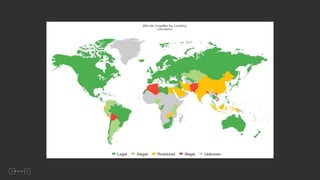
5.Global regulation
6.Future Use Cases of Public Blockchains
7.Valuation of VC Companies
8.Taxation
Annexures
9.Bitcoin Price - Case Study
Conclusion
10.Potential For India
Challenges
Opportunities
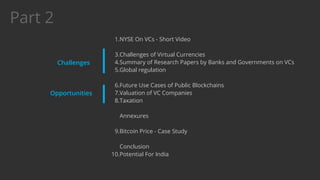
Part 2
Database
Private Blockchain
Public Blockchain
Database Private Blockchain Public Blockchain
Centralized Permissioned Nodes Decentralized
Trusted Third Party (TTP) No Trust Among Nodes No Trust (P2P)
KYC Consensus Consensus
Trust via Access Control Trust via Membership
Trust via Economic Penalties - Proof of
Work
Analogies
LAN WAN Internet
Windows Android Linux
Microsoft Expedia Wikipedia
Paypal SWIFT, NPCI Bitcoin blockchain
Amazon Web Services Hyperledger, Ethereum Enterprise Alliance Ethereum blockchain
Database Private Blockchain Public Blockchain
Scaling Easy Easy Difficult
Variable cost per
transaction
Low Low High
Overhead cost High High Low
Upgrades
Core - Fast, End Points -
Slow
Core - Fast, End Points -
Slow
Core - Slow, End Points - Fast
Immutable No No Yes
Hackable Core network Core network User accounts
Innovation Limited Limited Exponential
Access Controlled Controlled Open
Availability Downtime Downtime Congestion
R3: Private
Blockchain
Database Private Blockchain Public Blockchain
Remove trust between
institutions
P2P networks
Time Stamping and Verification
“Policy makers and regulators should not ignore
VCs, nor should they attempt to ban them. Both
extreme approaches are incorrect. VCs should be
treated by regulators as any other financial
instrument, proportionally to their market
importance, complexity, and associated risks.”
http://www.europarl.europa.eu/cmsdata/149900/CASE_FINAL%20publication.pdf
Issued by Issue Period Positive/ Negative/ Neutral
Department of Finance, Ireland March 2018 Positive
LSE Institute of Global affairs February 2018 Positive
Department of Treasury, USA 2017 Positive
Financial Services Regulatory Authority, Abu Dhabi October 2017 Positive
IMF Staff Discussion Notes January 2016 Neutral
Reserve Bank, New Zealand - Analytical notes November 2017 Neutral
United Nations Economic and Social Commission for
Asia and the Pacific
Not available Neutral
United Nations Economic Commission for Latin
America and Caribbean
January 2016 Positive
Bank of Korea April 2017 Positive
Bank of Canada November 2017 Positive
Journal of Information Systems & Operations
Management
Not available Positive
https://en.wikipedia.org/wiki/Freedom_in_the_World
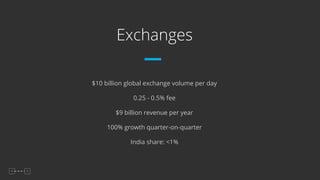
$10 billion global exchange volume per day
0.25 - 0.5% fee
$9 billion revenue per year
100% growth quarter-on-quarter
India share: <1%
Exchanges
Current: $200-300 billion
1 year ago: $16 billion
2 years ago: $7 billion
3 years ago: $1 billion
Capital Gain Tax
Market Cap
2010 Cycle 1
2011 Cycle 2
2012-13 Cycle 3
2014 Cycle 4
2015-17 Cycle 5
+9,500%
-70%
◦ Global Asset Class
◦ Micro Remittances
◦ Banking the Unbanked
◦ Fintech Hub
◦ Avoid success / fail prediction of
technology
◦ Address only concerns - illicit use,
money laundering, user protection
◦ Chasing bad actors has lower
economic costs than banning
network technologies, example,
Internet.
Sandeep Goenka
@GoenkaSandeep

Blockchain for India

  • 2.
    1. What isblockchain? 2. Database, Private blockchain, Public Blockchain 3. R3 Case Study 4. Uses of Private and Public Blockchains Part 1
  • 3.
    1.NYSE On VCs- Short Video 3.Challenges of Virtual Currencies 4.Summary of Research Papers by Banks and Governments on VCs 5.Global regulation 6.Future Use Cases of Public Blockchains 7.Valuation of VC Companies 8.Taxation Annexures 9.Bitcoin Price - Case Study Conclusion 10.Potential For India Challenges Opportunities Part 2
  • 7.
  • 8.
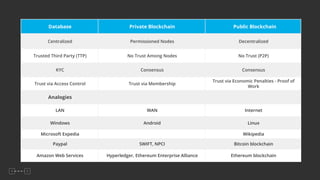
    Database Private BlockchainPublic Blockchain Centralized Permissioned Nodes Decentralized Trusted Third Party (TTP) No Trust Among Nodes No Trust (P2P) KYC Consensus Consensus Trust via Access Control Trust via Membership Trust via Economic Penalties - Proof of Work Analogies LAN WAN Internet Windows Android Linux Microsoft Expedia Wikipedia Paypal SWIFT, NPCI Bitcoin blockchain Amazon Web Services Hyperledger, Ethereum Enterprise Alliance Ethereum blockchain
  • 9.
    Database Private BlockchainPublic Blockchain Scaling Easy Easy Difficult Variable cost per transaction Low Low High Overhead cost High High Low Upgrades Core - Fast, End Points - Slow Core - Fast, End Points - Slow Core - Slow, End Points - Fast Immutable No No Yes Hackable Core network Core network User accounts Innovation Limited Limited Exponential Access Controlled Controlled Open Availability Downtime Downtime Congestion
  • 13.
  • 16.
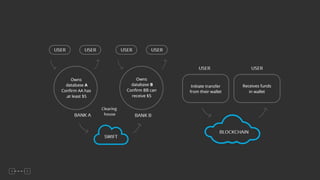
    Database Private BlockchainPublic Blockchain Remove trust between institutions P2P networks Time Stamping and Verification
  • 47.
    “Policy makers andregulators should not ignore VCs, nor should they attempt to ban them. Both extreme approaches are incorrect. VCs should be treated by regulators as any other financial instrument, proportionally to their market importance, complexity, and associated risks.” http://www.europarl.europa.eu/cmsdata/149900/CASE_FINAL%20publication.pdf
  • 48.
    Issued by IssuePeriod Positive/ Negative/ Neutral Department of Finance, Ireland March 2018 Positive LSE Institute of Global affairs February 2018 Positive Department of Treasury, USA 2017 Positive Financial Services Regulatory Authority, Abu Dhabi October 2017 Positive IMF Staff Discussion Notes January 2016 Neutral Reserve Bank, New Zealand - Analytical notes November 2017 Neutral United Nations Economic and Social Commission for Asia and the Pacific Not available Neutral United Nations Economic Commission for Latin America and Caribbean January 2016 Positive Bank of Korea April 2017 Positive Bank of Canada November 2017 Positive Journal of Information Systems & Operations Management Not available Positive
  • 51.
  • 54.
    $10 billion globalexchange volume per day 0.25 - 0.5% fee $9 billion revenue per year 100% growth quarter-on-quarter India share: <1% Exchanges
  • 55.
    Current: $200-300 billion 1year ago: $16 billion 2 years ago: $7 billion 3 years ago: $1 billion Capital Gain Tax Market Cap
  • 59.
  • 60.
  • 61.
  • 62.
  • 63.
  • 66.
    ◦ Global AssetClass ◦ Micro Remittances ◦ Banking the Unbanked ◦ Fintech Hub
  • 67.
    ◦ Avoid success/ fail prediction of technology ◦ Address only concerns - illicit use, money laundering, user protection ◦ Chasing bad actors has lower economic costs than banning network technologies, example, Internet.
  • 68.