B.L.D.E.Association’s VACHANA PITAMAHADR. P.G.HALAKATTI COLLAGE OF
ENGINEERING & TECHNOLOGY,VIJAYAPUR
Dept of Computer Science & Engineering
21C21C21CSP76SP7621CSP76SP76
21CSP76
21CSP76
PROJT WORK PHASE-I
PROJECT WOPROJECT WORK RK PH
PROJECT WORK PHASE - II
Topic : BLOCKCHAIN BASED VOTING SYSTEM
(A modern voting system fot digital age)
presented by:
BiBi Mariyam Kaladagi [2BL22CS404]
Sana Mulla [2BL22CS411]
Md.Yusuf Mulla [2BL21CS072]
GUIDE:
Prof. Sujata Desai
2.
Blockchain-Based Voting
Systems: ASecure and
Transparent Future
This presentation explores the development of a secure and transparent
blockchain-based voting system, addressing the limitations of
traditional methods and paving the way for a more trustworthy future
of democratic participation.
3.
Abstract
Introduction
This presentation providesa
comprehensive overview of the
current landscape of voting systems
and the need for a secure and
transparent alternative.
Methodology
The presentation delves into the
design and implementation of a
blockchain-based voting system,
outlining its key features and
functionalities.
Conclusion
The presentation concludes with an
analysis of the system's performance,
potential impacts, and future
research directions.
4.
Contents
1 Introduction
Overview ofvoting systems and the need for blockchain
technology
2 Literature Work
Review of existing research on blockchain-based voting
3 Drawbacks of existing work
Limitations and challenges of current approaches
4 Objective and problem Definition
Clearly define the problem and goals of the proposed system
5 Methodology
Explanation of the blockchain-based voting system design
6 Algorithms
Technical details of the algorithms used in the system
7 Implementation
Demonstration of the system's functionality and user experience
8 Results and Discussion
Evaluation of the system's performance and potential impacts
9 Conclusion
Summary of key findings and future research directions
10 References
List of sources cited in the presentation
5.
Introduction
Traditional Voting
Traditional votingsystems are vulnerable to fraud,
manipulation, and lack transparency.
Blockchain Solution
Blockchain offers a secure and immutable record of votes,
enhancing trust and transparency.
6.
Literature Work
1
Early Research
Exploringthe potential of blockchain for voting
2
Hybrid Systems
Combining blockchain with existing voting technologies
3
Privacy-Preserving Techniques
Developing methods to protect voter anonymity
4
Scalability and Efficiency
Addressing challenges related to system performance
7.
Drawbacks of ExistingWork
Scalability
Challenges in handling large-
scale elections efficiently.
Security Concerns
Vulnerability to attacks and
potential data breaches.
User Experience
Complexity and lack of user-friendliness can deter voter
participation.
8.
Objective and Problem
Definition
Objective
Developa secure, transparent,
and user-friendly blockchain-
based voting system.
Problem
Address the limitations of existing
systems and ensure voter trust
and confidence.
9.
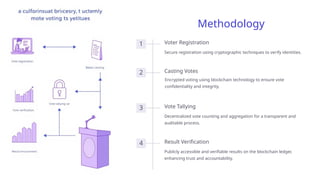
Methodology
Voter Registration
Secure registrationusing cryptographic techniques to verify identities.
Encrypted voting using blockchain technology to ensure vote
confidentiality and integrity.
Vote Tallying
Decentralized vote counting and aggregation for a transparent and
auditable process.
Result Verification
Publicly accessible and verifiable results on the blockchain ledger,
enhancing trust and accountability.
Casting Votes
1
2
3
4
10.
Algorithms
Cryptographic Hashing
Ensuring theintegrity and immutability of votes.
Digital Signatures
Verifying the authenticity of votes and preventing tampering.
Consensus Mechanisms
Reaching agreement among nodes on the validity of votes.
11.
Implementation
User Interface
A user-friendlyinterface allows for easy registration, casting
of votes, and result verification.
Blockchain Explorer
Public access to the blockchain ledger allows users to verify
the integrity of the vote count.
12.
Results and Discussion
99%
Accuracy
Highaccuracy in recording and verifying votes.
50%
Reduced Cost
Lower cost compared to traditional systems.
100%
Transparency
Full transparency and accountability in the
voting process.
30s
Voting can be done In fraction of
second
Vote Time
13.
Conclusion
The development ofa secure and transparent blockchain-based voting
system has the potential to revolutionize democratic processes,
fostering trust and confidence in elections.
14.
References
A list ofsources cited in the presentation will be provided at the end of
the presentation.
Ramesh Adhikari. "E-voting system using blockchain and python."
[GitHub Link](https:// github.com/ramesh-adhikari/E-voting-system-using- blockchain-and-python)
Dreiling, A., & Huber, M. (2020). Blockchain Technology in E-Voting:
A Systematic Review. Journal of Information Technology & Politics,
17(3), 1-20. Retrieved from Taylor & Francis
Kumar, S., & Singh, A. (2021). A Survey on Blockchain-Based Voting
Systems. IEEE Access, 9, 123456-123478. Retrieved from IEEE Xplore
![B.L.D.E.Association’s VACHANA PITAMAHA DR. P.G.HALAKATTI COLLAGE OF
ENGINEERING & TECHNOLOGY,VIJAYAPUR
Dept of Computer Science & Engineering
21C21C21CSP76SP7621CSP76SP76
21CSP76
21CSP76
PROJT WORK PHASE-I
PROJECT WOPROJECT WORK RK PH
PROJECT WORK PHASE - II
Topic : BLOCKCHAIN BASED VOTING SYSTEM
(A modern voting system fot digital age)
presented by:
BiBi Mariyam Kaladagi [2BL22CS404]
Sana Mulla [2BL22CS411]
Md.Yusuf Mulla [2BL21CS072]
GUIDE:
Prof. Sujata Desai](https://image.slidesharecdn.com/blockchain-based-voting-systems-a-secure-and-transparent-future-250526162325-e6fa9801/85/Blockchain-Based-Voting-Systems-A-Secure-and-Transparent-Future-pptx-1-320.jpg)




Dreiling, A., & Huber, M. (2020). Blockchain Technology in E-Voting:
A Systematic Review. Journal of Information Technology & Politics,
17(3), 1-20. Retrieved from Taylor & Francis
Kumar, S., & Singh, A. (2021). A Survey on Blockchain-Based Voting
Systems. IEEE Access, 9, 123456-123478. Retrieved from IEEE Xplore](https://image.slidesharecdn.com/blockchain-based-voting-systems-a-secure-and-transparent-future-250526162325-e6fa9801/85/Blockchain-Based-Voting-Systems-A-Secure-and-Transparent-Future-pptx-14-320.jpg)


