Blessing or Curse? Open Educational 
Resources (OER) Accessibility: The 
University of the South Pacific 
Experience 
Presentation by Alanieta Lesuma-Fatiaki & Neelam Narayan 
Centre for Flexible Learning 
The University of the South Pacific 
Suva 
AAOU Conference 2014 
Jubilee College, Open University of Hong Kong 
29th October
OVERVIEW 
 The University of the South Pacific 
(USP) – background 
 Project Background 
 Methodology 
 Scope & Limitations 
 Results 
 Recommendations 
 Conclusion
PROJECT BACKGROUND 
 STAR Project 
 27 OER selected 
 Testing request 
 Outcome: 27 OER can be twenty seven OER 
focusing on English language skills can be 
“instantly” accessed for `just-in-time’ learning 
opportunities for students outside Laucala 
Campus. 
 Testing team of ETs, Learning Systems, ITS & 
Instructional Designers
METHODOLOGY 
 OER Testing site: 
https://sites.google.com/site/englishoerusp/ 
 OER checklist 
 OER testing guidelines 
 Load time 
 Ease of download 
 Navigability 
 Devices 
 Peak & Off-Peak periods 
 Connection type 
 Site selection
SCOPE & LIMITATIONS 
 Time-frame 
 Selection and thorough articulation of the 
project design 
 Inclusion of students 
 Occasional power surges and network 
downtimes 
 Extensive study different perspectives
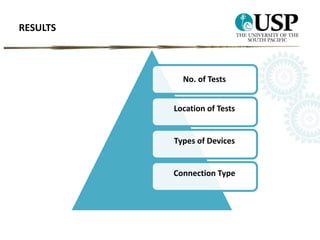
RESULTS 
No. of Tests 
Location of Tests 
Types of Devices 
Connection Type
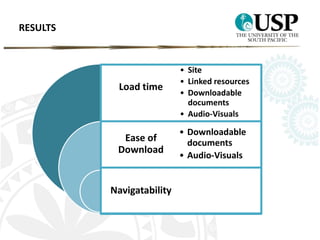
RESULTS 
Load time 
Ease of 
Download 
Navigatability 
• Site 
• Linked resources 
• Downloadable 
documents 
• Audio-Visuals 
• Downloadable 
documents 
• Audio-Visuals
RECOMMENDATIONS & CONCLUSION 
RECOMENDATIONS 
 IT Environment Reconfiguration 
 OER Repurposing 
CONCLUSION 
Is OER a blessing or a curse? We think its a blessing 
because even with the technical challenges that we were 
presented with, the project highlighted/reaffirmed for us 
the most valuable element of OER and that is, its 
“repurposing” nature that can allow us to counteract these 
technical challenges thus allowing our learners to access 
OER for their success.
Thank you!

Blessing or Curse? OER Accessibility: The University of the South Pacific Experience

  • 1.
    Blessing or Curse?Open Educational Resources (OER) Accessibility: The University of the South Pacific Experience Presentation by Alanieta Lesuma-Fatiaki & Neelam Narayan Centre for Flexible Learning The University of the South Pacific Suva AAOU Conference 2014 Jubilee College, Open University of Hong Kong 29th October
  • 2.
    OVERVIEW  TheUniversity of the South Pacific (USP) – background  Project Background  Methodology  Scope & Limitations  Results  Recommendations  Conclusion
  • 4.
    PROJECT BACKGROUND STAR Project  27 OER selected  Testing request  Outcome: 27 OER can be twenty seven OER focusing on English language skills can be “instantly” accessed for `just-in-time’ learning opportunities for students outside Laucala Campus.  Testing team of ETs, Learning Systems, ITS & Instructional Designers
  • 5.
    METHODOLOGY  OERTesting site: https://sites.google.com/site/englishoerusp/  OER checklist  OER testing guidelines  Load time  Ease of download  Navigability  Devices  Peak & Off-Peak periods  Connection type  Site selection
  • 6.
    SCOPE & LIMITATIONS  Time-frame  Selection and thorough articulation of the project design  Inclusion of students  Occasional power surges and network downtimes  Extensive study different perspectives
  • 7.
    RESULTS No. ofTests Location of Tests Types of Devices Connection Type
  • 8.
    RESULTS Load time Ease of Download Navigatability • Site • Linked resources • Downloadable documents • Audio-Visuals • Downloadable documents • Audio-Visuals
  • 9.
    RECOMMENDATIONS & CONCLUSION RECOMENDATIONS  IT Environment Reconfiguration  OER Repurposing CONCLUSION Is OER a blessing or a curse? We think its a blessing because even with the technical challenges that we were presented with, the project highlighted/reaffirmed for us the most valuable element of OER and that is, its “repurposing” nature that can allow us to counteract these technical challenges thus allowing our learners to access OER for their success.
  • 10.

Editor's Notes

  • #2 Good afternoon to you all! My name is Alanieta Lesuma-Fatiaki and the presentation that I am doing today is based on a paper that I co-wrote with my collegue Neelam Narayan. We both work as Instructional Designer designers at the University of the South Pacific, Laucala Campus in Suva, Fiji. Our paper is based on a project that was carried out in the last quarter of 2013 and this was focussed on testing the technical accessibility on selected OER in English language skills. My collegue Neelam will be presenting on the selection of these OER and she will be presenting in the afternoon session in Room D0710 and I encourage you all to attend so that you can get a more holistic perspective/outlook of what I am presenting on.
  • #3 Here is an overview of my presentation. I am sure that you are all wondering, where in the world is the USP!
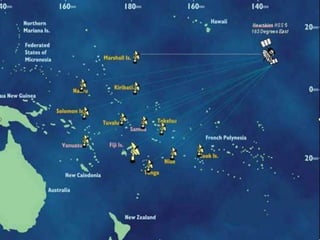
  • #4 USP is a regional university that is owned by 12 Pacific island countries in the Oceania region; namely Cook Islands, Fiji, Tuvalu, Tonga, Vanuatu, Kiribati, Nauru, Samoa, Solomons, Niue, Tokelau and Marshalls Spread across 33 square kilometres of ocean and population vary in size from Tokelau with 1600 people to Fiji with more than 800,000 people. It is because of these vast distances between each member country that warranted the need to offer some form of distance learning which began in the 1970s at the USP. These distance learning offerings expanded to include the setting up of its own satellite communications network known as USPNET that connects all its twelve member countries (USPNet, 2008). The USPNET has undertaken many upgrades through the years of its existence since 1968 and this coincides with much greater demand for its academic programmes to be offered in flexible learning modes in particular online (USP Strategic Plan 2013-2018, n.d.). The USPNET therefore provides the backdrop under which the testing of the 27 OER was carried out in the last quarter of 2013.
  • #5 Borne out of an institutional project known as Strategic Total Academic Review (STAR) that is aimed at an holistic review of all academic undergraduate and postgraduate programme to ensure its alignment with the USP’s mission thus ensuring work-ready graduates in all the twelve countries that own the USP (USP Strategic Plan 2013-2018, n.d.). The STAR project is organised into working groups that is focused on key areas identified to ensure that its aim is achieved. One of these key areas is English language proficiency (Working Group 4, 2012) and it was decided by the working group responsible for this that there was a need to expand English language skills support to all its campuses. In particular, the group looked at the possibility of self-paced typed resources that could be used to supplement English language skills support for the USP student. OER was looked upon as a possible response to meet this need therefore given that the expertise on OER resided in the Centre for Flexible Learning (CFL) unit of the USP, a request was therefore put forward to operationalise this request. The initial step that was undertaken involved the selection of OER in English language skills and this was a joint collaboration between the CFL staff and members of the STAR working group. Following the completion of the selection process, twenty seven OER was identified as suitable to provide the English language skills support for the USP student. All these OER resided in a digital format on the web and a further request was submitted to CFL that its technical accessibility be tested to ensure that all USP students are able to access these resources. This resulted in the formulation of technical testing guidelines based on the outcome that all twenty seven OER focusing on English language skills can be “instantly” accessed for `just-in-time’ learning opportunities for students outside Laucala team of fourteen members consisting of Education Technologists. Learning Systems, Information Technology officers and InstrucCampus.A tional Designers was formed to carry out the tests.
  • #6 In order to achieve the outcome, a web site which housed all the twenty seven OER was created. It was from this site that all the testing groups were required to initiate the tests. This was critical to ensure that the test settings were equivalent across the testing sites. Each OER was then assigned a number from one to twenty seven for ease of identification during the testing and the data analysis phase. This was then collated in a checklist document. A further consideration on these devices was the connection type used which was either wired or wireless and as many physical locations within the tests sites were covered as much as possible within the testing time-frame to ensure that it reflected students’ usability habits. A team of fourteen was formulated consisting of Education Technologists, Instructional Designers, Learning Systems personnel and Information Technology officers who were then further divided up into seven groups of two and assigned to each of the seven selected countries out of the 12 member countries of the USP. The project operated under a very tight schedule in which tests were required to be completed within a one month period from October to November 2013 and specifically each time was allotted a one week period to carry out the tests in the selected country sites.
  • #8 Each item that I have here on my screen are very much interrelated. In terms of types of OER that were tested majority were text/html 28%, Downloadable documents 27% and Video 23%; remaining were ebook, Graphics/Photo, audio other. 1063 tests carried out across the 10 sites; the number varied across each site due to its size which dictated the no. and range of facilities available for e.g. no. of computers, network downtimes & power surges that occurred. Majority of the tests conducted in the Student Lab therefore it also meant that the dominant mode of device used in this case were the Wired CPU & Wired Ncomputing connected PCs. Other locations include off-campus sites such as internet cafes, library and on-campus hotspots. Other devices used for the testing include Tablets, Mobiles, Laptop. CRITICAL POINT: The type of devices that were used for the testing was deliberate so as to reflect as much as possible student usability habits
  • #9 Load time refers to duration in which it takes for the loader to execute its function of locating a particular computer programme and loads it to its main storage as in the case of a PC, its random access memory (RAM) Load time was measured by time interval of less than a minute, between 1 to 5 minutes, more than 5 minutes and inability to load. 4 things were tested in terms of load time; site, linked resources, downloadable documents and AVs Key findings: Load Time Majority (over 60%) of the tests elicited a load time of less than a minute for site, linked resources and downloadable documents. AVs was a bit more tricky where the tests elicited only a 44% load time of less than a minute. 56 % of the tests elicited between 1 to 5 minutes, more than 5 minutes and inability to load respectively. Inability to load of 17% was attributed to the absence of appropriate plugins to access these. Ease of download measurements of easy, moderate and difficult Documents: 62% of the tests elicited an easy ability to download AVs: 56% of the tests elicited a moderate to difficult ability to download The findings mean that the USP will need to reconfigure its IT infrastructure & also perhaps look at repurposing the OER that were eliciting difficulty perhaps considering off-line formats on CD, DVDs etc. Navigability measurements of easy, moderate and difficult Majority of the tests elicited an easy navigatability of 74%, which is an encouraging finding and may be attributed to several factors one of whom could be the design of the OER. At the same time, it is important that we also take note of the 26% of the tests that elicited a moderate to difficult navigability outcome which can easily be resolved through feedback to the creator or have it repurposed for easier navigatability