MENACE OF BLACK MONEY AND
DEMONETIZATION
BLACK MONEY
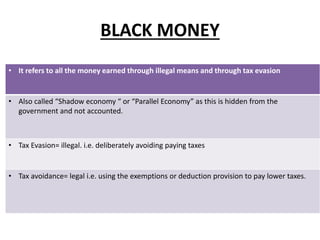
• It refers to all the money earned through illegal means and through tax evasion
• Also called “Shadow economy “ or “Parallel Economy” as this is hidden from the
government and not accounted.
• Tax Evasion= illegal. i.e. deliberately avoiding paying taxes
• Tax avoidance= legal i.e. using the exemptions or deduction provision to pay lower taxes.
GENERATION OF BLACK MONEY
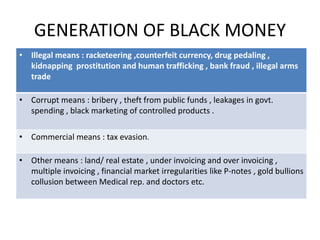
• Illegal means : racketeering ,counterfeit currency, drug pedaling ,
kidnapping prostitution and human trafficking , bank fraud , illegal arms
trade
• Corrupt means : bribery , theft from public funds , leakages in govt.
spending , black marketing of controlled products .
• Commercial means : tax evasion.
• Other means : land/ real estate , under invoicing and over invoicing ,
multiple invoicing , financial market irregularities like P-notes , gold bullions
collusion between Medical rep. and doctors etc.
DIFFERENCE IN BLACK MONEY PROFILE:
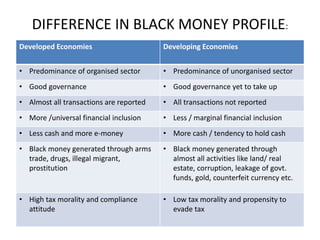
Developed Economies Developing Economies
• Predominance of organised sector • Predominance of unorganised sector
• Good governance • Good governance yet to take up
• Almost all transactions are reported • All transactions not reported
• More /universal financial inclusion • Less / marginal financial inclusion
• Less cash and more e-money • More cash / tendency to hold cash
• Black money generated through arms
trade, drugs, illegal migrant,
prostitution
• Black money generated through
almost all activities like land/ real
estate, corruption, leakage of govt.
funds, gold, counterfeit currency etc.
• High tax morality and compliance
attitude
• Low tax morality and propensity to
evade tax
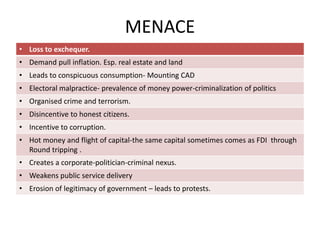
MENACE
• Loss to exchequer.
• Demand pull inflation. Esp. real estate and land
• Leads to conspicuous consumption- Mounting CAD
• Electoral malpractice- prevalence of money power-criminalization of politics
• Organised crime and terrorism.
• Disincentive to honest citizens.
• Incentive to corruption.
• Hot money and flight of capital-the same capital sometimes comes as FDI through
Round tripping .
• Creates a corporate-politician-criminal nexus.
• Weakens public service delivery
• Erosion of legitimacy of government – leads to protests.
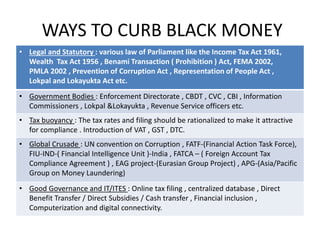
WAYS TO CURB BLACK MONEY
• Legal and Statutory : various law of Parliament like the Income Tax Act 1961,
Wealth Tax Act 1956 , Benami Transaction ( Prohibition ) Act, FEMA 2002,
PMLA 2002 , Prevention of Corruption Act , Representation of People Act ,
Lokpal and Lokayukta Act etc.
• Government Bodies : Enforcement Directorate , CBDT , CVC , CBI , Information
Commissioners , Lokpal &Lokayukta , Revenue Service officers etc.
• Tax buoyancy : The tax rates and filing should be rationalized to make it attractive
for compliance . Introduction of VAT , GST , DTC.
• Global Crusade : UN convention on Corruption , FATF-(Financial Action Task Force),
FIU-IND-( Financial Intelligence Unit )-India , FATCA – ( Foreign Account Tax
Compliance Agreement ) , EAG project-(Eurasian Group Project) , APG-(Asia/Pacific
Group on Money Laundering)
• Good Governance and IT/ITES : Online tax filing , centralized database , Direct
Benefit Transfer / Direct Subsidies / Cash transfer , Financial inclusion ,
Computerization and digital connectivity.
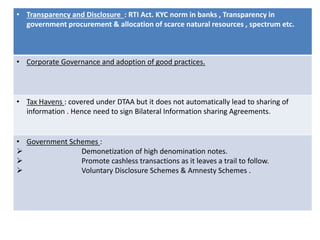
• Transparency and Disclosure : RTI Act. KYC norm in banks , Transparency in
government procurement & allocation of scarce natural resources , spectrum etc.
• Corporate Governance and adoption of good practices.
• Tax Havens : covered under DTAA but it does not automatically lead to sharing of
information . Hence need to sign Bilateral Information sharing Agreements.
• Government Schemes :
 Demonetization of high denomination notes.
 Promote cashless transactions as it leaves a trail to follow.
 Voluntary Disclosure Schemes & Amnesty Schemes .

Black Money

  • 1.
    MENACE OF BLACKMONEY AND DEMONETIZATION
  • 2.
    BLACK MONEY • Itrefers to all the money earned through illegal means and through tax evasion • Also called “Shadow economy “ or “Parallel Economy” as this is hidden from the government and not accounted. • Tax Evasion= illegal. i.e. deliberately avoiding paying taxes • Tax avoidance= legal i.e. using the exemptions or deduction provision to pay lower taxes.
  • 3.
    GENERATION OF BLACKMONEY • Illegal means : racketeering ,counterfeit currency, drug pedaling , kidnapping prostitution and human trafficking , bank fraud , illegal arms trade • Corrupt means : bribery , theft from public funds , leakages in govt. spending , black marketing of controlled products . • Commercial means : tax evasion. • Other means : land/ real estate , under invoicing and over invoicing , multiple invoicing , financial market irregularities like P-notes , gold bullions collusion between Medical rep. and doctors etc.
  • 4.
    DIFFERENCE IN BLACKMONEY PROFILE: Developed Economies Developing Economies • Predominance of organised sector • Predominance of unorganised sector • Good governance • Good governance yet to take up • Almost all transactions are reported • All transactions not reported • More /universal financial inclusion • Less / marginal financial inclusion • Less cash and more e-money • More cash / tendency to hold cash • Black money generated through arms trade, drugs, illegal migrant, prostitution • Black money generated through almost all activities like land/ real estate, corruption, leakage of govt. funds, gold, counterfeit currency etc. • High tax morality and compliance attitude • Low tax morality and propensity to evade tax
  • 5.
    MENACE • Loss toexchequer. • Demand pull inflation. Esp. real estate and land • Leads to conspicuous consumption- Mounting CAD • Electoral malpractice- prevalence of money power-criminalization of politics • Organised crime and terrorism. • Disincentive to honest citizens. • Incentive to corruption. • Hot money and flight of capital-the same capital sometimes comes as FDI through Round tripping . • Creates a corporate-politician-criminal nexus. • Weakens public service delivery • Erosion of legitimacy of government – leads to protests.
  • 6.
    WAYS TO CURBBLACK MONEY • Legal and Statutory : various law of Parliament like the Income Tax Act 1961, Wealth Tax Act 1956 , Benami Transaction ( Prohibition ) Act, FEMA 2002, PMLA 2002 , Prevention of Corruption Act , Representation of People Act , Lokpal and Lokayukta Act etc. • Government Bodies : Enforcement Directorate , CBDT , CVC , CBI , Information Commissioners , Lokpal &Lokayukta , Revenue Service officers etc. • Tax buoyancy : The tax rates and filing should be rationalized to make it attractive for compliance . Introduction of VAT , GST , DTC. • Global Crusade : UN convention on Corruption , FATF-(Financial Action Task Force), FIU-IND-( Financial Intelligence Unit )-India , FATCA – ( Foreign Account Tax Compliance Agreement ) , EAG project-(Eurasian Group Project) , APG-(Asia/Pacific Group on Money Laundering) • Good Governance and IT/ITES : Online tax filing , centralized database , Direct Benefit Transfer / Direct Subsidies / Cash transfer , Financial inclusion , Computerization and digital connectivity.
  • 7.
    • Transparency andDisclosure : RTI Act. KYC norm in banks , Transparency in government procurement & allocation of scarce natural resources , spectrum etc. • Corporate Governance and adoption of good practices. • Tax Havens : covered under DTAA but it does not automatically lead to sharing of information . Hence need to sign Bilateral Information sharing Agreements. • Government Schemes :  Demonetization of high denomination notes.  Promote cashless transactions as it leaves a trail to follow.  Voluntary Disclosure Schemes & Amnesty Schemes .