86 BKMAG.COM 87JULY/AUGUST 2016
JOSÉ PARLÁ LIKES to wander around unfamiliar
cities at 3 or 4am and take photos. “At that hour
you see things that you know people in bed won’t be
seeing,” he tells me. “It’s not necessarily about what’s
trendy in the street scene, but just what is happening
in the world outside.” Fans of Parlá’s work know that
the Brooklyn-based artist is constantly reinterpreting
the urban landscape with all its noise, energy,
movement, and rhythm. Ever since the eighties, when
he used to write on walls in Miami (he doesn’t like
the term graffiti), he has incorporated calligraphy,
lettering, and lines into his work. “I would say that
my life has been anything but quiet,” he tells me.
“I’ve always been out there, seeing things, being part
of stuff, and I like that kind of lifestyle.” Though he
has been rooted here in Brooklyn for almost twenty
years, he’s constantly on the go and his travels inform
much of his work. Sitting on the mezzanine level of
his Gowanus studio, I feel lucky to have gotten this
appointment, knowing that in the next few weeks
he will be traveling to Philadelphia, Miami, and
San Francisco, where he’ll attend the opening of SF
MoMA. After that, he’ll go to Istanbul, then Tokyo,
where he has a solo show opening in September.
Cuban-American artist José Parlá is conquering
the art world one brushstroke at a time
Master of
Abstraction
WORDS
LAURA
ITZKOWITZ
PHOTOS
MAGGIE
SHANNON
88 BKMAG.COM 89JULY/AUGUST 2016
I’ve been following Parlá’s career for several years now, but
I’d be hard pressed to pinpoint his status in the art world, which
seems fitting because he’s not much of a fan of labels. I can tell
you that the Miami-born artist has earned a rightful place on the
international stage with his large-scale abstract paintings and
murals, several of which grace important buildings around the city.
Even if you don’t know his name, you’ve probably seen his work—
the monumental murals inside the Barclays Center, BAM, and the
World Trade Center are just a few of his prestigious commissions.
He has collaborated with French artist JR on the Wrinkles of the
City project, which plastered enormous photographs
of seniors onto the sides of buildings in Havana and
incorporated his signature calligraphy-inspired paint
strokes. He participated in the Havana Biennial last
year with fellow Brooklyn-based artist Duke Riley.
His painted sculptures are now part of the Havana
Fine Arts Museum and his exhibitions have traveled
to museums and galleries in Atlanta, London, Tokyo,
Istanbul, and beyond. He’s currently working with
the nonprofit RxArt to create a mural for Incarnation
Children’s Center in Washington Heights and
collaborating with Snøhetta on a piece for the Far
Rockaway Public Library.
Last September I attended the opening of
his impressive solo show that took over Bryce
Wolkowitz and Mary Boone—two expansive
galleries in Chelsea. The opening was packed with
people who had come to admire Parlá’s vibrant
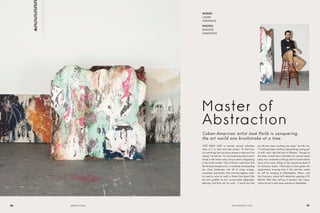
paintings and sculptures. Glance at one of
his pieces and the first things you’ll notice
are the colors and lines. Move your eyes
across the tableau and you might see a
word or a torn poster from the street. Get
up close and you’ll appreciate the layers of texture in the dry,
cracking paint juxtaposed with smooth brush strokes. As is the
case with any good abstract art, you have to work hard to find its
meaning. “What I feel like I’m translating is the soul of the place
because abstraction doesn’t come from thin air or nothing; I think
it comes from everything. And when you put everything together
it becomes a kind of chaos and I’m trying to translate that city
din or that chaos that comes from absorbing all of it.”
His vibrant paintings and murals have garnered many fans,
both in and outside the art world. “Most people know José’s work
through his public projects, so we were eager to show the breadth
of his distinct visual language by doing this two-gallery show with
Bryce Wolkowitz,” Ron Warren, director and partner at Mary
Boone Gallery told me. Later, I caught up with Wolkowitz, Parlá’s
exclusive gallerist in New York for the past eight years, who put
it quite succinctly, “José is unquestionably among the bright stars
working in abstraction today.” But Parlá wouldn’t tell you that—
he’s far too modest.
I ask the artist how he approaches a big commission like the
Barclays Center or the World Trade Center and he tells me that
when he was working on his Diary of Brooklyn mural in the latter,
he was inspired by James Agee’s book Brooklyn Is. “I like that
book because although it was written in the thirties, you read it
and Brooklyn hasn’t changed that much,” he says, explaining that
the arrival of people from other cities and countries keeps the
borough vibrant today, just as waves of immigrants shaped its
history. Striving to reflect Brooklyn’s past and present, he wove in
song lyrics and shout-outs to artists and musicians that have been
instrumental in the borough’s growth. “It’s not legible, but it’s in
there,” he tells me. “And the abstraction is important because in
a lot of my work I want people to see the abstraction and let it be
their own abstraction. So it’s not just me telling them a story, it’s
also them seeing themselves as part of the story. That’s always
something that I’m striving to do.”
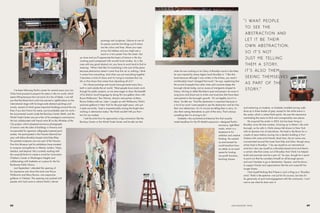
Snøhetta—the acclaimed architecture firm that recently
made headlines for the SF MoMA expansion—designed Parlá’s
enormous, light-filled
studio, which is a
testament to his
ambition and creative
thinking. He wanted
an environment he
could transform from
an atelier to an event
space for hosting
non-profit functions,
teaching classes,
and mentoring art students, so Snøhetta installed moving walls
done up in three shades of grey, except for the white arena in
the center, which is where Parlá paints. He uses the mezzanine
overlooking the arena to think and conceptualize new pieces.
He acquired the studio in 2013, but has been living in
Brooklyn since the late nineties. Growing up in Miami—the sixth
borough, as he calls it—Parlá always felt drawn to New York
with its dynamic mix of subcultures. He lived in the Bronx for a
couple of years before moving into a derelict building in Fort
Greene with some artist friends. Back then, the art scene was
concentrated around the Lower East Side and Soho, though many
artists lived in Brooklyn. “I do see myself as an international
artist but I also see myself as a Brooklyn-based artist and there’s
a certain vibe that comes out of Brooklyn that I think I’ve helped
build and promote and be a part of,” he says, though he is quick
to point out that he considers himself an all-borough person
and won’t hesitate to go to Manhattan, Queens, and the Bronx
to support friends and organizations like the arts nonprofit No
Longer Empty.
I find myself thinking that if there is such a thing as a “Brooklyn
artist,” Parlá is the epitome—not just for his success, but also for
his generosity of spirit and engagement with the community. I can’t
wait to see what he does next. ♦
 “I WANT PEOPLE
TO SEE TH E
ABSTRACTION AN D
LET IT BE TH EI R
OWN ABSTRACTION.
SO IT’S NOT
J UST M E TELLI NG
TH EM A STORY,
IT’S ALSO TH EM
SEEI NG TH EMSELVES
AS PART OF TH E
STORY.”

BK0716_03e_JoseParla

  • 1.
    86 BKMAG.COM 87JULY/AUGUST2016 JOSÉ PARLÁ LIKES to wander around unfamiliar cities at 3 or 4am and take photos. “At that hour you see things that you know people in bed won’t be seeing,” he tells me. “It’s not necessarily about what’s trendy in the street scene, but just what is happening in the world outside.” Fans of Parlá’s work know that the Brooklyn-based artist is constantly reinterpreting the urban landscape with all its noise, energy, movement, and rhythm. Ever since the eighties, when he used to write on walls in Miami (he doesn’t like the term graffiti), he has incorporated calligraphy, lettering, and lines into his work. “I would say that my life has been anything but quiet,” he tells me. “I’ve always been out there, seeing things, being part of stuff, and I like that kind of lifestyle.” Though he has been rooted here in Brooklyn for almost twenty years, he’s constantly on the go and his travels inform much of his work. Sitting on the mezzanine level of his Gowanus studio, I feel lucky to have gotten this appointment, knowing that in the next few weeks he will be traveling to Philadelphia, Miami, and San Francisco, where he’ll attend the opening of SF MoMA. After that, he’ll go to Istanbul, then Tokyo, where he has a solo show opening in September. Cuban-American artist José Parlá is conquering the art world one brushstroke at a time Master of Abstraction WORDS LAURA ITZKOWITZ PHOTOS MAGGIE SHANNON
  • 2.
    88 BKMAG.COM 89JULY/AUGUST2016 I’ve been following Parlá’s career for several years now, but I’d be hard pressed to pinpoint his status in the art world, which seems fitting because he’s not much of a fan of labels. I can tell you that the Miami-born artist has earned a rightful place on the international stage with his large-scale abstract paintings and murals, several of which grace important buildings around the city. Even if you don’t know his name, you’ve probably seen his work— the monumental murals inside the Barclays Center, BAM, and the World Trade Center are just a few of his prestigious commissions. He has collaborated with French artist JR on the Wrinkles of the City project, which plastered enormous photographs of seniors onto the sides of buildings in Havana and incorporated his signature calligraphy-inspired paint strokes. He participated in the Havana Biennial last year with fellow Brooklyn-based artist Duke Riley. His painted sculptures are now part of the Havana Fine Arts Museum and his exhibitions have traveled to museums and galleries in Atlanta, London, Tokyo, Istanbul, and beyond. He’s currently working with the nonprofit RxArt to create a mural for Incarnation Children’s Center in Washington Heights and collaborating with Snøhetta on a piece for the Far Rockaway Public Library. Last September I attended the opening of his impressive solo show that took over Bryce Wolkowitz and Mary Boone—two expansive galleries in Chelsea. The opening was packed with people who had come to admire Parlá’s vibrant paintings and sculptures. Glance at one of his pieces and the first things you’ll notice are the colors and lines. Move your eyes across the tableau and you might see a word or a torn poster from the street. Get up close and you’ll appreciate the layers of texture in the dry, cracking paint juxtaposed with smooth brush strokes. As is the case with any good abstract art, you have to work hard to find its meaning. “What I feel like I’m translating is the soul of the place because abstraction doesn’t come from thin air or nothing; I think it comes from everything. And when you put everything together it becomes a kind of chaos and I’m trying to translate that city din or that chaos that comes from absorbing all of it.” His vibrant paintings and murals have garnered many fans, both in and outside the art world. “Most people know José’s work through his public projects, so we were eager to show the breadth of his distinct visual language by doing this two-gallery show with Bryce Wolkowitz,” Ron Warren, director and partner at Mary Boone Gallery told me. Later, I caught up with Wolkowitz, Parlá’s exclusive gallerist in New York for the past eight years, who put it quite succinctly, “José is unquestionably among the bright stars working in abstraction today.” But Parlá wouldn’t tell you that— he’s far too modest. I ask the artist how he approaches a big commission like the Barclays Center or the World Trade Center and he tells me that when he was working on his Diary of Brooklyn mural in the latter, he was inspired by James Agee’s book Brooklyn Is. “I like that book because although it was written in the thirties, you read it and Brooklyn hasn’t changed that much,” he says, explaining that the arrival of people from other cities and countries keeps the borough vibrant today, just as waves of immigrants shaped its history. Striving to reflect Brooklyn’s past and present, he wove in song lyrics and shout-outs to artists and musicians that have been instrumental in the borough’s growth. “It’s not legible, but it’s in there,” he tells me. “And the abstraction is important because in a lot of my work I want people to see the abstraction and let it be their own abstraction. So it’s not just me telling them a story, it’s also them seeing themselves as part of the story. That’s always something that I’m striving to do.” Snøhetta—the acclaimed architecture firm that recently made headlines for the SF MoMA expansion—designed Parlá’s enormous, light-filled studio, which is a testament to his ambition and creative thinking. He wanted an environment he could transform from an atelier to an event space for hosting non-profit functions, teaching classes, and mentoring art students, so Snøhetta installed moving walls done up in three shades of grey, except for the white arena in the center, which is where Parlá paints. He uses the mezzanine overlooking the arena to think and conceptualize new pieces. He acquired the studio in 2013, but has been living in Brooklyn since the late nineties. Growing up in Miami—the sixth borough, as he calls it—Parlá always felt drawn to New York with its dynamic mix of subcultures. He lived in the Bronx for a couple of years before moving into a derelict building in Fort Greene with some artist friends. Back then, the art scene was concentrated around the Lower East Side and Soho, though many artists lived in Brooklyn. “I do see myself as an international artist but I also see myself as a Brooklyn-based artist and there’s a certain vibe that comes out of Brooklyn that I think I’ve helped build and promote and be a part of,” he says, though he is quick to point out that he considers himself an all-borough person and won’t hesitate to go to Manhattan, Queens, and the Bronx to support friends and organizations like the arts nonprofit No Longer Empty. I find myself thinking that if there is such a thing as a “Brooklyn artist,” Parlá is the epitome—not just for his success, but also for his generosity of spirit and engagement with the community. I can’t wait to see what he does next. ♦  “I WANT PEOPLE TO SEE TH E ABSTRACTION AN D LET IT BE TH EI R OWN ABSTRACTION. SO IT’S NOT J UST M E TELLI NG TH EM A STORY, IT’S ALSO TH EM SEEI NG TH EMSELVES AS PART OF TH E STORY.”