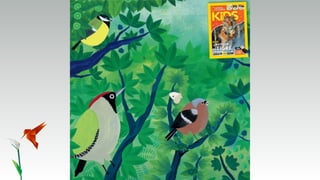
Birds from Romania
Dorina Marin
National College of Art”Octav Bancila„ Iasi-Romania
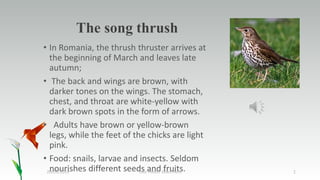
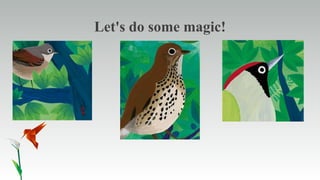
The song thrush
• In Romania, the thrush thruster arrives at
the beginning of March and leaves late
autumn;
• The back and wings are brown, with
darker tones on the wings. The stomach,
chest, and throat are white-yellow with
dark brown spots in the form of arrows.
• Adults have brown or yellow-brown
legs, while the feet of the chicks are light
pink.
• Food: snails, larvae and insects. Seldom
nourishes different seeds and fruits.Your Footer Goes Here 220/03/2019
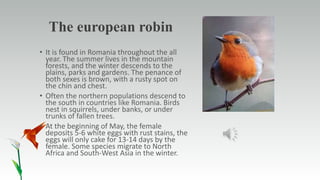
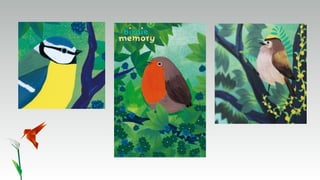
The european robin
• It is found in Romania throughout the all
year. The summer lives in the mountain
forests, and the winter descends to the
plains, parks and gardens. The penance of
both sexes is brown, with a rusty spot on
the chin and chest.
• Often the northern populations descend to
the south in countries like Romania. Birds
nest in squirrels, under banks, or under
trunks of fallen trees.
• At the beginning of May, the female
deposits 5-6 white eggs with rust stains, the
eggs will only cake for 13-14 days by the
female. Some species migrate to North
Africa and South-West Asia in the winter.
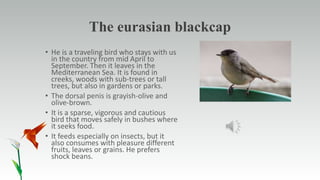
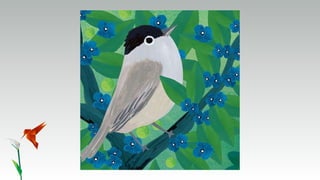
The eurasian blackcap
• He is a traveling bird who stays with us
in the country from mid April to
September. Then it leaves in the
Mediterranean Sea. It is found in
creeks, woods with sub-trees or tall
trees, but also in gardens or parks.
• The dorsal penis is grayish-olive and
olive-brown.
• It is a sparse, vigorous and cautious
bird that moves safely in bushes where
it seeks food.
• It feeds especially on insects, but it
also consumes with pleasure different
fruits, leaves or grains. He prefers
shock beans.
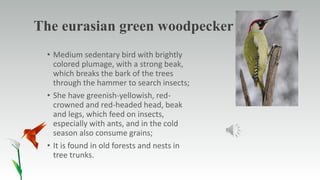
The eurasian green woodpecker
• Medium sedentary bird with brightly
colored plumage, with a strong beak,
which breaks the bark of the trees
through the hammer to search insects;
• She have greenish-yellowish, red-
crowned and red-headed head, beak
and legs, which feed on insects,
especially with ants, and in the cold
season also consume grains;
• It is found in old forests and nests in
tree trunks.
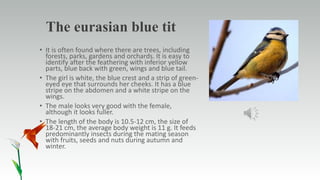
The eurasian blue tit
• It is often found where there are trees, including
forests, parks, gardens and orchards. It is easy to
identify after the feathering with inferior yellow
parts, blue back with green, wings and blue tail.
• The girl is white, the blue crest and a strip of green-
eyed eye that surrounds her cheeks. It has a blue
stripe on the abdomen and a white stripe on the
wings.
• The male looks very good with the female,
although it looks fuller.
• The length of the body is 10.5-12 cm, the size of
18-21 cm, the average body weight is 11 g. It feeds
predominantly insects during the mating season
with fruits, seeds and nuts during autumn and
winter.
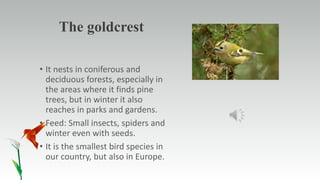
The goldcrest
• It nests in coniferous and
deciduous forests, especially in
the areas where it finds pine
trees, but in winter it also
reaches in parks and gardens.
• Feed: Small insects, spiders and
winter even with seeds.
• It is the smallest bird species in
our country, but also in Europe.
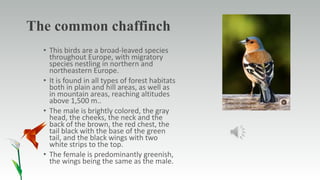
The common chaffinch
• This birds are a broad-leaved species
throughout Europe, with migratory
species nestling in northern and
northeastern Europe.
• It is found in all types of forest habitats
both in plain and hill areas, as well as
in mountain areas, reaching altitudes
above 1,500 m..
• The male is brightly colored, the gray
head, the cheeks, the neck and the
back of the brown, the red chest, the
tail black with the base of the green
tail, and the black wings with two
white strips to the top.
• The female is predominantly greenish,
the wings being the same as the male.
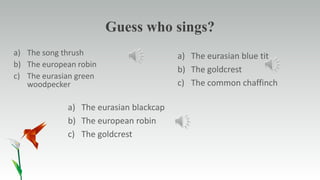
Guess who sings?
a) The song thrush
b) The european robin
c) The eurasian green
woodpecker
a) The eurasian blue tit
b) The goldcrest
c) The common chaffinch
a) The eurasian blackcap
b) The european robin
c) The goldcrest
Let's do some magic!
Sounds and pictures are from:
• https://ro.wikipedia.org;
• http://pasaridinromania.sor.ro;
• https://www.birdiememory.com/;
• https://www.europeana.eu/portal/en;
• https://twitter.com/lena_mazilu/status/1054691672158859264;

Birds from Romania

  • 1.
    Birds from Romania DorinaMarin National College of Art”Octav Bancila„ Iasi-Romania
  • 2.
    The song thrush •In Romania, the thrush thruster arrives at the beginning of March and leaves late autumn; • The back and wings are brown, with darker tones on the wings. The stomach, chest, and throat are white-yellow with dark brown spots in the form of arrows. • Adults have brown or yellow-brown legs, while the feet of the chicks are light pink. • Food: snails, larvae and insects. Seldom nourishes different seeds and fruits.Your Footer Goes Here 220/03/2019
  • 3.
    The european robin •It is found in Romania throughout the all year. The summer lives in the mountain forests, and the winter descends to the plains, parks and gardens. The penance of both sexes is brown, with a rusty spot on the chin and chest. • Often the northern populations descend to the south in countries like Romania. Birds nest in squirrels, under banks, or under trunks of fallen trees. • At the beginning of May, the female deposits 5-6 white eggs with rust stains, the eggs will only cake for 13-14 days by the female. Some species migrate to North Africa and South-West Asia in the winter.
  • 4.
    The eurasian blackcap •He is a traveling bird who stays with us in the country from mid April to September. Then it leaves in the Mediterranean Sea. It is found in creeks, woods with sub-trees or tall trees, but also in gardens or parks. • The dorsal penis is grayish-olive and olive-brown. • It is a sparse, vigorous and cautious bird that moves safely in bushes where it seeks food. • It feeds especially on insects, but it also consumes with pleasure different fruits, leaves or grains. He prefers shock beans.
  • 5.
    The eurasian greenwoodpecker • Medium sedentary bird with brightly colored plumage, with a strong beak, which breaks the bark of the trees through the hammer to search insects; • She have greenish-yellowish, red- crowned and red-headed head, beak and legs, which feed on insects, especially with ants, and in the cold season also consume grains; • It is found in old forests and nests in tree trunks.
  • 6.
    The eurasian bluetit • It is often found where there are trees, including forests, parks, gardens and orchards. It is easy to identify after the feathering with inferior yellow parts, blue back with green, wings and blue tail. • The girl is white, the blue crest and a strip of green- eyed eye that surrounds her cheeks. It has a blue stripe on the abdomen and a white stripe on the wings. • The male looks very good with the female, although it looks fuller. • The length of the body is 10.5-12 cm, the size of 18-21 cm, the average body weight is 11 g. It feeds predominantly insects during the mating season with fruits, seeds and nuts during autumn and winter.
  • 7.
    The goldcrest • Itnests in coniferous and deciduous forests, especially in the areas where it finds pine trees, but in winter it also reaches in parks and gardens. • Feed: Small insects, spiders and winter even with seeds. • It is the smallest bird species in our country, but also in Europe.
  • 8.
    The common chaffinch •This birds are a broad-leaved species throughout Europe, with migratory species nestling in northern and northeastern Europe. • It is found in all types of forest habitats both in plain and hill areas, as well as in mountain areas, reaching altitudes above 1,500 m.. • The male is brightly colored, the gray head, the cheeks, the neck and the back of the brown, the red chest, the tail black with the base of the green tail, and the black wings with two white strips to the top. • The female is predominantly greenish, the wings being the same as the male.
  • 9.
    Guess who sings? a)The song thrush b) The european robin c) The eurasian green woodpecker a) The eurasian blue tit b) The goldcrest c) The common chaffinch a) The eurasian blackcap b) The european robin c) The goldcrest
  • 10.
  • 14.
    Sounds and picturesare from: • https://ro.wikipedia.org; • http://pasaridinromania.sor.ro; • https://www.birdiememory.com/; • https://www.europeana.eu/portal/en; • https://twitter.com/lena_mazilu/status/1054691672158859264;