Bioprocess Engineering: Kinetics,
Sustainability, and Reactor Design 3rd Edition
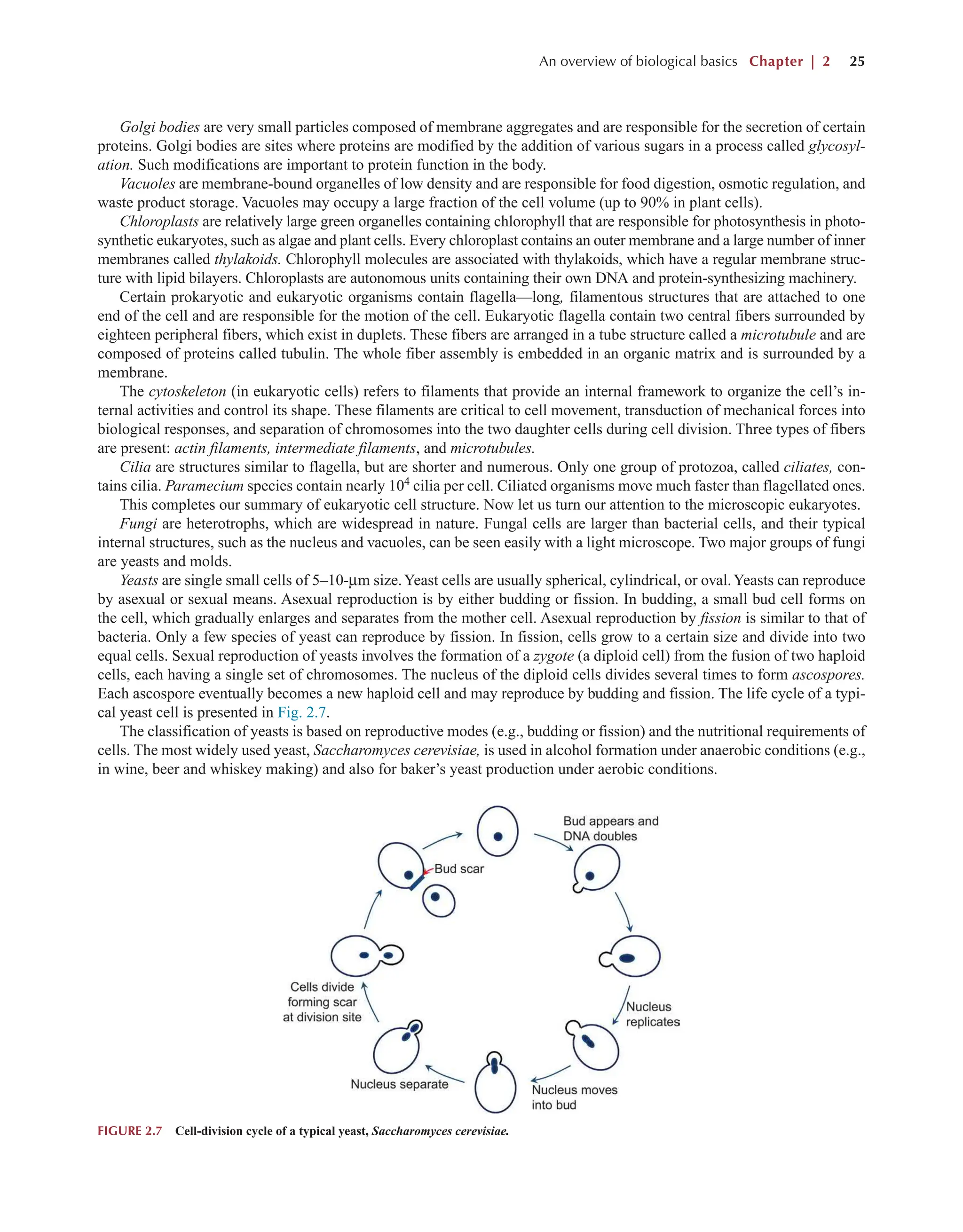
Shijie Liu download
https://textbookfull.com/product/bioprocess-engineering-kinetics-
sustainability-and-reactor-design-3rd-edition-shijie-liu/
Download full version ebook from https://textbookfull.com
We believe these products will be a great fit for you. Click
the link to download now, or visit textbookfull.com
to discover even more!
Biota Grow 2C gather 2C cook Loucas
https://textbookfull.com/product/biota-grow-2c-gather-2c-cook-
loucas/
Mathematics for Enzyme Reaction Kinetics and Reactor
Performance, 2 Volume Set (Enzyme Reaction Engineering)
1st Edition F. Xavier Malcata
https://textbookfull.com/product/mathematics-for-enzyme-reaction-
kinetics-and-reactor-performance-2-volume-set-enzyme-reaction-
engineering-1st-edition-f-xavier-malcata/
Chemical Reactor Design Mathematical Modeling and
Applications Conesa
https://textbookfull.com/product/chemical-reactor-design-
mathematical-modeling-and-applications-conesa/
Coulson and Richardson’s Chemical Engineering, Fourth
Edition: Volume 3A: Chemical and Biochemical Reactors
and Reaction Engineering R. Ravi
https://textbookfull.com/product/coulson-and-richardsons-
chemical-engineering-fourth-edition-volume-3a-chemical-and-
biochemical-reactors-and-reaction-engineering-r-ravi/
Bioprocess Engineering for Bioremediation: Valorization
and Management Techniques Manuel Jerold
https://textbookfull.com/product/bioprocess-engineering-for-
bioremediation-valorization-and-management-techniques-manuel-
jerold/
Nuclear Reactor: Physics and Engineering 1st Edition
John C. Lee
https://textbookfull.com/product/nuclear-reactor-physics-and-
engineering-1st-edition-john-c-lee/
Cell Culture Bioprocess Engineering, Second Edition
Wei-Shou Hu (Author)
https://textbookfull.com/product/cell-culture-bioprocess-
engineering-second-edition-wei-shou-hu-author/
Sustainability in Engineering Design 1st Edition
Anthony Johnson And Andy Gibson (Auth.)
https://textbookfull.com/product/sustainability-in-engineering-
design-1st-edition-anthony-johnson-and-andy-gibson-auth/
Chemical and Bioprocess Engineering Fundamental
Concepts for First Year Students Simpson
https://textbookfull.com/product/chemical-and-bioprocess-
engineering-fundamental-concepts-for-first-year-students-simpson/
Shijie Liu
Professor
Chemical Engineering
SUNY ESF
Syracuse
NY, United States
Bioprocess Engineering
Kinetics, Sustainability, and Reactor Design
Third Edition
Elsevier
Radarweg 29, PO Box 211, 1000 AE Amsterdam, Netherlands
The Boulevard, Langford Lane, Kidlington, Oxford OX5 1GB, United Kingdom
50 Hampshire Street, 5th Floor, Cambridge, MA 02139, United States
Copyright © 2020 Elsevier B.V. All rights reserved.
No part of this publication may be reproduced or transmitted in any form or by any means, electronic or mechanical, in-
cluding photocopying, recording, or any information storage and retrieval system, without permission in writing from the
publisher. Details on how to seek permission, further information about the Publisher’s permissions policies and our ar-
rangements with organizations such as the Copyright Clearance Center and the Copyright Licensing Agency, can be found
at our website: www.elsevier.com/permissions.
This book and the individual contributions contained in it are protected under copyright by the Publisher (other than as
may be noted herein).
Notices
Knowledge and best practice in this field are constantly changing. As new research and experience broaden our understand-
ing, changes in research methods, professional practices, or medical treatment may become necessary.
Practitioners and researchers must always rely on their own experience and knowledge in evaluating and using any infor-
mation, methods, compounds, or experiments described herein. In using such information or methods they should be
mindful of their own safety and the safety of others, including parties for whom they have a professional responsibility.
To the fullest extent of the law, neither the Publisher nor the authors, contributors, or editors, assume any liability for any
injury and/or damage to persons or property as a matter of products liability, negligence or otherwise, or from any use or
operation of any methods, products, instructions, or ideas contained in the material herein.
Library of Congress Cataloging-in-Publication Data
A catalog record for this book is available from the Library of Congress
British Library Cataloguing-in-Publication Data
A catalogue record for this book is available from the British Library
ISBN: 978-0-12-821012-3
For information on all Elsevier publications
visit our website at https://www.elsevier.com/books-and-journals
Publisher: Joe Hayton
Acquisitions Editor: Kostas Marinakis
Editorial Project Manager: Liz Heijkoop
Production Project Manager: Omer Mukthar
Designer: Mark Rogers
Typeset by Thomson Digital
Bioprocess Engineering. http://dx.doi.org/10.1016/B978-0-12-821012-3.00001-4
Copyright © 2020 Elsevier B.V. All rights reserved. 1
1.1 Biological cycle
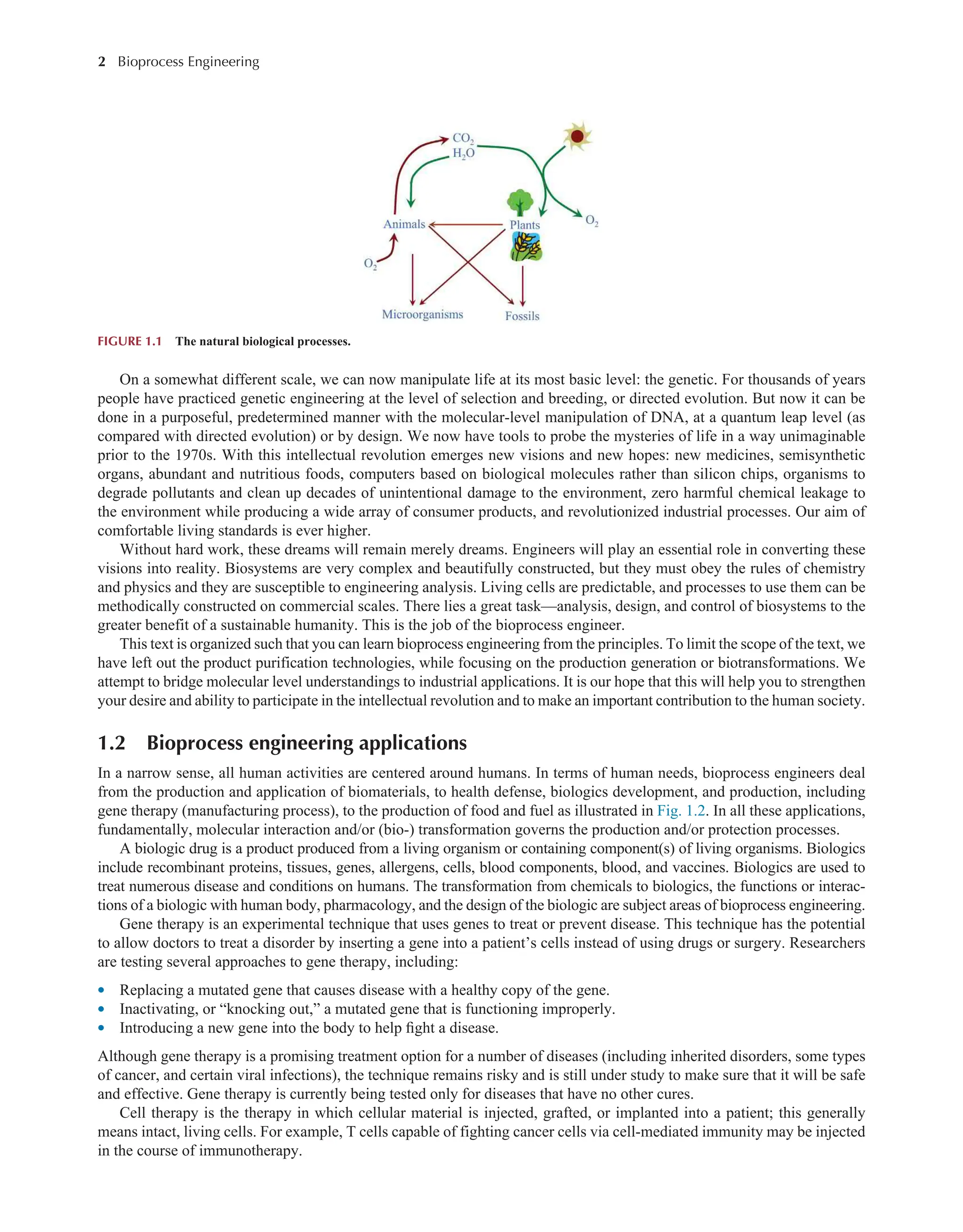
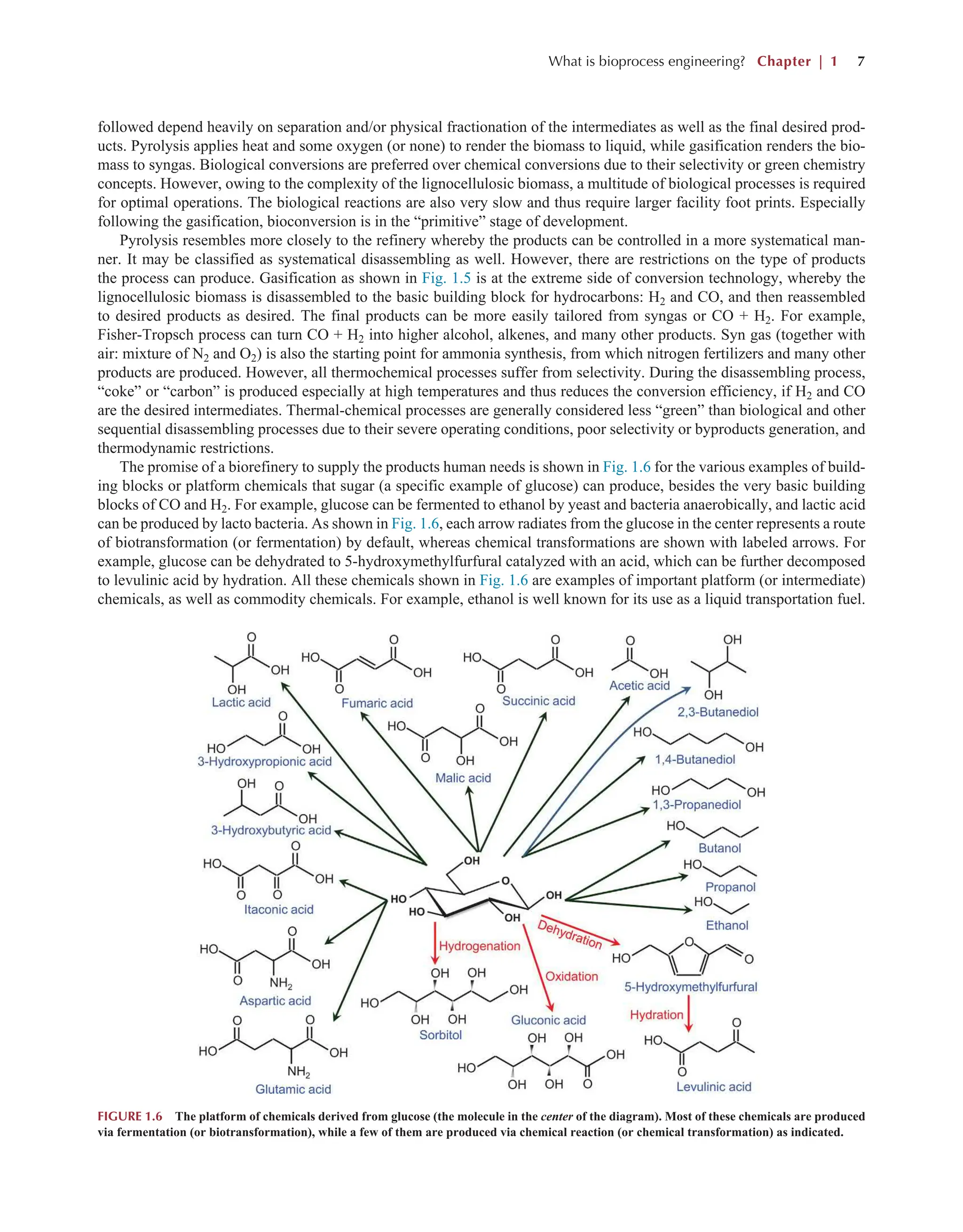
Fig. 1.1 illustrates the natural biological processes occurring on Earth. Living systems consist of plants, animals, and mi-
croorganisms. Sunlight is used by plants to convert CO2 and H2O into carbohydrates and other organic matter, releasing O2.
Animals consume plant matter, converting plant materials into animal cells, and using the chemical energy from oxidizing
plant matter into CO2 and H2O (H2O also serves as a key substrate for animals), finishing the cycle. Microorganisms further
convert dead animal and/or plant biomass into other form of organic substances fertilizing the growth of plants, releasing
CO2 and H2O, and the cycle is repeated. Energy from the Sun is used to form molecules and organisms that we call life. Ma-
terials or matter participating in the biological cycle are renewable so long as the cycle is maintained. Bioprocess engineers
manipulate and make use of this cycle by designing processes to make desired products, either by training microorganisms,
plants, and animals, or via direct chemical conversions.
The reactor is the heart of any chemical and/or biochemical processes. With reactors, bioprocesses turn inexpensive sus-
tainably renewable chemicals such as carbohydrates, into valuable ones that humans need. As such, bioprocesses are chemi-
cal processes that use biological substrates and/or catalysts. While not limited to such, we tend to refer to bioprocesses as
(1) biologically converting inexpensive “chemicals” or materials into valuable chemicals or materials; and (2) manipulating
biological organisms to serve as “catalyst” for conversion or production of products that human need. Bioprocess engineers
are the only people technically trained to understand, design, and efficiently handle bioreactors. Bioprocess engineering
ensures that a favorable sustainable state or predictable outcome of a bioprocess is achieved. This is equivalent to saying
that bioprocess engineers are engineers with, differentiating from other engineers, training in biological sciences, especially
quantitative and analytical biological sciences, and green chemistry.
If one thinks of science as a dream, engineering is making the dream a reality. The maturing of Chemical Engineer-
ing to a major discipline and as one of the very few well-defined disciplines in the 1950s has led to the ease in the mass
production of commodity chemicals and completely changed the economics or value structure of materials and chemicals,
thanks to the vastly available what were then “waste” and “toxic” materials—fossil resources. Food and materials can be
manufactured from the cheap fossil materials. Our living standards improved significantly. Today, chemical reactors and
chemical processes are not built by trial-and-error, but by design. The performance of a chemical reactor can be predicted,
not just found to happen that way; the differences between large and small reactors are largely solved. Once a dream for
the visional pioneers, it can now be achieved at ease. Fossil chemical and energy sources have provided much of our needs
for advancing and maintaining the living standards of today. With the dwindling of fossil resources, we are facing yet an-
other value structure change. The dream has been shifted to realizing a society that is built upon renewable and sustainable
resources. Fossil sources will no longer be abundant for human use. Sustainability becomes the primary concern. Who is
going to make this dream come true?
Chapter 1
What is bioprocess engineering?
Chapter outline
1.1 Biological cycle 1
1.2 Bioprocess engineering applications 2
1.3 Scales: living organism and manufacturing 3
1.4 Green chemistry 4
1.5 Sustainability 5
1.6 Biorefinery 5
1.7 Biotechnology and bioprocess engineering 8
1.8 Mathematics, biology, and engineering 9
1.9 The story of penicillin: the dawn of bioprocess
engineering 9
1.10 Bioprocesses: regulatory constraints 12
1.11 The pillars of bioprocess kinetics and systems
engineering 13
1.12 Summary 14
Problems 14
References 14
Further readings 15
2 Bioprocess Engineering

On a somewhat different scale, we can now manipulate life at its most basic level: the genetic. For thousands of years
people have practiced genetic engineering at the level of selection and breeding, or directed evolution. But now it can be
done in a purposeful, predetermined manner with the molecular-level manipulation of DNA, at a quantum leap level (as
compared with directed evolution) or by design. We now have tools to probe the mysteries of life in a way unimaginable
prior to the 1970s. With this intellectual revolution emerges new visions and new hopes: new medicines, semisynthetic
organs, abundant and nutritious foods, computers based on biological molecules rather than silicon chips, organisms to
degrade pollutants and clean up decades of unintentional damage to the environment, zero harmful chemical leakage to
the environment while producing a wide array of consumer products, and revolutionized industrial processes. Our aim of
comfortable living standards is ever higher.
Without hard work, these dreams will remain merely dreams. Engineers will play an essential role in converting these
visions into reality. Biosystems are very complex and beautifully constructed, but they must obey the rules of chemistry
and physics and they are susceptible to engineering analysis. Living cells are predictable, and processes to use them can be
methodically constructed on commercial scales. There lies a great task—analysis, design, and control of biosystems to the
greater benefit of a sustainable humanity. This is the job of the bioprocess engineer.
This text is organized such that you can learn bioprocess engineering from the principles. To limit the scope of the text, we
have left out the product purification technologies, while focusing on the production generation or biotransformations. We
attempt to bridge molecular level understandings to industrial applications. It is our hope that this will help you to strengthen
your desire and ability to participate in the intellectual revolution and to make an important contribution to the human society.
1.2 Bioprocess engineering applications
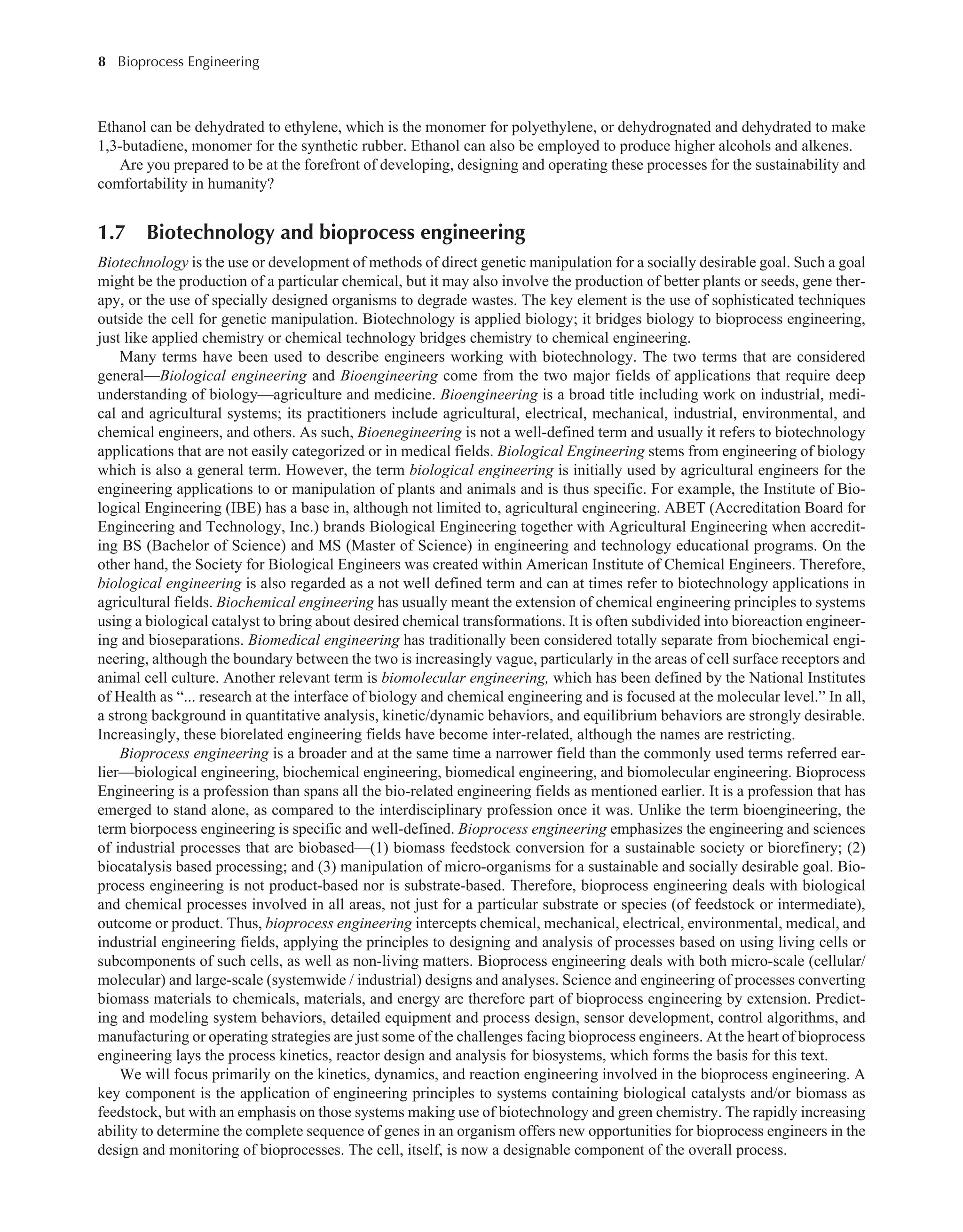
In a narrow sense, all human activities are centered around humans. In terms of human needs, bioprocess engineers deal
from the production and application of biomaterials, to health defense, biologics development, and production, including
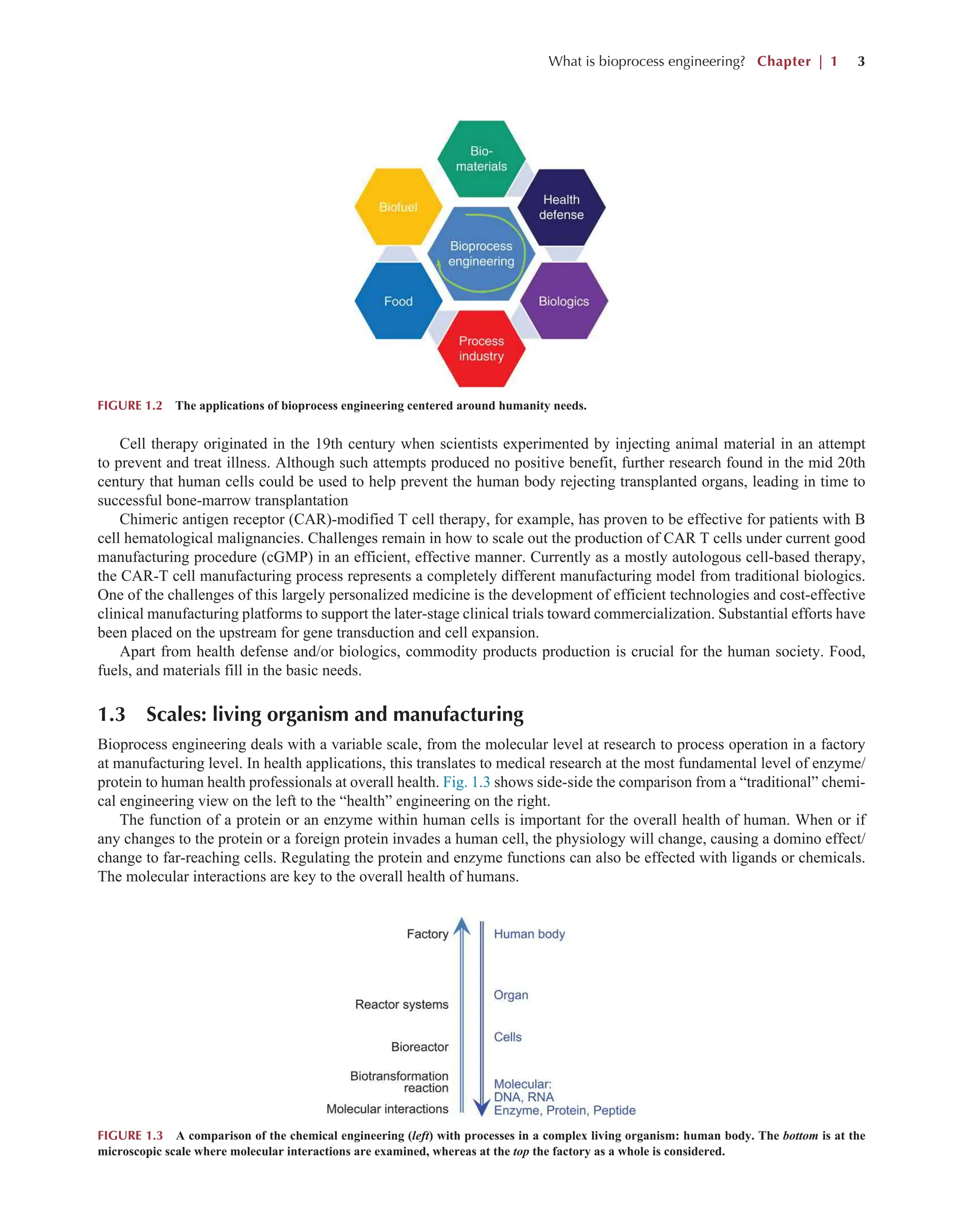
gene therapy (manufacturing process), to the production of food and fuel as illustrated in Fig. 1.2. In all these applications,
fundamentally, molecular interaction and/or (bio-) transformation governs the production and/or protection processes.
A biologic drug is a product produced from a living organism or containing component(s) of living organisms. Biologics
include recombinant proteins, tissues, genes, allergens, cells, blood components, blood, and vaccines. Biologics are used to
treat numerous disease and conditions on humans. The transformation from chemicals to biologics, the functions or interac-
tions of a biologic with human body, pharmacology, and the design of the biologic are subject areas of bioprocess engineering.
Gene therapy is an experimental technique that uses genes to treat or prevent disease. This technique has the potential
to allow doctors to treat a disorder by inserting a gene into a patient’s cells instead of using drugs or surgery. Researchers
are testing several approaches to gene therapy, including:
l Replacing a mutated gene that causes disease with a healthy copy of the gene.
l Inactivating, or “knocking out,” a mutated gene that is functioning improperly.
l Introducing a new gene into the body to help fight a disease.
Although gene therapy is a promising treatment option for a number of diseases (including inherited disorders, some types
of cancer, and certain viral infections), the technique remains risky and is still under study to make sure that it will be safe
and effective. Gene therapy is currently being tested only for diseases that have no other cures.
Cell therapy is the therapy in which cellular material is injected, grafted, or implanted into a patient; this generally
means intact, living cells. For example, T cells capable of fighting cancer cells via cell-mediated immunity may be injected
in the course of immunotherapy.
FIGURE 1.1 The natural biological processes.
What is bioprocess engineering? Chapter | 1 3
Cell therapy originated in the 19th century when scientists experimented by injecting animal material in an attempt
to prevent and treat illness. Although such attempts produced no positive benefit, further research found in the mid 20th
century that human cells could be used to help prevent the human body rejecting transplanted organs, leading in time to
successful bone-marrow transplantation
Chimeric antigen receptor (CAR)-modified T cell therapy, for example, has proven to be effective for patients with B
cell hematological malignancies. Challenges remain in how to scale out the production of CAR T cells under current good
manufacturing procedure (cGMP) in an efficient, effective manner. Currently as a mostly autologous cell-based therapy,
the CAR-T cell manufacturing process represents a completely different manufacturing model from traditional biologics.
One of the challenges of this largely personalized medicine is the development of efficient technologies and cost-effective
clinical manufacturing platforms to support the later-stage clinical trials toward commercialization. Substantial efforts have
been placed on the upstream for gene transduction and cell expansion.
Apart from health defense and/or biologics, commodity products production is crucial for the human society. Food,
fuels, and materials fill in the basic needs.
1.3 Scales: living organism and manufacturing
Bioprocess engineering deals with a variable scale, from the molecular level at research to process operation in a factory
at manufacturing level. In health applications, this translates to medical research at the most fundamental level of enzyme/
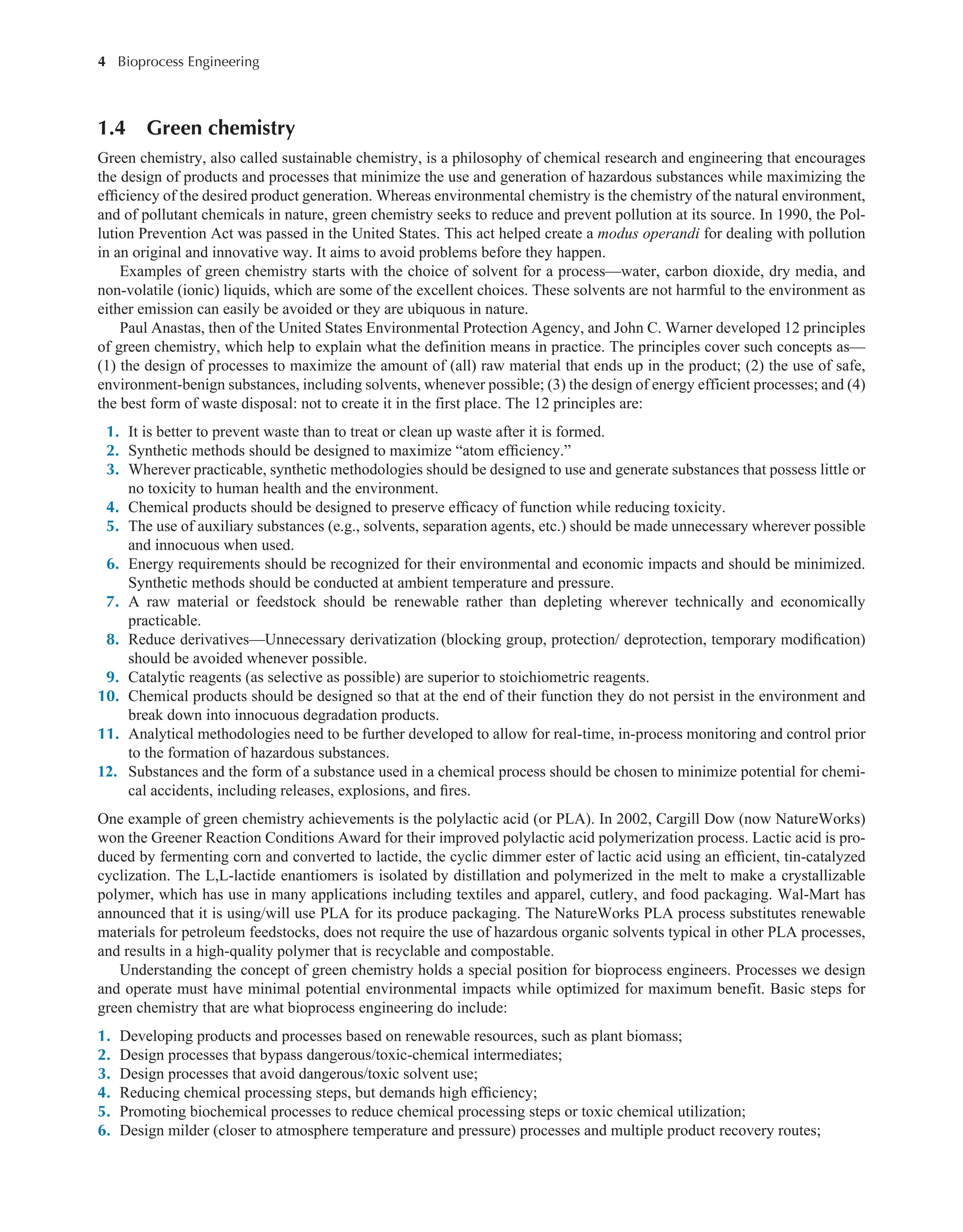
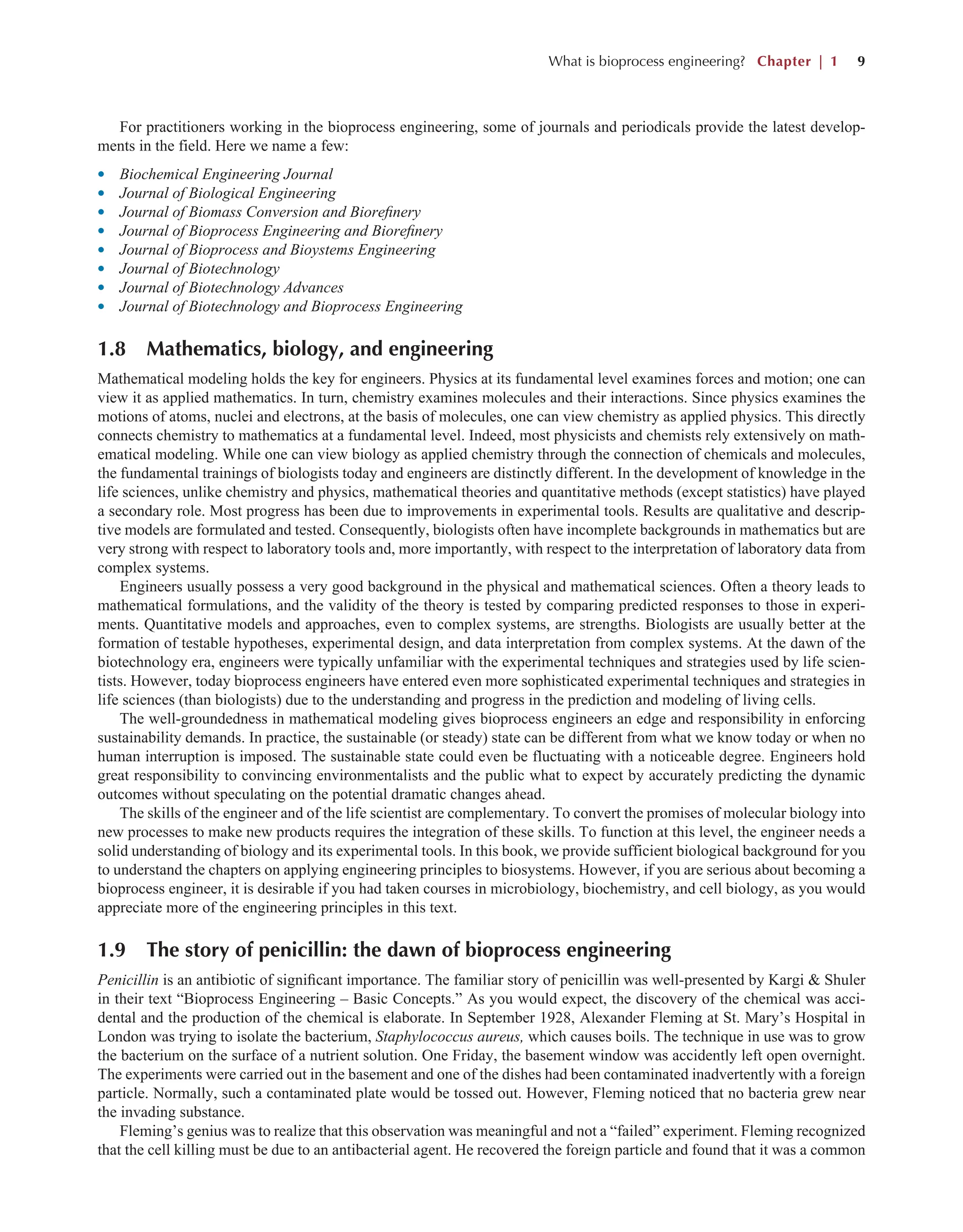
protein to human health professionals at overall health. Fig. 1.3 shows side-side the comparison from a “traditional” chemi-
cal engineering view on the left to the “health” engineering on the right.
The function of a protein or an enzyme within human cells is important for the overall health of human. When or if
any changes to the protein or a foreign protein invades a human cell, the physiology will change, causing a domino effect/
change to far-reaching cells. Regulating the protein and enzyme functions can also be effected with ligands or chemicals.
The molecular interactions are key to the overall health of humans.
FIGURE 1.2 The applications of bioprocess engineering centered around humanity needs.
FIGURE 1.3 A comparison of the chemical engineering (left) with processes in a complex living organism: human body. The bottom is at the
microscopic scale where molecular interactions are examined, whereas at the top the factory as a whole is considered.
4 Bioprocess Engineering

1.4 Green chemistry
Green chemistry, also called sustainable chemistry, is a philosophy of chemical research and engineering that encourages
the design of products and processes that minimize the use and generation of hazardous substances while maximizing the
efficiency of the desired product generation. Whereas environmental chemistry is the chemistry of the natural environment,
and of pollutant chemicals in nature, green chemistry seeks to reduce and prevent pollution at its source. In 1990, the Pol-
lution Prevention Act was passed in the United States. This act helped create a modus operandi for dealing with pollution
in an original and innovative way. It aims to avoid problems before they happen.
Examples of green chemistry starts with the choice of solvent for a process—water, carbon dioxide, dry media, and
non-volatile (ionic) liquids, which are some of the excellent choices. These solvents are not harmful to the environment as
either emission can easily be avoided or they are ubiquous in nature.
Paul Anastas, then of the United States Environmental Protection Agency, and John C. Warner developed 12 principles
of green chemistry, which help to explain what the definition means in practice. The principles cover such concepts as—
(1) the design of processes to maximize the amount of (all) raw material that ends up in the product; (2) the use of safe,
environment-benign substances, including solvents, whenever possible; (3) the design of energy efficient processes; and (4)
the best form of waste disposal: not to create it in the first place. The 12 principles are:
1. It is better to prevent waste than to treat or clean up waste after it is formed.
2. Synthetic methods should be designed to maximize “atom efficiency.”
3. Wherever practicable, synthetic methodologies should be designed to use and generate substances that possess little or
no toxicity to human health and the environment.
4. Chemical products should be designed to preserve efficacy of function while reducing toxicity.
5. The use of auxiliary substances (e.g., solvents, separation agents, etc.) should be made unnecessary wherever possible
and innocuous when used.
6. Energy requirements should be recognized for their environmental and economic impacts and should be minimized.
Synthetic methods should be conducted at ambient temperature and pressure.
7. A raw material or feedstock should be renewable rather than depleting wherever technically and economically
practicable.
8. Reduce derivatives—Unnecessary derivatization (blocking group, protection/ deprotection, temporary modification)
should be avoided whenever possible.
9. Catalytic reagents (as selective as possible) are superior to stoichiometric reagents.
10. Chemical products should be designed so that at the end of their function they do not persist in the environment and
break down into innocuous degradation products.
11. Analytical methodologies need to be further developed to allow for real-time, in-process monitoring and control prior
to the formation of hazardous substances.
12. Substances and the form of a substance used in a chemical process should be chosen to minimize potential for chemi-
cal accidents, including releases, explosions, and fires.
One example of green chemistry achievements is the polylactic acid (or PLA). In 2002, Cargill Dow (now NatureWorks)
won the Greener Reaction Conditions Award for their improved polylactic acid polymerization process. Lactic acid is pro-
duced by fermenting corn and converted to lactide, the cyclic dimmer ester of lactic acid using an efficient, tin-catalyzed
cyclization. The L,L-lactide enantiomers is isolated by distillation and polymerized in the melt to make a crystallizable
polymer, which has use in many applications including textiles and apparel, cutlery, and food packaging. Wal-Mart has
announced that it is using/will use PLA for its produce packaging. The NatureWorks PLA process substitutes renewable
materials for petroleum feedstocks, does not require the use of hazardous organic solvents typical in other PLA processes,
and results in a high-quality polymer that is recyclable and compostable.
Understanding the concept of green chemistry holds a special position for bioprocess engineers. Processes we design
and operate must have minimal potential environmental impacts while optimized for maximum benefit. Basic steps for
green chemistry that are what bioprocess engineering do include:
1. Developing products and processes based on renewable resources, such as plant biomass;
2. Design processes that bypass dangerous/toxic-chemical intermediates;
3. Design processes that avoid dangerous/toxic solvent use;
4. Reducing chemical processing steps, but demands high efficiency;
5. Promoting biochemical processes to reduce chemical processing steps or toxic chemical utilization;
6. Design milder (closer to atmosphere temperature and pressure) processes and multiple product recovery routes;
What is bioprocess engineering? Chapter | 1 5
7. Bypassing chemical equilibrium with innovative reactor design, and biocatalysis, rather than adding intermediate steps.
8. Avoid production of unwanted products other than H2O and CO2.
1.5 Sustainability
Sustainability is the capacity to endure or maintain at the longest timescale permissible. In other words, sustainability is the
ability to maintain continuum. In ecology, the word describes how biological systems remain diverse and productive over
time. Long-lived and healthy wetlands and forests are examples of sustainable biological systems. For humans, sustainabil-
ity is the potential for long-term maintenance of well-being, which has environmental, economic, and social dimensions.
Healthy ecosystems and environments provide vital goods and services to humans and other organisms. Utilization and
release of substances at a rate that is harmonious with a steady state nature is the key for sustainability. This naturally leads
to a carrying capacity for each substance or species with which humans interact. The sustainable state can be influenced by
(process conditions or) how we interact with nature. There are two major ways of reducing negative human impact and en-
hancing ecosystem services. The first is environmental management; this approach is based largely on information gained
from earth science, environmental science, and conservation biology. The second approach is management of human con-
sumption of resources, which is based largely on information gained from economics. Practice of both of these major steps
can ensure a more favorable sustainable state to be evolved into.
Sustainability interfaces with economics through the social and ecological consequences of economic activity. Sus-
tainable economics involves ecological economics where social, cultural, health-related, and monetary/financial aspects
are integrated. Moving toward sustainability is also a social challenge that entails international and national law, urban
planning and transport, local and individual lifestyles and ethical consumerism. Ways of living more sustainably can take
many forms from reorganizing living conditions (e.g., ecovillages, eco-municipalities, and sustainable cities), reapprais-
ing economic sectors (permaculture, green building, sustainable agriculture), or work practices (sustainable architecture),
using science to develop new technologies (green technologies, renewable energy), to adjustments in individual lifestyles
that conserve natural resources. These exercises reduce our reliance or demand on disturbing the environment. To make all
these concepts come to light, bioprocess engineers will be at the forefront of developing and implementing the technologies
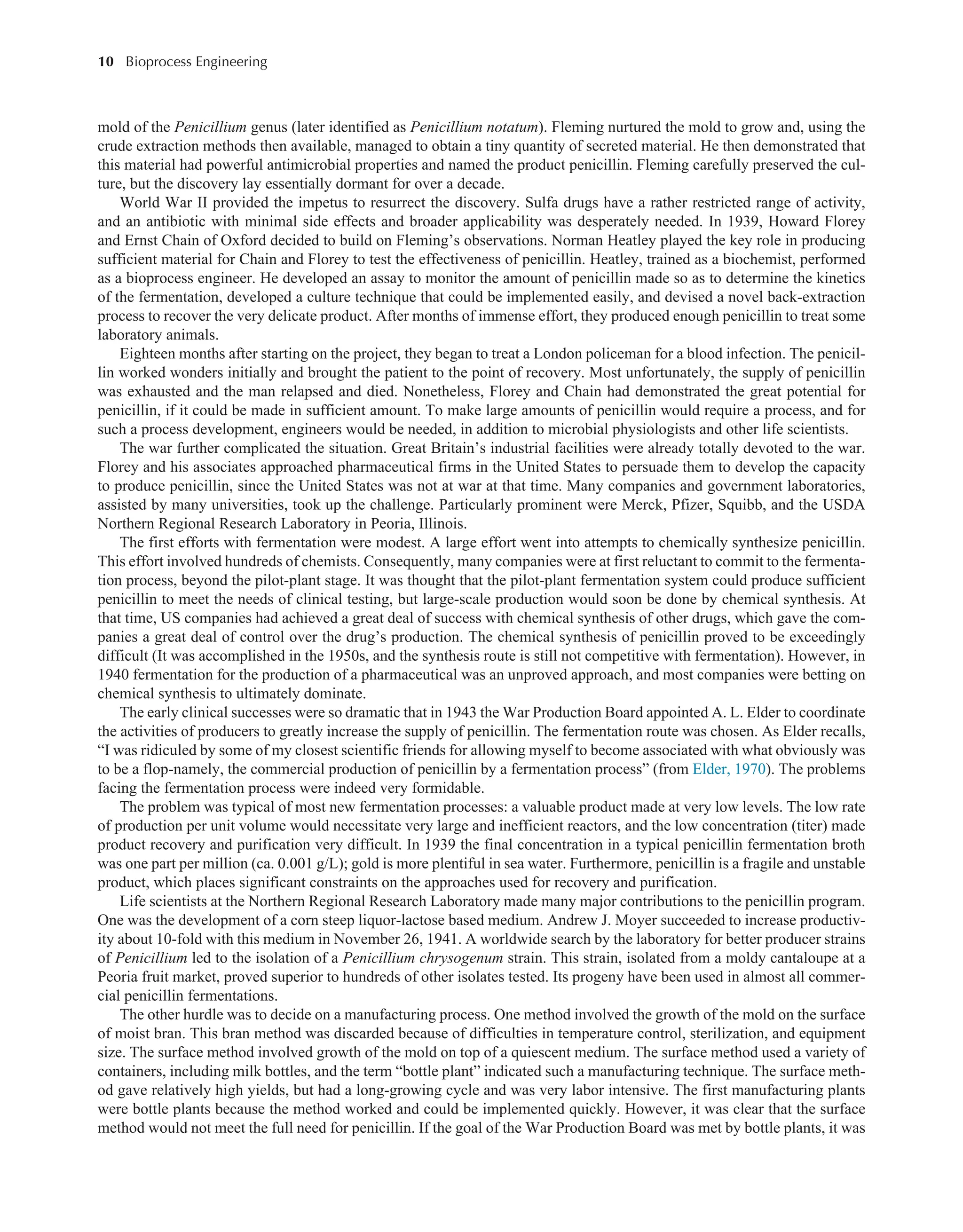
needed. On a grand scale, maintaining renewability or looking for a favorable predictable steady state on everything we
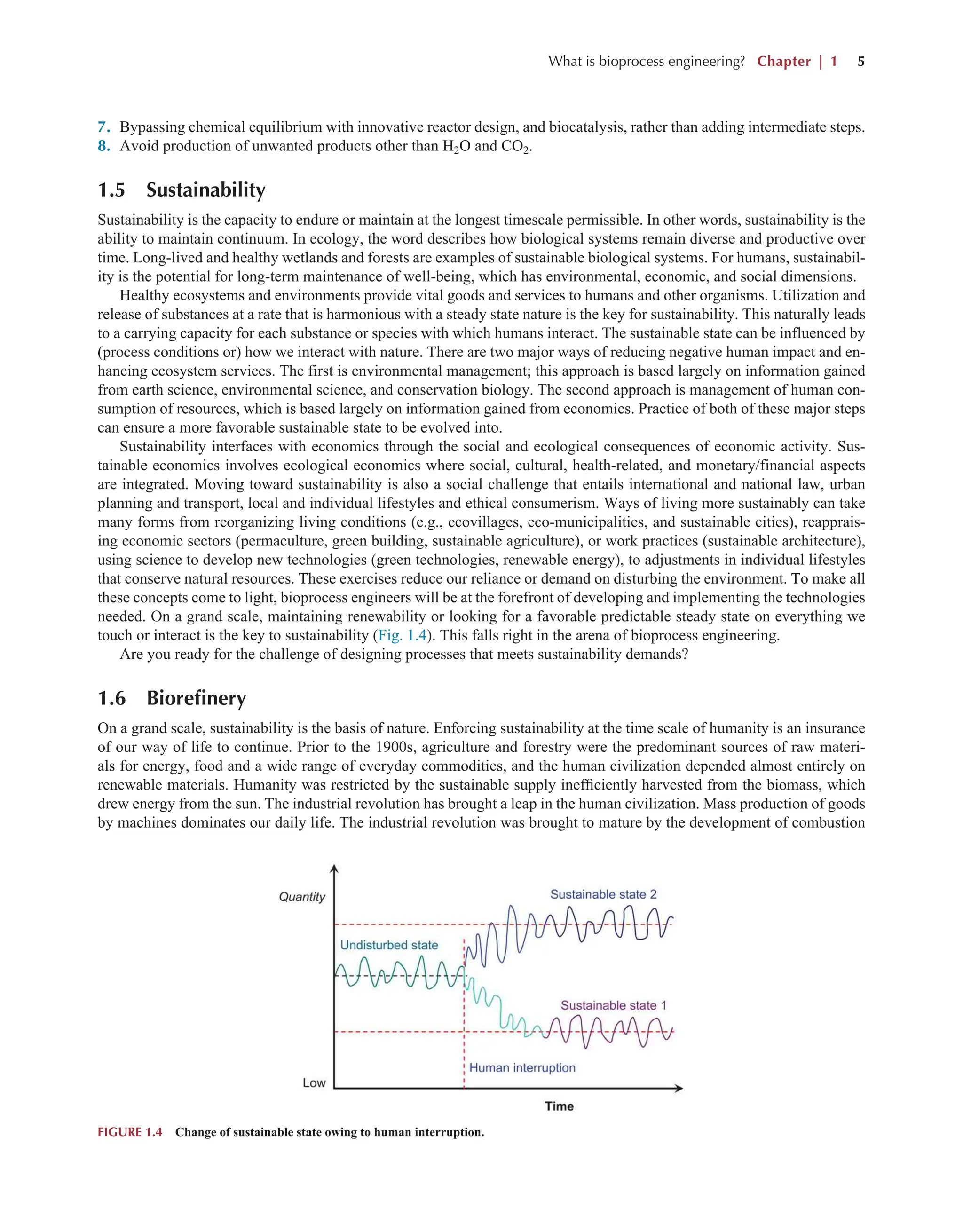
touch or interact is the key to sustainability (Fig. 1.4). This falls right in the arena of bioprocess engineering.
Are you ready for the challenge of designing processes that meets sustainability demands?
1.6 Biorefinery
On a grand scale, sustainability is the basis of nature. Enforcing sustainability at the time scale of humanity is an insurance
of our way of life to continue. Prior to the 1900s, agriculture and forestry were the predominant sources of raw materi-
als for energy, food and a wide range of everyday commodities, and the human civilization depended almost entirely on
renewable materials. Humanity was restricted by the sustainable supply inefficiently harvested from the biomass, which
drew energy from the sun. The industrial revolution has brought a leap in the human civilization. Mass production of goods
by machines dominates our daily life. The industrial revolution was brought to mature by the development of combustion
FIGURE 1.4 Change of sustainable state owing to human interruption.
6 Bioprocess Engineering

engines and subsequent development of fossil energy and chemical industry. Besides the more than doubling of useful bio-
mass production/harvest, mankind has increasingly tapped into the large fossil-energy reserves. At first the fossil chemicals
were regarded as waste and thus any use was welcomed. It soon became the cheapest chemical and energy sources for the
industrial revolution. As a result, our living standards have seen a leap. There is no turning back to the primitive way of life
in the past. However, fossil energy and chemical sources are depleting despite the cyclic price change of energy and com-
modity materials. There is a critical need to change the current industry and human civilization to a sustainable manner,
assuring that our way of life today continues on the path of improvement after the depletion of fossil sources. Our way of
life exists only if sustainability is maintained on a time scale no longer than our life span.
Biorefinery is concept in analogous to a petroleum refinery whereby a raw material feed (in this case plant ligocellulosic
biomass instead of petroleum) is refined to a potpourri of products (on demand). In a biorefinery, lignocellulosic biomass
is converted to chemicals, materials, and energy that runs on the human civilization, replacing the needs of petroleum,
coal, natural gas, and other non-renewable energy and chemical sources. Lignocellulosic biomass is renewable as shown
in Fig. 1.1, in that plant synthesizes chemicals by drawing energy from the sun and, carbon dioxide and water from the
environment, while releasing oxygen. Combustion of biomass releases energy, carbon dioxide, and water. Therefore, biore-
finery plays a key role in ensuring the cycle of biomass production and consumption included satisfying human needs for
energy and chemicals.
A biorefinery integrates a variety of conversion processes to produce multiple product streams such as transportation
liquid fuels, steam/heat, electricity, and chemicals from lignocellulosic biomass. Biorefinery has been identified as the most
promising route to the creation of a sustainable bio-based economy. Biorefinery is a collection of the essential technologies
to transform biological raw materials into a range of industrially useful intermediates. By producing multiple products,
a biorefinery maximizes the value derived from a lignocellulosic biomass feedstock. A biorefinery could produce one or
more low-volume, high-value chemical products together with a low-value, high-volume liquid transportation fuel, while
generating electricity and process heat for its own use and/or export.
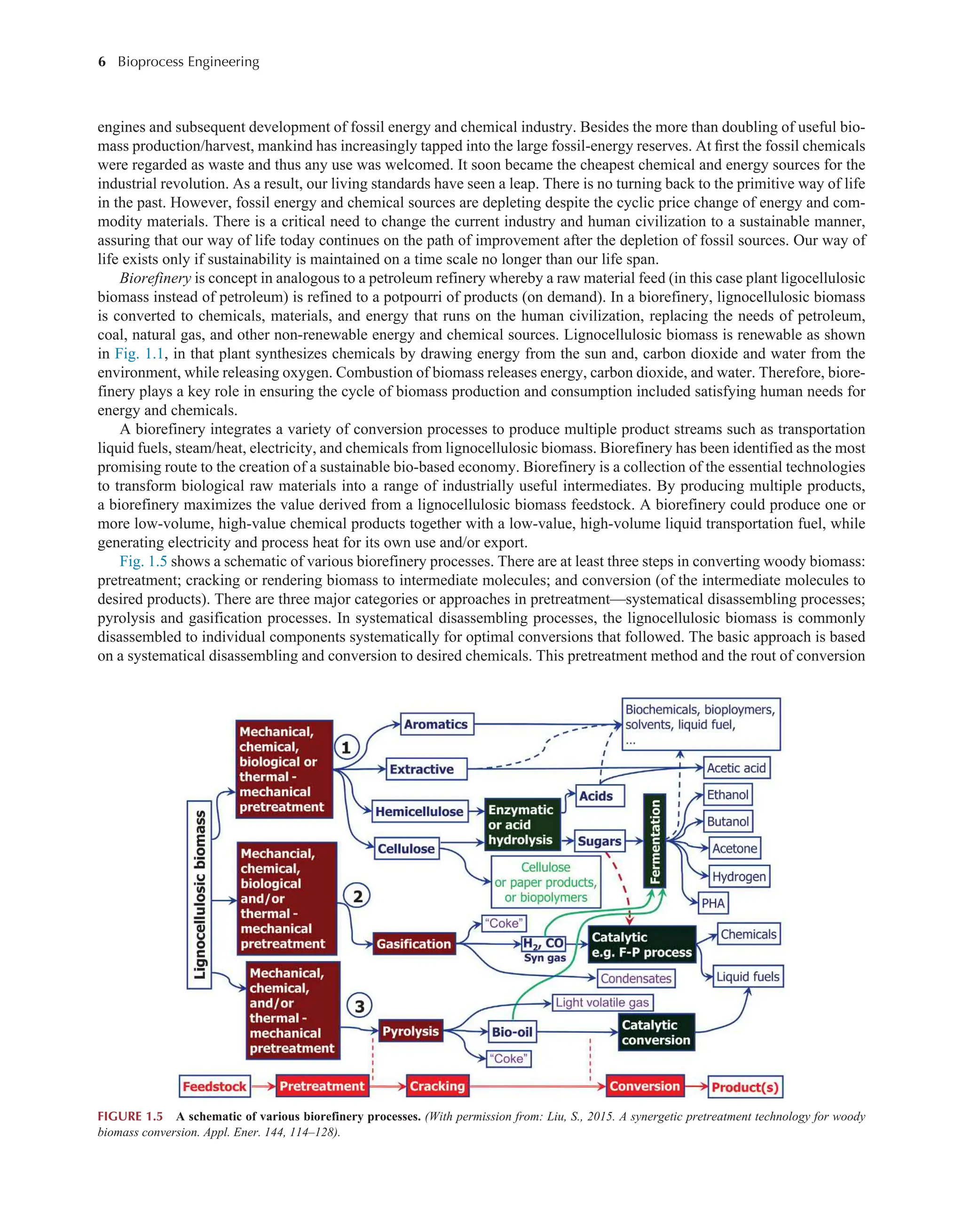
Fig. 1.5 shows a schematic of various biorefinery processes. There are at least three steps in converting woody biomass:
pretreatment; cracking or rendering biomass to intermediate molecules; and conversion (of the intermediate molecules to
desired products). There are three major categories or approaches in pretreatment—systematical disassembling processes;
pyrolysis and gasification processes. In systematical disassembling processes, the lignocellulosic biomass is commonly
disassembled to individual components systematically for optimal conversions that followed. The basic approach is based
on a systematical disassembling and conversion to desired chemicals. This pretreatment method and the rout of conversion
FIGURE 1.5 A schematic of various biorefinery processes. (With permission from: Liu, S., 2015. A synergetic pretreatment technology for woody
biomass conversion. Appl. Ener. 144, 114–128).
What is bioprocess engineering? Chapter | 1 7
followed depend heavily on separation and/or physical fractionation of the intermediates as well as the final desired prod-
ucts. Pyrolysis applies heat and some oxygen (or none) to render the biomass to liquid, while gasification renders the bio-
mass to syngas. Biological conversions are preferred over chemical conversions due to their selectivity or green chemistry
concepts. However, owing to the complexity of the lignocellulosic biomass, a multitude of biological processes is required
for optimal operations. The biological reactions are also very slow and thus require larger facility foot prints. Especially
following the gasification, bioconversion is in the “primitive” stage of development.
Pyrolysis resembles more closely to the refinery whereby the products can be controlled in a more systematical man-
ner. It may be classified as systematical disassembling as well. However, there are restrictions on the type of products
the process can produce. Gasification as shown in Fig. 1.5 is at the extreme side of conversion technology, whereby the
lignocellulosic biomass is disassembled to the basic building block for hydrocarbons: H2 and CO, and then reassembled
to desired products as desired. The final products can be more easily tailored from syngas or CO + H2. For example,
Fisher-Tropsch process can turn CO + H2 into higher alcohol, alkenes, and many other products. Syn gas (together with
air: mixture of N2 and O2) is also the starting point for ammonia synthesis, from which nitrogen fertilizers and many other
products are produced. However, all thermochemical processes suffer from selectivity. During the disassembling process,
“coke” or “carbon” is produced especially at high temperatures and thus reduces the conversion efficiency, if H2 and CO
are the desired intermediates. Thermal-chemical processes are generally considered less “green” than biological and other
sequential disassembling processes due to their severe operating conditions, poor selectivity or byproducts generation, and
thermodynamic restrictions.
The promise of a biorefinery to supply the products human needs is shown in Fig. 1.6 for the various examples of build-
ing blocks or platform chemicals that sugar (a specific example of glucose) can produce, besides the very basic building
blocks of CO and H2. For example, glucose can be fermented to ethanol by yeast and bacteria anaerobically, and lactic acid
can be produced by lacto bacteria. As shown in Fig. 1.6, each arrow radiates from the glucose in the center represents a route
of biotransformation (or fermentation) by default, whereas chemical transformations are shown with labeled arrows. For
example, glucose can be dehydrated to 5-hydroxymethylfurfural catalyzed with an acid, which can be further decomposed
to levulinic acid by hydration. All these chemicals shown in Fig. 1.6 are examples of important platform (or intermediate)
chemicals, as well as commodity chemicals. For example, ethanol is well known for its use as a liquid transportation fuel.
FIGURE 1.6 The platform of chemicals derived from glucose (the molecule in the center of the diagram). Most of these chemicals are produced
via fermentation (or biotransformation), while a few of them are produced via chemical reaction (or chemical transformation) as indicated.
8 Bioprocess Engineering

Ethanol can be dehydrated to ethylene, which is the monomer for polyethylene, or dehydrognated and dehydrated to make
1,3-butadiene, monomer for the synthetic rubber. Ethanol can also be employed to produce higher alcohols and alkenes.
Are you prepared to be at the forefront of developing, designing and operating these processes for the sustainability and
comfortability in humanity?
1.7 Biotechnology and bioprocess engineering
Biotechnology is the use or development of methods of direct genetic manipulation for a socially desirable goal. Such a goal
might be the production of a particular chemical, but it may also involve the production of better plants or seeds, gene ther-
apy, or the use of specially designed organisms to degrade wastes. The key element is the use of sophisticated techniques
outside the cell for genetic manipulation. Biotechnology is applied biology; it bridges biology to bioprocess engineering,
just like applied chemistry or chemical technology bridges chemistry to chemical engineering.
Many terms have been used to describe engineers working with biotechnology. The two terms that are considered
general—Biological engineering and Bioengineering come from the two major fields of applications that require deep
understanding of biology—agriculture and medicine. Bioengineering is a broad title including work on industrial, medi-
cal and agricultural systems; its practitioners include agricultural, electrical, mechanical, industrial, environmental, and
chemical engineers, and others. As such, Bioenegineering is not a well-defined term and usually it refers to biotechnology
applications that are not easily categorized or in medical fields. Biological Engineering stems from engineering of biology
which is also a general term. However, the term biological engineering is initially used by agricultural engineers for the
engineering applications to or manipulation of plants and animals and is thus specific. For example, the Institute of Bio-
logical Engineering (IBE) has a base in, although not limited to, agricultural engineering. ABET (Accreditation Board for
Engineering and Technology, Inc.) brands Biological Engineering together with Agricultural Engineering when accredit-
ing BS (Bachelor of Science) and MS (Master of Science) in engineering and technology educational programs. On the
other hand, the Society for Biological Engineers was created within American Institute of Chemical Engineers. Therefore,
biological engineering is also regarded as a not well defined term and can at times refer to biotechnology applications in
agricultural fields. Biochemical engineering has usually meant the extension of chemical engineering principles to systems
using a biological catalyst to bring about desired chemical transformations. It is often subdivided into bioreaction engineer-
ing and bioseparations. Biomedical engineering has traditionally been considered totally separate from biochemical engi-
neering, although the boundary between the two is increasingly vague, particularly in the areas of cell surface receptors and
animal cell culture. Another relevant term is biomolecular engineering, which has been defined by the National Institutes
of Health as “... research at the interface of biology and chemical engineering and is focused at the molecular level.” In all,
a strong background in quantitative analysis, kinetic/dynamic behaviors, and equilibrium behaviors are strongly desirable.
Increasingly, these biorelated engineering fields have become inter-related, although the names are restricting.
Bioprocess engineering is a broader and at the same time a narrower field than the commonly used terms referred ear-
lier—biological engineering, biochemical engineering, biomedical engineering, and biomolecular engineering. Bioprocess
Engineering is a profession than spans all the bio-related engineering fields as mentioned earlier. It is a profession that has
emerged to stand alone, as compared to the interdisciplinary profession once it was. Unlike the term bioengineering, the
term biorpocess engineering is specific and well-defined. Bioprocess engineering emphasizes the engineering and sciences
of industrial processes that are biobased—(1) biomass feedstock conversion for a sustainable society or biorefinery; (2)
biocatalysis based processing; and (3) manipulation of micro-organisms for a sustainable and socially desirable goal. Bio-
process engineering is not product-based nor is substrate-based. Therefore, bioprocess engineering deals with biological
and chemical processes involved in all areas, not just for a particular substrate or species (of feedstock or intermediate),
outcome or product. Thus, bioprocess engineering intercepts chemical, mechanical, electrical, environmental, medical, and
industrial engineering fields, applying the principles to designing and analysis of processes based on using living cells or
subcomponents of such cells, as well as non-living matters. Bioprocess engineering deals with both micro-scale (cellular/
molecular) and large-scale (systemwide / industrial) designs and analyses. Science and engineering of processes converting
biomass materials to chemicals, materials, and energy are therefore part of bioprocess engineering by extension. Predict-
ing and modeling system behaviors, detailed equipment and process design, sensor development, control algorithms, and
manufacturing or operating strategies are just some of the challenges facing bioprocess engineers. At the heart of bioprocess
engineering lays the process kinetics, reactor design and analysis for biosystems, which forms the basis for this text.
We will focus primarily on the kinetics, dynamics, and reaction engineering involved in the bioprocess engineering. A
key component is the application of engineering principles to systems containing biological catalysts and/or biomass as
feedstock, but with an emphasis on those systems making use of biotechnology and green chemistry. The rapidly increasing
ability to determine the complete sequence of genes in an organism offers new opportunities for bioprocess engineers in the
design and monitoring of bioprocesses. The cell, itself, is now a designable component of the overall process.
What is bioprocess engineering? Chapter | 1 9
For practitioners working in the bioprocess engineering, some of journals and periodicals provide the latest develop-
ments in the field. Here we name a few:
l Biochemical Engineering Journal
l Journal of Biological Engineering
l Journal of Biomass Conversion and Biorefinery
l Journal of Bioprocess Engineering and Biorefinery
l Journal of Bioprocess and Bioystems Engineering
l Journal of Biotechnology
l Journal of Biotechnology Advances
l Journal of Biotechnology and Bioprocess Engineering
1.8 Mathematics, biology, and engineering
Mathematical modeling holds the key for engineers. Physics at its fundamental level examines forces and motion; one can
view it as applied mathematics. In turn, chemistry examines molecules and their interactions. Since physics examines the
motions of atoms, nuclei and electrons, at the basis of molecules, one can view chemistry as applied physics. This directly
connects chemistry to mathematics at a fundamental level. Indeed, most physicists and chemists rely extensively on math-
ematical modeling. While one can view biology as applied chemistry through the connection of chemicals and molecules,
the fundamental trainings of biologists today and engineers are distinctly different. In the development of knowledge in the
life sciences, unlike chemistry and physics, mathematical theories and quantitative methods (except statistics) have played
a secondary role. Most progress has been due to improvements in experimental tools. Results are qualitative and descrip-
tive models are formulated and tested. Consequently, biologists often have incomplete backgrounds in mathematics but are
very strong with respect to laboratory tools and, more importantly, with respect to the interpretation of laboratory data from
complex systems.
Engineers usually possess a very good background in the physical and mathematical sciences. Often a theory leads to
mathematical formulations, and the validity of the theory is tested by comparing predicted responses to those in experi-
ments. Quantitative models and approaches, even to complex systems, are strengths. Biologists are usually better at the
formation of testable hypotheses, experimental design, and data interpretation from complex systems. At the dawn of the
biotechnology era, engineers were typically unfamiliar with the experimental techniques and strategies used by life scien-
tists. However, today bioprocess engineers have entered even more sophisticated experimental techniques and strategies in
life sciences (than biologists) due to the understanding and progress in the prediction and modeling of living cells.
The well-groundedness in mathematical modeling gives bioprocess engineers an edge and responsibility in enforcing
sustainability demands. In practice, the sustainable (or steady) state can be different from what we know today or when no
human interruption is imposed. The sustainable state could even be fluctuating with a noticeable degree. Engineers hold
great responsibility to convincing environmentalists and the public what to expect by accurately predicting the dynamic
outcomes without speculating on the potential dramatic changes ahead.
The skills of the engineer and of the life scientist are complementary. To convert the promises of molecular biology into
new processes to make new products requires the integration of these skills. To function at this level, the engineer needs a
solid understanding of biology and its experimental tools. In this book, we provide sufficient biological background for you
to understand the chapters on applying engineering principles to biosystems. However, if you are serious about becoming a
bioprocess engineer, it is desirable if you had taken courses in microbiology, biochemistry, and cell biology, as you would
appreciate more of the engineering principles in this text.
1.9 The story of penicillin: the dawn of bioprocess engineering
Penicillin is an antibiotic of significant importance. The familiar story of penicillin was well-presented by Kargi & Shuler
in their text “Bioprocess Engineering – Basic Concepts.” As you would expect, the discovery of the chemical was acci-
dental and the production of the chemical is elaborate. In September 1928, Alexander Fleming at St. Mary’s Hospital in
London was trying to isolate the bacterium, Staphylococcus aureus, which causes boils. The technique in use was to grow
the bacterium on the surface of a nutrient solution. One Friday, the basement window was accidently left open overnight.
The experiments were carried out in the basement and one of the dishes had been contaminated inadvertently with a foreign
particle. Normally, such a contaminated plate would be tossed out. However, Fleming noticed that no bacteria grew near
the invading substance.
Fleming’s genius was to realize that this observation was meaningful and not a “failed” experiment. Fleming recognized
that the cell killing must be due to an antibacterial agent. He recovered the foreign particle and found that it was a common
10 Bioprocess Engineering

mold of the Penicillium genus (later identified as Penicillium notatum). Fleming nurtured the mold to grow and, using the
crude extraction methods then available, managed to obtain a tiny quantity of secreted material. He then demonstrated that
this material had powerful antimicrobial properties and named the product penicillin. Fleming carefully preserved the cul-
ture, but the discovery lay essentially dormant for over a decade.
World War II provided the impetus to resurrect the discovery. Sulfa drugs have a rather restricted range of activity,
and an antibiotic with minimal side effects and broader applicability was desperately needed. In 1939, Howard Florey
and Ernst Chain of Oxford decided to build on Fleming’s observations. Norman Heatley played the key role in producing
sufficient material for Chain and Florey to test the effectiveness of penicillin. Heatley, trained as a biochemist, performed
as a bioprocess engineer. He developed an assay to monitor the amount of penicillin made so as to determine the kinetics
of the fermentation, developed a culture technique that could be implemented easily, and devised a novel back-extraction
process to recover the very delicate product. After months of immense effort, they produced enough penicillin to treat some
laboratory animals.
Eighteen months after starting on the project, they began to treat a London policeman for a blood infection. The penicil-
lin worked wonders initially and brought the patient to the point of recovery. Most unfortunately, the supply of penicillin
was exhausted and the man relapsed and died. Nonetheless, Florey and Chain had demonstrated the great potential for
penicillin, if it could be made in sufficient amount. To make large amounts of penicillin would require a process, and for
such a process development, engineers would be needed, in addition to microbial physiologists and other life scientists.
The war further complicated the situation. Great Britain’s industrial facilities were already totally devoted to the war.
Florey and his associates approached pharmaceutical firms in the United States to persuade them to develop the capacity
to produce penicillin, since the United States was not at war at that time. Many companies and government laboratories,
assisted by many universities, took up the challenge. Particularly prominent were Merck, Pfizer, Squibb, and the USDA
Northern Regional Research Laboratory in Peoria, Illinois.
The first efforts with fermentation were modest. A large effort went into attempts to chemically synthesize penicillin.
This effort involved hundreds of chemists. Consequently, many companies were at first reluctant to commit to the fermenta-
tion process, beyond the pilot-plant stage. It was thought that the pilot-plant fermentation system could produce sufficient
penicillin to meet the needs of clinical testing, but large-scale production would soon be done by chemical synthesis. At
that time, US companies had achieved a great deal of success with chemical synthesis of other drugs, which gave the com-
panies a great deal of control over the drug’s production. The chemical synthesis of penicillin proved to be exceedingly
difficult (It was accomplished in the 1950s, and the synthesis route is still not competitive with fermentation). However, in
1940 fermentation for the production of a pharmaceutical was an unproved approach, and most companies were betting on
chemical synthesis to ultimately dominate.
The early clinical successes were so dramatic that in 1943 the War Production Board appointed A. L. Elder to coordinate
the activities of producers to greatly increase the supply of penicillin. The fermentation route was chosen. As Elder recalls,
“I was ridiculed by some of my closest scientific friends for allowing myself to become associated with what obviously was
to be a flop-namely, the commercial production of penicillin by a fermentation process” (from Elder, 1970). The problems
facing the fermentation process were indeed very formidable.
The problem was typical of most new fermentation processes: a valuable product made at very low levels. The low rate
of production per unit volume would necessitate very large and inefficient reactors, and the low concentration (titer) made
product recovery and purification very difficult. In 1939 the final concentration in a typical penicillin fermentation broth
was one part per million (ca. 0.001 g/L); gold is more plentiful in sea water. Furthermore, penicillin is a fragile and unstable
product, which places significant constraints on the approaches used for recovery and purification.
Life scientists at the Northern Regional Research Laboratory made many major contributions to the penicillin program.
One was the development of a corn steep liquor-lactose based medium. Andrew J. Moyer succeeded to increase productiv-
ity about 10-fold with this medium in November 26, 1941. A worldwide search by the laboratory for better producer strains
of Penicillium led to the isolation of a Penicillium chrysogenum strain. This strain, isolated from a moldy cantaloupe at a
Peoria fruit market, proved superior to hundreds of other isolates tested. Its progeny have been used in almost all commer-
cial penicillin fermentations.
The other hurdle was to decide on a manufacturing process. One method involved the growth of the mold on the surface
of moist bran. This bran method was discarded because of difficulties in temperature control, sterilization, and equipment
size. The surface method involved growth of the mold on top of a quiescent medium. The surface method used a variety of
containers, including milk bottles, and the term “bottle plant” indicated such a manufacturing technique. The surface meth-
od gave relatively high yields, but had a long-growing cycle and was very labor intensive. The first manufacturing plants
were bottle plants because the method worked and could be implemented quickly. However, it was clear that the surface
method would not meet the full need for penicillin. If the goal of the War Production Board was met by bottle plants, it was
What is bioprocess engineering? Chapter | 1 11
estimated that the necessary bottles would fill a row stretching from New York City to San Francisco. Engineers generally
favored a submerged tank process. The submerged process presented challenges in terms of both mold physiology and in
tank design and operation. Large volumes of absolutely clean, oil- and dirt-free sterile air were required. What were then
very large agitators were required, and the mechanical seal for the agitator shaft had to be designed to prevent the entry
of organisms. Even today, problems of oxygen supply and heat removal are important constraints on antibiotic fermenter
design. Contamination by foreign organisms could degrade the product as fast as it was formed, consume nutrients before
they were converted to penicillin, or produce toxins.
In addition to these challenges in reactor design, there were similar hurdles in product recovery and purification. The
very fragile nature of penicillin required the development of special techniques. A combination of pH shifts and rapid
liquid-liquid extraction proved useful.
Soon processes using tanks of about 10,000 gal were built. Pfizer completed in less than 6 months the first plant for
commercial production of penicillin by submerged fermentation (Hobby, 1985). The plant had 14 tanks each of 7000-gal
capacity. By a combination of good luck and hard work, the United States had the capacity by the end of World War II to
produce enough penicillin for almost 100,000 patients per year. A schematic of the process is shown in Fig. 1.7.
This accomplishment required a high level of multidisciplinary work. For example, Merck realized that men who un-
derstood both engineering and biology were not available. Merck assigned a chemical engineer and microbiologist together
to each aspect of the problem. They planned, executed, and analyzed the experimental program jointly, “almost as if they
were one man” (see the chapter by Silcox in Elder, 1970).
Progress with penicillin fermentation has continued, as has the need for the interaction of biologists and engineers. From
1939 to now, the yield of penicillin has gone from 0.001 g/L to over 50 g/L of fermentation broth. Progress has involved
better understanding of mold physiology, metabolic pathways, penicillin structure, methods of mutation, and selection of
mold genetics, process control, and reactor design.
Before the penicillin process, almost no chemical engineers sought specialized training in the life sciences. With the
advent of modem antibiotics, the concept of the bioprocess engineering was born. The penicillin process also established
a paradigm for bioprocess development and biochemical engineering. This paradigm still guides much of our profession’s
FIGURE 1.7 Schematic of penicillin production process.
12 Bioprocess Engineering

thinking. The mindset of bioprocess engineers was cast by the penicillin experience. It is for this reason that we have fo-
cused on the penicillin story, rather than on an example for production of a protein from a genetically engineered organism.
Although many parallels can be made between the penicillin process and our efforts to use recombinant DNA, no similar
paradigm has yet emerged from our experience with genetically engineered cells. We must continually reexamine the preju­
dices the field has inherited from the penicillin experience.
It is you, the student, who will best be able to challenge these prejudices.
1.10 Bioprocesses: regulatory constraints
To be an effective in bioprocess engineering, you must understand the regulatory climate in which many bioprocess engi-
neers work. The US FDA (Food and Drug Administration) and its equivalents in other countries must insure the safety and
efficacy of food and medicines. For bioprocess engineers working in the pharmaceutical industry the primary concern is not
reduction of manufacturing cost (although that is still a very desirable goal), but the production of a product of consistently
high quality in amounts to satisfy the medical needs of the population.
Consider briefly the process by which a drug obtains FDA approval. A typical drug undergoes 6–7 years of development
from the discovery stage through preclinical testing in animals. To legally test the drug in humans in the United States, an
Investigational New Drug (IND) designation must be issued by FDA. Biologics such as vaccines and recombinant protein
drugs are generally approved by FDA via a Biologic License Application (BLA). There are five phases of trials before a
new drug is placed on market after its discovery:
Phase 0: Human microdosing studies (1–3 years). This is a designation for the exploratory, first-in-human trials conducted
within the regulations of US-FDA 2006 Guidance on Exploratory Investigational New Drug studies.
Phase I: First stage testing in human subjects. Normally, a small group of (20–80) of healthy volunteers is selected. Safety,
tolerability, pharmacokinetics, and pharmacodynamics of the drug are evaluated. This phase usually lasts about 1 year.
Different types of types of trials in this phase are Single Ascending Dose (SAD), Multiple Ascending Dose (MAD), and
Food Effect trials.
Phase II: clinical trials (about 2 years). After determining the initial safety and pharmacological parameters, this trial on a
larger group of 100–300 patients and volunteers is performed. This trial is designed to assess the efficacy (i.e., does it help
the patient) as well as further determining which side effects exist. Sometimes, Phase IIA is designed to determine the dos-
ing requirements and Phase IIB is designed to determine the efficacy of the drug. If the drug fails to meet the established
standards of the trials, further development of the new drug is usually stopped.
Phase III: clinical trials (about 3 years) with 300–3000 (or more) patients. Since individuals vary in body chemistry, it is
important to test the range of responses in terms of both side effects and efficacy by using a representative cross section of
the population. Randomized controlled multicenter trials on large patient groups are conducted to determine the effective-
ness of the drug. This phase of the clinic trials is very expensive, time-consuming, and difficult to design and run, espe-
cially in therapies for chronic medical conditions. It is common practice that certain Phase III trials will continue while the
regulatory submission is pending at the appropriate regulatory agency. This allows patients to continue to receive possibly
lifesaving drugs until the drug us available in the market for distribution. These trials also provide additional safety data
and support for marketing claims for the drug. Data from clinical trials is presented to the FDA for review (2 months to
3 years). The review document presented to FDA clearly show the trial results combined with description of the methods
and results of human and animal studies, manufacturing procedures, formulation details, and shelf life. If the clinical trials
are well designed and demonstrated statistically significant improvements in health with acceptable side effects, the drug
is likely to be approved.
Phase IV: Postmarketing surveillance trial. Continue safety surveillance (pharmacovigilance) and technical support of a
drug after receiving permission to be put on the market.
The whole discovery-through-approval process takes 5–10 years for a conventional small molecule drug, and 12–15 years
for a new biological drug to make it to the market. It takes about $800–$2000 million to send a new drug to the market. Only
one in ten drugs that enter human clinical trials receives approval. Recent FDA reforms have decreased the time to obtain
approval for life-saving drugs in treatment of diseases such as cancer and AIDS, but the overall process is still lengthy.
This process greatly affects a bioprocess engineer. FDA approval is for the product and the process together. There have
been tragic examples where a small process change has allowed a toxic trace compound to form or become incorporated
in the final product, resulting in severe side effects, including death. Thus, process changes may require new clinical trials
to test the safety of the resulting product. Since clinical trials are very expensive, process improvements are made under a
limited set of circumstances. Even during clinical trials it is difficult to make major process changes.
What is bioprocess engineering? Chapter | 1 13
Drugs sold on the market or used in clinical trials must come from facilities that are certified as GMP or cGMP and must
follow the appropriate Code of Federal Regulations (CFR). GMP stands for (current) good manufacturing practice. GMP
concerns the actual manufacturing facility design and layout, the equipment and procedures, training of production person-
nel, control of process inputs (e.g., raw materials and cultures), and handling of product. The plant layout and design must
prevent contamination of the product, and dictate the flow of material, personnel, and air. Equipment and procedures must
be validated. Procedures include not only operation of a piece of equipment, but also cleaning and sterilization. Computer
software used to monitor and control the process must be validated. Off-line assays done in laboratories must satisfy good
laboratory practice (GLP). Procedures are documented by SOPs (standard operating procedures).
The GMP guidelines stress the need for documented procedures to validate performance. “Process validation is estab-
lishing documented evidence which provides a high degree of assurance that a specific process will consistently produce
a product meeting its predetermined specifications and quality characteristics” and “There shall be written procedures for
production and process-control to assure that products have the identity, strength, quality, and purity they purport or are
represented to possess.”
The actual process of validation is often complex, particularly when a whole facility design is considered. The FDA pro-
vides extensive information and guidelines which are updated regularly. If students become involved in biomanufacturing
for pharmaceuticals, they will need to consult these sources. However, certain key concepts do not change. These concepts
are written documentation, consistency of procedures, consistency of product, and demonstrable measures of product qual-
ity, particularly purity, and safety. These tasks are demanding and require careful attention to detail. Bioprocess engineers
will often find that much of their effort will be to satisfy these regulatory requirements. The key point is that process
changes cannot be made without considering their considerable regulatory impact.
1.11 The pillars of bioprocess kinetics and systems engineering
As a profession, bioprocess engineers must be well-versed in thermodynamics, transport phenomena, colloids, biosepara-
tions, microbiology, bioprocess kinetics and systems engineering, and process simulation and design. This text deals with
the core of bioprocess engineering. Unlike earlier texts in this subject area, this text integrates bioprocess engineering prin-
ciples, in particular bioprocess kinetics and transformation or reaction engineering principles together. Chemical reaction
engineering is not a pre-requisite before taking on this text. Fig. 1.6 shows the pillars of this text. The sustainability on this
pillar is narrowly defined as having the net benefit to the human society and/or benign environmental effects.
As shown in Fig. 1.8, the fundamental knowledge of engineering science you will learn or expect in this text is
among the “pillars”: mass balance, rate expression, stoichiometry, cell metabolism, yield factor, energy balance, mass
FIGURE 1.8 The pillars of bioprocess kinetics and system engineering.
14 Bioprocess Engineering

transfer, cost, and profit analyses. These engineering science fundamentals form the basis or foundation for the design
and performance analysis of reactors and /or fermenters. In turn, process kinetic data analysis, biocatalyst design and
selection can be learned from the reactor performance, and applied to the design and performance analysis of reactors
and/or bioprocess systems. Process stability usually stems from multiplicity of the process, which controls the product
quality and consistency. Finally, the design and control of bioprocess systems must obey the greater law of nature:
sustainability.
1.12 Summary
Sustainability and green chemistry are important to the practice of bioprocess engineers. Biorefinery is a desired approach
to provide the products of human needs, putting the human needs into the biological cycle. Both biotransformation and
chemical transformations are important to biorefinery.
Genetic manipulations and biotransformation are important to the bioprocess engineering profession. Because of the
fundamental impact genetic manipulation and biotransformation can have on the cycle of life, ethics and regulations are
critical to the practice of bioprocess engineers.
It is the intention that this text can be used as a senior and/or graduate text for bioprocess engineering students. It may
also be served as a reference and/or graduate text for chemical kinetics, chemical reactor analysis, and bioprocess systems
engineering. In the same time, we have inserted materials, more advanced analysis or complex systems in the text as an
extension to the introductory material. It is our aim that this text can serve equally as a reference or resource for further
research or development.
Problems
1.1. How bioprocess engineering affects the overall health of humans?
1.2. Why are renewable materials preferred?
1.3. What is green chemistry?
1.4. What is sustainability?
1.5. What is a biorefinery?
1.6. Why is ethanol an important platform chemical?
1.7. An uninformed researcher is questioning the sustainability of biomass cultivation and utilization, arguing that fertil-
izer and fuels for heavy machinery must be produced with fossil energy and thus not renewable. Research into the
basis of the arguments and dismiss the notion of unsustainable biomass use.
1.8. What is GMP and how does it relate to the regulatory process for pharmaceuticals?
1.9. When the FDA approves a process, it requires validation of the process. Explain what validation means in the FDA
context.
1.10. Why does the FDA approve the process and product together?
1.11. What is biotransformation? What is chemical transformation?
References
D. History of Penicillin
Elder, A.L. (Ed.), 1970. The History of Penicillin Production, Chem. Eng. Prog. Symp. Ser. 66 (#100). American Institute of Chemical Engineers,
New York.
Hobby, G.L., 1985. Penicillin. Meeting the Challenge. Yale University Press, New Haven, CT.
What is bioprocess engineering? Chapter | 1 15
Further readings
A. Green Chemistry
Anatas, P.C., Warner, J.C., 1998. Green Chemistry: Theory and Practice. Oxford University Press, New York.
Linthorst JA, 2010. An overview: origins and development of green chemistry. Found. Chem. 12 (1), 55–68.
Wilson M, Schwarzman M. 2009. Toward a New U.S. Chemicals Policy: Rebuilding the Foundation to Advance New Science, Green Chemistry, and
Environmental Health. Environ Health Perspect. 117 (8) 1202–1209 and A358.
www.epa.gov/greenchemistry/.
B. Sustainability
Adams, W.M., Jeanrenaud, S.J., 2008. Transition to Sustainability: Towards a Humane and Diverse World. IUCN, Gland, Switzerland, 108 pp.
Atkinson, G., Dietz, S., Neumayer, E., 2007. Handbook of Sustainable Development. Edward Elgar, Cheltenham.
Blackburn, W.R., 2007. The Sustainability Handbook. Earthscan, London.
Blewitt, J., 2008. Understanding Sustainable Development. Earthscan, London.
Costanza, R., Graumlich, L.J., Steffen, W. (Eds.), 2007. Sustainability or Collapse? An Integrated History and Future of People on Earth. MIT Press,
Cambridge, MA.
Norton, B., 2005. Sustainability, A Philosophy of Adaptive Ecosystem Management. The University of Chicago Press, Chicago.
Soederbaum, P., 2008. Understanding Sustainability Economics. Earthscan, London.
C. Biorefinery
Liu, S., Lu, H., Hu, R., Shupe, A., Lin, L., Liang, L., 2012. A sustainable woody biomass biorefinery. J. Biotech. Adv. 30 (4), 785–810, http://dx.doi.
org/10.1016/j.biotechadv.2012.01.013.
FitzPatrick, M., Champagne, P., Cunningham, M.F., Whitney, R.A., 2010. A biorefinery processing perspective: treatment of lignocellulosic materials for
the production of value-added products”. Bioresour. Technol. 101 (23), 8915–8922.
Kaparaju, P., Serrano, M., Thomsen, A.B., Kongjan, P., Angelidaki, I., 2009. Bioethanol, biohydrogen and biogas production from wheat straw in a bio-
refinery concept”. Bioresour. Technol. 100 (9), 2562–2568.
Koutinas, A.A., Arifeen, N., Wang, R., Webb, C., 2007. Cereal-based biorefinery development: Integrated enzyme production for cereal flour hydrolysis”.
Biotechn. Bioeng. 97 (1), 61–72.
Liu, S., Amidon, T.E., Francis, R.C., Ramarao, B.V., Lai, Y.-Z., Scott, G.M., 2006. From forest biomass to chemicals and energy: biorefinery initiative in
New York. Ind. Biotech. 2 (2), 113–120.
Ohara, H., 2003. Biorefinery. App. Micobiol. and Biotechn. 62 (5–6), 474–477.
D. History of Penicillin
Moberg, C.L., 1991. Penicillin’s Forgotten Man: Norman Heatley. Science 253, 734–735.
Mateles, R.I. (Ed.), 1998. Penicillin, A Paradigm for Biotechnology. Candida Corp., Chicago, IL.
Sheehan, J.C., 1982. The Enchanted Ring. The Untold Story of Penicillin. MIT Press, Cambridge, MA.
E. Regulatory Issues
Currey, B., Klemic, P.A., 2008. A New Phase in Pharmaceutical Regulation. DRI Drug and Medical Device and Product Liability Committee. O’Melveny
& Myers LLP, PL California, United States.
Durfor, C.N., Andscribner, C.L., 1992. An FDA perspective of manufacturing changes for products in human use. Ann. NY Acad. Sci. 665, 356–363.
Naglak, T.J., Keith, M.G., Omstead, D.R., 1994. Validation of fermentation processes. Biopharm 7, 28–36.
Reisman, H.B., 1993. Problems in scale-up of biotechnology production processes. Crit. Rev. Biotechnol. 13, 195–253.
Wechsler, J. Science and Safety. Magazine: Pharmaceutial Excutive – Washington Report, Oct., 2009.
http://www.FDA.gov.
http://www.FDAreview.org/approval_process.
Bioprocess Engineering. http://dx.doi.org/10.1016/B978-0-12-821012-3.00002-6
Copyright © 2020 Elsevier B.V. All rights reserved. 17
Bioprocess engineers seek chemicals and materials for human needs in a sustainable manner. It is the chemicals and
materials from biological origin that can sustain the needs of humans. Microorganism also provides a tool for bioprocess
engineers to manipulate the chemicals and materials so that they can meet the needs of humanity. Therefore we shall first
review some of the biological basics to learn how living organisms (more specific: microorganisms) function and what their
important chemicals and materials are.
2.1 Cells and organisms
The cell is the basic structural and functional unit of all known living organisms. Cells are to living organisms as like atoms
are to molecules. It is the smallest unit of life that is classified as a living thing, and so is often called the building block
of life. Some organisms, such as most bacteria, are unicellular (consist of a single cell). Most single cell organisms are
microscopic in size and not visible to (human by) naked eyes, which are commonly called microorganisms. However, some
unicellular protists and bacteria are macroscopic and visible to the naked eye. For example, Xenophyophores, protozoans
of the phylum Foraminifera, are the largest examples known, with Syringammina fragilissima achieving a diameter of up
to 20 cm (7.9 inches). The largest bacterium is Thiomargarita namibiensis, reaching a diameter of up to 0.75 mm. Other
organisms, such as humans, are multicellular. (Humans have an estimated 100 trillion or 1014
cells; a typical cell size is
10 µm; a typical cell mass is 1 nanogram.) The largest known cell is an unfertilized ostrich egg cell. An average ostrich egg
is an oval about 15 cm × 13 cm and weighs 1.4 kg.
In 1835, before modern cell theory was developed, Jan Evangelista Purkyně observed small “granules” while looking
at plant tissue through a microscope. The cell theory, first developed in 1839 by Matthias Jakob Schleiden and Theodor
Schwann, states that all organisms are composed of one or more cells, that all cells come from preexisting cells, that vital
functions of an organism occur within cells, and that all cells contain the hereditary information necessary for regulating
cell functions and for transmitting information to the next generation of cells.
Each cell is at least somewhat self-contained and self-maintaining: it can take in nutrients, convert these nutrients into
energy, carry out specialized functions, and reproduce as necessary. Each cell stores its own set of instructions for carrying
out each of these activities.
Chapter 2
An overview of biological basics
Chapter outline
2.1 Cells and organisms 17
2.1.1 Microbial diversity 18
2.1.2 How cells are named 18
2.1.3 Prokaryotes 20
2.1.4 Eukaryotes 23
2.2 Viruses 27
2.3 Prions 30
2.4 Stem cell 30
2.5 Cell chemistry 31
2.5.1 Amino acids and proteins 32
2.5.2 Monosaccharides 37
2.5.3 Disaccharides 42
2.5.4 Polysaccharides 42
2.5.5 Phytic acid and inositol 46
2.5.6 Chitin and chitosan 48
2.5.7 Lignin 48
2.5.8 Lipids, fats, and steroids 50
2.5.9 Nucleic acids, RNA, and DNA 52
2.6 Cell feed 57
2.6.1 Macronutrients 58
2.6.2 Micronutrients 60
2.6.3 Growth media 61
2.7 Non earthly/unnatural biological agents 61
2.8 Summary 62
Problems 63
References 64
Further readings 64
18 Bioprocess Engineering

2.1.1 Microbial diversity
Life is very tenacious and can exist in extreme environments. Living cells can be found almost anywhere that water is in
the liquid state. The right temperature, pH, and moisture levels vary from one organism to another. Some cells can grow
at −20°C (in a brine to prevent freezing), while others can grow at 120°C (where water is under high enough pressure to
prevent boiling). Cells that grow best at low temperatures (below 20°C) are usually called psychrophiles, while those with
temperature optima in the range of 20–50°C are mesophiles. Organisms that grow best at temperatures greater than 50°C
are thermophiles.
Many organisms have pH optima far from neutrality; some prefer in an environment with a pH value down to 1 or 2,
while others may grow well at pH 9. Some organisms can grow at both low pH values and high temperatures.
Although most organisms can grow only with the presence of liquid water, others can grow on barely moist solid sur-
faces or in solutions with high salt concentrations.
Some cells require oxygen for growth and metabolism. Such organisms can be termed aerobic. Other organisms are
inhibited by the presence of oxygen and grow only anaerobically. Some organisms can switch metabolic pathways to allow
them to grow under either circumstance. Such organisms are facultative.
Often, organisms can grow in environments with almost no obvious source of nutrients. Some cyanobacteria (formerly
called blue-green algae) can grow in an environment with only a little moisture and a few dissolved minerals. These bacteria
are photosynthetic and can convert CO2 from the atmosphere into the organic compounds (e.g., sugars) necessary for life.
They can also convert N2 into NH3 for use in making the essential building blocks of life.
+ → +
CO (cabondioxude) H O(water) CH O(sugar) O (oxygen)
2 2 2 2 (2.1)
+ → +
N 3H O 2NH 3/2O
2 2 3 2 (2.2)
Cyanobacteria are important in colonizing nutrient-deficient environments. Organisms from these extreme environments
(extremophiles) often provide humanity with important tools for processes to make useful chemicals and medicinals. They
are also key to the maintenance of natural cycles and can be used in the recovery of metals from low-grade ores or in the
desulfurization of coal or other fuels. The fact that organisms can develop a capacity to exist and multiply in almost any
environment on Earth is extremely useful.
Not only do organisms occupy a wide variety of habitats, but they also come in a wide range of sizes and shapes. Spheri-
cal, cylindrical, ellipsoidal, spiral, and pleomorphic cells exist. Special names are used to describe the shape of bacteria. A
cell with a spherical or elliptical shape is often called a coccus (plural, cocci); a cylindrical cell is a rod or bacillus (plural,
bacilli); a spiral-shaped cell is a spirillum (plural, spirilla). Some cells may change shape in response to changes in their
local environment. Pleomophic cells take on at least two different forms or shapes during their life cycle.
Thus organisms can be found in the most extreme environments and have evolved a wondrous array of shapes, sizes,
and metabolic capabilities. This great diversity provides the engineer with an immense variety of potential tools. We have
barely begun to learn how to manipulate these tools.
2.1.2 How cells are named
The naming of cells is complicated by the large variety of organisms. A systematic approach to classifying these organ-
isms is an essential aid to their intelligent use. Taxonomy is the development of approaches to organize and summarize our
knowledge about the variety of organisms that exist. Although knowledge of taxonomy may seem remote from the needs
of an engineer, it is necessary for efficient communication among engineers and scientists working with living cells. Tax-
onomy can also play a critical role in patent litigation involving bioprocesses.
While taxonomy is concerned with approaches to classification, nomenclature refers to the actual naming of organ-
isms. For microorganisms we use a dual name (binary nomenclature). The names are given in Latin or are Latinized. A
genus is a group of related species, while a species includes organisms that are sufficiently alike to reproduce. A common
well-documented gut organism is Escherichia coli. Escherichia is the genus and coli the species. When writing a report
or paper, it is common practice to give the full name when the organism is first mentioned, but to abbreviate the genus to
the first letter in subsequent discussion, for example, E. coli. Although organisms that belong to the same species all share
the same major characteristics, there are subtle and often technologically important variations within species. A strain
of E. coli used in one laboratory may differ from that used in another. Thus various strains and substrains are designated
by the addition of letters and numbers. For example, E. coli fBr5 will differ in growth and physiological properties from
E. coli K01.
An overview of biological basics Chapter | 2 19
Now that we know how to name organisms, we could consider broader classification up to the level of kingdoms. There
is no universal agreement on how to classify microorganisms at this level. Such classification is rather arbitrary and need
not concern us. However, we must be aware that there are two primary cell types: eukaryotic and prokaryotic. The primary
difference between them is the presence or absence of a membrane around the cell’s genetic information.
Prokaryotes have a simple structure with a single chromosome (Fig. 2.1). Prokaryotic cells have no nuclear membrane
and no organelles (such as mitochondria and endoplasmic reticulum). Eukaryotes have a more complex internal structure,
with more than one chromosome (DNA molecule) in the nucleus. Eukaryotic cells have a true nuclear membrane and may
contain a variety of specialized organelles such as mitochondria, endoplasmic reticulum and Golgi apparatus (Fig. 2.2). A
detailed compare-son of prokaryotes and eukaryotes is presented in Table 2.1. Structural differences between prokaryotes
and eukaryotes are discussed later.
Evidence suggests that a common or universal ancestor gave rise to three distinctive branches of life: eukaryotes, eu-
bacteria (or “true” bacteria), and archaebacteria. Table 2.2 summarizes some of the distinctive features of these groups.
The ability to sequence the genes of whole organisms will have a great impact on our understanding of how these families
evolved and are related.
The cellular organisms summarized in Table 2.2 are free-living organisms and are all DNA based. Viruses cannot be
classified under any of these categories, as they are not independent (or free-living) organisms. Still, viruses are all nucleic
FIGURE 2.1 A schematic of a typical prokaryotic cell.
FIGURE 2.2 A schematic of a typical eukaryotic cell.
20 Bioprocess Engineering

acid (either DNA or RNA) based. Prions, on the other hand, are not even nucleic acid based. These rather simple “organ-
isms” play important roles in Bioprocess Engineering and thus we will discuss hem separately.
2.1.3 Prokaryotes
The sizes of most prokaryotes vary from 0.5–3 µm in equivalent radius. Different species have different shapes, such as
spherical or coccus (e.g., Staphylococci), cylindrical or bacillus (E. coli), or spiral or spirillum (Rhodospirillum). Prokary-
otic cells grow rapidly, with typical doubling times of half an hour to several hours. Also, prokaryotes can utilize a variety
of nutrients as carbon sources, including carbohydrates, hydrocarbons, proteins, and CO2.
2.1.3.1 Eubacteria
The eubacteria can be divided into several different groups. One distinction is based on the gram stain (developed by Hans
Christian Gram in 1884). The staining procedure first requires fixing the cells by heating. The basic dye, crystal violet,
is added; all bacteria will stain purple. Next, iodine is added, followed by the addition of ethanol. Gram-positive cells re-
main purple, while Gram-negative cells become colorless. Finally, counterstaining with safranin leaves Gram-positive cells
purple, while Gram-negative cells turn red. Cell reactions to the gram stain reveal intrinsic differences in the structure of
the cell envelope.
TABLE 2.1 A comparison of prokaryotes with eukaryotes.
Characteristic Prokaryotes Eukaryotes
Genome
No. of DNA molecules
DNA in organelles
DNA observed as chromosomes
Nuclear membrane
Mitotic and meiotic division of the nucleus
Formation of partial diploid
One
No
No
No
No
Yes
More than one
Yes
Yes
Yes
Yes
No
Organelles
Mitochondria
Endoplasmic reticulum
Golgi apparatus
Photosynthetic apparatus
Flagella
No
No
No
Chromosomes
Single protein, simple structure
Yes
Yes
Yes
Chloroplasts
Complex structure, with microtubules
Spores
Heat resistance
Endospores
High
Endo- and exospores
Low
Source: Millis, N.F., 1985, in: Moo-Young, M. (Ed.), Comprehensive Biotechnology, vol. I, Elsevier Science.
TABLE 2.2 Primary subdivisions of cellular organisms that have been recognized.
Group Cell morphology Properties Constituent groups
Eukaryotes Eukaryotic Multicellular; extensive differentiation
of cells and tissues
Unicellular, coenocytic, or mycelial;
little or no tissue differentiation
Plants (seed plants, ferns, mosses)
Animals (vertebrates, invertebrates)
Protists (algae, fungi, protozoa, slime moulds)
Eubacteria Prokaryotic Cell chemistry similar to eukaryotes Most bacteria
Archaea Prokaryotic Distinctive cell chemistry Crenarchaeota (sulfolobus, therofilum, thermopteus,
pyrobaculum, haloquadratum walsbyi)
Nanoarchaeota
Euryarchaeota (methanogens, halophiles, therrno-
acidophiles)
Korarchaeota
An overview of biological basics Chapter | 2 21
A typical Gram-negative cell is E. coli. It has an outer membrane supported by a thin peptidoglycan layer, as shown in
Fig. 2.3. Peptidoglycan is a complex polysaccharide with amino acids and forms a structure somewhat analogous to a chain-
link fence. A second membrane (the inner or cytoplasmic membrane) exists and is separated from the outer membrane by
the periplasmic space. The cytoplasmic membrane contains about 50% protein, 30% lipids, and 20% carbohydrates. The
cell envelope serves to retain important cellular compounds and to preferentially exclude undesirable compounds in the
environment. the loss of membrane integrity leads to cell lysis (cells breaking open) and cell death. The cell envelope is
crucial to the transport of selected material in and out of the cell.
A typical Gram-positive cell is Bacillus subtilis. Gram-positive cells do not have an outer membrane. Rather, they have
a very thick, rigid cell wall with multiple layers of peptidoglycan. Gram-positive cells also contain teichoic acids covalently
bonded to the peptidoglycan. Because Gram-positive bacteria have only a cytoplasmic membrane, they are better suited to
excretion of proteins. Excretion is technologically advantageous when the protein is a desired product.
Some bacteria are neither Gram-positive nor Gram-negative. For example, Mycoplasma has no cell walls. These bac-
teria are important not only clinically (e.g., primary atypical pneumonia), but also because they commonly contaminate
media used industrially for animal cell culture.
Actinomycetes are bacteria, but morphologically resemble molds with their long and highly branched hyphae. How-
ever, the lack of a nuclear membrane and the composition of the cell wall require classification as bacteria. Actinomycetes
are important sources of antibiotics. Certain Actinomycetes possess amylolytic and cellulolytic enzymes and are effective
in the enzymatic hydrolysis of starch and cellulose. Actinomyces, Thermomonospora, and Streptomyces are examples of
genera belonging to this group.
Other distinctions within the eubacteria can be made based on cellular nutrition and energy metabolism. One important
example is photosynthesis. Cyanobacteria (formerly called blue-green algae) have chlorophyll and fix CO2 into sugars. An-
oxygenic photosynthetic bacteria (the purple and green bacteria) have light-gathering pigments called bacteriochlorophyll.
Unlike true photosynthesis, the purple and green bacteria do not obtain reduction energy from the splitting of water and do
not form oxygen.
When stained properly, the area occupied by a prokaryotic cell’s DNA can be easily seen. Prokaryotes may also have
other visible structures when viewed under the microscope, such as ribosomes, storage granules, spores, and volutins.
Ribosomes are the site of protein synthesis. A typical bacterial cell contains approximately 10,000 ribosomes per cell,
although this number can vary greatly with growth rate. The size of a typical ribosome is 10–20 nm and consists of ap-
proximately 63% RNA and 37% protein. Storage granules (which are not present in every bacterium) can be used as a
source of key metabolites and often contain polysaccharides, lipids, and sulfur granules. The sizes of storage granules vary
between 0.5 µm and 1 µm. Some bacteria make intracellular spores (often called endospores in bacteria). Bacterial spores
are produced as a resistance to adverse conditions such as high temperature, radiation, and toxic chemicals. The usual con-
centration is 1 spore per cell, with a spore size of about 1 µm. Spores can germinate under favorable growth conditions to
yield actively growing bacteria.
FIGURE 2.3 Schematic of a typical Gram-negative bacterium (A) and its enlarged section of the membrane (B). A Gram-positive cell is similar,
except that it has no outer membrane, its peptidoglycan layer is thicker, and the chemical composition of the cell wall differs significantly from the outer
envelope of the Gram-negative cell.
22 Bioprocess Engineering

Volutin is another granular intracellular structure, made of inorganic polymetaphosphates, which is present in some
species. Some photosynthetic bacteria, such as Rhodospirilium, have chromatophores that are large inclusion bodies (50–
100 nm) utilized in photosynthesis for the absorption of light.
Extracellular products can adhere to or become incorporated within the surface of the cell. Certain bacteria have a coat-
ing or outside cell wall called capsule, which is usually a polysaccharide, or sometimes a polypeptide. Extracellular poly-
mers are important to biofilm formation and response to environmental challenges (e.g., viruses). Table 2.3 summarizes the
architecture of most bacteria.
2.1.3.2 Archaebacteria
Under the microscope archaebacteria appear to be nearly identical to eubacteria. However, these cells differ greatly at the
molecular level. In many ways the archaebacteria are as similar to the eukaryotes as they are to the eubacteria. Some ex-
amples of differences between archaebacteria and eubacteria are as follows:
1. archaebacteria have no peptidoglycan;
2. nucleotide sequences in ribosomal RNA are similar within the archaebacteria but distinctly different from those of eu-
bacteria;
3. the lipid composition of the cytoplasmic membrane is very different for the two groups.
TABLE 2.3 Characteristics of various components of bacteria.
Part Size Composition and comments
Slime layer
Microcapsule 5–10 nm Protein-polysaccharide-lipid complex responsible for the specific antigens of enteric bacteria
and other species.
Capsule 0.5–2.0 µm Mainly polysaccharides (e.g., Streptococcus); sometimes polypeptides (e.g., Bacillus antracis).
Slime Indefinite Mainly polysaccharides (e.g., Leuconostoc); sometimes polypeptides (e.g., Bacillus subtilis).
Cell wall
Gram-positive
species
10–20 nm Confers shape and rigidity upon the cell. In total, 20% dry weight of the cell. Consists mainly
of macromolecules of a mixed polymer of N-acetyl muramicpeptide, teichoic acids, and
polysaccharides.
Gram-negative
species
10–20 nm Consists mostly of a protein-polysaccharide-lipid complex with a small amount of the mu-
ramic polymer.
Cell membrane 5–10 nm Semipermeable barrier to nutrients. In total, 5%–10% dry weight of the cell, consisting of 50%
protein, 28% lipid, and 15%– 20% carbohydrate in a double-layered membrane.
Flagellum 10–20 nm by
4–12 µm
Protein of the myosin-keratin-fibrinogen class, MW of 40,000. Arises from the cell membrane
and is responsible for motility.
Pilus (fimbria) 5–10 nm by
0.5–2.0 µm
Rigid protein projections from the cell. Especially long ones are formed by Escherichia coli.
Inclusions
Spore 1.0–1.5 µm by
1.6–2.0 µm
One spore is formed per cell intracellularly. Spores show great resistance to heat, dryness, and
antibacterial agents.
Storage granule 0.5–2.0 µm Glycogenlike, sulfur, or lipid granules may be found in some species.
Chromatophore 50–100 nm Organelles in photosynthetic species. Rhodospirillum rubrum contains about 6000 per cell.
Ribosome 10–30 nm Organelles for synthesis of protein. About 10,000 ribosomes per cell. They contain 63% RNA
and 37% protein.
Volutin 0.5–1.0 µm Inorganic polymetaphosphates that stain metachromatically.
Nuclear material Composed of DNA that functions genetically as if the genes were arranged linearly on a
single endless chromosome, but that appears by light microscopy as irregular patches with
no nuclear membrane or distinguishable chromosomes. Autoradiography confirms the linear
arrangement of DNA and suggests a MW of at least 109
.
Source: Aiba, S., Humphrey, A.E., Millis, N. F., 1973, Biochemical Engineering, second ed. University of Tokyo Press, Tokyo.
An overview of biological basics Chapter | 2 23
Archaebacteria usually live in extreme environments and possess unusual metabolism. Methanogens, which are meth-
ane-producing bacteria, belong to this group, as well as thermoacidophiles, which can grow at high temperatures and low
pH values. Halobacteria, which can live only in very strong salt solutions, are also members of this group. These organisms
are important sources for catalytically active proteins (enzymes) with novel properties.
2.1.4 Eukaryotes
Fungi (yeasts and molds), algae, protozoa, and animal and plant cells constitute the eukaryotes. Eukaryotes are five to
ten times larger than prokaryotes in diameter (e.g., yeast about 5 µm, animal cells about 10 µm, and plants about 20 µm).
Eukaryotes have a true nucleus and a number of cellular organelles inside the cytoplasm. Fig. 2.4 is a schematic of two
typical eukaryotic cells.
In cell wall and cell membrane structure, eukaryotes are similar to prokaryotes. The plasma membrane is made
of proteins and phospholipids that form a bilayer structure. Major proteins of the membrane are hydrophobic and are
embedded in the phospholipid matrix. One major difference is the presence of sterols in the cytoplasmic membrane of
eukaryotes. Sterols strengthen the structure and make the membrane less flexible. The cell wall of eukaryotic cells shows
considerable variations. Some eukaryotes have a peptidoglycan layer in their cell wall; some have polysaccharides and
cellulose (e.g., algae). The plant cell wall is composed of cellulose fibers embedded in pectin aggregates, which impart
strength to the cell wall. Animal cells do not have a cell wall but only a cytoplasmic membrane. For this reason, animal
cells are very shear-sensitive and fragile. This factor significantly complicates the design of large-scale bioreactors for
animal cells.
The nucleus of eukaryotic cells contains chromosomes as nuclear material (DNA molecules with some closely associ-
ated small proteins), surrounded by a membrane. The nuclear membrane consists of a pair of concentric and porous mem-
branes. The nucleolus is an area in the nucleus that stains differently and is the site of ribosome synthesis. Many chromo-
somes contain small amounts of RNA and basic proteins called histones attached to the DNA. Each chromosome contains
a single linear DNA molecule on which the histones are attached.
Cell division (asexual) in eukaryotes involves several major steps: DNA synthesis, nuclear division, cell division, and
cell separation. Sexual reproduction in eukaryotic cells involves the conjugation of two cells called gametes (egg and
sperm cells). The single cell formed from the conjugation of gametes is called a zygote. The zygote has twice as many
chromosomes as the gamete. Gametes are haploid cells, while zygotes are diploid. For humans, a haploid cell contains 23
chromosomes, and diploid cells have 46 chromosomes. The cell-division cycle (asexual reproduction) in a eukaryotic cell
is depicted in Fig. 2.5.
The cell-division cycle is divided into four phases. The M phase consists of mitosis where the nucleus divides, and cy-
tokinesis where the cell splits into separate daughter cells. All of the phases between one M phase and the next are known
collectively as interphase. The interphase is divided into three phases: Gl, S, and G2.The cell increases in size during the
interphase. In the S phase, the cell replicates its nuclear DNA. There are key checkpoints in the cycle when the cell machin-
ery must commit to entry to the next phase. Checkpoints exist for entry into the S and M phases and exit from the M phase.
Cells may also be in a G0 state, which is a resting state without growth.
FIGURE 2.4 Schematics of the two primary types of higher eukaryotic cells. Neither sketch is complete, but each summarizes the principal differ-
ences and similarities of such cells.
24 Bioprocess Engineering

Mitochondria are the powerhouses of an eukaryotic cell, where respiration and oxidative phosphorylation take place.
Mitochondria have a nearly cylindrical shape 1 µm in diameter and 2–3 µm in length.A typical structure of a mitochondrion
is shown in Fig. 2.6. The external membrane is made of a phospholipid bilayer with proteins embedded in the lipid matrix.
Mitochondria contain a complex system of inner membranes called cristae. A gel-like matrix containing large amounts of
protein fills the space inside the cristae. Some enzymes of oxidative respiration are bound to the cristae. A mitochondrion
has its own DNA and protein-synthesizing machinery and reproduces independently.
The endoplasmic reticulum is a complex, convoluted membrane system leading from the cell membrane into the cell.
The rough endoplasmic reticulum contains ribosomes on the inner surfaces and is the site of protein synthesis and modifica-
tions of protein structure after synthesis. The smooth endoplasmic reticulum is more involved with lipid synthesis.
Lysosomes are very small membrane-bound particles that contain and release digestive enzymes. Lysosomes contrib-
ute to the digestion of nutrients and invading substances. Peroxisomes are similar to lysosomes in their structure, but not
in function. Peroxisomes carry out oxidative reactions that produce hydrogen peroxide. Glyoxysomes are also very small
membrane-bound particles that contain the enzymes of the glyoxylate cycle.
FIGURE 2.5 Schematic of cell division cycle in a eukaryote. (see text for details.)
FIGURE 2.6 Diagram of a mitochondrion.
An overview of biological basics Chapter | 2 25
Golgi bodies are very small particles composed of membrane aggregates and are responsible for the secretion of certain
proteins. Golgi bodies are sites where proteins are modified by the addition of various sugars in a process called glycosyl-
ation. Such modifications are important to protein function in the body.
Vacuoles are membrane-bound organelles of low density and are responsible for food digestion, osmotic regulation, and
waste product storage. Vacuoles may occupy a large fraction of the cell volume (up to 90% in plant cells).
Chloroplasts are relatively large green organelles containing chlorophyll that are responsible for photosynthesis in photo-
synthetic eukaryotes, such as algae and plant cells. Every chloroplast contains an outer membrane and a large number of inner
membranes called thylakoids. Chlorophyll molecules are associated with thylakoids, which have a regular membrane struc-
ture with lipid bilayers. Chloroplasts are autonomous units containing their own DNA and protein-synthesizing machinery.
Certain prokaryotic and eukaryotic organisms contain flagella—long, filamentous structures that are attached to one
end of the cell and are responsible for the motion of the cell. Eukaryotic flagella contain two central fibers surrounded by
eighteen peripheral fibers, which exist in duplets. These fibers are arranged in a tube structure called a microtubule and are
composed of proteins called tubulin. The whole fiber assembly is embedded in an organic matrix and is surrounded by a
membrane.
The cytoskeleton (in eukaryotic cells) refers to filaments that provide an internal framework to organize the cell’s in-
ternal activities and control its shape. These filaments are critical to cell movement, transduction of mechanical forces into
biological responses, and separation of chromosomes into the two daughter cells during cell division. Three types of fibers
are present: actin filaments, intermediate filaments, and microtubules.
Cilia are structures similar to flagella, but are shorter and numerous. Only one group of protozoa, called ciliates, con-
tains cilia. Paramecium species contain nearly 104
cilia per cell. Ciliated organisms move much faster than flagellated ones.
This completes our summary of eukaryotic cell structure. Now let us turn our attention to the microscopic eukaryotes.
Fungi are heterotrophs, which are widespread in nature. Fungal cells are larger than bacterial cells, and their typical
internal structures, such as the nucleus and vacuoles, can be seen easily with a light microscope. Two major groups of fungi
are yeasts and molds.
Yeasts are single small cells of 5–10-µm size.Yeast cells are usually spherical, cylindrical, or oval.Yeasts can reproduce
by asexual or sexual means. Asexual reproduction is by either budding or fission. In budding, a small bud cell forms on
the cell, which gradually enlarges and separates from the mother cell. Asexual reproduction by fission is similar to that of
bacteria. Only a few species of yeast can reproduce by fission. In fission, cells grow to a certain size and divide into two
equal cells. Sexual reproduction of yeasts involves the formation of a zygote (a diploid cell) from the fusion of two haploid
cells, each having a single set of chromosomes. The nucleus of the diploid cells divides several times to form ascospores.
Each ascospore eventually becomes a new haploid cell and may reproduce by budding and fission. The life cycle of a typi-
cal yeast cell is presented in Fig. 2.7.
The classification of yeasts is based on reproductive modes (e.g., budding or fission) and the nutritional requirements of
cells. The most widely used yeast, Saccharomyces cerevisiae, is used in alcohol formation under anaerobic conditions (e.g.,
in wine, beer and whiskey making) and also for baker’s yeast production under aerobic conditions.
FIGURE 2.7 Cell-division cycle of a typical yeast, Saccharomyces cerevisiae.
26 Bioprocess Engineering

Molds are filamentous fungi and have a mycelial structure. The mycelium is a highly branched system of tubes that
contains mobile cytoplasm with many nuclei. Long, thin filaments on the mycelium are called hyphae. Certain branches of
mycelium may grow in the air, and asexual spores called conidia are formed on these aerial branches. Conidia are nearly
spherical in structure and are often pigmented. Some molds reproduce by sexual means and form sexual spores. These
spores provide resistance against heat, freezing, drying, and some chemical agents. Both sexual and asexual spores of molds
can germinate and form new hyphae. Fig. 2.8 describes the structure and asexual reproduction of molds.
Molds usually form long, highly branched cells and easily grow on moist, solid nutrient surfaces. The typical size of a
filamentous mold is 5–20 µm. When grown in submerged culture, molds often form cell aggregates and pellets. The typical
size of a mold pellet varies between 50 µm and 1 mm, depending on the type of mold and growth conditions. Pellet forma-
tion can cause some nutrient-transfer (mainly oxygen) problems inside the pellet. However, pellet formation reduces broth
viscosity, which can improve bulk oxygen transfer.
On the basis of their mode of sexual reproduction, fungi are grouped in four classes.
1. The phycomycetes are algalike fungi; however, they do not possess chlorophyll and cannot photosynthesize. Aquatic
and terrestrial molds belong to this category.
2. The ascomycetes form sexual spores called ascospores, which are contained within a sac (a capsule structure). Some
molds of the genera Neurospora and Aspergillus and yeasts belong to this category.
3. The basidiomycetes reproduce by basidiospores, which are extended from the stalks of specialized cells called the
basidia. Mushrooms are basidiomycetes.
4. The deuteromycetes (Fungi imperfecti) cannot reproduce by sexual means. Only asexually reproducing molds belong to
this category. Some pathogenic fungi, such as Trichophyton, which causes athlete’s foot, belong to the deuteromycetes.
Molds are used for the production of citric acid (Aspergillus niger) and many antibiotics, such as penicillin (Penicillium
chrysogenum). Mold fermentations make up a large fraction of the fermentation industry.
Algae are usually unicellular organisms, although some plantlike multicellular structures are present in marine waters.
Algae can be divided into five groups: Rhodophyta (red algae), Phaeophyta (brown algae), Chlorophyta (green algae),
Cyanophyta (blue-green algae), and Bacillariophyta (golden-brown algae). Fig. 2.9 shows a drawing of typical green
algae. The largest alga is the giant kelp, which can grow over sixty meters long. All algae are photosynthetic and contain
chloroplasts, which normally impart a green color to the organisms. The chloroplasts are the sites of chlorophyll pigments
and are responsible for photosynthesis. A typical unicellular alga is 10–30 µm in size. Multicellular algae sometimes form
a branched or unbranched filamentous structure. Some algae contain silica or calcium carbonate in their cell wall. Diatoms
containing silica in their cell wall are used as filter aids in industry. Some algae, such as Chlorella, Scenedesmus, Spirul-
lina, and Dunaliella, are used for wastewater treatment while producing single-cell proteins. Certain gelling agents such as
agar and alginic acid are obtained from marine algae and seaweeds. Many algae have been proposed for biofuel production.
Protozoa are unicellular, motile, relatively large (1–50 mm) eukaryotic cells that lack cell walls. Protozoa usually obtain
food by ingesting other small organisms, such as bacteria, or other food particles. Protozoa are usually uninucleate and
FIGURE 2.8 Structure and asexual reproduction of molds.
An overview of biological basics Chapter | 2 27
reproduce by sexual or asexual means. They are classified on the basis of their motion. The amoebae move through ame-
boid motion, whereby the cytoplasm of the cell flows forward to form a pseudopodium (false foot), and the rest of the cell
flows toward this lobe. The flagellates move using their flagella. Trypanosomes move by flagella and cause a number of dis-
eases in humans. The ciliates move through motion of a large number of small appendages on the cell surface called cilia.
The sporozoans are nonmotile and contain members that are human and animal parasites. These protozoa do not engulf
food particles, but absorb dissolved food components through their membranes. Protozoa cause some diseases, such as ma-
laria and dysentery. Protozoa may have a beneficial role in removing bacteria in biological wastewater treatment processes.
2.2 Viruses
Viruses are very small and are obligate parasites of other cells, such as bacterial, yeast, plant, and animal cells. Viruses cannot
capture or store free energy and are not functionally active except when inside their host cells. The sizes of viruses vary from 30
to 200 nm. Viruses contain either DNA (DNA viruses) or RNA (RNA viruses) as genetic material. DNA stands for deoxyribo-
nucleic acid, and RNA is ribonucleic acid; we will soon discuss DNA and RNA molecules in more detail. In free-living cells, all
genetic information is contained in the DNA, whereas viruses can use either RNA or DNA to encode such information. This nu-
clear material is covered by a protein coat called a capsid. Some viruses have an outer envelope of a lipoprotein and some do not.
Almost all cell types are susceptible to viral infections. Viruses infecting bacteria are called bacteriophages. The most
common type of bacteriophage has a hexagonal head, tail, and tail fibers as shown in Fig. 2.10. Bacteriophages attach to the
cell wall of a host cell with tail fibers, alter the cell wall of the host cell, and inject the viral nuclear material into the host cell.
Fig. 2.11 describes the attachment of a virus onto a host cell. Bacteriophage nucleic acids reproduce inside the host cells to
produce more phages. At a certain stage of viral reproduction, host cells lysis or break apart and the new phages are released,
which can infect new host cells. This mode of reproduction of viruses is called the lytic cycle. In some cases, phage DNA may
be incorporated into the host DNA, and the host may continue to multiply in this state, which is called the lysogenic cycle.
Viruses are the cause of many diseases, and antiviral agents are important targets for drug discovery. However, viruses
are also important to bioprocess technology. For example, a phage attack on an E. coli fermentation to make a recombinant
protein product can be extremely destructive, causing the loss of the whole culture in vessels of many thousands of liters.
However, phages can be used as agents to move desired genetic material into E. coli. Modified animal viruses can be used
as vectors to genetically engineer animal cells to produce proteins from recombinant DNA technology. In some cases a
killed virus preparation can be used as a vaccine. Genetic engineering allows the production of virus-like units that are
empty shells; the shell is the capsid and all nucleic acid is removed. Such units can be used as vaccines without fear of viral
FIGURE 2.9 A sketch of green algae. Source: “Siphoneae”, Ernst Haecket, Kunstformen der Natur, 1904.
Other documents randomly have
different content
“I seek refuge in Allah. Is she worshipping the sun?” gasped
Na’imah. “She should be punished for such gross impiety.”
“She is going to give that crow his salutation,” said Gulbeyzah.
The bird had wheeled away, but now drew near again.
“If good the news, O bird, alight and welcome;
If bad, draw up thy claws and hie away!”
The slave-girl having chanted the time-honoured formula, turned to
resume her attitude of patient waiting. She grinned to find herself
the object of all eyes.
“I shamed him,” she remarked, with a wide flash of teeth, as she sat
down once more.
“Thou knowest the history—not so, O my flower?” said Na’imah.
“Umm ed-Dahak has related it a thousand times—the Lord have
mercy on her!” Barakah made answer in a tone of fond
remembrance.
“O light of my eyes, surely every woman here in Egypt knows it!”
giggled Yûsuf’s youngest sister. “They say it has been handed down
among us from the days of our lord Noah, when we sent up the
petition.”
“That every girl might be allowed four husbands?” asked Gulbeyzah.
“More! more!—or so old Umm ed-Dahak used to tell me—as many
as she could endure, my sweet!” laughed Barakah.
“May Allah destroy the house of that most wicked crow, who has
kept us waiting all these thousands of long years till now!” groaned
Na’imah.
“How long! How long, O Lord!” sighed out Gulbeyzah in a comic
ecstasy.
“Never in my time, that is certain, under Allah,” answered Barakah.
“But perhaps you young ones....”
“Young ones! O Allah, listen to her! Ah, alas for us!” cried Yûsuf’s
youngest sister, with a sobbing laugh. Whereat the ladies looked into
each other’s faces, illumined by the greenish light which follows
sunset. A silence and a shudder fell upon them.
“Allah have mercy on us!” Gulbeyzah broke the stillness with a
shrug. “Behold us finished for the joys of this low world.”
“The praise to Allah!” answered Na’imah devoutly.
They were all old withered bodies, for the grave.
Printed by Morrison & Gibb Limited, Edinburgh
MR. EVELEIGH NASH’S LIST OF NEW
BOOKS
THINGS I CAN TELL
By Lord Rossmore
Illustrated Price 10/6 net
Lord Rossmore’s recollections should contribute to the gaiety of the
nation, for it would be difficult to find, within the covers of a book, a
collection of stories so racy and so rich in humour.
Lord Rossmore was a friend of King Edward, and he has several
good stories to tell about the late monarch.
Among the many well-known people who figure prominently in the
book are the Duke and Duchess of Connaught; the late Duchess of
Teck; Consuelo, Duchess of Manchester; Lord Marcus Beresford; the
late Lord Dufferin; Lord and Lady Zetland; Lord Lonsdale; the late
Viscount Masserene and Ferrard; Lord and Lady Londonderry; the
late Lady Cadogan; Mrs. Cornwallis West; “Bay” Middleton;
“Chicken” Hartopp; and the late Lord Clonmell.
“Things I Can Tell” abounds in amusing anecdotes, and there are
few people in Society who will not be tempted to read it—if only in
self-defence—for, in dining out this autumn, there is one question
which is sure to be asked, and that is, “Have you read the Rossmore
Recollections?”
FORTY-FIVE YEARS OF MY LIFE
By Princess Louise of Prussia
Illustrated Price 16/- net
An important and interesting autobiography, containing many
recollections of royal persons. The Princess was a niece of Frederick
the Great and has several anecdotes to tell of him. Many secrets of
his Court, and of the Courts of his two successors, are for the first
time made public in this fascinating volume. There are also stories of
Napoleon, Talleyrand, Madame de Staël, the Empress Elizabeth of
Russia, and most of the European notabilities of the period. The
author lived in stirring times, amid wars and rumours of wars, and
she gives a lively and graphic account of them—also the inner
history of the Peace of Tilsit.
KING EDWARD IN HIS TRUE COLOURS
By Edward Legge
Author of “The Empress Eugenie, 1870-1910,” etc.
Illustrated Price 16/- net
No matter how great the reputation, there comes a time when the
memory of a magnetic personality becomes a target for the
dispassionate historian, and the Memoir in the recently published
volume of the Dictionary of National Biography indicates that this
time has arrived even with regard to King Edward. In view of the
great prominence given to this Memoir, no small interest will attach
to the new biography by Mr. Edward Legge—well-known as a forcible
and candid writer.
Mr. Legge, who shows an exceptionally intimate acquaintance with
the personality of King Edward, narrates the notable events in his
career with the utmost frankness.
He shows him as diplomat and statesman, as “The Friend of Kings”
and “At His Best” (to quote from his chapter headings), and, in a
section entitled “A Great Figure,” treats of him from many points of
view, including the anecdotal and amusing.
On unchallengable evidence, Mr. Legge is able to refute certain
portions of the National Biography Memoir, and he also deals with
the personal relations between King Edward and the German
Emperor; though this, among other parts of his book, is likely to
provoke some controversy.
Mr. Legge concludes a striking and well-balanced volume with a
special section on Queen Alexandra.
A KEEPER OF ROYAL SECRETS
Being the Private and Political Life of Madame de Genlis
By Jean Harmand
Illustrated Price 16/- net
The career of Madame de Genlis is one of the baffling enigmas of
history. For the greater part of her life she played an important role
in the social and political life of France.
By virtue of her intimate association with Philip Egalité, Duc
d’Orleans, and her high position as the Governor of Louis Phillipe
and the other Orleans children, the influence she wielded practically
amounted to royal power.
She cast her spell over a wide circle, winning admiration even from
her enemies, and yet her life has been the subject of a storm of
scandalous reports and speculations.
What was her exact relationship to the Duke? was she the mother of
the famous “Pamela” whom Lord Edward Fitzgerald married? what
was her share in the astounding affair of “Maria Stella”? what part
did she play in the Revolution?—these are some of the mysteries
surrounding her on which M. Harmand, with the help of many
unpublished letters and documents, throws much new light.
The whole truth will probably never be known, but M. Harmand in
his elaborate biography gives us an immensely fascinating and vivid
story and unearths many new details regarding her curious and
romantic life.
MY AUTOBIOGRAPHY
By Madame Judith
(of the Comédie Française)
Illustrated Price 10/6 net
Madame Judith’s memories extend over a deeply interesting period
of French history, commencing with the Revolution that ushered in
the Second Empire, and ending with the foundation of the Republic
after the Franco-Prussian War.
Famous actors and actresses, poets, novelists and dramatists,
members of the Imperial family, statesmen, and minor actors in the
drama of life flit across the canvas, their personalities being vividly
realised by some significant anecdotes or pregnant sentences.
Kind-hearted, clear-headed and brilliantly gifted, Madame Judith led
an active and fascinating life, and it is to her credit that while she
does not hesitate to tell of the weaknesses of others she is equally
ready to acknowledge her own.
MONARCHS AND MEN
By Maxmilian Harden
Author of “Word Portraits”
Illustrated Price 15/- net
Herr Maxmilian Harden is Germany’s most forcible writer. The
outspoken criticisms on men and matters which he writes as editor
of the famous “Zukunft” are read and discussed far beyond the
borders of his native land, and have more than once brought him
into conflict with the authorities.
In “Monarchs and Men” he gives us some brilliant biographical
essays on seven great European figures, most notable among which
is our King, Edward VII.
While it is often impossible to agree with Herr Harden’s conclusions,
one cannot ignore them, and no one who is abreast of modern
thought will deny the high value of his virile essays.
Contents:—King Edward VII—King Albert of Saxony—Pope Leo XIII—
The Emperor of Austria—The Tsar of Russia—M. Briand, Ex-
Prime Minister of France—Lueger—Tolstoi and Rockefeller.
THE STORY OF THE BORGIAS
By John Fyvie
Author of “Tragedy Queens of the Georgian Era,” etc.
Illustrated Price 15/- net
The striking personalities of the Borgia have afforded a fascinating
problem alike for historian, for psychologist, and for novelist. A lurid
legend grew up about their lives, and for three centuries their name
was a byword for the vilest infamy. But in our own day a number of
writers have attempted to rehabilitate the characters of the Borgia
by that process of juggling with historical evidence popularly termed
“whitewashing.”
In the present volume, Mr. Fyvie attempts to present the true history
of this extraordinary family after a careful sifting of all fresh
evidence. No monograph on any single one of the family can ever be
satisfactory. The lives and careers of Rodrigo, Cesare, and Lucrezia
Borgia are so interwoven that their portraits must all appear in the
same picture. They played their parts on an elevated stage,
surrounded by all the material, intellectual, and artistic splendour of
the Italian Renaissance, and with the magnificent background of the
Holy Roman Church. They were magnetic personalities; and their
story is as intensely interesting and as profoundly tragic as anything
in the whole range of fiction.
ENGLAND’S WEAK POINTS
By a German Resident—Mariano Hergellet
Price 3/6 net
This little book is the outcome of close observation during the social
and business life of a German, fifteen years resident in London.
Its conclusions are not flattering, its statements are extremely frank,
and it is naturally being read with avidity throughout the Fatherland.
After a tribute to our many qualities, which are quite unknown to or
unappreciated by his countrymen, the author postulates fifteen rules
of life to which, he says, the average Briton adheres, and he
proceeds to describe the results of these habits.
The book concludes with an examination of the probability of war
between England and Germany (which the author considers
inevitable), and an endeavour to forecast the future of the two
countries.
IN ABOR JUNGLES
Being an account of the Abor Expedition, the Mishmi Mission, and
the Miri Mission
By Angus Hamilton
Author of “Korea,” “Afghanistan,” etc.
With numerous Illustrations and a Map Price 18/- net
In this volume, the famous war correspondent of the Central News
describes our latest “Jungle War,” i.e., the punitive operations
against the Abors. Mr. Hamilton tells the thrilling narrative of the
operations in a picturesque and graphic manner, and has seized the
first opportunity which has occurred in the history of the North-
Eastern frontier to depict the life of the wild tribes inhabiting that
region.
He also describes the characteristics of the country, and deals fully
with the many political questions centreing round this mysterious
corner of India.
Considerable interest will undoubtedly attach to the statement by an
Abor Gam regarding the murder of Mr. Williamson, which is
published for the first time in Mr. Hamilton’s book, and which differs
in many important particulars from the official White Paper on the
subject; but the Gam was well known to the members of the party,
and there is every probability that his story is a correct record of the
events which culminated in the massacre.
The inclusion of a wonderfully fine series of photographs, and the
first published map of the country, showing the proposed large
extension of our frontier line into Tibetan territory, gives additional
interest and importance to what is one of the most engrossing books
of its kind issued in recent years.
VEILED MYSTERIES OF EGYPT
By S. H. Leeder
Author of “The Desert Gateway,” etc.
Illustrated Price 16/- net
Though books innumerable have been written upon Egypt, the life of
the natives has scarcely ever been touched upon, the reason
probably being that Mohammedanism has always thrown a veil over
the inner life and thought of the Orient.
Mr. Leeder has had the unique opportunity extended to him by the
head of the Islamic religion, of living for a considerable period on
familiar terms with Egyptian people, not only in the cities, but in
remote villages and in the desert. He is therefore able to lift the veil
of mystery that surrounds Egyptian native life and to show us how
the people live, what they think and talk about, what are the
motives and ideals which shape their lives, and what are the
practices of their mysterious religion.
Mr. Leeder has the qualities of sympathy, insight and unfailing
patience, and these, together with a naturally picturesque and vivid
style, have combined to produce a book which throws a flood of light
on a subject of intense human interest, and opens a new and
fascinating chapter of life in the East.
A series of beautiful photographs, illustrating the native life and
haunts of the country, is included in the book, which no intending
visitor to Egypt should fail to read.
THE CHAPELS ROYAL
By Archdeacon Sinclair
With Full-page Illustrations reproduced in Photogravure from Point
Drawings by Louis Weirter, R.B.A.
Royal 8vo. Price 21/- net
A beautiful book on a great national subject, teeming with historical
interest and romance. Such Royal Chapels as those at the Tower of
London, Whitehall, St. James’s, Windsor, Buckingham Palace,
Marlborough House, Edinburgh Castle, Holyrood, Stirling Castle,
Falkland Palace, Linlithgow and Dublin Castle are described from the
different points of view—historical, architectural, ecclesiastical and
personal. The Archdeacon’s illuminating and engrossing text is
accompanied by a series of very beautiful plates by Mr. Louis Weirter.
THE GREY GHOST BOOK
By Jessie Adelaide Middleton
Price 6/-
Some startling instances of modern haunting are described in this
book, which, while laying no claim to be a scientific investigation of
psychic phenomena, aims at interesting the reader for whom the
supernatural has a fascination.
One section is devoted to London Ghosts, and in particular to the
unravelling of the famous mystery of Berkeley Square, and another
section relates the Legends of Famous Houses.
In each case the author has submitted them for authentication to
the representatives of the various families concerned. Their
corrections and suggestions have, of course, greatly added to the
value of the stories. Among those who have read and corrected the
legends of their own houses, or have corresponded with the author
regarding the book are: The Countess of Airlie, the late Marquis of
Waterford, the Earl of Powis, the Countess of Selkirk, Lord Hylton,
Mr. Ralph Nevill, Sir Griffith Boynton, the Earl of Durham, Sir William
Jardine, Lord Leith of Fyvie, and the late Mr. Andrew Lang.
BEFORE THE DOCTOR COMES
By Dr. Andrew Wilson
Price 2/- net
An invaluable little book by a well-known authority. The title of the
book indicates the lines upon which the information runs, and the
work is prefaced by a clearly put and easily understood description
of the various organs of the human body and the functions they are
supposed to perform.
THE CARE OF CHILDREN
By Arthur Miller, M.D., M.R.C.S., L.R.C.P.
Price 2/- net
A companion book to “Before the Doctor Comes.” In simple language
it imparts a wealth of valuable information on how to bring up
children healthily. Special attention is devoted to the important
subjects of Diet and Hygiene, and the symptoms and treatment of
all common ailments to which children are liable are thoroughly
explained.
FORTY YEARS OF PARISIAN SOCIETY
By Arthur Meyer
With Photogravure Frontispiece Price 10/6 net
“A pleasant salad of amusing gossip, singularly free from spite or
pretention, about the world of politics, literature and diplomacy.”—
Spectator.
“Scarcely a name of interest in Paris, from the ’sixties to the present
day, but receives some mention; and the celebrities with whom he
has come most closely in contact are sketched in the style that
announces the editor of the trenchant, lively, and observant
‘Gaulois.’”—Daily Chronicle.
MANY CELEBRITIES, AND A FEW OTHERS
By William H. Rideing
Illustrated Price 10/6 net
“A book full of hearty enjoyment of the best intellectual company ...
engages you from the very first page to the last ... the soul of
picturesqueness.”—Pall Mall Gazette.
N.B.—Among the many well-known people who figure in Mr.
Rideing’s book are: Gladstone, Thomas Hardy, Sir Henry Lucy
(“Toby, M.P.”), Lord Wolseley, Lord Randolph Churchill, Mark
Twain, Oliver Wendell Holmes, and Sir Walter Besant.
OLD WORLD PLACES
By Allan Fea
Author of “Nooks and Corners of Old England”
Profusely Illustrated Price 10/6 net
“He writes in an easy, gossiping style of the various old manors,
churches, inns, and signs with which he meets, and gives a wealth
of antiquarian detail of the witch stories, ghost stories, secret
chambers and legends that cling about such places.... An interesting
book.”—Birmingham Daily Post.
THE BOYS’ BOOK OF MODEL AEROPLANES:
By Francis A. Collins
Illustrated with many Photographs by the Author.
Price 3/6 net
Certainly no new pastime has taken such hold of boys’ imagination
and in so short a time enrolled such an army of enthusiasts as the
making and flying of model aeroplanes. The present book, which
deals fully with their construction and gives in simple language the
fascinating story of the growth of aviation, should find favour with
hundreds of boys as a Christmas present this year.
NEW SIX-SHILLING NOVELS
THE NEW LADY BERINGTON
By Lady Angela Forbes
Author of “The Broken Commandment” and “Penelope’s Progress.”
A story of love and intrigue. The plot concerns the struggle of Judith
—the new Lady Berington—with an influence which comes between
her and her husband, a rising member of the Government, and the
action takes place at various country houses and in London.
Judith—fascinating, impulsive, unconventional—gets the reader’s
sympathy at once, while the other characters, including the Prime
Minister and the famous political hostess, Lady Mildred Stern (an old
flame of Sir Philip Berington’s and Judith’s bitter enemy) are crisply
and vividly drawn.
The smart, sparkling dialogue, the easy epigrams, the by-play of
conflicting ambitions, and the deftly managed situations add
materially to the enjoyment of a book, which should greatly increase
Lady Angela Forbes’ rapidly growing popularity.
THE HUSSY
By James Lancaster
A powerful, rugged story by a new writer, depicting the life of an
attractive, unbridled country girl. Susan Murfield is a finely drawn
character; the brazen nature, the rebellion against the narrow
existence of an obscure and somnolent village, the yearning to taste
life in the glare and glitter of a great city, the artless attempt to ape
the actions of subtler and more world-wise minds, the inevitable
catastrophe and the return to the village home—all are shown with a
realism that must impress itself on the most jaded novel-reader and
keep him interested to the final scene.
THE FINE AIR OF MORNING
By J. S. Fletcher
Author of “The Paths of the Prudent,” “The Town of Crooked Ways,”
etc.
Mr. Fletcher’s new novel is of the same genre as his well-known
story “The Paths of the Prudent,” which was so popular a few years
ago. A beautiful peasant girl of seventeen, Valency Winsome, having
half-killed a brutal stepfather, sets out into the world to fend for
herself. She meets and travels with an eccentric youth, Hilary Crewe,
who is poet and poacher too, and who caravans about the country
peddling. His poaching brings him within reach of the law, and
Valency, unexpectedly left alone, drifts into the hands of a wealthy
young man, Jeffery Hessle, who conceives the idea of bringing her
out on the operatic stage. Her adventures with him and his friend,
Hadyn Smith, a musician, her final revolt, and her eventual escape
to Hilary Crewe, and the wild life of the woods and heaths, are
narrated in a spirit of genuine comedy, while the story is marked
with all Mr. Fletcher’s well-known gifts of strong characterisation and
graphic description of life in the open country.
THE PRIVATE LIFE OF HENRY MAITLAND
By Morley Roberts
Author of “Rachael Marr,” “David Bran,” etc.
THE HOUSE OPPOSITE By “Rita”
Author of “Grim Justice,” etc., etc.
A dramatic story with a sensational dénoument.
THE UNKNOWN QUANTITY
By Charles Inge
“An unusual and powerful novel ... the character studies are
wonderfully human and strong.”—Daily News.
THE SWEETNESS OF LIFE
By Marcelle Tinayre
“A brilliant and exciting story, instinct with the voluptuous magic of
Italy past and present.”—Daily Mail.
THE MUMMY By Riccardo Stephens
“It reminds one very much of Wilkie Collins ... he has the knack of
putting and keeping us on good terms with the men and women we
meet in his pages.”—Evening Standard.
WITHOUT TRACE
By William Le Queux
A new Egyptian mystery which has for its central figure a fashionable
ladies’ doctor, who is also an expert in certain newly-discovered
poisons, and is as exquisitely polite as he is unscrupulous.
THE SOUL OF A DANCER
By Theodore Flatau
“A deeply interesting and picturesque tale, with Ariha, the
wonderfully fascinating, weird and wayward dancer, as the central
figure.... ‘The Soul of a Dancer’ is, moreover, remarkable for its
atmospheric effects ... amazingly realistic indeed, is the picture he
gives of existence in Cairo.”—Daily Telegraph.
3/6 NET NOVELS
HEART OF THE WEST By O. Henry
Author of “Cabbages and Kings”
“Vivid, racy, artful and exquisitely droll.”—Glasgow Evening News.
“Bright, fresh and vivid as Bret Harte at his best.”—Nottingham
Guardian.
THE GOLDEN VENTURE
By J. S. Fletcher
Author of “The Harvest Moon,” etc.
“A good, bustling story.”—Times.
“He has utilised the coming of the airship for purposes of romance
... a spirited and interesting story.”—Daily Telegraph.
TWO-SHILLING NOVELS
SETH OF THE CROSS
By Alphonse Courlander
THE SPLENDID SINNER
By Arthur Lambton
THE INDISCRETIONS OF A LADY’S MAID
By William Le Queux
QUEEN SHEBA’S RING
By H. Rider Haggard
THE HOUSE OF FORTUNE
By Max Pemberton
THE NATIONAL LIBRARY OF
SPORTS AND PASTIMES
NEW VOLUMES
Ski-ing and other Winter Sports. By Arnold Lunn. With 32 Action
Photographs. 2/- net
Bridge and Auction Bridge. By “Valet de Pique.” With 48 Problems.
2/- net
PREVIOUS VOLUMES
Cricket. Batsmanship. By C. B. Fry. With 32 Action Photographs. 2/-
net
Hockey. By Eric H. Green (English International) and Eustace E.
White (Author of “The Complete Hockey-Player”). 32 Action
Photographs. 2/- net
Athletics. By E. H. Ryle (Ex-President Cambridge University Athletic
Club), with contributions by famous Athletes. With 32 Action
Photographs. 2/- net
TRANSCRIBER’S NOTE
Archaic, unusual and inconsistent spellings have been maintained in the text. The only
change which was made to the text was the sentence on page 74 which was originally
written: “At unawares she joined the gusty sigh ...” In the next edition it was changed to
“All unawares ...” which is clearer to me.
*** END OF THE PROJECT GUTENBERG EBOOK VEILED WOMEN
***
Updated editions will replace the previous one—the old editions
will be renamed.
Creating the works from print editions not protected by U.S.
copyright law means that no one owns a United States
copyright in these works, so the Foundation (and you!) can copy
and distribute it in the United States without permission and
without paying copyright royalties. Special rules, set forth in the
General Terms of Use part of this license, apply to copying and
distributing Project Gutenberg™ electronic works to protect the
PROJECT GUTENBERG™ concept and trademark. Project
Gutenberg is a registered trademark, and may not be used if
you charge for an eBook, except by following the terms of the
trademark license, including paying royalties for use of the
Project Gutenberg trademark. If you do not charge anything for
copies of this eBook, complying with the trademark license is
very easy. You may use this eBook for nearly any purpose such
as creation of derivative works, reports, performances and
research. Project Gutenberg eBooks may be modified and
printed and given away—you may do practically ANYTHING in
the United States with eBooks not protected by U.S. copyright
law. Redistribution is subject to the trademark license, especially
commercial redistribution.
START: FULL LICENSE
THE FULL PROJECT GUTENBERG LICENSE
PLEASE READ THIS BEFORE YOU DISTRIBUTE OR USE THIS WORK
To protect the Project Gutenberg™ mission of promoting the
free distribution of electronic works, by using or distributing this
work (or any other work associated in any way with the phrase
“Project Gutenberg”), you agree to comply with all the terms of
the Full Project Gutenberg™ License available with this file or
online at www.gutenberg.org/license.
Section 1. General Terms of Use and
Redistributing Project Gutenberg™
electronic works
1.A. By reading or using any part of this Project Gutenberg™
electronic work, you indicate that you have read, understand,
agree to and accept all the terms of this license and intellectual
property (trademark/copyright) agreement. If you do not agree
to abide by all the terms of this agreement, you must cease
using and return or destroy all copies of Project Gutenberg™
electronic works in your possession. If you paid a fee for
obtaining a copy of or access to a Project Gutenberg™
electronic work and you do not agree to be bound by the terms
of this agreement, you may obtain a refund from the person or
entity to whom you paid the fee as set forth in paragraph 1.E.8.
1.B. “Project Gutenberg” is a registered trademark. It may only
be used on or associated in any way with an electronic work by
people who agree to be bound by the terms of this agreement.
There are a few things that you can do with most Project
Gutenberg™ electronic works even without complying with the
full terms of this agreement. See paragraph 1.C below. There
are a lot of things you can do with Project Gutenberg™
electronic works if you follow the terms of this agreement and
help preserve free future access to Project Gutenberg™
electronic works. See paragraph 1.E below.
1.C. The Project Gutenberg Literary Archive Foundation (“the
Foundation” or PGLAF), owns a compilation copyright in the
collection of Project Gutenberg™ electronic works. Nearly all the
individual works in the collection are in the public domain in the
United States. If an individual work is unprotected by copyright
law in the United States and you are located in the United
States, we do not claim a right to prevent you from copying,
distributing, performing, displaying or creating derivative works
based on the work as long as all references to Project
Gutenberg are removed. Of course, we hope that you will
support the Project Gutenberg™ mission of promoting free
access to electronic works by freely sharing Project Gutenberg™
works in compliance with the terms of this agreement for
keeping the Project Gutenberg™ name associated with the
work. You can easily comply with the terms of this agreement
by keeping this work in the same format with its attached full
Project Gutenberg™ License when you share it without charge
with others.
1.D. The copyright laws of the place where you are located also
govern what you can do with this work. Copyright laws in most
countries are in a constant state of change. If you are outside
the United States, check the laws of your country in addition to
the terms of this agreement before downloading, copying,
displaying, performing, distributing or creating derivative works
based on this work or any other Project Gutenberg™ work. The
Foundation makes no representations concerning the copyright
status of any work in any country other than the United States.
1.E. Unless you have removed all references to Project
Gutenberg:
1.E.1. The following sentence, with active links to, or other
immediate access to, the full Project Gutenberg™ License must
appear prominently whenever any copy of a Project
Gutenberg™ work (any work on which the phrase “Project
Gutenberg” appears, or with which the phrase “Project
Gutenberg” is associated) is accessed, displayed, performed,
viewed, copied or distributed:
This eBook is for the use of anyone anywhere in the United
States and most other parts of the world at no cost and
with almost no restrictions whatsoever. You may copy it,
give it away or re-use it under the terms of the Project
Gutenberg License included with this eBook or online at
www.gutenberg.org. If you are not located in the United
States, you will have to check the laws of the country
where you are located before using this eBook.
1.E.2. If an individual Project Gutenberg™ electronic work is
derived from texts not protected by U.S. copyright law (does not
contain a notice indicating that it is posted with permission of
the copyright holder), the work can be copied and distributed to
anyone in the United States without paying any fees or charges.
If you are redistributing or providing access to a work with the
phrase “Project Gutenberg” associated with or appearing on the
work, you must comply either with the requirements of
paragraphs 1.E.1 through 1.E.7 or obtain permission for the use
of the work and the Project Gutenberg™ trademark as set forth
in paragraphs 1.E.8 or 1.E.9.
1.E.3. If an individual Project Gutenberg™ electronic work is
posted with the permission of the copyright holder, your use and
distribution must comply with both paragraphs 1.E.1 through
1.E.7 and any additional terms imposed by the copyright holder.
Additional terms will be linked to the Project Gutenberg™
License for all works posted with the permission of the copyright
holder found at the beginning of this work.
1.E.4. Do not unlink or detach or remove the full Project
Gutenberg™ License terms from this work, or any files
containing a part of this work or any other work associated with
Project Gutenberg™.
1.E.5. Do not copy, display, perform, distribute or redistribute
this electronic work, or any part of this electronic work, without
prominently displaying the sentence set forth in paragraph 1.E.1
with active links or immediate access to the full terms of the
Project Gutenberg™ License.
1.E.6. You may convert to and distribute this work in any binary,
compressed, marked up, nonproprietary or proprietary form,
including any word processing or hypertext form. However, if
you provide access to or distribute copies of a Project
Gutenberg™ work in a format other than “Plain Vanilla ASCII” or
other format used in the official version posted on the official
Project Gutenberg™ website (www.gutenberg.org), you must,
at no additional cost, fee or expense to the user, provide a copy,
a means of exporting a copy, or a means of obtaining a copy
upon request, of the work in its original “Plain Vanilla ASCII” or
other form. Any alternate format must include the full Project
Gutenberg™ License as specified in paragraph 1.E.1.
1.E.7. Do not charge a fee for access to, viewing, displaying,
performing, copying or distributing any Project Gutenberg™
works unless you comply with paragraph 1.E.8 or 1.E.9.
1.E.8. You may charge a reasonable fee for copies of or
providing access to or distributing Project Gutenberg™
electronic works provided that:
• You pay a royalty fee of 20% of the gross profits you derive
from the use of Project Gutenberg™ works calculated using the
method you already use to calculate your applicable taxes. The
fee is owed to the owner of the Project Gutenberg™ trademark,
but he has agreed to donate royalties under this paragraph to
the Project Gutenberg Literary Archive Foundation. Royalty
payments must be paid within 60 days following each date on
which you prepare (or are legally required to prepare) your
periodic tax returns. Royalty payments should be clearly marked
as such and sent to the Project Gutenberg Literary Archive
Foundation at the address specified in Section 4, “Information
about donations to the Project Gutenberg Literary Archive
Foundation.”
• You provide a full refund of any money paid by a user who
notifies you in writing (or by e-mail) within 30 days of receipt
that s/he does not agree to the terms of the full Project
Gutenberg™ License. You must require such a user to return or
destroy all copies of the works possessed in a physical medium
and discontinue all use of and all access to other copies of
Project Gutenberg™ works.
• You provide, in accordance with paragraph 1.F.3, a full refund of
any money paid for a work or a replacement copy, if a defect in
the electronic work is discovered and reported to you within 90
days of receipt of the work.
• You comply with all other terms of this agreement for free
distribution of Project Gutenberg™ works.
1.E.9. If you wish to charge a fee or distribute a Project
Gutenberg™ electronic work or group of works on different
terms than are set forth in this agreement, you must obtain
permission in writing from the Project Gutenberg Literary
Archive Foundation, the manager of the Project Gutenberg™
trademark. Contact the Foundation as set forth in Section 3
below.
1.F.
1.F.1. Project Gutenberg volunteers and employees expend
considerable effort to identify, do copyright research on,
transcribe and proofread works not protected by U.S. copyright
law in creating the Project Gutenberg™ collection. Despite these
efforts, Project Gutenberg™ electronic works, and the medium
on which they may be stored, may contain “Defects,” such as,
but not limited to, incomplete, inaccurate or corrupt data,
transcription errors, a copyright or other intellectual property
infringement, a defective or damaged disk or other medium, a
computer virus, or computer codes that damage or cannot be
read by your equipment.
1.F.2. LIMITED WARRANTY, DISCLAIMER OF DAMAGES - Except
for the “Right of Replacement or Refund” described in
paragraph 1.F.3, the Project Gutenberg Literary Archive
Foundation, the owner of the Project Gutenberg™ trademark,
and any other party distributing a Project Gutenberg™ electronic
work under this agreement, disclaim all liability to you for
damages, costs and expenses, including legal fees. YOU AGREE
THAT YOU HAVE NO REMEDIES FOR NEGLIGENCE, STRICT
LIABILITY, BREACH OF WARRANTY OR BREACH OF CONTRACT
EXCEPT THOSE PROVIDED IN PARAGRAPH 1.F.3. YOU AGREE
THAT THE FOUNDATION, THE TRADEMARK OWNER, AND ANY
DISTRIBUTOR UNDER THIS AGREEMENT WILL NOT BE LIABLE
TO YOU FOR ACTUAL, DIRECT, INDIRECT, CONSEQUENTIAL,
PUNITIVE OR INCIDENTAL DAMAGES EVEN IF YOU GIVE
NOTICE OF THE POSSIBILITY OF SUCH DAMAGE.
1.F.3. LIMITED RIGHT OF REPLACEMENT OR REFUND - If you
discover a defect in this electronic work within 90 days of
receiving it, you can receive a refund of the money (if any) you
paid for it by sending a written explanation to the person you
received the work from. If you received the work on a physical
medium, you must return the medium with your written
explanation. The person or entity that provided you with the
defective work may elect to provide a replacement copy in lieu
of a refund. If you received the work electronically, the person
or entity providing it to you may choose to give you a second
opportunity to receive the work electronically in lieu of a refund.
Welcome to our website – the ideal destination for book lovers and
knowledge seekers. With a mission to inspire endlessly, we offer a
vast collection of books, ranging from classic literary works to
specialized publications, self-development books, and children's
literature. Each book is a new journey of discovery, expanding
knowledge and enriching the soul of the reade
Our website is not just a platform for buying books, but a bridge
connecting readers to the timeless values of culture and wisdom. With
an elegant, user-friendly interface and an intelligent search system,
we are committed to providing a quick and convenient shopping
experience. Additionally, our special promotions and home delivery
services ensure that you save time and fully enjoy the joy of reading.
Let us accompany you on the journey of exploring knowledge and
personal growth!
textbookfull.com

Bioprocess Engineering: Kinetics, Sustainability, and Reactor Design 3rd Edition Shijie Liu
  • 1.
    Bioprocess Engineering: Kinetics, Sustainability,and Reactor Design 3rd Edition Shijie Liu download https://textbookfull.com/product/bioprocess-engineering-kinetics- sustainability-and-reactor-design-3rd-edition-shijie-liu/ Download full version ebook from https://textbookfull.com
  • 2.
    We believe theseproducts will be a great fit for you. Click the link to download now, or visit textbookfull.com to discover even more! Biota Grow 2C gather 2C cook Loucas https://textbookfull.com/product/biota-grow-2c-gather-2c-cook- loucas/ Mathematics for Enzyme Reaction Kinetics and Reactor Performance, 2 Volume Set (Enzyme Reaction Engineering) 1st Edition F. Xavier Malcata https://textbookfull.com/product/mathematics-for-enzyme-reaction- kinetics-and-reactor-performance-2-volume-set-enzyme-reaction- engineering-1st-edition-f-xavier-malcata/ Chemical Reactor Design Mathematical Modeling and Applications Conesa https://textbookfull.com/product/chemical-reactor-design- mathematical-modeling-and-applications-conesa/ Coulson and Richardson’s Chemical Engineering, Fourth Edition: Volume 3A: Chemical and Biochemical Reactors and Reaction Engineering R. Ravi https://textbookfull.com/product/coulson-and-richardsons- chemical-engineering-fourth-edition-volume-3a-chemical-and- biochemical-reactors-and-reaction-engineering-r-ravi/
  • 3.
    Bioprocess Engineering forBioremediation: Valorization and Management Techniques Manuel Jerold https://textbookfull.com/product/bioprocess-engineering-for- bioremediation-valorization-and-management-techniques-manuel- jerold/ Nuclear Reactor: Physics and Engineering 1st Edition John C. Lee https://textbookfull.com/product/nuclear-reactor-physics-and- engineering-1st-edition-john-c-lee/ Cell Culture Bioprocess Engineering, Second Edition Wei-Shou Hu (Author) https://textbookfull.com/product/cell-culture-bioprocess- engineering-second-edition-wei-shou-hu-author/ Sustainability in Engineering Design 1st Edition Anthony Johnson And Andy Gibson (Auth.) https://textbookfull.com/product/sustainability-in-engineering- design-1st-edition-anthony-johnson-and-andy-gibson-auth/ Chemical and Bioprocess Engineering Fundamental Concepts for First Year Students Simpson https://textbookfull.com/product/chemical-and-bioprocess- engineering-fundamental-concepts-for-first-year-students-simpson/
  • 5.
    Shijie Liu Professor Chemical Engineering SUNYESF Syracuse NY, United States Bioprocess Engineering Kinetics, Sustainability, and Reactor Design Third Edition
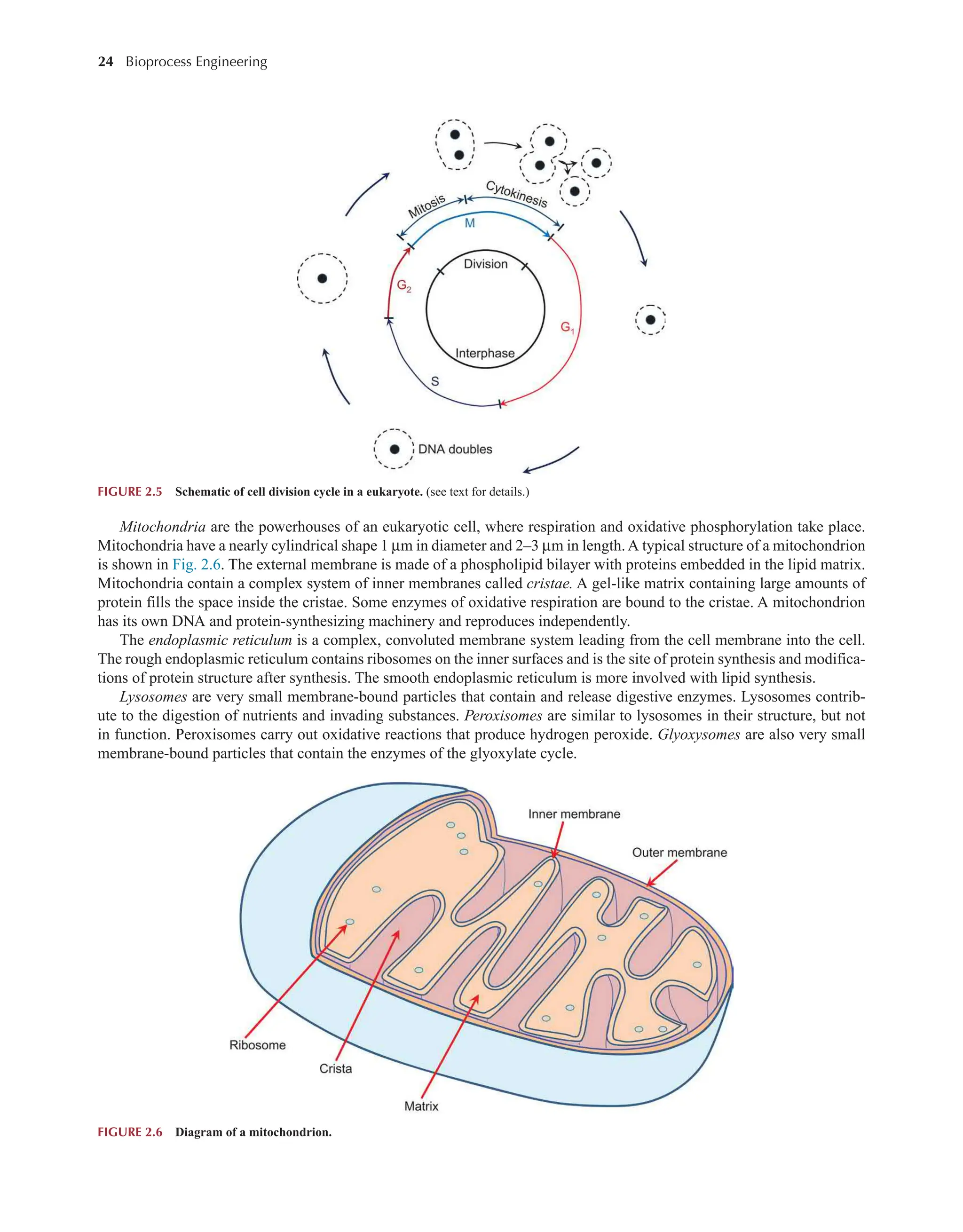
  • 6.
    Elsevier Radarweg 29, POBox 211, 1000 AE Amsterdam, Netherlands The Boulevard, Langford Lane, Kidlington, Oxford OX5 1GB, United Kingdom 50 Hampshire Street, 5th Floor, Cambridge, MA 02139, United States Copyright © 2020 Elsevier B.V. All rights reserved. No part of this publication may be reproduced or transmitted in any form or by any means, electronic or mechanical, in- cluding photocopying, recording, or any information storage and retrieval system, without permission in writing from the publisher. Details on how to seek permission, further information about the Publisher’s permissions policies and our ar- rangements with organizations such as the Copyright Clearance Center and the Copyright Licensing Agency, can be found at our website: www.elsevier.com/permissions. This book and the individual contributions contained in it are protected under copyright by the Publisher (other than as may be noted herein). Notices Knowledge and best practice in this field are constantly changing. As new research and experience broaden our understand- ing, changes in research methods, professional practices, or medical treatment may become necessary. Practitioners and researchers must always rely on their own experience and knowledge in evaluating and using any infor- mation, methods, compounds, or experiments described herein. In using such information or methods they should be mindful of their own safety and the safety of others, including parties for whom they have a professional responsibility. To the fullest extent of the law, neither the Publisher nor the authors, contributors, or editors, assume any liability for any injury and/or damage to persons or property as a matter of products liability, negligence or otherwise, or from any use or operation of any methods, products, instructions, or ideas contained in the material herein. Library of Congress Cataloging-in-Publication Data A catalog record for this book is available from the Library of Congress British Library Cataloguing-in-Publication Data A catalogue record for this book is available from the British Library ISBN: 978-0-12-821012-3 For information on all Elsevier publications visit our website at https://www.elsevier.com/books-and-journals Publisher: Joe Hayton Acquisitions Editor: Kostas Marinakis Editorial Project Manager: Liz Heijkoop Production Project Manager: Omer Mukthar Designer: Mark Rogers Typeset by Thomson Digital
  • 7.
    Bioprocess Engineering. http://dx.doi.org/10.1016/B978-0-12-821012-3.00001-4 Copyright© 2020 Elsevier B.V. All rights reserved. 1 1.1 Biological cycle Fig. 1.1 illustrates the natural biological processes occurring on Earth. Living systems consist of plants, animals, and mi- croorganisms. Sunlight is used by plants to convert CO2 and H2O into carbohydrates and other organic matter, releasing O2. Animals consume plant matter, converting plant materials into animal cells, and using the chemical energy from oxidizing plant matter into CO2 and H2O (H2O also serves as a key substrate for animals), finishing the cycle. Microorganisms further convert dead animal and/or plant biomass into other form of organic substances fertilizing the growth of plants, releasing CO2 and H2O, and the cycle is repeated. Energy from the Sun is used to form molecules and organisms that we call life. Ma- terials or matter participating in the biological cycle are renewable so long as the cycle is maintained. Bioprocess engineers manipulate and make use of this cycle by designing processes to make desired products, either by training microorganisms, plants, and animals, or via direct chemical conversions. The reactor is the heart of any chemical and/or biochemical processes. With reactors, bioprocesses turn inexpensive sus- tainably renewable chemicals such as carbohydrates, into valuable ones that humans need. As such, bioprocesses are chemi- cal processes that use biological substrates and/or catalysts. While not limited to such, we tend to refer to bioprocesses as (1) biologically converting inexpensive “chemicals” or materials into valuable chemicals or materials; and (2) manipulating biological organisms to serve as “catalyst” for conversion or production of products that human need. Bioprocess engineers are the only people technically trained to understand, design, and efficiently handle bioreactors. Bioprocess engineering ensures that a favorable sustainable state or predictable outcome of a bioprocess is achieved. This is equivalent to saying that bioprocess engineers are engineers with, differentiating from other engineers, training in biological sciences, especially quantitative and analytical biological sciences, and green chemistry. If one thinks of science as a dream, engineering is making the dream a reality. The maturing of Chemical Engineer- ing to a major discipline and as one of the very few well-defined disciplines in the 1950s has led to the ease in the mass production of commodity chemicals and completely changed the economics or value structure of materials and chemicals, thanks to the vastly available what were then “waste” and “toxic” materials—fossil resources. Food and materials can be manufactured from the cheap fossil materials. Our living standards improved significantly. Today, chemical reactors and chemical processes are not built by trial-and-error, but by design. The performance of a chemical reactor can be predicted, not just found to happen that way; the differences between large and small reactors are largely solved. Once a dream for the visional pioneers, it can now be achieved at ease. Fossil chemical and energy sources have provided much of our needs for advancing and maintaining the living standards of today. With the dwindling of fossil resources, we are facing yet an- other value structure change. The dream has been shifted to realizing a society that is built upon renewable and sustainable resources. Fossil sources will no longer be abundant for human use. Sustainability becomes the primary concern. Who is going to make this dream come true? Chapter 1 What is bioprocess engineering? Chapter outline 1.1 Biological cycle 1 1.2 Bioprocess engineering applications 2 1.3 Scales: living organism and manufacturing 3 1.4 Green chemistry 4 1.5 Sustainability 5 1.6 Biorefinery 5 1.7 Biotechnology and bioprocess engineering 8 1.8 Mathematics, biology, and engineering 9 1.9 The story of penicillin: the dawn of bioprocess engineering 9 1.10 Bioprocesses: regulatory constraints 12 1.11 The pillars of bioprocess kinetics and systems engineering 13 1.12 Summary 14 Problems 14 References 14 Further readings 15
  • 8.
    2 Bioprocess Engineering  Ona somewhat different scale, we can now manipulate life at its most basic level: the genetic. For thousands of years people have practiced genetic engineering at the level of selection and breeding, or directed evolution. But now it can be done in a purposeful, predetermined manner with the molecular-level manipulation of DNA, at a quantum leap level (as compared with directed evolution) or by design. We now have tools to probe the mysteries of life in a way unimaginable prior to the 1970s. With this intellectual revolution emerges new visions and new hopes: new medicines, semisynthetic organs, abundant and nutritious foods, computers based on biological molecules rather than silicon chips, organisms to degrade pollutants and clean up decades of unintentional damage to the environment, zero harmful chemical leakage to the environment while producing a wide array of consumer products, and revolutionized industrial processes. Our aim of comfortable living standards is ever higher. Without hard work, these dreams will remain merely dreams. Engineers will play an essential role in converting these visions into reality. Biosystems are very complex and beautifully constructed, but they must obey the rules of chemistry and physics and they are susceptible to engineering analysis. Living cells are predictable, and processes to use them can be methodically constructed on commercial scales. There lies a great task—analysis, design, and control of biosystems to the greater benefit of a sustainable humanity. This is the job of the bioprocess engineer. This text is organized such that you can learn bioprocess engineering from the principles. To limit the scope of the text, we have left out the product purification technologies, while focusing on the production generation or biotransformations. We attempt to bridge molecular level understandings to industrial applications. It is our hope that this will help you to strengthen your desire and ability to participate in the intellectual revolution and to make an important contribution to the human society. 1.2 Bioprocess engineering applications In a narrow sense, all human activities are centered around humans. In terms of human needs, bioprocess engineers deal from the production and application of biomaterials, to health defense, biologics development, and production, including gene therapy (manufacturing process), to the production of food and fuel as illustrated in Fig. 1.2. In all these applications, fundamentally, molecular interaction and/or (bio-) transformation governs the production and/or protection processes. A biologic drug is a product produced from a living organism or containing component(s) of living organisms. Biologics include recombinant proteins, tissues, genes, allergens, cells, blood components, blood, and vaccines. Biologics are used to treat numerous disease and conditions on humans. The transformation from chemicals to biologics, the functions or interac- tions of a biologic with human body, pharmacology, and the design of the biologic are subject areas of bioprocess engineering. Gene therapy is an experimental technique that uses genes to treat or prevent disease. This technique has the potential to allow doctors to treat a disorder by inserting a gene into a patient’s cells instead of using drugs or surgery. Researchers are testing several approaches to gene therapy, including: l Replacing a mutated gene that causes disease with a healthy copy of the gene. l Inactivating, or “knocking out,” a mutated gene that is functioning improperly. l Introducing a new gene into the body to help fight a disease. Although gene therapy is a promising treatment option for a number of diseases (including inherited disorders, some types of cancer, and certain viral infections), the technique remains risky and is still under study to make sure that it will be safe and effective. Gene therapy is currently being tested only for diseases that have no other cures. Cell therapy is the therapy in which cellular material is injected, grafted, or implanted into a patient; this generally means intact, living cells. For example, T cells capable of fighting cancer cells via cell-mediated immunity may be injected in the course of immunotherapy. FIGURE 1.1 The natural biological processes.
  • 9.
    What is bioprocessengineering? Chapter | 1 3 Cell therapy originated in the 19th century when scientists experimented by injecting animal material in an attempt to prevent and treat illness. Although such attempts produced no positive benefit, further research found in the mid 20th century that human cells could be used to help prevent the human body rejecting transplanted organs, leading in time to successful bone-marrow transplantation Chimeric antigen receptor (CAR)-modified T cell therapy, for example, has proven to be effective for patients with B cell hematological malignancies. Challenges remain in how to scale out the production of CAR T cells under current good manufacturing procedure (cGMP) in an efficient, effective manner. Currently as a mostly autologous cell-based therapy, the CAR-T cell manufacturing process represents a completely different manufacturing model from traditional biologics. One of the challenges of this largely personalized medicine is the development of efficient technologies and cost-effective clinical manufacturing platforms to support the later-stage clinical trials toward commercialization. Substantial efforts have been placed on the upstream for gene transduction and cell expansion. Apart from health defense and/or biologics, commodity products production is crucial for the human society. Food, fuels, and materials fill in the basic needs. 1.3 Scales: living organism and manufacturing Bioprocess engineering deals with a variable scale, from the molecular level at research to process operation in a factory at manufacturing level. In health applications, this translates to medical research at the most fundamental level of enzyme/ protein to human health professionals at overall health. Fig. 1.3 shows side-side the comparison from a “traditional” chemi- cal engineering view on the left to the “health” engineering on the right. The function of a protein or an enzyme within human cells is important for the overall health of human. When or if any changes to the protein or a foreign protein invades a human cell, the physiology will change, causing a domino effect/ change to far-reaching cells. Regulating the protein and enzyme functions can also be effected with ligands or chemicals. The molecular interactions are key to the overall health of humans. FIGURE 1.2 The applications of bioprocess engineering centered around humanity needs. FIGURE 1.3 A comparison of the chemical engineering (left) with processes in a complex living organism: human body. The bottom is at the microscopic scale where molecular interactions are examined, whereas at the top the factory as a whole is considered.
  • 10.
    4 Bioprocess Engineering  1.4Green chemistry Green chemistry, also called sustainable chemistry, is a philosophy of chemical research and engineering that encourages the design of products and processes that minimize the use and generation of hazardous substances while maximizing the efficiency of the desired product generation. Whereas environmental chemistry is the chemistry of the natural environment, and of pollutant chemicals in nature, green chemistry seeks to reduce and prevent pollution at its source. In 1990, the Pol- lution Prevention Act was passed in the United States. This act helped create a modus operandi for dealing with pollution in an original and innovative way. It aims to avoid problems before they happen. Examples of green chemistry starts with the choice of solvent for a process—water, carbon dioxide, dry media, and non-volatile (ionic) liquids, which are some of the excellent choices. These solvents are not harmful to the environment as either emission can easily be avoided or they are ubiquous in nature. Paul Anastas, then of the United States Environmental Protection Agency, and John C. Warner developed 12 principles of green chemistry, which help to explain what the definition means in practice. The principles cover such concepts as— (1) the design of processes to maximize the amount of (all) raw material that ends up in the product; (2) the use of safe, environment-benign substances, including solvents, whenever possible; (3) the design of energy efficient processes; and (4) the best form of waste disposal: not to create it in the first place. The 12 principles are: 1. It is better to prevent waste than to treat or clean up waste after it is formed. 2. Synthetic methods should be designed to maximize “atom efficiency.” 3. Wherever practicable, synthetic methodologies should be designed to use and generate substances that possess little or no toxicity to human health and the environment. 4. Chemical products should be designed to preserve efficacy of function while reducing toxicity. 5. The use of auxiliary substances (e.g., solvents, separation agents, etc.) should be made unnecessary wherever possible and innocuous when used. 6. Energy requirements should be recognized for their environmental and economic impacts and should be minimized. Synthetic methods should be conducted at ambient temperature and pressure. 7. A raw material or feedstock should be renewable rather than depleting wherever technically and economically practicable. 8. Reduce derivatives—Unnecessary derivatization (blocking group, protection/ deprotection, temporary modification) should be avoided whenever possible. 9. Catalytic reagents (as selective as possible) are superior to stoichiometric reagents. 10. Chemical products should be designed so that at the end of their function they do not persist in the environment and break down into innocuous degradation products. 11. Analytical methodologies need to be further developed to allow for real-time, in-process monitoring and control prior to the formation of hazardous substances. 12. Substances and the form of a substance used in a chemical process should be chosen to minimize potential for chemi- cal accidents, including releases, explosions, and fires. One example of green chemistry achievements is the polylactic acid (or PLA). In 2002, Cargill Dow (now NatureWorks) won the Greener Reaction Conditions Award for their improved polylactic acid polymerization process. Lactic acid is pro- duced by fermenting corn and converted to lactide, the cyclic dimmer ester of lactic acid using an efficient, tin-catalyzed cyclization. The L,L-lactide enantiomers is isolated by distillation and polymerized in the melt to make a crystallizable polymer, which has use in many applications including textiles and apparel, cutlery, and food packaging. Wal-Mart has announced that it is using/will use PLA for its produce packaging. The NatureWorks PLA process substitutes renewable materials for petroleum feedstocks, does not require the use of hazardous organic solvents typical in other PLA processes, and results in a high-quality polymer that is recyclable and compostable. Understanding the concept of green chemistry holds a special position for bioprocess engineers. Processes we design and operate must have minimal potential environmental impacts while optimized for maximum benefit. Basic steps for green chemistry that are what bioprocess engineering do include: 1. Developing products and processes based on renewable resources, such as plant biomass; 2. Design processes that bypass dangerous/toxic-chemical intermediates; 3. Design processes that avoid dangerous/toxic solvent use; 4. Reducing chemical processing steps, but demands high efficiency; 5. Promoting biochemical processes to reduce chemical processing steps or toxic chemical utilization; 6. Design milder (closer to atmosphere temperature and pressure) processes and multiple product recovery routes;
  • 11.
    What is bioprocessengineering? Chapter | 1 5 7. Bypassing chemical equilibrium with innovative reactor design, and biocatalysis, rather than adding intermediate steps. 8. Avoid production of unwanted products other than H2O and CO2. 1.5 Sustainability Sustainability is the capacity to endure or maintain at the longest timescale permissible. In other words, sustainability is the ability to maintain continuum. In ecology, the word describes how biological systems remain diverse and productive over time. Long-lived and healthy wetlands and forests are examples of sustainable biological systems. For humans, sustainabil- ity is the potential for long-term maintenance of well-being, which has environmental, economic, and social dimensions. Healthy ecosystems and environments provide vital goods and services to humans and other organisms. Utilization and release of substances at a rate that is harmonious with a steady state nature is the key for sustainability. This naturally leads to a carrying capacity for each substance or species with which humans interact. The sustainable state can be influenced by (process conditions or) how we interact with nature. There are two major ways of reducing negative human impact and en- hancing ecosystem services. The first is environmental management; this approach is based largely on information gained from earth science, environmental science, and conservation biology. The second approach is management of human con- sumption of resources, which is based largely on information gained from economics. Practice of both of these major steps can ensure a more favorable sustainable state to be evolved into. Sustainability interfaces with economics through the social and ecological consequences of economic activity. Sus- tainable economics involves ecological economics where social, cultural, health-related, and monetary/financial aspects are integrated. Moving toward sustainability is also a social challenge that entails international and national law, urban planning and transport, local and individual lifestyles and ethical consumerism. Ways of living more sustainably can take many forms from reorganizing living conditions (e.g., ecovillages, eco-municipalities, and sustainable cities), reapprais- ing economic sectors (permaculture, green building, sustainable agriculture), or work practices (sustainable architecture), using science to develop new technologies (green technologies, renewable energy), to adjustments in individual lifestyles that conserve natural resources. These exercises reduce our reliance or demand on disturbing the environment. To make all these concepts come to light, bioprocess engineers will be at the forefront of developing and implementing the technologies needed. On a grand scale, maintaining renewability or looking for a favorable predictable steady state on everything we touch or interact is the key to sustainability (Fig. 1.4). This falls right in the arena of bioprocess engineering. Are you ready for the challenge of designing processes that meets sustainability demands? 1.6 Biorefinery On a grand scale, sustainability is the basis of nature. Enforcing sustainability at the time scale of humanity is an insurance of our way of life to continue. Prior to the 1900s, agriculture and forestry were the predominant sources of raw materi- als for energy, food and a wide range of everyday commodities, and the human civilization depended almost entirely on renewable materials. Humanity was restricted by the sustainable supply inefficiently harvested from the biomass, which drew energy from the sun. The industrial revolution has brought a leap in the human civilization. Mass production of goods by machines dominates our daily life. The industrial revolution was brought to mature by the development of combustion FIGURE 1.4 Change of sustainable state owing to human interruption.
  • 12.
    6 Bioprocess Engineering  enginesand subsequent development of fossil energy and chemical industry. Besides the more than doubling of useful bio- mass production/harvest, mankind has increasingly tapped into the large fossil-energy reserves. At first the fossil chemicals were regarded as waste and thus any use was welcomed. It soon became the cheapest chemical and energy sources for the industrial revolution. As a result, our living standards have seen a leap. There is no turning back to the primitive way of life in the past. However, fossil energy and chemical sources are depleting despite the cyclic price change of energy and com- modity materials. There is a critical need to change the current industry and human civilization to a sustainable manner, assuring that our way of life today continues on the path of improvement after the depletion of fossil sources. Our way of life exists only if sustainability is maintained on a time scale no longer than our life span. Biorefinery is concept in analogous to a petroleum refinery whereby a raw material feed (in this case plant ligocellulosic biomass instead of petroleum) is refined to a potpourri of products (on demand). In a biorefinery, lignocellulosic biomass is converted to chemicals, materials, and energy that runs on the human civilization, replacing the needs of petroleum, coal, natural gas, and other non-renewable energy and chemical sources. Lignocellulosic biomass is renewable as shown in Fig. 1.1, in that plant synthesizes chemicals by drawing energy from the sun and, carbon dioxide and water from the environment, while releasing oxygen. Combustion of biomass releases energy, carbon dioxide, and water. Therefore, biore- finery plays a key role in ensuring the cycle of biomass production and consumption included satisfying human needs for energy and chemicals. A biorefinery integrates a variety of conversion processes to produce multiple product streams such as transportation liquid fuels, steam/heat, electricity, and chemicals from lignocellulosic biomass. Biorefinery has been identified as the most promising route to the creation of a sustainable bio-based economy. Biorefinery is a collection of the essential technologies to transform biological raw materials into a range of industrially useful intermediates. By producing multiple products, a biorefinery maximizes the value derived from a lignocellulosic biomass feedstock. A biorefinery could produce one or more low-volume, high-value chemical products together with a low-value, high-volume liquid transportation fuel, while generating electricity and process heat for its own use and/or export. Fig. 1.5 shows a schematic of various biorefinery processes. There are at least three steps in converting woody biomass: pretreatment; cracking or rendering biomass to intermediate molecules; and conversion (of the intermediate molecules to desired products). There are three major categories or approaches in pretreatment—systematical disassembling processes; pyrolysis and gasification processes. In systematical disassembling processes, the lignocellulosic biomass is commonly disassembled to individual components systematically for optimal conversions that followed. The basic approach is based on a systematical disassembling and conversion to desired chemicals. This pretreatment method and the rout of conversion FIGURE 1.5 A schematic of various biorefinery processes. (With permission from: Liu, S., 2015. A synergetic pretreatment technology for woody biomass conversion. Appl. Ener. 144, 114–128).
  • 13.
    What is bioprocessengineering? Chapter | 1 7 followed depend heavily on separation and/or physical fractionation of the intermediates as well as the final desired prod- ucts. Pyrolysis applies heat and some oxygen (or none) to render the biomass to liquid, while gasification renders the bio- mass to syngas. Biological conversions are preferred over chemical conversions due to their selectivity or green chemistry concepts. However, owing to the complexity of the lignocellulosic biomass, a multitude of biological processes is required for optimal operations. The biological reactions are also very slow and thus require larger facility foot prints. Especially following the gasification, bioconversion is in the “primitive” stage of development. Pyrolysis resembles more closely to the refinery whereby the products can be controlled in a more systematical man- ner. It may be classified as systematical disassembling as well. However, there are restrictions on the type of products the process can produce. Gasification as shown in Fig. 1.5 is at the extreme side of conversion technology, whereby the lignocellulosic biomass is disassembled to the basic building block for hydrocarbons: H2 and CO, and then reassembled to desired products as desired. The final products can be more easily tailored from syngas or CO + H2. For example, Fisher-Tropsch process can turn CO + H2 into higher alcohol, alkenes, and many other products. Syn gas (together with air: mixture of N2 and O2) is also the starting point for ammonia synthesis, from which nitrogen fertilizers and many other products are produced. However, all thermochemical processes suffer from selectivity. During the disassembling process, “coke” or “carbon” is produced especially at high temperatures and thus reduces the conversion efficiency, if H2 and CO are the desired intermediates. Thermal-chemical processes are generally considered less “green” than biological and other sequential disassembling processes due to their severe operating conditions, poor selectivity or byproducts generation, and thermodynamic restrictions. The promise of a biorefinery to supply the products human needs is shown in Fig. 1.6 for the various examples of build- ing blocks or platform chemicals that sugar (a specific example of glucose) can produce, besides the very basic building blocks of CO and H2. For example, glucose can be fermented to ethanol by yeast and bacteria anaerobically, and lactic acid can be produced by lacto bacteria. As shown in Fig. 1.6, each arrow radiates from the glucose in the center represents a route of biotransformation (or fermentation) by default, whereas chemical transformations are shown with labeled arrows. For example, glucose can be dehydrated to 5-hydroxymethylfurfural catalyzed with an acid, which can be further decomposed to levulinic acid by hydration. All these chemicals shown in Fig. 1.6 are examples of important platform (or intermediate) chemicals, as well as commodity chemicals. For example, ethanol is well known for its use as a liquid transportation fuel. FIGURE 1.6 The platform of chemicals derived from glucose (the molecule in the center of the diagram). Most of these chemicals are produced via fermentation (or biotransformation), while a few of them are produced via chemical reaction (or chemical transformation) as indicated.
  • 14.
    8 Bioprocess Engineering  Ethanolcan be dehydrated to ethylene, which is the monomer for polyethylene, or dehydrognated and dehydrated to make 1,3-butadiene, monomer for the synthetic rubber. Ethanol can also be employed to produce higher alcohols and alkenes. Are you prepared to be at the forefront of developing, designing and operating these processes for the sustainability and comfortability in humanity? 1.7 Biotechnology and bioprocess engineering Biotechnology is the use or development of methods of direct genetic manipulation for a socially desirable goal. Such a goal might be the production of a particular chemical, but it may also involve the production of better plants or seeds, gene ther- apy, or the use of specially designed organisms to degrade wastes. The key element is the use of sophisticated techniques outside the cell for genetic manipulation. Biotechnology is applied biology; it bridges biology to bioprocess engineering, just like applied chemistry or chemical technology bridges chemistry to chemical engineering. Many terms have been used to describe engineers working with biotechnology. The two terms that are considered general—Biological engineering and Bioengineering come from the two major fields of applications that require deep understanding of biology—agriculture and medicine. Bioengineering is a broad title including work on industrial, medi- cal and agricultural systems; its practitioners include agricultural, electrical, mechanical, industrial, environmental, and chemical engineers, and others. As such, Bioenegineering is not a well-defined term and usually it refers to biotechnology applications that are not easily categorized or in medical fields. Biological Engineering stems from engineering of biology which is also a general term. However, the term biological engineering is initially used by agricultural engineers for the engineering applications to or manipulation of plants and animals and is thus specific. For example, the Institute of Bio- logical Engineering (IBE) has a base in, although not limited to, agricultural engineering. ABET (Accreditation Board for Engineering and Technology, Inc.) brands Biological Engineering together with Agricultural Engineering when accredit- ing BS (Bachelor of Science) and MS (Master of Science) in engineering and technology educational programs. On the other hand, the Society for Biological Engineers was created within American Institute of Chemical Engineers. Therefore, biological engineering is also regarded as a not well defined term and can at times refer to biotechnology applications in agricultural fields. Biochemical engineering has usually meant the extension of chemical engineering principles to systems using a biological catalyst to bring about desired chemical transformations. It is often subdivided into bioreaction engineer- ing and bioseparations. Biomedical engineering has traditionally been considered totally separate from biochemical engi- neering, although the boundary between the two is increasingly vague, particularly in the areas of cell surface receptors and animal cell culture. Another relevant term is biomolecular engineering, which has been defined by the National Institutes of Health as “... research at the interface of biology and chemical engineering and is focused at the molecular level.” In all, a strong background in quantitative analysis, kinetic/dynamic behaviors, and equilibrium behaviors are strongly desirable. Increasingly, these biorelated engineering fields have become inter-related, although the names are restricting. Bioprocess engineering is a broader and at the same time a narrower field than the commonly used terms referred ear- lier—biological engineering, biochemical engineering, biomedical engineering, and biomolecular engineering. Bioprocess Engineering is a profession than spans all the bio-related engineering fields as mentioned earlier. It is a profession that has emerged to stand alone, as compared to the interdisciplinary profession once it was. Unlike the term bioengineering, the term biorpocess engineering is specific and well-defined. Bioprocess engineering emphasizes the engineering and sciences of industrial processes that are biobased—(1) biomass feedstock conversion for a sustainable society or biorefinery; (2) biocatalysis based processing; and (3) manipulation of micro-organisms for a sustainable and socially desirable goal. Bio- process engineering is not product-based nor is substrate-based. Therefore, bioprocess engineering deals with biological and chemical processes involved in all areas, not just for a particular substrate or species (of feedstock or intermediate), outcome or product. Thus, bioprocess engineering intercepts chemical, mechanical, electrical, environmental, medical, and industrial engineering fields, applying the principles to designing and analysis of processes based on using living cells or subcomponents of such cells, as well as non-living matters. Bioprocess engineering deals with both micro-scale (cellular/ molecular) and large-scale (systemwide / industrial) designs and analyses. Science and engineering of processes converting biomass materials to chemicals, materials, and energy are therefore part of bioprocess engineering by extension. Predict- ing and modeling system behaviors, detailed equipment and process design, sensor development, control algorithms, and manufacturing or operating strategies are just some of the challenges facing bioprocess engineers. At the heart of bioprocess engineering lays the process kinetics, reactor design and analysis for biosystems, which forms the basis for this text. We will focus primarily on the kinetics, dynamics, and reaction engineering involved in the bioprocess engineering. A key component is the application of engineering principles to systems containing biological catalysts and/or biomass as feedstock, but with an emphasis on those systems making use of biotechnology and green chemistry. The rapidly increasing ability to determine the complete sequence of genes in an organism offers new opportunities for bioprocess engineers in the design and monitoring of bioprocesses. The cell, itself, is now a designable component of the overall process.
  • 15.
    What is bioprocessengineering? Chapter | 1 9 For practitioners working in the bioprocess engineering, some of journals and periodicals provide the latest develop- ments in the field. Here we name a few: l Biochemical Engineering Journal l Journal of Biological Engineering l Journal of Biomass Conversion and Biorefinery l Journal of Bioprocess Engineering and Biorefinery l Journal of Bioprocess and Bioystems Engineering l Journal of Biotechnology l Journal of Biotechnology Advances l Journal of Biotechnology and Bioprocess Engineering 1.8 Mathematics, biology, and engineering Mathematical modeling holds the key for engineers. Physics at its fundamental level examines forces and motion; one can view it as applied mathematics. In turn, chemistry examines molecules and their interactions. Since physics examines the motions of atoms, nuclei and electrons, at the basis of molecules, one can view chemistry as applied physics. This directly connects chemistry to mathematics at a fundamental level. Indeed, most physicists and chemists rely extensively on math- ematical modeling. While one can view biology as applied chemistry through the connection of chemicals and molecules, the fundamental trainings of biologists today and engineers are distinctly different. In the development of knowledge in the life sciences, unlike chemistry and physics, mathematical theories and quantitative methods (except statistics) have played a secondary role. Most progress has been due to improvements in experimental tools. Results are qualitative and descrip- tive models are formulated and tested. Consequently, biologists often have incomplete backgrounds in mathematics but are very strong with respect to laboratory tools and, more importantly, with respect to the interpretation of laboratory data from complex systems. Engineers usually possess a very good background in the physical and mathematical sciences. Often a theory leads to mathematical formulations, and the validity of the theory is tested by comparing predicted responses to those in experi- ments. Quantitative models and approaches, even to complex systems, are strengths. Biologists are usually better at the formation of testable hypotheses, experimental design, and data interpretation from complex systems. At the dawn of the biotechnology era, engineers were typically unfamiliar with the experimental techniques and strategies used by life scien- tists. However, today bioprocess engineers have entered even more sophisticated experimental techniques and strategies in life sciences (than biologists) due to the understanding and progress in the prediction and modeling of living cells. The well-groundedness in mathematical modeling gives bioprocess engineers an edge and responsibility in enforcing sustainability demands. In practice, the sustainable (or steady) state can be different from what we know today or when no human interruption is imposed. The sustainable state could even be fluctuating with a noticeable degree. Engineers hold great responsibility to convincing environmentalists and the public what to expect by accurately predicting the dynamic outcomes without speculating on the potential dramatic changes ahead. The skills of the engineer and of the life scientist are complementary. To convert the promises of molecular biology into new processes to make new products requires the integration of these skills. To function at this level, the engineer needs a solid understanding of biology and its experimental tools. In this book, we provide sufficient biological background for you to understand the chapters on applying engineering principles to biosystems. However, if you are serious about becoming a bioprocess engineer, it is desirable if you had taken courses in microbiology, biochemistry, and cell biology, as you would appreciate more of the engineering principles in this text. 1.9 The story of penicillin: the dawn of bioprocess engineering Penicillin is an antibiotic of significant importance. The familiar story of penicillin was well-presented by Kargi & Shuler in their text “Bioprocess Engineering – Basic Concepts.” As you would expect, the discovery of the chemical was acci- dental and the production of the chemical is elaborate. In September 1928, Alexander Fleming at St. Mary’s Hospital in London was trying to isolate the bacterium, Staphylococcus aureus, which causes boils. The technique in use was to grow the bacterium on the surface of a nutrient solution. One Friday, the basement window was accidently left open overnight. The experiments were carried out in the basement and one of the dishes had been contaminated inadvertently with a foreign particle. Normally, such a contaminated plate would be tossed out. However, Fleming noticed that no bacteria grew near the invading substance. Fleming’s genius was to realize that this observation was meaningful and not a “failed” experiment. Fleming recognized that the cell killing must be due to an antibacterial agent. He recovered the foreign particle and found that it was a common
  • 16.
    10 Bioprocess Engineering  moldof the Penicillium genus (later identified as Penicillium notatum). Fleming nurtured the mold to grow and, using the crude extraction methods then available, managed to obtain a tiny quantity of secreted material. He then demonstrated that this material had powerful antimicrobial properties and named the product penicillin. Fleming carefully preserved the cul- ture, but the discovery lay essentially dormant for over a decade. World War II provided the impetus to resurrect the discovery. Sulfa drugs have a rather restricted range of activity, and an antibiotic with minimal side effects and broader applicability was desperately needed. In 1939, Howard Florey and Ernst Chain of Oxford decided to build on Fleming’s observations. Norman Heatley played the key role in producing sufficient material for Chain and Florey to test the effectiveness of penicillin. Heatley, trained as a biochemist, performed as a bioprocess engineer. He developed an assay to monitor the amount of penicillin made so as to determine the kinetics of the fermentation, developed a culture technique that could be implemented easily, and devised a novel back-extraction process to recover the very delicate product. After months of immense effort, they produced enough penicillin to treat some laboratory animals. Eighteen months after starting on the project, they began to treat a London policeman for a blood infection. The penicil- lin worked wonders initially and brought the patient to the point of recovery. Most unfortunately, the supply of penicillin was exhausted and the man relapsed and died. Nonetheless, Florey and Chain had demonstrated the great potential for penicillin, if it could be made in sufficient amount. To make large amounts of penicillin would require a process, and for such a process development, engineers would be needed, in addition to microbial physiologists and other life scientists. The war further complicated the situation. Great Britain’s industrial facilities were already totally devoted to the war. Florey and his associates approached pharmaceutical firms in the United States to persuade them to develop the capacity to produce penicillin, since the United States was not at war at that time. Many companies and government laboratories, assisted by many universities, took up the challenge. Particularly prominent were Merck, Pfizer, Squibb, and the USDA Northern Regional Research Laboratory in Peoria, Illinois. The first efforts with fermentation were modest. A large effort went into attempts to chemically synthesize penicillin. This effort involved hundreds of chemists. Consequently, many companies were at first reluctant to commit to the fermenta- tion process, beyond the pilot-plant stage. It was thought that the pilot-plant fermentation system could produce sufficient penicillin to meet the needs of clinical testing, but large-scale production would soon be done by chemical synthesis. At that time, US companies had achieved a great deal of success with chemical synthesis of other drugs, which gave the com- panies a great deal of control over the drug’s production. The chemical synthesis of penicillin proved to be exceedingly difficult (It was accomplished in the 1950s, and the synthesis route is still not competitive with fermentation). However, in 1940 fermentation for the production of a pharmaceutical was an unproved approach, and most companies were betting on chemical synthesis to ultimately dominate. The early clinical successes were so dramatic that in 1943 the War Production Board appointed A. L. Elder to coordinate the activities of producers to greatly increase the supply of penicillin. The fermentation route was chosen. As Elder recalls, “I was ridiculed by some of my closest scientific friends for allowing myself to become associated with what obviously was to be a flop-namely, the commercial production of penicillin by a fermentation process” (from Elder, 1970). The problems facing the fermentation process were indeed very formidable. The problem was typical of most new fermentation processes: a valuable product made at very low levels. The low rate of production per unit volume would necessitate very large and inefficient reactors, and the low concentration (titer) made product recovery and purification very difficult. In 1939 the final concentration in a typical penicillin fermentation broth was one part per million (ca. 0.001 g/L); gold is more plentiful in sea water. Furthermore, penicillin is a fragile and unstable product, which places significant constraints on the approaches used for recovery and purification. Life scientists at the Northern Regional Research Laboratory made many major contributions to the penicillin program. One was the development of a corn steep liquor-lactose based medium. Andrew J. Moyer succeeded to increase productiv- ity about 10-fold with this medium in November 26, 1941. A worldwide search by the laboratory for better producer strains of Penicillium led to the isolation of a Penicillium chrysogenum strain. This strain, isolated from a moldy cantaloupe at a Peoria fruit market, proved superior to hundreds of other isolates tested. Its progeny have been used in almost all commer- cial penicillin fermentations. The other hurdle was to decide on a manufacturing process. One method involved the growth of the mold on the surface of moist bran. This bran method was discarded because of difficulties in temperature control, sterilization, and equipment size. The surface method involved growth of the mold on top of a quiescent medium. The surface method used a variety of containers, including milk bottles, and the term “bottle plant” indicated such a manufacturing technique. The surface meth- od gave relatively high yields, but had a long-growing cycle and was very labor intensive. The first manufacturing plants were bottle plants because the method worked and could be implemented quickly. However, it was clear that the surface method would not meet the full need for penicillin. If the goal of the War Production Board was met by bottle plants, it was
  • 17.
    What is bioprocessengineering? Chapter | 1 11 estimated that the necessary bottles would fill a row stretching from New York City to San Francisco. Engineers generally favored a submerged tank process. The submerged process presented challenges in terms of both mold physiology and in tank design and operation. Large volumes of absolutely clean, oil- and dirt-free sterile air were required. What were then very large agitators were required, and the mechanical seal for the agitator shaft had to be designed to prevent the entry of organisms. Even today, problems of oxygen supply and heat removal are important constraints on antibiotic fermenter design. Contamination by foreign organisms could degrade the product as fast as it was formed, consume nutrients before they were converted to penicillin, or produce toxins. In addition to these challenges in reactor design, there were similar hurdles in product recovery and purification. The very fragile nature of penicillin required the development of special techniques. A combination of pH shifts and rapid liquid-liquid extraction proved useful. Soon processes using tanks of about 10,000 gal were built. Pfizer completed in less than 6 months the first plant for commercial production of penicillin by submerged fermentation (Hobby, 1985). The plant had 14 tanks each of 7000-gal capacity. By a combination of good luck and hard work, the United States had the capacity by the end of World War II to produce enough penicillin for almost 100,000 patients per year. A schematic of the process is shown in Fig. 1.7. This accomplishment required a high level of multidisciplinary work. For example, Merck realized that men who un- derstood both engineering and biology were not available. Merck assigned a chemical engineer and microbiologist together to each aspect of the problem. They planned, executed, and analyzed the experimental program jointly, “almost as if they were one man” (see the chapter by Silcox in Elder, 1970). Progress with penicillin fermentation has continued, as has the need for the interaction of biologists and engineers. From 1939 to now, the yield of penicillin has gone from 0.001 g/L to over 50 g/L of fermentation broth. Progress has involved better understanding of mold physiology, metabolic pathways, penicillin structure, methods of mutation, and selection of mold genetics, process control, and reactor design. Before the penicillin process, almost no chemical engineers sought specialized training in the life sciences. With the advent of modem antibiotics, the concept of the bioprocess engineering was born. The penicillin process also established a paradigm for bioprocess development and biochemical engineering. This paradigm still guides much of our profession’s FIGURE 1.7 Schematic of penicillin production process.
  • 18.
    12 Bioprocess Engineering  thinking.The mindset of bioprocess engineers was cast by the penicillin experience. It is for this reason that we have fo- cused on the penicillin story, rather than on an example for production of a protein from a genetically engineered organism. Although many parallels can be made between the penicillin process and our efforts to use recombinant DNA, no similar paradigm has yet emerged from our experience with genetically engineered cells. We must continually reexamine the preju­ dices the field has inherited from the penicillin experience. It is you, the student, who will best be able to challenge these prejudices. 1.10 Bioprocesses: regulatory constraints To be an effective in bioprocess engineering, you must understand the regulatory climate in which many bioprocess engi- neers work. The US FDA (Food and Drug Administration) and its equivalents in other countries must insure the safety and efficacy of food and medicines. For bioprocess engineers working in the pharmaceutical industry the primary concern is not reduction of manufacturing cost (although that is still a very desirable goal), but the production of a product of consistently high quality in amounts to satisfy the medical needs of the population. Consider briefly the process by which a drug obtains FDA approval. A typical drug undergoes 6–7 years of development from the discovery stage through preclinical testing in animals. To legally test the drug in humans in the United States, an Investigational New Drug (IND) designation must be issued by FDA. Biologics such as vaccines and recombinant protein drugs are generally approved by FDA via a Biologic License Application (BLA). There are five phases of trials before a new drug is placed on market after its discovery: Phase 0: Human microdosing studies (1–3 years). This is a designation for the exploratory, first-in-human trials conducted within the regulations of US-FDA 2006 Guidance on Exploratory Investigational New Drug studies. Phase I: First stage testing in human subjects. Normally, a small group of (20–80) of healthy volunteers is selected. Safety, tolerability, pharmacokinetics, and pharmacodynamics of the drug are evaluated. This phase usually lasts about 1 year. Different types of types of trials in this phase are Single Ascending Dose (SAD), Multiple Ascending Dose (MAD), and Food Effect trials. Phase II: clinical trials (about 2 years). After determining the initial safety and pharmacological parameters, this trial on a larger group of 100–300 patients and volunteers is performed. This trial is designed to assess the efficacy (i.e., does it help the patient) as well as further determining which side effects exist. Sometimes, Phase IIA is designed to determine the dos- ing requirements and Phase IIB is designed to determine the efficacy of the drug. If the drug fails to meet the established standards of the trials, further development of the new drug is usually stopped. Phase III: clinical trials (about 3 years) with 300–3000 (or more) patients. Since individuals vary in body chemistry, it is important to test the range of responses in terms of both side effects and efficacy by using a representative cross section of the population. Randomized controlled multicenter trials on large patient groups are conducted to determine the effective- ness of the drug. This phase of the clinic trials is very expensive, time-consuming, and difficult to design and run, espe- cially in therapies for chronic medical conditions. It is common practice that certain Phase III trials will continue while the regulatory submission is pending at the appropriate regulatory agency. This allows patients to continue to receive possibly lifesaving drugs until the drug us available in the market for distribution. These trials also provide additional safety data and support for marketing claims for the drug. Data from clinical trials is presented to the FDA for review (2 months to 3 years). The review document presented to FDA clearly show the trial results combined with description of the methods and results of human and animal studies, manufacturing procedures, formulation details, and shelf life. If the clinical trials are well designed and demonstrated statistically significant improvements in health with acceptable side effects, the drug is likely to be approved. Phase IV: Postmarketing surveillance trial. Continue safety surveillance (pharmacovigilance) and technical support of a drug after receiving permission to be put on the market. The whole discovery-through-approval process takes 5–10 years for a conventional small molecule drug, and 12–15 years for a new biological drug to make it to the market. It takes about $800–$2000 million to send a new drug to the market. Only one in ten drugs that enter human clinical trials receives approval. Recent FDA reforms have decreased the time to obtain approval for life-saving drugs in treatment of diseases such as cancer and AIDS, but the overall process is still lengthy. This process greatly affects a bioprocess engineer. FDA approval is for the product and the process together. There have been tragic examples where a small process change has allowed a toxic trace compound to form or become incorporated in the final product, resulting in severe side effects, including death. Thus, process changes may require new clinical trials to test the safety of the resulting product. Since clinical trials are very expensive, process improvements are made under a limited set of circumstances. Even during clinical trials it is difficult to make major process changes.
  • 19.
    What is bioprocessengineering? Chapter | 1 13 Drugs sold on the market or used in clinical trials must come from facilities that are certified as GMP or cGMP and must follow the appropriate Code of Federal Regulations (CFR). GMP stands for (current) good manufacturing practice. GMP concerns the actual manufacturing facility design and layout, the equipment and procedures, training of production person- nel, control of process inputs (e.g., raw materials and cultures), and handling of product. The plant layout and design must prevent contamination of the product, and dictate the flow of material, personnel, and air. Equipment and procedures must be validated. Procedures include not only operation of a piece of equipment, but also cleaning and sterilization. Computer software used to monitor and control the process must be validated. Off-line assays done in laboratories must satisfy good laboratory practice (GLP). Procedures are documented by SOPs (standard operating procedures). The GMP guidelines stress the need for documented procedures to validate performance. “Process validation is estab- lishing documented evidence which provides a high degree of assurance that a specific process will consistently produce a product meeting its predetermined specifications and quality characteristics” and “There shall be written procedures for production and process-control to assure that products have the identity, strength, quality, and purity they purport or are represented to possess.” The actual process of validation is often complex, particularly when a whole facility design is considered. The FDA pro- vides extensive information and guidelines which are updated regularly. If students become involved in biomanufacturing for pharmaceuticals, they will need to consult these sources. However, certain key concepts do not change. These concepts are written documentation, consistency of procedures, consistency of product, and demonstrable measures of product qual- ity, particularly purity, and safety. These tasks are demanding and require careful attention to detail. Bioprocess engineers will often find that much of their effort will be to satisfy these regulatory requirements. The key point is that process changes cannot be made without considering their considerable regulatory impact. 1.11 The pillars of bioprocess kinetics and systems engineering As a profession, bioprocess engineers must be well-versed in thermodynamics, transport phenomena, colloids, biosepara- tions, microbiology, bioprocess kinetics and systems engineering, and process simulation and design. This text deals with the core of bioprocess engineering. Unlike earlier texts in this subject area, this text integrates bioprocess engineering prin- ciples, in particular bioprocess kinetics and transformation or reaction engineering principles together. Chemical reaction engineering is not a pre-requisite before taking on this text. Fig. 1.6 shows the pillars of this text. The sustainability on this pillar is narrowly defined as having the net benefit to the human society and/or benign environmental effects. As shown in Fig. 1.8, the fundamental knowledge of engineering science you will learn or expect in this text is among the “pillars”: mass balance, rate expression, stoichiometry, cell metabolism, yield factor, energy balance, mass FIGURE 1.8 The pillars of bioprocess kinetics and system engineering.
  • 20.
    14 Bioprocess Engineering  transfer,cost, and profit analyses. These engineering science fundamentals form the basis or foundation for the design and performance analysis of reactors and /or fermenters. In turn, process kinetic data analysis, biocatalyst design and selection can be learned from the reactor performance, and applied to the design and performance analysis of reactors and/or bioprocess systems. Process stability usually stems from multiplicity of the process, which controls the product quality and consistency. Finally, the design and control of bioprocess systems must obey the greater law of nature: sustainability. 1.12 Summary Sustainability and green chemistry are important to the practice of bioprocess engineers. Biorefinery is a desired approach to provide the products of human needs, putting the human needs into the biological cycle. Both biotransformation and chemical transformations are important to biorefinery. Genetic manipulations and biotransformation are important to the bioprocess engineering profession. Because of the fundamental impact genetic manipulation and biotransformation can have on the cycle of life, ethics and regulations are critical to the practice of bioprocess engineers. It is the intention that this text can be used as a senior and/or graduate text for bioprocess engineering students. It may also be served as a reference and/or graduate text for chemical kinetics, chemical reactor analysis, and bioprocess systems engineering. In the same time, we have inserted materials, more advanced analysis or complex systems in the text as an extension to the introductory material. It is our aim that this text can serve equally as a reference or resource for further research or development. Problems 1.1. How bioprocess engineering affects the overall health of humans? 1.2. Why are renewable materials preferred? 1.3. What is green chemistry? 1.4. What is sustainability? 1.5. What is a biorefinery? 1.6. Why is ethanol an important platform chemical? 1.7. An uninformed researcher is questioning the sustainability of biomass cultivation and utilization, arguing that fertil- izer and fuels for heavy machinery must be produced with fossil energy and thus not renewable. Research into the basis of the arguments and dismiss the notion of unsustainable biomass use. 1.8. What is GMP and how does it relate to the regulatory process for pharmaceuticals? 1.9. When the FDA approves a process, it requires validation of the process. Explain what validation means in the FDA context. 1.10. Why does the FDA approve the process and product together? 1.11. What is biotransformation? What is chemical transformation? References D. History of Penicillin Elder, A.L. (Ed.), 1970. The History of Penicillin Production, Chem. Eng. Prog. Symp. Ser. 66 (#100). American Institute of Chemical Engineers, New York. Hobby, G.L., 1985. Penicillin. Meeting the Challenge. Yale University Press, New Haven, CT.
  • 21.
    What is bioprocessengineering? Chapter | 1 15 Further readings A. Green Chemistry Anatas, P.C., Warner, J.C., 1998. Green Chemistry: Theory and Practice. Oxford University Press, New York. Linthorst JA, 2010. An overview: origins and development of green chemistry. Found. Chem. 12 (1), 55–68. Wilson M, Schwarzman M. 2009. Toward a New U.S. Chemicals Policy: Rebuilding the Foundation to Advance New Science, Green Chemistry, and Environmental Health. Environ Health Perspect. 117 (8) 1202–1209 and A358. www.epa.gov/greenchemistry/. B. Sustainability Adams, W.M., Jeanrenaud, S.J., 2008. Transition to Sustainability: Towards a Humane and Diverse World. IUCN, Gland, Switzerland, 108 pp. Atkinson, G., Dietz, S., Neumayer, E., 2007. Handbook of Sustainable Development. Edward Elgar, Cheltenham. Blackburn, W.R., 2007. The Sustainability Handbook. Earthscan, London. Blewitt, J., 2008. Understanding Sustainable Development. Earthscan, London. Costanza, R., Graumlich, L.J., Steffen, W. (Eds.), 2007. Sustainability or Collapse? An Integrated History and Future of People on Earth. MIT Press, Cambridge, MA. Norton, B., 2005. Sustainability, A Philosophy of Adaptive Ecosystem Management. The University of Chicago Press, Chicago. Soederbaum, P., 2008. Understanding Sustainability Economics. Earthscan, London. C. Biorefinery Liu, S., Lu, H., Hu, R., Shupe, A., Lin, L., Liang, L., 2012. A sustainable woody biomass biorefinery. J. Biotech. Adv. 30 (4), 785–810, http://dx.doi. org/10.1016/j.biotechadv.2012.01.013. FitzPatrick, M., Champagne, P., Cunningham, M.F., Whitney, R.A., 2010. A biorefinery processing perspective: treatment of lignocellulosic materials for the production of value-added products”. Bioresour. Technol. 101 (23), 8915–8922. Kaparaju, P., Serrano, M., Thomsen, A.B., Kongjan, P., Angelidaki, I., 2009. Bioethanol, biohydrogen and biogas production from wheat straw in a bio- refinery concept”. Bioresour. Technol. 100 (9), 2562–2568. Koutinas, A.A., Arifeen, N., Wang, R., Webb, C., 2007. Cereal-based biorefinery development: Integrated enzyme production for cereal flour hydrolysis”. Biotechn. Bioeng. 97 (1), 61–72. Liu, S., Amidon, T.E., Francis, R.C., Ramarao, B.V., Lai, Y.-Z., Scott, G.M., 2006. From forest biomass to chemicals and energy: biorefinery initiative in New York. Ind. Biotech. 2 (2), 113–120. Ohara, H., 2003. Biorefinery. App. Micobiol. and Biotechn. 62 (5–6), 474–477. D. History of Penicillin Moberg, C.L., 1991. Penicillin’s Forgotten Man: Norman Heatley. Science 253, 734–735. Mateles, R.I. (Ed.), 1998. Penicillin, A Paradigm for Biotechnology. Candida Corp., Chicago, IL. Sheehan, J.C., 1982. The Enchanted Ring. The Untold Story of Penicillin. MIT Press, Cambridge, MA. E. Regulatory Issues Currey, B., Klemic, P.A., 2008. A New Phase in Pharmaceutical Regulation. DRI Drug and Medical Device and Product Liability Committee. O’Melveny & Myers LLP, PL California, United States. Durfor, C.N., Andscribner, C.L., 1992. An FDA perspective of manufacturing changes for products in human use. Ann. NY Acad. Sci. 665, 356–363. Naglak, T.J., Keith, M.G., Omstead, D.R., 1994. Validation of fermentation processes. Biopharm 7, 28–36. Reisman, H.B., 1993. Problems in scale-up of biotechnology production processes. Crit. Rev. Biotechnol. 13, 195–253. Wechsler, J. Science and Safety. Magazine: Pharmaceutial Excutive – Washington Report, Oct., 2009. http://www.FDA.gov. http://www.FDAreview.org/approval_process.
  • 22.
    Bioprocess Engineering. http://dx.doi.org/10.1016/B978-0-12-821012-3.00002-6 Copyright© 2020 Elsevier B.V. All rights reserved. 17 Bioprocess engineers seek chemicals and materials for human needs in a sustainable manner. It is the chemicals and materials from biological origin that can sustain the needs of humans. Microorganism also provides a tool for bioprocess engineers to manipulate the chemicals and materials so that they can meet the needs of humanity. Therefore we shall first review some of the biological basics to learn how living organisms (more specific: microorganisms) function and what their important chemicals and materials are. 2.1 Cells and organisms The cell is the basic structural and functional unit of all known living organisms. Cells are to living organisms as like atoms are to molecules. It is the smallest unit of life that is classified as a living thing, and so is often called the building block of life. Some organisms, such as most bacteria, are unicellular (consist of a single cell). Most single cell organisms are microscopic in size and not visible to (human by) naked eyes, which are commonly called microorganisms. However, some unicellular protists and bacteria are macroscopic and visible to the naked eye. For example, Xenophyophores, protozoans of the phylum Foraminifera, are the largest examples known, with Syringammina fragilissima achieving a diameter of up to 20 cm (7.9 inches). The largest bacterium is Thiomargarita namibiensis, reaching a diameter of up to 0.75 mm. Other organisms, such as humans, are multicellular. (Humans have an estimated 100 trillion or 1014 cells; a typical cell size is 10 µm; a typical cell mass is 1 nanogram.) The largest known cell is an unfertilized ostrich egg cell. An average ostrich egg is an oval about 15 cm × 13 cm and weighs 1.4 kg. In 1835, before modern cell theory was developed, Jan Evangelista Purkyně observed small “granules” while looking at plant tissue through a microscope. The cell theory, first developed in 1839 by Matthias Jakob Schleiden and Theodor Schwann, states that all organisms are composed of one or more cells, that all cells come from preexisting cells, that vital functions of an organism occur within cells, and that all cells contain the hereditary information necessary for regulating cell functions and for transmitting information to the next generation of cells. Each cell is at least somewhat self-contained and self-maintaining: it can take in nutrients, convert these nutrients into energy, carry out specialized functions, and reproduce as necessary. Each cell stores its own set of instructions for carrying out each of these activities. Chapter 2 An overview of biological basics Chapter outline 2.1 Cells and organisms 17 2.1.1 Microbial diversity 18 2.1.2 How cells are named 18 2.1.3 Prokaryotes 20 2.1.4 Eukaryotes 23 2.2 Viruses 27 2.3 Prions 30 2.4 Stem cell 30 2.5 Cell chemistry 31 2.5.1 Amino acids and proteins 32 2.5.2 Monosaccharides 37 2.5.3 Disaccharides 42 2.5.4 Polysaccharides 42 2.5.5 Phytic acid and inositol 46 2.5.6 Chitin and chitosan 48 2.5.7 Lignin 48 2.5.8 Lipids, fats, and steroids 50 2.5.9 Nucleic acids, RNA, and DNA 52 2.6 Cell feed 57 2.6.1 Macronutrients 58 2.6.2 Micronutrients 60 2.6.3 Growth media 61 2.7 Non earthly/unnatural biological agents 61 2.8 Summary 62 Problems 63 References 64 Further readings 64
  • 23.
    18 Bioprocess Engineering  2.1.1Microbial diversity Life is very tenacious and can exist in extreme environments. Living cells can be found almost anywhere that water is in the liquid state. The right temperature, pH, and moisture levels vary from one organism to another. Some cells can grow at −20°C (in a brine to prevent freezing), while others can grow at 120°C (where water is under high enough pressure to prevent boiling). Cells that grow best at low temperatures (below 20°C) are usually called psychrophiles, while those with temperature optima in the range of 20–50°C are mesophiles. Organisms that grow best at temperatures greater than 50°C are thermophiles. Many organisms have pH optima far from neutrality; some prefer in an environment with a pH value down to 1 or 2, while others may grow well at pH 9. Some organisms can grow at both low pH values and high temperatures. Although most organisms can grow only with the presence of liquid water, others can grow on barely moist solid sur- faces or in solutions with high salt concentrations. Some cells require oxygen for growth and metabolism. Such organisms can be termed aerobic. Other organisms are inhibited by the presence of oxygen and grow only anaerobically. Some organisms can switch metabolic pathways to allow them to grow under either circumstance. Such organisms are facultative. Often, organisms can grow in environments with almost no obvious source of nutrients. Some cyanobacteria (formerly called blue-green algae) can grow in an environment with only a little moisture and a few dissolved minerals. These bacteria are photosynthetic and can convert CO2 from the atmosphere into the organic compounds (e.g., sugars) necessary for life. They can also convert N2 into NH3 for use in making the essential building blocks of life. + → + CO (cabondioxude) H O(water) CH O(sugar) O (oxygen) 2 2 2 2 (2.1) + → + N 3H O 2NH 3/2O 2 2 3 2 (2.2) Cyanobacteria are important in colonizing nutrient-deficient environments. Organisms from these extreme environments (extremophiles) often provide humanity with important tools for processes to make useful chemicals and medicinals. They are also key to the maintenance of natural cycles and can be used in the recovery of metals from low-grade ores or in the desulfurization of coal or other fuels. The fact that organisms can develop a capacity to exist and multiply in almost any environment on Earth is extremely useful. Not only do organisms occupy a wide variety of habitats, but they also come in a wide range of sizes and shapes. Spheri- cal, cylindrical, ellipsoidal, spiral, and pleomorphic cells exist. Special names are used to describe the shape of bacteria. A cell with a spherical or elliptical shape is often called a coccus (plural, cocci); a cylindrical cell is a rod or bacillus (plural, bacilli); a spiral-shaped cell is a spirillum (plural, spirilla). Some cells may change shape in response to changes in their local environment. Pleomophic cells take on at least two different forms or shapes during their life cycle. Thus organisms can be found in the most extreme environments and have evolved a wondrous array of shapes, sizes, and metabolic capabilities. This great diversity provides the engineer with an immense variety of potential tools. We have barely begun to learn how to manipulate these tools. 2.1.2 How cells are named The naming of cells is complicated by the large variety of organisms. A systematic approach to classifying these organ- isms is an essential aid to their intelligent use. Taxonomy is the development of approaches to organize and summarize our knowledge about the variety of organisms that exist. Although knowledge of taxonomy may seem remote from the needs of an engineer, it is necessary for efficient communication among engineers and scientists working with living cells. Tax- onomy can also play a critical role in patent litigation involving bioprocesses. While taxonomy is concerned with approaches to classification, nomenclature refers to the actual naming of organ- isms. For microorganisms we use a dual name (binary nomenclature). The names are given in Latin or are Latinized. A genus is a group of related species, while a species includes organisms that are sufficiently alike to reproduce. A common well-documented gut organism is Escherichia coli. Escherichia is the genus and coli the species. When writing a report or paper, it is common practice to give the full name when the organism is first mentioned, but to abbreviate the genus to the first letter in subsequent discussion, for example, E. coli. Although organisms that belong to the same species all share the same major characteristics, there are subtle and often technologically important variations within species. A strain of E. coli used in one laboratory may differ from that used in another. Thus various strains and substrains are designated by the addition of letters and numbers. For example, E. coli fBr5 will differ in growth and physiological properties from E. coli K01.
  • 24.
    An overview ofbiological basics Chapter | 2 19 Now that we know how to name organisms, we could consider broader classification up to the level of kingdoms. There is no universal agreement on how to classify microorganisms at this level. Such classification is rather arbitrary and need not concern us. However, we must be aware that there are two primary cell types: eukaryotic and prokaryotic. The primary difference between them is the presence or absence of a membrane around the cell’s genetic information. Prokaryotes have a simple structure with a single chromosome (Fig. 2.1). Prokaryotic cells have no nuclear membrane and no organelles (such as mitochondria and endoplasmic reticulum). Eukaryotes have a more complex internal structure, with more than one chromosome (DNA molecule) in the nucleus. Eukaryotic cells have a true nuclear membrane and may contain a variety of specialized organelles such as mitochondria, endoplasmic reticulum and Golgi apparatus (Fig. 2.2). A detailed compare-son of prokaryotes and eukaryotes is presented in Table 2.1. Structural differences between prokaryotes and eukaryotes are discussed later. Evidence suggests that a common or universal ancestor gave rise to three distinctive branches of life: eukaryotes, eu- bacteria (or “true” bacteria), and archaebacteria. Table 2.2 summarizes some of the distinctive features of these groups. The ability to sequence the genes of whole organisms will have a great impact on our understanding of how these families evolved and are related. The cellular organisms summarized in Table 2.2 are free-living organisms and are all DNA based. Viruses cannot be classified under any of these categories, as they are not independent (or free-living) organisms. Still, viruses are all nucleic FIGURE 2.1 A schematic of a typical prokaryotic cell. FIGURE 2.2 A schematic of a typical eukaryotic cell.
  • 25.
    20 Bioprocess Engineering  acid(either DNA or RNA) based. Prions, on the other hand, are not even nucleic acid based. These rather simple “organ- isms” play important roles in Bioprocess Engineering and thus we will discuss hem separately. 2.1.3 Prokaryotes The sizes of most prokaryotes vary from 0.5–3 µm in equivalent radius. Different species have different shapes, such as spherical or coccus (e.g., Staphylococci), cylindrical or bacillus (E. coli), or spiral or spirillum (Rhodospirillum). Prokary- otic cells grow rapidly, with typical doubling times of half an hour to several hours. Also, prokaryotes can utilize a variety of nutrients as carbon sources, including carbohydrates, hydrocarbons, proteins, and CO2. 2.1.3.1 Eubacteria The eubacteria can be divided into several different groups. One distinction is based on the gram stain (developed by Hans Christian Gram in 1884). The staining procedure first requires fixing the cells by heating. The basic dye, crystal violet, is added; all bacteria will stain purple. Next, iodine is added, followed by the addition of ethanol. Gram-positive cells re- main purple, while Gram-negative cells become colorless. Finally, counterstaining with safranin leaves Gram-positive cells purple, while Gram-negative cells turn red. Cell reactions to the gram stain reveal intrinsic differences in the structure of the cell envelope. TABLE 2.1 A comparison of prokaryotes with eukaryotes. Characteristic Prokaryotes Eukaryotes Genome No. of DNA molecules DNA in organelles DNA observed as chromosomes Nuclear membrane Mitotic and meiotic division of the nucleus Formation of partial diploid One No No No No Yes More than one Yes Yes Yes Yes No Organelles Mitochondria Endoplasmic reticulum Golgi apparatus Photosynthetic apparatus Flagella No No No Chromosomes Single protein, simple structure Yes Yes Yes Chloroplasts Complex structure, with microtubules Spores Heat resistance Endospores High Endo- and exospores Low Source: Millis, N.F., 1985, in: Moo-Young, M. (Ed.), Comprehensive Biotechnology, vol. I, Elsevier Science. TABLE 2.2 Primary subdivisions of cellular organisms that have been recognized. Group Cell morphology Properties Constituent groups Eukaryotes Eukaryotic Multicellular; extensive differentiation of cells and tissues Unicellular, coenocytic, or mycelial; little or no tissue differentiation Plants (seed plants, ferns, mosses) Animals (vertebrates, invertebrates) Protists (algae, fungi, protozoa, slime moulds) Eubacteria Prokaryotic Cell chemistry similar to eukaryotes Most bacteria Archaea Prokaryotic Distinctive cell chemistry Crenarchaeota (sulfolobus, therofilum, thermopteus, pyrobaculum, haloquadratum walsbyi) Nanoarchaeota Euryarchaeota (methanogens, halophiles, therrno- acidophiles) Korarchaeota
  • 26.
    An overview ofbiological basics Chapter | 2 21 A typical Gram-negative cell is E. coli. It has an outer membrane supported by a thin peptidoglycan layer, as shown in Fig. 2.3. Peptidoglycan is a complex polysaccharide with amino acids and forms a structure somewhat analogous to a chain- link fence. A second membrane (the inner or cytoplasmic membrane) exists and is separated from the outer membrane by the periplasmic space. The cytoplasmic membrane contains about 50% protein, 30% lipids, and 20% carbohydrates. The cell envelope serves to retain important cellular compounds and to preferentially exclude undesirable compounds in the environment. the loss of membrane integrity leads to cell lysis (cells breaking open) and cell death. The cell envelope is crucial to the transport of selected material in and out of the cell. A typical Gram-positive cell is Bacillus subtilis. Gram-positive cells do not have an outer membrane. Rather, they have a very thick, rigid cell wall with multiple layers of peptidoglycan. Gram-positive cells also contain teichoic acids covalently bonded to the peptidoglycan. Because Gram-positive bacteria have only a cytoplasmic membrane, they are better suited to excretion of proteins. Excretion is technologically advantageous when the protein is a desired product. Some bacteria are neither Gram-positive nor Gram-negative. For example, Mycoplasma has no cell walls. These bac- teria are important not only clinically (e.g., primary atypical pneumonia), but also because they commonly contaminate media used industrially for animal cell culture. Actinomycetes are bacteria, but morphologically resemble molds with their long and highly branched hyphae. How- ever, the lack of a nuclear membrane and the composition of the cell wall require classification as bacteria. Actinomycetes are important sources of antibiotics. Certain Actinomycetes possess amylolytic and cellulolytic enzymes and are effective in the enzymatic hydrolysis of starch and cellulose. Actinomyces, Thermomonospora, and Streptomyces are examples of genera belonging to this group. Other distinctions within the eubacteria can be made based on cellular nutrition and energy metabolism. One important example is photosynthesis. Cyanobacteria (formerly called blue-green algae) have chlorophyll and fix CO2 into sugars. An- oxygenic photosynthetic bacteria (the purple and green bacteria) have light-gathering pigments called bacteriochlorophyll. Unlike true photosynthesis, the purple and green bacteria do not obtain reduction energy from the splitting of water and do not form oxygen. When stained properly, the area occupied by a prokaryotic cell’s DNA can be easily seen. Prokaryotes may also have other visible structures when viewed under the microscope, such as ribosomes, storage granules, spores, and volutins. Ribosomes are the site of protein synthesis. A typical bacterial cell contains approximately 10,000 ribosomes per cell, although this number can vary greatly with growth rate. The size of a typical ribosome is 10–20 nm and consists of ap- proximately 63% RNA and 37% protein. Storage granules (which are not present in every bacterium) can be used as a source of key metabolites and often contain polysaccharides, lipids, and sulfur granules. The sizes of storage granules vary between 0.5 µm and 1 µm. Some bacteria make intracellular spores (often called endospores in bacteria). Bacterial spores are produced as a resistance to adverse conditions such as high temperature, radiation, and toxic chemicals. The usual con- centration is 1 spore per cell, with a spore size of about 1 µm. Spores can germinate under favorable growth conditions to yield actively growing bacteria. FIGURE 2.3 Schematic of a typical Gram-negative bacterium (A) and its enlarged section of the membrane (B). A Gram-positive cell is similar, except that it has no outer membrane, its peptidoglycan layer is thicker, and the chemical composition of the cell wall differs significantly from the outer envelope of the Gram-negative cell.
  • 27.
    22 Bioprocess Engineering  Volutinis another granular intracellular structure, made of inorganic polymetaphosphates, which is present in some species. Some photosynthetic bacteria, such as Rhodospirilium, have chromatophores that are large inclusion bodies (50– 100 nm) utilized in photosynthesis for the absorption of light. Extracellular products can adhere to or become incorporated within the surface of the cell. Certain bacteria have a coat- ing or outside cell wall called capsule, which is usually a polysaccharide, or sometimes a polypeptide. Extracellular poly- mers are important to biofilm formation and response to environmental challenges (e.g., viruses). Table 2.3 summarizes the architecture of most bacteria. 2.1.3.2 Archaebacteria Under the microscope archaebacteria appear to be nearly identical to eubacteria. However, these cells differ greatly at the molecular level. In many ways the archaebacteria are as similar to the eukaryotes as they are to the eubacteria. Some ex- amples of differences between archaebacteria and eubacteria are as follows: 1. archaebacteria have no peptidoglycan; 2. nucleotide sequences in ribosomal RNA are similar within the archaebacteria but distinctly different from those of eu- bacteria; 3. the lipid composition of the cytoplasmic membrane is very different for the two groups. TABLE 2.3 Characteristics of various components of bacteria. Part Size Composition and comments Slime layer Microcapsule 5–10 nm Protein-polysaccharide-lipid complex responsible for the specific antigens of enteric bacteria and other species. Capsule 0.5–2.0 µm Mainly polysaccharides (e.g., Streptococcus); sometimes polypeptides (e.g., Bacillus antracis). Slime Indefinite Mainly polysaccharides (e.g., Leuconostoc); sometimes polypeptides (e.g., Bacillus subtilis). Cell wall Gram-positive species 10–20 nm Confers shape and rigidity upon the cell. In total, 20% dry weight of the cell. Consists mainly of macromolecules of a mixed polymer of N-acetyl muramicpeptide, teichoic acids, and polysaccharides. Gram-negative species 10–20 nm Consists mostly of a protein-polysaccharide-lipid complex with a small amount of the mu- ramic polymer. Cell membrane 5–10 nm Semipermeable barrier to nutrients. In total, 5%–10% dry weight of the cell, consisting of 50% protein, 28% lipid, and 15%– 20% carbohydrate in a double-layered membrane. Flagellum 10–20 nm by 4–12 µm Protein of the myosin-keratin-fibrinogen class, MW of 40,000. Arises from the cell membrane and is responsible for motility. Pilus (fimbria) 5–10 nm by 0.5–2.0 µm Rigid protein projections from the cell. Especially long ones are formed by Escherichia coli. Inclusions Spore 1.0–1.5 µm by 1.6–2.0 µm One spore is formed per cell intracellularly. Spores show great resistance to heat, dryness, and antibacterial agents. Storage granule 0.5–2.0 µm Glycogenlike, sulfur, or lipid granules may be found in some species. Chromatophore 50–100 nm Organelles in photosynthetic species. Rhodospirillum rubrum contains about 6000 per cell. Ribosome 10–30 nm Organelles for synthesis of protein. About 10,000 ribosomes per cell. They contain 63% RNA and 37% protein. Volutin 0.5–1.0 µm Inorganic polymetaphosphates that stain metachromatically. Nuclear material Composed of DNA that functions genetically as if the genes were arranged linearly on a single endless chromosome, but that appears by light microscopy as irregular patches with no nuclear membrane or distinguishable chromosomes. Autoradiography confirms the linear arrangement of DNA and suggests a MW of at least 109 . Source: Aiba, S., Humphrey, A.E., Millis, N. F., 1973, Biochemical Engineering, second ed. University of Tokyo Press, Tokyo.
  • 28.
    An overview ofbiological basics Chapter | 2 23 Archaebacteria usually live in extreme environments and possess unusual metabolism. Methanogens, which are meth- ane-producing bacteria, belong to this group, as well as thermoacidophiles, which can grow at high temperatures and low pH values. Halobacteria, which can live only in very strong salt solutions, are also members of this group. These organisms are important sources for catalytically active proteins (enzymes) with novel properties. 2.1.4 Eukaryotes Fungi (yeasts and molds), algae, protozoa, and animal and plant cells constitute the eukaryotes. Eukaryotes are five to ten times larger than prokaryotes in diameter (e.g., yeast about 5 µm, animal cells about 10 µm, and plants about 20 µm). Eukaryotes have a true nucleus and a number of cellular organelles inside the cytoplasm. Fig. 2.4 is a schematic of two typical eukaryotic cells. In cell wall and cell membrane structure, eukaryotes are similar to prokaryotes. The plasma membrane is made of proteins and phospholipids that form a bilayer structure. Major proteins of the membrane are hydrophobic and are embedded in the phospholipid matrix. One major difference is the presence of sterols in the cytoplasmic membrane of eukaryotes. Sterols strengthen the structure and make the membrane less flexible. The cell wall of eukaryotic cells shows considerable variations. Some eukaryotes have a peptidoglycan layer in their cell wall; some have polysaccharides and cellulose (e.g., algae). The plant cell wall is composed of cellulose fibers embedded in pectin aggregates, which impart strength to the cell wall. Animal cells do not have a cell wall but only a cytoplasmic membrane. For this reason, animal cells are very shear-sensitive and fragile. This factor significantly complicates the design of large-scale bioreactors for animal cells. The nucleus of eukaryotic cells contains chromosomes as nuclear material (DNA molecules with some closely associ- ated small proteins), surrounded by a membrane. The nuclear membrane consists of a pair of concentric and porous mem- branes. The nucleolus is an area in the nucleus that stains differently and is the site of ribosome synthesis. Many chromo- somes contain small amounts of RNA and basic proteins called histones attached to the DNA. Each chromosome contains a single linear DNA molecule on which the histones are attached. Cell division (asexual) in eukaryotes involves several major steps: DNA synthesis, nuclear division, cell division, and cell separation. Sexual reproduction in eukaryotic cells involves the conjugation of two cells called gametes (egg and sperm cells). The single cell formed from the conjugation of gametes is called a zygote. The zygote has twice as many chromosomes as the gamete. Gametes are haploid cells, while zygotes are diploid. For humans, a haploid cell contains 23 chromosomes, and diploid cells have 46 chromosomes. The cell-division cycle (asexual reproduction) in a eukaryotic cell is depicted in Fig. 2.5. The cell-division cycle is divided into four phases. The M phase consists of mitosis where the nucleus divides, and cy- tokinesis where the cell splits into separate daughter cells. All of the phases between one M phase and the next are known collectively as interphase. The interphase is divided into three phases: Gl, S, and G2.The cell increases in size during the interphase. In the S phase, the cell replicates its nuclear DNA. There are key checkpoints in the cycle when the cell machin- ery must commit to entry to the next phase. Checkpoints exist for entry into the S and M phases and exit from the M phase. Cells may also be in a G0 state, which is a resting state without growth. FIGURE 2.4 Schematics of the two primary types of higher eukaryotic cells. Neither sketch is complete, but each summarizes the principal differ- ences and similarities of such cells.
  • 29.
    24 Bioprocess Engineering  Mitochondriaare the powerhouses of an eukaryotic cell, where respiration and oxidative phosphorylation take place. Mitochondria have a nearly cylindrical shape 1 µm in diameter and 2–3 µm in length.A typical structure of a mitochondrion is shown in Fig. 2.6. The external membrane is made of a phospholipid bilayer with proteins embedded in the lipid matrix. Mitochondria contain a complex system of inner membranes called cristae. A gel-like matrix containing large amounts of protein fills the space inside the cristae. Some enzymes of oxidative respiration are bound to the cristae. A mitochondrion has its own DNA and protein-synthesizing machinery and reproduces independently. The endoplasmic reticulum is a complex, convoluted membrane system leading from the cell membrane into the cell. The rough endoplasmic reticulum contains ribosomes on the inner surfaces and is the site of protein synthesis and modifica- tions of protein structure after synthesis. The smooth endoplasmic reticulum is more involved with lipid synthesis. Lysosomes are very small membrane-bound particles that contain and release digestive enzymes. Lysosomes contrib- ute to the digestion of nutrients and invading substances. Peroxisomes are similar to lysosomes in their structure, but not in function. Peroxisomes carry out oxidative reactions that produce hydrogen peroxide. Glyoxysomes are also very small membrane-bound particles that contain the enzymes of the glyoxylate cycle. FIGURE 2.5 Schematic of cell division cycle in a eukaryote. (see text for details.) FIGURE 2.6 Diagram of a mitochondrion.
  • 30.
    An overview ofbiological basics Chapter | 2 25 Golgi bodies are very small particles composed of membrane aggregates and are responsible for the secretion of certain proteins. Golgi bodies are sites where proteins are modified by the addition of various sugars in a process called glycosyl- ation. Such modifications are important to protein function in the body. Vacuoles are membrane-bound organelles of low density and are responsible for food digestion, osmotic regulation, and waste product storage. Vacuoles may occupy a large fraction of the cell volume (up to 90% in plant cells). Chloroplasts are relatively large green organelles containing chlorophyll that are responsible for photosynthesis in photo- synthetic eukaryotes, such as algae and plant cells. Every chloroplast contains an outer membrane and a large number of inner membranes called thylakoids. Chlorophyll molecules are associated with thylakoids, which have a regular membrane struc- ture with lipid bilayers. Chloroplasts are autonomous units containing their own DNA and protein-synthesizing machinery. Certain prokaryotic and eukaryotic organisms contain flagella—long, filamentous structures that are attached to one end of the cell and are responsible for the motion of the cell. Eukaryotic flagella contain two central fibers surrounded by eighteen peripheral fibers, which exist in duplets. These fibers are arranged in a tube structure called a microtubule and are composed of proteins called tubulin. The whole fiber assembly is embedded in an organic matrix and is surrounded by a membrane. The cytoskeleton (in eukaryotic cells) refers to filaments that provide an internal framework to organize the cell’s in- ternal activities and control its shape. These filaments are critical to cell movement, transduction of mechanical forces into biological responses, and separation of chromosomes into the two daughter cells during cell division. Three types of fibers are present: actin filaments, intermediate filaments, and microtubules. Cilia are structures similar to flagella, but are shorter and numerous. Only one group of protozoa, called ciliates, con- tains cilia. Paramecium species contain nearly 104 cilia per cell. Ciliated organisms move much faster than flagellated ones. This completes our summary of eukaryotic cell structure. Now let us turn our attention to the microscopic eukaryotes. Fungi are heterotrophs, which are widespread in nature. Fungal cells are larger than bacterial cells, and their typical internal structures, such as the nucleus and vacuoles, can be seen easily with a light microscope. Two major groups of fungi are yeasts and molds. Yeasts are single small cells of 5–10-µm size.Yeast cells are usually spherical, cylindrical, or oval.Yeasts can reproduce by asexual or sexual means. Asexual reproduction is by either budding or fission. In budding, a small bud cell forms on the cell, which gradually enlarges and separates from the mother cell. Asexual reproduction by fission is similar to that of bacteria. Only a few species of yeast can reproduce by fission. In fission, cells grow to a certain size and divide into two equal cells. Sexual reproduction of yeasts involves the formation of a zygote (a diploid cell) from the fusion of two haploid cells, each having a single set of chromosomes. The nucleus of the diploid cells divides several times to form ascospores. Each ascospore eventually becomes a new haploid cell and may reproduce by budding and fission. The life cycle of a typi- cal yeast cell is presented in Fig. 2.7. The classification of yeasts is based on reproductive modes (e.g., budding or fission) and the nutritional requirements of cells. The most widely used yeast, Saccharomyces cerevisiae, is used in alcohol formation under anaerobic conditions (e.g., in wine, beer and whiskey making) and also for baker’s yeast production under aerobic conditions. FIGURE 2.7 Cell-division cycle of a typical yeast, Saccharomyces cerevisiae.
  • 31.
    26 Bioprocess Engineering  Moldsare filamentous fungi and have a mycelial structure. The mycelium is a highly branched system of tubes that contains mobile cytoplasm with many nuclei. Long, thin filaments on the mycelium are called hyphae. Certain branches of mycelium may grow in the air, and asexual spores called conidia are formed on these aerial branches. Conidia are nearly spherical in structure and are often pigmented. Some molds reproduce by sexual means and form sexual spores. These spores provide resistance against heat, freezing, drying, and some chemical agents. Both sexual and asexual spores of molds can germinate and form new hyphae. Fig. 2.8 describes the structure and asexual reproduction of molds. Molds usually form long, highly branched cells and easily grow on moist, solid nutrient surfaces. The typical size of a filamentous mold is 5–20 µm. When grown in submerged culture, molds often form cell aggregates and pellets. The typical size of a mold pellet varies between 50 µm and 1 mm, depending on the type of mold and growth conditions. Pellet forma- tion can cause some nutrient-transfer (mainly oxygen) problems inside the pellet. However, pellet formation reduces broth viscosity, which can improve bulk oxygen transfer. On the basis of their mode of sexual reproduction, fungi are grouped in four classes. 1. The phycomycetes are algalike fungi; however, they do not possess chlorophyll and cannot photosynthesize. Aquatic and terrestrial molds belong to this category. 2. The ascomycetes form sexual spores called ascospores, which are contained within a sac (a capsule structure). Some molds of the genera Neurospora and Aspergillus and yeasts belong to this category. 3. The basidiomycetes reproduce by basidiospores, which are extended from the stalks of specialized cells called the basidia. Mushrooms are basidiomycetes. 4. The deuteromycetes (Fungi imperfecti) cannot reproduce by sexual means. Only asexually reproducing molds belong to this category. Some pathogenic fungi, such as Trichophyton, which causes athlete’s foot, belong to the deuteromycetes. Molds are used for the production of citric acid (Aspergillus niger) and many antibiotics, such as penicillin (Penicillium chrysogenum). Mold fermentations make up a large fraction of the fermentation industry. Algae are usually unicellular organisms, although some plantlike multicellular structures are present in marine waters. Algae can be divided into five groups: Rhodophyta (red algae), Phaeophyta (brown algae), Chlorophyta (green algae), Cyanophyta (blue-green algae), and Bacillariophyta (golden-brown algae). Fig. 2.9 shows a drawing of typical green algae. The largest alga is the giant kelp, which can grow over sixty meters long. All algae are photosynthetic and contain chloroplasts, which normally impart a green color to the organisms. The chloroplasts are the sites of chlorophyll pigments and are responsible for photosynthesis. A typical unicellular alga is 10–30 µm in size. Multicellular algae sometimes form a branched or unbranched filamentous structure. Some algae contain silica or calcium carbonate in their cell wall. Diatoms containing silica in their cell wall are used as filter aids in industry. Some algae, such as Chlorella, Scenedesmus, Spirul- lina, and Dunaliella, are used for wastewater treatment while producing single-cell proteins. Certain gelling agents such as agar and alginic acid are obtained from marine algae and seaweeds. Many algae have been proposed for biofuel production. Protozoa are unicellular, motile, relatively large (1–50 mm) eukaryotic cells that lack cell walls. Protozoa usually obtain food by ingesting other small organisms, such as bacteria, or other food particles. Protozoa are usually uninucleate and FIGURE 2.8 Structure and asexual reproduction of molds.
  • 32.
    An overview ofbiological basics Chapter | 2 27 reproduce by sexual or asexual means. They are classified on the basis of their motion. The amoebae move through ame- boid motion, whereby the cytoplasm of the cell flows forward to form a pseudopodium (false foot), and the rest of the cell flows toward this lobe. The flagellates move using their flagella. Trypanosomes move by flagella and cause a number of dis- eases in humans. The ciliates move through motion of a large number of small appendages on the cell surface called cilia. The sporozoans are nonmotile and contain members that are human and animal parasites. These protozoa do not engulf food particles, but absorb dissolved food components through their membranes. Protozoa cause some diseases, such as ma- laria and dysentery. Protozoa may have a beneficial role in removing bacteria in biological wastewater treatment processes. 2.2 Viruses Viruses are very small and are obligate parasites of other cells, such as bacterial, yeast, plant, and animal cells. Viruses cannot capture or store free energy and are not functionally active except when inside their host cells. The sizes of viruses vary from 30 to 200 nm. Viruses contain either DNA (DNA viruses) or RNA (RNA viruses) as genetic material. DNA stands for deoxyribo- nucleic acid, and RNA is ribonucleic acid; we will soon discuss DNA and RNA molecules in more detail. In free-living cells, all genetic information is contained in the DNA, whereas viruses can use either RNA or DNA to encode such information. This nu- clear material is covered by a protein coat called a capsid. Some viruses have an outer envelope of a lipoprotein and some do not. Almost all cell types are susceptible to viral infections. Viruses infecting bacteria are called bacteriophages. The most common type of bacteriophage has a hexagonal head, tail, and tail fibers as shown in Fig. 2.10. Bacteriophages attach to the cell wall of a host cell with tail fibers, alter the cell wall of the host cell, and inject the viral nuclear material into the host cell. Fig. 2.11 describes the attachment of a virus onto a host cell. Bacteriophage nucleic acids reproduce inside the host cells to produce more phages. At a certain stage of viral reproduction, host cells lysis or break apart and the new phages are released, which can infect new host cells. This mode of reproduction of viruses is called the lytic cycle. In some cases, phage DNA may be incorporated into the host DNA, and the host may continue to multiply in this state, which is called the lysogenic cycle. Viruses are the cause of many diseases, and antiviral agents are important targets for drug discovery. However, viruses are also important to bioprocess technology. For example, a phage attack on an E. coli fermentation to make a recombinant protein product can be extremely destructive, causing the loss of the whole culture in vessels of many thousands of liters. However, phages can be used as agents to move desired genetic material into E. coli. Modified animal viruses can be used as vectors to genetically engineer animal cells to produce proteins from recombinant DNA technology. In some cases a killed virus preparation can be used as a vaccine. Genetic engineering allows the production of virus-like units that are empty shells; the shell is the capsid and all nucleic acid is removed. Such units can be used as vaccines without fear of viral FIGURE 2.9 A sketch of green algae. Source: “Siphoneae”, Ernst Haecket, Kunstformen der Natur, 1904.
  • 33.
    Other documents randomlyhave different content
  • 34.
    “I seek refugein Allah. Is she worshipping the sun?” gasped Na’imah. “She should be punished for such gross impiety.” “She is going to give that crow his salutation,” said Gulbeyzah. The bird had wheeled away, but now drew near again. “If good the news, O bird, alight and welcome; If bad, draw up thy claws and hie away!” The slave-girl having chanted the time-honoured formula, turned to resume her attitude of patient waiting. She grinned to find herself the object of all eyes. “I shamed him,” she remarked, with a wide flash of teeth, as she sat down once more. “Thou knowest the history—not so, O my flower?” said Na’imah. “Umm ed-Dahak has related it a thousand times—the Lord have mercy on her!” Barakah made answer in a tone of fond remembrance. “O light of my eyes, surely every woman here in Egypt knows it!” giggled Yûsuf’s youngest sister. “They say it has been handed down among us from the days of our lord Noah, when we sent up the petition.” “That every girl might be allowed four husbands?” asked Gulbeyzah. “More! more!—or so old Umm ed-Dahak used to tell me—as many as she could endure, my sweet!” laughed Barakah. “May Allah destroy the house of that most wicked crow, who has kept us waiting all these thousands of long years till now!” groaned Na’imah. “How long! How long, O Lord!” sighed out Gulbeyzah in a comic ecstasy. “Never in my time, that is certain, under Allah,” answered Barakah. “But perhaps you young ones....”
  • 35.
    “Young ones! OAllah, listen to her! Ah, alas for us!” cried Yûsuf’s youngest sister, with a sobbing laugh. Whereat the ladies looked into each other’s faces, illumined by the greenish light which follows sunset. A silence and a shudder fell upon them. “Allah have mercy on us!” Gulbeyzah broke the stillness with a shrug. “Behold us finished for the joys of this low world.” “The praise to Allah!” answered Na’imah devoutly. They were all old withered bodies, for the grave. Printed by Morrison & Gibb Limited, Edinburgh
  • 37.
    MR. EVELEIGH NASH’SLIST OF NEW BOOKS THINGS I CAN TELL By Lord Rossmore Illustrated Price 10/6 net Lord Rossmore’s recollections should contribute to the gaiety of the nation, for it would be difficult to find, within the covers of a book, a collection of stories so racy and so rich in humour. Lord Rossmore was a friend of King Edward, and he has several good stories to tell about the late monarch. Among the many well-known people who figure prominently in the book are the Duke and Duchess of Connaught; the late Duchess of Teck; Consuelo, Duchess of Manchester; Lord Marcus Beresford; the late Lord Dufferin; Lord and Lady Zetland; Lord Lonsdale; the late Viscount Masserene and Ferrard; Lord and Lady Londonderry; the late Lady Cadogan; Mrs. Cornwallis West; “Bay” Middleton; “Chicken” Hartopp; and the late Lord Clonmell. “Things I Can Tell” abounds in amusing anecdotes, and there are few people in Society who will not be tempted to read it—if only in self-defence—for, in dining out this autumn, there is one question which is sure to be asked, and that is, “Have you read the Rossmore Recollections?” FORTY-FIVE YEARS OF MY LIFE By Princess Louise of Prussia
  • 38.
    Illustrated Price 16/-net An important and interesting autobiography, containing many recollections of royal persons. The Princess was a niece of Frederick the Great and has several anecdotes to tell of him. Many secrets of his Court, and of the Courts of his two successors, are for the first time made public in this fascinating volume. There are also stories of Napoleon, Talleyrand, Madame de Staël, the Empress Elizabeth of Russia, and most of the European notabilities of the period. The author lived in stirring times, amid wars and rumours of wars, and she gives a lively and graphic account of them—also the inner history of the Peace of Tilsit. KING EDWARD IN HIS TRUE COLOURS By Edward Legge Author of “The Empress Eugenie, 1870-1910,” etc. Illustrated Price 16/- net No matter how great the reputation, there comes a time when the memory of a magnetic personality becomes a target for the dispassionate historian, and the Memoir in the recently published volume of the Dictionary of National Biography indicates that this time has arrived even with regard to King Edward. In view of the great prominence given to this Memoir, no small interest will attach to the new biography by Mr. Edward Legge—well-known as a forcible and candid writer. Mr. Legge, who shows an exceptionally intimate acquaintance with the personality of King Edward, narrates the notable events in his career with the utmost frankness. He shows him as diplomat and statesman, as “The Friend of Kings” and “At His Best” (to quote from his chapter headings), and, in a section entitled “A Great Figure,” treats of him from many points of view, including the anecdotal and amusing.
  • 39.
    On unchallengable evidence,Mr. Legge is able to refute certain portions of the National Biography Memoir, and he also deals with the personal relations between King Edward and the German Emperor; though this, among other parts of his book, is likely to provoke some controversy. Mr. Legge concludes a striking and well-balanced volume with a special section on Queen Alexandra. A KEEPER OF ROYAL SECRETS Being the Private and Political Life of Madame de Genlis By Jean Harmand Illustrated Price 16/- net The career of Madame de Genlis is one of the baffling enigmas of history. For the greater part of her life she played an important role in the social and political life of France. By virtue of her intimate association with Philip Egalité, Duc d’Orleans, and her high position as the Governor of Louis Phillipe and the other Orleans children, the influence she wielded practically amounted to royal power. She cast her spell over a wide circle, winning admiration even from her enemies, and yet her life has been the subject of a storm of scandalous reports and speculations. What was her exact relationship to the Duke? was she the mother of the famous “Pamela” whom Lord Edward Fitzgerald married? what was her share in the astounding affair of “Maria Stella”? what part did she play in the Revolution?—these are some of the mysteries surrounding her on which M. Harmand, with the help of many unpublished letters and documents, throws much new light. The whole truth will probably never be known, but M. Harmand in his elaborate biography gives us an immensely fascinating and vivid
  • 40.
    story and unearthsmany new details regarding her curious and romantic life. MY AUTOBIOGRAPHY By Madame Judith (of the Comédie Française) Illustrated Price 10/6 net Madame Judith’s memories extend over a deeply interesting period of French history, commencing with the Revolution that ushered in the Second Empire, and ending with the foundation of the Republic after the Franco-Prussian War. Famous actors and actresses, poets, novelists and dramatists, members of the Imperial family, statesmen, and minor actors in the drama of life flit across the canvas, their personalities being vividly realised by some significant anecdotes or pregnant sentences. Kind-hearted, clear-headed and brilliantly gifted, Madame Judith led an active and fascinating life, and it is to her credit that while she does not hesitate to tell of the weaknesses of others she is equally ready to acknowledge her own. MONARCHS AND MEN By Maxmilian Harden Author of “Word Portraits” Illustrated Price 15/- net Herr Maxmilian Harden is Germany’s most forcible writer. The outspoken criticisms on men and matters which he writes as editor of the famous “Zukunft” are read and discussed far beyond the borders of his native land, and have more than once brought him into conflict with the authorities.
  • 41.
    In “Monarchs andMen” he gives us some brilliant biographical essays on seven great European figures, most notable among which is our King, Edward VII. While it is often impossible to agree with Herr Harden’s conclusions, one cannot ignore them, and no one who is abreast of modern thought will deny the high value of his virile essays. Contents:—King Edward VII—King Albert of Saxony—Pope Leo XIII— The Emperor of Austria—The Tsar of Russia—M. Briand, Ex- Prime Minister of France—Lueger—Tolstoi and Rockefeller. THE STORY OF THE BORGIAS By John Fyvie Author of “Tragedy Queens of the Georgian Era,” etc. Illustrated Price 15/- net The striking personalities of the Borgia have afforded a fascinating problem alike for historian, for psychologist, and for novelist. A lurid legend grew up about their lives, and for three centuries their name was a byword for the vilest infamy. But in our own day a number of writers have attempted to rehabilitate the characters of the Borgia by that process of juggling with historical evidence popularly termed “whitewashing.” In the present volume, Mr. Fyvie attempts to present the true history of this extraordinary family after a careful sifting of all fresh evidence. No monograph on any single one of the family can ever be satisfactory. The lives and careers of Rodrigo, Cesare, and Lucrezia Borgia are so interwoven that their portraits must all appear in the same picture. They played their parts on an elevated stage, surrounded by all the material, intellectual, and artistic splendour of the Italian Renaissance, and with the magnificent background of the Holy Roman Church. They were magnetic personalities; and their story is as intensely interesting and as profoundly tragic as anything in the whole range of fiction.
  • 42.
    ENGLAND’S WEAK POINTS Bya German Resident—Mariano Hergellet Price 3/6 net This little book is the outcome of close observation during the social and business life of a German, fifteen years resident in London. Its conclusions are not flattering, its statements are extremely frank, and it is naturally being read with avidity throughout the Fatherland. After a tribute to our many qualities, which are quite unknown to or unappreciated by his countrymen, the author postulates fifteen rules of life to which, he says, the average Briton adheres, and he proceeds to describe the results of these habits. The book concludes with an examination of the probability of war between England and Germany (which the author considers inevitable), and an endeavour to forecast the future of the two countries. IN ABOR JUNGLES Being an account of the Abor Expedition, the Mishmi Mission, and the Miri Mission By Angus Hamilton Author of “Korea,” “Afghanistan,” etc. With numerous Illustrations and a Map Price 18/- net In this volume, the famous war correspondent of the Central News describes our latest “Jungle War,” i.e., the punitive operations against the Abors. Mr. Hamilton tells the thrilling narrative of the operations in a picturesque and graphic manner, and has seized the first opportunity which has occurred in the history of the North- Eastern frontier to depict the life of the wild tribes inhabiting that region.
  • 43.
    He also describesthe characteristics of the country, and deals fully with the many political questions centreing round this mysterious corner of India. Considerable interest will undoubtedly attach to the statement by an Abor Gam regarding the murder of Mr. Williamson, which is published for the first time in Mr. Hamilton’s book, and which differs in many important particulars from the official White Paper on the subject; but the Gam was well known to the members of the party, and there is every probability that his story is a correct record of the events which culminated in the massacre. The inclusion of a wonderfully fine series of photographs, and the first published map of the country, showing the proposed large extension of our frontier line into Tibetan territory, gives additional interest and importance to what is one of the most engrossing books of its kind issued in recent years. VEILED MYSTERIES OF EGYPT By S. H. Leeder Author of “The Desert Gateway,” etc. Illustrated Price 16/- net Though books innumerable have been written upon Egypt, the life of the natives has scarcely ever been touched upon, the reason probably being that Mohammedanism has always thrown a veil over the inner life and thought of the Orient. Mr. Leeder has had the unique opportunity extended to him by the head of the Islamic religion, of living for a considerable period on familiar terms with Egyptian people, not only in the cities, but in remote villages and in the desert. He is therefore able to lift the veil of mystery that surrounds Egyptian native life and to show us how the people live, what they think and talk about, what are the motives and ideals which shape their lives, and what are the practices of their mysterious religion.
  • 44.
    Mr. Leeder hasthe qualities of sympathy, insight and unfailing patience, and these, together with a naturally picturesque and vivid style, have combined to produce a book which throws a flood of light on a subject of intense human interest, and opens a new and fascinating chapter of life in the East. A series of beautiful photographs, illustrating the native life and haunts of the country, is included in the book, which no intending visitor to Egypt should fail to read. THE CHAPELS ROYAL By Archdeacon Sinclair With Full-page Illustrations reproduced in Photogravure from Point Drawings by Louis Weirter, R.B.A. Royal 8vo. Price 21/- net A beautiful book on a great national subject, teeming with historical interest and romance. Such Royal Chapels as those at the Tower of London, Whitehall, St. James’s, Windsor, Buckingham Palace, Marlborough House, Edinburgh Castle, Holyrood, Stirling Castle, Falkland Palace, Linlithgow and Dublin Castle are described from the different points of view—historical, architectural, ecclesiastical and personal. The Archdeacon’s illuminating and engrossing text is accompanied by a series of very beautiful plates by Mr. Louis Weirter. THE GREY GHOST BOOK By Jessie Adelaide Middleton Price 6/- Some startling instances of modern haunting are described in this book, which, while laying no claim to be a scientific investigation of psychic phenomena, aims at interesting the reader for whom the supernatural has a fascination.
  • 45.
    One section isdevoted to London Ghosts, and in particular to the unravelling of the famous mystery of Berkeley Square, and another section relates the Legends of Famous Houses. In each case the author has submitted them for authentication to the representatives of the various families concerned. Their corrections and suggestions have, of course, greatly added to the value of the stories. Among those who have read and corrected the legends of their own houses, or have corresponded with the author regarding the book are: The Countess of Airlie, the late Marquis of Waterford, the Earl of Powis, the Countess of Selkirk, Lord Hylton, Mr. Ralph Nevill, Sir Griffith Boynton, the Earl of Durham, Sir William Jardine, Lord Leith of Fyvie, and the late Mr. Andrew Lang. BEFORE THE DOCTOR COMES By Dr. Andrew Wilson Price 2/- net An invaluable little book by a well-known authority. The title of the book indicates the lines upon which the information runs, and the work is prefaced by a clearly put and easily understood description of the various organs of the human body and the functions they are supposed to perform. THE CARE OF CHILDREN By Arthur Miller, M.D., M.R.C.S., L.R.C.P. Price 2/- net A companion book to “Before the Doctor Comes.” In simple language it imparts a wealth of valuable information on how to bring up children healthily. Special attention is devoted to the important subjects of Diet and Hygiene, and the symptoms and treatment of
  • 46.
    all common ailmentsto which children are liable are thoroughly explained. FORTY YEARS OF PARISIAN SOCIETY By Arthur Meyer With Photogravure Frontispiece Price 10/6 net “A pleasant salad of amusing gossip, singularly free from spite or pretention, about the world of politics, literature and diplomacy.”— Spectator. “Scarcely a name of interest in Paris, from the ’sixties to the present day, but receives some mention; and the celebrities with whom he has come most closely in contact are sketched in the style that announces the editor of the trenchant, lively, and observant ‘Gaulois.’”—Daily Chronicle. MANY CELEBRITIES, AND A FEW OTHERS By William H. Rideing Illustrated Price 10/6 net “A book full of hearty enjoyment of the best intellectual company ... engages you from the very first page to the last ... the soul of picturesqueness.”—Pall Mall Gazette. N.B.—Among the many well-known people who figure in Mr. Rideing’s book are: Gladstone, Thomas Hardy, Sir Henry Lucy (“Toby, M.P.”), Lord Wolseley, Lord Randolph Churchill, Mark Twain, Oliver Wendell Holmes, and Sir Walter Besant. OLD WORLD PLACES By Allan Fea
  • 47.
    Author of “Nooksand Corners of Old England” Profusely Illustrated Price 10/6 net “He writes in an easy, gossiping style of the various old manors, churches, inns, and signs with which he meets, and gives a wealth of antiquarian detail of the witch stories, ghost stories, secret chambers and legends that cling about such places.... An interesting book.”—Birmingham Daily Post. THE BOYS’ BOOK OF MODEL AEROPLANES: By Francis A. Collins Illustrated with many Photographs by the Author. Price 3/6 net Certainly no new pastime has taken such hold of boys’ imagination and in so short a time enrolled such an army of enthusiasts as the making and flying of model aeroplanes. The present book, which deals fully with their construction and gives in simple language the fascinating story of the growth of aviation, should find favour with hundreds of boys as a Christmas present this year.
  • 48.
    NEW SIX-SHILLING NOVELS THENEW LADY BERINGTON By Lady Angela Forbes Author of “The Broken Commandment” and “Penelope’s Progress.” A story of love and intrigue. The plot concerns the struggle of Judith —the new Lady Berington—with an influence which comes between her and her husband, a rising member of the Government, and the action takes place at various country houses and in London. Judith—fascinating, impulsive, unconventional—gets the reader’s sympathy at once, while the other characters, including the Prime Minister and the famous political hostess, Lady Mildred Stern (an old flame of Sir Philip Berington’s and Judith’s bitter enemy) are crisply and vividly drawn. The smart, sparkling dialogue, the easy epigrams, the by-play of conflicting ambitions, and the deftly managed situations add materially to the enjoyment of a book, which should greatly increase Lady Angela Forbes’ rapidly growing popularity. THE HUSSY By James Lancaster A powerful, rugged story by a new writer, depicting the life of an attractive, unbridled country girl. Susan Murfield is a finely drawn character; the brazen nature, the rebellion against the narrow existence of an obscure and somnolent village, the yearning to taste life in the glare and glitter of a great city, the artless attempt to ape the actions of subtler and more world-wise minds, the inevitable
  • 49.
    catastrophe and thereturn to the village home—all are shown with a realism that must impress itself on the most jaded novel-reader and keep him interested to the final scene. THE FINE AIR OF MORNING By J. S. Fletcher Author of “The Paths of the Prudent,” “The Town of Crooked Ways,” etc. Mr. Fletcher’s new novel is of the same genre as his well-known story “The Paths of the Prudent,” which was so popular a few years ago. A beautiful peasant girl of seventeen, Valency Winsome, having half-killed a brutal stepfather, sets out into the world to fend for herself. She meets and travels with an eccentric youth, Hilary Crewe, who is poet and poacher too, and who caravans about the country peddling. His poaching brings him within reach of the law, and Valency, unexpectedly left alone, drifts into the hands of a wealthy young man, Jeffery Hessle, who conceives the idea of bringing her out on the operatic stage. Her adventures with him and his friend, Hadyn Smith, a musician, her final revolt, and her eventual escape to Hilary Crewe, and the wild life of the woods and heaths, are narrated in a spirit of genuine comedy, while the story is marked with all Mr. Fletcher’s well-known gifts of strong characterisation and graphic description of life in the open country. THE PRIVATE LIFE OF HENRY MAITLAND By Morley Roberts Author of “Rachael Marr,” “David Bran,” etc. THE HOUSE OPPOSITE By “Rita” Author of “Grim Justice,” etc., etc.
  • 50.
    A dramatic storywith a sensational dénoument. THE UNKNOWN QUANTITY By Charles Inge “An unusual and powerful novel ... the character studies are wonderfully human and strong.”—Daily News. THE SWEETNESS OF LIFE By Marcelle Tinayre “A brilliant and exciting story, instinct with the voluptuous magic of Italy past and present.”—Daily Mail. THE MUMMY By Riccardo Stephens “It reminds one very much of Wilkie Collins ... he has the knack of putting and keeping us on good terms with the men and women we meet in his pages.”—Evening Standard. WITHOUT TRACE By William Le Queux A new Egyptian mystery which has for its central figure a fashionable ladies’ doctor, who is also an expert in certain newly-discovered poisons, and is as exquisitely polite as he is unscrupulous. THE SOUL OF A DANCER By Theodore Flatau “A deeply interesting and picturesque tale, with Ariha, the wonderfully fascinating, weird and wayward dancer, as the central
  • 51.
    figure.... ‘The Soulof a Dancer’ is, moreover, remarkable for its atmospheric effects ... amazingly realistic indeed, is the picture he gives of existence in Cairo.”—Daily Telegraph.
  • 52.
    3/6 NET NOVELS HEARTOF THE WEST By O. Henry Author of “Cabbages and Kings” “Vivid, racy, artful and exquisitely droll.”—Glasgow Evening News. “Bright, fresh and vivid as Bret Harte at his best.”—Nottingham Guardian. THE GOLDEN VENTURE By J. S. Fletcher Author of “The Harvest Moon,” etc. “A good, bustling story.”—Times. “He has utilised the coming of the airship for purposes of romance ... a spirited and interesting story.”—Daily Telegraph.
  • 53.
    TWO-SHILLING NOVELS SETH OFTHE CROSS By Alphonse Courlander THE SPLENDID SINNER By Arthur Lambton THE INDISCRETIONS OF A LADY’S MAID By William Le Queux QUEEN SHEBA’S RING By H. Rider Haggard THE HOUSE OF FORTUNE By Max Pemberton
  • 54.
    THE NATIONAL LIBRARYOF SPORTS AND PASTIMES NEW VOLUMES Ski-ing and other Winter Sports. By Arnold Lunn. With 32 Action Photographs. 2/- net Bridge and Auction Bridge. By “Valet de Pique.” With 48 Problems. 2/- net PREVIOUS VOLUMES Cricket. Batsmanship. By C. B. Fry. With 32 Action Photographs. 2/- net Hockey. By Eric H. Green (English International) and Eustace E. White (Author of “The Complete Hockey-Player”). 32 Action Photographs. 2/- net Athletics. By E. H. Ryle (Ex-President Cambridge University Athletic Club), with contributions by famous Athletes. With 32 Action Photographs. 2/- net
  • 56.
    TRANSCRIBER’S NOTE Archaic, unusualand inconsistent spellings have been maintained in the text. The only change which was made to the text was the sentence on page 74 which was originally written: “At unawares she joined the gusty sigh ...” In the next edition it was changed to “All unawares ...” which is clearer to me.
  • 58.
    *** END OFTHE PROJECT GUTENBERG EBOOK VEILED WOMEN *** Updated editions will replace the previous one—the old editions will be renamed. Creating the works from print editions not protected by U.S. copyright law means that no one owns a United States copyright in these works, so the Foundation (and you!) can copy and distribute it in the United States without permission and without paying copyright royalties. Special rules, set forth in the General Terms of Use part of this license, apply to copying and distributing Project Gutenberg™ electronic works to protect the PROJECT GUTENBERG™ concept and trademark. Project Gutenberg is a registered trademark, and may not be used if you charge for an eBook, except by following the terms of the trademark license, including paying royalties for use of the Project Gutenberg trademark. If you do not charge anything for copies of this eBook, complying with the trademark license is very easy. You may use this eBook for nearly any purpose such as creation of derivative works, reports, performances and research. Project Gutenberg eBooks may be modified and printed and given away—you may do practically ANYTHING in the United States with eBooks not protected by U.S. copyright law. Redistribution is subject to the trademark license, especially commercial redistribution. START: FULL LICENSE
  • 59.
    THE FULL PROJECTGUTENBERG LICENSE
  • 60.
    PLEASE READ THISBEFORE YOU DISTRIBUTE OR USE THIS WORK To protect the Project Gutenberg™ mission of promoting the free distribution of electronic works, by using or distributing this work (or any other work associated in any way with the phrase “Project Gutenberg”), you agree to comply with all the terms of the Full Project Gutenberg™ License available with this file or online at www.gutenberg.org/license. Section 1. General Terms of Use and Redistributing Project Gutenberg™ electronic works 1.A. By reading or using any part of this Project Gutenberg™ electronic work, you indicate that you have read, understand, agree to and accept all the terms of this license and intellectual property (trademark/copyright) agreement. If you do not agree to abide by all the terms of this agreement, you must cease using and return or destroy all copies of Project Gutenberg™ electronic works in your possession. If you paid a fee for obtaining a copy of or access to a Project Gutenberg™ electronic work and you do not agree to be bound by the terms of this agreement, you may obtain a refund from the person or entity to whom you paid the fee as set forth in paragraph 1.E.8. 1.B. “Project Gutenberg” is a registered trademark. It may only be used on or associated in any way with an electronic work by people who agree to be bound by the terms of this agreement. There are a few things that you can do with most Project Gutenberg™ electronic works even without complying with the full terms of this agreement. See paragraph 1.C below. There are a lot of things you can do with Project Gutenberg™ electronic works if you follow the terms of this agreement and help preserve free future access to Project Gutenberg™ electronic works. See paragraph 1.E below.
  • 61.
    1.C. The ProjectGutenberg Literary Archive Foundation (“the Foundation” or PGLAF), owns a compilation copyright in the collection of Project Gutenberg™ electronic works. Nearly all the individual works in the collection are in the public domain in the United States. If an individual work is unprotected by copyright law in the United States and you are located in the United States, we do not claim a right to prevent you from copying, distributing, performing, displaying or creating derivative works based on the work as long as all references to Project Gutenberg are removed. Of course, we hope that you will support the Project Gutenberg™ mission of promoting free access to electronic works by freely sharing Project Gutenberg™ works in compliance with the terms of this agreement for keeping the Project Gutenberg™ name associated with the work. You can easily comply with the terms of this agreement by keeping this work in the same format with its attached full Project Gutenberg™ License when you share it without charge with others. 1.D. The copyright laws of the place where you are located also govern what you can do with this work. Copyright laws in most countries are in a constant state of change. If you are outside the United States, check the laws of your country in addition to the terms of this agreement before downloading, copying, displaying, performing, distributing or creating derivative works based on this work or any other Project Gutenberg™ work. The Foundation makes no representations concerning the copyright status of any work in any country other than the United States. 1.E. Unless you have removed all references to Project Gutenberg: 1.E.1. The following sentence, with active links to, or other immediate access to, the full Project Gutenberg™ License must appear prominently whenever any copy of a Project Gutenberg™ work (any work on which the phrase “Project
  • 62.
    Gutenberg” appears, orwith which the phrase “Project Gutenberg” is associated) is accessed, displayed, performed, viewed, copied or distributed: This eBook is for the use of anyone anywhere in the United States and most other parts of the world at no cost and with almost no restrictions whatsoever. You may copy it, give it away or re-use it under the terms of the Project Gutenberg License included with this eBook or online at www.gutenberg.org. If you are not located in the United States, you will have to check the laws of the country where you are located before using this eBook. 1.E.2. If an individual Project Gutenberg™ electronic work is derived from texts not protected by U.S. copyright law (does not contain a notice indicating that it is posted with permission of the copyright holder), the work can be copied and distributed to anyone in the United States without paying any fees or charges. If you are redistributing or providing access to a work with the phrase “Project Gutenberg” associated with or appearing on the work, you must comply either with the requirements of paragraphs 1.E.1 through 1.E.7 or obtain permission for the use of the work and the Project Gutenberg™ trademark as set forth in paragraphs 1.E.8 or 1.E.9. 1.E.3. If an individual Project Gutenberg™ electronic work is posted with the permission of the copyright holder, your use and distribution must comply with both paragraphs 1.E.1 through 1.E.7 and any additional terms imposed by the copyright holder. Additional terms will be linked to the Project Gutenberg™ License for all works posted with the permission of the copyright holder found at the beginning of this work. 1.E.4. Do not unlink or detach or remove the full Project Gutenberg™ License terms from this work, or any files
  • 63.
    containing a partof this work or any other work associated with Project Gutenberg™. 1.E.5. Do not copy, display, perform, distribute or redistribute this electronic work, or any part of this electronic work, without prominently displaying the sentence set forth in paragraph 1.E.1 with active links or immediate access to the full terms of the Project Gutenberg™ License. 1.E.6. You may convert to and distribute this work in any binary, compressed, marked up, nonproprietary or proprietary form, including any word processing or hypertext form. However, if you provide access to or distribute copies of a Project Gutenberg™ work in a format other than “Plain Vanilla ASCII” or other format used in the official version posted on the official Project Gutenberg™ website (www.gutenberg.org), you must, at no additional cost, fee or expense to the user, provide a copy, a means of exporting a copy, or a means of obtaining a copy upon request, of the work in its original “Plain Vanilla ASCII” or other form. Any alternate format must include the full Project Gutenberg™ License as specified in paragraph 1.E.1. 1.E.7. Do not charge a fee for access to, viewing, displaying, performing, copying or distributing any Project Gutenberg™ works unless you comply with paragraph 1.E.8 or 1.E.9. 1.E.8. You may charge a reasonable fee for copies of or providing access to or distributing Project Gutenberg™ electronic works provided that: • You pay a royalty fee of 20% of the gross profits you derive from the use of Project Gutenberg™ works calculated using the method you already use to calculate your applicable taxes. The fee is owed to the owner of the Project Gutenberg™ trademark, but he has agreed to donate royalties under this paragraph to the Project Gutenberg Literary Archive Foundation. Royalty
  • 64.
    payments must bepaid within 60 days following each date on which you prepare (or are legally required to prepare) your periodic tax returns. Royalty payments should be clearly marked as such and sent to the Project Gutenberg Literary Archive Foundation at the address specified in Section 4, “Information about donations to the Project Gutenberg Literary Archive Foundation.” • You provide a full refund of any money paid by a user who notifies you in writing (or by e-mail) within 30 days of receipt that s/he does not agree to the terms of the full Project Gutenberg™ License. You must require such a user to return or destroy all copies of the works possessed in a physical medium and discontinue all use of and all access to other copies of Project Gutenberg™ works. • You provide, in accordance with paragraph 1.F.3, a full refund of any money paid for a work or a replacement copy, if a defect in the electronic work is discovered and reported to you within 90 days of receipt of the work. • You comply with all other terms of this agreement for free distribution of Project Gutenberg™ works. 1.E.9. If you wish to charge a fee or distribute a Project Gutenberg™ electronic work or group of works on different terms than are set forth in this agreement, you must obtain permission in writing from the Project Gutenberg Literary Archive Foundation, the manager of the Project Gutenberg™ trademark. Contact the Foundation as set forth in Section 3 below. 1.F. 1.F.1. Project Gutenberg volunteers and employees expend considerable effort to identify, do copyright research on, transcribe and proofread works not protected by U.S. copyright
  • 65.
    law in creatingthe Project Gutenberg™ collection. Despite these efforts, Project Gutenberg™ electronic works, and the medium on which they may be stored, may contain “Defects,” such as, but not limited to, incomplete, inaccurate or corrupt data, transcription errors, a copyright or other intellectual property infringement, a defective or damaged disk or other medium, a computer virus, or computer codes that damage or cannot be read by your equipment. 1.F.2. LIMITED WARRANTY, DISCLAIMER OF DAMAGES - Except for the “Right of Replacement or Refund” described in paragraph 1.F.3, the Project Gutenberg Literary Archive Foundation, the owner of the Project Gutenberg™ trademark, and any other party distributing a Project Gutenberg™ electronic work under this agreement, disclaim all liability to you for damages, costs and expenses, including legal fees. YOU AGREE THAT YOU HAVE NO REMEDIES FOR NEGLIGENCE, STRICT LIABILITY, BREACH OF WARRANTY OR BREACH OF CONTRACT EXCEPT THOSE PROVIDED IN PARAGRAPH 1.F.3. YOU AGREE THAT THE FOUNDATION, THE TRADEMARK OWNER, AND ANY DISTRIBUTOR UNDER THIS AGREEMENT WILL NOT BE LIABLE TO YOU FOR ACTUAL, DIRECT, INDIRECT, CONSEQUENTIAL, PUNITIVE OR INCIDENTAL DAMAGES EVEN IF YOU GIVE NOTICE OF THE POSSIBILITY OF SUCH DAMAGE. 1.F.3. LIMITED RIGHT OF REPLACEMENT OR REFUND - If you discover a defect in this electronic work within 90 days of receiving it, you can receive a refund of the money (if any) you paid for it by sending a written explanation to the person you received the work from. If you received the work on a physical medium, you must return the medium with your written explanation. The person or entity that provided you with the defective work may elect to provide a replacement copy in lieu of a refund. If you received the work electronically, the person or entity providing it to you may choose to give you a second opportunity to receive the work electronically in lieu of a refund.
  • 66.
    Welcome to ourwebsite – the ideal destination for book lovers and knowledge seekers. With a mission to inspire endlessly, we offer a vast collection of books, ranging from classic literary works to specialized publications, self-development books, and children's literature. Each book is a new journey of discovery, expanding knowledge and enriching the soul of the reade Our website is not just a platform for buying books, but a bridge connecting readers to the timeless values of culture and wisdom. With an elegant, user-friendly interface and an intelligent search system, we are committed to providing a quick and convenient shopping experience. Additionally, our special promotions and home delivery services ensure that you save time and fully enjoy the joy of reading. Let us accompany you on the journey of exploring knowledge and personal growth! textbookfull.com