Bioprocess Engineering: Kinetics,
Sustainability, and Reactor Design 3rd Edition
Shijie Liu download
https://textbookfull.com/product/bioprocess-engineering-kinetics-
sustainability-and-reactor-design-3rd-edition-shijie-liu/
Download more ebook from https://textbookfull.com
We believe these products will be a great fit for you. Click
the link to download now, or visit textbookfull.com
to discover even more!
Biota Grow 2C gather 2C cook Loucas
https://textbookfull.com/product/biota-grow-2c-gather-2c-cook-
loucas/
Mathematics for Enzyme Reaction Kinetics and Reactor
Performance, 2 Volume Set (Enzyme Reaction Engineering)
1st Edition F. Xavier Malcata
https://textbookfull.com/product/mathematics-for-enzyme-reaction-
kinetics-and-reactor-performance-2-volume-set-enzyme-reaction-
engineering-1st-edition-f-xavier-malcata/
Chemical Reactor Design Mathematical Modeling and
Applications Conesa
https://textbookfull.com/product/chemical-reactor-design-
mathematical-modeling-and-applications-conesa/
Coulson and Richardson’s Chemical Engineering, Fourth
Edition: Volume 3A: Chemical and Biochemical Reactors
and Reaction Engineering R. Ravi
https://textbookfull.com/product/coulson-and-richardsons-
chemical-engineering-fourth-edition-volume-3a-chemical-and-
biochemical-reactors-and-reaction-engineering-r-ravi/
Bioprocess Engineering for Bioremediation: Valorization
and Management Techniques Manuel Jerold
https://textbookfull.com/product/bioprocess-engineering-for-
bioremediation-valorization-and-management-techniques-manuel-
jerold/
Nuclear Reactor: Physics and Engineering 1st Edition
John C. Lee
https://textbookfull.com/product/nuclear-reactor-physics-and-
engineering-1st-edition-john-c-lee/
Cell Culture Bioprocess Engineering, Second Edition
Wei-Shou Hu (Author)
https://textbookfull.com/product/cell-culture-bioprocess-
engineering-second-edition-wei-shou-hu-author/
Sustainability in Engineering Design 1st Edition
Anthony Johnson And Andy Gibson (Auth.)
https://textbookfull.com/product/sustainability-in-engineering-
design-1st-edition-anthony-johnson-and-andy-gibson-auth/
Chemical and Bioprocess Engineering Fundamental
Concepts for First Year Students Simpson
https://textbookfull.com/product/chemical-and-bioprocess-
engineering-fundamental-concepts-for-first-year-students-simpson/
Shijie Liu
Professor
Chemical Engineering
SUNY ESF
Syracuse
NY, United States
Bioprocess Engineering
Kinetics, Sustainability, and Reactor Design
Third Edition
Elsevier
Radarweg 29, PO Box 211, 1000 AE Amsterdam, Netherlands
The Boulevard, Langford Lane, Kidlington, Oxford OX5 1GB, United Kingdom
50 Hampshire Street, 5th Floor, Cambridge, MA 02139, United States
Copyright © 2020 Elsevier B.V. All rights reserved.
No part of this publication may be reproduced or transmitted in any form or by any means, electronic or mechanical, in-
cluding photocopying, recording, or any information storage and retrieval system, without permission in writing from the
publisher. Details on how to seek permission, further information about the Publisher’s permissions policies and our ar-
rangements with organizations such as the Copyright Clearance Center and the Copyright Licensing Agency, can be found
at our website: www.elsevier.com/permissions.
This book and the individual contributions contained in it are protected under copyright by the Publisher (other than as
may be noted herein).
Notices
Knowledge and best practice in this field are constantly changing. As new research and experience broaden our understand-
ing, changes in research methods, professional practices, or medical treatment may become necessary.
Practitioners and researchers must always rely on their own experience and knowledge in evaluating and using any infor-
mation, methods, compounds, or experiments described herein. In using such information or methods they should be
mindful of their own safety and the safety of others, including parties for whom they have a professional responsibility.
To the fullest extent of the law, neither the Publisher nor the authors, contributors, or editors, assume any liability for any
injury and/or damage to persons or property as a matter of products liability, negligence or otherwise, or from any use or
operation of any methods, products, instructions, or ideas contained in the material herein.
Library of Congress Cataloging-in-Publication Data
A catalog record for this book is available from the Library of Congress
British Library Cataloguing-in-Publication Data
A catalogue record for this book is available from the British Library
ISBN: 978-0-12-821012-3
For information on all Elsevier publications
visit our website at https://www.elsevier.com/books-and-journals
Publisher: Joe Hayton
Acquisitions Editor: Kostas Marinakis
Editorial Project Manager: Liz Heijkoop
Production Project Manager: Omer Mukthar
Designer: Mark Rogers
Typeset by Thomson Digital
Bioprocess Engineering. http://dx.doi.org/10.1016/B978-0-12-821012-3.00001-4
Copyright © 2020 Elsevier B.V. All rights reserved. 1
1.1 Biological cycle
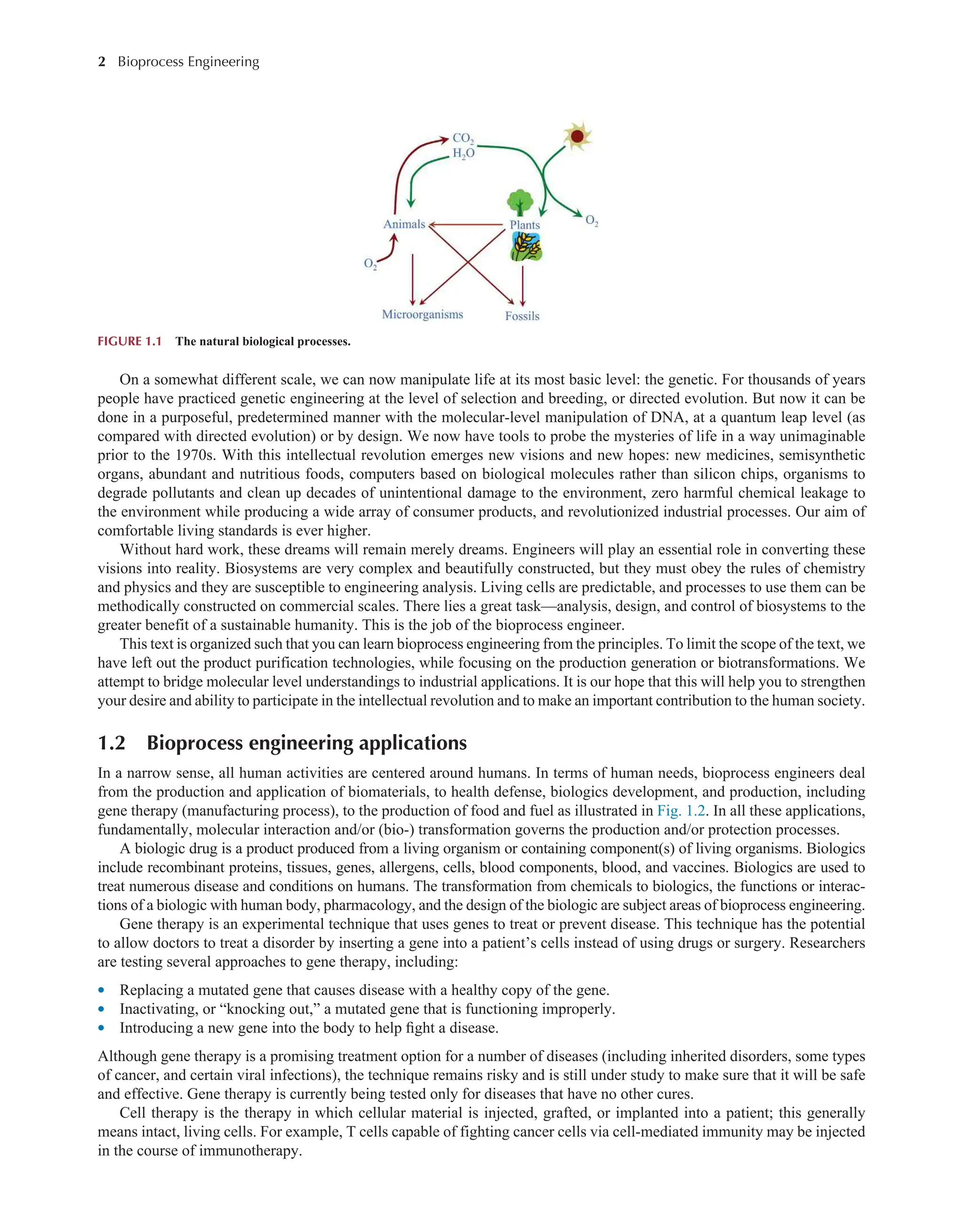
Fig. 1.1 illustrates the natural biological processes occurring on Earth. Living systems consist of plants, animals, and mi-
croorganisms. Sunlight is used by plants to convert CO2 and H2O into carbohydrates and other organic matter, releasing O2.
Animals consume plant matter, converting plant materials into animal cells, and using the chemical energy from oxidizing
plant matter into CO2 and H2O (H2O also serves as a key substrate for animals), finishing the cycle. Microorganisms further
convert dead animal and/or plant biomass into other form of organic substances fertilizing the growth of plants, releasing
CO2 and H2O, and the cycle is repeated. Energy from the Sun is used to form molecules and organisms that we call life. Ma-
terials or matter participating in the biological cycle are renewable so long as the cycle is maintained. Bioprocess engineers
manipulate and make use of this cycle by designing processes to make desired products, either by training microorganisms,
plants, and animals, or via direct chemical conversions.
The reactor is the heart of any chemical and/or biochemical processes. With reactors, bioprocesses turn inexpensive sus-
tainably renewable chemicals such as carbohydrates, into valuable ones that humans need. As such, bioprocesses are chemi-
cal processes that use biological substrates and/or catalysts. While not limited to such, we tend to refer to bioprocesses as
(1) biologically converting inexpensive “chemicals” or materials into valuable chemicals or materials; and (2) manipulating
biological organisms to serve as “catalyst” for conversion or production of products that human need. Bioprocess engineers
are the only people technically trained to understand, design, and efficiently handle bioreactors. Bioprocess engineering
ensures that a favorable sustainable state or predictable outcome of a bioprocess is achieved. This is equivalent to saying
that bioprocess engineers are engineers with, differentiating from other engineers, training in biological sciences, especially
quantitative and analytical biological sciences, and green chemistry.
If one thinks of science as a dream, engineering is making the dream a reality. The maturing of Chemical Engineer-
ing to a major discipline and as one of the very few well-defined disciplines in the 1950s has led to the ease in the mass
production of commodity chemicals and completely changed the economics or value structure of materials and chemicals,
thanks to the vastly available what were then “waste” and “toxic” materials—fossil resources. Food and materials can be
manufactured from the cheap fossil materials. Our living standards improved significantly. Today, chemical reactors and
chemical processes are not built by trial-and-error, but by design. The performance of a chemical reactor can be predicted,
not just found to happen that way; the differences between large and small reactors are largely solved. Once a dream for
the visional pioneers, it can now be achieved at ease. Fossil chemical and energy sources have provided much of our needs
for advancing and maintaining the living standards of today. With the dwindling of fossil resources, we are facing yet an-
other value structure change. The dream has been shifted to realizing a society that is built upon renewable and sustainable
resources. Fossil sources will no longer be abundant for human use. Sustainability becomes the primary concern. Who is
going to make this dream come true?
Chapter 1
What is bioprocess engineering?
Chapter outline
1.1 Biological cycle 1
1.2 Bioprocess engineering applications 2
1.3 Scales: living organism and manufacturing 3
1.4 Green chemistry 4
1.5 Sustainability 5
1.6 Biorefinery 5
1.7 Biotechnology and bioprocess engineering 8
1.8 Mathematics, biology, and engineering 9
1.9 The story of penicillin: the dawn of bioprocess
engineering 9
1.10 Bioprocesses: regulatory constraints 12
1.11 The pillars of bioprocess kinetics and systems
engineering 13
1.12 Summary 14
Problems 14
References 14
Further readings 15
2 Bioprocess Engineering

On a somewhat different scale, we can now manipulate life at its most basic level: the genetic. For thousands of years
people have practiced genetic engineering at the level of selection and breeding, or directed evolution. But now it can be
done in a purposeful, predetermined manner with the molecular-level manipulation of DNA, at a quantum leap level (as
compared with directed evolution) or by design. We now have tools to probe the mysteries of life in a way unimaginable
prior to the 1970s. With this intellectual revolution emerges new visions and new hopes: new medicines, semisynthetic
organs, abundant and nutritious foods, computers based on biological molecules rather than silicon chips, organisms to
degrade pollutants and clean up decades of unintentional damage to the environment, zero harmful chemical leakage to
the environment while producing a wide array of consumer products, and revolutionized industrial processes. Our aim of
comfortable living standards is ever higher.
Without hard work, these dreams will remain merely dreams. Engineers will play an essential role in converting these
visions into reality. Biosystems are very complex and beautifully constructed, but they must obey the rules of chemistry
and physics and they are susceptible to engineering analysis. Living cells are predictable, and processes to use them can be
methodically constructed on commercial scales. There lies a great task—analysis, design, and control of biosystems to the
greater benefit of a sustainable humanity. This is the job of the bioprocess engineer.
This text is organized such that you can learn bioprocess engineering from the principles. To limit the scope of the text, we
have left out the product purification technologies, while focusing on the production generation or biotransformations. We
attempt to bridge molecular level understandings to industrial applications. It is our hope that this will help you to strengthen
your desire and ability to participate in the intellectual revolution and to make an important contribution to the human society.
1.2 Bioprocess engineering applications
In a narrow sense, all human activities are centered around humans. In terms of human needs, bioprocess engineers deal
from the production and application of biomaterials, to health defense, biologics development, and production, including
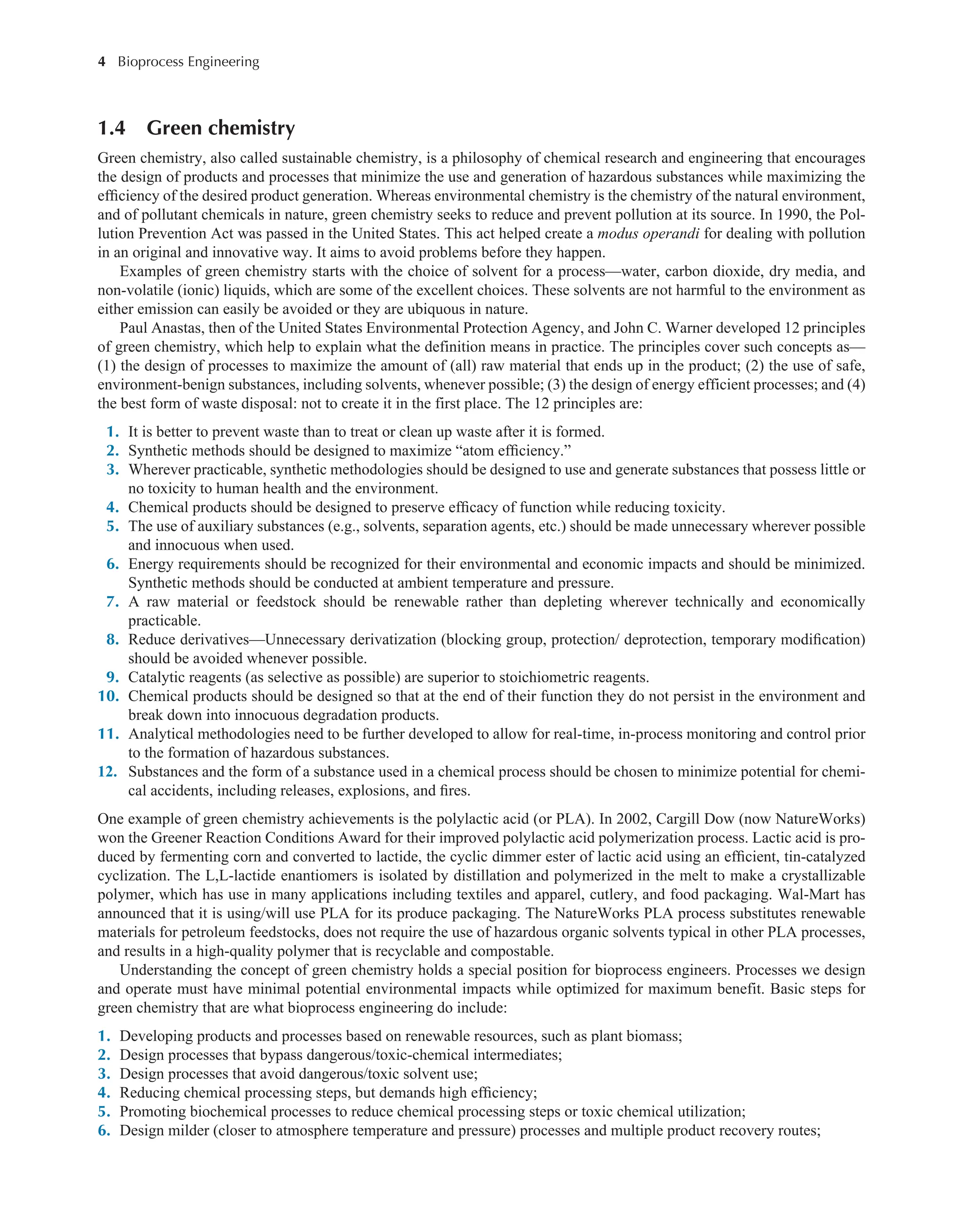
gene therapy (manufacturing process), to the production of food and fuel as illustrated in Fig. 1.2. In all these applications,
fundamentally, molecular interaction and/or (bio-) transformation governs the production and/or protection processes.
A biologic drug is a product produced from a living organism or containing component(s) of living organisms. Biologics
include recombinant proteins, tissues, genes, allergens, cells, blood components, blood, and vaccines. Biologics are used to
treat numerous disease and conditions on humans. The transformation from chemicals to biologics, the functions or interac-
tions of a biologic with human body, pharmacology, and the design of the biologic are subject areas of bioprocess engineering.
Gene therapy is an experimental technique that uses genes to treat or prevent disease. This technique has the potential
to allow doctors to treat a disorder by inserting a gene into a patient’s cells instead of using drugs or surgery. Researchers
are testing several approaches to gene therapy, including:
l Replacing a mutated gene that causes disease with a healthy copy of the gene.
l Inactivating, or “knocking out,” a mutated gene that is functioning improperly.
l Introducing a new gene into the body to help fight a disease.
Although gene therapy is a promising treatment option for a number of diseases (including inherited disorders, some types
of cancer, and certain viral infections), the technique remains risky and is still under study to make sure that it will be safe
and effective. Gene therapy is currently being tested only for diseases that have no other cures.
Cell therapy is the therapy in which cellular material is injected, grafted, or implanted into a patient; this generally
means intact, living cells. For example, T cells capable of fighting cancer cells via cell-mediated immunity may be injected
in the course of immunotherapy.
FIGURE 1.1 The natural biological processes.
What is bioprocess engineering? Chapter | 1 3
Cell therapy originated in the 19th century when scientists experimented by injecting animal material in an attempt
to prevent and treat illness. Although such attempts produced no positive benefit, further research found in the mid 20th
century that human cells could be used to help prevent the human body rejecting transplanted organs, leading in time to
successful bone-marrow transplantation
Chimeric antigen receptor (CAR)-modified T cell therapy, for example, has proven to be effective for patients with B
cell hematological malignancies. Challenges remain in how to scale out the production of CAR T cells under current good
manufacturing procedure (cGMP) in an efficient, effective manner. Currently as a mostly autologous cell-based therapy,
the CAR-T cell manufacturing process represents a completely different manufacturing model from traditional biologics.
One of the challenges of this largely personalized medicine is the development of efficient technologies and cost-effective
clinical manufacturing platforms to support the later-stage clinical trials toward commercialization. Substantial efforts have
been placed on the upstream for gene transduction and cell expansion.
Apart from health defense and/or biologics, commodity products production is crucial for the human society. Food,
fuels, and materials fill in the basic needs.
1.3 Scales: living organism and manufacturing
Bioprocess engineering deals with a variable scale, from the molecular level at research to process operation in a factory
at manufacturing level. In health applications, this translates to medical research at the most fundamental level of enzyme/
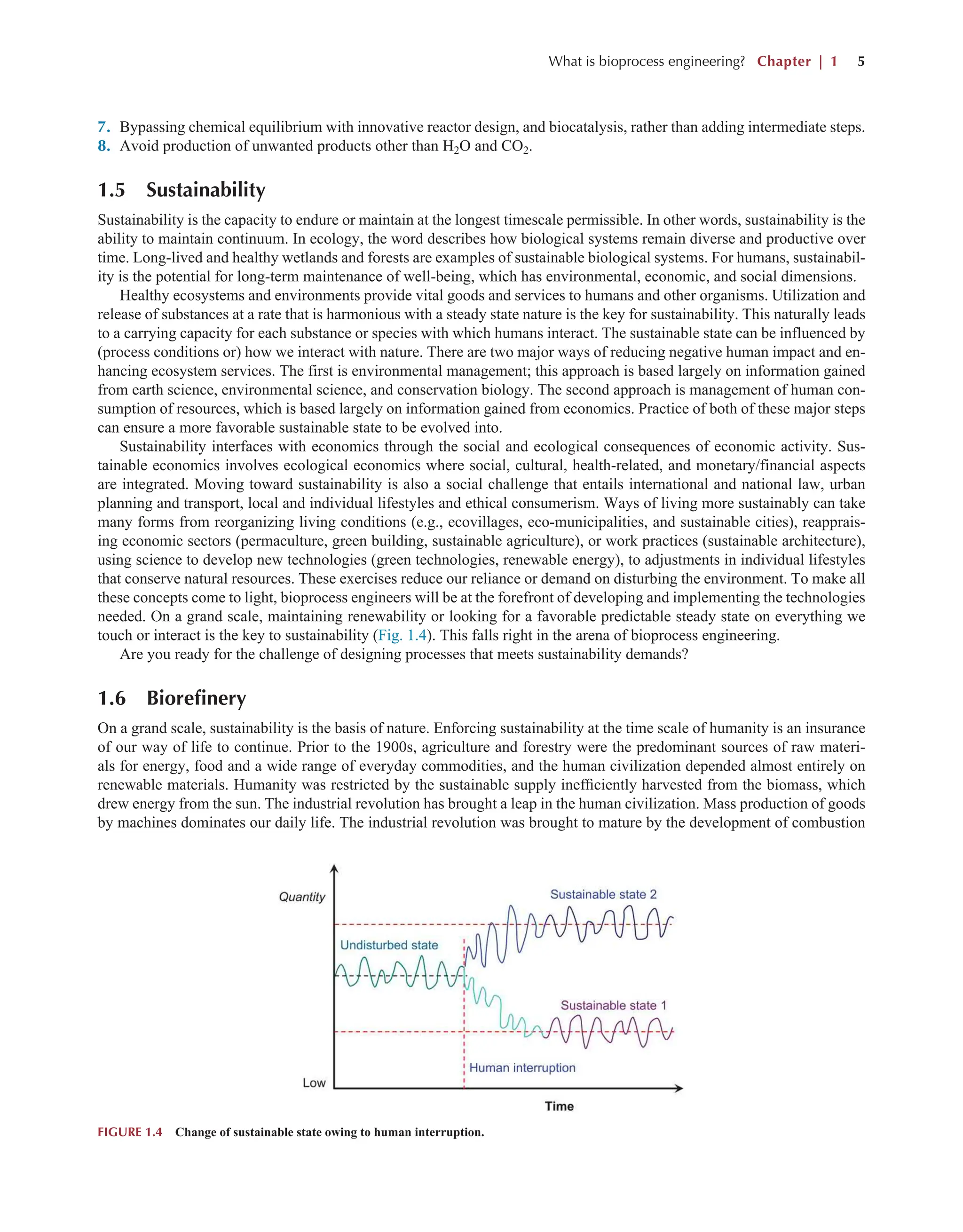
protein to human health professionals at overall health. Fig. 1.3 shows side-side the comparison from a “traditional” chemi-
cal engineering view on the left to the “health” engineering on the right.
The function of a protein or an enzyme within human cells is important for the overall health of human. When or if
any changes to the protein or a foreign protein invades a human cell, the physiology will change, causing a domino effect/
change to far-reaching cells. Regulating the protein and enzyme functions can also be effected with ligands or chemicals.
The molecular interactions are key to the overall health of humans.
FIGURE 1.2 The applications of bioprocess engineering centered around humanity needs.
FIGURE 1.3 A comparison of the chemical engineering (left) with processes in a complex living organism: human body. The bottom is at the
microscopic scale where molecular interactions are examined, whereas at the top the factory as a whole is considered.
4 Bioprocess Engineering

1.4 Green chemistry
Green chemistry, also called sustainable chemistry, is a philosophy of chemical research and engineering that encourages
the design of products and processes that minimize the use and generation of hazardous substances while maximizing the
efficiency of the desired product generation. Whereas environmental chemistry is the chemistry of the natural environment,
and of pollutant chemicals in nature, green chemistry seeks to reduce and prevent pollution at its source. In 1990, the Pol-
lution Prevention Act was passed in the United States. This act helped create a modus operandi for dealing with pollution
in an original and innovative way. It aims to avoid problems before they happen.
Examples of green chemistry starts with the choice of solvent for a process—water, carbon dioxide, dry media, and
non-volatile (ionic) liquids, which are some of the excellent choices. These solvents are not harmful to the environment as
either emission can easily be avoided or they are ubiquous in nature.
Paul Anastas, then of the United States Environmental Protection Agency, and John C. Warner developed 12 principles
of green chemistry, which help to explain what the definition means in practice. The principles cover such concepts as—
(1) the design of processes to maximize the amount of (all) raw material that ends up in the product; (2) the use of safe,
environment-benign substances, including solvents, whenever possible; (3) the design of energy efficient processes; and (4)
the best form of waste disposal: not to create it in the first place. The 12 principles are:
1. It is better to prevent waste than to treat or clean up waste after it is formed.
2. Synthetic methods should be designed to maximize “atom efficiency.”
3. Wherever practicable, synthetic methodologies should be designed to use and generate substances that possess little or
no toxicity to human health and the environment.
4. Chemical products should be designed to preserve efficacy of function while reducing toxicity.
5. The use of auxiliary substances (e.g., solvents, separation agents, etc.) should be made unnecessary wherever possible
and innocuous when used.
6. Energy requirements should be recognized for their environmental and economic impacts and should be minimized.
Synthetic methods should be conducted at ambient temperature and pressure.
7. A raw material or feedstock should be renewable rather than depleting wherever technically and economically
practicable.
8. Reduce derivatives—Unnecessary derivatization (blocking group, protection/ deprotection, temporary modification)
should be avoided whenever possible.
9. Catalytic reagents (as selective as possible) are superior to stoichiometric reagents.
10. Chemical products should be designed so that at the end of their function they do not persist in the environment and
break down into innocuous degradation products.
11. Analytical methodologies need to be further developed to allow for real-time, in-process monitoring and control prior
to the formation of hazardous substances.
12. Substances and the form of a substance used in a chemical process should be chosen to minimize potential for chemi-
cal accidents, including releases, explosions, and fires.
One example of green chemistry achievements is the polylactic acid (or PLA). In 2002, Cargill Dow (now NatureWorks)
won the Greener Reaction Conditions Award for their improved polylactic acid polymerization process. Lactic acid is pro-
duced by fermenting corn and converted to lactide, the cyclic dimmer ester of lactic acid using an efficient, tin-catalyzed
cyclization. The L,L-lactide enantiomers is isolated by distillation and polymerized in the melt to make a crystallizable
polymer, which has use in many applications including textiles and apparel, cutlery, and food packaging. Wal-Mart has
announced that it is using/will use PLA for its produce packaging. The NatureWorks PLA process substitutes renewable
materials for petroleum feedstocks, does not require the use of hazardous organic solvents typical in other PLA processes,
and results in a high-quality polymer that is recyclable and compostable.
Understanding the concept of green chemistry holds a special position for bioprocess engineers. Processes we design
and operate must have minimal potential environmental impacts while optimized for maximum benefit. Basic steps for
green chemistry that are what bioprocess engineering do include:
1. Developing products and processes based on renewable resources, such as plant biomass;
2. Design processes that bypass dangerous/toxic-chemical intermediates;
3. Design processes that avoid dangerous/toxic solvent use;
4. Reducing chemical processing steps, but demands high efficiency;
5. Promoting biochemical processes to reduce chemical processing steps or toxic chemical utilization;
6. Design milder (closer to atmosphere temperature and pressure) processes and multiple product recovery routes;
What is bioprocess engineering? Chapter | 1 5
7. Bypassing chemical equilibrium with innovative reactor design, and biocatalysis, rather than adding intermediate steps.
8. Avoid production of unwanted products other than H2O and CO2.
1.5 Sustainability
Sustainability is the capacity to endure or maintain at the longest timescale permissible. In other words, sustainability is the
ability to maintain continuum. In ecology, the word describes how biological systems remain diverse and productive over
time. Long-lived and healthy wetlands and forests are examples of sustainable biological systems. For humans, sustainabil-
ity is the potential for long-term maintenance of well-being, which has environmental, economic, and social dimensions.
Healthy ecosystems and environments provide vital goods and services to humans and other organisms. Utilization and
release of substances at a rate that is harmonious with a steady state nature is the key for sustainability. This naturally leads
to a carrying capacity for each substance or species with which humans interact. The sustainable state can be influenced by
(process conditions or) how we interact with nature. There are two major ways of reducing negative human impact and en-
hancing ecosystem services. The first is environmental management; this approach is based largely on information gained
from earth science, environmental science, and conservation biology. The second approach is management of human con-
sumption of resources, which is based largely on information gained from economics. Practice of both of these major steps
can ensure a more favorable sustainable state to be evolved into.
Sustainability interfaces with economics through the social and ecological consequences of economic activity. Sus-
tainable economics involves ecological economics where social, cultural, health-related, and monetary/financial aspects
are integrated. Moving toward sustainability is also a social challenge that entails international and national law, urban
planning and transport, local and individual lifestyles and ethical consumerism. Ways of living more sustainably can take
many forms from reorganizing living conditions (e.g., ecovillages, eco-municipalities, and sustainable cities), reapprais-
ing economic sectors (permaculture, green building, sustainable agriculture), or work practices (sustainable architecture),
using science to develop new technologies (green technologies, renewable energy), to adjustments in individual lifestyles
that conserve natural resources. These exercises reduce our reliance or demand on disturbing the environment. To make all
these concepts come to light, bioprocess engineers will be at the forefront of developing and implementing the technologies
needed. On a grand scale, maintaining renewability or looking for a favorable predictable steady state on everything we
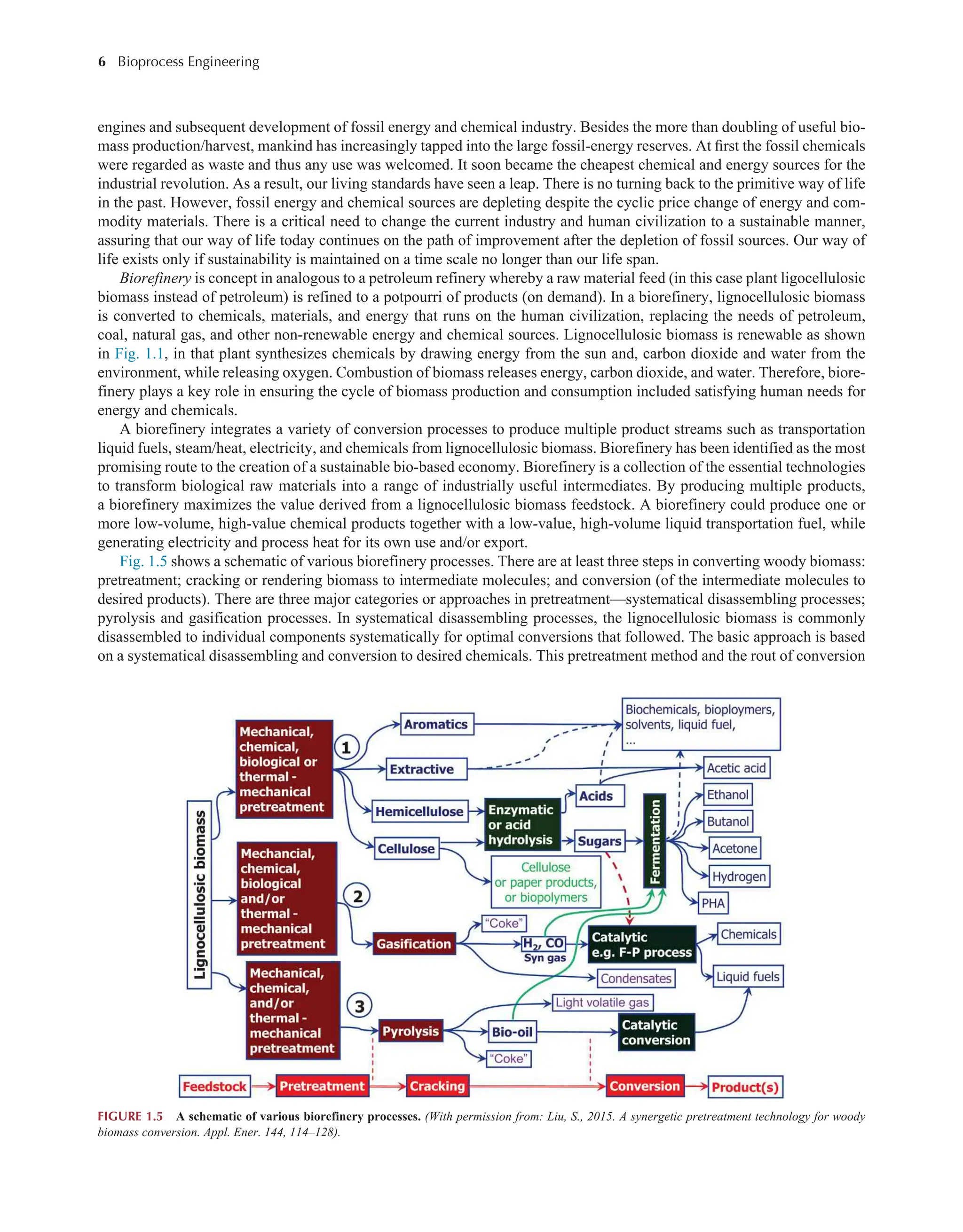
touch or interact is the key to sustainability (Fig. 1.4). This falls right in the arena of bioprocess engineering.
Are you ready for the challenge of designing processes that meets sustainability demands?
1.6 Biorefinery
On a grand scale, sustainability is the basis of nature. Enforcing sustainability at the time scale of humanity is an insurance
of our way of life to continue. Prior to the 1900s, agriculture and forestry were the predominant sources of raw materi-
als for energy, food and a wide range of everyday commodities, and the human civilization depended almost entirely on
renewable materials. Humanity was restricted by the sustainable supply inefficiently harvested from the biomass, which
drew energy from the sun. The industrial revolution has brought a leap in the human civilization. Mass production of goods
by machines dominates our daily life. The industrial revolution was brought to mature by the development of combustion
FIGURE 1.4 Change of sustainable state owing to human interruption.
6 Bioprocess Engineering

engines and subsequent development of fossil energy and chemical industry. Besides the more than doubling of useful bio-
mass production/harvest, mankind has increasingly tapped into the large fossil-energy reserves. At first the fossil chemicals
were regarded as waste and thus any use was welcomed. It soon became the cheapest chemical and energy sources for the
industrial revolution. As a result, our living standards have seen a leap. There is no turning back to the primitive way of life
in the past. However, fossil energy and chemical sources are depleting despite the cyclic price change of energy and com-
modity materials. There is a critical need to change the current industry and human civilization to a sustainable manner,
assuring that our way of life today continues on the path of improvement after the depletion of fossil sources. Our way of
life exists only if sustainability is maintained on a time scale no longer than our life span.
Biorefinery is concept in analogous to a petroleum refinery whereby a raw material feed (in this case plant ligocellulosic
biomass instead of petroleum) is refined to a potpourri of products (on demand). In a biorefinery, lignocellulosic biomass
is converted to chemicals, materials, and energy that runs on the human civilization, replacing the needs of petroleum,
coal, natural gas, and other non-renewable energy and chemical sources. Lignocellulosic biomass is renewable as shown
in Fig. 1.1, in that plant synthesizes chemicals by drawing energy from the sun and, carbon dioxide and water from the
environment, while releasing oxygen. Combustion of biomass releases energy, carbon dioxide, and water. Therefore, biore-
finery plays a key role in ensuring the cycle of biomass production and consumption included satisfying human needs for
energy and chemicals.
A biorefinery integrates a variety of conversion processes to produce multiple product streams such as transportation
liquid fuels, steam/heat, electricity, and chemicals from lignocellulosic biomass. Biorefinery has been identified as the most
promising route to the creation of a sustainable bio-based economy. Biorefinery is a collection of the essential technologies
to transform biological raw materials into a range of industrially useful intermediates. By producing multiple products,
a biorefinery maximizes the value derived from a lignocellulosic biomass feedstock. A biorefinery could produce one or
more low-volume, high-value chemical products together with a low-value, high-volume liquid transportation fuel, while
generating electricity and process heat for its own use and/or export.
Fig. 1.5 shows a schematic of various biorefinery processes. There are at least three steps in converting woody biomass:
pretreatment; cracking or rendering biomass to intermediate molecules; and conversion (of the intermediate molecules to
desired products). There are three major categories or approaches in pretreatment—systematical disassembling processes;
pyrolysis and gasification processes. In systematical disassembling processes, the lignocellulosic biomass is commonly
disassembled to individual components systematically for optimal conversions that followed. The basic approach is based
on a systematical disassembling and conversion to desired chemicals. This pretreatment method and the rout of conversion
FIGURE 1.5 A schematic of various biorefinery processes. (With permission from: Liu, S., 2015. A synergetic pretreatment technology for woody
biomass conversion. Appl. Ener. 144, 114–128).
What is bioprocess engineering? Chapter | 1 7
followed depend heavily on separation and/or physical fractionation of the intermediates as well as the final desired prod-
ucts. Pyrolysis applies heat and some oxygen (or none) to render the biomass to liquid, while gasification renders the bio-
mass to syngas. Biological conversions are preferred over chemical conversions due to their selectivity or green chemistry
concepts. However, owing to the complexity of the lignocellulosic biomass, a multitude of biological processes is required
for optimal operations. The biological reactions are also very slow and thus require larger facility foot prints. Especially
following the gasification, bioconversion is in the “primitive” stage of development.
Pyrolysis resembles more closely to the refinery whereby the products can be controlled in a more systematical man-
ner. It may be classified as systematical disassembling as well. However, there are restrictions on the type of products
the process can produce. Gasification as shown in Fig. 1.5 is at the extreme side of conversion technology, whereby the
lignocellulosic biomass is disassembled to the basic building block for hydrocarbons: H2 and CO, and then reassembled
to desired products as desired. The final products can be more easily tailored from syngas or CO + H2. For example,
Fisher-Tropsch process can turn CO + H2 into higher alcohol, alkenes, and many other products. Syn gas (together with
air: mixture of N2 and O2) is also the starting point for ammonia synthesis, from which nitrogen fertilizers and many other
products are produced. However, all thermochemical processes suffer from selectivity. During the disassembling process,
“coke” or “carbon” is produced especially at high temperatures and thus reduces the conversion efficiency, if H2 and CO
are the desired intermediates. Thermal-chemical processes are generally considered less “green” than biological and other
sequential disassembling processes due to their severe operating conditions, poor selectivity or byproducts generation, and
thermodynamic restrictions.
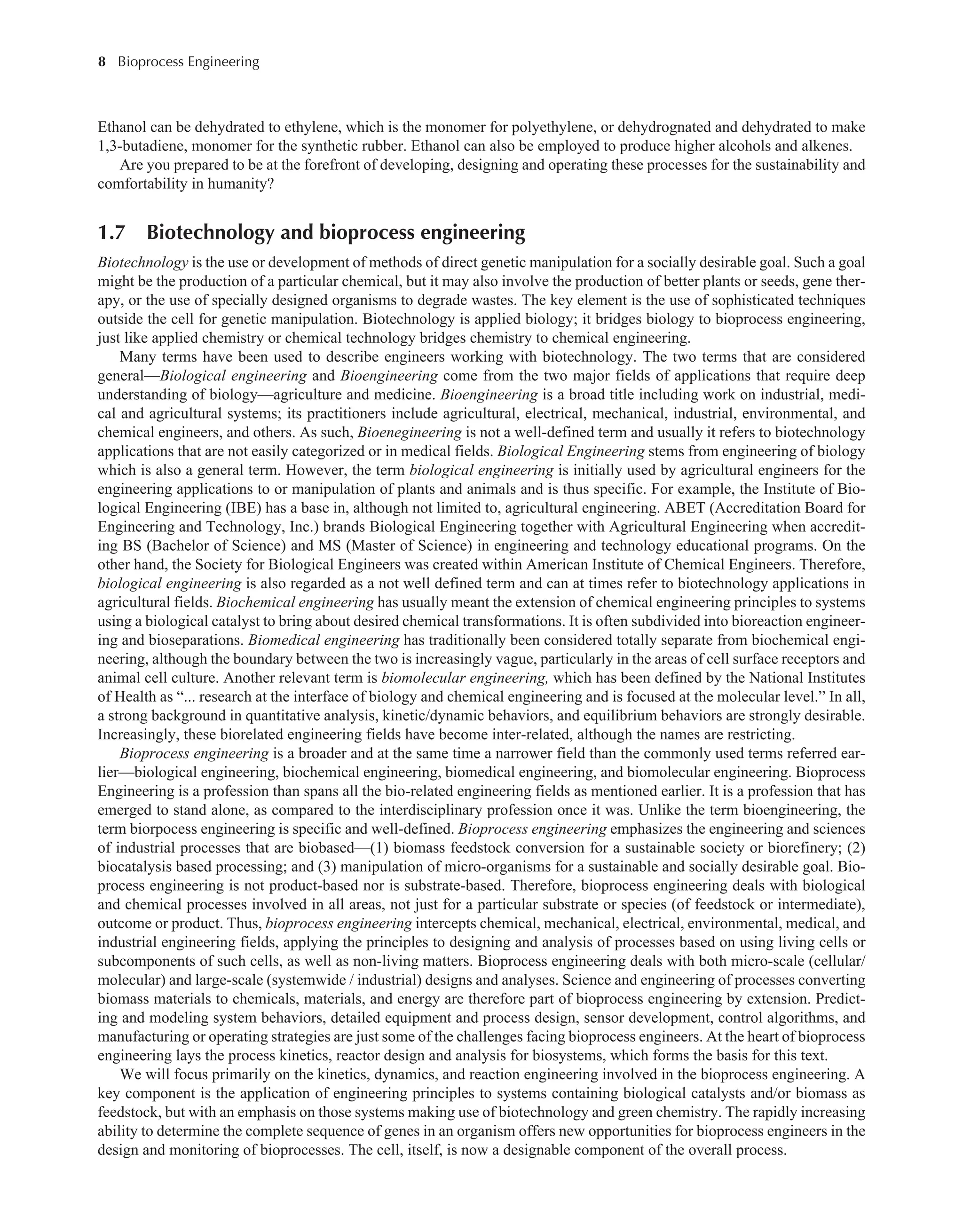
The promise of a biorefinery to supply the products human needs is shown in Fig. 1.6 for the various examples of build-
ing blocks or platform chemicals that sugar (a specific example of glucose) can produce, besides the very basic building
blocks of CO and H2. For example, glucose can be fermented to ethanol by yeast and bacteria anaerobically, and lactic acid
can be produced by lacto bacteria. As shown in Fig. 1.6, each arrow radiates from the glucose in the center represents a route
of biotransformation (or fermentation) by default, whereas chemical transformations are shown with labeled arrows. For
example, glucose can be dehydrated to 5-hydroxymethylfurfural catalyzed with an acid, which can be further decomposed
to levulinic acid by hydration. All these chemicals shown in Fig. 1.6 are examples of important platform (or intermediate)
chemicals, as well as commodity chemicals. For example, ethanol is well known for its use as a liquid transportation fuel.
FIGURE 1.6 The platform of chemicals derived from glucose (the molecule in the center of the diagram). Most of these chemicals are produced
via fermentation (or biotransformation), while a few of them are produced via chemical reaction (or chemical transformation) as indicated.
8 Bioprocess Engineering

Ethanol can be dehydrated to ethylene, which is the monomer for polyethylene, or dehydrognated and dehydrated to make
1,3-butadiene, monomer for the synthetic rubber. Ethanol can also be employed to produce higher alcohols and alkenes.
Are you prepared to be at the forefront of developing, designing and operating these processes for the sustainability and
comfortability in humanity?
1.7 Biotechnology and bioprocess engineering
Biotechnology is the use or development of methods of direct genetic manipulation for a socially desirable goal. Such a goal
might be the production of a particular chemical, but it may also involve the production of better plants or seeds, gene ther-
apy, or the use of specially designed organisms to degrade wastes. The key element is the use of sophisticated techniques
outside the cell for genetic manipulation. Biotechnology is applied biology; it bridges biology to bioprocess engineering,
just like applied chemistry or chemical technology bridges chemistry to chemical engineering.
Many terms have been used to describe engineers working with biotechnology. The two terms that are considered
general—Biological engineering and Bioengineering come from the two major fields of applications that require deep
understanding of biology—agriculture and medicine. Bioengineering is a broad title including work on industrial, medi-
cal and agricultural systems; its practitioners include agricultural, electrical, mechanical, industrial, environmental, and
chemical engineers, and others. As such, Bioenegineering is not a well-defined term and usually it refers to biotechnology
applications that are not easily categorized or in medical fields. Biological Engineering stems from engineering of biology
which is also a general term. However, the term biological engineering is initially used by agricultural engineers for the
engineering applications to or manipulation of plants and animals and is thus specific. For example, the Institute of Bio-
logical Engineering (IBE) has a base in, although not limited to, agricultural engineering. ABET (Accreditation Board for
Engineering and Technology, Inc.) brands Biological Engineering together with Agricultural Engineering when accredit-
ing BS (Bachelor of Science) and MS (Master of Science) in engineering and technology educational programs. On the
other hand, the Society for Biological Engineers was created within American Institute of Chemical Engineers. Therefore,
biological engineering is also regarded as a not well defined term and can at times refer to biotechnology applications in
agricultural fields. Biochemical engineering has usually meant the extension of chemical engineering principles to systems
using a biological catalyst to bring about desired chemical transformations. It is often subdivided into bioreaction engineer-
ing and bioseparations. Biomedical engineering has traditionally been considered totally separate from biochemical engi-
neering, although the boundary between the two is increasingly vague, particularly in the areas of cell surface receptors and
animal cell culture. Another relevant term is biomolecular engineering, which has been defined by the National Institutes
of Health as “... research at the interface of biology and chemical engineering and is focused at the molecular level.” In all,
a strong background in quantitative analysis, kinetic/dynamic behaviors, and equilibrium behaviors are strongly desirable.
Increasingly, these biorelated engineering fields have become inter-related, although the names are restricting.
Bioprocess engineering is a broader and at the same time a narrower field than the commonly used terms referred ear-
lier—biological engineering, biochemical engineering, biomedical engineering, and biomolecular engineering. Bioprocess
Engineering is a profession than spans all the bio-related engineering fields as mentioned earlier. It is a profession that has
emerged to stand alone, as compared to the interdisciplinary profession once it was. Unlike the term bioengineering, the
term biorpocess engineering is specific and well-defined. Bioprocess engineering emphasizes the engineering and sciences
of industrial processes that are biobased—(1) biomass feedstock conversion for a sustainable society or biorefinery; (2)
biocatalysis based processing; and (3) manipulation of micro-organisms for a sustainable and socially desirable goal. Bio-
process engineering is not product-based nor is substrate-based. Therefore, bioprocess engineering deals with biological
and chemical processes involved in all areas, not just for a particular substrate or species (of feedstock or intermediate),
outcome or product. Thus, bioprocess engineering intercepts chemical, mechanical, electrical, environmental, medical, and
industrial engineering fields, applying the principles to designing and analysis of processes based on using living cells or
subcomponents of such cells, as well as non-living matters. Bioprocess engineering deals with both micro-scale (cellular/
molecular) and large-scale (systemwide / industrial) designs and analyses. Science and engineering of processes converting
biomass materials to chemicals, materials, and energy are therefore part of bioprocess engineering by extension. Predict-
ing and modeling system behaviors, detailed equipment and process design, sensor development, control algorithms, and
manufacturing or operating strategies are just some of the challenges facing bioprocess engineers. At the heart of bioprocess
engineering lays the process kinetics, reactor design and analysis for biosystems, which forms the basis for this text.
We will focus primarily on the kinetics, dynamics, and reaction engineering involved in the bioprocess engineering. A
key component is the application of engineering principles to systems containing biological catalysts and/or biomass as
feedstock, but with an emphasis on those systems making use of biotechnology and green chemistry. The rapidly increasing
ability to determine the complete sequence of genes in an organism offers new opportunities for bioprocess engineers in the
design and monitoring of bioprocesses. The cell, itself, is now a designable component of the overall process.
What is bioprocess engineering? Chapter | 1 9
For practitioners working in the bioprocess engineering, some of journals and periodicals provide the latest develop-
ments in the field. Here we name a few:
l Biochemical Engineering Journal
l Journal of Biological Engineering
l Journal of Biomass Conversion and Biorefinery
l Journal of Bioprocess Engineering and Biorefinery
l Journal of Bioprocess and Bioystems Engineering
l Journal of Biotechnology
l Journal of Biotechnology Advances
l Journal of Biotechnology and Bioprocess Engineering
1.8 Mathematics, biology, and engineering
Mathematical modeling holds the key for engineers. Physics at its fundamental level examines forces and motion; one can
view it as applied mathematics. In turn, chemistry examines molecules and their interactions. Since physics examines the
motions of atoms, nuclei and electrons, at the basis of molecules, one can view chemistry as applied physics. This directly
connects chemistry to mathematics at a fundamental level. Indeed, most physicists and chemists rely extensively on math-
ematical modeling. While one can view biology as applied chemistry through the connection of chemicals and molecules,
the fundamental trainings of biologists today and engineers are distinctly different. In the development of knowledge in the
life sciences, unlike chemistry and physics, mathematical theories and quantitative methods (except statistics) have played
a secondary role. Most progress has been due to improvements in experimental tools. Results are qualitative and descrip-
tive models are formulated and tested. Consequently, biologists often have incomplete backgrounds in mathematics but are
very strong with respect to laboratory tools and, more importantly, with respect to the interpretation of laboratory data from
complex systems.
Engineers usually possess a very good background in the physical and mathematical sciences. Often a theory leads to
mathematical formulations, and the validity of the theory is tested by comparing predicted responses to those in experi-
ments. Quantitative models and approaches, even to complex systems, are strengths. Biologists are usually better at the
formation of testable hypotheses, experimental design, and data interpretation from complex systems. At the dawn of the
biotechnology era, engineers were typically unfamiliar with the experimental techniques and strategies used by life scien-
tists. However, today bioprocess engineers have entered even more sophisticated experimental techniques and strategies in
life sciences (than biologists) due to the understanding and progress in the prediction and modeling of living cells.
The well-groundedness in mathematical modeling gives bioprocess engineers an edge and responsibility in enforcing
sustainability demands. In practice, the sustainable (or steady) state can be different from what we know today or when no
human interruption is imposed. The sustainable state could even be fluctuating with a noticeable degree. Engineers hold
great responsibility to convincing environmentalists and the public what to expect by accurately predicting the dynamic
outcomes without speculating on the potential dramatic changes ahead.
The skills of the engineer and of the life scientist are complementary. To convert the promises of molecular biology into
new processes to make new products requires the integration of these skills. To function at this level, the engineer needs a
solid understanding of biology and its experimental tools. In this book, we provide sufficient biological background for you
to understand the chapters on applying engineering principles to biosystems. However, if you are serious about becoming a
bioprocess engineer, it is desirable if you had taken courses in microbiology, biochemistry, and cell biology, as you would
appreciate more of the engineering principles in this text.
1.9 The story of penicillin: the dawn of bioprocess engineering
Penicillin is an antibiotic of significant importance. The familiar story of penicillin was well-presented by Kargi & Shuler
in their text “Bioprocess Engineering – Basic Concepts.” As you would expect, the discovery of the chemical was acci-
dental and the production of the chemical is elaborate. In September 1928, Alexander Fleming at St. Mary’s Hospital in
London was trying to isolate the bacterium, Staphylococcus aureus, which causes boils. The technique in use was to grow
the bacterium on the surface of a nutrient solution. One Friday, the basement window was accidently left open overnight.
The experiments were carried out in the basement and one of the dishes had been contaminated inadvertently with a foreign
particle. Normally, such a contaminated plate would be tossed out. However, Fleming noticed that no bacteria grew near
the invading substance.
Fleming’s genius was to realize that this observation was meaningful and not a “failed” experiment. Fleming recognized
that the cell killing must be due to an antibacterial agent. He recovered the foreign particle and found that it was a common
10 Bioprocess Engineering

mold of the Penicillium genus (later identified as Penicillium notatum). Fleming nurtured the mold to grow and, using the
crude extraction methods then available, managed to obtain a tiny quantity of secreted material. He then demonstrated that
this material had powerful antimicrobial properties and named the product penicillin. Fleming carefully preserved the cul-
ture, but the discovery lay essentially dormant for over a decade.
World War II provided the impetus to resurrect the discovery. Sulfa drugs have a rather restricted range of activity,
and an antibiotic with minimal side effects and broader applicability was desperately needed. In 1939, Howard Florey
and Ernst Chain of Oxford decided to build on Fleming’s observations. Norman Heatley played the key role in producing
sufficient material for Chain and Florey to test the effectiveness of penicillin. Heatley, trained as a biochemist, performed
as a bioprocess engineer. He developed an assay to monitor the amount of penicillin made so as to determine the kinetics
of the fermentation, developed a culture technique that could be implemented easily, and devised a novel back-extraction
process to recover the very delicate product. After months of immense effort, they produced enough penicillin to treat some
laboratory animals.
Eighteen months after starting on the project, they began to treat a London policeman for a blood infection. The penicil-
lin worked wonders initially and brought the patient to the point of recovery. Most unfortunately, the supply of penicillin
was exhausted and the man relapsed and died. Nonetheless, Florey and Chain had demonstrated the great potential for
penicillin, if it could be made in sufficient amount. To make large amounts of penicillin would require a process, and for
such a process development, engineers would be needed, in addition to microbial physiologists and other life scientists.
The war further complicated the situation. Great Britain’s industrial facilities were already totally devoted to the war.
Florey and his associates approached pharmaceutical firms in the United States to persuade them to develop the capacity
to produce penicillin, since the United States was not at war at that time. Many companies and government laboratories,
assisted by many universities, took up the challenge. Particularly prominent were Merck, Pfizer, Squibb, and the USDA
Northern Regional Research Laboratory in Peoria, Illinois.
The first efforts with fermentation were modest. A large effort went into attempts to chemically synthesize penicillin.
This effort involved hundreds of chemists. Consequently, many companies were at first reluctant to commit to the fermenta-
tion process, beyond the pilot-plant stage. It was thought that the pilot-plant fermentation system could produce sufficient
penicillin to meet the needs of clinical testing, but large-scale production would soon be done by chemical synthesis. At
that time, US companies had achieved a great deal of success with chemical synthesis of other drugs, which gave the com-
panies a great deal of control over the drug’s production. The chemical synthesis of penicillin proved to be exceedingly
difficult (It was accomplished in the 1950s, and the synthesis route is still not competitive with fermentation). However, in
1940 fermentation for the production of a pharmaceutical was an unproved approach, and most companies were betting on
chemical synthesis to ultimately dominate.
The early clinical successes were so dramatic that in 1943 the War Production Board appointed A. L. Elder to coordinate
the activities of producers to greatly increase the supply of penicillin. The fermentation route was chosen. As Elder recalls,
“I was ridiculed by some of my closest scientific friends for allowing myself to become associated with what obviously was
to be a flop-namely, the commercial production of penicillin by a fermentation process” (from Elder, 1970). The problems
facing the fermentation process were indeed very formidable.
The problem was typical of most new fermentation processes: a valuable product made at very low levels. The low rate
of production per unit volume would necessitate very large and inefficient reactors, and the low concentration (titer) made
product recovery and purification very difficult. In 1939 the final concentration in a typical penicillin fermentation broth
was one part per million (ca. 0.001 g/L); gold is more plentiful in sea water. Furthermore, penicillin is a fragile and unstable
product, which places significant constraints on the approaches used for recovery and purification.
Life scientists at the Northern Regional Research Laboratory made many major contributions to the penicillin program.
One was the development of a corn steep liquor-lactose based medium. Andrew J. Moyer succeeded to increase productiv-
ity about 10-fold with this medium in November 26, 1941. A worldwide search by the laboratory for better producer strains
of Penicillium led to the isolation of a Penicillium chrysogenum strain. This strain, isolated from a moldy cantaloupe at a
Peoria fruit market, proved superior to hundreds of other isolates tested. Its progeny have been used in almost all commer-
cial penicillin fermentations.
The other hurdle was to decide on a manufacturing process. One method involved the growth of the mold on the surface
of moist bran. This bran method was discarded because of difficulties in temperature control, sterilization, and equipment
size. The surface method involved growth of the mold on top of a quiescent medium. The surface method used a variety of
containers, including milk bottles, and the term “bottle plant” indicated such a manufacturing technique. The surface meth-
od gave relatively high yields, but had a long-growing cycle and was very labor intensive. The first manufacturing plants
were bottle plants because the method worked and could be implemented quickly. However, it was clear that the surface
method would not meet the full need for penicillin. If the goal of the War Production Board was met by bottle plants, it was
What is bioprocess engineering? Chapter | 1 11
estimated that the necessary bottles would fill a row stretching from New York City to San Francisco. Engineers generally
favored a submerged tank process. The submerged process presented challenges in terms of both mold physiology and in
tank design and operation. Large volumes of absolutely clean, oil- and dirt-free sterile air were required. What were then
very large agitators were required, and the mechanical seal for the agitator shaft had to be designed to prevent the entry
of organisms. Even today, problems of oxygen supply and heat removal are important constraints on antibiotic fermenter
design. Contamination by foreign organisms could degrade the product as fast as it was formed, consume nutrients before
they were converted to penicillin, or produce toxins.
In addition to these challenges in reactor design, there were similar hurdles in product recovery and purification. The
very fragile nature of penicillin required the development of special techniques. A combination of pH shifts and rapid
liquid-liquid extraction proved useful.
Soon processes using tanks of about 10,000 gal were built. Pfizer completed in less than 6 months the first plant for
commercial production of penicillin by submerged fermentation (Hobby, 1985). The plant had 14 tanks each of 7000-gal
capacity. By a combination of good luck and hard work, the United States had the capacity by the end of World War II to
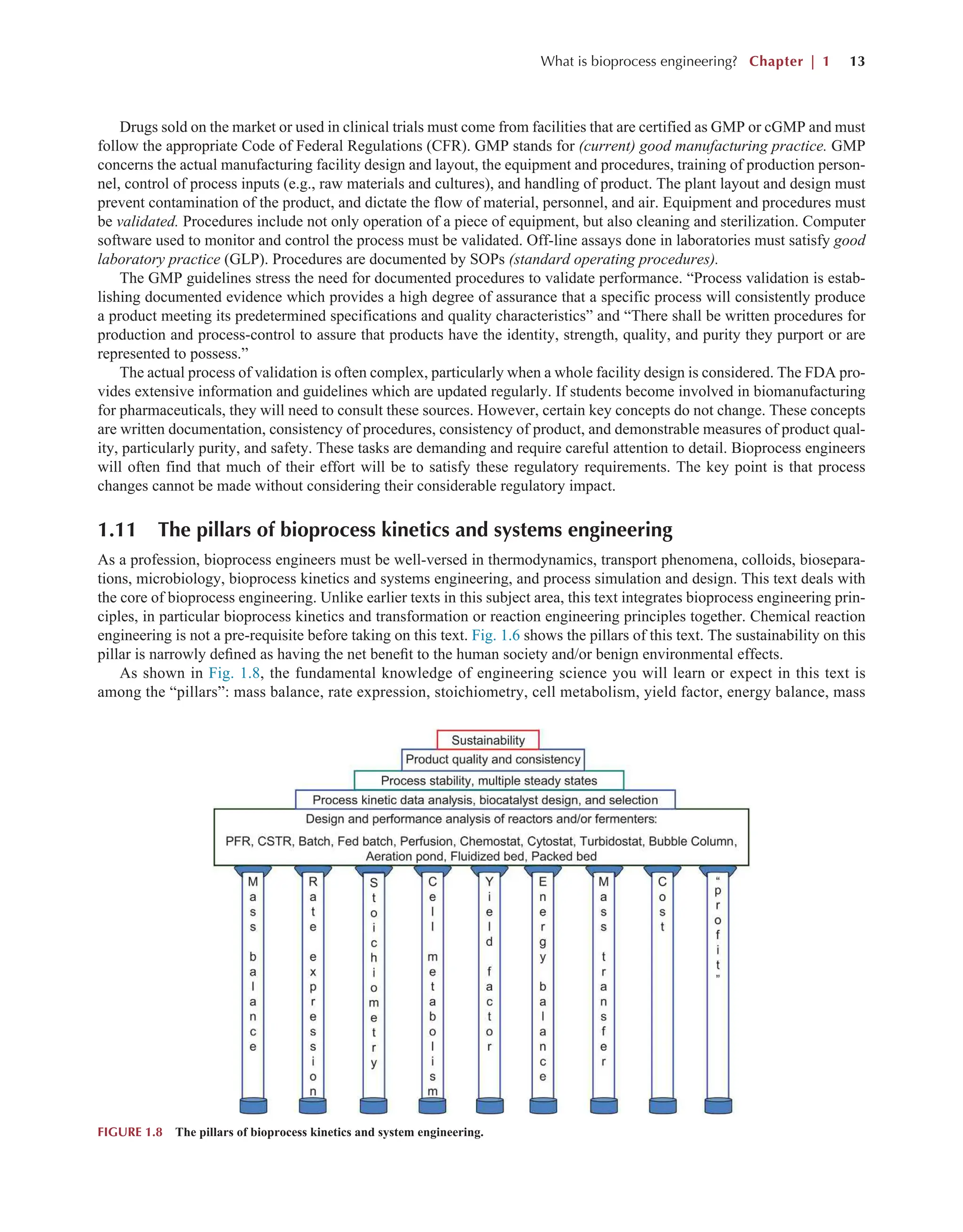
produce enough penicillin for almost 100,000 patients per year. A schematic of the process is shown in Fig. 1.7.
This accomplishment required a high level of multidisciplinary work. For example, Merck realized that men who un-
derstood both engineering and biology were not available. Merck assigned a chemical engineer and microbiologist together
to each aspect of the problem. They planned, executed, and analyzed the experimental program jointly, “almost as if they
were one man” (see the chapter by Silcox in Elder, 1970).
Progress with penicillin fermentation has continued, as has the need for the interaction of biologists and engineers. From
1939 to now, the yield of penicillin has gone from 0.001 g/L to over 50 g/L of fermentation broth. Progress has involved
better understanding of mold physiology, metabolic pathways, penicillin structure, methods of mutation, and selection of
mold genetics, process control, and reactor design.
Before the penicillin process, almost no chemical engineers sought specialized training in the life sciences. With the
advent of modem antibiotics, the concept of the bioprocess engineering was born. The penicillin process also established
a paradigm for bioprocess development and biochemical engineering. This paradigm still guides much of our profession’s
FIGURE 1.7 Schematic of penicillin production process.
12 Bioprocess Engineering

thinking. The mindset of bioprocess engineers was cast by the penicillin experience. It is for this reason that we have fo-
cused on the penicillin story, rather than on an example for production of a protein from a genetically engineered organism.
Although many parallels can be made between the penicillin process and our efforts to use recombinant DNA, no similar
paradigm has yet emerged from our experience with genetically engineered cells. We must continually reexamine the preju­
dices the field has inherited from the penicillin experience.
It is you, the student, who will best be able to challenge these prejudices.
1.10 Bioprocesses: regulatory constraints
To be an effective in bioprocess engineering, you must understand the regulatory climate in which many bioprocess engi-
neers work. The US FDA (Food and Drug Administration) and its equivalents in other countries must insure the safety and
efficacy of food and medicines. For bioprocess engineers working in the pharmaceutical industry the primary concern is not
reduction of manufacturing cost (although that is still a very desirable goal), but the production of a product of consistently
high quality in amounts to satisfy the medical needs of the population.
Consider briefly the process by which a drug obtains FDA approval. A typical drug undergoes 6–7 years of development
from the discovery stage through preclinical testing in animals. To legally test the drug in humans in the United States, an
Investigational New Drug (IND) designation must be issued by FDA. Biologics such as vaccines and recombinant protein
drugs are generally approved by FDA via a Biologic License Application (BLA). There are five phases of trials before a
new drug is placed on market after its discovery:
Phase 0: Human microdosing studies (1–3 years). This is a designation for the exploratory, first-in-human trials conducted
within the regulations of US-FDA 2006 Guidance on Exploratory Investigational New Drug studies.
Phase I: First stage testing in human subjects. Normally, a small group of (20–80) of healthy volunteers is selected. Safety,
tolerability, pharmacokinetics, and pharmacodynamics of the drug are evaluated. This phase usually lasts about 1 year.
Different types of types of trials in this phase are Single Ascending Dose (SAD), Multiple Ascending Dose (MAD), and
Food Effect trials.
Phase II: clinical trials (about 2 years). After determining the initial safety and pharmacological parameters, this trial on a
larger group of 100–300 patients and volunteers is performed. This trial is designed to assess the efficacy (i.e., does it help
the patient) as well as further determining which side effects exist. Sometimes, Phase IIA is designed to determine the dos-
ing requirements and Phase IIB is designed to determine the efficacy of the drug. If the drug fails to meet the established
standards of the trials, further development of the new drug is usually stopped.
Phase III: clinical trials (about 3 years) with 300–3000 (or more) patients. Since individuals vary in body chemistry, it is
important to test the range of responses in terms of both side effects and efficacy by using a representative cross section of
the population. Randomized controlled multicenter trials on large patient groups are conducted to determine the effective-
ness of the drug. This phase of the clinic trials is very expensive, time-consuming, and difficult to design and run, espe-
cially in therapies for chronic medical conditions. It is common practice that certain Phase III trials will continue while the
regulatory submission is pending at the appropriate regulatory agency. This allows patients to continue to receive possibly
lifesaving drugs until the drug us available in the market for distribution. These trials also provide additional safety data
and support for marketing claims for the drug. Data from clinical trials is presented to the FDA for review (2 months to
3 years). The review document presented to FDA clearly show the trial results combined with description of the methods
and results of human and animal studies, manufacturing procedures, formulation details, and shelf life. If the clinical trials
are well designed and demonstrated statistically significant improvements in health with acceptable side effects, the drug
is likely to be approved.
Phase IV: Postmarketing surveillance trial. Continue safety surveillance (pharmacovigilance) and technical support of a
drug after receiving permission to be put on the market.
The whole discovery-through-approval process takes 5–10 years for a conventional small molecule drug, and 12–15 years
for a new biological drug to make it to the market. It takes about $800–$2000 million to send a new drug to the market. Only
one in ten drugs that enter human clinical trials receives approval. Recent FDA reforms have decreased the time to obtain
approval for life-saving drugs in treatment of diseases such as cancer and AIDS, but the overall process is still lengthy.
This process greatly affects a bioprocess engineer. FDA approval is for the product and the process together. There have
been tragic examples where a small process change has allowed a toxic trace compound to form or become incorporated
in the final product, resulting in severe side effects, including death. Thus, process changes may require new clinical trials
to test the safety of the resulting product. Since clinical trials are very expensive, process improvements are made under a
limited set of circumstances. Even during clinical trials it is difficult to make major process changes.
What is bioprocess engineering? Chapter | 1 13
Drugs sold on the market or used in clinical trials must come from facilities that are certified as GMP or cGMP and must
follow the appropriate Code of Federal Regulations (CFR). GMP stands for (current) good manufacturing practice. GMP
concerns the actual manufacturing facility design and layout, the equipment and procedures, training of production person-
nel, control of process inputs (e.g., raw materials and cultures), and handling of product. The plant layout and design must
prevent contamination of the product, and dictate the flow of material, personnel, and air. Equipment and procedures must
be validated. Procedures include not only operation of a piece of equipment, but also cleaning and sterilization. Computer
software used to monitor and control the process must be validated. Off-line assays done in laboratories must satisfy good
laboratory practice (GLP). Procedures are documented by SOPs (standard operating procedures).
The GMP guidelines stress the need for documented procedures to validate performance. “Process validation is estab-
lishing documented evidence which provides a high degree of assurance that a specific process will consistently produce
a product meeting its predetermined specifications and quality characteristics” and “There shall be written procedures for
production and process-control to assure that products have the identity, strength, quality, and purity they purport or are
represented to possess.”
The actual process of validation is often complex, particularly when a whole facility design is considered. The FDA pro-
vides extensive information and guidelines which are updated regularly. If students become involved in biomanufacturing
for pharmaceuticals, they will need to consult these sources. However, certain key concepts do not change. These concepts
are written documentation, consistency of procedures, consistency of product, and demonstrable measures of product qual-
ity, particularly purity, and safety. These tasks are demanding and require careful attention to detail. Bioprocess engineers
will often find that much of their effort will be to satisfy these regulatory requirements. The key point is that process
changes cannot be made without considering their considerable regulatory impact.
1.11 The pillars of bioprocess kinetics and systems engineering
As a profession, bioprocess engineers must be well-versed in thermodynamics, transport phenomena, colloids, biosepara-
tions, microbiology, bioprocess kinetics and systems engineering, and process simulation and design. This text deals with
the core of bioprocess engineering. Unlike earlier texts in this subject area, this text integrates bioprocess engineering prin-
ciples, in particular bioprocess kinetics and transformation or reaction engineering principles together. Chemical reaction
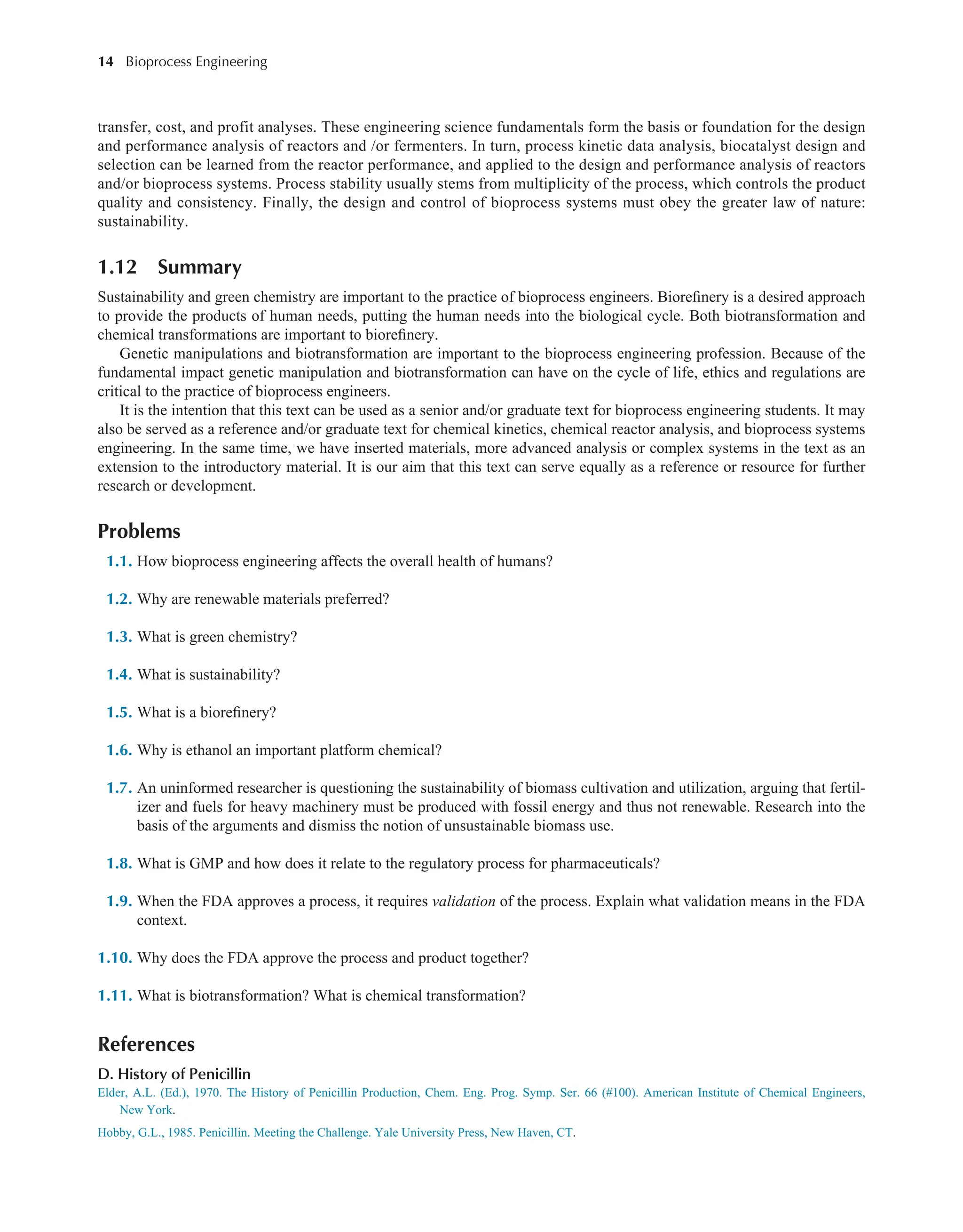
engineering is not a pre-requisite before taking on this text. Fig. 1.6 shows the pillars of this text. The sustainability on this
pillar is narrowly defined as having the net benefit to the human society and/or benign environmental effects.
As shown in Fig. 1.8, the fundamental knowledge of engineering science you will learn or expect in this text is
among the “pillars”: mass balance, rate expression, stoichiometry, cell metabolism, yield factor, energy balance, mass
FIGURE 1.8 The pillars of bioprocess kinetics and system engineering.
14 Bioprocess Engineering

transfer, cost, and profit analyses. These engineering science fundamentals form the basis or foundation for the design
and performance analysis of reactors and /or fermenters. In turn, process kinetic data analysis, biocatalyst design and
selection can be learned from the reactor performance, and applied to the design and performance analysis of reactors
and/or bioprocess systems. Process stability usually stems from multiplicity of the process, which controls the product
quality and consistency. Finally, the design and control of bioprocess systems must obey the greater law of nature:
sustainability.
1.12 Summary
Sustainability and green chemistry are important to the practice of bioprocess engineers. Biorefinery is a desired approach
to provide the products of human needs, putting the human needs into the biological cycle. Both biotransformation and
chemical transformations are important to biorefinery.
Genetic manipulations and biotransformation are important to the bioprocess engineering profession. Because of the
fundamental impact genetic manipulation and biotransformation can have on the cycle of life, ethics and regulations are
critical to the practice of bioprocess engineers.
It is the intention that this text can be used as a senior and/or graduate text for bioprocess engineering students. It may
also be served as a reference and/or graduate text for chemical kinetics, chemical reactor analysis, and bioprocess systems
engineering. In the same time, we have inserted materials, more advanced analysis or complex systems in the text as an
extension to the introductory material. It is our aim that this text can serve equally as a reference or resource for further
research or development.
Problems
1.1. How bioprocess engineering affects the overall health of humans?
1.2. Why are renewable materials preferred?
1.3. What is green chemistry?
1.4. What is sustainability?
1.5. What is a biorefinery?
1.6. Why is ethanol an important platform chemical?
1.7. An uninformed researcher is questioning the sustainability of biomass cultivation and utilization, arguing that fertil-
izer and fuels for heavy machinery must be produced with fossil energy and thus not renewable. Research into the
basis of the arguments and dismiss the notion of unsustainable biomass use.
1.8. What is GMP and how does it relate to the regulatory process for pharmaceuticals?
1.9. When the FDA approves a process, it requires validation of the process. Explain what validation means in the FDA
context.
1.10. Why does the FDA approve the process and product together?
1.11. What is biotransformation? What is chemical transformation?
References
D. History of Penicillin
Elder, A.L. (Ed.), 1970. The History of Penicillin Production, Chem. Eng. Prog. Symp. Ser. 66 (#100). American Institute of Chemical Engineers,
New York.
Hobby, G.L., 1985. Penicillin. Meeting the Challenge. Yale University Press, New Haven, CT.
What is bioprocess engineering? Chapter | 1 15
Further readings
A. Green Chemistry
Anatas, P.C., Warner, J.C., 1998. Green Chemistry: Theory and Practice. Oxford University Press, New York.
Linthorst JA, 2010. An overview: origins and development of green chemistry. Found. Chem. 12 (1), 55–68.
Wilson M, Schwarzman M. 2009. Toward a New U.S. Chemicals Policy: Rebuilding the Foundation to Advance New Science, Green Chemistry, and
Environmental Health. Environ Health Perspect. 117 (8) 1202–1209 and A358.
www.epa.gov/greenchemistry/.
B. Sustainability
Adams, W.M., Jeanrenaud, S.J., 2008. Transition to Sustainability: Towards a Humane and Diverse World. IUCN, Gland, Switzerland, 108 pp.
Atkinson, G., Dietz, S., Neumayer, E., 2007. Handbook of Sustainable Development. Edward Elgar, Cheltenham.
Blackburn, W.R., 2007. The Sustainability Handbook. Earthscan, London.
Blewitt, J., 2008. Understanding Sustainable Development. Earthscan, London.
Costanza, R., Graumlich, L.J., Steffen, W. (Eds.), 2007. Sustainability or Collapse? An Integrated History and Future of People on Earth. MIT Press,
Cambridge, MA.
Norton, B., 2005. Sustainability, A Philosophy of Adaptive Ecosystem Management. The University of Chicago Press, Chicago.
Soederbaum, P., 2008. Understanding Sustainability Economics. Earthscan, London.
C. Biorefinery
Liu, S., Lu, H., Hu, R., Shupe, A., Lin, L., Liang, L., 2012. A sustainable woody biomass biorefinery. J. Biotech. Adv. 30 (4), 785–810, http://dx.doi.
org/10.1016/j.biotechadv.2012.01.013.
FitzPatrick, M., Champagne, P., Cunningham, M.F., Whitney, R.A., 2010. A biorefinery processing perspective: treatment of lignocellulosic materials for
the production of value-added products”. Bioresour. Technol. 101 (23), 8915–8922.
Kaparaju, P., Serrano, M., Thomsen, A.B., Kongjan, P., Angelidaki, I., 2009. Bioethanol, biohydrogen and biogas production from wheat straw in a bio-
refinery concept”. Bioresour. Technol. 100 (9), 2562–2568.
Koutinas, A.A., Arifeen, N., Wang, R., Webb, C., 2007. Cereal-based biorefinery development: Integrated enzyme production for cereal flour hydrolysis”.
Biotechn. Bioeng. 97 (1), 61–72.
Liu, S., Amidon, T.E., Francis, R.C., Ramarao, B.V., Lai, Y.-Z., Scott, G.M., 2006. From forest biomass to chemicals and energy: biorefinery initiative in
New York. Ind. Biotech. 2 (2), 113–120.
Ohara, H., 2003. Biorefinery. App. Micobiol. and Biotechn. 62 (5–6), 474–477.
D. History of Penicillin
Moberg, C.L., 1991. Penicillin’s Forgotten Man: Norman Heatley. Science 253, 734–735.
Mateles, R.I. (Ed.), 1998. Penicillin, A Paradigm for Biotechnology. Candida Corp., Chicago, IL.
Sheehan, J.C., 1982. The Enchanted Ring. The Untold Story of Penicillin. MIT Press, Cambridge, MA.
E. Regulatory Issues
Currey, B., Klemic, P.A., 2008. A New Phase in Pharmaceutical Regulation. DRI Drug and Medical Device and Product Liability Committee. O’Melveny
& Myers LLP, PL California, United States.
Durfor, C.N., Andscribner, C.L., 1992. An FDA perspective of manufacturing changes for products in human use. Ann. NY Acad. Sci. 665, 356–363.
Naglak, T.J., Keith, M.G., Omstead, D.R., 1994. Validation of fermentation processes. Biopharm 7, 28–36.
Reisman, H.B., 1993. Problems in scale-up of biotechnology production processes. Crit. Rev. Biotechnol. 13, 195–253.
Wechsler, J. Science and Safety. Magazine: Pharmaceutial Excutive – Washington Report, Oct., 2009.
http://www.FDA.gov.
http://www.FDAreview.org/approval_process.
Bioprocess Engineering. http://dx.doi.org/10.1016/B978-0-12-821012-3.00002-6
Copyright © 2020 Elsevier B.V. All rights reserved. 17
Bioprocess engineers seek chemicals and materials for human needs in a sustainable manner. It is the chemicals and
materials from biological origin that can sustain the needs of humans. Microorganism also provides a tool for bioprocess
engineers to manipulate the chemicals and materials so that they can meet the needs of humanity. Therefore we shall first
review some of the biological basics to learn how living organisms (more specific: microorganisms) function and what their
important chemicals and materials are.
2.1 Cells and organisms
The cell is the basic structural and functional unit of all known living organisms. Cells are to living organisms as like atoms
are to molecules. It is the smallest unit of life that is classified as a living thing, and so is often called the building block
of life. Some organisms, such as most bacteria, are unicellular (consist of a single cell). Most single cell organisms are
microscopic in size and not visible to (human by) naked eyes, which are commonly called microorganisms. However, some
unicellular protists and bacteria are macroscopic and visible to the naked eye. For example, Xenophyophores, protozoans
of the phylum Foraminifera, are the largest examples known, with Syringammina fragilissima achieving a diameter of up
to 20 cm (7.9 inches). The largest bacterium is Thiomargarita namibiensis, reaching a diameter of up to 0.75 mm. Other
organisms, such as humans, are multicellular. (Humans have an estimated 100 trillion or 1014
cells; a typical cell size is
10 µm; a typical cell mass is 1 nanogram.) The largest known cell is an unfertilized ostrich egg cell. An average ostrich egg
is an oval about 15 cm × 13 cm and weighs 1.4 kg.
In 1835, before modern cell theory was developed, Jan Evangelista Purkyně observed small “granules” while looking
at plant tissue through a microscope. The cell theory, first developed in 1839 by Matthias Jakob Schleiden and Theodor
Schwann, states that all organisms are composed of one or more cells, that all cells come from preexisting cells, that vital
functions of an organism occur within cells, and that all cells contain the hereditary information necessary for regulating
cell functions and for transmitting information to the next generation of cells.
Each cell is at least somewhat self-contained and self-maintaining: it can take in nutrients, convert these nutrients into
energy, carry out specialized functions, and reproduce as necessary. Each cell stores its own set of instructions for carrying
out each of these activities.
Chapter 2
An overview of biological basics
Chapter outline
2.1 Cells and organisms 17
2.1.1 Microbial diversity 18
2.1.2 How cells are named 18
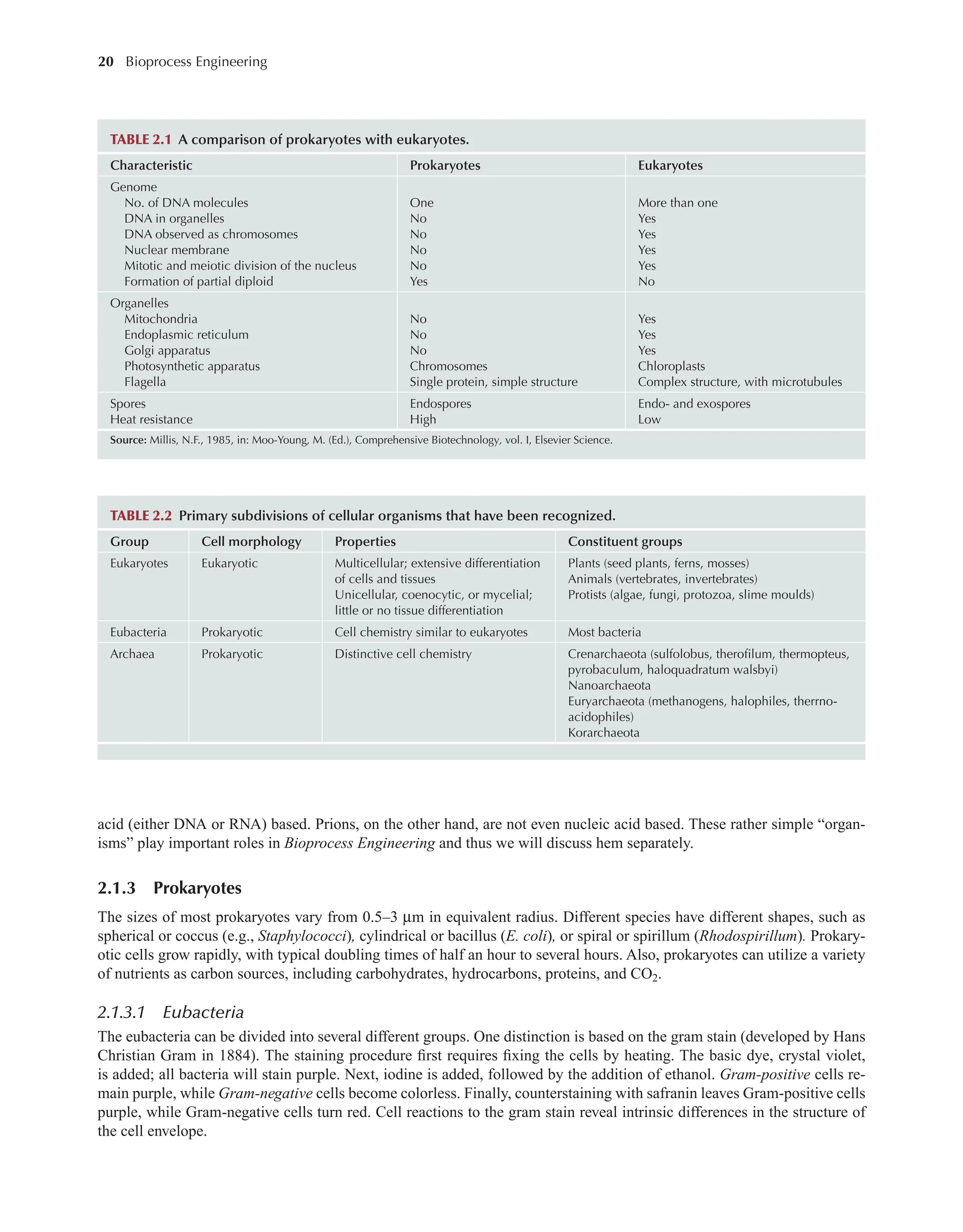
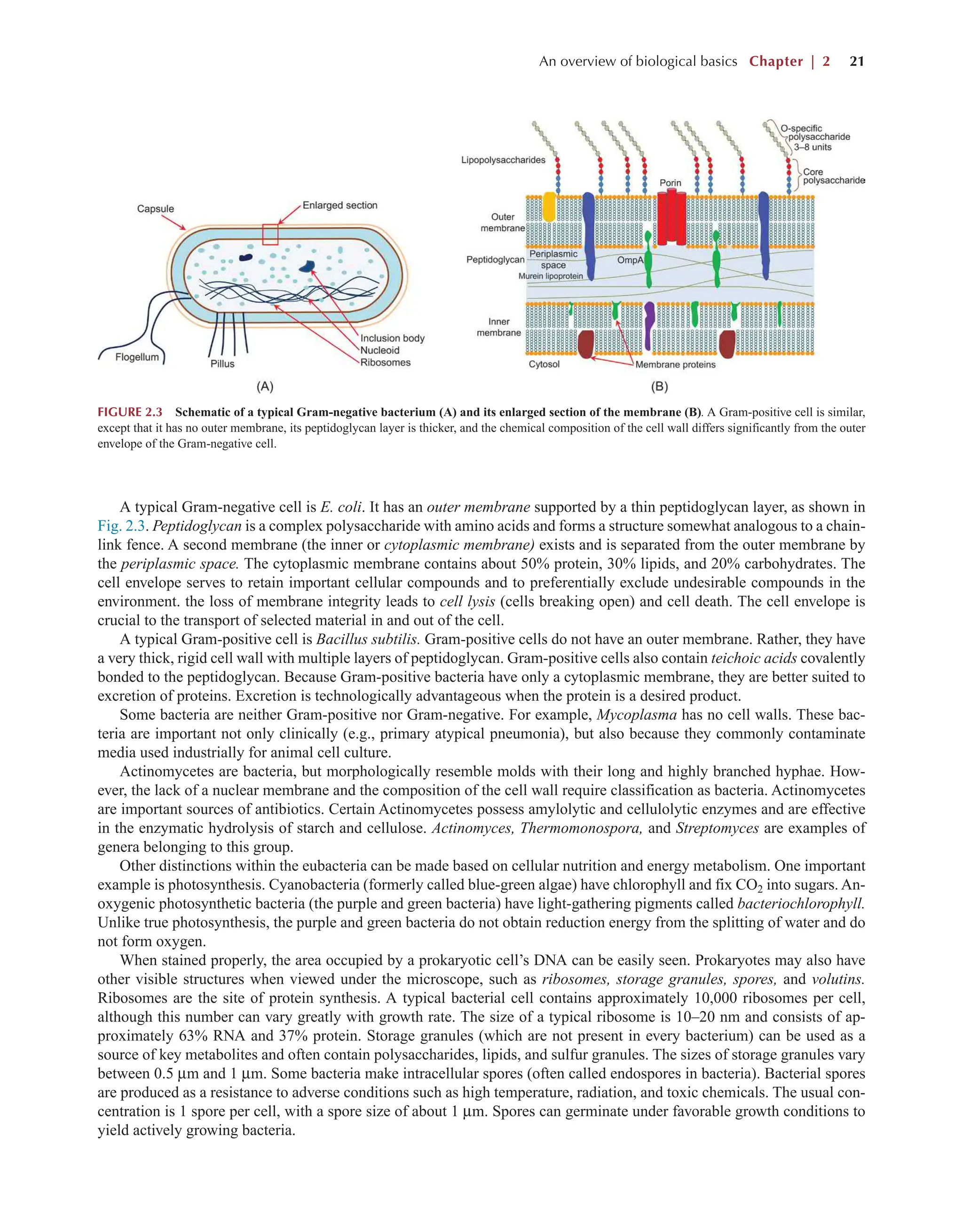
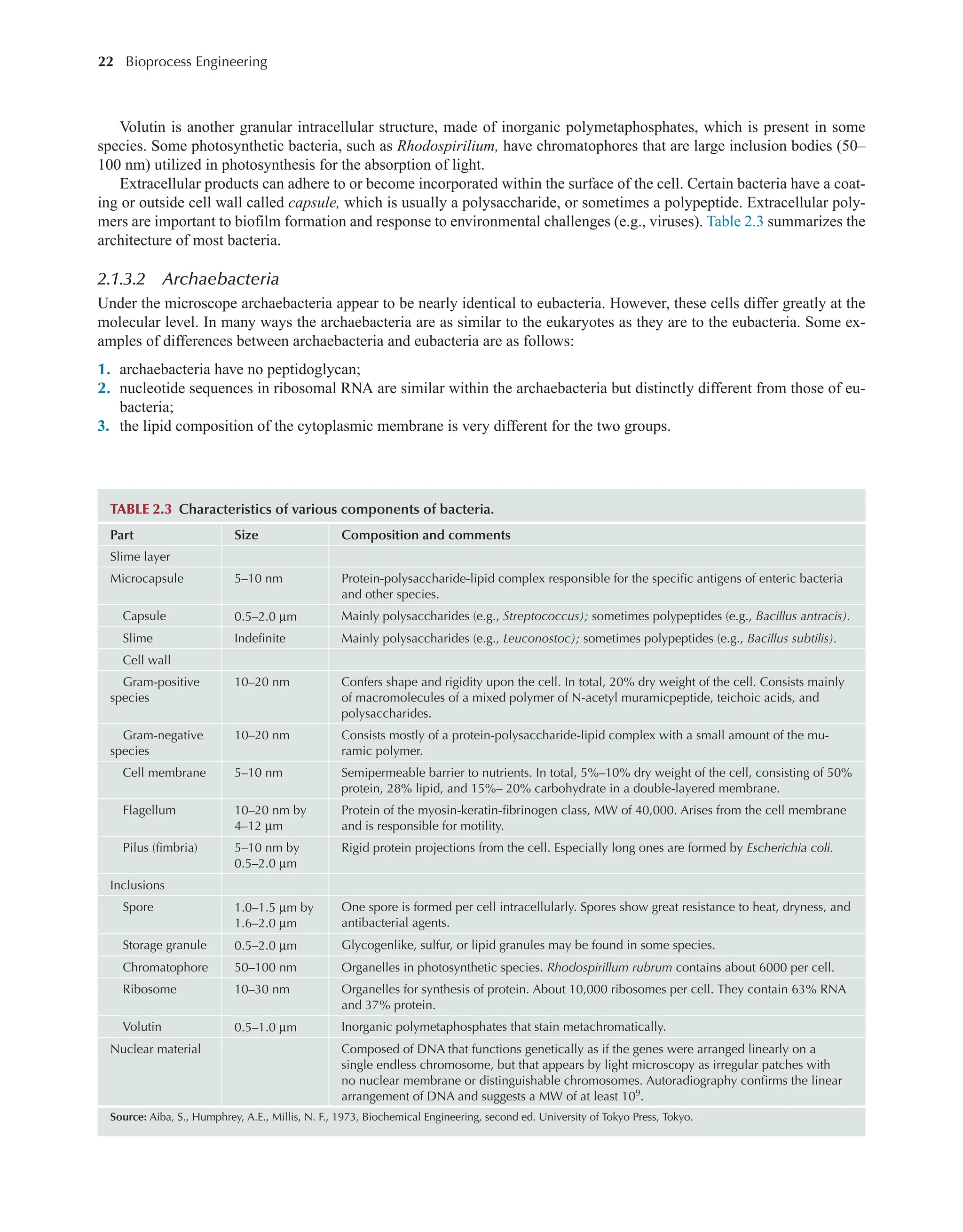
2.1.3 Prokaryotes 20
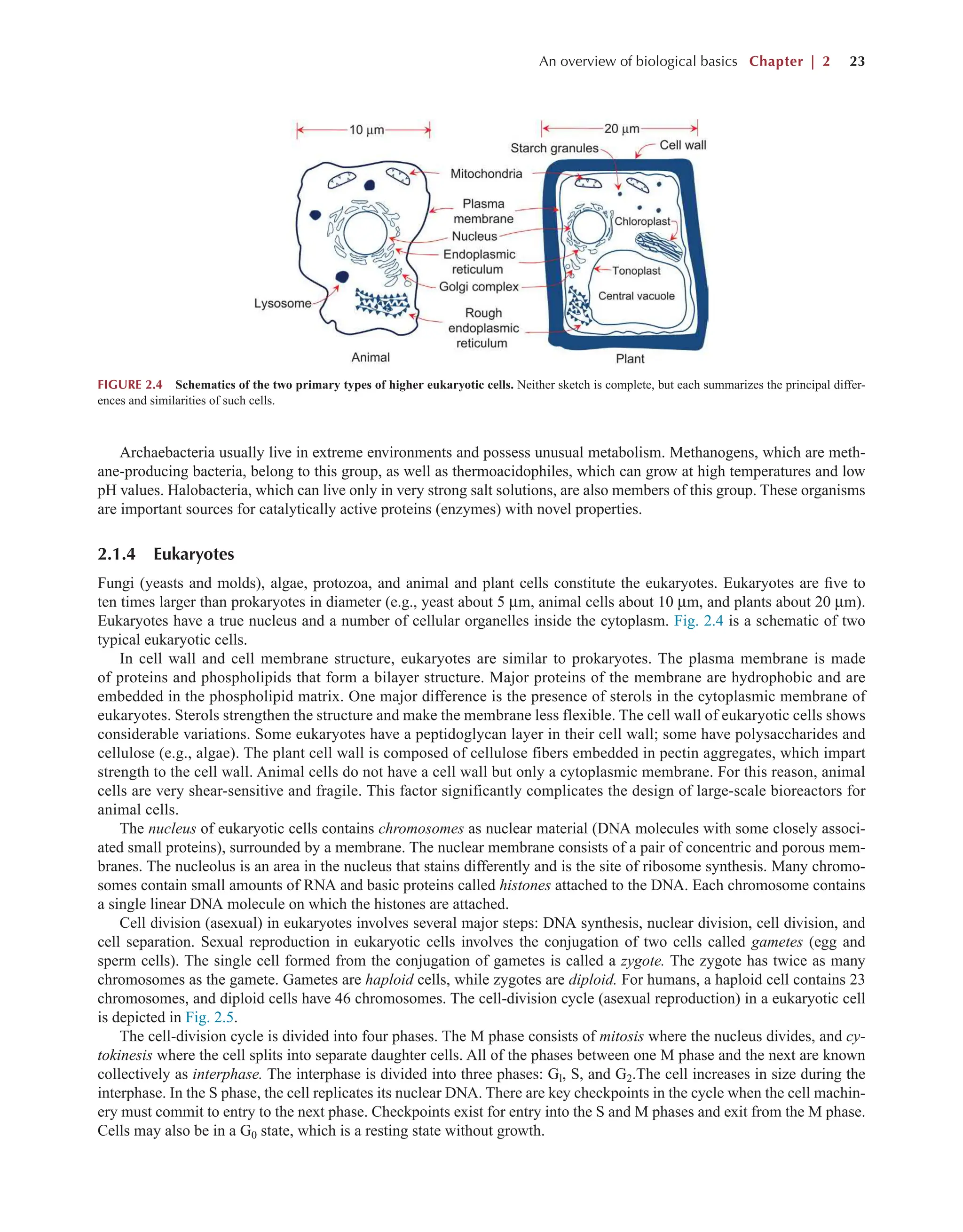
2.1.4 Eukaryotes 23
2.2 Viruses 27
2.3 Prions 30
2.4 Stem cell 30
2.5 Cell chemistry 31
2.5.1 Amino acids and proteins 32
2.5.2 Monosaccharides 37
2.5.3 Disaccharides 42
2.5.4 Polysaccharides 42
2.5.5 Phytic acid and inositol 46
2.5.6 Chitin and chitosan 48
2.5.7 Lignin 48
2.5.8 Lipids, fats, and steroids 50
2.5.9 Nucleic acids, RNA, and DNA 52
2.6 Cell feed 57
2.6.1 Macronutrients 58
2.6.2 Micronutrients 60
2.6.3 Growth media 61
2.7 Non earthly/unnatural biological agents 61
2.8 Summary 62
Problems 63
References 64
Further readings 64
18 Bioprocess Engineering

2.1.1 Microbial diversity
Life is very tenacious and can exist in extreme environments. Living cells can be found almost anywhere that water is in
the liquid state. The right temperature, pH, and moisture levels vary from one organism to another. Some cells can grow
at −20°C (in a brine to prevent freezing), while others can grow at 120°C (where water is under high enough pressure to
prevent boiling). Cells that grow best at low temperatures (below 20°C) are usually called psychrophiles, while those with
temperature optima in the range of 20–50°C are mesophiles. Organisms that grow best at temperatures greater than 50°C
are thermophiles.
Many organisms have pH optima far from neutrality; some prefer in an environment with a pH value down to 1 or 2,
while others may grow well at pH 9. Some organisms can grow at both low pH values and high temperatures.
Although most organisms can grow only with the presence of liquid water, others can grow on barely moist solid sur-
faces or in solutions with high salt concentrations.
Some cells require oxygen for growth and metabolism. Such organisms can be termed aerobic. Other organisms are
inhibited by the presence of oxygen and grow only anaerobically. Some organisms can switch metabolic pathways to allow
them to grow under either circumstance. Such organisms are facultative.
Often, organisms can grow in environments with almost no obvious source of nutrients. Some cyanobacteria (formerly
called blue-green algae) can grow in an environment with only a little moisture and a few dissolved minerals. These bacteria
are photosynthetic and can convert CO2 from the atmosphere into the organic compounds (e.g., sugars) necessary for life.
They can also convert N2 into NH3 for use in making the essential building blocks of life.
+ → +
CO (cabondioxude) H O(water) CH O(sugar) O (oxygen)
2 2 2 2 (2.1)
+ → +
N 3H O 2NH 3/2O
2 2 3 2 (2.2)
Cyanobacteria are important in colonizing nutrient-deficient environments. Organisms from these extreme environments
(extremophiles) often provide humanity with important tools for processes to make useful chemicals and medicinals. They
are also key to the maintenance of natural cycles and can be used in the recovery of metals from low-grade ores or in the
desulfurization of coal or other fuels. The fact that organisms can develop a capacity to exist and multiply in almost any
environment on Earth is extremely useful.
Not only do organisms occupy a wide variety of habitats, but they also come in a wide range of sizes and shapes. Spheri-
cal, cylindrical, ellipsoidal, spiral, and pleomorphic cells exist. Special names are used to describe the shape of bacteria. A
cell with a spherical or elliptical shape is often called a coccus (plural, cocci); a cylindrical cell is a rod or bacillus (plural,
bacilli); a spiral-shaped cell is a spirillum (plural, spirilla). Some cells may change shape in response to changes in their
local environment. Pleomophic cells take on at least two different forms or shapes during their life cycle.
Thus organisms can be found in the most extreme environments and have evolved a wondrous array of shapes, sizes,
and metabolic capabilities. This great diversity provides the engineer with an immense variety of potential tools. We have
barely begun to learn how to manipulate these tools.
2.1.2 How cells are named
The naming of cells is complicated by the large variety of organisms. A systematic approach to classifying these organ-
isms is an essential aid to their intelligent use. Taxonomy is the development of approaches to organize and summarize our
knowledge about the variety of organisms that exist. Although knowledge of taxonomy may seem remote from the needs
of an engineer, it is necessary for efficient communication among engineers and scientists working with living cells. Tax-
onomy can also play a critical role in patent litigation involving bioprocesses.
While taxonomy is concerned with approaches to classification, nomenclature refers to the actual naming of organ-
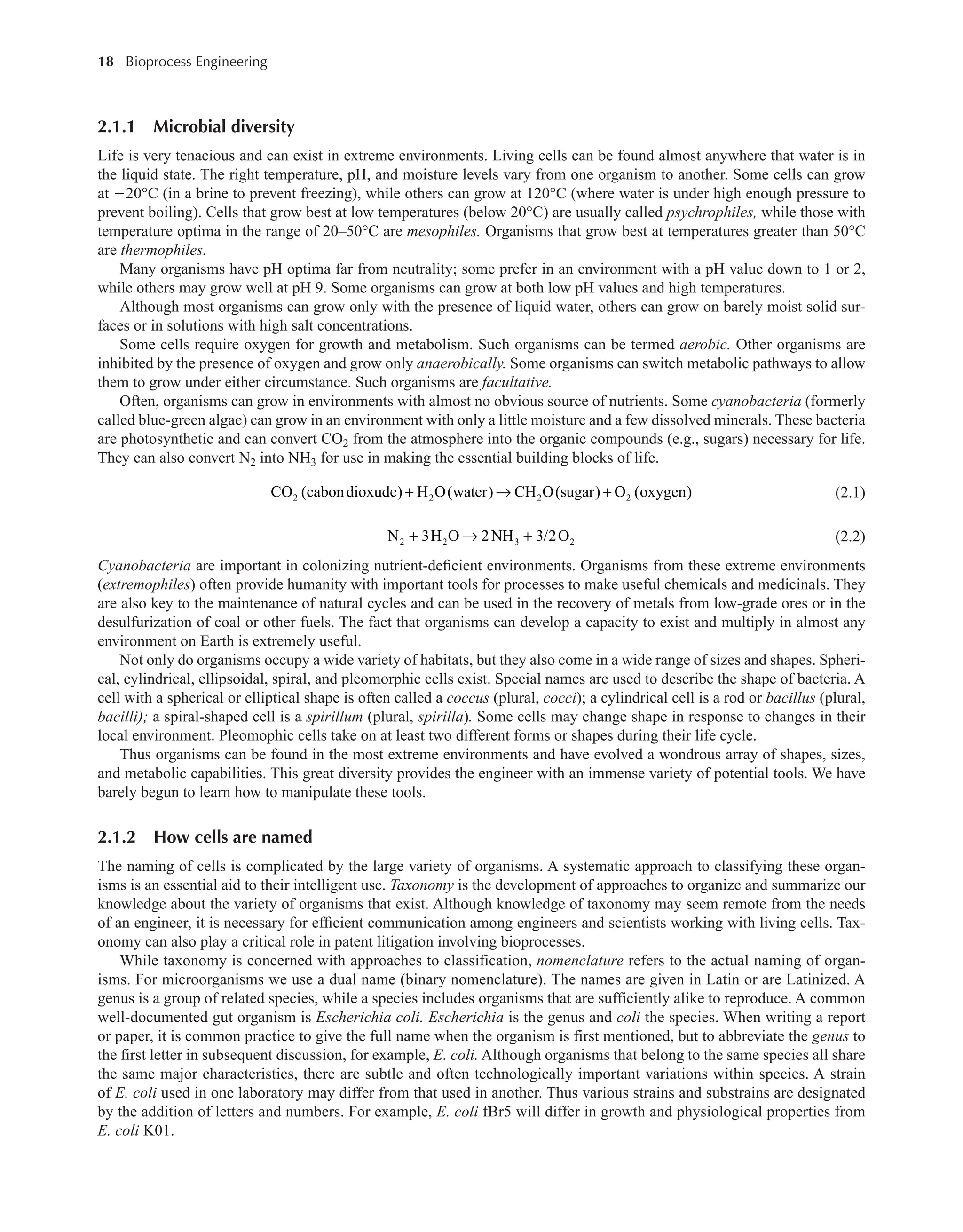
isms. For microorganisms we use a dual name (binary nomenclature). The names are given in Latin or are Latinized. A
genus is a group of related species, while a species includes organisms that are sufficiently alike to reproduce. A common
well-documented gut organism is Escherichia coli. Escherichia is the genus and coli the species. When writing a report
or paper, it is common practice to give the full name when the organism is first mentioned, but to abbreviate the genus to
the first letter in subsequent discussion, for example, E. coli. Although organisms that belong to the same species all share
the same major characteristics, there are subtle and often technologically important variations within species. A strain
of E. coli used in one laboratory may differ from that used in another. Thus various strains and substrains are designated
by the addition of letters and numbers. For example, E. coli fBr5 will differ in growth and physiological properties from
E. coli K01.
An overview of biological basics Chapter | 2 19
Now that we know how to name organisms, we could consider broader classification up to the level of kingdoms. There
is no universal agreement on how to classify microorganisms at this level. Such classification is rather arbitrary and need
not concern us. However, we must be aware that there are two primary cell types: eukaryotic and prokaryotic. The primary
difference between them is the presence or absence of a membrane around the cell’s genetic information.
Prokaryotes have a simple structure with a single chromosome (Fig. 2.1). Prokaryotic cells have no nuclear membrane
and no organelles (such as mitochondria and endoplasmic reticulum). Eukaryotes have a more complex internal structure,
with more than one chromosome (DNA molecule) in the nucleus. Eukaryotic cells have a true nuclear membrane and may
contain a variety of specialized organelles such as mitochondria, endoplasmic reticulum and Golgi apparatus (Fig. 2.2). A
detailed compare-son of prokaryotes and eukaryotes is presented in Table 2.1. Structural differences between prokaryotes
and eukaryotes are discussed later.
Evidence suggests that a common or universal ancestor gave rise to three distinctive branches of life: eukaryotes, eu-
bacteria (or “true” bacteria), and archaebacteria. Table 2.2 summarizes some of the distinctive features of these groups.
The ability to sequence the genes of whole organisms will have a great impact on our understanding of how these families
evolved and are related.
The cellular organisms summarized in Table 2.2 are free-living organisms and are all DNA based. Viruses cannot be
classified under any of these categories, as they are not independent (or free-living) organisms. Still, viruses are all nucleic
FIGURE 2.1 A schematic of a typical prokaryotic cell.
FIGURE 2.2 A schematic of a typical eukaryotic cell.
20 Bioprocess Engineering

acid (either DNA or RNA) based. Prions, on the other hand, are not even nucleic acid based. These rather simple “organ-
isms” play important roles in Bioprocess Engineering and thus we will discuss hem separately.
2.1.3 Prokaryotes
The sizes of most prokaryotes vary from 0.5–3 µm in equivalent radius. Different species have different shapes, such as
spherical or coccus (e.g., Staphylococci), cylindrical or bacillus (E. coli), or spiral or spirillum (Rhodospirillum). Prokary-
otic cells grow rapidly, with typical doubling times of half an hour to several hours. Also, prokaryotes can utilize a variety
of nutrients as carbon sources, including carbohydrates, hydrocarbons, proteins, and CO2.
2.1.3.1 Eubacteria
The eubacteria can be divided into several different groups. One distinction is based on the gram stain (developed by Hans
Christian Gram in 1884). The staining procedure first requires fixing the cells by heating. The basic dye, crystal violet,
is added; all bacteria will stain purple. Next, iodine is added, followed by the addition of ethanol. Gram-positive cells re-
main purple, while Gram-negative cells become colorless. Finally, counterstaining with safranin leaves Gram-positive cells
purple, while Gram-negative cells turn red. Cell reactions to the gram stain reveal intrinsic differences in the structure of
the cell envelope.
TABLE 2.1 A comparison of prokaryotes with eukaryotes.
Characteristic Prokaryotes Eukaryotes
Genome
No. of DNA molecules
DNA in organelles
DNA observed as chromosomes
Nuclear membrane
Mitotic and meiotic division of the nucleus
Formation of partial diploid
One
No
No
No
No
Yes
More than one
Yes
Yes
Yes
Yes
No
Organelles
Mitochondria
Endoplasmic reticulum
Golgi apparatus
Photosynthetic apparatus
Flagella
No
No
No
Chromosomes
Single protein, simple structure
Yes
Yes
Yes
Chloroplasts
Complex structure, with microtubules
Spores
Heat resistance
Endospores
High
Endo- and exospores
Low
Source: Millis, N.F., 1985, in: Moo-Young, M. (Ed.), Comprehensive Biotechnology, vol. I, Elsevier Science.
TABLE 2.2 Primary subdivisions of cellular organisms that have been recognized.
Group Cell morphology Properties Constituent groups
Eukaryotes Eukaryotic Multicellular; extensive differentiation
of cells and tissues
Unicellular, coenocytic, or mycelial;
little or no tissue differentiation
Plants (seed plants, ferns, mosses)
Animals (vertebrates, invertebrates)
Protists (algae, fungi, protozoa, slime moulds)
Eubacteria Prokaryotic Cell chemistry similar to eukaryotes Most bacteria
Archaea Prokaryotic Distinctive cell chemistry Crenarchaeota (sulfolobus, therofilum, thermopteus,
pyrobaculum, haloquadratum walsbyi)
Nanoarchaeota
Euryarchaeota (methanogens, halophiles, therrno-
acidophiles)
Korarchaeota
An overview of biological basics Chapter | 2 21
A typical Gram-negative cell is E. coli. It has an outer membrane supported by a thin peptidoglycan layer, as shown in
Fig. 2.3. Peptidoglycan is a complex polysaccharide with amino acids and forms a structure somewhat analogous to a chain-
link fence. A second membrane (the inner or cytoplasmic membrane) exists and is separated from the outer membrane by
the periplasmic space. The cytoplasmic membrane contains about 50% protein, 30% lipids, and 20% carbohydrates. The
cell envelope serves to retain important cellular compounds and to preferentially exclude undesirable compounds in the
environment. the loss of membrane integrity leads to cell lysis (cells breaking open) and cell death. The cell envelope is
crucial to the transport of selected material in and out of the cell.
A typical Gram-positive cell is Bacillus subtilis. Gram-positive cells do not have an outer membrane. Rather, they have
a very thick, rigid cell wall with multiple layers of peptidoglycan. Gram-positive cells also contain teichoic acids covalently
bonded to the peptidoglycan. Because Gram-positive bacteria have only a cytoplasmic membrane, they are better suited to
excretion of proteins. Excretion is technologically advantageous when the protein is a desired product.
Some bacteria are neither Gram-positive nor Gram-negative. For example, Mycoplasma has no cell walls. These bac-
teria are important not only clinically (e.g., primary atypical pneumonia), but also because they commonly contaminate
media used industrially for animal cell culture.
Actinomycetes are bacteria, but morphologically resemble molds with their long and highly branched hyphae. How-
ever, the lack of a nuclear membrane and the composition of the cell wall require classification as bacteria. Actinomycetes
are important sources of antibiotics. Certain Actinomycetes possess amylolytic and cellulolytic enzymes and are effective
in the enzymatic hydrolysis of starch and cellulose. Actinomyces, Thermomonospora, and Streptomyces are examples of
genera belonging to this group.
Other distinctions within the eubacteria can be made based on cellular nutrition and energy metabolism. One important
example is photosynthesis. Cyanobacteria (formerly called blue-green algae) have chlorophyll and fix CO2 into sugars. An-
oxygenic photosynthetic bacteria (the purple and green bacteria) have light-gathering pigments called bacteriochlorophyll.
Unlike true photosynthesis, the purple and green bacteria do not obtain reduction energy from the splitting of water and do
not form oxygen.
When stained properly, the area occupied by a prokaryotic cell’s DNA can be easily seen. Prokaryotes may also have
other visible structures when viewed under the microscope, such as ribosomes, storage granules, spores, and volutins.
Ribosomes are the site of protein synthesis. A typical bacterial cell contains approximately 10,000 ribosomes per cell,
although this number can vary greatly with growth rate. The size of a typical ribosome is 10–20 nm and consists of ap-
proximately 63% RNA and 37% protein. Storage granules (which are not present in every bacterium) can be used as a
source of key metabolites and often contain polysaccharides, lipids, and sulfur granules. The sizes of storage granules vary
between 0.5 µm and 1 µm. Some bacteria make intracellular spores (often called endospores in bacteria). Bacterial spores
are produced as a resistance to adverse conditions such as high temperature, radiation, and toxic chemicals. The usual con-
centration is 1 spore per cell, with a spore size of about 1 µm. Spores can germinate under favorable growth conditions to
yield actively growing bacteria.
FIGURE 2.3 Schematic of a typical Gram-negative bacterium (A) and its enlarged section of the membrane (B). A Gram-positive cell is similar,
except that it has no outer membrane, its peptidoglycan layer is thicker, and the chemical composition of the cell wall differs significantly from the outer
envelope of the Gram-negative cell.
22 Bioprocess Engineering

Volutin is another granular intracellular structure, made of inorganic polymetaphosphates, which is present in some
species. Some photosynthetic bacteria, such as Rhodospirilium, have chromatophores that are large inclusion bodies (50–
100 nm) utilized in photosynthesis for the absorption of light.
Extracellular products can adhere to or become incorporated within the surface of the cell. Certain bacteria have a coat-
ing or outside cell wall called capsule, which is usually a polysaccharide, or sometimes a polypeptide. Extracellular poly-
mers are important to biofilm formation and response to environmental challenges (e.g., viruses). Table 2.3 summarizes the
architecture of most bacteria.
2.1.3.2 Archaebacteria
Under the microscope archaebacteria appear to be nearly identical to eubacteria. However, these cells differ greatly at the
molecular level. In many ways the archaebacteria are as similar to the eukaryotes as they are to the eubacteria. Some ex-
amples of differences between archaebacteria and eubacteria are as follows:
1. archaebacteria have no peptidoglycan;
2. nucleotide sequences in ribosomal RNA are similar within the archaebacteria but distinctly different from those of eu-
bacteria;
3. the lipid composition of the cytoplasmic membrane is very different for the two groups.
TABLE 2.3 Characteristics of various components of bacteria.
Part Size Composition and comments
Slime layer
Microcapsule 5–10 nm Protein-polysaccharide-lipid complex responsible for the specific antigens of enteric bacteria
and other species.
Capsule 0.5–2.0 µm Mainly polysaccharides (e.g., Streptococcus); sometimes polypeptides (e.g., Bacillus antracis).
Slime Indefinite Mainly polysaccharides (e.g., Leuconostoc); sometimes polypeptides (e.g., Bacillus subtilis).
Cell wall
Gram-positive
species
10–20 nm Confers shape and rigidity upon the cell. In total, 20% dry weight of the cell. Consists mainly
of macromolecules of a mixed polymer of N-acetyl muramicpeptide, teichoic acids, and
polysaccharides.
Gram-negative
species
10–20 nm Consists mostly of a protein-polysaccharide-lipid complex with a small amount of the mu-
ramic polymer.
Cell membrane 5–10 nm Semipermeable barrier to nutrients. In total, 5%–10% dry weight of the cell, consisting of 50%
protein, 28% lipid, and 15%– 20% carbohydrate in a double-layered membrane.
Flagellum 10–20 nm by
4–12 µm
Protein of the myosin-keratin-fibrinogen class, MW of 40,000. Arises from the cell membrane
and is responsible for motility.
Pilus (fimbria) 5–10 nm by
0.5–2.0 µm
Rigid protein projections from the cell. Especially long ones are formed by Escherichia coli.
Inclusions
Spore 1.0–1.5 µm by
1.6–2.0 µm
One spore is formed per cell intracellularly. Spores show great resistance to heat, dryness, and
antibacterial agents.
Storage granule 0.5–2.0 µm Glycogenlike, sulfur, or lipid granules may be found in some species.
Chromatophore 50–100 nm Organelles in photosynthetic species. Rhodospirillum rubrum contains about 6000 per cell.
Ribosome 10–30 nm Organelles for synthesis of protein. About 10,000 ribosomes per cell. They contain 63% RNA
and 37% protein.
Volutin 0.5–1.0 µm Inorganic polymetaphosphates that stain metachromatically.
Nuclear material Composed of DNA that functions genetically as if the genes were arranged linearly on a
single endless chromosome, but that appears by light microscopy as irregular patches with
no nuclear membrane or distinguishable chromosomes. Autoradiography confirms the linear
arrangement of DNA and suggests a MW of at least 109
.
Source: Aiba, S., Humphrey, A.E., Millis, N. F., 1973, Biochemical Engineering, second ed. University of Tokyo Press, Tokyo.
An overview of biological basics Chapter | 2 23
Archaebacteria usually live in extreme environments and possess unusual metabolism. Methanogens, which are meth-
ane-producing bacteria, belong to this group, as well as thermoacidophiles, which can grow at high temperatures and low
pH values. Halobacteria, which can live only in very strong salt solutions, are also members of this group. These organisms
are important sources for catalytically active proteins (enzymes) with novel properties.
2.1.4 Eukaryotes
Fungi (yeasts and molds), algae, protozoa, and animal and plant cells constitute the eukaryotes. Eukaryotes are five to
ten times larger than prokaryotes in diameter (e.g., yeast about 5 µm, animal cells about 10 µm, and plants about 20 µm).
Eukaryotes have a true nucleus and a number of cellular organelles inside the cytoplasm. Fig. 2.4 is a schematic of two
typical eukaryotic cells.
In cell wall and cell membrane structure, eukaryotes are similar to prokaryotes. The plasma membrane is made
of proteins and phospholipids that form a bilayer structure. Major proteins of the membrane are hydrophobic and are
embedded in the phospholipid matrix. One major difference is the presence of sterols in the cytoplasmic membrane of
eukaryotes. Sterols strengthen the structure and make the membrane less flexible. The cell wall of eukaryotic cells shows
considerable variations. Some eukaryotes have a peptidoglycan layer in their cell wall; some have polysaccharides and
cellulose (e.g., algae). The plant cell wall is composed of cellulose fibers embedded in pectin aggregates, which impart
strength to the cell wall. Animal cells do not have a cell wall but only a cytoplasmic membrane. For this reason, animal
cells are very shear-sensitive and fragile. This factor significantly complicates the design of large-scale bioreactors for
animal cells.
The nucleus of eukaryotic cells contains chromosomes as nuclear material (DNA molecules with some closely associ-
ated small proteins), surrounded by a membrane. The nuclear membrane consists of a pair of concentric and porous mem-
branes. The nucleolus is an area in the nucleus that stains differently and is the site of ribosome synthesis. Many chromo-
somes contain small amounts of RNA and basic proteins called histones attached to the DNA. Each chromosome contains
a single linear DNA molecule on which the histones are attached.
Cell division (asexual) in eukaryotes involves several major steps: DNA synthesis, nuclear division, cell division, and
cell separation. Sexual reproduction in eukaryotic cells involves the conjugation of two cells called gametes (egg and
sperm cells). The single cell formed from the conjugation of gametes is called a zygote. The zygote has twice as many
chromosomes as the gamete. Gametes are haploid cells, while zygotes are diploid. For humans, a haploid cell contains 23
chromosomes, and diploid cells have 46 chromosomes. The cell-division cycle (asexual reproduction) in a eukaryotic cell
is depicted in Fig. 2.5.
The cell-division cycle is divided into four phases. The M phase consists of mitosis where the nucleus divides, and cy-
tokinesis where the cell splits into separate daughter cells. All of the phases between one M phase and the next are known
collectively as interphase. The interphase is divided into three phases: Gl, S, and G2.The cell increases in size during the
interphase. In the S phase, the cell replicates its nuclear DNA. There are key checkpoints in the cycle when the cell machin-
ery must commit to entry to the next phase. Checkpoints exist for entry into the S and M phases and exit from the M phase.
Cells may also be in a G0 state, which is a resting state without growth.
FIGURE 2.4 Schematics of the two primary types of higher eukaryotic cells. Neither sketch is complete, but each summarizes the principal differ-
ences and similarities of such cells.
24 Bioprocess Engineering

Mitochondria are the powerhouses of an eukaryotic cell, where respiration and oxidative phosphorylation take place.
Mitochondria have a nearly cylindrical shape 1 µm in diameter and 2–3 µm in length.A typical structure of a mitochondrion
is shown in Fig. 2.6. The external membrane is made of a phospholipid bilayer with proteins embedded in the lipid matrix.
Mitochondria contain a complex system of inner membranes called cristae. A gel-like matrix containing large amounts of
protein fills the space inside the cristae. Some enzymes of oxidative respiration are bound to the cristae. A mitochondrion
has its own DNA and protein-synthesizing machinery and reproduces independently.
The endoplasmic reticulum is a complex, convoluted membrane system leading from the cell membrane into the cell.
The rough endoplasmic reticulum contains ribosomes on the inner surfaces and is the site of protein synthesis and modifica-
tions of protein structure after synthesis. The smooth endoplasmic reticulum is more involved with lipid synthesis.
Lysosomes are very small membrane-bound particles that contain and release digestive enzymes. Lysosomes contrib-
ute to the digestion of nutrients and invading substances. Peroxisomes are similar to lysosomes in their structure, but not
in function. Peroxisomes carry out oxidative reactions that produce hydrogen peroxide. Glyoxysomes are also very small
membrane-bound particles that contain the enzymes of the glyoxylate cycle.
FIGURE 2.5 Schematic of cell division cycle in a eukaryote. (see text for details.)
FIGURE 2.6 Diagram of a mitochondrion.
An overview of biological basics Chapter | 2 25
Golgi bodies are very small particles composed of membrane aggregates and are responsible for the secretion of certain
proteins. Golgi bodies are sites where proteins are modified by the addition of various sugars in a process called glycosyl-
ation. Such modifications are important to protein function in the body.
Vacuoles are membrane-bound organelles of low density and are responsible for food digestion, osmotic regulation, and
waste product storage. Vacuoles may occupy a large fraction of the cell volume (up to 90% in plant cells).
Chloroplasts are relatively large green organelles containing chlorophyll that are responsible for photosynthesis in photo-
synthetic eukaryotes, such as algae and plant cells. Every chloroplast contains an outer membrane and a large number of inner
membranes called thylakoids. Chlorophyll molecules are associated with thylakoids, which have a regular membrane struc-
ture with lipid bilayers. Chloroplasts are autonomous units containing their own DNA and protein-synthesizing machinery.
Certain prokaryotic and eukaryotic organisms contain flagella—long, filamentous structures that are attached to one
end of the cell and are responsible for the motion of the cell. Eukaryotic flagella contain two central fibers surrounded by
eighteen peripheral fibers, which exist in duplets. These fibers are arranged in a tube structure called a microtubule and are
composed of proteins called tubulin. The whole fiber assembly is embedded in an organic matrix and is surrounded by a
membrane.
The cytoskeleton (in eukaryotic cells) refers to filaments that provide an internal framework to organize the cell’s in-
ternal activities and control its shape. These filaments are critical to cell movement, transduction of mechanical forces into
biological responses, and separation of chromosomes into the two daughter cells during cell division. Three types of fibers
are present: actin filaments, intermediate filaments, and microtubules.
Cilia are structures similar to flagella, but are shorter and numerous. Only one group of protozoa, called ciliates, con-
tains cilia. Paramecium species contain nearly 104
cilia per cell. Ciliated organisms move much faster than flagellated ones.
This completes our summary of eukaryotic cell structure. Now let us turn our attention to the microscopic eukaryotes.
Fungi are heterotrophs, which are widespread in nature. Fungal cells are larger than bacterial cells, and their typical
internal structures, such as the nucleus and vacuoles, can be seen easily with a light microscope. Two major groups of fungi
are yeasts and molds.
Yeasts are single small cells of 5–10-µm size.Yeast cells are usually spherical, cylindrical, or oval.Yeasts can reproduce
by asexual or sexual means. Asexual reproduction is by either budding or fission. In budding, a small bud cell forms on
the cell, which gradually enlarges and separates from the mother cell. Asexual reproduction by fission is similar to that of
bacteria. Only a few species of yeast can reproduce by fission. In fission, cells grow to a certain size and divide into two
equal cells. Sexual reproduction of yeasts involves the formation of a zygote (a diploid cell) from the fusion of two haploid
cells, each having a single set of chromosomes. The nucleus of the diploid cells divides several times to form ascospores.
Each ascospore eventually becomes a new haploid cell and may reproduce by budding and fission. The life cycle of a typi-
cal yeast cell is presented in Fig. 2.7.
The classification of yeasts is based on reproductive modes (e.g., budding or fission) and the nutritional requirements of
cells. The most widely used yeast, Saccharomyces cerevisiae, is used in alcohol formation under anaerobic conditions (e.g.,
in wine, beer and whiskey making) and also for baker’s yeast production under aerobic conditions.
FIGURE 2.7 Cell-division cycle of a typical yeast, Saccharomyces cerevisiae.
26 Bioprocess Engineering

Molds are filamentous fungi and have a mycelial structure. The mycelium is a highly branched system of tubes that
contains mobile cytoplasm with many nuclei. Long, thin filaments on the mycelium are called hyphae. Certain branches of
mycelium may grow in the air, and asexual spores called conidia are formed on these aerial branches. Conidia are nearly
spherical in structure and are often pigmented. Some molds reproduce by sexual means and form sexual spores. These
spores provide resistance against heat, freezing, drying, and some chemical agents. Both sexual and asexual spores of molds
can germinate and form new hyphae. Fig. 2.8 describes the structure and asexual reproduction of molds.
Molds usually form long, highly branched cells and easily grow on moist, solid nutrient surfaces. The typical size of a
filamentous mold is 5–20 µm. When grown in submerged culture, molds often form cell aggregates and pellets. The typical
size of a mold pellet varies between 50 µm and 1 mm, depending on the type of mold and growth conditions. Pellet forma-
tion can cause some nutrient-transfer (mainly oxygen) problems inside the pellet. However, pellet formation reduces broth
viscosity, which can improve bulk oxygen transfer.
On the basis of their mode of sexual reproduction, fungi are grouped in four classes.
1. The phycomycetes are algalike fungi; however, they do not possess chlorophyll and cannot photosynthesize. Aquatic
and terrestrial molds belong to this category.
2. The ascomycetes form sexual spores called ascospores, which are contained within a sac (a capsule structure). Some
molds of the genera Neurospora and Aspergillus and yeasts belong to this category.
3. The basidiomycetes reproduce by basidiospores, which are extended from the stalks of specialized cells called the
basidia. Mushrooms are basidiomycetes.
4. The deuteromycetes (Fungi imperfecti) cannot reproduce by sexual means. Only asexually reproducing molds belong to
this category. Some pathogenic fungi, such as Trichophyton, which causes athlete’s foot, belong to the deuteromycetes.
Molds are used for the production of citric acid (Aspergillus niger) and many antibiotics, such as penicillin (Penicillium
chrysogenum). Mold fermentations make up a large fraction of the fermentation industry.
Algae are usually unicellular organisms, although some plantlike multicellular structures are present in marine waters.
Algae can be divided into five groups: Rhodophyta (red algae), Phaeophyta (brown algae), Chlorophyta (green algae),
Cyanophyta (blue-green algae), and Bacillariophyta (golden-brown algae). Fig. 2.9 shows a drawing of typical green
algae. The largest alga is the giant kelp, which can grow over sixty meters long. All algae are photosynthetic and contain
chloroplasts, which normally impart a green color to the organisms. The chloroplasts are the sites of chlorophyll pigments
and are responsible for photosynthesis. A typical unicellular alga is 10–30 µm in size. Multicellular algae sometimes form
a branched or unbranched filamentous structure. Some algae contain silica or calcium carbonate in their cell wall. Diatoms
containing silica in their cell wall are used as filter aids in industry. Some algae, such as Chlorella, Scenedesmus, Spirul-
lina, and Dunaliella, are used for wastewater treatment while producing single-cell proteins. Certain gelling agents such as
agar and alginic acid are obtained from marine algae and seaweeds. Many algae have been proposed for biofuel production.
Protozoa are unicellular, motile, relatively large (1–50 mm) eukaryotic cells that lack cell walls. Protozoa usually obtain
food by ingesting other small organisms, such as bacteria, or other food particles. Protozoa are usually uninucleate and
FIGURE 2.8 Structure and asexual reproduction of molds.
An overview of biological basics Chapter | 2 27
reproduce by sexual or asexual means. They are classified on the basis of their motion. The amoebae move through ame-
boid motion, whereby the cytoplasm of the cell flows forward to form a pseudopodium (false foot), and the rest of the cell
flows toward this lobe. The flagellates move using their flagella. Trypanosomes move by flagella and cause a number of dis-
eases in humans. The ciliates move through motion of a large number of small appendages on the cell surface called cilia.
The sporozoans are nonmotile and contain members that are human and animal parasites. These protozoa do not engulf
food particles, but absorb dissolved food components through their membranes. Protozoa cause some diseases, such as ma-
laria and dysentery. Protozoa may have a beneficial role in removing bacteria in biological wastewater treatment processes.
2.2 Viruses
Viruses are very small and are obligate parasites of other cells, such as bacterial, yeast, plant, and animal cells. Viruses cannot
capture or store free energy and are not functionally active except when inside their host cells. The sizes of viruses vary from 30
to 200 nm. Viruses contain either DNA (DNA viruses) or RNA (RNA viruses) as genetic material. DNA stands for deoxyribo-
nucleic acid, and RNA is ribonucleic acid; we will soon discuss DNA and RNA molecules in more detail. In free-living cells, all
genetic information is contained in the DNA, whereas viruses can use either RNA or DNA to encode such information. This nu-
clear material is covered by a protein coat called a capsid. Some viruses have an outer envelope of a lipoprotein and some do not.
Almost all cell types are susceptible to viral infections. Viruses infecting bacteria are called bacteriophages. The most
common type of bacteriophage has a hexagonal head, tail, and tail fibers as shown in Fig. 2.10. Bacteriophages attach to the
cell wall of a host cell with tail fibers, alter the cell wall of the host cell, and inject the viral nuclear material into the host cell.
Fig. 2.11 describes the attachment of a virus onto a host cell. Bacteriophage nucleic acids reproduce inside the host cells to
produce more phages. At a certain stage of viral reproduction, host cells lysis or break apart and the new phages are released,
which can infect new host cells. This mode of reproduction of viruses is called the lytic cycle. In some cases, phage DNA may
be incorporated into the host DNA, and the host may continue to multiply in this state, which is called the lysogenic cycle.
Viruses are the cause of many diseases, and antiviral agents are important targets for drug discovery. However, viruses
are also important to bioprocess technology. For example, a phage attack on an E. coli fermentation to make a recombinant
protein product can be extremely destructive, causing the loss of the whole culture in vessels of many thousands of liters.
However, phages can be used as agents to move desired genetic material into E. coli. Modified animal viruses can be used
as vectors to genetically engineer animal cells to produce proteins from recombinant DNA technology. In some cases a
killed virus preparation can be used as a vaccine. Genetic engineering allows the production of virus-like units that are
empty shells; the shell is the capsid and all nucleic acid is removed. Such units can be used as vaccines without fear of viral
FIGURE 2.9 A sketch of green algae. Source: “Siphoneae”, Ernst Haecket, Kunstformen der Natur, 1904.
Discovering Diverse Content Through
Random Scribd Documents
Glory, Paul saw God's Redeeming Love upon the throne of the
universe; it had descended deeper than sin and death; it was
exalted now above all heavens; it filled all things. That sight he
carried with him everywhere; it was his salvation and his Gospel, the
inspiration of his inmost life, and the motive of all his labours. One
who owed all this to Christ was not likely to make Christ's service the
theatre of his own ambitions; he could not do anything but take the
servant's place, and proclaim Jesus Christ as Lord.
There is a difficulty in the last half of ver. 6: it is not clear what
precisely meant by πρὸς φωτισμὸν τῆς γνώσεως τῆς δόξης τοῦ Θεοῦ
κ.τ.λ. By some the passage is rendered: God shined in our hearts,
"that He might bring into the light (for us to see it) the knowledge of
His glory," etc. This is certainly legitimate, and strikes me as the
most natural interpretation. It would answer then to what Paul says
in Gal. i. 15 f., referring to the same event: "It pleased God to reveal
His Son in me." But others think all this is covered by the words
"God shined in our hearts," and they take πρὸς φωτισμὸν κ.τ.λ., as a
description of the apostolic vocation: God shined in our hearts, "that
we might bring into the light (for others to see) the knowledge of
His glory," etc. The words would then answer to what follows in Gal.
i. 16: God revealed His Son in me, "that I might preach Him among
the heathen." This construction is possible, but I think forced. In
Paul's experience his conversion and vocation were indissolubly
connected; but πρὸς φωτισμὸν κ.τ.λ., can only mean one, and the
conversion is the likelier.
XII
THE VICTORY OF FAITH
"But we have this treasure in earthen vessels, that the
exceeding greatness of the power may be of God, and not from
ourselves; we are pressed on every side, yet not straitened;
perplexed, yet not unto despair; pursued, yet not forsaken;
smitten down, yet not destroyed; always bearing about in the
body the dying of Jesus, that the life also of Jesus may be
manifested in our body. For we which live are alway delivered
unto death for Jesus' sake, that the life also of Jesus may be
manifested in our mortal flesh. So then death worketh in us, but
life in you. But having the same spirit of faith, according to that
which is written, I believed, and therefore did I speak; we also
believe, and therefore also we speak; knowing that He which
raised up the Lord Jesus shall raise up us also with Jesus, and
shall present us with you. For all things are for your sakes, that
the grace, being multiplied through the many, may cause the
thanksgiving to abound unto the glory of God.
"Wherefore we faint not; but though our outward man is
decaying, yet our inward man is renewed day by day. For our
light affliction, which is for the moment, worketh for us more
and more exceedingly an eternal weight of glory; while we look
not at the things which are seen, but at the things which are
not seen: for the things which are seen are temporal; but the
things which are not seen are eternal."—2 Cor. iv. 7-18 (R.V.).
In the opening verses of this chapter Paul has magnified his office,
and his equipment for it. He has risen to a great height, poetic and
spiritual, in speaking of the Lord of glory, and of the light which
shines from His face for the illumining and redemption of men. The
disproportion between his own nature and powers, and the high
calling to which he has been called, flashes across his mind. It is
quite possible that this disproportion, viewed with a malignant eye,
had been made matter of reproach by his adversaries. "Who," they
may have said, "is this man, who soars to such heights, and makes
such extraordinary claims? The part does not suit him; he is quite
unequal to it; his bodily presence is weak, and his speech
contemptible." It is possible, further, though I hardly think it
probable, that the very sufferings Paul endured in his apostolic work
were cast in his teeth by Jewish teachers at Corinth; they were read
by these spiteful interpreters as signs of God's wrath, the judgment
of the Almighty on a wanton subverter of His law. But surely it is not
too much to suppose that Paul could sometimes think unchallenged.
A soul as great and as sensitive as his might well be struck by the
contrast which pervades this passage without requiring to have it
suggested by the malice of his foes. The interpretation which he
puts upon the contrast is not merely a happy artifice (so Calvin), and
still less a tour de force; it is a profound truth, a favourite, if one
may say so, in the New Testament, and of universal application.
"We have this treasure," he writes—the treasure of the knowledge of
the glory of God in the face of Jesus Christ, including the apostolic
vocation to diffuse that knowledge—"we have this treasure in
earthen vessels, that the exceeding greatness of the power [which it
exercises, and which is exhibited in sustaining us in our function]
may be seen to be God's, and not from us." Earthen vessels are
fragile, and what the word immediately suggests is no doubt bodily
weakness, and especially mortality; but the nature of some of the
trials referred to in vv. 8 and 9 (ἀπορούμενοι, ἀλλ' οὐκ
ἐξαπορύμενοι) shows that it would be a mistake to confine the
meaning to the body. The earthen vessel which holds the priceless
treasure of the knowledge of God—the lamp of frail ware in which
the light of Christ's glory shines for the illumination of the world—is
human nature as it is; man's body in its weakness, and liability to
death; his mind with its limitations and confusions; his moral nature
with its distortions and misconceptions, and its insight not yet half
restored. It was not merely in his physique that Paul felt the
disparity between himself and his calling to preach the Gospel of the
glory of Christ; it was in his whole being. But instead of finding in
this disparity reason to doubt his vocation, he saw in it an illustration
of a great law of God. It served to protect the truth that salvation is
of the Lord. No one who saw the exceeding greatness of the power
which the Gospel exercised—not only in sustaining its preachers
under persecution, but in transforming human nature, and making
bad men good—no one who saw this, and looked at a preacher like
Paul, could dream that the explanation lay in him. Not in an ugly
little Jew, without presence, without eloquence, without the means
to bribe or to compel, could the source of such courage, the cause
of such transformations, be found; it must be sought, not in him, but
in God. "God hath chosen the foolish things of the world to confound
the wise; and God hath chosen the weak things of the world to
confound the things which are mighty; and base things of the world,
and things which are despised, hath God chosen, yea, and things
which are not, to bring to nought things which are." And the end of
it all is that he which glorieth should glory in the Lord.
This verse is never without its application; and though the contempt
of the world did not suggest it to St. Paul, it may naturally enough
recall it to us. One would sometimes think, from the tone of current
literature, that no person with gifts above contempt is any longer
identified with the Gospel. Clever men, we are told, do not become
preachers now—still less do they go to church. They find it
impossible to have real or sincere intellectual intercourse with
Christian ministers. Perhaps this is not so alarming as the clever
people think. There always have been men in the world so clever
that God could make no use of them; they could never do His work,
because they were so lost in admiration of their own. But God's work
never depended on them, and it does not depend on them now. It
depends on those who, when they see Jesus Christ, become
unconscious, once and for ever, of all that they have been used to
call their wisdom and their strength—on those who are but earthen
vessels in which another's jewel is kept, lamps of clay in which
another's light shines. The kingdom of God has not changed its
administration since the first century; its supreme law is still the
glory of God, and not the glory of the clever men; and we may be
quite sure it will not change. God will always have his work done by
instruments who are willing to have it clear that the exceeding
greatness of the power is His, and not theirs.
The eighth and ninth verses illustrate the contrast between Paul's
weakness and God's power. In the series of participles which the
Apostle uses, the earthen vessel is represented by the first in each
pair, the divine power by the second. "We are pressed on every side,
but not straitened"—i.e., not brought into a narrow place from which
there is no escape. "We are perplexed, but not unto despair," or,
preserving the relation between the words of the original, "put to it,
but not utterly put out." This distinctly suggests inward rather than
merely bodily trials, or at least the inward aspect of these:
constantly at a loss, the Apostle nevertheless constantly finds the
solution of his problems. "Pursued, but not abandoned"—i.e., not
left in the enemy's hands. "Smitten down, but not destroyed": even
when trouble has done its worst, when the persecuted man has
been overtaken and struck to the ground, the blow is not fatal, and
he rises again. All these partial contrasts of human weakness and
Divine power are condensed and concentrated in the tenth verse in
one great contrast, the two sides of which are presented in their
divinely intended relation to each other: "always bearing about in
the body the dying of Jesus, that the life also of Jesus may be
manifested in our body." And this again, with its mystical poetic
aspect, especially in the first clause, is reaffirmed and rendered into
prose in ver. 11: "For we, alive as we are, are ever being delivered
unto death for Jesus' sake, that the life also of Jesus may be
manifested in our mortal flesh."
Paul does not say that he bears about in his body the death of Jesus
(θάνατος), but his dying (νέκρωσις, mortificatio), the process which
produces death. The sufferings which come upon him daily in his
work for Jesus are gradually killing him; the pains, the perils, the
spiritual pressure, the excitement of danger and the excitement of
deliverance, are wearing out his strength, and soon he must die. In
the very same way Jesus Himself had spent His strength and died,
and in that life of weakness and suffering which was always bringing
him nearer the grave, Paul felt himself in intimate sympathetic
communion with his Master: it was "the dying of Jesus" that he
carried about in his body. But that was not all. In spite of the dying,
he was not dead. Perpetually in peril, he had a perpetual series of
escapes; perpetually at his wits end, his way perpetually opened
before him. What was the explanation of that? It was the life of
Jesus manifesting itself in his body. The life of Jesus can only mean
the life which Jesus lives now at God's right hand; and these
repeated escapes of the Apostle, these restorations of his courage,
are manifestations of that life; they are, so to speak, a series of
resurrections. Paul's communion with Jesus is not only in His dying,
but in His rising again; he has the evidence of the Resurrection,
because he has its power, present with him, in these constant
deliverances and renewals. Nay, the very purpose of his sufferings
and perils is to provide occasion for the manifestation of this
resurrection life. Unless he were exposed to death, God could not
deliver him from it; unless he were pressed in the spirit, God could
not give him relief; there could be no setting off of the exceeding
greatness of His power in contrast with the exceeding frailty of the
earthen vessel. The use of body and of mortal flesh in these verses
has been appealed to in support of an interpretation which would
limit the meaning to what is merely physical: "I am in daily danger
of death, God daily delivers me from it, and thus the life of Jesus is
manifested in me." This is of course included in the interpretation
given above; but I cannot suppose it is all the Apostle meant. The
truth is, there is no such thing in the passage, or indeed in human
life, as a merely physical experience. To be delivered to death for
Jesus' sake is an experience which is at once and indissolubly
physical and spiritual; it could not be, unless the soul had its part,
and that the chief part, in it. To be delivered from such death is also
an experience as much spiritual as physical. And in both aspects,
and not least in the first, is the life of Jesus manifested. Nor can I
see that it is in the least degree unnatural for one who feels this to
speak of that life as being manifested in his "body," or in his "mortal
flesh"; it is a way which all men understand of describing the human
nature, which is the scene of the manifestation, as a frail and
powerless thing.
The moral of the passage is similar to that of chap. i. 3-11.
Suffering, for the Christian, is not an accident; it is a divine
appointment and a divine opportunity. To wear life out in the service
of Jesus is to open it to the entrance of Jesus' life; it is to receive, in
all its alleviations, in all its renewals, in all its deliverances, a witness
to His resurrection. Perhaps it is only by accepting this service, with
the daily dying it demands, that that witness can be given to us; and
"the life of Jesus" on His throne may become inapprehensible and
unreal in proportion as we decline to bear about in our bodies His
dying. All who have commented on this passage have noticed the
iteration of the name of Jesus. Singulariter sensit Paulus dulcedinem
ejus. Schmiedel explains the repetition as partly accidental, and
partly indicative of the fact that Christ's death is here regarded as a
purely human occurrence, and not as a redemptive deed of the
Messiah. This points in the right direction, though it may fairly be
doubted whether Paul would have drawn this distinction, or could
even have been made to understand it. The analytic tendency of the
modern mind often disintegrates what depends for its virtue on
being kept whole and entire, and this seems to me a case in point.
The use of the name Jesus rather indicates that, in recalling the
actual events of his own career, Paul saw them run continually
parallel to events in the career of Another; they were one in kind
with that painful series of incidents which ended in the death of the
historical Saviour. People have often sought in the Epistles of Paul for
traces of a knowledge of Christ like that which is conserved in the
first three Gospels; in this expression, τὴν νέκρωσιν τοῦ Ἰησοῦ, and
in the repetition of the historical proper name, there is an indirect
but quite convincing proof that the general character of Christ's life
was known to the Apostle. And though he does not dwell on Christ's
sympathy with the fulness and power of the writer to the Hebrews, it
is evident from this passage that he was in sympathetic fellowship
with One who had suffered as he suffered, and that even to name
His human name was consolation.
In ver. 12 an abrupt conclusion is drawn from all that precedes: "So
then death worketh in us, but life in you." Ironice dictum, is Calvin's
comment, and the words are at least intelligible if so taken. The
stinging passage beginning at chap. iv. 8 of the First Epistle is
ironical in precisely this sense—"We are fools for Christ's sake, but
ye are wise in Christ; we are weak, but ye are strong; ye have glory,
but we have dishonour": this is as it were a variation on the theme
"death worketh in us, but life in you." Still, the irony does not seem
in place here: Paul writes in all seriousness that the sufferings which
he endures as a preacher of the Gospel, and which eventually bring
death to him—which are the approaches of death, or death itself at
work—are the means by which life, in the most unqualified sense,
comes to be at work in the Corinthians. If the death and life which
are in view wherever the Gospel appears are to be distributed
among them, the death is his, and the life theirs; the dying of Jesus
is borne about by the Evangelist, while those who accept the
message he brings at this cost are made partakers in Jesus' life.
Not indeed that the contrast can be thus absolute: the thirteenth
verse corrects this hasty inference. If death alone were at work in
St. Paul, it would frustrate his vocation; he would not be able to
preach at all. But he is able to preach. In spite of all the
discouragement which his sufferings might beget, his faith remains
vigorous; he is conscious of possessing that same confidence toward
God which animated the ancient Psalmist to sing, "I believed,
therefore I spoke." "We also," he says, "believe, and therefore also
we speak." What he believes, and what prompts his utterance, we
read in the thirteenth verse: "We speak; knowing that He who raised
Jesus shall raise us also like[40] Jesus, and shall present us with you.
With you, I say: for the whole thing is for your sakes, that the grace,
having become abundant, may by means of many[41] cause the
thanksgiving to abound to the glory of God."
What an interesting illustration this is of the communion of the
saints! Paul recognises a spiritual kinsman in the writer of the Psalm;
[42] faith in God, the power which faith confers, the obligations
which faith imposes, are the same in all ages. He recognises spiritual
kinsmen in the Corinthians also. All his sufferings have their interest
in view, and it is part of his joy, as he looks on to the future, that
when God raises him from the dead, as He raised His own Son, He
will present him along with them. Their unity will not be dissolved by
death. The word here rendered "present" has often a technical sense
in Paul's Epistles; it is almost appropriated to the presenting of men
before the judgment-seat of Christ. Good scholars insist on that
meaning here; but even with the proviso that acceptance in the
judgment is taken for granted, I cannot feel that it is quite
congruous. There is such a thing as presentation to a sovereign as
well as to a judge—the presenting of the bride to the bridegroom on
the wedding day as well as of the criminal to the justice—and it is
the great and glad occasion which answers to the feeling in the
Apostle's mind. The communion of the saints, in virtue of which his
sufferings bring blessing to the Corinthians, has its issue in the joyful
union of all before the throne. As Paul thinks of that, he sees an end
in the Gospel lying beyond the blessing it brings to men. That end is
God's glory. The more he toils and suffers, the more God's grace is
made known and received; and the more it is received, the more
does it cause thanksgiving to abound to the glory of God.
Two practical reflections present themselves here, nearly related to
each other. The first is that faith naturally speaks; the second, that
grace merits thanksgiving. Put the two into one, and we may say
that grace received by faith merits articulate thanksgiving. Much
modern faith is inarticulate, and it is far too soothing to be true if we
say, Better so. Of course the utterance of faith is not prescribed to it;
to be of any value it must be spontaneous. Not all the believing are
to be teachers and preachers, but all are to be confessors. Every one
who has faith has a witness to bear to God. Every one who has
accepted God's grace by faith has a thankful acknowledgment of it
to make, and at some time or other to make in words. It is not the
faculty of speech that is wanting where this is not done; it is courage
and gratitude; it is the same Spirit of faith which prompted the
Psalmist and St. Paul. It is true that hypocrites sometimes speak,
and that testimonies and thanksgivings are apt to be discredited on
their account; but bad money would never be put in circulation
unless good money was indisputably valuable. It is not the dumb,
but the confessing Christian, not the taciturn, but the outspokenly
thankful, who glorifies God, and helps on the Gospel. Calvin is
properly severe on our "pseudo-nicodemi," who make a merit of
their silence, and boast that they have never by a syllable betrayed
their faith. Faith is betrayed in another and more serious sense when
it is kept secret.
But to return to the Apostle, who himself, at ver. 16, returns to the
beginning of the chapter, and resumes the οὐκ ἐγκακοῦμεν of ver. 1:
"Wherefore we faint not." "Wherefore" means "With all that has
been said in view"; not only the glorious future in which Paul and his
disciples are to be raised and presented together to Christ, but his
daily experience of the life of Jesus manifested in his mortal flesh.
This kept him brave and strong. "We faint not; but though our
outward man is decaying, yet our inward man is renewed day by
day." The outward man covers the same area as "our body," or "our
mortal flesh." It is human nature as it is constituted in this world—a
weak, fragile, perishable thing. Paul could not mistake, and did not
hide from himself, the effect which his apostolic work had upon him.
He saw it was killing him. He was old long before the time. He was a
sorely broken man at an age when many are in the fulness of their
strength. The earthen vessel was visibly crumbling. Still, that was
not the whole of his experience. "The inward man is renewed day by
day." The meaning of these words must be fixed mainly by the
opposition in which they stand to οὐκ ἐγκακοῦμεν ("we faint not").
The same word (ἀνακαινοῦσθαι) is used of the renewal of the soul in
the Creator's image (Col. iii. 10)—i.e., of the work of sanctification;
but the opposition in question proves that this is not contemplated
here. We must rather think of the daily supply of spiritual power for
apostolic service—of the new strength and joy which were given to
St. Paul every morning, in spite of the toils and sufferings which
every day exhausted him. Of course we can say of all people, bad as
well as good, "The outward man is decaying." Time tires the stoutest
runner, crumbles the compactest wall. But we cannot say of all, "The
inward man is renewed day by day." That is not the compensation of
every one; it is the compensation of those whose outward man has
decayed in Jesus' service, who have been worn out in labours for His
sake. It is they, and they only, who have a life within which is
independent of outward conditions, which sufferings and deaths
cannot crush, and which never grows old. The decay of the outward
man in the godless is a melancholy spectacle, for it is the decay of
everything; in the Christian it does not touch that life which is hid
with Christ in God, and which is in the soul itself a well of water
springing up to life eternal.
But who shall speak of the two great verses in which the Apostle,
leaving controversy out of sight, solemnly weighs against each other
time and eternity, the seen and the unseen, and claims his
inheritance beyond? "Our light affliction, which is for the moment,
worketh for us more and more exceedingly an eternal weight of
glory; while we look not at the things which are seen, but at the
things which are not seen: for the things which are seen are
temporal; but the things which are not seen are eternal." One can
imagine that he was dictating quick and eagerly as he began the
sentence; he "crowds and hurries and precipitates" the grand
contrasts of which his mind is full. Affliction in any case is
outweighed by glory, but the affliction in question is a light matter,
the glory a great weight: the light affliction is but momentary—it
ends with death at the latest, it may end in the coming of Jesus to
anticipate death; the weight of glory is eternal; and as if this were
not enough, the light affliction which is but for a moment works out
for us the weight of glory which endures for ever, "in excess and to
excess," in a way above conception, to a degree above conception:
it works out for us the things which eye hath not seen, nor ear
heard, nor man's heart conceived, "all that God has prepared for
them that love Him" (1 Cor. ii. 9). If Paul spoke fast and with beating
heart as he crowded all this into two brief lines, we can well believe
that the pressure was relaxed, and that the pen moved more
steadily and slowly over the contemplative words that follow: "while
we look not to the things which are seen, but to the things which
are not seen: for the things which are seen are temporal, but the
things which are not seen are eternal." This sentence is sometimes
translated conditionally: "provided we look," etc. This is legitimate,
but unnecessary. The Apostle is speaking, in the first instance, of
himself, and the looking is taken for granted. The look is not merely
equivalent to vision; it means that the unseen is the goal of him who
looks. The eye is to be directed to it, not as an indifferent object, but
as a mark to aim at, an end to attain. This observation goes some
way to limit the application of the whole passage. The contrast of
things seen and things unseen is sometimes taken in a latitude
which deprives it of much of its force: psychology and metaphysics
are dragged in to define and to confuse the Apostle's thought. But
everything here is practical. The things seen are to all intents and
purposes that tempest-tossed life of which St. Paul has been
speaking, that daily dying, that pressure, perplexity, persecution, and
downcasting, which are for the present his lot. To these he does not
look: in comparison with that to which he does look, these are a
light and momentary affliction which is not worth a thought.
Similarly, the things unseen are not everything, indefinitely, which is
invisible; to all intents and purposes they are the glory of Christ. It is
on this the Apostle's eye is fixed, this which is his goal. The stormy
life, even when most is made of its storms, passes; but Christ's glory
can never pass. It is infinite, inconceivable, eternal. There is an
inheritance in it for all who keep their eyes upon it, and, sustained
by a hope so high, bear the daily death of a life like Paul's as a light
and momentary affliction. The connexion between the two is so
close that the one is said to work for us the other. By divine
appointment they are united; fellowship with Jesus is fellowship all
through—in the daily dying, which soon has done its worst, and then
in the endless life. We may say, if we please, that the glory is the
reward of the suffering; it would be truer to say that it was its
compensation, truer still that it was its fruit. There is a vital
connexion between them, but no one can imagine he is reading
Paul's thought who should find here the idea that the trivial service
of man can make God his debtor for so vast a sum. The excellency
of the power which raises the earthen vessel to this height of faith,
hope, and inspiration is itself God's, and God's alone.
Distrust of the supernatural, insistence on the present and the
practical, and the pride of a self-styled common sense, have done
much to rob modern Christianity of this vast horizon, to blind it to
this heavenly vision. But wherever the life of Jesus is being
manifested in mortal flesh—wherever in His service and for His sake
men and women die daily, wearing out nature, but with spirit
ceaselessly renewed—there the unseen becomes real again. Such
people know that what they do is not for one dead, but for One who
lives; they know that the daily inspirations they receive, the hopes,
the deliverances, are wrought in them, not by themselves, but by
One who has all power in heaven and on earth. The things that are
unseen and eternal stand out as what they are in relation to lives
like these; to other lives, they have no relation at all. A worldly and
selfish career does not work out an exceeding and eternal weight of
glory, and therefore to the worldly and selfish man heaven is for
ever an unpractical, incredible thing. But it not only comes out in its
brightness, it comes out as a mighty inspiration and support, to
every one who bears about in his body the dying of Jesus; as he
fastens his eye upon it, he takes heart anew, and in spite of daily
dying "faints not."
XIII
THE CHRISTIAN HOPE
"For we know that if the earthly house of our tabernacle be
dissolved, we have a building from God, a house not made with
hands, eternal, in the heavens. For verily in this we groan,
longing to be clothed upon with our habitation which is from
heaven: if so be that being clothed we shall not be found naked.
For indeed we that are in this tabernacle do groan, being
burdened; not for that we would be unclothed, but that we
would be clothed upon, that what is mortal may be swallowed
up of life. Now He that wrought us for this very thing is God,
who gave unto us the earnest of the Spirit. Being therefore
always of good courage, and knowing that, whilst we are at
home in the body, we are absent from the Lord (for we walk by
faith, not by sight); we are of good courage, I say, and are
willing rather to be absent from the body, and to be at home
with the Lord. Wherefore also we make it our aim, whether at
home or absent, to be well-pleasing unto Him. For we must all
be made manifest before the judgment-seat of Christ; that each
one may receive the things done in the body, according to what
he hath done, whether it be good or bad."—2 Cor. v. 1-10
(R.V.).
That outlook on the future, which at the close of chap. iv. is
presented in the most general terms, is here carried out by the
Apostle into more definite detail. The passage is one of the most
difficult in his writings, and has received the most various
interpretations; yet the first impression it leaves on a simple reader
is probably as near the truth as the subtlest ingenuity of exegesis. It
is indeed to such first impressions that one often returns when the
mind has ceased to sway this way and that under the impact of
conflicting arguments.
The Apostle has been speaking about his life as a daily dying, and in
the first verse of this chapter he looks at the possibility that this
dying may be consummated in death. It is only a possibility, for to
the end of his life it was always conceivable that Christ might come,
and forestall the last enemy. Still, it is a possibility; the earthly house
of our tabernacle may be dissolved; the tent in which we live may be
taken down. With what hope does the Apostle confront such a
contingency? "If this befall us," he says, "we have a building from
God, a house not made with hands, eternal, in the heavens." Every
word here points the contrast between this new house and the old
one, and points it in favour of the new. The old was a tent; the new
is a building: the old, though not literally made with hands, had
many of the qualities and defects of manufactured articles; the new
is God's work and God's gift: the old was perishable; the new is
eternal. When Paul says we have this house in the heavens, it is
plain that it is not heaven itself; it is a new body which replaces and
surpasses the old. It is in the heavens in the sense that it is God's
gift; it is something which He has for us where He is, and which we
shall wear there. "We have it" means "it is ours"; any more precise
definition must be justified on grounds extraneous to the text.
The second verse brings us to one of the ambiguities of the passage.
"For verily," our R.V. reads, "in this we groan, longing to be clothed
upon with our habitation which is from heaven." The meaning which
the English reader finds in the words "in this we groan" is in all
probability "in our present body we groan." This is also the meaning
defended by Meyer, and by many scholars. But it cannot be denied
that ἐν τούτῳ does not naturally refer to ἡ ἐπίγειος ἡμῶν οἰκία τοῦ
σκήνους. If it means "in this body," it must be attached specially to
σκήνους, and σκήνους is only a subordinate word in the clause.
Elsewhere in the New Testament ἐν τούτῳ means "on this account,"
or "for this reason" (see 1 Cor. iv. 4; John xvi. 30: Ἐν τούτῳ
πιστεύομεν ὅτι ἀπὸ Θεοῦ ἐξῆλθες), and I prefer to take it in this
sense here: "For this cause—i.e., because we are the heirs of such a
hope—we groan, longing to be clothed upon with our habitation
which is from heaven." If Paul had no hope, he would not sigh for
the future; but the very longing which pressed the sighs from his
bosom became itself a witness to the glory which awaited him. The
same argument, it has often been pointed out, is found in Rom. viii.
19 ff. The earnest expectation of the creation, waiting for the
manifestation of the sons of God, is evidence that this manifestation
will in due time take place. The spiritual instincts are prophetic. They
have not been implanted in the soul by God only to be disappointed.
It is of the longing hope of immortality—that very hope which is in
question here—that Jesus says: "If it were not so, I would have told
you."
The third verse states the great gain which lies in the fulfilment of
this hope: "Since, of course, being clothed [with this new body], we
shall not be found naked [i.e., without any body]." I cannot think,
especially looking on to ver. 4, that these two verses (2 and 3) mean
anything else than that Paul longs for Christ to come before death. If
Christ comes first, the Apostle will receive the new body by the
transformation, instead of the putting off, of the old; he will, so to
speak, put it on above the old ἐπενδύσασθαι; he will be spared the
shuddering fear of dying; he will not know what it is to have the old
tent taken down, and to be left houseless and naked. We do not
need to investigate the opinions of the Hebrews or the Greeks about
the condition of souls in Hades in order to understand these words;
the conception, figurative as it is, carries its own meaning and
impression to every one. It is reiterated, rather than proved, in the
fourth verse:[43] "For we who are in the tabernacle groan also, being
burdened, in that our will is not to be unclothed, but to be clothed
upon, that what is mortal may be swallowed up of life." It is natural
to take βαρούμενοι ("being burdened") as referring to the weight of
care and suffering by which men are oppressed while in the body;
but here also, as in the similar case of ver. 2, the proper reference of
the word is forward. What oppresses Paul, and makes him sigh, is
the intensity of his desire to escape "being unclothed," his immense
longing to see Jesus come, and, instead of passing through the
terrific experience of death, to have the corruptible put on
incorruption, and the mortal put on immortality, without that trial.
This seems plain enough, but we must remember that the
confidence which Paul has been expressing in the first verse is
meant to meet the very case in which this desire is not gratified, the
case in which death has to be encountered, and the tabernacle
taken down. "If this should befall us," he says, "we have another
body awaiting us, far better than that which we leave, and hence we
are confident." The confidence which this hope inspires would
naturally, we think, be most perfect, if in the very act of dissolution
the new body were assumed; if death were the initial stage in the
transformation scene in which an that is mortal is swallowed up by
life; if it were, not the ushering of the Christian into a condition of
"nakedness," which, temporary though it be, is a mere blank to the
mind and imagination, but his admission to celestial life; if "to be
absent from the body" were immediately, and in the fullest sense of
the words, the same thing as "to be at home with the Lord." This is,
in point of fact, the sense in which the passage is understood by a
good many scholars, and those who read it so find in it a decisive
turning-point in the Apostle's teaching on the last things. In the First
Epistle to the Thessalonians, they say, and indeed in the First to the
Corinthians also, Paul's eschatology was still essentially Jewish. The
Christian dead are οἱ κοιμώμενοι, or οἱ κοιμηθέντες ("those that
sleep"); nothing definite is said of their condition; only it is implied
that they do not get the incorruptible body till Jesus comes again
and raises them from the dead. In other words, those who die
before the Parousia have the soul-chilling prospect of an unknown
term of "nakedness." Here this terror is dispelled by the new
revelation made to the Apostle, or the new insight to which he has
attained: there is no longer any such interval between death and
glory; the heavenly body is assumed at once; the state called
κοιμᾶσθαι ("being asleep") vanishes from the future. Sabatier and
Schmiedel, who adopt this view, draw extreme consequences from
it. It marks an advance, according to Schmiedel, of the highest
importance. The religious postulate of an uninterrupted communion
of life with Christ, violated by the conception of a κοιμᾶσθαι, or
falling asleep, is satisfied; Christ's descent from heaven, and a
simultaneous resurrection and judgment, become superfluous;
judgment is transferred to the moment of death, or rather to the
process of development during life on earth; and, finally, the place of
eternal blessedness passes from earth (the Jewish and early
Christian opinion, probably shared by Paul, as he gives no indication
of the contrary) to heaven. All this, it is further pointed out, is an
approximation, more or less close, to the Greek doctrine of the
immortality of the soul, and may even have been excogitated in part
under its influence; and it is at the same time a half-way house
between the Pharisaic eschatology of First Thessalonians and the
perfected Christian doctrine of a passage like John v. 24: "Verily,
verily, I say unto you, He that heareth My word, and believeth Him
that sent Me, hath eternal life, and cometh not into judgment, but
hath passed out of death into life."
There is no objection to be made in principle to the idea that the
Apostle's outlook on the future was subject to modification—that he
was capable of attaining, or even did attain, a deeper insight, with
experience, into the connexion between that which is and that which
is to come. But it is surely somewhat against the above estimate of
the alleged change here that Paul himself seems to have been quite
unconscious of it. He was not a man whose mind wrought at
unawares, and who passed unwittingly from one standpoint to
another. He was nothing if not reflective. According to Sabatier and
Schmiedel, he had made a revolutionary change in his opinions—a
change so vast that on account of it Sabatier reckons this Epistle,
and especially this passage, the most important in all his writings for
the comprehension of his theological development; and yet, side by
side with the new revolutionary ideas, uttered literally in the same
breath with them, we find the old standing undisturbed. The
simultaneous resurrection and judgment, according to Schmiedel,
should be impossible now; but in chap. iv. 14 the resurrection
appears precisely as in Thessalonians and in chap. v. 10 the
judgment, precisely as in all his Epistles from the first to the last. As
for the inconsistency between going to be at home with the Lord
and the Lord's coming, it also recurs in later years: Paul writes to the
Philippians that he has a desire to depart and to be with Christ; and
in the same letter, that the Lord is at hand, and that we wait for the
Saviour from heaven. Probably the misleading idea in the study of
the whole subject has been the assumption that the κοιμώμενοι—the
dead in Christ—were in some dismal, dreary condition which could
fairly be described as "nakedness." There is not a word in the New
Testament which favours this idea. Where we see men die in faith,
we see something quite different. "To-day shalt thou be with Me in
Paradise." "Lord Jesus, receive my spirit." "I saw the souls of them
which had been slain for the Word of God ... and there was given
them, to each one, a white robe." When Paul speaks of those who
have fallen asleep, in First Thessalonians, it is with the express
intention of showing that those who survive to the Parousia have no
advantage over them. "Jesus Christ died for us," he writes (1 Thess.
v. 10), "that, whether we wake or sleep, we may live together with
Him." And he uses one most expressive word in a similar connexion
(1 Thess. iv. 14): "Them also that sleep in Jesus will God bring [ἄξει]
with Him." Suave verbum, says Bengel: dicitur de viventibus. May
we not say with equal cogency, not only "de viventibus," but "de
viventibus cum Iesu"? Those who are asleep are with Him; they are
in blessedness with Him; what their mode of existence is it may be
impossible for us to conceive, but it is certainly not a thing to shrink
from with horror. The taking down of the old tent in which we live
here is a thing from which one cannot but shrink, and that is why
Paul would rather have Christ come, and be saved the pain and fear
of dying. With death in view he mentions the new body as the
ground of his confidence, because it is the final realisation of the
Christian hope, the crown of redemption (Rom. viii. 23). But he does
not mean to say that, unless the new body were granted in the very
instant of dying, death would usher him into an appalling void, and
separate him from Christ. This assumption, on which the
interpretation of Sabatier and Schmiedel rests, is entirely groundless,
and therefore that interpretation, in spite of a superficial plausibility,
is to be decidedly rejected. It is to be rejected all the more when we
are invited to see the occasion which produced Paul's supposed
change of opinion in the danger which he had lately incurred in Asia
(chap. i. 8-10). Paul, we are to imagine, who had always been
confident that he would live to see the Parousia, had come to very
close quarters with death, and this experience constrained him to
seek in his religion a hope and consolation more adequate to the
terribleness of death than any he had yet conceived. Hence the
mighty advance explained above. But is it not absurd to say that a
man, whose life was constantly in peril, had never thought of death
till this time? Can any one seriously believe that, as Sabatier puts it,
"the image of death, with which the Apostle had not hitherto
concerned himself, [here] enters for the first time within the scope
of his doctrine"? Can any one who knows the kind of man Paul was
deliberately suggest that fear and self-pity conferred on him an
enlargement of spiritual vision which no sympathy for bereaved
disciples, and no sense of fellowship with those who had fallen
asleep in Jesus, availed to bestow? Believe this who will, it seems
utterly incredible to me. The passage says nothing inconsistent with
Thessalonians, or First Corinthians, or Philippians, or Second
Timothy, about the last things: it expresses in a special situation the
constant Christian faith and hope—"the redemption of the body";
that is the possession of the believer ἔχομεν; it is ours; and the
Apostle is not concerned to fix the moment of time at which hope
becomes sight. "Come what will," he says, "come death itself, this is
ours; and because it is ours, though we dread the possible necessity
of having to strip off the old body, and would fain escape it, we do
not allow it to dismay us."
The Apostle cannot look to the end of the Christian hope without
referring to its condition and guarantee. "He that wrought us for this
very thing is God, who gave us the earnest of the Spirit." The future
is never considered in the New Testament in a speculative fashion;
nothing could be less like an apostle than to discuss the immortality
of the soul. The question of life beyond death is for Paul not a
metaphysical but a Christian question; the pledge of anything worth
the name of life is not the inherent constitution of human nature,
but the possession of the Divine Spirit. Without the Spirit, Paul could
have had no such certainty, no such triumphant hope, as he had;
without the Spirit there can be no such certainty yet. Hence it is idle
to criticise the Christian hope on purely speculative grounds, and as
idle to try on such grounds to establish it. That hope is of a piece
with the experience which comes when the Spirit of Him who raised
up Christ from the dead dwells in us, and apart from this experience
it cannot even be understood. But to say that there is no eternal life
except in Christ is not to accept what is called "conditional
immortality"; it is only to accept conditional glory.
The fifth verse marks a pause: in the three which follow Paul
describes the mood in which, possessed of the Christian hope, he
confronts all the conditions of the present and the alternatives of the
future. "We are of good courage at all times," he says. "We know
that while we are at home in the body we are away from home as
far as the Lord is concerned—at a distance from Him." This does not
mean that fellowship is broken, or that the soul is separated from
the love of Christ; it only means that earth is not heaven, and that
Paul is painfully conscious of the fact. This is what is proved by ver.
7: We are absent from the Lord, our true home, "for in this world we
are walking through the realm of faith, not through that of actual
appearance."[44] There is a world, a mode of existence, to which
Paul looks forward, which is one of actual appearance; he will be in
Christ's presence there, and see Him face to face (1 Cor. xiii. 12).
But the world through which his course lies meanwhile is not that
world of immediate presence and manifestation; on the contrary, it is
a world of faith, which realises that future world of manifestation
only by a strong spiritual conviction; it is through a faith-land that
Paul's journey leads him. All along the way his faith keeps him in
good heart; nay, when he thinks of all that it ensures, of all that is
guaranteed by the Spirit, he is willing rather to be absent from the
body, and to be at home with the Lord.
"For, ah! the Master is so fair,
His smile so sweet on banished men,
That they who meet it unaware
Can never turn to earth again;
And they who see Him risen afar,
At God's right hand to welcome them,
Forgetful stand of home and land,
Desiring fair Jerusalem."
If he had to make his choice, it would incline this way, rather than
the other; but it is not his to make a choice, and so he does not
express himself unconditionally. The whole tone of the passage
anticipates that of Phil. i. 21 ff.: "For to me to live is Christ, and to
die is gain. But if to live in the flesh,—if this is the fruit of my work,
then what I shall choose I wot not. But I am in a strait betwixt the
two, having the desire to depart and to be with Christ; for it is very
far better: yet to abide in the flesh is more needful for your sake."
Nothing could be less like the Apostle than a monkish, unmanly wish
to die. He exulted in his calling. It was a joy to him above all joys to
speak to men of the love of God in Jesus Christ. But nothing, on the
other hand, could be less like him than to lose sight of the future in
the present, and to forget amid the service of men the glory which is
to be revealed. He stood between two worlds; he felt the whole
attraction of both; in the earnest of the Spirit he knew that he had
an inheritance there as well as here. It is this consciousness of the
dimensions of life that makes him so immensely interesting; he
never wrote a dull word; his soul was stirred incessantly by impulses
from earth and from heaven, swept by breezes from the dark and
troubled sea of man's life, touched by inspirations from the radiant
heights where Christ dwelt. We do not need to be afraid of the
reproach of "other worldliness" if we seek to live in this same spirit;
the reproach is as false as it is threadbare. It would be an
incalculable gain if we could recover the primitive hope in something
like its primitive strength. It would not make us false to our duties in
the world, but it would give us the victory over the world.
Welcome to our website – the ideal destination for book lovers and
knowledge seekers. With a mission to inspire endlessly, we offer a
vast collection of books, ranging from classic literary works to
specialized publications, self-development books, and children's
literature. Each book is a new journey of discovery, expanding
knowledge and enriching the soul of the reade
Our website is not just a platform for buying books, but a bridge
connecting readers to the timeless values of culture and wisdom. With
an elegant, user-friendly interface and an intelligent search system,
we are committed to providing a quick and convenient shopping
experience. Additionally, our special promotions and home delivery
services ensure that you save time and fully enjoy the joy of reading.
Let us accompany you on the journey of exploring knowledge and
personal growth!
textbookfull.com

Bioprocess Engineering: Kinetics, Sustainability, and Reactor Design 3rd Edition Shijie Liu

  • 1.
    Bioprocess Engineering: Kinetics, Sustainability,and Reactor Design 3rd Edition Shijie Liu download https://textbookfull.com/product/bioprocess-engineering-kinetics- sustainability-and-reactor-design-3rd-edition-shijie-liu/ Download more ebook from https://textbookfull.com
  • 2.
    We believe theseproducts will be a great fit for you. Click the link to download now, or visit textbookfull.com to discover even more! Biota Grow 2C gather 2C cook Loucas https://textbookfull.com/product/biota-grow-2c-gather-2c-cook- loucas/ Mathematics for Enzyme Reaction Kinetics and Reactor Performance, 2 Volume Set (Enzyme Reaction Engineering) 1st Edition F. Xavier Malcata https://textbookfull.com/product/mathematics-for-enzyme-reaction- kinetics-and-reactor-performance-2-volume-set-enzyme-reaction- engineering-1st-edition-f-xavier-malcata/ Chemical Reactor Design Mathematical Modeling and Applications Conesa https://textbookfull.com/product/chemical-reactor-design- mathematical-modeling-and-applications-conesa/ Coulson and Richardson’s Chemical Engineering, Fourth Edition: Volume 3A: Chemical and Biochemical Reactors and Reaction Engineering R. Ravi https://textbookfull.com/product/coulson-and-richardsons- chemical-engineering-fourth-edition-volume-3a-chemical-and- biochemical-reactors-and-reaction-engineering-r-ravi/
  • 3.
    Bioprocess Engineering forBioremediation: Valorization and Management Techniques Manuel Jerold https://textbookfull.com/product/bioprocess-engineering-for- bioremediation-valorization-and-management-techniques-manuel- jerold/ Nuclear Reactor: Physics and Engineering 1st Edition John C. Lee https://textbookfull.com/product/nuclear-reactor-physics-and- engineering-1st-edition-john-c-lee/ Cell Culture Bioprocess Engineering, Second Edition Wei-Shou Hu (Author) https://textbookfull.com/product/cell-culture-bioprocess- engineering-second-edition-wei-shou-hu-author/ Sustainability in Engineering Design 1st Edition Anthony Johnson And Andy Gibson (Auth.) https://textbookfull.com/product/sustainability-in-engineering- design-1st-edition-anthony-johnson-and-andy-gibson-auth/ Chemical and Bioprocess Engineering Fundamental Concepts for First Year Students Simpson https://textbookfull.com/product/chemical-and-bioprocess- engineering-fundamental-concepts-for-first-year-students-simpson/
  • 5.
    Shijie Liu Professor Chemical Engineering SUNYESF Syracuse NY, United States Bioprocess Engineering Kinetics, Sustainability, and Reactor Design Third Edition
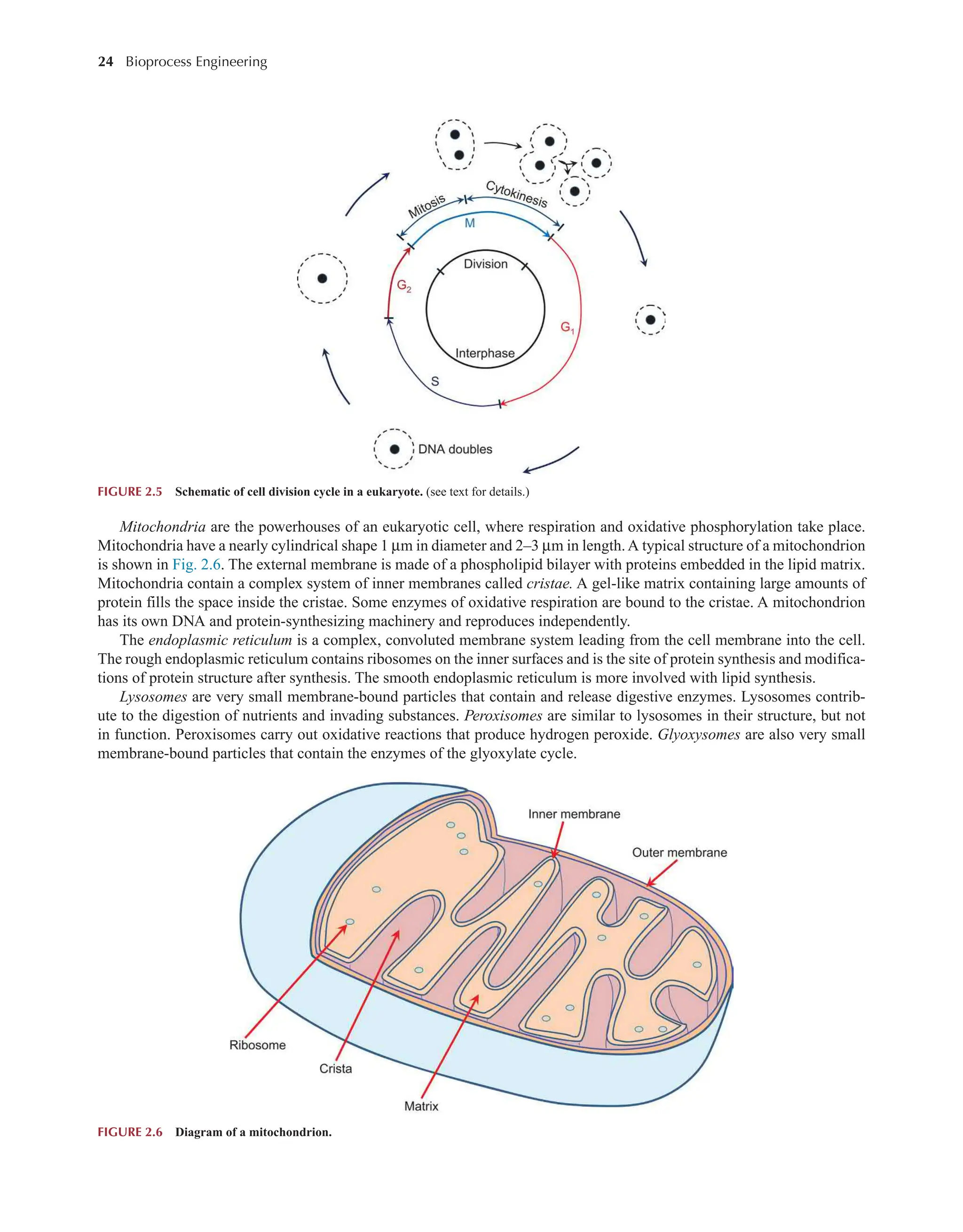
  • 6.
    Elsevier Radarweg 29, POBox 211, 1000 AE Amsterdam, Netherlands The Boulevard, Langford Lane, Kidlington, Oxford OX5 1GB, United Kingdom 50 Hampshire Street, 5th Floor, Cambridge, MA 02139, United States Copyright © 2020 Elsevier B.V. All rights reserved. No part of this publication may be reproduced or transmitted in any form or by any means, electronic or mechanical, in- cluding photocopying, recording, or any information storage and retrieval system, without permission in writing from the publisher. Details on how to seek permission, further information about the Publisher’s permissions policies and our ar- rangements with organizations such as the Copyright Clearance Center and the Copyright Licensing Agency, can be found at our website: www.elsevier.com/permissions. This book and the individual contributions contained in it are protected under copyright by the Publisher (other than as may be noted herein). Notices Knowledge and best practice in this field are constantly changing. As new research and experience broaden our understand- ing, changes in research methods, professional practices, or medical treatment may become necessary. Practitioners and researchers must always rely on their own experience and knowledge in evaluating and using any infor- mation, methods, compounds, or experiments described herein. In using such information or methods they should be mindful of their own safety and the safety of others, including parties for whom they have a professional responsibility. To the fullest extent of the law, neither the Publisher nor the authors, contributors, or editors, assume any liability for any injury and/or damage to persons or property as a matter of products liability, negligence or otherwise, or from any use or operation of any methods, products, instructions, or ideas contained in the material herein. Library of Congress Cataloging-in-Publication Data A catalog record for this book is available from the Library of Congress British Library Cataloguing-in-Publication Data A catalogue record for this book is available from the British Library ISBN: 978-0-12-821012-3 For information on all Elsevier publications visit our website at https://www.elsevier.com/books-and-journals Publisher: Joe Hayton Acquisitions Editor: Kostas Marinakis Editorial Project Manager: Liz Heijkoop Production Project Manager: Omer Mukthar Designer: Mark Rogers Typeset by Thomson Digital
  • 7.
    Bioprocess Engineering. http://dx.doi.org/10.1016/B978-0-12-821012-3.00001-4 Copyright© 2020 Elsevier B.V. All rights reserved. 1 1.1 Biological cycle Fig. 1.1 illustrates the natural biological processes occurring on Earth. Living systems consist of plants, animals, and mi- croorganisms. Sunlight is used by plants to convert CO2 and H2O into carbohydrates and other organic matter, releasing O2. Animals consume plant matter, converting plant materials into animal cells, and using the chemical energy from oxidizing plant matter into CO2 and H2O (H2O also serves as a key substrate for animals), finishing the cycle. Microorganisms further convert dead animal and/or plant biomass into other form of organic substances fertilizing the growth of plants, releasing CO2 and H2O, and the cycle is repeated. Energy from the Sun is used to form molecules and organisms that we call life. Ma- terials or matter participating in the biological cycle are renewable so long as the cycle is maintained. Bioprocess engineers manipulate and make use of this cycle by designing processes to make desired products, either by training microorganisms, plants, and animals, or via direct chemical conversions. The reactor is the heart of any chemical and/or biochemical processes. With reactors, bioprocesses turn inexpensive sus- tainably renewable chemicals such as carbohydrates, into valuable ones that humans need. As such, bioprocesses are chemi- cal processes that use biological substrates and/or catalysts. While not limited to such, we tend to refer to bioprocesses as (1) biologically converting inexpensive “chemicals” or materials into valuable chemicals or materials; and (2) manipulating biological organisms to serve as “catalyst” for conversion or production of products that human need. Bioprocess engineers are the only people technically trained to understand, design, and efficiently handle bioreactors. Bioprocess engineering ensures that a favorable sustainable state or predictable outcome of a bioprocess is achieved. This is equivalent to saying that bioprocess engineers are engineers with, differentiating from other engineers, training in biological sciences, especially quantitative and analytical biological sciences, and green chemistry. If one thinks of science as a dream, engineering is making the dream a reality. The maturing of Chemical Engineer- ing to a major discipline and as one of the very few well-defined disciplines in the 1950s has led to the ease in the mass production of commodity chemicals and completely changed the economics or value structure of materials and chemicals, thanks to the vastly available what were then “waste” and “toxic” materials—fossil resources. Food and materials can be manufactured from the cheap fossil materials. Our living standards improved significantly. Today, chemical reactors and chemical processes are not built by trial-and-error, but by design. The performance of a chemical reactor can be predicted, not just found to happen that way; the differences between large and small reactors are largely solved. Once a dream for the visional pioneers, it can now be achieved at ease. Fossil chemical and energy sources have provided much of our needs for advancing and maintaining the living standards of today. With the dwindling of fossil resources, we are facing yet an- other value structure change. The dream has been shifted to realizing a society that is built upon renewable and sustainable resources. Fossil sources will no longer be abundant for human use. Sustainability becomes the primary concern. Who is going to make this dream come true? Chapter 1 What is bioprocess engineering? Chapter outline 1.1 Biological cycle 1 1.2 Bioprocess engineering applications 2 1.3 Scales: living organism and manufacturing 3 1.4 Green chemistry 4 1.5 Sustainability 5 1.6 Biorefinery 5 1.7 Biotechnology and bioprocess engineering 8 1.8 Mathematics, biology, and engineering 9 1.9 The story of penicillin: the dawn of bioprocess engineering 9 1.10 Bioprocesses: regulatory constraints 12 1.11 The pillars of bioprocess kinetics and systems engineering 13 1.12 Summary 14 Problems 14 References 14 Further readings 15
  • 8.
    2 Bioprocess Engineering  Ona somewhat different scale, we can now manipulate life at its most basic level: the genetic. For thousands of years people have practiced genetic engineering at the level of selection and breeding, or directed evolution. But now it can be done in a purposeful, predetermined manner with the molecular-level manipulation of DNA, at a quantum leap level (as compared with directed evolution) or by design. We now have tools to probe the mysteries of life in a way unimaginable prior to the 1970s. With this intellectual revolution emerges new visions and new hopes: new medicines, semisynthetic organs, abundant and nutritious foods, computers based on biological molecules rather than silicon chips, organisms to degrade pollutants and clean up decades of unintentional damage to the environment, zero harmful chemical leakage to the environment while producing a wide array of consumer products, and revolutionized industrial processes. Our aim of comfortable living standards is ever higher. Without hard work, these dreams will remain merely dreams. Engineers will play an essential role in converting these visions into reality. Biosystems are very complex and beautifully constructed, but they must obey the rules of chemistry and physics and they are susceptible to engineering analysis. Living cells are predictable, and processes to use them can be methodically constructed on commercial scales. There lies a great task—analysis, design, and control of biosystems to the greater benefit of a sustainable humanity. This is the job of the bioprocess engineer. This text is organized such that you can learn bioprocess engineering from the principles. To limit the scope of the text, we have left out the product purification technologies, while focusing on the production generation or biotransformations. We attempt to bridge molecular level understandings to industrial applications. It is our hope that this will help you to strengthen your desire and ability to participate in the intellectual revolution and to make an important contribution to the human society. 1.2 Bioprocess engineering applications In a narrow sense, all human activities are centered around humans. In terms of human needs, bioprocess engineers deal from the production and application of biomaterials, to health defense, biologics development, and production, including gene therapy (manufacturing process), to the production of food and fuel as illustrated in Fig. 1.2. In all these applications, fundamentally, molecular interaction and/or (bio-) transformation governs the production and/or protection processes. A biologic drug is a product produced from a living organism or containing component(s) of living organisms. Biologics include recombinant proteins, tissues, genes, allergens, cells, blood components, blood, and vaccines. Biologics are used to treat numerous disease and conditions on humans. The transformation from chemicals to biologics, the functions or interac- tions of a biologic with human body, pharmacology, and the design of the biologic are subject areas of bioprocess engineering. Gene therapy is an experimental technique that uses genes to treat or prevent disease. This technique has the potential to allow doctors to treat a disorder by inserting a gene into a patient’s cells instead of using drugs or surgery. Researchers are testing several approaches to gene therapy, including: l Replacing a mutated gene that causes disease with a healthy copy of the gene. l Inactivating, or “knocking out,” a mutated gene that is functioning improperly. l Introducing a new gene into the body to help fight a disease. Although gene therapy is a promising treatment option for a number of diseases (including inherited disorders, some types of cancer, and certain viral infections), the technique remains risky and is still under study to make sure that it will be safe and effective. Gene therapy is currently being tested only for diseases that have no other cures. Cell therapy is the therapy in which cellular material is injected, grafted, or implanted into a patient; this generally means intact, living cells. For example, T cells capable of fighting cancer cells via cell-mediated immunity may be injected in the course of immunotherapy. FIGURE 1.1 The natural biological processes.
  • 9.
    What is bioprocessengineering? Chapter | 1 3 Cell therapy originated in the 19th century when scientists experimented by injecting animal material in an attempt to prevent and treat illness. Although such attempts produced no positive benefit, further research found in the mid 20th century that human cells could be used to help prevent the human body rejecting transplanted organs, leading in time to successful bone-marrow transplantation Chimeric antigen receptor (CAR)-modified T cell therapy, for example, has proven to be effective for patients with B cell hematological malignancies. Challenges remain in how to scale out the production of CAR T cells under current good manufacturing procedure (cGMP) in an efficient, effective manner. Currently as a mostly autologous cell-based therapy, the CAR-T cell manufacturing process represents a completely different manufacturing model from traditional biologics. One of the challenges of this largely personalized medicine is the development of efficient technologies and cost-effective clinical manufacturing platforms to support the later-stage clinical trials toward commercialization. Substantial efforts have been placed on the upstream for gene transduction and cell expansion. Apart from health defense and/or biologics, commodity products production is crucial for the human society. Food, fuels, and materials fill in the basic needs. 1.3 Scales: living organism and manufacturing Bioprocess engineering deals with a variable scale, from the molecular level at research to process operation in a factory at manufacturing level. In health applications, this translates to medical research at the most fundamental level of enzyme/ protein to human health professionals at overall health. Fig. 1.3 shows side-side the comparison from a “traditional” chemi- cal engineering view on the left to the “health” engineering on the right. The function of a protein or an enzyme within human cells is important for the overall health of human. When or if any changes to the protein or a foreign protein invades a human cell, the physiology will change, causing a domino effect/ change to far-reaching cells. Regulating the protein and enzyme functions can also be effected with ligands or chemicals. The molecular interactions are key to the overall health of humans. FIGURE 1.2 The applications of bioprocess engineering centered around humanity needs. FIGURE 1.3 A comparison of the chemical engineering (left) with processes in a complex living organism: human body. The bottom is at the microscopic scale where molecular interactions are examined, whereas at the top the factory as a whole is considered.
  • 10.
    4 Bioprocess Engineering  1.4Green chemistry Green chemistry, also called sustainable chemistry, is a philosophy of chemical research and engineering that encourages the design of products and processes that minimize the use and generation of hazardous substances while maximizing the efficiency of the desired product generation. Whereas environmental chemistry is the chemistry of the natural environment, and of pollutant chemicals in nature, green chemistry seeks to reduce and prevent pollution at its source. In 1990, the Pol- lution Prevention Act was passed in the United States. This act helped create a modus operandi for dealing with pollution in an original and innovative way. It aims to avoid problems before they happen. Examples of green chemistry starts with the choice of solvent for a process—water, carbon dioxide, dry media, and non-volatile (ionic) liquids, which are some of the excellent choices. These solvents are not harmful to the environment as either emission can easily be avoided or they are ubiquous in nature. Paul Anastas, then of the United States Environmental Protection Agency, and John C. Warner developed 12 principles of green chemistry, which help to explain what the definition means in practice. The principles cover such concepts as— (1) the design of processes to maximize the amount of (all) raw material that ends up in the product; (2) the use of safe, environment-benign substances, including solvents, whenever possible; (3) the design of energy efficient processes; and (4) the best form of waste disposal: not to create it in the first place. The 12 principles are: 1. It is better to prevent waste than to treat or clean up waste after it is formed. 2. Synthetic methods should be designed to maximize “atom efficiency.” 3. Wherever practicable, synthetic methodologies should be designed to use and generate substances that possess little or no toxicity to human health and the environment. 4. Chemical products should be designed to preserve efficacy of function while reducing toxicity. 5. The use of auxiliary substances (e.g., solvents, separation agents, etc.) should be made unnecessary wherever possible and innocuous when used. 6. Energy requirements should be recognized for their environmental and economic impacts and should be minimized. Synthetic methods should be conducted at ambient temperature and pressure. 7. A raw material or feedstock should be renewable rather than depleting wherever technically and economically practicable. 8. Reduce derivatives—Unnecessary derivatization (blocking group, protection/ deprotection, temporary modification) should be avoided whenever possible. 9. Catalytic reagents (as selective as possible) are superior to stoichiometric reagents. 10. Chemical products should be designed so that at the end of their function they do not persist in the environment and break down into innocuous degradation products. 11. Analytical methodologies need to be further developed to allow for real-time, in-process monitoring and control prior to the formation of hazardous substances. 12. Substances and the form of a substance used in a chemical process should be chosen to minimize potential for chemi- cal accidents, including releases, explosions, and fires. One example of green chemistry achievements is the polylactic acid (or PLA). In 2002, Cargill Dow (now NatureWorks) won the Greener Reaction Conditions Award for their improved polylactic acid polymerization process. Lactic acid is pro- duced by fermenting corn and converted to lactide, the cyclic dimmer ester of lactic acid using an efficient, tin-catalyzed cyclization. The L,L-lactide enantiomers is isolated by distillation and polymerized in the melt to make a crystallizable polymer, which has use in many applications including textiles and apparel, cutlery, and food packaging. Wal-Mart has announced that it is using/will use PLA for its produce packaging. The NatureWorks PLA process substitutes renewable materials for petroleum feedstocks, does not require the use of hazardous organic solvents typical in other PLA processes, and results in a high-quality polymer that is recyclable and compostable. Understanding the concept of green chemistry holds a special position for bioprocess engineers. Processes we design and operate must have minimal potential environmental impacts while optimized for maximum benefit. Basic steps for green chemistry that are what bioprocess engineering do include: 1. Developing products and processes based on renewable resources, such as plant biomass; 2. Design processes that bypass dangerous/toxic-chemical intermediates; 3. Design processes that avoid dangerous/toxic solvent use; 4. Reducing chemical processing steps, but demands high efficiency; 5. Promoting biochemical processes to reduce chemical processing steps or toxic chemical utilization; 6. Design milder (closer to atmosphere temperature and pressure) processes and multiple product recovery routes;
  • 11.
    What is bioprocessengineering? Chapter | 1 5 7. Bypassing chemical equilibrium with innovative reactor design, and biocatalysis, rather than adding intermediate steps. 8. Avoid production of unwanted products other than H2O and CO2. 1.5 Sustainability Sustainability is the capacity to endure or maintain at the longest timescale permissible. In other words, sustainability is the ability to maintain continuum. In ecology, the word describes how biological systems remain diverse and productive over time. Long-lived and healthy wetlands and forests are examples of sustainable biological systems. For humans, sustainabil- ity is the potential for long-term maintenance of well-being, which has environmental, economic, and social dimensions. Healthy ecosystems and environments provide vital goods and services to humans and other organisms. Utilization and release of substances at a rate that is harmonious with a steady state nature is the key for sustainability. This naturally leads to a carrying capacity for each substance or species with which humans interact. The sustainable state can be influenced by (process conditions or) how we interact with nature. There are two major ways of reducing negative human impact and en- hancing ecosystem services. The first is environmental management; this approach is based largely on information gained from earth science, environmental science, and conservation biology. The second approach is management of human con- sumption of resources, which is based largely on information gained from economics. Practice of both of these major steps can ensure a more favorable sustainable state to be evolved into. Sustainability interfaces with economics through the social and ecological consequences of economic activity. Sus- tainable economics involves ecological economics where social, cultural, health-related, and monetary/financial aspects are integrated. Moving toward sustainability is also a social challenge that entails international and national law, urban planning and transport, local and individual lifestyles and ethical consumerism. Ways of living more sustainably can take many forms from reorganizing living conditions (e.g., ecovillages, eco-municipalities, and sustainable cities), reapprais- ing economic sectors (permaculture, green building, sustainable agriculture), or work practices (sustainable architecture), using science to develop new technologies (green technologies, renewable energy), to adjustments in individual lifestyles that conserve natural resources. These exercises reduce our reliance or demand on disturbing the environment. To make all these concepts come to light, bioprocess engineers will be at the forefront of developing and implementing the technologies needed. On a grand scale, maintaining renewability or looking for a favorable predictable steady state on everything we touch or interact is the key to sustainability (Fig. 1.4). This falls right in the arena of bioprocess engineering. Are you ready for the challenge of designing processes that meets sustainability demands? 1.6 Biorefinery On a grand scale, sustainability is the basis of nature. Enforcing sustainability at the time scale of humanity is an insurance of our way of life to continue. Prior to the 1900s, agriculture and forestry were the predominant sources of raw materi- als for energy, food and a wide range of everyday commodities, and the human civilization depended almost entirely on renewable materials. Humanity was restricted by the sustainable supply inefficiently harvested from the biomass, which drew energy from the sun. The industrial revolution has brought a leap in the human civilization. Mass production of goods by machines dominates our daily life. The industrial revolution was brought to mature by the development of combustion FIGURE 1.4 Change of sustainable state owing to human interruption.
  • 12.
    6 Bioprocess Engineering  enginesand subsequent development of fossil energy and chemical industry. Besides the more than doubling of useful bio- mass production/harvest, mankind has increasingly tapped into the large fossil-energy reserves. At first the fossil chemicals were regarded as waste and thus any use was welcomed. It soon became the cheapest chemical and energy sources for the industrial revolution. As a result, our living standards have seen a leap. There is no turning back to the primitive way of life in the past. However, fossil energy and chemical sources are depleting despite the cyclic price change of energy and com- modity materials. There is a critical need to change the current industry and human civilization to a sustainable manner, assuring that our way of life today continues on the path of improvement after the depletion of fossil sources. Our way of life exists only if sustainability is maintained on a time scale no longer than our life span. Biorefinery is concept in analogous to a petroleum refinery whereby a raw material feed (in this case plant ligocellulosic biomass instead of petroleum) is refined to a potpourri of products (on demand). In a biorefinery, lignocellulosic biomass is converted to chemicals, materials, and energy that runs on the human civilization, replacing the needs of petroleum, coal, natural gas, and other non-renewable energy and chemical sources. Lignocellulosic biomass is renewable as shown in Fig. 1.1, in that plant synthesizes chemicals by drawing energy from the sun and, carbon dioxide and water from the environment, while releasing oxygen. Combustion of biomass releases energy, carbon dioxide, and water. Therefore, biore- finery plays a key role in ensuring the cycle of biomass production and consumption included satisfying human needs for energy and chemicals. A biorefinery integrates a variety of conversion processes to produce multiple product streams such as transportation liquid fuels, steam/heat, electricity, and chemicals from lignocellulosic biomass. Biorefinery has been identified as the most promising route to the creation of a sustainable bio-based economy. Biorefinery is a collection of the essential technologies to transform biological raw materials into a range of industrially useful intermediates. By producing multiple products, a biorefinery maximizes the value derived from a lignocellulosic biomass feedstock. A biorefinery could produce one or more low-volume, high-value chemical products together with a low-value, high-volume liquid transportation fuel, while generating electricity and process heat for its own use and/or export. Fig. 1.5 shows a schematic of various biorefinery processes. There are at least three steps in converting woody biomass: pretreatment; cracking or rendering biomass to intermediate molecules; and conversion (of the intermediate molecules to desired products). There are three major categories or approaches in pretreatment—systematical disassembling processes; pyrolysis and gasification processes. In systematical disassembling processes, the lignocellulosic biomass is commonly disassembled to individual components systematically for optimal conversions that followed. The basic approach is based on a systematical disassembling and conversion to desired chemicals. This pretreatment method and the rout of conversion FIGURE 1.5 A schematic of various biorefinery processes. (With permission from: Liu, S., 2015. A synergetic pretreatment technology for woody biomass conversion. Appl. Ener. 144, 114–128).
  • 13.
    What is bioprocessengineering? Chapter | 1 7 followed depend heavily on separation and/or physical fractionation of the intermediates as well as the final desired prod- ucts. Pyrolysis applies heat and some oxygen (or none) to render the biomass to liquid, while gasification renders the bio- mass to syngas. Biological conversions are preferred over chemical conversions due to their selectivity or green chemistry concepts. However, owing to the complexity of the lignocellulosic biomass, a multitude of biological processes is required for optimal operations. The biological reactions are also very slow and thus require larger facility foot prints. Especially following the gasification, bioconversion is in the “primitive” stage of development. Pyrolysis resembles more closely to the refinery whereby the products can be controlled in a more systematical man- ner. It may be classified as systematical disassembling as well. However, there are restrictions on the type of products the process can produce. Gasification as shown in Fig. 1.5 is at the extreme side of conversion technology, whereby the lignocellulosic biomass is disassembled to the basic building block for hydrocarbons: H2 and CO, and then reassembled to desired products as desired. The final products can be more easily tailored from syngas or CO + H2. For example, Fisher-Tropsch process can turn CO + H2 into higher alcohol, alkenes, and many other products. Syn gas (together with air: mixture of N2 and O2) is also the starting point for ammonia synthesis, from which nitrogen fertilizers and many other products are produced. However, all thermochemical processes suffer from selectivity. During the disassembling process, “coke” or “carbon” is produced especially at high temperatures and thus reduces the conversion efficiency, if H2 and CO are the desired intermediates. Thermal-chemical processes are generally considered less “green” than biological and other sequential disassembling processes due to their severe operating conditions, poor selectivity or byproducts generation, and thermodynamic restrictions. The promise of a biorefinery to supply the products human needs is shown in Fig. 1.6 for the various examples of build- ing blocks or platform chemicals that sugar (a specific example of glucose) can produce, besides the very basic building blocks of CO and H2. For example, glucose can be fermented to ethanol by yeast and bacteria anaerobically, and lactic acid can be produced by lacto bacteria. As shown in Fig. 1.6, each arrow radiates from the glucose in the center represents a route of biotransformation (or fermentation) by default, whereas chemical transformations are shown with labeled arrows. For example, glucose can be dehydrated to 5-hydroxymethylfurfural catalyzed with an acid, which can be further decomposed to levulinic acid by hydration. All these chemicals shown in Fig. 1.6 are examples of important platform (or intermediate) chemicals, as well as commodity chemicals. For example, ethanol is well known for its use as a liquid transportation fuel. FIGURE 1.6 The platform of chemicals derived from glucose (the molecule in the center of the diagram). Most of these chemicals are produced via fermentation (or biotransformation), while a few of them are produced via chemical reaction (or chemical transformation) as indicated.
  • 14.
    8 Bioprocess Engineering  Ethanolcan be dehydrated to ethylene, which is the monomer for polyethylene, or dehydrognated and dehydrated to make 1,3-butadiene, monomer for the synthetic rubber. Ethanol can also be employed to produce higher alcohols and alkenes. Are you prepared to be at the forefront of developing, designing and operating these processes for the sustainability and comfortability in humanity? 1.7 Biotechnology and bioprocess engineering Biotechnology is the use or development of methods of direct genetic manipulation for a socially desirable goal. Such a goal might be the production of a particular chemical, but it may also involve the production of better plants or seeds, gene ther- apy, or the use of specially designed organisms to degrade wastes. The key element is the use of sophisticated techniques outside the cell for genetic manipulation. Biotechnology is applied biology; it bridges biology to bioprocess engineering, just like applied chemistry or chemical technology bridges chemistry to chemical engineering. Many terms have been used to describe engineers working with biotechnology. The two terms that are considered general—Biological engineering and Bioengineering come from the two major fields of applications that require deep understanding of biology—agriculture and medicine. Bioengineering is a broad title including work on industrial, medi- cal and agricultural systems; its practitioners include agricultural, electrical, mechanical, industrial, environmental, and chemical engineers, and others. As such, Bioenegineering is not a well-defined term and usually it refers to biotechnology applications that are not easily categorized or in medical fields. Biological Engineering stems from engineering of biology which is also a general term. However, the term biological engineering is initially used by agricultural engineers for the engineering applications to or manipulation of plants and animals and is thus specific. For example, the Institute of Bio- logical Engineering (IBE) has a base in, although not limited to, agricultural engineering. ABET (Accreditation Board for Engineering and Technology, Inc.) brands Biological Engineering together with Agricultural Engineering when accredit- ing BS (Bachelor of Science) and MS (Master of Science) in engineering and technology educational programs. On the other hand, the Society for Biological Engineers was created within American Institute of Chemical Engineers. Therefore, biological engineering is also regarded as a not well defined term and can at times refer to biotechnology applications in agricultural fields. Biochemical engineering has usually meant the extension of chemical engineering principles to systems using a biological catalyst to bring about desired chemical transformations. It is often subdivided into bioreaction engineer- ing and bioseparations. Biomedical engineering has traditionally been considered totally separate from biochemical engi- neering, although the boundary between the two is increasingly vague, particularly in the areas of cell surface receptors and animal cell culture. Another relevant term is biomolecular engineering, which has been defined by the National Institutes of Health as “... research at the interface of biology and chemical engineering and is focused at the molecular level.” In all, a strong background in quantitative analysis, kinetic/dynamic behaviors, and equilibrium behaviors are strongly desirable. Increasingly, these biorelated engineering fields have become inter-related, although the names are restricting. Bioprocess engineering is a broader and at the same time a narrower field than the commonly used terms referred ear- lier—biological engineering, biochemical engineering, biomedical engineering, and biomolecular engineering. Bioprocess Engineering is a profession than spans all the bio-related engineering fields as mentioned earlier. It is a profession that has emerged to stand alone, as compared to the interdisciplinary profession once it was. Unlike the term bioengineering, the term biorpocess engineering is specific and well-defined. Bioprocess engineering emphasizes the engineering and sciences of industrial processes that are biobased—(1) biomass feedstock conversion for a sustainable society or biorefinery; (2) biocatalysis based processing; and (3) manipulation of micro-organisms for a sustainable and socially desirable goal. Bio- process engineering is not product-based nor is substrate-based. Therefore, bioprocess engineering deals with biological and chemical processes involved in all areas, not just for a particular substrate or species (of feedstock or intermediate), outcome or product. Thus, bioprocess engineering intercepts chemical, mechanical, electrical, environmental, medical, and industrial engineering fields, applying the principles to designing and analysis of processes based on using living cells or subcomponents of such cells, as well as non-living matters. Bioprocess engineering deals with both micro-scale (cellular/ molecular) and large-scale (systemwide / industrial) designs and analyses. Science and engineering of processes converting biomass materials to chemicals, materials, and energy are therefore part of bioprocess engineering by extension. Predict- ing and modeling system behaviors, detailed equipment and process design, sensor development, control algorithms, and manufacturing or operating strategies are just some of the challenges facing bioprocess engineers. At the heart of bioprocess engineering lays the process kinetics, reactor design and analysis for biosystems, which forms the basis for this text. We will focus primarily on the kinetics, dynamics, and reaction engineering involved in the bioprocess engineering. A key component is the application of engineering principles to systems containing biological catalysts and/or biomass as feedstock, but with an emphasis on those systems making use of biotechnology and green chemistry. The rapidly increasing ability to determine the complete sequence of genes in an organism offers new opportunities for bioprocess engineers in the design and monitoring of bioprocesses. The cell, itself, is now a designable component of the overall process.
  • 15.
    What is bioprocessengineering? Chapter | 1 9 For practitioners working in the bioprocess engineering, some of journals and periodicals provide the latest develop- ments in the field. Here we name a few: l Biochemical Engineering Journal l Journal of Biological Engineering l Journal of Biomass Conversion and Biorefinery l Journal of Bioprocess Engineering and Biorefinery l Journal of Bioprocess and Bioystems Engineering l Journal of Biotechnology l Journal of Biotechnology Advances l Journal of Biotechnology and Bioprocess Engineering 1.8 Mathematics, biology, and engineering Mathematical modeling holds the key for engineers. Physics at its fundamental level examines forces and motion; one can view it as applied mathematics. In turn, chemistry examines molecules and their interactions. Since physics examines the motions of atoms, nuclei and electrons, at the basis of molecules, one can view chemistry as applied physics. This directly connects chemistry to mathematics at a fundamental level. Indeed, most physicists and chemists rely extensively on math- ematical modeling. While one can view biology as applied chemistry through the connection of chemicals and molecules, the fundamental trainings of biologists today and engineers are distinctly different. In the development of knowledge in the life sciences, unlike chemistry and physics, mathematical theories and quantitative methods (except statistics) have played a secondary role. Most progress has been due to improvements in experimental tools. Results are qualitative and descrip- tive models are formulated and tested. Consequently, biologists often have incomplete backgrounds in mathematics but are very strong with respect to laboratory tools and, more importantly, with respect to the interpretation of laboratory data from complex systems. Engineers usually possess a very good background in the physical and mathematical sciences. Often a theory leads to mathematical formulations, and the validity of the theory is tested by comparing predicted responses to those in experi- ments. Quantitative models and approaches, even to complex systems, are strengths. Biologists are usually better at the formation of testable hypotheses, experimental design, and data interpretation from complex systems. At the dawn of the biotechnology era, engineers were typically unfamiliar with the experimental techniques and strategies used by life scien- tists. However, today bioprocess engineers have entered even more sophisticated experimental techniques and strategies in life sciences (than biologists) due to the understanding and progress in the prediction and modeling of living cells. The well-groundedness in mathematical modeling gives bioprocess engineers an edge and responsibility in enforcing sustainability demands. In practice, the sustainable (or steady) state can be different from what we know today or when no human interruption is imposed. The sustainable state could even be fluctuating with a noticeable degree. Engineers hold great responsibility to convincing environmentalists and the public what to expect by accurately predicting the dynamic outcomes without speculating on the potential dramatic changes ahead. The skills of the engineer and of the life scientist are complementary. To convert the promises of molecular biology into new processes to make new products requires the integration of these skills. To function at this level, the engineer needs a solid understanding of biology and its experimental tools. In this book, we provide sufficient biological background for you to understand the chapters on applying engineering principles to biosystems. However, if you are serious about becoming a bioprocess engineer, it is desirable if you had taken courses in microbiology, biochemistry, and cell biology, as you would appreciate more of the engineering principles in this text. 1.9 The story of penicillin: the dawn of bioprocess engineering Penicillin is an antibiotic of significant importance. The familiar story of penicillin was well-presented by Kargi & Shuler in their text “Bioprocess Engineering – Basic Concepts.” As you would expect, the discovery of the chemical was acci- dental and the production of the chemical is elaborate. In September 1928, Alexander Fleming at St. Mary’s Hospital in London was trying to isolate the bacterium, Staphylococcus aureus, which causes boils. The technique in use was to grow the bacterium on the surface of a nutrient solution. One Friday, the basement window was accidently left open overnight. The experiments were carried out in the basement and one of the dishes had been contaminated inadvertently with a foreign particle. Normally, such a contaminated plate would be tossed out. However, Fleming noticed that no bacteria grew near the invading substance. Fleming’s genius was to realize that this observation was meaningful and not a “failed” experiment. Fleming recognized that the cell killing must be due to an antibacterial agent. He recovered the foreign particle and found that it was a common
  • 16.
    10 Bioprocess Engineering  moldof the Penicillium genus (later identified as Penicillium notatum). Fleming nurtured the mold to grow and, using the crude extraction methods then available, managed to obtain a tiny quantity of secreted material. He then demonstrated that this material had powerful antimicrobial properties and named the product penicillin. Fleming carefully preserved the cul- ture, but the discovery lay essentially dormant for over a decade. World War II provided the impetus to resurrect the discovery. Sulfa drugs have a rather restricted range of activity, and an antibiotic with minimal side effects and broader applicability was desperately needed. In 1939, Howard Florey and Ernst Chain of Oxford decided to build on Fleming’s observations. Norman Heatley played the key role in producing sufficient material for Chain and Florey to test the effectiveness of penicillin. Heatley, trained as a biochemist, performed as a bioprocess engineer. He developed an assay to monitor the amount of penicillin made so as to determine the kinetics of the fermentation, developed a culture technique that could be implemented easily, and devised a novel back-extraction process to recover the very delicate product. After months of immense effort, they produced enough penicillin to treat some laboratory animals. Eighteen months after starting on the project, they began to treat a London policeman for a blood infection. The penicil- lin worked wonders initially and brought the patient to the point of recovery. Most unfortunately, the supply of penicillin was exhausted and the man relapsed and died. Nonetheless, Florey and Chain had demonstrated the great potential for penicillin, if it could be made in sufficient amount. To make large amounts of penicillin would require a process, and for such a process development, engineers would be needed, in addition to microbial physiologists and other life scientists. The war further complicated the situation. Great Britain’s industrial facilities were already totally devoted to the war. Florey and his associates approached pharmaceutical firms in the United States to persuade them to develop the capacity to produce penicillin, since the United States was not at war at that time. Many companies and government laboratories, assisted by many universities, took up the challenge. Particularly prominent were Merck, Pfizer, Squibb, and the USDA Northern Regional Research Laboratory in Peoria, Illinois. The first efforts with fermentation were modest. A large effort went into attempts to chemically synthesize penicillin. This effort involved hundreds of chemists. Consequently, many companies were at first reluctant to commit to the fermenta- tion process, beyond the pilot-plant stage. It was thought that the pilot-plant fermentation system could produce sufficient penicillin to meet the needs of clinical testing, but large-scale production would soon be done by chemical synthesis. At that time, US companies had achieved a great deal of success with chemical synthesis of other drugs, which gave the com- panies a great deal of control over the drug’s production. The chemical synthesis of penicillin proved to be exceedingly difficult (It was accomplished in the 1950s, and the synthesis route is still not competitive with fermentation). However, in 1940 fermentation for the production of a pharmaceutical was an unproved approach, and most companies were betting on chemical synthesis to ultimately dominate. The early clinical successes were so dramatic that in 1943 the War Production Board appointed A. L. Elder to coordinate the activities of producers to greatly increase the supply of penicillin. The fermentation route was chosen. As Elder recalls, “I was ridiculed by some of my closest scientific friends for allowing myself to become associated with what obviously was to be a flop-namely, the commercial production of penicillin by a fermentation process” (from Elder, 1970). The problems facing the fermentation process were indeed very formidable. The problem was typical of most new fermentation processes: a valuable product made at very low levels. The low rate of production per unit volume would necessitate very large and inefficient reactors, and the low concentration (titer) made product recovery and purification very difficult. In 1939 the final concentration in a typical penicillin fermentation broth was one part per million (ca. 0.001 g/L); gold is more plentiful in sea water. Furthermore, penicillin is a fragile and unstable product, which places significant constraints on the approaches used for recovery and purification. Life scientists at the Northern Regional Research Laboratory made many major contributions to the penicillin program. One was the development of a corn steep liquor-lactose based medium. Andrew J. Moyer succeeded to increase productiv- ity about 10-fold with this medium in November 26, 1941. A worldwide search by the laboratory for better producer strains of Penicillium led to the isolation of a Penicillium chrysogenum strain. This strain, isolated from a moldy cantaloupe at a Peoria fruit market, proved superior to hundreds of other isolates tested. Its progeny have been used in almost all commer- cial penicillin fermentations. The other hurdle was to decide on a manufacturing process. One method involved the growth of the mold on the surface of moist bran. This bran method was discarded because of difficulties in temperature control, sterilization, and equipment size. The surface method involved growth of the mold on top of a quiescent medium. The surface method used a variety of containers, including milk bottles, and the term “bottle plant” indicated such a manufacturing technique. The surface meth- od gave relatively high yields, but had a long-growing cycle and was very labor intensive. The first manufacturing plants were bottle plants because the method worked and could be implemented quickly. However, it was clear that the surface method would not meet the full need for penicillin. If the goal of the War Production Board was met by bottle plants, it was
  • 17.
    What is bioprocessengineering? Chapter | 1 11 estimated that the necessary bottles would fill a row stretching from New York City to San Francisco. Engineers generally favored a submerged tank process. The submerged process presented challenges in terms of both mold physiology and in tank design and operation. Large volumes of absolutely clean, oil- and dirt-free sterile air were required. What were then very large agitators were required, and the mechanical seal for the agitator shaft had to be designed to prevent the entry of organisms. Even today, problems of oxygen supply and heat removal are important constraints on antibiotic fermenter design. Contamination by foreign organisms could degrade the product as fast as it was formed, consume nutrients before they were converted to penicillin, or produce toxins. In addition to these challenges in reactor design, there were similar hurdles in product recovery and purification. The very fragile nature of penicillin required the development of special techniques. A combination of pH shifts and rapid liquid-liquid extraction proved useful. Soon processes using tanks of about 10,000 gal were built. Pfizer completed in less than 6 months the first plant for commercial production of penicillin by submerged fermentation (Hobby, 1985). The plant had 14 tanks each of 7000-gal capacity. By a combination of good luck and hard work, the United States had the capacity by the end of World War II to produce enough penicillin for almost 100,000 patients per year. A schematic of the process is shown in Fig. 1.7. This accomplishment required a high level of multidisciplinary work. For example, Merck realized that men who un- derstood both engineering and biology were not available. Merck assigned a chemical engineer and microbiologist together to each aspect of the problem. They planned, executed, and analyzed the experimental program jointly, “almost as if they were one man” (see the chapter by Silcox in Elder, 1970). Progress with penicillin fermentation has continued, as has the need for the interaction of biologists and engineers. From 1939 to now, the yield of penicillin has gone from 0.001 g/L to over 50 g/L of fermentation broth. Progress has involved better understanding of mold physiology, metabolic pathways, penicillin structure, methods of mutation, and selection of mold genetics, process control, and reactor design. Before the penicillin process, almost no chemical engineers sought specialized training in the life sciences. With the advent of modem antibiotics, the concept of the bioprocess engineering was born. The penicillin process also established a paradigm for bioprocess development and biochemical engineering. This paradigm still guides much of our profession’s FIGURE 1.7 Schematic of penicillin production process.
  • 18.
    12 Bioprocess Engineering  thinking.The mindset of bioprocess engineers was cast by the penicillin experience. It is for this reason that we have fo- cused on the penicillin story, rather than on an example for production of a protein from a genetically engineered organism. Although many parallels can be made between the penicillin process and our efforts to use recombinant DNA, no similar paradigm has yet emerged from our experience with genetically engineered cells. We must continually reexamine the preju­ dices the field has inherited from the penicillin experience. It is you, the student, who will best be able to challenge these prejudices. 1.10 Bioprocesses: regulatory constraints To be an effective in bioprocess engineering, you must understand the regulatory climate in which many bioprocess engi- neers work. The US FDA (Food and Drug Administration) and its equivalents in other countries must insure the safety and efficacy of food and medicines. For bioprocess engineers working in the pharmaceutical industry the primary concern is not reduction of manufacturing cost (although that is still a very desirable goal), but the production of a product of consistently high quality in amounts to satisfy the medical needs of the population. Consider briefly the process by which a drug obtains FDA approval. A typical drug undergoes 6–7 years of development from the discovery stage through preclinical testing in animals. To legally test the drug in humans in the United States, an Investigational New Drug (IND) designation must be issued by FDA. Biologics such as vaccines and recombinant protein drugs are generally approved by FDA via a Biologic License Application (BLA). There are five phases of trials before a new drug is placed on market after its discovery: Phase 0: Human microdosing studies (1–3 years). This is a designation for the exploratory, first-in-human trials conducted within the regulations of US-FDA 2006 Guidance on Exploratory Investigational New Drug studies. Phase I: First stage testing in human subjects. Normally, a small group of (20–80) of healthy volunteers is selected. Safety, tolerability, pharmacokinetics, and pharmacodynamics of the drug are evaluated. This phase usually lasts about 1 year. Different types of types of trials in this phase are Single Ascending Dose (SAD), Multiple Ascending Dose (MAD), and Food Effect trials. Phase II: clinical trials (about 2 years). After determining the initial safety and pharmacological parameters, this trial on a larger group of 100–300 patients and volunteers is performed. This trial is designed to assess the efficacy (i.e., does it help the patient) as well as further determining which side effects exist. Sometimes, Phase IIA is designed to determine the dos- ing requirements and Phase IIB is designed to determine the efficacy of the drug. If the drug fails to meet the established standards of the trials, further development of the new drug is usually stopped. Phase III: clinical trials (about 3 years) with 300–3000 (or more) patients. Since individuals vary in body chemistry, it is important to test the range of responses in terms of both side effects and efficacy by using a representative cross section of the population. Randomized controlled multicenter trials on large patient groups are conducted to determine the effective- ness of the drug. This phase of the clinic trials is very expensive, time-consuming, and difficult to design and run, espe- cially in therapies for chronic medical conditions. It is common practice that certain Phase III trials will continue while the regulatory submission is pending at the appropriate regulatory agency. This allows patients to continue to receive possibly lifesaving drugs until the drug us available in the market for distribution. These trials also provide additional safety data and support for marketing claims for the drug. Data from clinical trials is presented to the FDA for review (2 months to 3 years). The review document presented to FDA clearly show the trial results combined with description of the methods and results of human and animal studies, manufacturing procedures, formulation details, and shelf life. If the clinical trials are well designed and demonstrated statistically significant improvements in health with acceptable side effects, the drug is likely to be approved. Phase IV: Postmarketing surveillance trial. Continue safety surveillance (pharmacovigilance) and technical support of a drug after receiving permission to be put on the market. The whole discovery-through-approval process takes 5–10 years for a conventional small molecule drug, and 12–15 years for a new biological drug to make it to the market. It takes about $800–$2000 million to send a new drug to the market. Only one in ten drugs that enter human clinical trials receives approval. Recent FDA reforms have decreased the time to obtain approval for life-saving drugs in treatment of diseases such as cancer and AIDS, but the overall process is still lengthy. This process greatly affects a bioprocess engineer. FDA approval is for the product and the process together. There have been tragic examples where a small process change has allowed a toxic trace compound to form or become incorporated in the final product, resulting in severe side effects, including death. Thus, process changes may require new clinical trials to test the safety of the resulting product. Since clinical trials are very expensive, process improvements are made under a limited set of circumstances. Even during clinical trials it is difficult to make major process changes.
  • 19.
    What is bioprocessengineering? Chapter | 1 13 Drugs sold on the market or used in clinical trials must come from facilities that are certified as GMP or cGMP and must follow the appropriate Code of Federal Regulations (CFR). GMP stands for (current) good manufacturing practice. GMP concerns the actual manufacturing facility design and layout, the equipment and procedures, training of production person- nel, control of process inputs (e.g., raw materials and cultures), and handling of product. The plant layout and design must prevent contamination of the product, and dictate the flow of material, personnel, and air. Equipment and procedures must be validated. Procedures include not only operation of a piece of equipment, but also cleaning and sterilization. Computer software used to monitor and control the process must be validated. Off-line assays done in laboratories must satisfy good laboratory practice (GLP). Procedures are documented by SOPs (standard operating procedures). The GMP guidelines stress the need for documented procedures to validate performance. “Process validation is estab- lishing documented evidence which provides a high degree of assurance that a specific process will consistently produce a product meeting its predetermined specifications and quality characteristics” and “There shall be written procedures for production and process-control to assure that products have the identity, strength, quality, and purity they purport or are represented to possess.” The actual process of validation is often complex, particularly when a whole facility design is considered. The FDA pro- vides extensive information and guidelines which are updated regularly. If students become involved in biomanufacturing for pharmaceuticals, they will need to consult these sources. However, certain key concepts do not change. These concepts are written documentation, consistency of procedures, consistency of product, and demonstrable measures of product qual- ity, particularly purity, and safety. These tasks are demanding and require careful attention to detail. Bioprocess engineers will often find that much of their effort will be to satisfy these regulatory requirements. The key point is that process changes cannot be made without considering their considerable regulatory impact. 1.11 The pillars of bioprocess kinetics and systems engineering As a profession, bioprocess engineers must be well-versed in thermodynamics, transport phenomena, colloids, biosepara- tions, microbiology, bioprocess kinetics and systems engineering, and process simulation and design. This text deals with the core of bioprocess engineering. Unlike earlier texts in this subject area, this text integrates bioprocess engineering prin- ciples, in particular bioprocess kinetics and transformation or reaction engineering principles together. Chemical reaction engineering is not a pre-requisite before taking on this text. Fig. 1.6 shows the pillars of this text. The sustainability on this pillar is narrowly defined as having the net benefit to the human society and/or benign environmental effects. As shown in Fig. 1.8, the fundamental knowledge of engineering science you will learn or expect in this text is among the “pillars”: mass balance, rate expression, stoichiometry, cell metabolism, yield factor, energy balance, mass FIGURE 1.8 The pillars of bioprocess kinetics and system engineering.
  • 20.
    14 Bioprocess Engineering  transfer,cost, and profit analyses. These engineering science fundamentals form the basis or foundation for the design and performance analysis of reactors and /or fermenters. In turn, process kinetic data analysis, biocatalyst design and selection can be learned from the reactor performance, and applied to the design and performance analysis of reactors and/or bioprocess systems. Process stability usually stems from multiplicity of the process, which controls the product quality and consistency. Finally, the design and control of bioprocess systems must obey the greater law of nature: sustainability. 1.12 Summary Sustainability and green chemistry are important to the practice of bioprocess engineers. Biorefinery is a desired approach to provide the products of human needs, putting the human needs into the biological cycle. Both biotransformation and chemical transformations are important to biorefinery. Genetic manipulations and biotransformation are important to the bioprocess engineering profession. Because of the fundamental impact genetic manipulation and biotransformation can have on the cycle of life, ethics and regulations are critical to the practice of bioprocess engineers. It is the intention that this text can be used as a senior and/or graduate text for bioprocess engineering students. It may also be served as a reference and/or graduate text for chemical kinetics, chemical reactor analysis, and bioprocess systems engineering. In the same time, we have inserted materials, more advanced analysis or complex systems in the text as an extension to the introductory material. It is our aim that this text can serve equally as a reference or resource for further research or development. Problems 1.1. How bioprocess engineering affects the overall health of humans? 1.2. Why are renewable materials preferred? 1.3. What is green chemistry? 1.4. What is sustainability? 1.5. What is a biorefinery? 1.6. Why is ethanol an important platform chemical? 1.7. An uninformed researcher is questioning the sustainability of biomass cultivation and utilization, arguing that fertil- izer and fuels for heavy machinery must be produced with fossil energy and thus not renewable. Research into the basis of the arguments and dismiss the notion of unsustainable biomass use. 1.8. What is GMP and how does it relate to the regulatory process for pharmaceuticals? 1.9. When the FDA approves a process, it requires validation of the process. Explain what validation means in the FDA context. 1.10. Why does the FDA approve the process and product together? 1.11. What is biotransformation? What is chemical transformation? References D. History of Penicillin Elder, A.L. (Ed.), 1970. The History of Penicillin Production, Chem. Eng. Prog. Symp. Ser. 66 (#100). American Institute of Chemical Engineers, New York. Hobby, G.L., 1985. Penicillin. Meeting the Challenge. Yale University Press, New Haven, CT.
  • 21.
    What is bioprocessengineering? Chapter | 1 15 Further readings A. Green Chemistry Anatas, P.C., Warner, J.C., 1998. Green Chemistry: Theory and Practice. Oxford University Press, New York. Linthorst JA, 2010. An overview: origins and development of green chemistry. Found. Chem. 12 (1), 55–68. Wilson M, Schwarzman M. 2009. Toward a New U.S. Chemicals Policy: Rebuilding the Foundation to Advance New Science, Green Chemistry, and Environmental Health. Environ Health Perspect. 117 (8) 1202–1209 and A358. www.epa.gov/greenchemistry/. B. Sustainability Adams, W.M., Jeanrenaud, S.J., 2008. Transition to Sustainability: Towards a Humane and Diverse World. IUCN, Gland, Switzerland, 108 pp. Atkinson, G., Dietz, S., Neumayer, E., 2007. Handbook of Sustainable Development. Edward Elgar, Cheltenham. Blackburn, W.R., 2007. The Sustainability Handbook. Earthscan, London. Blewitt, J., 2008. Understanding Sustainable Development. Earthscan, London. Costanza, R., Graumlich, L.J., Steffen, W. (Eds.), 2007. Sustainability or Collapse? An Integrated History and Future of People on Earth. MIT Press, Cambridge, MA. Norton, B., 2005. Sustainability, A Philosophy of Adaptive Ecosystem Management. The University of Chicago Press, Chicago. Soederbaum, P., 2008. Understanding Sustainability Economics. Earthscan, London. C. Biorefinery Liu, S., Lu, H., Hu, R., Shupe, A., Lin, L., Liang, L., 2012. A sustainable woody biomass biorefinery. J. Biotech. Adv. 30 (4), 785–810, http://dx.doi. org/10.1016/j.biotechadv.2012.01.013. FitzPatrick, M., Champagne, P., Cunningham, M.F., Whitney, R.A., 2010. A biorefinery processing perspective: treatment of lignocellulosic materials for the production of value-added products”. Bioresour. Technol. 101 (23), 8915–8922. Kaparaju, P., Serrano, M., Thomsen, A.B., Kongjan, P., Angelidaki, I., 2009. Bioethanol, biohydrogen and biogas production from wheat straw in a bio- refinery concept”. Bioresour. Technol. 100 (9), 2562–2568. Koutinas, A.A., Arifeen, N., Wang, R., Webb, C., 2007. Cereal-based biorefinery development: Integrated enzyme production for cereal flour hydrolysis”. Biotechn. Bioeng. 97 (1), 61–72. Liu, S., Amidon, T.E., Francis, R.C., Ramarao, B.V., Lai, Y.-Z., Scott, G.M., 2006. From forest biomass to chemicals and energy: biorefinery initiative in New York. Ind. Biotech. 2 (2), 113–120. Ohara, H., 2003. Biorefinery. App. Micobiol. and Biotechn. 62 (5–6), 474–477. D. History of Penicillin Moberg, C.L., 1991. Penicillin’s Forgotten Man: Norman Heatley. Science 253, 734–735. Mateles, R.I. (Ed.), 1998. Penicillin, A Paradigm for Biotechnology. Candida Corp., Chicago, IL. Sheehan, J.C., 1982. The Enchanted Ring. The Untold Story of Penicillin. MIT Press, Cambridge, MA. E. Regulatory Issues Currey, B., Klemic, P.A., 2008. A New Phase in Pharmaceutical Regulation. DRI Drug and Medical Device and Product Liability Committee. O’Melveny & Myers LLP, PL California, United States. Durfor, C.N., Andscribner, C.L., 1992. An FDA perspective of manufacturing changes for products in human use. Ann. NY Acad. Sci. 665, 356–363. Naglak, T.J., Keith, M.G., Omstead, D.R., 1994. Validation of fermentation processes. Biopharm 7, 28–36. Reisman, H.B., 1993. Problems in scale-up of biotechnology production processes. Crit. Rev. Biotechnol. 13, 195–253. Wechsler, J. Science and Safety. Magazine: Pharmaceutial Excutive – Washington Report, Oct., 2009. http://www.FDA.gov. http://www.FDAreview.org/approval_process.
  • 22.
    Bioprocess Engineering. http://dx.doi.org/10.1016/B978-0-12-821012-3.00002-6 Copyright© 2020 Elsevier B.V. All rights reserved. 17 Bioprocess engineers seek chemicals and materials for human needs in a sustainable manner. It is the chemicals and materials from biological origin that can sustain the needs of humans. Microorganism also provides a tool for bioprocess engineers to manipulate the chemicals and materials so that they can meet the needs of humanity. Therefore we shall first review some of the biological basics to learn how living organisms (more specific: microorganisms) function and what their important chemicals and materials are. 2.1 Cells and organisms The cell is the basic structural and functional unit of all known living organisms. Cells are to living organisms as like atoms are to molecules. It is the smallest unit of life that is classified as a living thing, and so is often called the building block of life. Some organisms, such as most bacteria, are unicellular (consist of a single cell). Most single cell organisms are microscopic in size and not visible to (human by) naked eyes, which are commonly called microorganisms. However, some unicellular protists and bacteria are macroscopic and visible to the naked eye. For example, Xenophyophores, protozoans of the phylum Foraminifera, are the largest examples known, with Syringammina fragilissima achieving a diameter of up to 20 cm (7.9 inches). The largest bacterium is Thiomargarita namibiensis, reaching a diameter of up to 0.75 mm. Other organisms, such as humans, are multicellular. (Humans have an estimated 100 trillion or 1014 cells; a typical cell size is 10 µm; a typical cell mass is 1 nanogram.) The largest known cell is an unfertilized ostrich egg cell. An average ostrich egg is an oval about 15 cm × 13 cm and weighs 1.4 kg. In 1835, before modern cell theory was developed, Jan Evangelista Purkyně observed small “granules” while looking at plant tissue through a microscope. The cell theory, first developed in 1839 by Matthias Jakob Schleiden and Theodor Schwann, states that all organisms are composed of one or more cells, that all cells come from preexisting cells, that vital functions of an organism occur within cells, and that all cells contain the hereditary information necessary for regulating cell functions and for transmitting information to the next generation of cells. Each cell is at least somewhat self-contained and self-maintaining: it can take in nutrients, convert these nutrients into energy, carry out specialized functions, and reproduce as necessary. Each cell stores its own set of instructions for carrying out each of these activities. Chapter 2 An overview of biological basics Chapter outline 2.1 Cells and organisms 17 2.1.1 Microbial diversity 18 2.1.2 How cells are named 18 2.1.3 Prokaryotes 20 2.1.4 Eukaryotes 23 2.2 Viruses 27 2.3 Prions 30 2.4 Stem cell 30 2.5 Cell chemistry 31 2.5.1 Amino acids and proteins 32 2.5.2 Monosaccharides 37 2.5.3 Disaccharides 42 2.5.4 Polysaccharides 42 2.5.5 Phytic acid and inositol 46 2.5.6 Chitin and chitosan 48 2.5.7 Lignin 48 2.5.8 Lipids, fats, and steroids 50 2.5.9 Nucleic acids, RNA, and DNA 52 2.6 Cell feed 57 2.6.1 Macronutrients 58 2.6.2 Micronutrients 60 2.6.3 Growth media 61 2.7 Non earthly/unnatural biological agents 61 2.8 Summary 62 Problems 63 References 64 Further readings 64
  • 23.
    18 Bioprocess Engineering  2.1.1Microbial diversity Life is very tenacious and can exist in extreme environments. Living cells can be found almost anywhere that water is in the liquid state. The right temperature, pH, and moisture levels vary from one organism to another. Some cells can grow at −20°C (in a brine to prevent freezing), while others can grow at 120°C (where water is under high enough pressure to prevent boiling). Cells that grow best at low temperatures (below 20°C) are usually called psychrophiles, while those with temperature optima in the range of 20–50°C are mesophiles. Organisms that grow best at temperatures greater than 50°C are thermophiles. Many organisms have pH optima far from neutrality; some prefer in an environment with a pH value down to 1 or 2, while others may grow well at pH 9. Some organisms can grow at both low pH values and high temperatures. Although most organisms can grow only with the presence of liquid water, others can grow on barely moist solid sur- faces or in solutions with high salt concentrations. Some cells require oxygen for growth and metabolism. Such organisms can be termed aerobic. Other organisms are inhibited by the presence of oxygen and grow only anaerobically. Some organisms can switch metabolic pathways to allow them to grow under either circumstance. Such organisms are facultative. Often, organisms can grow in environments with almost no obvious source of nutrients. Some cyanobacteria (formerly called blue-green algae) can grow in an environment with only a little moisture and a few dissolved minerals. These bacteria are photosynthetic and can convert CO2 from the atmosphere into the organic compounds (e.g., sugars) necessary for life. They can also convert N2 into NH3 for use in making the essential building blocks of life. + → + CO (cabondioxude) H O(water) CH O(sugar) O (oxygen) 2 2 2 2 (2.1) + → + N 3H O 2NH 3/2O 2 2 3 2 (2.2) Cyanobacteria are important in colonizing nutrient-deficient environments. Organisms from these extreme environments (extremophiles) often provide humanity with important tools for processes to make useful chemicals and medicinals. They are also key to the maintenance of natural cycles and can be used in the recovery of metals from low-grade ores or in the desulfurization of coal or other fuels. The fact that organisms can develop a capacity to exist and multiply in almost any environment on Earth is extremely useful. Not only do organisms occupy a wide variety of habitats, but they also come in a wide range of sizes and shapes. Spheri- cal, cylindrical, ellipsoidal, spiral, and pleomorphic cells exist. Special names are used to describe the shape of bacteria. A cell with a spherical or elliptical shape is often called a coccus (plural, cocci); a cylindrical cell is a rod or bacillus (plural, bacilli); a spiral-shaped cell is a spirillum (plural, spirilla). Some cells may change shape in response to changes in their local environment. Pleomophic cells take on at least two different forms or shapes during their life cycle. Thus organisms can be found in the most extreme environments and have evolved a wondrous array of shapes, sizes, and metabolic capabilities. This great diversity provides the engineer with an immense variety of potential tools. We have barely begun to learn how to manipulate these tools. 2.1.2 How cells are named The naming of cells is complicated by the large variety of organisms. A systematic approach to classifying these organ- isms is an essential aid to their intelligent use. Taxonomy is the development of approaches to organize and summarize our knowledge about the variety of organisms that exist. Although knowledge of taxonomy may seem remote from the needs of an engineer, it is necessary for efficient communication among engineers and scientists working with living cells. Tax- onomy can also play a critical role in patent litigation involving bioprocesses. While taxonomy is concerned with approaches to classification, nomenclature refers to the actual naming of organ- isms. For microorganisms we use a dual name (binary nomenclature). The names are given in Latin or are Latinized. A genus is a group of related species, while a species includes organisms that are sufficiently alike to reproduce. A common well-documented gut organism is Escherichia coli. Escherichia is the genus and coli the species. When writing a report or paper, it is common practice to give the full name when the organism is first mentioned, but to abbreviate the genus to the first letter in subsequent discussion, for example, E. coli. Although organisms that belong to the same species all share the same major characteristics, there are subtle and often technologically important variations within species. A strain of E. coli used in one laboratory may differ from that used in another. Thus various strains and substrains are designated by the addition of letters and numbers. For example, E. coli fBr5 will differ in growth and physiological properties from E. coli K01.
  • 24.
    An overview ofbiological basics Chapter | 2 19 Now that we know how to name organisms, we could consider broader classification up to the level of kingdoms. There is no universal agreement on how to classify microorganisms at this level. Such classification is rather arbitrary and need not concern us. However, we must be aware that there are two primary cell types: eukaryotic and prokaryotic. The primary difference between them is the presence or absence of a membrane around the cell’s genetic information. Prokaryotes have a simple structure with a single chromosome (Fig. 2.1). Prokaryotic cells have no nuclear membrane and no organelles (such as mitochondria and endoplasmic reticulum). Eukaryotes have a more complex internal structure, with more than one chromosome (DNA molecule) in the nucleus. Eukaryotic cells have a true nuclear membrane and may contain a variety of specialized organelles such as mitochondria, endoplasmic reticulum and Golgi apparatus (Fig. 2.2). A detailed compare-son of prokaryotes and eukaryotes is presented in Table 2.1. Structural differences between prokaryotes and eukaryotes are discussed later. Evidence suggests that a common or universal ancestor gave rise to three distinctive branches of life: eukaryotes, eu- bacteria (or “true” bacteria), and archaebacteria. Table 2.2 summarizes some of the distinctive features of these groups. The ability to sequence the genes of whole organisms will have a great impact on our understanding of how these families evolved and are related. The cellular organisms summarized in Table 2.2 are free-living organisms and are all DNA based. Viruses cannot be classified under any of these categories, as they are not independent (or free-living) organisms. Still, viruses are all nucleic FIGURE 2.1 A schematic of a typical prokaryotic cell. FIGURE 2.2 A schematic of a typical eukaryotic cell.
  • 25.
    20 Bioprocess Engineering  acid(either DNA or RNA) based. Prions, on the other hand, are not even nucleic acid based. These rather simple “organ- isms” play important roles in Bioprocess Engineering and thus we will discuss hem separately. 2.1.3 Prokaryotes The sizes of most prokaryotes vary from 0.5–3 µm in equivalent radius. Different species have different shapes, such as spherical or coccus (e.g., Staphylococci), cylindrical or bacillus (E. coli), or spiral or spirillum (Rhodospirillum). Prokary- otic cells grow rapidly, with typical doubling times of half an hour to several hours. Also, prokaryotes can utilize a variety of nutrients as carbon sources, including carbohydrates, hydrocarbons, proteins, and CO2. 2.1.3.1 Eubacteria The eubacteria can be divided into several different groups. One distinction is based on the gram stain (developed by Hans Christian Gram in 1884). The staining procedure first requires fixing the cells by heating. The basic dye, crystal violet, is added; all bacteria will stain purple. Next, iodine is added, followed by the addition of ethanol. Gram-positive cells re- main purple, while Gram-negative cells become colorless. Finally, counterstaining with safranin leaves Gram-positive cells purple, while Gram-negative cells turn red. Cell reactions to the gram stain reveal intrinsic differences in the structure of the cell envelope. TABLE 2.1 A comparison of prokaryotes with eukaryotes. Characteristic Prokaryotes Eukaryotes Genome No. of DNA molecules DNA in organelles DNA observed as chromosomes Nuclear membrane Mitotic and meiotic division of the nucleus Formation of partial diploid One No No No No Yes More than one Yes Yes Yes Yes No Organelles Mitochondria Endoplasmic reticulum Golgi apparatus Photosynthetic apparatus Flagella No No No Chromosomes Single protein, simple structure Yes Yes Yes Chloroplasts Complex structure, with microtubules Spores Heat resistance Endospores High Endo- and exospores Low Source: Millis, N.F., 1985, in: Moo-Young, M. (Ed.), Comprehensive Biotechnology, vol. I, Elsevier Science. TABLE 2.2 Primary subdivisions of cellular organisms that have been recognized. Group Cell morphology Properties Constituent groups Eukaryotes Eukaryotic Multicellular; extensive differentiation of cells and tissues Unicellular, coenocytic, or mycelial; little or no tissue differentiation Plants (seed plants, ferns, mosses) Animals (vertebrates, invertebrates) Protists (algae, fungi, protozoa, slime moulds) Eubacteria Prokaryotic Cell chemistry similar to eukaryotes Most bacteria Archaea Prokaryotic Distinctive cell chemistry Crenarchaeota (sulfolobus, therofilum, thermopteus, pyrobaculum, haloquadratum walsbyi) Nanoarchaeota Euryarchaeota (methanogens, halophiles, therrno- acidophiles) Korarchaeota
  • 26.
    An overview ofbiological basics Chapter | 2 21 A typical Gram-negative cell is E. coli. It has an outer membrane supported by a thin peptidoglycan layer, as shown in Fig. 2.3. Peptidoglycan is a complex polysaccharide with amino acids and forms a structure somewhat analogous to a chain- link fence. A second membrane (the inner or cytoplasmic membrane) exists and is separated from the outer membrane by the periplasmic space. The cytoplasmic membrane contains about 50% protein, 30% lipids, and 20% carbohydrates. The cell envelope serves to retain important cellular compounds and to preferentially exclude undesirable compounds in the environment. the loss of membrane integrity leads to cell lysis (cells breaking open) and cell death. The cell envelope is crucial to the transport of selected material in and out of the cell. A typical Gram-positive cell is Bacillus subtilis. Gram-positive cells do not have an outer membrane. Rather, they have a very thick, rigid cell wall with multiple layers of peptidoglycan. Gram-positive cells also contain teichoic acids covalently bonded to the peptidoglycan. Because Gram-positive bacteria have only a cytoplasmic membrane, they are better suited to excretion of proteins. Excretion is technologically advantageous when the protein is a desired product. Some bacteria are neither Gram-positive nor Gram-negative. For example, Mycoplasma has no cell walls. These bac- teria are important not only clinically (e.g., primary atypical pneumonia), but also because they commonly contaminate media used industrially for animal cell culture. Actinomycetes are bacteria, but morphologically resemble molds with their long and highly branched hyphae. How- ever, the lack of a nuclear membrane and the composition of the cell wall require classification as bacteria. Actinomycetes are important sources of antibiotics. Certain Actinomycetes possess amylolytic and cellulolytic enzymes and are effective in the enzymatic hydrolysis of starch and cellulose. Actinomyces, Thermomonospora, and Streptomyces are examples of genera belonging to this group. Other distinctions within the eubacteria can be made based on cellular nutrition and energy metabolism. One important example is photosynthesis. Cyanobacteria (formerly called blue-green algae) have chlorophyll and fix CO2 into sugars. An- oxygenic photosynthetic bacteria (the purple and green bacteria) have light-gathering pigments called bacteriochlorophyll. Unlike true photosynthesis, the purple and green bacteria do not obtain reduction energy from the splitting of water and do not form oxygen. When stained properly, the area occupied by a prokaryotic cell’s DNA can be easily seen. Prokaryotes may also have other visible structures when viewed under the microscope, such as ribosomes, storage granules, spores, and volutins. Ribosomes are the site of protein synthesis. A typical bacterial cell contains approximately 10,000 ribosomes per cell, although this number can vary greatly with growth rate. The size of a typical ribosome is 10–20 nm and consists of ap- proximately 63% RNA and 37% protein. Storage granules (which are not present in every bacterium) can be used as a source of key metabolites and often contain polysaccharides, lipids, and sulfur granules. The sizes of storage granules vary between 0.5 µm and 1 µm. Some bacteria make intracellular spores (often called endospores in bacteria). Bacterial spores are produced as a resistance to adverse conditions such as high temperature, radiation, and toxic chemicals. The usual con- centration is 1 spore per cell, with a spore size of about 1 µm. Spores can germinate under favorable growth conditions to yield actively growing bacteria. FIGURE 2.3 Schematic of a typical Gram-negative bacterium (A) and its enlarged section of the membrane (B). A Gram-positive cell is similar, except that it has no outer membrane, its peptidoglycan layer is thicker, and the chemical composition of the cell wall differs significantly from the outer envelope of the Gram-negative cell.
  • 27.
    22 Bioprocess Engineering  Volutinis another granular intracellular structure, made of inorganic polymetaphosphates, which is present in some species. Some photosynthetic bacteria, such as Rhodospirilium, have chromatophores that are large inclusion bodies (50– 100 nm) utilized in photosynthesis for the absorption of light. Extracellular products can adhere to or become incorporated within the surface of the cell. Certain bacteria have a coat- ing or outside cell wall called capsule, which is usually a polysaccharide, or sometimes a polypeptide. Extracellular poly- mers are important to biofilm formation and response to environmental challenges (e.g., viruses). Table 2.3 summarizes the architecture of most bacteria. 2.1.3.2 Archaebacteria Under the microscope archaebacteria appear to be nearly identical to eubacteria. However, these cells differ greatly at the molecular level. In many ways the archaebacteria are as similar to the eukaryotes as they are to the eubacteria. Some ex- amples of differences between archaebacteria and eubacteria are as follows: 1. archaebacteria have no peptidoglycan; 2. nucleotide sequences in ribosomal RNA are similar within the archaebacteria but distinctly different from those of eu- bacteria; 3. the lipid composition of the cytoplasmic membrane is very different for the two groups. TABLE 2.3 Characteristics of various components of bacteria. Part Size Composition and comments Slime layer Microcapsule 5–10 nm Protein-polysaccharide-lipid complex responsible for the specific antigens of enteric bacteria and other species. Capsule 0.5–2.0 µm Mainly polysaccharides (e.g., Streptococcus); sometimes polypeptides (e.g., Bacillus antracis). Slime Indefinite Mainly polysaccharides (e.g., Leuconostoc); sometimes polypeptides (e.g., Bacillus subtilis). Cell wall Gram-positive species 10–20 nm Confers shape and rigidity upon the cell. In total, 20% dry weight of the cell. Consists mainly of macromolecules of a mixed polymer of N-acetyl muramicpeptide, teichoic acids, and polysaccharides. Gram-negative species 10–20 nm Consists mostly of a protein-polysaccharide-lipid complex with a small amount of the mu- ramic polymer. Cell membrane 5–10 nm Semipermeable barrier to nutrients. In total, 5%–10% dry weight of the cell, consisting of 50% protein, 28% lipid, and 15%– 20% carbohydrate in a double-layered membrane. Flagellum 10–20 nm by 4–12 µm Protein of the myosin-keratin-fibrinogen class, MW of 40,000. Arises from the cell membrane and is responsible for motility. Pilus (fimbria) 5–10 nm by 0.5–2.0 µm Rigid protein projections from the cell. Especially long ones are formed by Escherichia coli. Inclusions Spore 1.0–1.5 µm by 1.6–2.0 µm One spore is formed per cell intracellularly. Spores show great resistance to heat, dryness, and antibacterial agents. Storage granule 0.5–2.0 µm Glycogenlike, sulfur, or lipid granules may be found in some species. Chromatophore 50–100 nm Organelles in photosynthetic species. Rhodospirillum rubrum contains about 6000 per cell. Ribosome 10–30 nm Organelles for synthesis of protein. About 10,000 ribosomes per cell. They contain 63% RNA and 37% protein. Volutin 0.5–1.0 µm Inorganic polymetaphosphates that stain metachromatically. Nuclear material Composed of DNA that functions genetically as if the genes were arranged linearly on a single endless chromosome, but that appears by light microscopy as irregular patches with no nuclear membrane or distinguishable chromosomes. Autoradiography confirms the linear arrangement of DNA and suggests a MW of at least 109 . Source: Aiba, S., Humphrey, A.E., Millis, N. F., 1973, Biochemical Engineering, second ed. University of Tokyo Press, Tokyo.
  • 28.
    An overview ofbiological basics Chapter | 2 23 Archaebacteria usually live in extreme environments and possess unusual metabolism. Methanogens, which are meth- ane-producing bacteria, belong to this group, as well as thermoacidophiles, which can grow at high temperatures and low pH values. Halobacteria, which can live only in very strong salt solutions, are also members of this group. These organisms are important sources for catalytically active proteins (enzymes) with novel properties. 2.1.4 Eukaryotes Fungi (yeasts and molds), algae, protozoa, and animal and plant cells constitute the eukaryotes. Eukaryotes are five to ten times larger than prokaryotes in diameter (e.g., yeast about 5 µm, animal cells about 10 µm, and plants about 20 µm). Eukaryotes have a true nucleus and a number of cellular organelles inside the cytoplasm. Fig. 2.4 is a schematic of two typical eukaryotic cells. In cell wall and cell membrane structure, eukaryotes are similar to prokaryotes. The plasma membrane is made of proteins and phospholipids that form a bilayer structure. Major proteins of the membrane are hydrophobic and are embedded in the phospholipid matrix. One major difference is the presence of sterols in the cytoplasmic membrane of eukaryotes. Sterols strengthen the structure and make the membrane less flexible. The cell wall of eukaryotic cells shows considerable variations. Some eukaryotes have a peptidoglycan layer in their cell wall; some have polysaccharides and cellulose (e.g., algae). The plant cell wall is composed of cellulose fibers embedded in pectin aggregates, which impart strength to the cell wall. Animal cells do not have a cell wall but only a cytoplasmic membrane. For this reason, animal cells are very shear-sensitive and fragile. This factor significantly complicates the design of large-scale bioreactors for animal cells. The nucleus of eukaryotic cells contains chromosomes as nuclear material (DNA molecules with some closely associ- ated small proteins), surrounded by a membrane. The nuclear membrane consists of a pair of concentric and porous mem- branes. The nucleolus is an area in the nucleus that stains differently and is the site of ribosome synthesis. Many chromo- somes contain small amounts of RNA and basic proteins called histones attached to the DNA. Each chromosome contains a single linear DNA molecule on which the histones are attached. Cell division (asexual) in eukaryotes involves several major steps: DNA synthesis, nuclear division, cell division, and cell separation. Sexual reproduction in eukaryotic cells involves the conjugation of two cells called gametes (egg and sperm cells). The single cell formed from the conjugation of gametes is called a zygote. The zygote has twice as many chromosomes as the gamete. Gametes are haploid cells, while zygotes are diploid. For humans, a haploid cell contains 23 chromosomes, and diploid cells have 46 chromosomes. The cell-division cycle (asexual reproduction) in a eukaryotic cell is depicted in Fig. 2.5. The cell-division cycle is divided into four phases. The M phase consists of mitosis where the nucleus divides, and cy- tokinesis where the cell splits into separate daughter cells. All of the phases between one M phase and the next are known collectively as interphase. The interphase is divided into three phases: Gl, S, and G2.The cell increases in size during the interphase. In the S phase, the cell replicates its nuclear DNA. There are key checkpoints in the cycle when the cell machin- ery must commit to entry to the next phase. Checkpoints exist for entry into the S and M phases and exit from the M phase. Cells may also be in a G0 state, which is a resting state without growth. FIGURE 2.4 Schematics of the two primary types of higher eukaryotic cells. Neither sketch is complete, but each summarizes the principal differ- ences and similarities of such cells.
  • 29.
    24 Bioprocess Engineering  Mitochondriaare the powerhouses of an eukaryotic cell, where respiration and oxidative phosphorylation take place. Mitochondria have a nearly cylindrical shape 1 µm in diameter and 2–3 µm in length.A typical structure of a mitochondrion is shown in Fig. 2.6. The external membrane is made of a phospholipid bilayer with proteins embedded in the lipid matrix. Mitochondria contain a complex system of inner membranes called cristae. A gel-like matrix containing large amounts of protein fills the space inside the cristae. Some enzymes of oxidative respiration are bound to the cristae. A mitochondrion has its own DNA and protein-synthesizing machinery and reproduces independently. The endoplasmic reticulum is a complex, convoluted membrane system leading from the cell membrane into the cell. The rough endoplasmic reticulum contains ribosomes on the inner surfaces and is the site of protein synthesis and modifica- tions of protein structure after synthesis. The smooth endoplasmic reticulum is more involved with lipid synthesis. Lysosomes are very small membrane-bound particles that contain and release digestive enzymes. Lysosomes contrib- ute to the digestion of nutrients and invading substances. Peroxisomes are similar to lysosomes in their structure, but not in function. Peroxisomes carry out oxidative reactions that produce hydrogen peroxide. Glyoxysomes are also very small membrane-bound particles that contain the enzymes of the glyoxylate cycle. FIGURE 2.5 Schematic of cell division cycle in a eukaryote. (see text for details.) FIGURE 2.6 Diagram of a mitochondrion.
  • 30.
    An overview ofbiological basics Chapter | 2 25 Golgi bodies are very small particles composed of membrane aggregates and are responsible for the secretion of certain proteins. Golgi bodies are sites where proteins are modified by the addition of various sugars in a process called glycosyl- ation. Such modifications are important to protein function in the body. Vacuoles are membrane-bound organelles of low density and are responsible for food digestion, osmotic regulation, and waste product storage. Vacuoles may occupy a large fraction of the cell volume (up to 90% in plant cells). Chloroplasts are relatively large green organelles containing chlorophyll that are responsible for photosynthesis in photo- synthetic eukaryotes, such as algae and plant cells. Every chloroplast contains an outer membrane and a large number of inner membranes called thylakoids. Chlorophyll molecules are associated with thylakoids, which have a regular membrane struc- ture with lipid bilayers. Chloroplasts are autonomous units containing their own DNA and protein-synthesizing machinery. Certain prokaryotic and eukaryotic organisms contain flagella—long, filamentous structures that are attached to one end of the cell and are responsible for the motion of the cell. Eukaryotic flagella contain two central fibers surrounded by eighteen peripheral fibers, which exist in duplets. These fibers are arranged in a tube structure called a microtubule and are composed of proteins called tubulin. The whole fiber assembly is embedded in an organic matrix and is surrounded by a membrane. The cytoskeleton (in eukaryotic cells) refers to filaments that provide an internal framework to organize the cell’s in- ternal activities and control its shape. These filaments are critical to cell movement, transduction of mechanical forces into biological responses, and separation of chromosomes into the two daughter cells during cell division. Three types of fibers are present: actin filaments, intermediate filaments, and microtubules. Cilia are structures similar to flagella, but are shorter and numerous. Only one group of protozoa, called ciliates, con- tains cilia. Paramecium species contain nearly 104 cilia per cell. Ciliated organisms move much faster than flagellated ones. This completes our summary of eukaryotic cell structure. Now let us turn our attention to the microscopic eukaryotes. Fungi are heterotrophs, which are widespread in nature. Fungal cells are larger than bacterial cells, and their typical internal structures, such as the nucleus and vacuoles, can be seen easily with a light microscope. Two major groups of fungi are yeasts and molds. Yeasts are single small cells of 5–10-µm size.Yeast cells are usually spherical, cylindrical, or oval.Yeasts can reproduce by asexual or sexual means. Asexual reproduction is by either budding or fission. In budding, a small bud cell forms on the cell, which gradually enlarges and separates from the mother cell. Asexual reproduction by fission is similar to that of bacteria. Only a few species of yeast can reproduce by fission. In fission, cells grow to a certain size and divide into two equal cells. Sexual reproduction of yeasts involves the formation of a zygote (a diploid cell) from the fusion of two haploid cells, each having a single set of chromosomes. The nucleus of the diploid cells divides several times to form ascospores. Each ascospore eventually becomes a new haploid cell and may reproduce by budding and fission. The life cycle of a typi- cal yeast cell is presented in Fig. 2.7. The classification of yeasts is based on reproductive modes (e.g., budding or fission) and the nutritional requirements of cells. The most widely used yeast, Saccharomyces cerevisiae, is used in alcohol formation under anaerobic conditions (e.g., in wine, beer and whiskey making) and also for baker’s yeast production under aerobic conditions. FIGURE 2.7 Cell-division cycle of a typical yeast, Saccharomyces cerevisiae.
  • 31.
    26 Bioprocess Engineering  Moldsare filamentous fungi and have a mycelial structure. The mycelium is a highly branched system of tubes that contains mobile cytoplasm with many nuclei. Long, thin filaments on the mycelium are called hyphae. Certain branches of mycelium may grow in the air, and asexual spores called conidia are formed on these aerial branches. Conidia are nearly spherical in structure and are often pigmented. Some molds reproduce by sexual means and form sexual spores. These spores provide resistance against heat, freezing, drying, and some chemical agents. Both sexual and asexual spores of molds can germinate and form new hyphae. Fig. 2.8 describes the structure and asexual reproduction of molds. Molds usually form long, highly branched cells and easily grow on moist, solid nutrient surfaces. The typical size of a filamentous mold is 5–20 µm. When grown in submerged culture, molds often form cell aggregates and pellets. The typical size of a mold pellet varies between 50 µm and 1 mm, depending on the type of mold and growth conditions. Pellet forma- tion can cause some nutrient-transfer (mainly oxygen) problems inside the pellet. However, pellet formation reduces broth viscosity, which can improve bulk oxygen transfer. On the basis of their mode of sexual reproduction, fungi are grouped in four classes. 1. The phycomycetes are algalike fungi; however, they do not possess chlorophyll and cannot photosynthesize. Aquatic and terrestrial molds belong to this category. 2. The ascomycetes form sexual spores called ascospores, which are contained within a sac (a capsule structure). Some molds of the genera Neurospora and Aspergillus and yeasts belong to this category. 3. The basidiomycetes reproduce by basidiospores, which are extended from the stalks of specialized cells called the basidia. Mushrooms are basidiomycetes. 4. The deuteromycetes (Fungi imperfecti) cannot reproduce by sexual means. Only asexually reproducing molds belong to this category. Some pathogenic fungi, such as Trichophyton, which causes athlete’s foot, belong to the deuteromycetes. Molds are used for the production of citric acid (Aspergillus niger) and many antibiotics, such as penicillin (Penicillium chrysogenum). Mold fermentations make up a large fraction of the fermentation industry. Algae are usually unicellular organisms, although some plantlike multicellular structures are present in marine waters. Algae can be divided into five groups: Rhodophyta (red algae), Phaeophyta (brown algae), Chlorophyta (green algae), Cyanophyta (blue-green algae), and Bacillariophyta (golden-brown algae). Fig. 2.9 shows a drawing of typical green algae. The largest alga is the giant kelp, which can grow over sixty meters long. All algae are photosynthetic and contain chloroplasts, which normally impart a green color to the organisms. The chloroplasts are the sites of chlorophyll pigments and are responsible for photosynthesis. A typical unicellular alga is 10–30 µm in size. Multicellular algae sometimes form a branched or unbranched filamentous structure. Some algae contain silica or calcium carbonate in their cell wall. Diatoms containing silica in their cell wall are used as filter aids in industry. Some algae, such as Chlorella, Scenedesmus, Spirul- lina, and Dunaliella, are used for wastewater treatment while producing single-cell proteins. Certain gelling agents such as agar and alginic acid are obtained from marine algae and seaweeds. Many algae have been proposed for biofuel production. Protozoa are unicellular, motile, relatively large (1–50 mm) eukaryotic cells that lack cell walls. Protozoa usually obtain food by ingesting other small organisms, such as bacteria, or other food particles. Protozoa are usually uninucleate and FIGURE 2.8 Structure and asexual reproduction of molds.
  • 32.
    An overview ofbiological basics Chapter | 2 27 reproduce by sexual or asexual means. They are classified on the basis of their motion. The amoebae move through ame- boid motion, whereby the cytoplasm of the cell flows forward to form a pseudopodium (false foot), and the rest of the cell flows toward this lobe. The flagellates move using their flagella. Trypanosomes move by flagella and cause a number of dis- eases in humans. The ciliates move through motion of a large number of small appendages on the cell surface called cilia. The sporozoans are nonmotile and contain members that are human and animal parasites. These protozoa do not engulf food particles, but absorb dissolved food components through their membranes. Protozoa cause some diseases, such as ma- laria and dysentery. Protozoa may have a beneficial role in removing bacteria in biological wastewater treatment processes. 2.2 Viruses Viruses are very small and are obligate parasites of other cells, such as bacterial, yeast, plant, and animal cells. Viruses cannot capture or store free energy and are not functionally active except when inside their host cells. The sizes of viruses vary from 30 to 200 nm. Viruses contain either DNA (DNA viruses) or RNA (RNA viruses) as genetic material. DNA stands for deoxyribo- nucleic acid, and RNA is ribonucleic acid; we will soon discuss DNA and RNA molecules in more detail. In free-living cells, all genetic information is contained in the DNA, whereas viruses can use either RNA or DNA to encode such information. This nu- clear material is covered by a protein coat called a capsid. Some viruses have an outer envelope of a lipoprotein and some do not. Almost all cell types are susceptible to viral infections. Viruses infecting bacteria are called bacteriophages. The most common type of bacteriophage has a hexagonal head, tail, and tail fibers as shown in Fig. 2.10. Bacteriophages attach to the cell wall of a host cell with tail fibers, alter the cell wall of the host cell, and inject the viral nuclear material into the host cell. Fig. 2.11 describes the attachment of a virus onto a host cell. Bacteriophage nucleic acids reproduce inside the host cells to produce more phages. At a certain stage of viral reproduction, host cells lysis or break apart and the new phages are released, which can infect new host cells. This mode of reproduction of viruses is called the lytic cycle. In some cases, phage DNA may be incorporated into the host DNA, and the host may continue to multiply in this state, which is called the lysogenic cycle. Viruses are the cause of many diseases, and antiviral agents are important targets for drug discovery. However, viruses are also important to bioprocess technology. For example, a phage attack on an E. coli fermentation to make a recombinant protein product can be extremely destructive, causing the loss of the whole culture in vessels of many thousands of liters. However, phages can be used as agents to move desired genetic material into E. coli. Modified animal viruses can be used as vectors to genetically engineer animal cells to produce proteins from recombinant DNA technology. In some cases a killed virus preparation can be used as a vaccine. Genetic engineering allows the production of virus-like units that are empty shells; the shell is the capsid and all nucleic acid is removed. Such units can be used as vaccines without fear of viral FIGURE 2.9 A sketch of green algae. Source: “Siphoneae”, Ernst Haecket, Kunstformen der Natur, 1904.
  • 33.
    Discovering Diverse ContentThrough Random Scribd Documents
  • 34.
    Glory, Paul sawGod's Redeeming Love upon the throne of the universe; it had descended deeper than sin and death; it was exalted now above all heavens; it filled all things. That sight he carried with him everywhere; it was his salvation and his Gospel, the inspiration of his inmost life, and the motive of all his labours. One who owed all this to Christ was not likely to make Christ's service the theatre of his own ambitions; he could not do anything but take the servant's place, and proclaim Jesus Christ as Lord. There is a difficulty in the last half of ver. 6: it is not clear what precisely meant by πρὸς φωτισμὸν τῆς γνώσεως τῆς δόξης τοῦ Θεοῦ κ.τ.λ. By some the passage is rendered: God shined in our hearts, "that He might bring into the light (for us to see it) the knowledge of His glory," etc. This is certainly legitimate, and strikes me as the most natural interpretation. It would answer then to what Paul says in Gal. i. 15 f., referring to the same event: "It pleased God to reveal His Son in me." But others think all this is covered by the words "God shined in our hearts," and they take πρὸς φωτισμὸν κ.τ.λ., as a description of the apostolic vocation: God shined in our hearts, "that we might bring into the light (for others to see) the knowledge of His glory," etc. The words would then answer to what follows in Gal. i. 16: God revealed His Son in me, "that I might preach Him among the heathen." This construction is possible, but I think forced. In Paul's experience his conversion and vocation were indissolubly connected; but πρὸς φωτισμὸν κ.τ.λ., can only mean one, and the conversion is the likelier.
  • 35.
    XII THE VICTORY OFFAITH "But we have this treasure in earthen vessels, that the exceeding greatness of the power may be of God, and not from ourselves; we are pressed on every side, yet not straitened; perplexed, yet not unto despair; pursued, yet not forsaken; smitten down, yet not destroyed; always bearing about in the body the dying of Jesus, that the life also of Jesus may be manifested in our body. For we which live are alway delivered unto death for Jesus' sake, that the life also of Jesus may be manifested in our mortal flesh. So then death worketh in us, but life in you. But having the same spirit of faith, according to that which is written, I believed, and therefore did I speak; we also believe, and therefore also we speak; knowing that He which raised up the Lord Jesus shall raise up us also with Jesus, and shall present us with you. For all things are for your sakes, that the grace, being multiplied through the many, may cause the thanksgiving to abound unto the glory of God. "Wherefore we faint not; but though our outward man is decaying, yet our inward man is renewed day by day. For our light affliction, which is for the moment, worketh for us more and more exceedingly an eternal weight of glory; while we look not at the things which are seen, but at the things which are not seen: for the things which are seen are temporal; but the things which are not seen are eternal."—2 Cor. iv. 7-18 (R.V.). In the opening verses of this chapter Paul has magnified his office, and his equipment for it. He has risen to a great height, poetic and spiritual, in speaking of the Lord of glory, and of the light which
  • 36.
    shines from Hisface for the illumining and redemption of men. The disproportion between his own nature and powers, and the high calling to which he has been called, flashes across his mind. It is quite possible that this disproportion, viewed with a malignant eye, had been made matter of reproach by his adversaries. "Who," they may have said, "is this man, who soars to such heights, and makes such extraordinary claims? The part does not suit him; he is quite unequal to it; his bodily presence is weak, and his speech contemptible." It is possible, further, though I hardly think it probable, that the very sufferings Paul endured in his apostolic work were cast in his teeth by Jewish teachers at Corinth; they were read by these spiteful interpreters as signs of God's wrath, the judgment of the Almighty on a wanton subverter of His law. But surely it is not too much to suppose that Paul could sometimes think unchallenged. A soul as great and as sensitive as his might well be struck by the contrast which pervades this passage without requiring to have it suggested by the malice of his foes. The interpretation which he puts upon the contrast is not merely a happy artifice (so Calvin), and still less a tour de force; it is a profound truth, a favourite, if one may say so, in the New Testament, and of universal application. "We have this treasure," he writes—the treasure of the knowledge of the glory of God in the face of Jesus Christ, including the apostolic vocation to diffuse that knowledge—"we have this treasure in earthen vessels, that the exceeding greatness of the power [which it exercises, and which is exhibited in sustaining us in our function] may be seen to be God's, and not from us." Earthen vessels are fragile, and what the word immediately suggests is no doubt bodily weakness, and especially mortality; but the nature of some of the trials referred to in vv. 8 and 9 (ἀπορούμενοι, ἀλλ' οὐκ ἐξαπορύμενοι) shows that it would be a mistake to confine the meaning to the body. The earthen vessel which holds the priceless treasure of the knowledge of God—the lamp of frail ware in which the light of Christ's glory shines for the illumination of the world—is human nature as it is; man's body in its weakness, and liability to death; his mind with its limitations and confusions; his moral nature
  • 37.
    with its distortionsand misconceptions, and its insight not yet half restored. It was not merely in his physique that Paul felt the disparity between himself and his calling to preach the Gospel of the glory of Christ; it was in his whole being. But instead of finding in this disparity reason to doubt his vocation, he saw in it an illustration of a great law of God. It served to protect the truth that salvation is of the Lord. No one who saw the exceeding greatness of the power which the Gospel exercised—not only in sustaining its preachers under persecution, but in transforming human nature, and making bad men good—no one who saw this, and looked at a preacher like Paul, could dream that the explanation lay in him. Not in an ugly little Jew, without presence, without eloquence, without the means to bribe or to compel, could the source of such courage, the cause of such transformations, be found; it must be sought, not in him, but in God. "God hath chosen the foolish things of the world to confound the wise; and God hath chosen the weak things of the world to confound the things which are mighty; and base things of the world, and things which are despised, hath God chosen, yea, and things which are not, to bring to nought things which are." And the end of it all is that he which glorieth should glory in the Lord. This verse is never without its application; and though the contempt of the world did not suggest it to St. Paul, it may naturally enough recall it to us. One would sometimes think, from the tone of current literature, that no person with gifts above contempt is any longer identified with the Gospel. Clever men, we are told, do not become preachers now—still less do they go to church. They find it impossible to have real or sincere intellectual intercourse with Christian ministers. Perhaps this is not so alarming as the clever people think. There always have been men in the world so clever that God could make no use of them; they could never do His work, because they were so lost in admiration of their own. But God's work never depended on them, and it does not depend on them now. It depends on those who, when they see Jesus Christ, become unconscious, once and for ever, of all that they have been used to call their wisdom and their strength—on those who are but earthen
  • 38.
    vessels in whichanother's jewel is kept, lamps of clay in which another's light shines. The kingdom of God has not changed its administration since the first century; its supreme law is still the glory of God, and not the glory of the clever men; and we may be quite sure it will not change. God will always have his work done by instruments who are willing to have it clear that the exceeding greatness of the power is His, and not theirs. The eighth and ninth verses illustrate the contrast between Paul's weakness and God's power. In the series of participles which the Apostle uses, the earthen vessel is represented by the first in each pair, the divine power by the second. "We are pressed on every side, but not straitened"—i.e., not brought into a narrow place from which there is no escape. "We are perplexed, but not unto despair," or, preserving the relation between the words of the original, "put to it, but not utterly put out." This distinctly suggests inward rather than merely bodily trials, or at least the inward aspect of these: constantly at a loss, the Apostle nevertheless constantly finds the solution of his problems. "Pursued, but not abandoned"—i.e., not left in the enemy's hands. "Smitten down, but not destroyed": even when trouble has done its worst, when the persecuted man has been overtaken and struck to the ground, the blow is not fatal, and he rises again. All these partial contrasts of human weakness and Divine power are condensed and concentrated in the tenth verse in one great contrast, the two sides of which are presented in their divinely intended relation to each other: "always bearing about in the body the dying of Jesus, that the life also of Jesus may be manifested in our body." And this again, with its mystical poetic aspect, especially in the first clause, is reaffirmed and rendered into prose in ver. 11: "For we, alive as we are, are ever being delivered unto death for Jesus' sake, that the life also of Jesus may be manifested in our mortal flesh." Paul does not say that he bears about in his body the death of Jesus (θάνατος), but his dying (νέκρωσις, mortificatio), the process which produces death. The sufferings which come upon him daily in his
  • 39.
    work for Jesusare gradually killing him; the pains, the perils, the spiritual pressure, the excitement of danger and the excitement of deliverance, are wearing out his strength, and soon he must die. In the very same way Jesus Himself had spent His strength and died, and in that life of weakness and suffering which was always bringing him nearer the grave, Paul felt himself in intimate sympathetic communion with his Master: it was "the dying of Jesus" that he carried about in his body. But that was not all. In spite of the dying, he was not dead. Perpetually in peril, he had a perpetual series of escapes; perpetually at his wits end, his way perpetually opened before him. What was the explanation of that? It was the life of Jesus manifesting itself in his body. The life of Jesus can only mean the life which Jesus lives now at God's right hand; and these repeated escapes of the Apostle, these restorations of his courage, are manifestations of that life; they are, so to speak, a series of resurrections. Paul's communion with Jesus is not only in His dying, but in His rising again; he has the evidence of the Resurrection, because he has its power, present with him, in these constant deliverances and renewals. Nay, the very purpose of his sufferings and perils is to provide occasion for the manifestation of this resurrection life. Unless he were exposed to death, God could not deliver him from it; unless he were pressed in the spirit, God could not give him relief; there could be no setting off of the exceeding greatness of His power in contrast with the exceeding frailty of the earthen vessel. The use of body and of mortal flesh in these verses has been appealed to in support of an interpretation which would limit the meaning to what is merely physical: "I am in daily danger of death, God daily delivers me from it, and thus the life of Jesus is manifested in me." This is of course included in the interpretation given above; but I cannot suppose it is all the Apostle meant. The truth is, there is no such thing in the passage, or indeed in human life, as a merely physical experience. To be delivered to death for Jesus' sake is an experience which is at once and indissolubly physical and spiritual; it could not be, unless the soul had its part, and that the chief part, in it. To be delivered from such death is also an experience as much spiritual as physical. And in both aspects,
  • 40.
    and not leastin the first, is the life of Jesus manifested. Nor can I see that it is in the least degree unnatural for one who feels this to speak of that life as being manifested in his "body," or in his "mortal flesh"; it is a way which all men understand of describing the human nature, which is the scene of the manifestation, as a frail and powerless thing. The moral of the passage is similar to that of chap. i. 3-11. Suffering, for the Christian, is not an accident; it is a divine appointment and a divine opportunity. To wear life out in the service of Jesus is to open it to the entrance of Jesus' life; it is to receive, in all its alleviations, in all its renewals, in all its deliverances, a witness to His resurrection. Perhaps it is only by accepting this service, with the daily dying it demands, that that witness can be given to us; and "the life of Jesus" on His throne may become inapprehensible and unreal in proportion as we decline to bear about in our bodies His dying. All who have commented on this passage have noticed the iteration of the name of Jesus. Singulariter sensit Paulus dulcedinem ejus. Schmiedel explains the repetition as partly accidental, and partly indicative of the fact that Christ's death is here regarded as a purely human occurrence, and not as a redemptive deed of the Messiah. This points in the right direction, though it may fairly be doubted whether Paul would have drawn this distinction, or could even have been made to understand it. The analytic tendency of the modern mind often disintegrates what depends for its virtue on being kept whole and entire, and this seems to me a case in point. The use of the name Jesus rather indicates that, in recalling the actual events of his own career, Paul saw them run continually parallel to events in the career of Another; they were one in kind with that painful series of incidents which ended in the death of the historical Saviour. People have often sought in the Epistles of Paul for traces of a knowledge of Christ like that which is conserved in the first three Gospels; in this expression, τὴν νέκρωσιν τοῦ Ἰησοῦ, and in the repetition of the historical proper name, there is an indirect but quite convincing proof that the general character of Christ's life was known to the Apostle. And though he does not dwell on Christ's
  • 41.
    sympathy with thefulness and power of the writer to the Hebrews, it is evident from this passage that he was in sympathetic fellowship with One who had suffered as he suffered, and that even to name His human name was consolation. In ver. 12 an abrupt conclusion is drawn from all that precedes: "So then death worketh in us, but life in you." Ironice dictum, is Calvin's comment, and the words are at least intelligible if so taken. The stinging passage beginning at chap. iv. 8 of the First Epistle is ironical in precisely this sense—"We are fools for Christ's sake, but ye are wise in Christ; we are weak, but ye are strong; ye have glory, but we have dishonour": this is as it were a variation on the theme "death worketh in us, but life in you." Still, the irony does not seem in place here: Paul writes in all seriousness that the sufferings which he endures as a preacher of the Gospel, and which eventually bring death to him—which are the approaches of death, or death itself at work—are the means by which life, in the most unqualified sense, comes to be at work in the Corinthians. If the death and life which are in view wherever the Gospel appears are to be distributed among them, the death is his, and the life theirs; the dying of Jesus is borne about by the Evangelist, while those who accept the message he brings at this cost are made partakers in Jesus' life. Not indeed that the contrast can be thus absolute: the thirteenth verse corrects this hasty inference. If death alone were at work in St. Paul, it would frustrate his vocation; he would not be able to preach at all. But he is able to preach. In spite of all the discouragement which his sufferings might beget, his faith remains vigorous; he is conscious of possessing that same confidence toward God which animated the ancient Psalmist to sing, "I believed, therefore I spoke." "We also," he says, "believe, and therefore also we speak." What he believes, and what prompts his utterance, we read in the thirteenth verse: "We speak; knowing that He who raised Jesus shall raise us also like[40] Jesus, and shall present us with you. With you, I say: for the whole thing is for your sakes, that the grace,
  • 42.
    having become abundant,may by means of many[41] cause the thanksgiving to abound to the glory of God." What an interesting illustration this is of the communion of the saints! Paul recognises a spiritual kinsman in the writer of the Psalm; [42] faith in God, the power which faith confers, the obligations which faith imposes, are the same in all ages. He recognises spiritual kinsmen in the Corinthians also. All his sufferings have their interest in view, and it is part of his joy, as he looks on to the future, that when God raises him from the dead, as He raised His own Son, He will present him along with them. Their unity will not be dissolved by death. The word here rendered "present" has often a technical sense in Paul's Epistles; it is almost appropriated to the presenting of men before the judgment-seat of Christ. Good scholars insist on that meaning here; but even with the proviso that acceptance in the judgment is taken for granted, I cannot feel that it is quite congruous. There is such a thing as presentation to a sovereign as well as to a judge—the presenting of the bride to the bridegroom on the wedding day as well as of the criminal to the justice—and it is the great and glad occasion which answers to the feeling in the Apostle's mind. The communion of the saints, in virtue of which his sufferings bring blessing to the Corinthians, has its issue in the joyful union of all before the throne. As Paul thinks of that, he sees an end in the Gospel lying beyond the blessing it brings to men. That end is God's glory. The more he toils and suffers, the more God's grace is made known and received; and the more it is received, the more does it cause thanksgiving to abound to the glory of God. Two practical reflections present themselves here, nearly related to each other. The first is that faith naturally speaks; the second, that grace merits thanksgiving. Put the two into one, and we may say that grace received by faith merits articulate thanksgiving. Much modern faith is inarticulate, and it is far too soothing to be true if we say, Better so. Of course the utterance of faith is not prescribed to it; to be of any value it must be spontaneous. Not all the believing are to be teachers and preachers, but all are to be confessors. Every one
  • 43.
    who has faithhas a witness to bear to God. Every one who has accepted God's grace by faith has a thankful acknowledgment of it to make, and at some time or other to make in words. It is not the faculty of speech that is wanting where this is not done; it is courage and gratitude; it is the same Spirit of faith which prompted the Psalmist and St. Paul. It is true that hypocrites sometimes speak, and that testimonies and thanksgivings are apt to be discredited on their account; but bad money would never be put in circulation unless good money was indisputably valuable. It is not the dumb, but the confessing Christian, not the taciturn, but the outspokenly thankful, who glorifies God, and helps on the Gospel. Calvin is properly severe on our "pseudo-nicodemi," who make a merit of their silence, and boast that they have never by a syllable betrayed their faith. Faith is betrayed in another and more serious sense when it is kept secret. But to return to the Apostle, who himself, at ver. 16, returns to the beginning of the chapter, and resumes the οὐκ ἐγκακοῦμεν of ver. 1: "Wherefore we faint not." "Wherefore" means "With all that has been said in view"; not only the glorious future in which Paul and his disciples are to be raised and presented together to Christ, but his daily experience of the life of Jesus manifested in his mortal flesh. This kept him brave and strong. "We faint not; but though our outward man is decaying, yet our inward man is renewed day by day." The outward man covers the same area as "our body," or "our mortal flesh." It is human nature as it is constituted in this world—a weak, fragile, perishable thing. Paul could not mistake, and did not hide from himself, the effect which his apostolic work had upon him. He saw it was killing him. He was old long before the time. He was a sorely broken man at an age when many are in the fulness of their strength. The earthen vessel was visibly crumbling. Still, that was not the whole of his experience. "The inward man is renewed day by day." The meaning of these words must be fixed mainly by the opposition in which they stand to οὐκ ἐγκακοῦμεν ("we faint not"). The same word (ἀνακαινοῦσθαι) is used of the renewal of the soul in the Creator's image (Col. iii. 10)—i.e., of the work of sanctification;
  • 44.
    but the oppositionin question proves that this is not contemplated here. We must rather think of the daily supply of spiritual power for apostolic service—of the new strength and joy which were given to St. Paul every morning, in spite of the toils and sufferings which every day exhausted him. Of course we can say of all people, bad as well as good, "The outward man is decaying." Time tires the stoutest runner, crumbles the compactest wall. But we cannot say of all, "The inward man is renewed day by day." That is not the compensation of every one; it is the compensation of those whose outward man has decayed in Jesus' service, who have been worn out in labours for His sake. It is they, and they only, who have a life within which is independent of outward conditions, which sufferings and deaths cannot crush, and which never grows old. The decay of the outward man in the godless is a melancholy spectacle, for it is the decay of everything; in the Christian it does not touch that life which is hid with Christ in God, and which is in the soul itself a well of water springing up to life eternal. But who shall speak of the two great verses in which the Apostle, leaving controversy out of sight, solemnly weighs against each other time and eternity, the seen and the unseen, and claims his inheritance beyond? "Our light affliction, which is for the moment, worketh for us more and more exceedingly an eternal weight of glory; while we look not at the things which are seen, but at the things which are not seen: for the things which are seen are temporal; but the things which are not seen are eternal." One can imagine that he was dictating quick and eagerly as he began the sentence; he "crowds and hurries and precipitates" the grand contrasts of which his mind is full. Affliction in any case is outweighed by glory, but the affliction in question is a light matter, the glory a great weight: the light affliction is but momentary—it ends with death at the latest, it may end in the coming of Jesus to anticipate death; the weight of glory is eternal; and as if this were not enough, the light affliction which is but for a moment works out for us the weight of glory which endures for ever, "in excess and to excess," in a way above conception, to a degree above conception:
  • 45.
    it works outfor us the things which eye hath not seen, nor ear heard, nor man's heart conceived, "all that God has prepared for them that love Him" (1 Cor. ii. 9). If Paul spoke fast and with beating heart as he crowded all this into two brief lines, we can well believe that the pressure was relaxed, and that the pen moved more steadily and slowly over the contemplative words that follow: "while we look not to the things which are seen, but to the things which are not seen: for the things which are seen are temporal, but the things which are not seen are eternal." This sentence is sometimes translated conditionally: "provided we look," etc. This is legitimate, but unnecessary. The Apostle is speaking, in the first instance, of himself, and the looking is taken for granted. The look is not merely equivalent to vision; it means that the unseen is the goal of him who looks. The eye is to be directed to it, not as an indifferent object, but as a mark to aim at, an end to attain. This observation goes some way to limit the application of the whole passage. The contrast of things seen and things unseen is sometimes taken in a latitude which deprives it of much of its force: psychology and metaphysics are dragged in to define and to confuse the Apostle's thought. But everything here is practical. The things seen are to all intents and purposes that tempest-tossed life of which St. Paul has been speaking, that daily dying, that pressure, perplexity, persecution, and downcasting, which are for the present his lot. To these he does not look: in comparison with that to which he does look, these are a light and momentary affliction which is not worth a thought. Similarly, the things unseen are not everything, indefinitely, which is invisible; to all intents and purposes they are the glory of Christ. It is on this the Apostle's eye is fixed, this which is his goal. The stormy life, even when most is made of its storms, passes; but Christ's glory can never pass. It is infinite, inconceivable, eternal. There is an inheritance in it for all who keep their eyes upon it, and, sustained by a hope so high, bear the daily death of a life like Paul's as a light and momentary affliction. The connexion between the two is so close that the one is said to work for us the other. By divine appointment they are united; fellowship with Jesus is fellowship all through—in the daily dying, which soon has done its worst, and then
  • 46.
    in the endlesslife. We may say, if we please, that the glory is the reward of the suffering; it would be truer to say that it was its compensation, truer still that it was its fruit. There is a vital connexion between them, but no one can imagine he is reading Paul's thought who should find here the idea that the trivial service of man can make God his debtor for so vast a sum. The excellency of the power which raises the earthen vessel to this height of faith, hope, and inspiration is itself God's, and God's alone. Distrust of the supernatural, insistence on the present and the practical, and the pride of a self-styled common sense, have done much to rob modern Christianity of this vast horizon, to blind it to this heavenly vision. But wherever the life of Jesus is being manifested in mortal flesh—wherever in His service and for His sake men and women die daily, wearing out nature, but with spirit ceaselessly renewed—there the unseen becomes real again. Such people know that what they do is not for one dead, but for One who lives; they know that the daily inspirations they receive, the hopes, the deliverances, are wrought in them, not by themselves, but by One who has all power in heaven and on earth. The things that are unseen and eternal stand out as what they are in relation to lives like these; to other lives, they have no relation at all. A worldly and selfish career does not work out an exceeding and eternal weight of glory, and therefore to the worldly and selfish man heaven is for ever an unpractical, incredible thing. But it not only comes out in its brightness, it comes out as a mighty inspiration and support, to every one who bears about in his body the dying of Jesus; as he fastens his eye upon it, he takes heart anew, and in spite of daily dying "faints not."
  • 47.
    XIII THE CHRISTIAN HOPE "Forwe know that if the earthly house of our tabernacle be dissolved, we have a building from God, a house not made with hands, eternal, in the heavens. For verily in this we groan, longing to be clothed upon with our habitation which is from heaven: if so be that being clothed we shall not be found naked. For indeed we that are in this tabernacle do groan, being burdened; not for that we would be unclothed, but that we would be clothed upon, that what is mortal may be swallowed up of life. Now He that wrought us for this very thing is God, who gave unto us the earnest of the Spirit. Being therefore always of good courage, and knowing that, whilst we are at home in the body, we are absent from the Lord (for we walk by faith, not by sight); we are of good courage, I say, and are willing rather to be absent from the body, and to be at home with the Lord. Wherefore also we make it our aim, whether at home or absent, to be well-pleasing unto Him. For we must all be made manifest before the judgment-seat of Christ; that each one may receive the things done in the body, according to what he hath done, whether it be good or bad."—2 Cor. v. 1-10 (R.V.). That outlook on the future, which at the close of chap. iv. is presented in the most general terms, is here carried out by the Apostle into more definite detail. The passage is one of the most difficult in his writings, and has received the most various interpretations; yet the first impression it leaves on a simple reader is probably as near the truth as the subtlest ingenuity of exegesis. It is indeed to such first impressions that one often returns when the
  • 48.
    mind has ceasedto sway this way and that under the impact of conflicting arguments. The Apostle has been speaking about his life as a daily dying, and in the first verse of this chapter he looks at the possibility that this dying may be consummated in death. It is only a possibility, for to the end of his life it was always conceivable that Christ might come, and forestall the last enemy. Still, it is a possibility; the earthly house of our tabernacle may be dissolved; the tent in which we live may be taken down. With what hope does the Apostle confront such a contingency? "If this befall us," he says, "we have a building from God, a house not made with hands, eternal, in the heavens." Every word here points the contrast between this new house and the old one, and points it in favour of the new. The old was a tent; the new is a building: the old, though not literally made with hands, had many of the qualities and defects of manufactured articles; the new is God's work and God's gift: the old was perishable; the new is eternal. When Paul says we have this house in the heavens, it is plain that it is not heaven itself; it is a new body which replaces and surpasses the old. It is in the heavens in the sense that it is God's gift; it is something which He has for us where He is, and which we shall wear there. "We have it" means "it is ours"; any more precise definition must be justified on grounds extraneous to the text. The second verse brings us to one of the ambiguities of the passage. "For verily," our R.V. reads, "in this we groan, longing to be clothed upon with our habitation which is from heaven." The meaning which the English reader finds in the words "in this we groan" is in all probability "in our present body we groan." This is also the meaning defended by Meyer, and by many scholars. But it cannot be denied that ἐν τούτῳ does not naturally refer to ἡ ἐπίγειος ἡμῶν οἰκία τοῦ σκήνους. If it means "in this body," it must be attached specially to σκήνους, and σκήνους is only a subordinate word in the clause. Elsewhere in the New Testament ἐν τούτῳ means "on this account," or "for this reason" (see 1 Cor. iv. 4; John xvi. 30: Ἐν τούτῳ πιστεύομεν ὅτι ἀπὸ Θεοῦ ἐξῆλθες), and I prefer to take it in this
  • 49.
    sense here: "Forthis cause—i.e., because we are the heirs of such a hope—we groan, longing to be clothed upon with our habitation which is from heaven." If Paul had no hope, he would not sigh for the future; but the very longing which pressed the sighs from his bosom became itself a witness to the glory which awaited him. The same argument, it has often been pointed out, is found in Rom. viii. 19 ff. The earnest expectation of the creation, waiting for the manifestation of the sons of God, is evidence that this manifestation will in due time take place. The spiritual instincts are prophetic. They have not been implanted in the soul by God only to be disappointed. It is of the longing hope of immortality—that very hope which is in question here—that Jesus says: "If it were not so, I would have told you." The third verse states the great gain which lies in the fulfilment of this hope: "Since, of course, being clothed [with this new body], we shall not be found naked [i.e., without any body]." I cannot think, especially looking on to ver. 4, that these two verses (2 and 3) mean anything else than that Paul longs for Christ to come before death. If Christ comes first, the Apostle will receive the new body by the transformation, instead of the putting off, of the old; he will, so to speak, put it on above the old ἐπενδύσασθαι; he will be spared the shuddering fear of dying; he will not know what it is to have the old tent taken down, and to be left houseless and naked. We do not need to investigate the opinions of the Hebrews or the Greeks about the condition of souls in Hades in order to understand these words; the conception, figurative as it is, carries its own meaning and impression to every one. It is reiterated, rather than proved, in the fourth verse:[43] "For we who are in the tabernacle groan also, being burdened, in that our will is not to be unclothed, but to be clothed upon, that what is mortal may be swallowed up of life." It is natural to take βαρούμενοι ("being burdened") as referring to the weight of care and suffering by which men are oppressed while in the body; but here also, as in the similar case of ver. 2, the proper reference of the word is forward. What oppresses Paul, and makes him sigh, is the intensity of his desire to escape "being unclothed," his immense
  • 50.
    longing to seeJesus come, and, instead of passing through the terrific experience of death, to have the corruptible put on incorruption, and the mortal put on immortality, without that trial. This seems plain enough, but we must remember that the confidence which Paul has been expressing in the first verse is meant to meet the very case in which this desire is not gratified, the case in which death has to be encountered, and the tabernacle taken down. "If this should befall us," he says, "we have another body awaiting us, far better than that which we leave, and hence we are confident." The confidence which this hope inspires would naturally, we think, be most perfect, if in the very act of dissolution the new body were assumed; if death were the initial stage in the transformation scene in which an that is mortal is swallowed up by life; if it were, not the ushering of the Christian into a condition of "nakedness," which, temporary though it be, is a mere blank to the mind and imagination, but his admission to celestial life; if "to be absent from the body" were immediately, and in the fullest sense of the words, the same thing as "to be at home with the Lord." This is, in point of fact, the sense in which the passage is understood by a good many scholars, and those who read it so find in it a decisive turning-point in the Apostle's teaching on the last things. In the First Epistle to the Thessalonians, they say, and indeed in the First to the Corinthians also, Paul's eschatology was still essentially Jewish. The Christian dead are οἱ κοιμώμενοι, or οἱ κοιμηθέντες ("those that sleep"); nothing definite is said of their condition; only it is implied that they do not get the incorruptible body till Jesus comes again and raises them from the dead. In other words, those who die before the Parousia have the soul-chilling prospect of an unknown term of "nakedness." Here this terror is dispelled by the new revelation made to the Apostle, or the new insight to which he has attained: there is no longer any such interval between death and glory; the heavenly body is assumed at once; the state called κοιμᾶσθαι ("being asleep") vanishes from the future. Sabatier and Schmiedel, who adopt this view, draw extreme consequences from it. It marks an advance, according to Schmiedel, of the highest
  • 51.
    importance. The religiouspostulate of an uninterrupted communion of life with Christ, violated by the conception of a κοιμᾶσθαι, or falling asleep, is satisfied; Christ's descent from heaven, and a simultaneous resurrection and judgment, become superfluous; judgment is transferred to the moment of death, or rather to the process of development during life on earth; and, finally, the place of eternal blessedness passes from earth (the Jewish and early Christian opinion, probably shared by Paul, as he gives no indication of the contrary) to heaven. All this, it is further pointed out, is an approximation, more or less close, to the Greek doctrine of the immortality of the soul, and may even have been excogitated in part under its influence; and it is at the same time a half-way house between the Pharisaic eschatology of First Thessalonians and the perfected Christian doctrine of a passage like John v. 24: "Verily, verily, I say unto you, He that heareth My word, and believeth Him that sent Me, hath eternal life, and cometh not into judgment, but hath passed out of death into life." There is no objection to be made in principle to the idea that the Apostle's outlook on the future was subject to modification—that he was capable of attaining, or even did attain, a deeper insight, with experience, into the connexion between that which is and that which is to come. But it is surely somewhat against the above estimate of the alleged change here that Paul himself seems to have been quite unconscious of it. He was not a man whose mind wrought at unawares, and who passed unwittingly from one standpoint to another. He was nothing if not reflective. According to Sabatier and Schmiedel, he had made a revolutionary change in his opinions—a change so vast that on account of it Sabatier reckons this Epistle, and especially this passage, the most important in all his writings for the comprehension of his theological development; and yet, side by side with the new revolutionary ideas, uttered literally in the same breath with them, we find the old standing undisturbed. The simultaneous resurrection and judgment, according to Schmiedel, should be impossible now; but in chap. iv. 14 the resurrection appears precisely as in Thessalonians and in chap. v. 10 the
  • 52.
    judgment, precisely asin all his Epistles from the first to the last. As for the inconsistency between going to be at home with the Lord and the Lord's coming, it also recurs in later years: Paul writes to the Philippians that he has a desire to depart and to be with Christ; and in the same letter, that the Lord is at hand, and that we wait for the Saviour from heaven. Probably the misleading idea in the study of the whole subject has been the assumption that the κοιμώμενοι—the dead in Christ—were in some dismal, dreary condition which could fairly be described as "nakedness." There is not a word in the New Testament which favours this idea. Where we see men die in faith, we see something quite different. "To-day shalt thou be with Me in Paradise." "Lord Jesus, receive my spirit." "I saw the souls of them which had been slain for the Word of God ... and there was given them, to each one, a white robe." When Paul speaks of those who have fallen asleep, in First Thessalonians, it is with the express intention of showing that those who survive to the Parousia have no advantage over them. "Jesus Christ died for us," he writes (1 Thess. v. 10), "that, whether we wake or sleep, we may live together with Him." And he uses one most expressive word in a similar connexion (1 Thess. iv. 14): "Them also that sleep in Jesus will God bring [ἄξει] with Him." Suave verbum, says Bengel: dicitur de viventibus. May we not say with equal cogency, not only "de viventibus," but "de viventibus cum Iesu"? Those who are asleep are with Him; they are in blessedness with Him; what their mode of existence is it may be impossible for us to conceive, but it is certainly not a thing to shrink from with horror. The taking down of the old tent in which we live here is a thing from which one cannot but shrink, and that is why Paul would rather have Christ come, and be saved the pain and fear of dying. With death in view he mentions the new body as the ground of his confidence, because it is the final realisation of the Christian hope, the crown of redemption (Rom. viii. 23). But he does not mean to say that, unless the new body were granted in the very instant of dying, death would usher him into an appalling void, and separate him from Christ. This assumption, on which the interpretation of Sabatier and Schmiedel rests, is entirely groundless, and therefore that interpretation, in spite of a superficial plausibility,
  • 53.
    is to bedecidedly rejected. It is to be rejected all the more when we are invited to see the occasion which produced Paul's supposed change of opinion in the danger which he had lately incurred in Asia (chap. i. 8-10). Paul, we are to imagine, who had always been confident that he would live to see the Parousia, had come to very close quarters with death, and this experience constrained him to seek in his religion a hope and consolation more adequate to the terribleness of death than any he had yet conceived. Hence the mighty advance explained above. But is it not absurd to say that a man, whose life was constantly in peril, had never thought of death till this time? Can any one seriously believe that, as Sabatier puts it, "the image of death, with which the Apostle had not hitherto concerned himself, [here] enters for the first time within the scope of his doctrine"? Can any one who knows the kind of man Paul was deliberately suggest that fear and self-pity conferred on him an enlargement of spiritual vision which no sympathy for bereaved disciples, and no sense of fellowship with those who had fallen asleep in Jesus, availed to bestow? Believe this who will, it seems utterly incredible to me. The passage says nothing inconsistent with Thessalonians, or First Corinthians, or Philippians, or Second Timothy, about the last things: it expresses in a special situation the constant Christian faith and hope—"the redemption of the body"; that is the possession of the believer ἔχομεν; it is ours; and the Apostle is not concerned to fix the moment of time at which hope becomes sight. "Come what will," he says, "come death itself, this is ours; and because it is ours, though we dread the possible necessity of having to strip off the old body, and would fain escape it, we do not allow it to dismay us." The Apostle cannot look to the end of the Christian hope without referring to its condition and guarantee. "He that wrought us for this very thing is God, who gave us the earnest of the Spirit." The future is never considered in the New Testament in a speculative fashion; nothing could be less like an apostle than to discuss the immortality of the soul. The question of life beyond death is for Paul not a metaphysical but a Christian question; the pledge of anything worth
  • 54.
    the name oflife is not the inherent constitution of human nature, but the possession of the Divine Spirit. Without the Spirit, Paul could have had no such certainty, no such triumphant hope, as he had; without the Spirit there can be no such certainty yet. Hence it is idle to criticise the Christian hope on purely speculative grounds, and as idle to try on such grounds to establish it. That hope is of a piece with the experience which comes when the Spirit of Him who raised up Christ from the dead dwells in us, and apart from this experience it cannot even be understood. But to say that there is no eternal life except in Christ is not to accept what is called "conditional immortality"; it is only to accept conditional glory. The fifth verse marks a pause: in the three which follow Paul describes the mood in which, possessed of the Christian hope, he confronts all the conditions of the present and the alternatives of the future. "We are of good courage at all times," he says. "We know that while we are at home in the body we are away from home as far as the Lord is concerned—at a distance from Him." This does not mean that fellowship is broken, or that the soul is separated from the love of Christ; it only means that earth is not heaven, and that Paul is painfully conscious of the fact. This is what is proved by ver. 7: We are absent from the Lord, our true home, "for in this world we are walking through the realm of faith, not through that of actual appearance."[44] There is a world, a mode of existence, to which Paul looks forward, which is one of actual appearance; he will be in Christ's presence there, and see Him face to face (1 Cor. xiii. 12). But the world through which his course lies meanwhile is not that world of immediate presence and manifestation; on the contrary, it is a world of faith, which realises that future world of manifestation only by a strong spiritual conviction; it is through a faith-land that Paul's journey leads him. All along the way his faith keeps him in good heart; nay, when he thinks of all that it ensures, of all that is guaranteed by the Spirit, he is willing rather to be absent from the body, and to be at home with the Lord. "For, ah! the Master is so fair,
  • 55.
    His smile sosweet on banished men, That they who meet it unaware Can never turn to earth again; And they who see Him risen afar, At God's right hand to welcome them, Forgetful stand of home and land, Desiring fair Jerusalem." If he had to make his choice, it would incline this way, rather than the other; but it is not his to make a choice, and so he does not express himself unconditionally. The whole tone of the passage anticipates that of Phil. i. 21 ff.: "For to me to live is Christ, and to die is gain. But if to live in the flesh,—if this is the fruit of my work, then what I shall choose I wot not. But I am in a strait betwixt the two, having the desire to depart and to be with Christ; for it is very far better: yet to abide in the flesh is more needful for your sake." Nothing could be less like the Apostle than a monkish, unmanly wish to die. He exulted in his calling. It was a joy to him above all joys to speak to men of the love of God in Jesus Christ. But nothing, on the other hand, could be less like him than to lose sight of the future in the present, and to forget amid the service of men the glory which is to be revealed. He stood between two worlds; he felt the whole attraction of both; in the earnest of the Spirit he knew that he had an inheritance there as well as here. It is this consciousness of the dimensions of life that makes him so immensely interesting; he never wrote a dull word; his soul was stirred incessantly by impulses from earth and from heaven, swept by breezes from the dark and troubled sea of man's life, touched by inspirations from the radiant heights where Christ dwelt. We do not need to be afraid of the reproach of "other worldliness" if we seek to live in this same spirit; the reproach is as false as it is threadbare. It would be an incalculable gain if we could recover the primitive hope in something like its primitive strength. It would not make us false to our duties in the world, but it would give us the victory over the world.
  • 56.
    Welcome to ourwebsite – the ideal destination for book lovers and knowledge seekers. With a mission to inspire endlessly, we offer a vast collection of books, ranging from classic literary works to specialized publications, self-development books, and children's literature. Each book is a new journey of discovery, expanding knowledge and enriching the soul of the reade Our website is not just a platform for buying books, but a bridge connecting readers to the timeless values of culture and wisdom. With an elegant, user-friendly interface and an intelligent search system, we are committed to providing a quick and convenient shopping experience. Additionally, our special promotions and home delivery services ensure that you save time and fully enjoy the joy of reading. Let us accompany you on the journey of exploring knowledge and personal growth! textbookfull.com