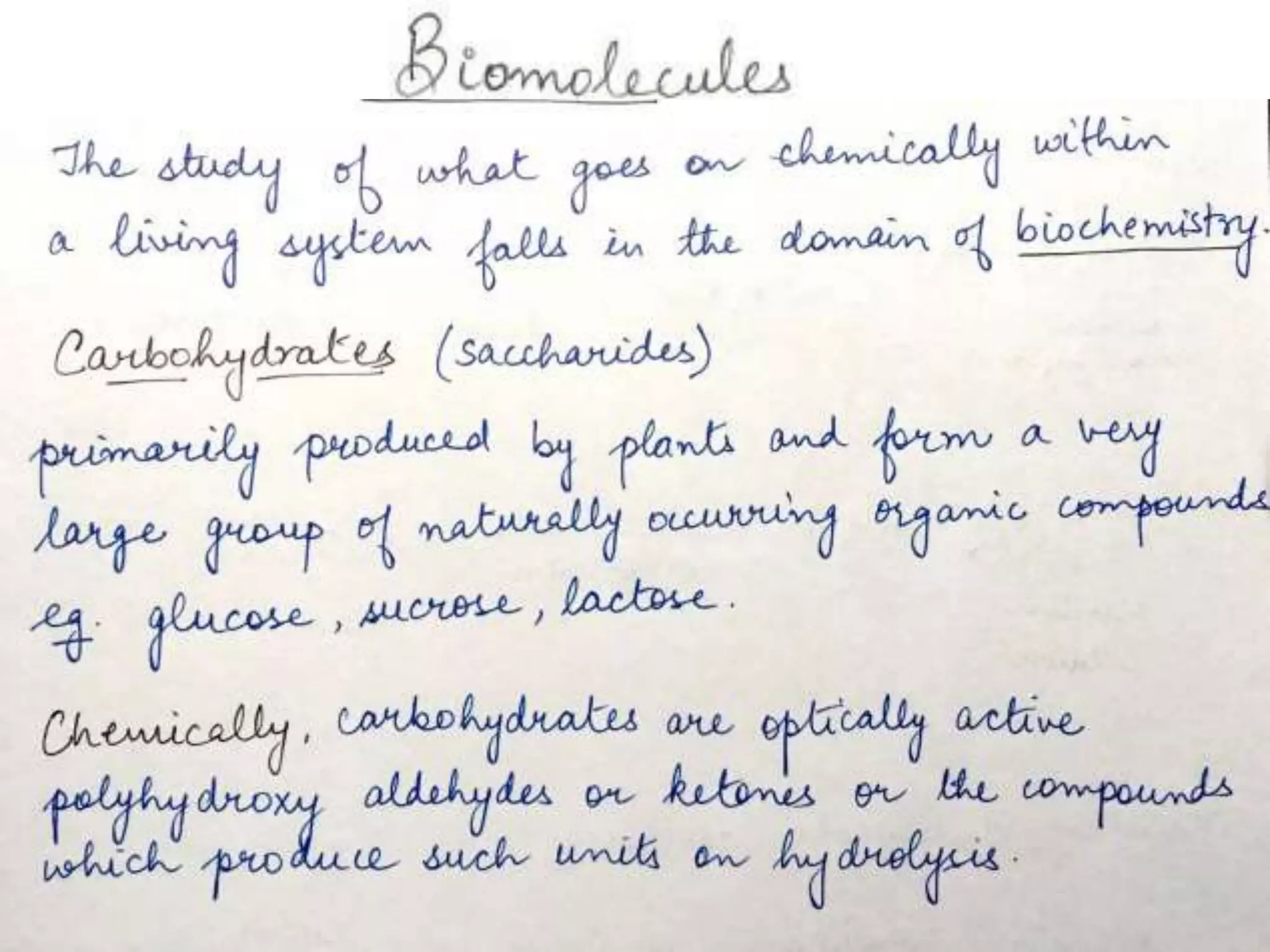
BIOMOLECULES
A) On the basis of units of hydrolysis
i) Monosachharides : These carbohydrates cannot be
hydrolysed further to give simpler units
Example: Glucose, fructose etc
ii) Oligosachharides: These carbohydrates can be hydrolysed
further to give 2-10 simpler units. If they give two units
then disachharide, 3 then trisachharides etc.
Example: sucrose (glucose + fructose), maltose (glucose +
glucose) etc
iii)Polysachharides: These carbohydrates can be hydrolysed
further to give large number of simpler units
Example: cellulose, starch, glycogen etc
B) On the basis of reducing character
i) Reducing Sugars : The carbohydrates that can reduce fehling’s and tollen’s
reagent are known as reducing sugars. Example: maltose and lactose
ii) Non-reducing sugars: The carbohydrates that cannot reduce fehling’s and
tollen’s reagent are known as reducing sugars. Example: Sucrose
C) On the basis of functional
group(Monosaccharides)
i) Aldose: If the monosachharide contains aldehyde as the functional group, then
it is known as aldose. Eg: Glucose
ii) Ketose: If the monosachharide contains ketone as the functional group, then it
is known as ketose. Eg: Fructose
C) On the basis of number of carbon atoms
present(Monosaccharides)
Relative configuration – D and L nomenclature
If the OH group on the lowest asymmetric carbon is on the right,
then the Carbohydrate is assigned D- configuration whereas if it is
on left, then it is L-configuration.
Anomers
The cyclic stereoisomers that differ in position of OH group
at the first chiral carbon are known as anomers
Mutarotation
The spontaneous change in the specific rotation of an optically active compound
with time till equilibrium is reached is known as mutarotation.
Eg: The specific rotation of freshly prepared solution of α-D(+)glucose changes
from 112.2o to 52.5o with time whereas that of β-D(+) glucose changes from 18.7o
to 52.5o with time till it reaches equilibrium.
Epimers
The stereoisomers that differ in position of OH group at any
chiral carbon are known as anomers
 MF : C6H12O6
 Contains ketonic functional group
 Name is D-(-) Fructose.
(Laeveorotatory)
Cyclic form
Physical properties
 Colourless, crystalline solids
 High melting point
 Water soluble substances
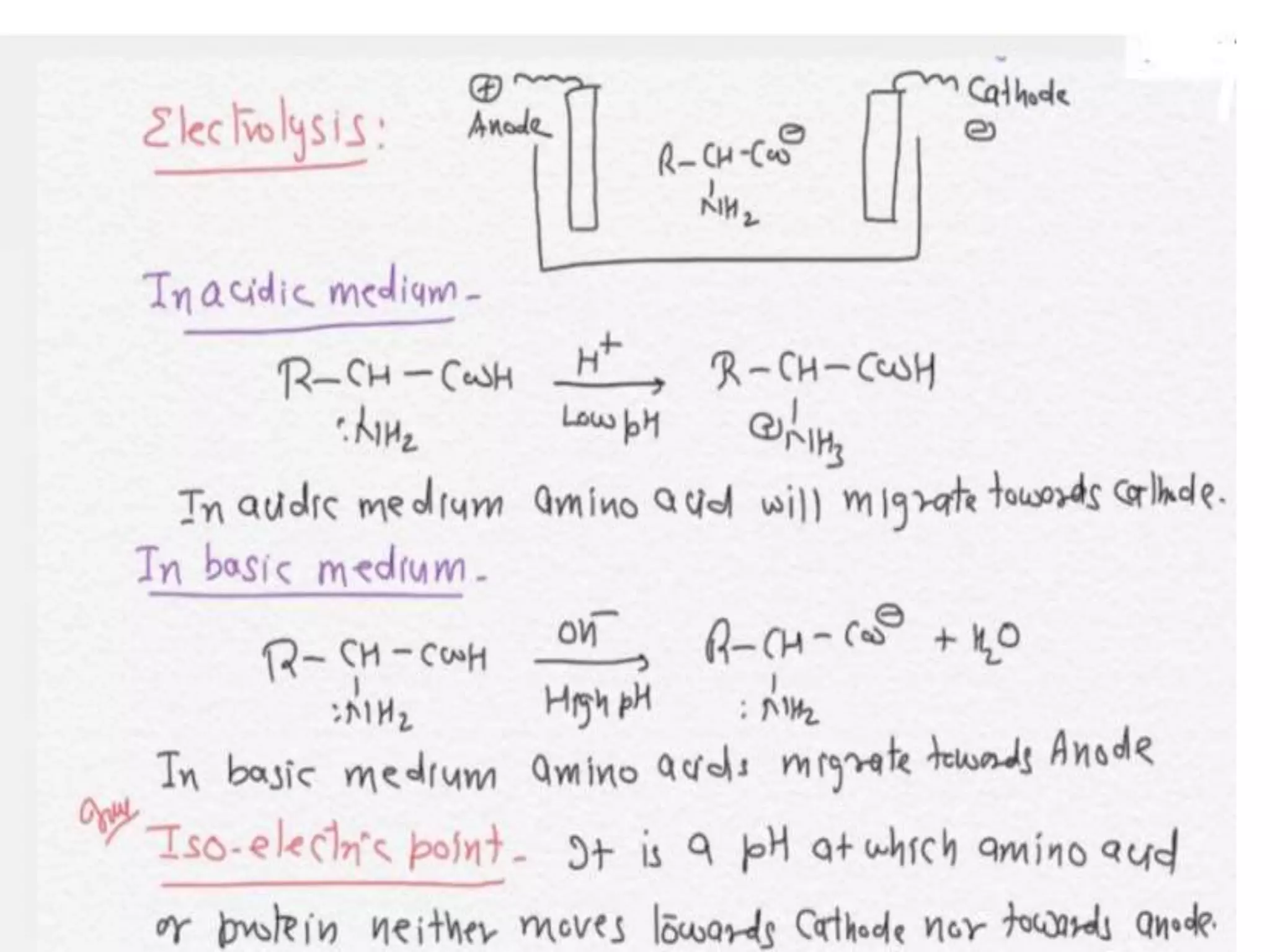
 Behave like salts due to presence of both acidic (carboxyl) and basic (amino)
group.
Basic group
Acidic group
Polypeptide: When the number of combining amino acids is
more than 10, then it is known as polypeptide.
When the polypeptide has more than 100 amino acids, with
molecular mass more than 10,000 u is known as protein.
Parallel AntiParallel
When a protein in native form is subjected to change in
temperature, ph, chemical change, then the hydrogen bonds
are broken due to which globules unfold, helix gets uncoiled
and protein loses it biological activity known as denaturation.
BIOMOLECULES complete.pptx

BIOMOLECULES complete.pptx

  • 1.
  • 6.
    A) On thebasis of units of hydrolysis i) Monosachharides : These carbohydrates cannot be hydrolysed further to give simpler units Example: Glucose, fructose etc ii) Oligosachharides: These carbohydrates can be hydrolysed further to give 2-10 simpler units. If they give two units then disachharide, 3 then trisachharides etc. Example: sucrose (glucose + fructose), maltose (glucose + glucose) etc iii)Polysachharides: These carbohydrates can be hydrolysed further to give large number of simpler units Example: cellulose, starch, glycogen etc
  • 7.
    B) On thebasis of reducing character i) Reducing Sugars : The carbohydrates that can reduce fehling’s and tollen’s reagent are known as reducing sugars. Example: maltose and lactose ii) Non-reducing sugars: The carbohydrates that cannot reduce fehling’s and tollen’s reagent are known as reducing sugars. Example: Sucrose C) On the basis of functional group(Monosaccharides) i) Aldose: If the monosachharide contains aldehyde as the functional group, then it is known as aldose. Eg: Glucose ii) Ketose: If the monosachharide contains ketone as the functional group, then it is known as ketose. Eg: Fructose
  • 8.
    C) On thebasis of number of carbon atoms present(Monosaccharides)
  • 14.
    Relative configuration –D and L nomenclature If the OH group on the lowest asymmetric carbon is on the right, then the Carbohydrate is assigned D- configuration whereas if it is on left, then it is L-configuration.
  • 18.
    Anomers The cyclic stereoisomersthat differ in position of OH group at the first chiral carbon are known as anomers
  • 19.
    Mutarotation The spontaneous changein the specific rotation of an optically active compound with time till equilibrium is reached is known as mutarotation. Eg: The specific rotation of freshly prepared solution of α-D(+)glucose changes from 112.2o to 52.5o with time whereas that of β-D(+) glucose changes from 18.7o to 52.5o with time till it reaches equilibrium.
  • 20.
    Epimers The stereoisomers thatdiffer in position of OH group at any chiral carbon are known as anomers
  • 21.
     MF :C6H12O6  Contains ketonic functional group  Name is D-(-) Fructose. (Laeveorotatory) Cyclic form
  • 34.
    Physical properties  Colourless,crystalline solids  High melting point  Water soluble substances  Behave like salts due to presence of both acidic (carboxyl) and basic (amino) group. Basic group Acidic group
  • 38.
    Polypeptide: When thenumber of combining amino acids is more than 10, then it is known as polypeptide. When the polypeptide has more than 100 amino acids, with molecular mass more than 10,000 u is known as protein.
  • 44.
  • 48.
    When a proteinin native form is subjected to change in temperature, ph, chemical change, then the hydrogen bonds are broken due to which globules unfold, helix gets uncoiled and protein loses it biological activity known as denaturation.