Biomechanical engineering and its applications.pptx
Bioengineering applies engineering principles to biological systems and living organisms.
Includes: medical devices and imaging, biomaterials, tissue engineering, systems/synthetic biology.
Biomechanical engineering and its applications.pptx
1.
LECTURE 7 –FALL2025
Biomechanical engineering
Assoc. Prof. Dr. Jasmin Šutković
Date: 27.11.2025
Course: Introduction to Bioengineering
2.
Bioengineering: The BigUmbrella
• Bioengineering applies engineering principles to biological
systems and living organisms.
• Includes: medical devices and imaging, biomaterials, tissue
engineering, systems/synthetic biology.
• Biomechanics is one subfield within bioengineering.
• Overall goal: improve health, the environment, and our
understanding of biology.
Biomechanical Engineering /Biomechanics
• Biomechanical engineering combines mechanics, biology, and
engineering to study and design for living systems.
• Often treated as a subfield of mechanical and biomedical
engineering.
• Focuses on:
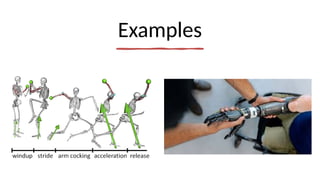
– motion of the body (gait, sports, posture),
– mechanical behaviour of tissues (bone, cartilage, muscle), and
– devices that interact with the body (prostheses, implants).
5.
How Biomechanics Fitsinto Bioengineering?
• Bioengineering: broad – all biological systems (health,
agriculture, environment).
• Biomechanical engineering: subfield focusing on mechanics of
tissues and movement within that medical/biological context.
• These areas interact tightly in device design, rehabilitation,
sports, and healthcare.
6.
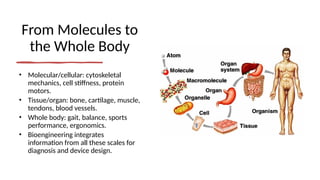
From Molecules to
theWhole Body
• Molecular/cellular: cytoskeletal
mechanics, cell stiffness, protein
motors.
• Tissue/organ: bone, cartilage, muscle,
tendons, blood vessels.
• Whole body: gait, balance, sports
performance, ergonomics.
• Bioengineering integrates
information from all these scales for
diagnosis and device design.
7.
Mechanical Engineering
Concepts inLiving Systems
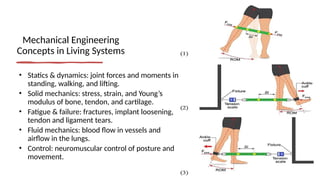
• Statics & dynamics: joint forces and moments in
standing, walking, and lifting.
• Solid mechanics: stress, strain, and Young’s
modulus of bone, tendon, and cartilage.
• Fatigue & failure: fractures, implant loosening,
tendon and ligament tears.
• Fluid mechanics: blood flow in vessels and
airflow in the lungs.
• Control: neuromuscular control of posture and
movement.
8.
How We Measure
HumanMovement
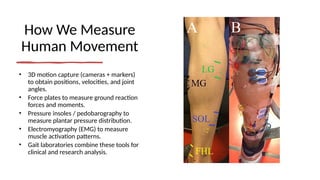
• 3D motion capture (cameras + markers)
to obtain positions, velocities, and joint
angles.
• Force plates to measure ground reaction
forces and moments.
• Pressure insoles / pedobarography to
measure plantar pressure distribution.
• Electromyography (EMG) to measure
muscle activation patterns.
• Gait laboratories combine these tools for
clinical and research analysis.
9.
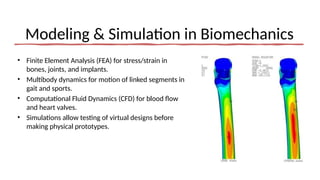
Modeling & Simulationin Biomechanics
• Finite Element Analysis (FEA) for stress/strain in
bones, joints, and implants.
• Multibody dynamics for motion of linked segments in
gait and sports.
• Computational Fluid Dynamics (CFD) for blood flow
and heart valves.
• Simulations allow testing of virtual designs before
making physical prototypes.
10.
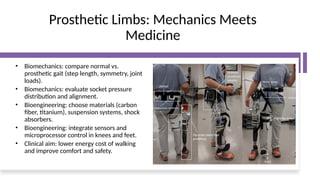
Prosthetic Limbs: MechanicsMeets
Medicine
• Biomechanics: compare normal vs.
prosthetic gait (step length, symmetry, joint
loads).
• Biomechanics: evaluate socket pressure
distribution and alignment.
• Bioengineering: choose materials (carbon
fiber, titanium), suspension systems, shock
absorbers.
• Bioengineering: integrate sensors and
microprocessor control in knees and feet.
• Clinical aim: lower energy cost of walking
and improve comfort and safety.
11.
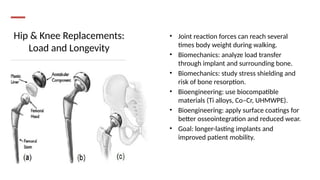
Hip & KneeReplacements:
Load and Longevity
• Joint reaction forces can reach several
times body weight during walking.
• Biomechanics: analyze load transfer
through implant and surrounding bone.
• Biomechanics: study stress shielding and
risk of bone resorption.
• Bioengineering: use biocompatible
materials (Ti alloys, Co–Cr, UHMWPE).
• Bioengineering: apply surface coatings for
better osseointegration and reduced wear.
• Goal: longer-lasting implants and
improved patient mobility.
12.
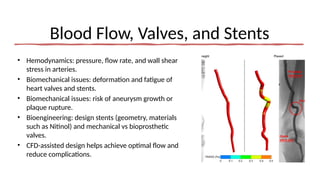
Blood Flow, Valves,and Stents
• Hemodynamics: pressure, flow rate, and wall shear
stress in arteries.
• Biomechanical issues: deformation and fatigue of
heart valves and stents.
• Biomechanical issues: risk of aneurysm growth or
plaque rupture.
• Bioengineering: design stents (geometry, materials
such as Nitinol) and mechanical vs bioprosthetic
valves.
• CFD-assisted design helps achieve optimal flow and
reduce complications.
13.
Sports Biomechanics andEquipment Design
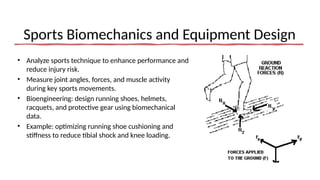
• Analyze sports technique to enhance performance and
reduce injury risk.
• Measure joint angles, forces, and muscle activity
during key sports movements.
• Bioengineering: design running shoes, helmets,
racquets, and protective gear using biomechanical
data.
• Example: optimizing running shoe cushioning and
stiffness to reduce tibial shock and knee loading.
14.
Case Study: FromSimulation
to Powered Prosthesis
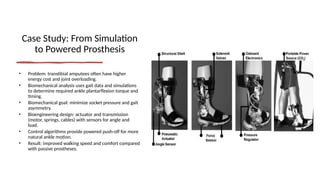
• Problem: transtibial amputees often have higher
energy cost and joint overloading.
• Biomechanical analysis uses gait data and simulations
to determine required ankle plantarflexion torque and
timing.
• Biomechanical goal: minimize socket pressure and gait
asymmetry.
• Bioengineering design: actuator and transmission
(motor, springs, cables) with sensors for angle and
load.
• Control algorithms provide powered push-off for more
natural ankle motion.
• Result: improved walking speed and comfort compared
with passive prostheses.
15.
Rehabilitation Robotics &Assistive Devices
• Biomechanics is used to characterize
pathological gait (stroke, Parkinson’s
disease, cerebral palsy).
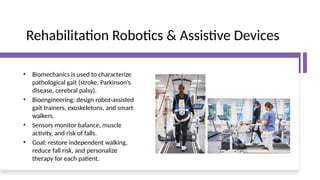
• Bioengineering: design robot-assisted
gait trainers, exoskeletons, and smart
walkers.
• Sensors monitor balance, muscle
activity, and risk of falls.
• Goal: restore independent walking,
reduce fall risk, and personalize
therapy for each patient.
16.
Wearables, Smart Insoles,
andEveryday Gait Data
• Motion capture labs are accurate but expensive
and limited to controlled environments.
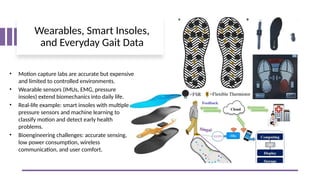
• Wearable sensors (IMUs, EMG, pressure
insoles) extend biomechanics into daily life.
• Real-life example: smart insoles with multiple
pressure sensors and machine learning to
classify motion and detect early health
problems.
• Bioengineering challenges: accurate sensing,
low power consumption, wireless
communication, and user comfort.
17.
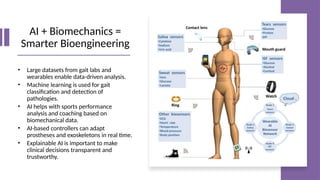
AI + Biomechanics=
Smarter Bioengineering
• Large datasets from gait labs and
wearables enable data-driven analysis.
• Machine learning is used for gait
classification and detection of
pathologies.
• AI helps with sports performance
analysis and coaching based on
biomechanical data.
• AI-based controllers can adapt
prostheses and exoskeletons in real time.
• Explainable AI is important to make
clinical decisions transparent and
trustworthy.
18.
Ethics, Access, andSafety
• Accessibility and cost of advanced prostheses, implants, and
exoskeletons are major concerns.
• Medical devices must satisfy strict regulatory approval and safety
testing.
• Long-term monitoring of device performance and failures is
needed.
• Data privacy is crucial for gait and movement data from wearables.
• Fairness in sports: performance-enhancing prostheses and
equipment raise ethical questions.
Editor's Notes
#2 Suggested figure: Pie chart: Biomechanics, Biomaterials, Medical Imaging, Systems Biology, etc.
#3 Human body mechanics.
Biomechanics is the study of the structure and function of biological systems, using the methods of mechanics
#7 : Free-body diagram of a leg during walking with joint reaction forces and moments.
#8 Diagram of a gait lab: subject with markers walking over force plates, with EMG electrodes on muscles.
#9 von Mises stress distribution in cortical bone at load
#10 Development of a Powered Four-Bar Prosthetic Hip
#11 Cross-section of a hip implant with arrows showing the load path through implant and bone.
#12 Schematic artery with CFD-style velocity profile, then the same artery with a stent in place.
#13 Suggested figure: Sprinter on a force plate with motion capture markers and arrows indicating ground reaction forces.
#14 Biomechanical model → Optimization → Prototype powered ankle–foot device.
#15 Person with a lower-limb exoskeleton walking on a treadmill with body-weight support harness.
#16 Schematic of a shoe with embedded pressure and motion sensors sending data to a smartphone.
#17 Sensors → AI model → Diagnosis / Control signals → Device.


![[Paolo b. pascolo_(eds.)]_biomechanics_and_sports](https://cdn.slidesharecdn.com/ss_thumbnails/cit35kpls2u6rkklcr7z-signature-3b74e62c5879b3ccadf062a94f6a3b7551e4d7ecbc5276acf4bb63a57d68ef95-poli-180810191644-thumbnail.jpg?width=640&height=640&fit=bounds)
![[Paolo b. pascolo_(eds.)]_biomechanics_and_sports](https://cdn.slidesharecdn.com/ss_thumbnails/qsxhxsir0onpfngf0efs-signature-4d1304081ceda718672e1f8fc7b985e72ceefd95c2259f8d544d5aeb61938269-poli-190727144111-thumbnail.jpg?width=640&height=640&fit=bounds)


