Bioenergy in Energy System Models
with flexibility
Winter 2023 semi-annual ETSAP workshop
Anna Krook-Riekkola, Associate Professor
Energy Engineering, Luleå University of Technology
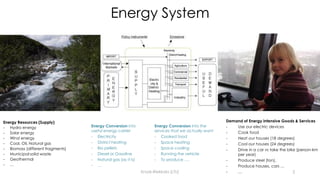
Energy System
2
How the energy system evolve will depend both
on the development of the demand and of the supply
Energy Resources (Supply)
- Hydro energy
- Solar energy
- Wind energy
- Coal, Oil, Natural gas
- Biomass (different fragments)
- Municipal solid waste
- Geothermal
- …
Demand of Energy intensive Goods & Services
- Use our electric devices
- Cook food
- Heat our houses (18 degrees)
- Cool our houses (24 degrees)
- Drive in a car vs take the bike (person-km
per year)
- Produce steel (ton),
- Produce houses, cars …
- …
Energy Conversion into
useful energy carrier
- Electricity
- District heating
- Bio pellets
- Diesel or Gasoline
- Natural gas (as it is)
- …
Energy Conversion into the
services that we actually want
- Cooked food
- Space heating
- Space cooling
- Running the vehicle
- To produce ….
Krook-Riekkola (LTU)
Sector coupling is important,
Sector coupling goes beyond electricity.
Biomass is easy to store (compared with
electricity) → Can provide flexibility to the
power system
Biomass can often replace fossil fuels
without a big (if any) change of technology
→ An enabler when reducing the climate
impact. Will have different roles in during
different years on our way to net zero.
Krook-Riekkola (LTU) 5
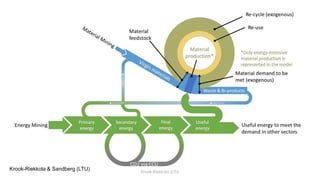
Biomass and Fossil Fuels
• The same commodity can either be used as
feed-stock (material) or as fuel (energy)
• CO2-emissions can be turned into fuels (that
can be either feed-stock or energy)
• Consider both fossil and biogenic CO2
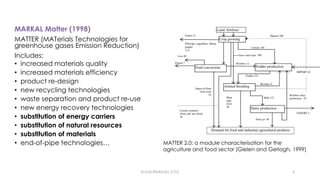
MARKAL Matter (1998)
MATTER (MATerials Technologies for
greenhouse gases Emission Reduction)
Includes:
• increased materials quality
• increased materials efficiency
• product re-design
• new recycling technologies
• waste separation and product re-use
• new energy recovery technologies
• substitution of energy carriers
• substitution of natural resources
• substitution of materials
• end-of-pipe technologies… MATTER 2.0: a module characterisation for the
agriculture and food sector (Gielen and Gerlagh, 1999)
Krook-Riekkola (LTU) 6
Krook-Riekkola (LTU) 7
Biomass and Fossil Fuels
• The same commodity can either be used as
feed-stock (material) or as fuel (energy)
• CO2-emissions can be turned into fuels (that
can be either feed-stock or energy)
• Consider both fossil and biogenic CO2
Krook-Riekkola (LTU) 8
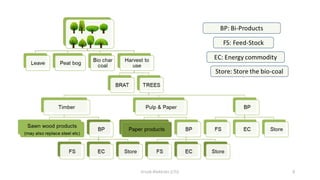
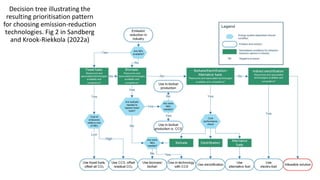
Decision tree illustrating the
resulting prioritisation pattern
for choosing emission-reduction
technologies. Fig 2 in Sandberg
and Krook-Riekkola (2022a)
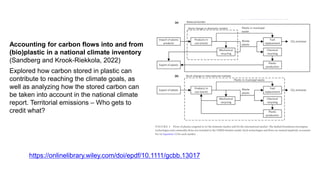
Accounting for carbon flows into and from
(bio)plastic in a national climate inventory
(Sandberg and Krook-Riekkola, 2022)
Explored how carbon stored in plastic can
contribute to reaching the climate goals, as
well as analyzing how the stored carbon can
be taken into account in the national climate
report. Territorial emissions – Who gets to
credit what?
https://onlinelibrary.wiley.com/doi/epdf/10.1111/gcbb.13017
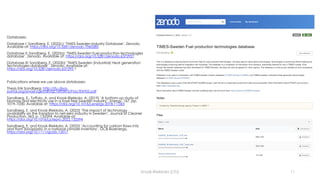
Databases:
Database I: Sandberg, E. (2022c) ‘TIMES-Sweden Industry Database’. Zenodo.
Available at: https://doi.org/10.5281/zenodo.7060285
Database II: Sandberg, E. (2022a) ‘TIMES-Sweden Fuel production technologies
database’. Zenodo. Available at: https://doi.org/10.5281/zenodo.6372927
Database III: Sandberg, E. (2022b) ‘TIMES-Sweden (Industrial) Heat generation
technologies database’. Zenodo. Available at:
https://doi.org/10.5281/zenodo.637293 1
Publications where we use above databases:
Thesis Erik Sandberg: http://ltu.diva-
portal.org/smash/get/diva2:1693415/FULLTEXT02.pdf
Sandberg, E., Toffolo, A. and Krook-Riekkola, A. (2019) ‘A bottom-up study of
biomass and electricity use in a fossil free Swedish industry’, Energy, 167, pp.
1019–1030. Available at: https://doi.org/10.1016/j.energy.2018.11.065
Sandberg, E. and Krook-Riekkola, A. (2022) ‘The impact of technology
availability on the transition to net-zero industry in Sweden’, Journal of Cleaner
Production, 363, p. 132594. Available at:
https://doi.org/10.1016/j.jclepro.2022.132594
Sandberg, E. and Krook-Riekkola, A. (2022) ‘Accounting for carbon flows into
and from (bio)plastic in a national climate inventory’. GCB Bioenergy,
https://doi.org/10.1111/gcbb.13017
Krook-Riekkola (LTU) 11
Anna.Krook-Riekkola@LTU.se
Krook-Riekkola & Sandberg (LTU) Krook-Riekkola (LTU)

Bioenergy in energy system models with flexibility

  • 1.
    Bioenergy in EnergySystem Models with flexibility Winter 2023 semi-annual ETSAP workshop Anna Krook-Riekkola, Associate Professor Energy Engineering, Luleå University of Technology
  • 2.
    Energy System 2 How theenergy system evolve will depend both on the development of the demand and of the supply Energy Resources (Supply) - Hydro energy - Solar energy - Wind energy - Coal, Oil, Natural gas - Biomass (different fragments) - Municipal solid waste - Geothermal - … Demand of Energy intensive Goods & Services - Use our electric devices - Cook food - Heat our houses (18 degrees) - Cool our houses (24 degrees) - Drive in a car vs take the bike (person-km per year) - Produce steel (ton), - Produce houses, cars … - … Energy Conversion into useful energy carrier - Electricity - District heating - Bio pellets - Diesel or Gasoline - Natural gas (as it is) - … Energy Conversion into the services that we actually want - Cooked food - Space heating - Space cooling - Running the vehicle - To produce …. Krook-Riekkola (LTU)
  • 4.
    Sector coupling isimportant, Sector coupling goes beyond electricity. Biomass is easy to store (compared with electricity) → Can provide flexibility to the power system Biomass can often replace fossil fuels without a big (if any) change of technology → An enabler when reducing the climate impact. Will have different roles in during different years on our way to net zero.
  • 5.
    Krook-Riekkola (LTU) 5 Biomassand Fossil Fuels • The same commodity can either be used as feed-stock (material) or as fuel (energy) • CO2-emissions can be turned into fuels (that can be either feed-stock or energy) • Consider both fossil and biogenic CO2
  • 6.
    MARKAL Matter (1998) MATTER(MATerials Technologies for greenhouse gases Emission Reduction) Includes: • increased materials quality • increased materials efficiency • product re-design • new recycling technologies • waste separation and product re-use • new energy recovery technologies • substitution of energy carriers • substitution of natural resources • substitution of materials • end-of-pipe technologies… MATTER 2.0: a module characterisation for the agriculture and food sector (Gielen and Gerlagh, 1999) Krook-Riekkola (LTU) 6
  • 7.
    Krook-Riekkola (LTU) 7 Biomassand Fossil Fuels • The same commodity can either be used as feed-stock (material) or as fuel (energy) • CO2-emissions can be turned into fuels (that can be either feed-stock or energy) • Consider both fossil and biogenic CO2
  • 8.
  • 9.
    Decision tree illustratingthe resulting prioritisation pattern for choosing emission-reduction technologies. Fig 2 in Sandberg and Krook-Riekkola (2022a)
  • 10.
    Accounting for carbonflows into and from (bio)plastic in a national climate inventory (Sandberg and Krook-Riekkola, 2022) Explored how carbon stored in plastic can contribute to reaching the climate goals, as well as analyzing how the stored carbon can be taken into account in the national climate report. Territorial emissions – Who gets to credit what? https://onlinelibrary.wiley.com/doi/epdf/10.1111/gcbb.13017
  • 11.
    Databases: Database I: Sandberg,E. (2022c) ‘TIMES-Sweden Industry Database’. Zenodo. Available at: https://doi.org/10.5281/zenodo.7060285 Database II: Sandberg, E. (2022a) ‘TIMES-Sweden Fuel production technologies database’. Zenodo. Available at: https://doi.org/10.5281/zenodo.6372927 Database III: Sandberg, E. (2022b) ‘TIMES-Sweden (Industrial) Heat generation technologies database’. Zenodo. Available at: https://doi.org/10.5281/zenodo.637293 1 Publications where we use above databases: Thesis Erik Sandberg: http://ltu.diva- portal.org/smash/get/diva2:1693415/FULLTEXT02.pdf Sandberg, E., Toffolo, A. and Krook-Riekkola, A. (2019) ‘A bottom-up study of biomass and electricity use in a fossil free Swedish industry’, Energy, 167, pp. 1019–1030. Available at: https://doi.org/10.1016/j.energy.2018.11.065 Sandberg, E. and Krook-Riekkola, A. (2022) ‘The impact of technology availability on the transition to net-zero industry in Sweden’, Journal of Cleaner Production, 363, p. 132594. Available at: https://doi.org/10.1016/j.jclepro.2022.132594 Sandberg, E. and Krook-Riekkola, A. (2022) ‘Accounting for carbon flows into and from (bio)plastic in a national climate inventory’. GCB Bioenergy, https://doi.org/10.1111/gcbb.13017 Krook-Riekkola (LTU) 11
  • 12.
  • 13.
    Krook-Riekkola & Sandberg(LTU) Krook-Riekkola (LTU)