1.2 Unifying Themes of Biology
TEKS 4B, 7E, 10A, 10C, 11A
The student is expected to:
4B investigate and explain cellular processes,
including homeostasis, energy conversions,
transport of molecules, and synthesis of new
molecules;
7E analyze and evaluate the relationship of natural
selection to adaptation and to the development of
diversity in and among species;
1.2 Unifying Themes of Biology
TEKS 4B, 7E, 10A, 10C, 11A
(Continued)
10A describe the interactions that occur among
systems...; 10C analyze the levels of
organization in biological systems and relate
the levels to each other and to the whole
system; 11A describe the role of internal
feedback mechanisms in the maintenance of
homeostasis
1.2 Unifying Themes of Biology
TEKS 4B, 7E, 10A, 10C, 11A
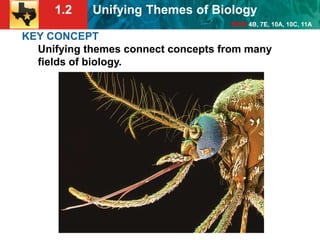
KEY CONCEPT
Unifying themes connect concepts from many
fields of biology.
1.2 Unifying Themes of Biology
TEKS 4B, 7E, 10A, 10C, 11A
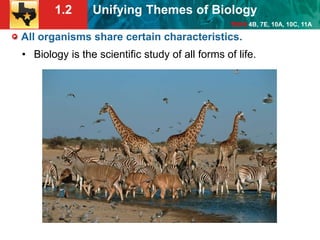
All organisms share certain characteristics.
• Biology is the scientific study of all forms of life.
1.2 Unifying Themes of Biology
TEKS 4B, 7E, 10A, 10C, 11A
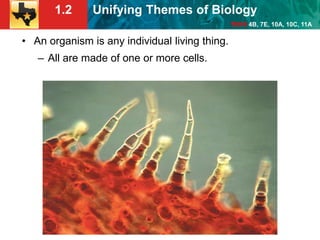
• An organism is any individual living thing.
– All are made of one or more cells.
1.2 Unifying Themes of Biology
TEKS 4B, 7E, 10A, 10C, 11A
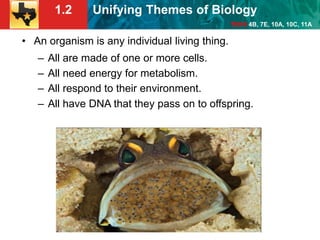
– All need energy for metabolism.
• An organism is any individual living thing.
– All are made of one or more cells.
– All respond to their environment.
– All have DNA that they pass on to offspring.
1.2 Unifying Themes of Biology
TEKS 4B, 7E, 10A, 10C, 11A
All levels of life have systems of related parts.
• A system is an organized group of interacting parts.
– A cell is a system of chemicals and processes.
– A body system includes organs that interact.
– An ecosystem includes living and nonliving things that
interact.
1.2 Unifying Themes of Biology
TEKS 4B, 7E, 10A, 10C, 11A
• Biologists study many different systems.
1.2 Unifying Themes of Biology
TEKS 4B, 7E, 10A, 10C, 11A
Structure and function are related in biology.
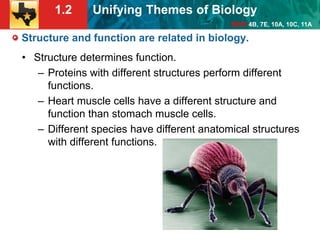
• Structure determines function.
– Proteins with different structures perform different
functions.
– Heart muscle cells have a different structure and
function than stomach muscle cells.
– Different species have different anatomical structures
with different functions.
1.2 Unifying Themes of Biology
TEKS 4B, 7E, 10A, 10C, 11A
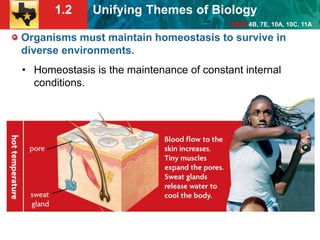
Organisms must maintain homeostasis to survive in
diverse environments.
• Homeostasis is the maintenance of constant internal
conditions.
1.2 Unifying Themes of Biology
TEKS 4B, 7E, 10A, 10C, 11A
– Homeostasis is usually maintained through negative
feedback.
– Negative feedback systems return a condition to its
normal (set) point.
• Homeostasis is the maintenance of constant internal
conditions.
1.2 Unifying Themes of Biology
TEKS 4B, 7E, 10A, 10C, 11A
• Behaviors and adaptations can help maintain
homeostasis.
1.2 Unifying Themes of Biology
TEKS 4B, 7E, 10A, 10C, 11A
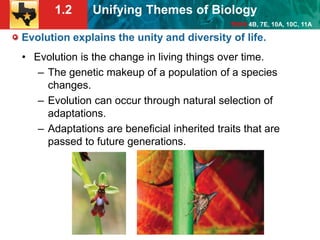
Evolution explains the unity and diversity of life.
• Evolution is the change in living things over time.
– The genetic makeup of a population of a species
changes.
– Evolution can occur through natural selection of
adaptations.
– Adaptations are beneficial inherited traits that are
passed to future generations.
1.2 Unifying Themes of Biology
TEKS 4B, 7E, 10A, 10C, 11A
• Evolution accounts for both the diversity and the unity of
life.

bio chapter 1.2.ppt

  • 1.
    1.2 Unifying Themesof Biology TEKS 4B, 7E, 10A, 10C, 11A The student is expected to: 4B investigate and explain cellular processes, including homeostasis, energy conversions, transport of molecules, and synthesis of new molecules; 7E analyze and evaluate the relationship of natural selection to adaptation and to the development of diversity in and among species;
  • 2.
    1.2 Unifying Themesof Biology TEKS 4B, 7E, 10A, 10C, 11A (Continued) 10A describe the interactions that occur among systems...; 10C analyze the levels of organization in biological systems and relate the levels to each other and to the whole system; 11A describe the role of internal feedback mechanisms in the maintenance of homeostasis
  • 3.
    1.2 Unifying Themesof Biology TEKS 4B, 7E, 10A, 10C, 11A KEY CONCEPT Unifying themes connect concepts from many fields of biology.
  • 4.
    1.2 Unifying Themesof Biology TEKS 4B, 7E, 10A, 10C, 11A All organisms share certain characteristics. • Biology is the scientific study of all forms of life.
  • 5.
    1.2 Unifying Themesof Biology TEKS 4B, 7E, 10A, 10C, 11A • An organism is any individual living thing. – All are made of one or more cells.
  • 6.
    1.2 Unifying Themesof Biology TEKS 4B, 7E, 10A, 10C, 11A – All need energy for metabolism. • An organism is any individual living thing. – All are made of one or more cells. – All respond to their environment. – All have DNA that they pass on to offspring.
  • 7.
    1.2 Unifying Themesof Biology TEKS 4B, 7E, 10A, 10C, 11A All levels of life have systems of related parts. • A system is an organized group of interacting parts. – A cell is a system of chemicals and processes. – A body system includes organs that interact. – An ecosystem includes living and nonliving things that interact.
  • 8.
    1.2 Unifying Themesof Biology TEKS 4B, 7E, 10A, 10C, 11A • Biologists study many different systems.
  • 9.
    1.2 Unifying Themesof Biology TEKS 4B, 7E, 10A, 10C, 11A Structure and function are related in biology. • Structure determines function. – Proteins with different structures perform different functions. – Heart muscle cells have a different structure and function than stomach muscle cells. – Different species have different anatomical structures with different functions.
  • 10.
    1.2 Unifying Themesof Biology TEKS 4B, 7E, 10A, 10C, 11A Organisms must maintain homeostasis to survive in diverse environments. • Homeostasis is the maintenance of constant internal conditions.
  • 11.
    1.2 Unifying Themesof Biology TEKS 4B, 7E, 10A, 10C, 11A – Homeostasis is usually maintained through negative feedback. – Negative feedback systems return a condition to its normal (set) point. • Homeostasis is the maintenance of constant internal conditions.
  • 12.
    1.2 Unifying Themesof Biology TEKS 4B, 7E, 10A, 10C, 11A • Behaviors and adaptations can help maintain homeostasis.
  • 13.
    1.2 Unifying Themesof Biology TEKS 4B, 7E, 10A, 10C, 11A Evolution explains the unity and diversity of life. • Evolution is the change in living things over time. – The genetic makeup of a population of a species changes. – Evolution can occur through natural selection of adaptations. – Adaptations are beneficial inherited traits that are passed to future generations.
  • 14.
    1.2 Unifying Themesof Biology TEKS 4B, 7E, 10A, 10C, 11A • Evolution accounts for both the diversity and the unity of life.