BIO 1 GENERAL BIOLOGY Prof. Verna Marie Monsanto- Hearne
PRINCIPLES OF BIOLOGY WITH EMPHASIS ON THE MOLECULAR, CELLULAR, TISSUE-ORGAN, AND ORGANISMIC LEVEL OF ORGANIZATION OF LIFE
BIO / LOGY LIFE   SCIENCE
concept map of the course
 
SCIENCE from latin “ Scientia ” meaning knowledge search for what is true  study of the world around us
SCIENCE answers the how, what, where, and why of our surroundings organized body of knowledge  a system of acquiring knowledge using the scientific method
scientific method “ organized common sense”  - Claude Villee
scientific method a frame of mind that involves  1. curiosity 2. refusal to accept an explanation without evidence
keen observation: **most basic skill of a scientist **makes use of our 5 senses
know the facts which are already available
hypothesis: possible explanation
design the experiment **assign a control set-up and an experimental set-up (or a set-up with an experimental variable)
accurate d escription :   another required skill in a scientist : writing or telling about observations data :  careful records of observations and information
use of quantitative measurements length, volume, weight, temperature, etc
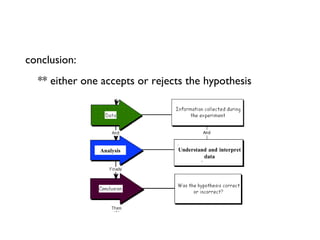
hypothesis: possible explanation Analysis Understand and interpret data
hypothesis: possible explanation Analysis Understand and interpret data conclusion: ** either one accepts or rejects the hypothesis Share publish results
hypothesis: possible explanation Analysis Understand and interpret data share by means of publication, seminars, etc to make experiment relevant Share publish results
note: one cannot prove or disprove a hypothesis based on just a single experiment result must be reproducible
Theory when a hypothesis is confirmed often enough and is unlikely to be disproved THEORY: powerful, time tested concepts that make useful and dependable predictions about the natural world
Scientific knowledge constantly changing body of observations ex: flat earth, sun revolving around the earth not a collection of eternal truths
Analysis Share publish   results Understand and interpret data some bacteria grow in Nabok river, a mercury contaminated site there are some bacteria which are mercury resistant the bacteria growing in Nabok river are mercury resistant culture bacteria isolated from Nabok river, grow in medium containing mercury (experimental) and grow bacteria in medium without mercury check for bacterial growth in both media there is bacterial growth in both media the bacteria are mercury resistant
The Scientific Method in Everyday Experience
BIO / LOGY LIFE   SCIENCE

Bio 1 lecture 1

  • 1.
    BIO 1 GENERALBIOLOGY Prof. Verna Marie Monsanto- Hearne
  • 2.
    PRINCIPLES OF BIOLOGYWITH EMPHASIS ON THE MOLECULAR, CELLULAR, TISSUE-ORGAN, AND ORGANISMIC LEVEL OF ORGANIZATION OF LIFE
  • 3.
    BIO / LOGYLIFE SCIENCE
  • 4.
    concept map ofthe course
  • 5.
  • 6.
    SCIENCE from latin“ Scientia ” meaning knowledge search for what is true study of the world around us
  • 7.
    SCIENCE answers thehow, what, where, and why of our surroundings organized body of knowledge a system of acquiring knowledge using the scientific method
  • 8.
    scientific method “organized common sense” - Claude Villee
  • 9.
    scientific method aframe of mind that involves 1. curiosity 2. refusal to accept an explanation without evidence
  • 10.
    keen observation: **mostbasic skill of a scientist **makes use of our 5 senses
  • 11.
    know the factswhich are already available
  • 12.
  • 13.
    design the experiment**assign a control set-up and an experimental set-up (or a set-up with an experimental variable)
  • 14.
    accurate d escription: another required skill in a scientist : writing or telling about observations data : careful records of observations and information
  • 15.
    use of quantitativemeasurements length, volume, weight, temperature, etc
  • 16.
    hypothesis: possible explanationAnalysis Understand and interpret data
  • 17.
    hypothesis: possible explanationAnalysis Understand and interpret data conclusion: ** either one accepts or rejects the hypothesis Share publish results
  • 18.
    hypothesis: possible explanationAnalysis Understand and interpret data share by means of publication, seminars, etc to make experiment relevant Share publish results
  • 19.
    note: one cannotprove or disprove a hypothesis based on just a single experiment result must be reproducible
  • 20.
    Theory when ahypothesis is confirmed often enough and is unlikely to be disproved THEORY: powerful, time tested concepts that make useful and dependable predictions about the natural world
  • 21.
    Scientific knowledge constantlychanging body of observations ex: flat earth, sun revolving around the earth not a collection of eternal truths
  • 22.
    Analysis Share publish results Understand and interpret data some bacteria grow in Nabok river, a mercury contaminated site there are some bacteria which are mercury resistant the bacteria growing in Nabok river are mercury resistant culture bacteria isolated from Nabok river, grow in medium containing mercury (experimental) and grow bacteria in medium without mercury check for bacterial growth in both media there is bacterial growth in both media the bacteria are mercury resistant
  • 23.
    The Scientific Methodin Everyday Experience
  • 24.
    BIO / LOGYLIFE SCIENCE

Editor's Notes

  • #11 Let's look more closely at the skills of a sientist. The most basic skill is observing . Observing is what we see, hear, smell, touch, or taste. Eyes are extremely important in making observations. However, the way people see varies from person to person. Describing is another skill of the scientist. Describing is writing or telling about observations. A good description allows us to share observations with others. Describing often includes the skill of identifying , or naming something. A skill that build upon observing, describing, and identifying is the skill of inferring . Inferring is drawing conclusions based on what you see and what you already know. There is nothing magic about science. You already have some of the qualities of the scientist. You are curious. you like to do new and different things. you like to explore new places. These are the natural talents or skills of a scients. Not all students select science for a career. However, all of you live in a society affected by science. Knowing how to apply science and knowing some of the facts of science will help you appreciate and understand your modern world. Let's look more closely at the skills of a sientist. The most basic skill is observing . Observing is what we see, hear, smell, touch, or taste. Eyes are extremely important in making observations. However, the way people see varies from person to person. Describing is another skill of the scientist. Describing is writing or telling about observations. A good description allows us to share observations with others. Describing often includes the skill of identifying , or naming something. A skill that build upon observing, describing, and identifying is the skill of inferring . Inferring is drawing conclusions based on what you see and what
  • #12 Let's look more closely at the skills of a sientist. The most basic skill is observing . Observing is what we see, hear, smell, touch, or taste. Eyes are extremely important in making observations. However, the way people see varies from person to person. Describing is another skill of the scientist. Describing is writing or telling about observations. A good description allows us to share observations with others. Describing often includes the skill of identifying , or naming something. A skill that build upon observing, describing, and identifying is the skill of inferring . Inferring is drawing conclusions based on what you see and what you already know. There is nothing magic about science. You already have some of the qualities of the scientist. You are curious. you like to do new and different things. you like to explore new places. These are the natural talents or skills of a scients. Not all students select science for a career. However, all of you live in a society affected by science. Knowing how to apply science and knowing some of the facts of science will help you appreciate and understand your modern world. Let's look more closely at the skills of a sientist. The most basic skill is observing . Observing is what we see, hear, smell, touch, or taste. Eyes are extremely important in making observations. However, the way people see varies from person to person. Describing is another skill of the scientist. Describing is writing or telling about observations. A good description allows us to share observations with others. Describing often includes the skill of identifying , or naming something. A skill that build upon observing, describing, and identifying is the skill of inferring . Inferring is drawing conclusions based on what you see and what
  • #13 Let's look more closely at the skills of a sientist. The most basic skill is observing . Observing is what we see, hear, smell, touch, or taste. Eyes are extremely important in making observations. However, the way people see varies from person to person. Describing is another skill of the scientist. Describing is writing or telling about observations. A good description allows us to share observations with others. Describing often includes the skill of identifying , or naming something. A skill that build upon observing, describing, and identifying is the skill of inferring . Inferring is drawing conclusions based on what you see and what you already know. There is nothing magic about science. You already have some of the qualities of the scientist. You are curious. you like to do new and different things. you like to explore new places. These are the natural talents or skills of a scients. Not all students select science for a career. However, all of you live in a society affected by science. Knowing how to apply science and knowing some of the facts of science will help you appreciate and understand your modern world. Let's look more closely at the skills of a sientist. The most basic skill is observing . Observing is what we see, hear, smell, touch, or taste. Eyes are extremely important in making observations. However, the way people see varies from person to person. Describing is another skill of the scientist. Describing is writing or telling about observations. A good description allows us to share observations with others. Describing often includes the skill of identifying , or naming something. A skill that build upon observing, describing, and identifying is the skill of inferring . Inferring is drawing conclusions based on what you see and what
  • #14 Let's look more closely at the skills of a sientist. The most basic skill is observing . Observing is what we see, hear, smell, touch, or taste. Eyes are extremely important in making observations. However, the way people see varies from person to person. Describing is another skill of the scientist. Describing is writing or telling about observations. A good description allows us to share observations with others. Describing often includes the skill of identifying , or naming something. A skill that build upon observing, describing, and identifying is the skill of inferring . Inferring is drawing conclusions based on what you see and what you already know. There is nothing magic about science. You already have some of the qualities of the scientist. You are curious. you like to do new and different things. you like to explore new places. These are the natural talents or skills of a scients. Not all students select science for a career. However, all of you live in a society affected by science. Knowing how to apply science and knowing some of the facts of science will help you appreciate and understand your modern world. Let's look more closely at the skills of a sientist. The most basic skill is observing . Observing is what we see, hear, smell, touch, or taste. Eyes are extremely important in making observations. However, the way people see varies from person to person. Describing is another skill of the scientist. Describing is writing or telling about observations. A good description allows us to share observations with others. Describing often includes the skill of identifying , or naming something. A skill that build upon observing, describing, and identifying is the skill of inferring . Inferring is drawing conclusions based on what you see and what
  • #15 Let's look more closely at the skills of a sientist. The most basic skill is observing . Observing is what we see, hear, smell, touch, or taste. Eyes are extremely important in making observations. However, the way people see varies from person to person. Describing is another skill of the scientist. Describing is writing or telling about observations. A good description allows us to share observations with others. Describing often includes the skill of identifying , or naming something. A skill that build upon observing, describing, and identifying is the skill of inferring . Inferring is drawing conclusions based on what you see and what you already know. There is nothing magic about science. You already have some of the qualities of the scientist. You are curious. you like to do new and different things. you like to explore new places. These are the natural talents or skills of a scients. Not all students select science for a career. However, all of you live in a society affected by science. Knowing how to apply science and knowing some of the facts of science will help you appreciate and understand your modern world. Let's look more closely at the skills of a sientist. The most basic skill is observing . Observing is what we see, hear, smell, touch, or taste. Eyes are extremely important in making observations. However, the way people see varies from person to person. Describing is another skill of the scientist. Describing is writing or telling about observations. A good description allows us to share observations with others. Describing often includes the skill of identifying , or naming something. A skill that build upon observing, describing, and identifying is the skill of inferring . Inferring is drawing conclusions based on what you see and what
  • #17 Let's look more closely at the skills of a sientist. The most basic skill is observing . Observing is what we see, hear, smell, touch, or taste. Eyes are extremely important in making observations. However, the way people see varies from person to person. Describing is another skill of the scientist. Describing is writing or telling about observations. A good description allows us to share observations with others. Describing often includes the skill of identifying , or naming something. A skill that build upon observing, describing, and identifying is the skill of inferring . Inferring is drawing conclusions based on what you see and what you already know. There is nothing magic about science. You already have some of the qualities of the scientist. You are curious. you like to do new and different things. you like to explore new places. These are the natural talents or skills of a scients. Not all students select science for a career. However, all of you live in a society affected by science. Knowing how to apply science and knowing some of the facts of science will help you appreciate and understand your modern world. Let's look more closely at the skills of a sientist. The most basic skill is observing . Observing is what we see, hear, smell, touch, or taste. Eyes are extremely important in making observations. However, the way people see varies from person to person. Describing is another skill of the scientist. Describing is writing or telling about observations. A good description allows us to share observations with others. Describing often includes the skill of identifying , or naming something. A skill that build upon observing, describing, and identifying is the skill of inferring . Inferring is drawing conclusions based on what you see and what
  • #18 Let's look more closely at the skills of a sientist. The most basic skill is observing . Observing is what we see, hear, smell, touch, or taste. Eyes are extremely important in making observations. However, the way people see varies from person to person. Describing is another skill of the scientist. Describing is writing or telling about observations. A good description allows us to share observations with others. Describing often includes the skill of identifying , or naming something. A skill that build upon observing, describing, and identifying is the skill of inferring . Inferring is drawing conclusions based on what you see and what you already know. There is nothing magic about science. You already have some of the qualities of the scientist. You are curious. you like to do new and different things. you like to explore new places. These are the natural talents or skills of a scients. Not all students select science for a career. However, all of you live in a society affected by science. Knowing how to apply science and knowing some of the facts of science will help you appreciate and understand your modern world. Let's look more closely at the skills of a sientist. The most basic skill is observing . Observing is what we see, hear, smell, touch, or taste. Eyes are extremely important in making observations. However, the way people see varies from person to person. Describing is another skill of the scientist. Describing is writing or telling about observations. A good description allows us to share observations with others. Describing often includes the skill of identifying , or naming something. A skill that build upon observing, describing, and identifying is the skill of inferring . Inferring is drawing conclusions based on what you see and what
  • #19 Let's look more closely at the skills of a sientist. The most basic skill is observing . Observing is what we see, hear, smell, touch, or taste. Eyes are extremely important in making observations. However, the way people see varies from person to person. Describing is another skill of the scientist. Describing is writing or telling about observations. A good description allows us to share observations with others. Describing often includes the skill of identifying , or naming something. A skill that build upon observing, describing, and identifying is the skill of inferring . Inferring is drawing conclusions based on what you see and what you already know. There is nothing magic about science. You already have some of the qualities of the scientist. You are curious. you like to do new and different things. you like to explore new places. These are the natural talents or skills of a scients. Not all students select science for a career. However, all of you live in a society affected by science. Knowing how to apply science and knowing some of the facts of science will help you appreciate and understand your modern world. Let's look more closely at the skills of a sientist. The most basic skill is observing . Observing is what we see, hear, smell, touch, or taste. Eyes are extremely important in making observations. However, the way people see varies from person to person. Describing is another skill of the scientist. Describing is writing or telling about observations. A good description allows us to share observations with others. Describing often includes the skill of identifying , or naming something. A skill that build upon observing, describing, and identifying is the skill of inferring . Inferring is drawing conclusions based on what you see and what