Budapest University of Technology and Economics
Department of Measurement and Information Systems
Budapest University of Technology and Economics
Fault Tolerant Systems Research Group
INCQUERY-D:
INCREMENTAL QUERIES IN THE CLOUD
Gábor Szárnyas, Benedek Izsó,
István Ráth, Dániel Varró
Overview
 Introduction
 MDE scalability challenges for model queries
 Overview: scaling out in the cloud
 Evaluation: a feasibility study
 Conclusions and future work
SCALABILITY IN MDE
Scalability challenges in MDE
 Complex instance models and queries
 Instance model complexity
o Size
o Structure
 Query complexity
o MDE workloads involve much more complex queries
than typical data-driven applications (e.g. model
validation, transformations, …)
 Scalability challenges arise due to their
combination
Model sizes
 Instance models with several million elements
o AUTOSAR models [1]
o Source code models
o Sensor data
Source: Markus Scheidgen, How Big are Models – An Estimation, 2012. [2]
application model size
software models 0 – 109
sensor data 109
geo-spatial models 109 – 1012
[1] http://wiki.eclipse.org/Auto_IWG_WP2
[2] http://hwl.hu-berlin.de/fileadmin/user_upload/documents/howbig_techreport.pdf
EMF-IncQuery
 State of the art incremental graph query engine
 Open source Eclipse project by BUTE and others
 Typical use cases
o Validation
o Incremental model transformation
o Model synchronization, view maintenance
Single workstation limitations
 Majority of tools mostly work for <1M model
elements due to algorithmic complexity
 Best tools for <10M model elements due to JVM’s
limitations
o A JVM cannot handle 15+ GB heap memory efficiently
o Long GC pauses
o Specialized JVMs (e.g. Azul Systems’ Zing)
• Commercial, experimental
• May require special hardware
 Proposed solution
o Scale out: distributed system
OVERVIEW OF THE
INCQUERY-D APPROACH
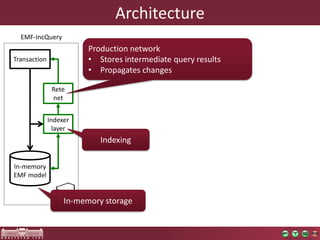
In-memory
EMF model
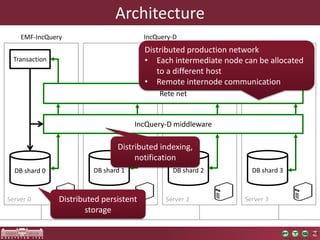
Architecture
In-memory storage
Transaction
Rete
net
Indexer
layer
Indexing
Production network
• Stores intermediate query results
• Propagates changes
EMF-IncQuery
DB shard 0
Architecture
In-memory storageServer 1
DB shard 1
Server 2
DB shard 2
Server 3
DB shard 3
Transaction
Server 0
Rete
net
Indexer
layer
IncQuery-D middleware
Rete net
Distributed indexing,
notification
Distributed persistent
storage
Distributed production network
• Each intermediate node can be allocated
to a different host
• Remote internode communication
EMF-IncQuery IncQuery-D
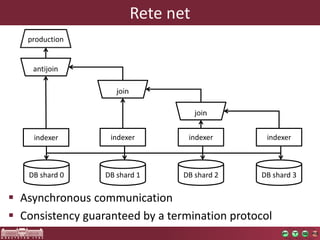
Rete net
 Asynchronous communication
 Consistency guaranteed by a termination protocol
indexer indexer indexer indexer
production
DB shard 0 DB shard 1 DB shard 2 DB shard 3
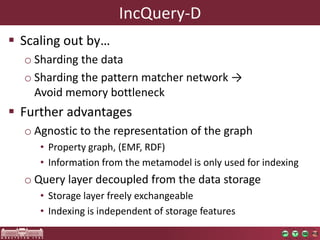
IncQuery-D
 Scaling out by…
o Sharding the data
o Sharding the pattern matcher network →
Avoid memory bottleneck
 Further advantages
o Agnostic to the representation of the graph
• Property graph, (EMF, RDF)
• Information from the metamodel is only used for indexing
o Query layer decoupled from the data storage
• Storage layer freely exchangeable
• Indexing is independent of storage features
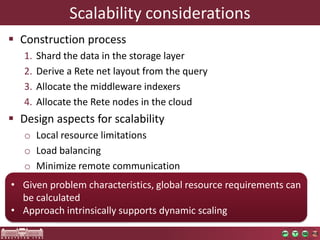
Scalability considerations
 Construction process
1. Shard the data in the storage layer
2. Derive a Rete net layout from the query
3. Allocate the middleware indexers
4. Allocate the Rete nodes in the cloud
 Design aspects for scalability
o Local resource limitations
o Load balancing
o Minimize remote communication
• Given problem characteristics, global resource requirements can
be calculated
• Approach intrinsically supports dynamic scaling
EVALUATION
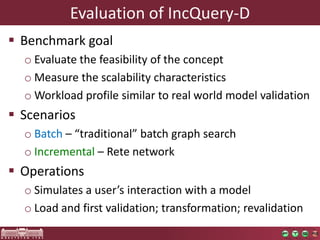
 Benchmark goal
o Evaluate the feasibility of the concept
o Measure the scalability characteristics
o Workload profile similar to real world model validation
 Scenarios
o Batch – “traditional” batch graph search
o Incremental – Rete network
 Operations
o Simulates a user’s interaction with a model
o Load and first validation; transformation; revalidation
Evaluation of IncQuery-D
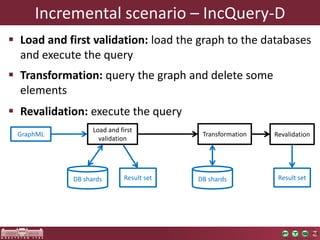
 Load and first validation: load the graph to the databases
and execute the query
 Transformation: query the graph and delete some
elements
 Revalidation: execute the query
Batch graph scenarioIncremental scenario – IncQuery-D
Transformation RevalidationGraphML
DB shards Result set
Load and first
validation
DB shards Result set
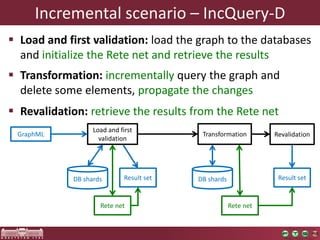
 Load and first validation: load the graph to the databases
and initialize the Rete net and retrieve the results
 Revalidation: retrieve the results from the Rete net
 Transformation: incrementally query the graph and
delete some elements, propagate the changes
Batch graph scenarioIncremental scenario – IncQuery-D
Transformation RevalidationGraphML
DB shards Result set
Rete net
Load and first
validation
DB shards Result set
Rete net
Implementation
Server 1
DB shard 1
Server 2
DB shard 2
Server 3
DB shard 3
Transaction
In-memory
EMF model
DB shard 0
Server 0
Rete
net
Indexer
layer
IncQuery-D middleware
Rete net
Neo4j
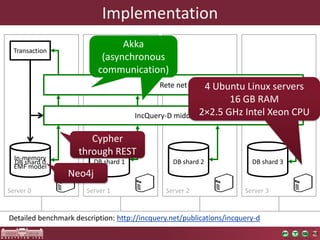
4 Ubuntu Linux servers
16 GB RAM
2×2.5 GHz Intel Xeon CPU
Detailed benchmark description: http://incquery.net/publications/incquery-d
Cypher
through REST
Akka
(asynchronous
communication)
Akka
(asynchronous
communication)
1
2
4
8
16
32
64
128
256
512
1024
2048
4096
0.1 /
0.008
0.2 /
0.015
0.5 /
0.03
0.9 /
0.06
1.7 /
0.114
3.5 /
0.231
7.1 /
0.47
14.1 /
0.945
28.0 /
1.907
55.8 /
3.853
time[s]
model size [million elements / file size in GB]
Neo4j/Cypher (batch) IncQuery-D (incremental)
Load and first validation phase
Small overhead for
the Rete network’s
construction
50M+: approx. 30 minutesParallel loading of the
graph from a GraphML
representation
1
2
4
8
16
32
64
128
256
512
1024
2048
4096
0.1 /
0.008
0.2 /
0.015
0.5 /
0.03
0.9 /
0.06
1.7 /
0.114
3.5 /
0.231
7.1 /
0.47
14.1 /
0.945
28.0 /
1.907
55.8 /
3.853
time[s]
model size [million elements / file size in GB]
Neo4j/Cypher (batch) IncQuery-D (incremental)
Transformation phase
1. Elementary model query
2. Model manipulation
• Both implemented with Cypher
• The query evaluation time is dominating
• Query is supported by the Rete net
• Only the manipulation implemented with Cypher
• Overhead due to change propagation is negligible
• 1.5 OOM faster
• Performs a transformation
over a 55M model in one
minute
0.25
1
4
16
64
256
1024
4096
0.1 /
0.008
0.2 /
0.015
0.5 /
0.03
0.9 /
0.06
1.7 /
0.114
3.5 /
0.231
7.1 /
0.47
14.1 /
0.945
28.0 /
1.907
55.8 /
3.853
time[s]
model size [million elements / file size in GB]
Neo4j/Cypher (batch) IncQuery-D (incremental)
Revalidation phase
Near instant
response time for
very large models
Different characteristics,
4 OOM for the largest model
Revalidation time is
independent of node size
CONCLUSIONS
Conclusions
 Novel approach for the distributed execution of
incremental graph queries
 Distributed Rete network
o Middleware for change propagation and indexing
o Incremental query layer decoupled from a sharded
graph database
 Results
o Working proof of concept
o Near instantaneous query evaluation up to 50M+
model elements
o Improves scalability of transformations significantly
Future work
 Tooling and automation
o Evolve the prototype into a developer tool
 Explore optimization possibilities
o Allocation of Rete nodes
o Dynamic reallocation of Rete nodes
o Sharding strategy, resource usage, network
communication overhead
 Cloud readiness
 Experiment with distributed EMF model stores
o CDO, MongoEMF, Morsa, …

IncQuery-D: Incremental Queries in the Cloud

  • 1.
    Budapest University ofTechnology and Economics Department of Measurement and Information Systems Budapest University of Technology and Economics Fault Tolerant Systems Research Group INCQUERY-D: INCREMENTAL QUERIES IN THE CLOUD Gábor Szárnyas, Benedek Izsó, István Ráth, Dániel Varró
  • 2.
    Overview  Introduction  MDEscalability challenges for model queries  Overview: scaling out in the cloud  Evaluation: a feasibility study  Conclusions and future work
  • 3.
  • 4.
    Scalability challenges inMDE  Complex instance models and queries  Instance model complexity o Size o Structure  Query complexity o MDE workloads involve much more complex queries than typical data-driven applications (e.g. model validation, transformations, …)  Scalability challenges arise due to their combination
  • 5.
    Model sizes  Instancemodels with several million elements o AUTOSAR models [1] o Source code models o Sensor data Source: Markus Scheidgen, How Big are Models – An Estimation, 2012. [2] application model size software models 0 – 109 sensor data 109 geo-spatial models 109 – 1012 [1] http://wiki.eclipse.org/Auto_IWG_WP2 [2] http://hwl.hu-berlin.de/fileadmin/user_upload/documents/howbig_techreport.pdf
  • 6.
    EMF-IncQuery  State ofthe art incremental graph query engine  Open source Eclipse project by BUTE and others  Typical use cases o Validation o Incremental model transformation o Model synchronization, view maintenance
  • 7.
    Single workstation limitations Majority of tools mostly work for <1M model elements due to algorithmic complexity  Best tools for <10M model elements due to JVM’s limitations o A JVM cannot handle 15+ GB heap memory efficiently o Long GC pauses o Specialized JVMs (e.g. Azul Systems’ Zing) • Commercial, experimental • May require special hardware  Proposed solution o Scale out: distributed system
  • 8.
  • 9.
    In-memory EMF model Architecture In-memory storage Transaction Rete net Indexer layer Indexing Productionnetwork • Stores intermediate query results • Propagates changes EMF-IncQuery
  • 10.
    DB shard 0 Architecture In-memorystorageServer 1 DB shard 1 Server 2 DB shard 2 Server 3 DB shard 3 Transaction Server 0 Rete net Indexer layer IncQuery-D middleware Rete net Distributed indexing, notification Distributed persistent storage Distributed production network • Each intermediate node can be allocated to a different host • Remote internode communication EMF-IncQuery IncQuery-D
  • 11.
    Rete net  Asynchronouscommunication  Consistency guaranteed by a termination protocol indexer indexer indexer indexer production DB shard 0 DB shard 1 DB shard 2 DB shard 3
  • 12.
    IncQuery-D  Scaling outby… o Sharding the data o Sharding the pattern matcher network → Avoid memory bottleneck  Further advantages o Agnostic to the representation of the graph • Property graph, (EMF, RDF) • Information from the metamodel is only used for indexing o Query layer decoupled from the data storage • Storage layer freely exchangeable • Indexing is independent of storage features
  • 13.
    Scalability considerations  Constructionprocess 1. Shard the data in the storage layer 2. Derive a Rete net layout from the query 3. Allocate the middleware indexers 4. Allocate the Rete nodes in the cloud  Design aspects for scalability o Local resource limitations o Load balancing o Minimize remote communication • Given problem characteristics, global resource requirements can be calculated • Approach intrinsically supports dynamic scaling
  • 14.
  • 15.
     Benchmark goal oEvaluate the feasibility of the concept o Measure the scalability characteristics o Workload profile similar to real world model validation  Scenarios o Batch – “traditional” batch graph search o Incremental – Rete network  Operations o Simulates a user’s interaction with a model o Load and first validation; transformation; revalidation Evaluation of IncQuery-D
  • 16.
     Load andfirst validation: load the graph to the databases and execute the query  Transformation: query the graph and delete some elements  Revalidation: execute the query Batch graph scenarioIncremental scenario – IncQuery-D Transformation RevalidationGraphML DB shards Result set Load and first validation DB shards Result set
  • 17.
     Load andfirst validation: load the graph to the databases and initialize the Rete net and retrieve the results  Revalidation: retrieve the results from the Rete net  Transformation: incrementally query the graph and delete some elements, propagate the changes Batch graph scenarioIncremental scenario – IncQuery-D Transformation RevalidationGraphML DB shards Result set Rete net Load and first validation DB shards Result set Rete net
  • 18.
    Implementation Server 1 DB shard1 Server 2 DB shard 2 Server 3 DB shard 3 Transaction In-memory EMF model DB shard 0 Server 0 Rete net Indexer layer IncQuery-D middleware Rete net Neo4j 4 Ubuntu Linux servers 16 GB RAM 2×2.5 GHz Intel Xeon CPU Detailed benchmark description: http://incquery.net/publications/incquery-d Cypher through REST Akka (asynchronous communication) Akka (asynchronous communication)
  • 19.
    1 2 4 8 16 32 64 128 256 512 1024 2048 4096 0.1 / 0.008 0.2 / 0.015 0.5/ 0.03 0.9 / 0.06 1.7 / 0.114 3.5 / 0.231 7.1 / 0.47 14.1 / 0.945 28.0 / 1.907 55.8 / 3.853 time[s] model size [million elements / file size in GB] Neo4j/Cypher (batch) IncQuery-D (incremental) Load and first validation phase Small overhead for the Rete network’s construction 50M+: approx. 30 minutesParallel loading of the graph from a GraphML representation
  • 20.
    1 2 4 8 16 32 64 128 256 512 1024 2048 4096 0.1 / 0.008 0.2 / 0.015 0.5/ 0.03 0.9 / 0.06 1.7 / 0.114 3.5 / 0.231 7.1 / 0.47 14.1 / 0.945 28.0 / 1.907 55.8 / 3.853 time[s] model size [million elements / file size in GB] Neo4j/Cypher (batch) IncQuery-D (incremental) Transformation phase 1. Elementary model query 2. Model manipulation • Both implemented with Cypher • The query evaluation time is dominating • Query is supported by the Rete net • Only the manipulation implemented with Cypher • Overhead due to change propagation is negligible • 1.5 OOM faster • Performs a transformation over a 55M model in one minute
  • 21.
    0.25 1 4 16 64 256 1024 4096 0.1 / 0.008 0.2 / 0.015 0.5/ 0.03 0.9 / 0.06 1.7 / 0.114 3.5 / 0.231 7.1 / 0.47 14.1 / 0.945 28.0 / 1.907 55.8 / 3.853 time[s] model size [million elements / file size in GB] Neo4j/Cypher (batch) IncQuery-D (incremental) Revalidation phase Near instant response time for very large models Different characteristics, 4 OOM for the largest model Revalidation time is independent of node size
  • 22.
  • 23.
    Conclusions  Novel approachfor the distributed execution of incremental graph queries  Distributed Rete network o Middleware for change propagation and indexing o Incremental query layer decoupled from a sharded graph database  Results o Working proof of concept o Near instantaneous query evaluation up to 50M+ model elements o Improves scalability of transformations significantly
  • 24.
    Future work  Toolingand automation o Evolve the prototype into a developer tool  Explore optimization possibilities o Allocation of Rete nodes o Dynamic reallocation of Rete nodes o Sharding strategy, resource usage, network communication overhead  Cloud readiness  Experiment with distributed EMF model stores o CDO, MongoEMF, Morsa, …