crafted design sandromancuso 
an introduction to Interaction-Driven Design (IDD)
 What is this application about? 
 What are the main concepts? 
 What does this application do? 
 What are the main features? 
 Where do I change it? 
 Where do I add a new feature or fix a bug?
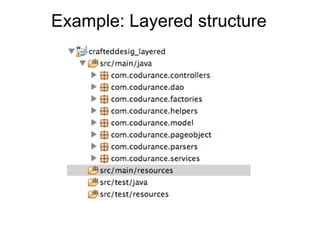
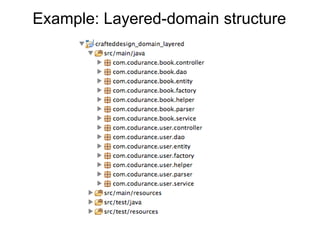
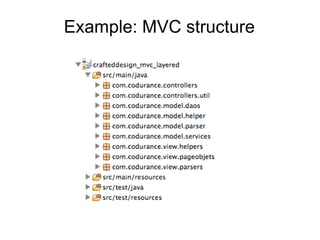
 Badly structured packages/namespaces 
 Architectural and design concepts mixed with domain 
 Classes and methods are too low level 
 Acceptance tests either absent or badly written
Example: Layered structure
Example: Layered-domain structure
Example: MVC structure
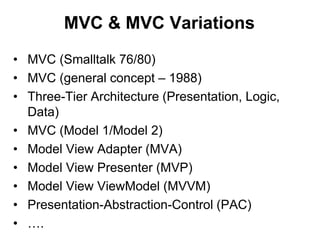
MVC & MVC Variations 
• MVC (Smalltalk 76/80) 
• MVC (general concept – 1988) 
• Three-Tier Architecture (Presentation, Logic, 
Data) 
• MVC (Model 1/Model 2) 
• Model View Adapter (MVA) 
• Model View Presenter (MVP) 
• Model View ViewModel (MVVM) 
• Presentation-Abstraction-Control (PAC) 
• ….
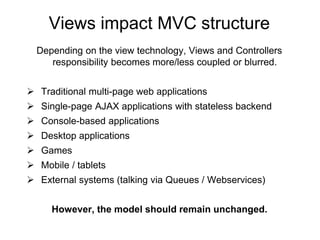
Views impact MVC structure 
Depending on the view technology, Views and Controllers 
responsibility becomes more/less coupled or blurred. 
 Traditional multi-page web applications 
 Single-page AJAX applications with stateless backend 
 Console-based applications 
 Desktop applications 
 Games 
 Mobile / tablets 
 External systems (talking via Queues / Webservices) 
However, the model should remain unchanged.
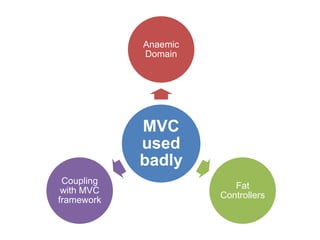
Anaemic 
Domain 
MVC 
used 
badly 
Fat 
Controllers 
Coupling 
with MVC 
framework
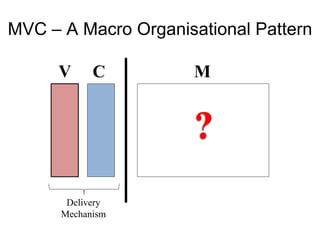
MVC – A Macro Organisational Pattern 
V C M 
Model 
Delivery 
Mechanism
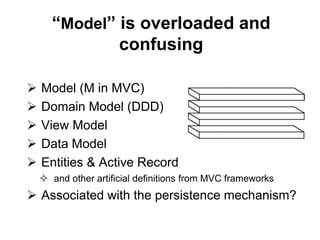
“Model” is overloaded and 
confusing 
 Model (M in MVC) 
 Domain Model (DDD) 
 View Model 
 Data Model 
 Entities & Active Record 
 and other artificial definitions from MVC frameworks 
 Associated with the persistence mechanism?
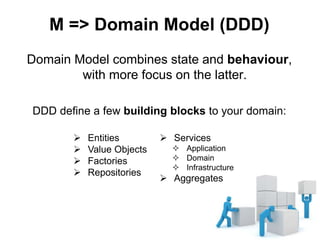
M => Domain Model (DDD) 
Domain Model combines state and behaviour, 
with more focus on the latter. 
DDD define a few building blocks to your domain: 
 Entities 
 Value Objects 
 Factories 
 Repositories 
 Services 
 Application 
 Domain 
 Infrastructure 
 Aggregates
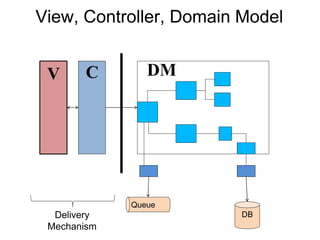
View, Controller, Domain Model 
Model V C DM 
Delivery 
Mechanism 
DB 
Queue
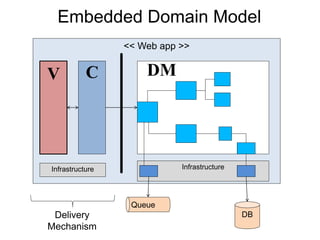
Embedded Domain Model 
<< Web app >> 
Model V C DM 
Infrastructure Infrastructure 
Delivery 
Mechanism 
DB 
Queue
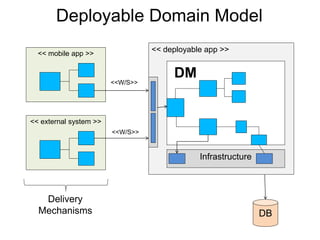
Deployable Domain Model 
<< mobile app >> 
<< external system >> 
Delivery 
Mechanisms 
DB 
<< deployable app >> 
Model 
Infrastructure 
DM 
<<W/S>> 
<<W/S>>
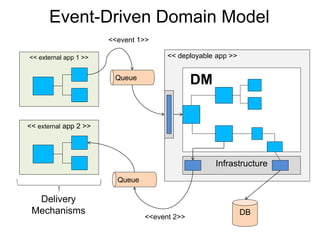
Event-Driven Domain Model 
<<event 1>> 
<< external app 1 >> << deployable app >> 
<< external app 2 >> 
Delivery 
Queue DM 
Queue 
Model 
Infrastructure 
Mechanisms DB 
<<event 2>>
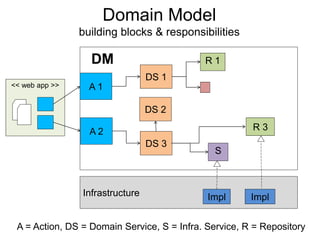
Domain Model 
building blocks & responsibilities 
Model 
DM 
A 1 
R 3 
DS 1 
DS 2 
DS 3 
R 1 
S 
A 2 
Infrastructure Impl 
Impl 
<< web app >> 
A = Action, DS = Domain Service, S = Infra. Service, R = Repository
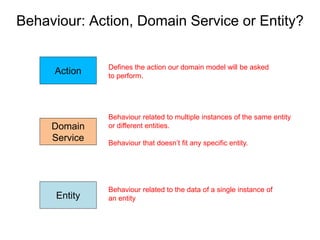
Behaviour: Action, Domain Service or Entity? 
Action Defines the action our domain model will be asked 
Domain 
Service 
Entity 
to perform. 
Behaviour related to multiple instances of the same entity 
or different entities. 
Behaviour that doesn’t fit any specific entity. 
Behaviour related to the data of a single instance of 
an entity
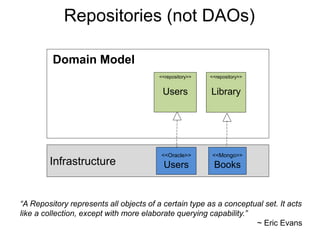
Repositories (not DAOs) 
Model 
<<repository>> 
Library 
<<repository>> 
Users 
Infrastructure 
<<Mongo>> 
Books 
Domain Model 
<<Oracle>> 
Users 
“A Repository represents all objects of a certain type as a conceptual set. It acts 
like a collection, except with more elaborate querying capability.” 
~ Eric Evans
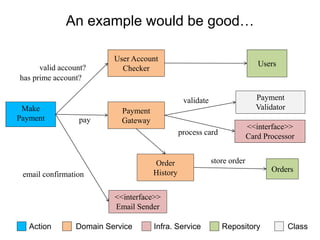
An example would be good… 
Payment 
User Account 
has prime account? 
validate 
Make Validator 
Payment 
<<interface>> 
Card Processor 
Order 
History Orders 
Checker 
Users 
valid account? 
Payment 
pay Gateway 
process card 
store order 
<<interface>> 
Email Sender 
email confirmation 
Action Domain Service Infra. Service Repository Class
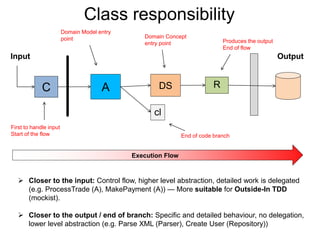
Class responsibility 
Produces the output 
End of flow 
Domain Model entry 
point Domain Concept 
entry point 
Input Output 
C A DS R 
cl 
End of code branch 
First to handle input 
Start of the flow 
Execution Flow 
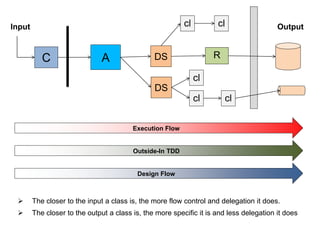
 Closer to the input: Control flow, higher level abstraction, detailed work is delegated 
(e.g. ProcessTrade (A), MakePayment (A)) — More suitable for Outside-In TDD 
(mockist). 
 Closer to the output / end of branch: Specific and detailed behaviour, no delegation, 
lower level abstraction (e.g. Parse XML (Parser), Create User (Repository))
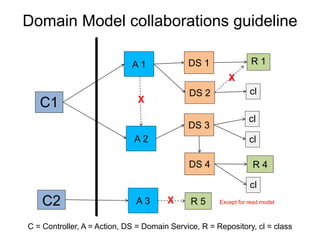
Domain Model collaborations guideline 
C1 
A 1 
X 
A 2 
DS 1 
DS 2 
DS 3 
DS 4 
R 1 
cl 
cl 
cl 
R 4 
cl 
X 
C2 A 3 X R 5 Except for read model 
C = Controller, A = Action, DS = Domain Service, R = Repository, cl = class
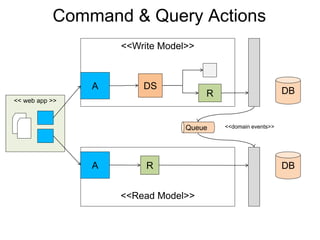
Command & Query Actions 
<< web app >> 
Model 
R 
<<Write Model>> 
DS 
A 
Model 
A R 
<<Read Model>> 
DB 
DB 
Queue <<domain events>>
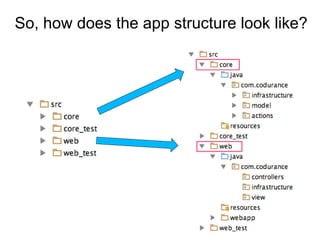
So, how does the app structure look like?
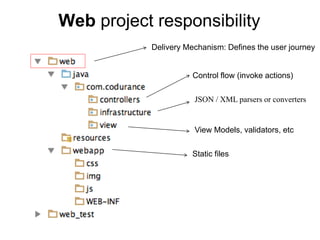
Web project responsibility 
Delivery Mechanism: Defines the user journey 
Control flow (invoke actions) 
JSON / XML parsers or converters 
View Models, validators, etc 
Static files
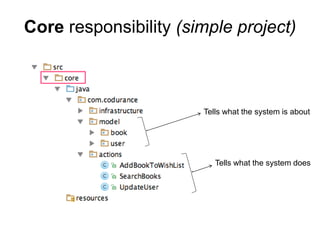
Core responsibility (simple project) 
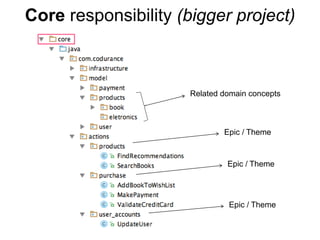
Tells what the system is about 
Tells what the system does
Core responsibility (bigger project) 
Related domain concepts 
Epic / Theme 
Epic / Theme 
Epic / Theme
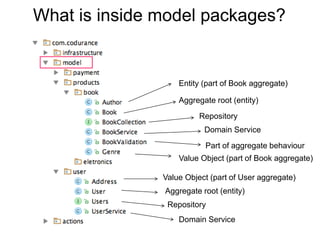
What is inside model packages? 
Entity (part of Book aggregate) 
Aggregate root (entity) 
Repository 
Domain Service 
Part of aggregate behaviour 
Value Object (part of Book aggregate) 
Value Object (part of User aggregate) 
Aggregate root (entity) 
Repository 
Domain Service
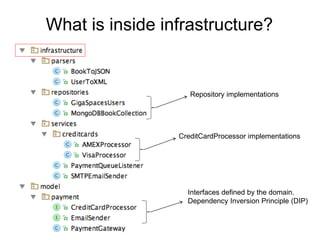
What is inside infrastructure? 
Repository implementations 
CreditCardProcessor implementations 
Interfaces defined by the domain. 
Dependency Inversion Principle (DIP)
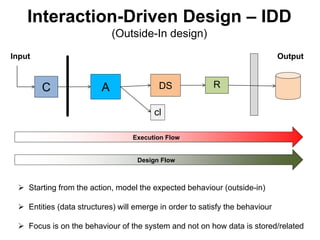
Interaction-Driven Design – IDD 
(Outside-In design) 
Input Output 
C A DS R 
cl 
Execution Flow 
Design Flow 
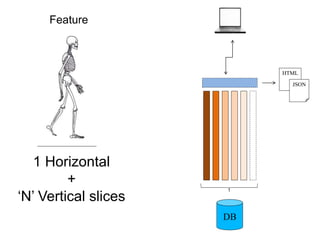
 Starting from the action, model the expected behaviour (outside-in) 
 Entities (data structures) will emerge in order to satisfy the behaviour 
 Focus is on the behaviour of the system and not on how data is stored/related
DB 
HTML 
JSON 
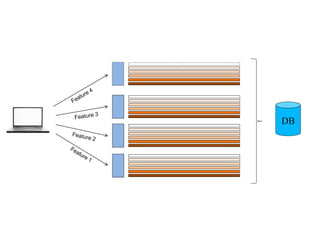
Feature 
1 Horizontal 
+ 
‘N’ Vertical slices
DB
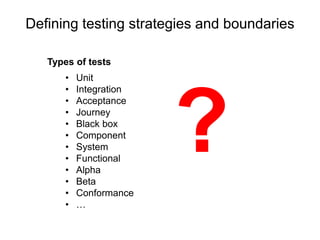
Defining testing strategies and boundaries 
Types of tests 
• Unit 
• Integration 
• Acceptance 
• Journey 
• Black box 
• Component 
• System 
• Functional 
• Alpha 
• Beta 
• Conformance 
• …
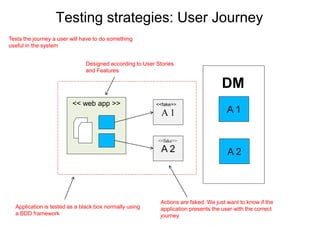
Testing strategies: User Journey 
Model 
DM 
A 1 
A 2 
Designed according to User Stories 
and Features 
<< web app >> 
<<fake>> 
A 1 
<<fake>> 
A 2 
Tests the journey a user will have to do something 
useful in the system 
Application is tested as a black box normally using 
a BDD framework 
Actions are faked. We just want to know if the 
application presents the user with the correct 
journey
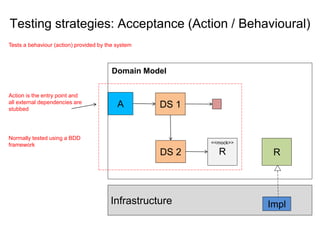
Testing strategies: Acceptance (Action / Behavioural) 
Tests a behaviour (action) provided by the system 
A DS 1 
<<mock>> 
DS 2 R R 
Infrastructure Impl 
Action is the entry point and 
all external dependencies are 
stubbed 
Domain Model 
Normally tested using a BDD 
framework
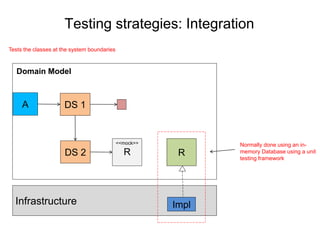
Testing strategies: Integration 
Tests the classes at the system boundaries 
Domain Model 
A DS 1 
<<mock>> 
DS 2 R R 
Infrastructure Impl 
Normally done using an in-memory 
Database using a unit 
testing framework
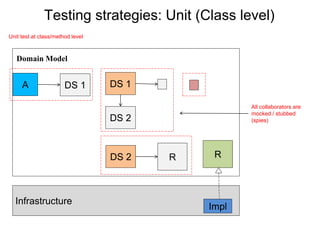
Testing strategies: Unit (Class level) 
Unit test at class/method level 
Infrastructure 
Impl 
A DS 1 
DS 2 R R 
Domain Model 
DS 1 
DS 2 
All collaborators are 
mocked / stubbed 
(spies)
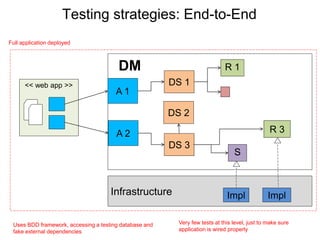
Testing strategies: End-to-End 
Model 
DM 
A 1 
R 3 
DS 1 
DS 2 
DS 3 
R 1 
S 
Infrastructure Impl 
Impl 
A 2 
Full application deployed 
<< web app >> 
Uses BDD framework, accessing a testing database and 
fake external dependencies 
Very few tests at this level, just to make sure 
application is wired properly
Use libraries, not frameworks
TDD is easy. Hard is to design software well.
cl cl 
Input Output 
C A DS R 
DS 
Execution Flow 
Outside-In TDD 
Design Flow 
cl 
cl 
cl 
 The closer to the input a class is, the more flow control and delegation it does. 
 The closer to the output a class is, the more specific it is and less delegation it does
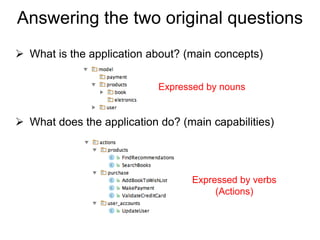
Answering the two original questions 
 What is the application about? (main concepts) 
Expressed by nouns 
 What does the application do? (main capabilities) 
Expressed by verbs 
(Actions)
Thank You 
@sandromancuso

Crafted Design - Sandro Mancuso

  • 1.
    crafted design sandromancuso an introduction to Interaction-Driven Design (IDD)
  • 2.
     What isthis application about?  What are the main concepts?  What does this application do?  What are the main features?  Where do I change it?  Where do I add a new feature or fix a bug?
  • 3.
     Badly structuredpackages/namespaces  Architectural and design concepts mixed with domain  Classes and methods are too low level  Acceptance tests either absent or badly written
  • 4.
  • 5.
  • 6.
  • 8.
    MVC & MVCVariations • MVC (Smalltalk 76/80) • MVC (general concept – 1988) • Three-Tier Architecture (Presentation, Logic, Data) • MVC (Model 1/Model 2) • Model View Adapter (MVA) • Model View Presenter (MVP) • Model View ViewModel (MVVM) • Presentation-Abstraction-Control (PAC) • ….
  • 9.
    Views impact MVCstructure Depending on the view technology, Views and Controllers responsibility becomes more/less coupled or blurred.  Traditional multi-page web applications  Single-page AJAX applications with stateless backend  Console-based applications  Desktop applications  Games  Mobile / tablets  External systems (talking via Queues / Webservices) However, the model should remain unchanged.
  • 10.
    Anaemic Domain MVC used badly Fat Controllers Coupling with MVC framework
  • 11.
    MVC – AMacro Organisational Pattern V C M Model Delivery Mechanism
  • 12.
    “Model” is overloadedand confusing  Model (M in MVC)  Domain Model (DDD)  View Model  Data Model  Entities & Active Record  and other artificial definitions from MVC frameworks  Associated with the persistence mechanism?
  • 13.
    M => DomainModel (DDD) Domain Model combines state and behaviour, with more focus on the latter. DDD define a few building blocks to your domain:  Entities  Value Objects  Factories  Repositories  Services  Application  Domain  Infrastructure  Aggregates
  • 14.
    View, Controller, DomainModel Model V C DM Delivery Mechanism DB Queue
  • 15.
    Embedded Domain Model << Web app >> Model V C DM Infrastructure Infrastructure Delivery Mechanism DB Queue
  • 16.
    Deployable Domain Model << mobile app >> << external system >> Delivery Mechanisms DB << deployable app >> Model Infrastructure DM <<W/S>> <<W/S>>
  • 17.
    Event-Driven Domain Model <<event 1>> << external app 1 >> << deployable app >> << external app 2 >> Delivery Queue DM Queue Model Infrastructure Mechanisms DB <<event 2>>
  • 18.
    Domain Model buildingblocks & responsibilities Model DM A 1 R 3 DS 1 DS 2 DS 3 R 1 S A 2 Infrastructure Impl Impl << web app >> A = Action, DS = Domain Service, S = Infra. Service, R = Repository
  • 19.
    Behaviour: Action, DomainService or Entity? Action Defines the action our domain model will be asked Domain Service Entity to perform. Behaviour related to multiple instances of the same entity or different entities. Behaviour that doesn’t fit any specific entity. Behaviour related to the data of a single instance of an entity
  • 20.
    Repositories (not DAOs) Model <<repository>> Library <<repository>> Users Infrastructure <<Mongo>> Books Domain Model <<Oracle>> Users “A Repository represents all objects of a certain type as a conceptual set. It acts like a collection, except with more elaborate querying capability.” ~ Eric Evans
  • 21.
    An example wouldbe good… Payment User Account has prime account? validate Make Validator Payment <<interface>> Card Processor Order History Orders Checker Users valid account? Payment pay Gateway process card store order <<interface>> Email Sender email confirmation Action Domain Service Infra. Service Repository Class
  • 22.
    Class responsibility Producesthe output End of flow Domain Model entry point Domain Concept entry point Input Output C A DS R cl End of code branch First to handle input Start of the flow Execution Flow  Closer to the input: Control flow, higher level abstraction, detailed work is delegated (e.g. ProcessTrade (A), MakePayment (A)) — More suitable for Outside-In TDD (mockist).  Closer to the output / end of branch: Specific and detailed behaviour, no delegation, lower level abstraction (e.g. Parse XML (Parser), Create User (Repository))
  • 23.
    Domain Model collaborationsguideline C1 A 1 X A 2 DS 1 DS 2 DS 3 DS 4 R 1 cl cl cl R 4 cl X C2 A 3 X R 5 Except for read model C = Controller, A = Action, DS = Domain Service, R = Repository, cl = class
  • 24.
    Command & QueryActions << web app >> Model R <<Write Model>> DS A Model A R <<Read Model>> DB DB Queue <<domain events>>
  • 25.
    So, how doesthe app structure look like?
  • 26.
    Web project responsibility Delivery Mechanism: Defines the user journey Control flow (invoke actions) JSON / XML parsers or converters View Models, validators, etc Static files
  • 27.
    Core responsibility (simpleproject) Tells what the system is about Tells what the system does
  • 28.
    Core responsibility (biggerproject) Related domain concepts Epic / Theme Epic / Theme Epic / Theme
  • 29.
    What is insidemodel packages? Entity (part of Book aggregate) Aggregate root (entity) Repository Domain Service Part of aggregate behaviour Value Object (part of Book aggregate) Value Object (part of User aggregate) Aggregate root (entity) Repository Domain Service
  • 30.
    What is insideinfrastructure? Repository implementations CreditCardProcessor implementations Interfaces defined by the domain. Dependency Inversion Principle (DIP)
  • 31.
    Interaction-Driven Design –IDD (Outside-In design) Input Output C A DS R cl Execution Flow Design Flow  Starting from the action, model the expected behaviour (outside-in)  Entities (data structures) will emerge in order to satisfy the behaviour  Focus is on the behaviour of the system and not on how data is stored/related
  • 32.
    DB HTML JSON Feature 1 Horizontal + ‘N’ Vertical slices
  • 33.
  • 34.
    Defining testing strategiesand boundaries Types of tests • Unit • Integration • Acceptance • Journey • Black box • Component • System • Functional • Alpha • Beta • Conformance • …
  • 35.
    Testing strategies: UserJourney Model DM A 1 A 2 Designed according to User Stories and Features << web app >> <<fake>> A 1 <<fake>> A 2 Tests the journey a user will have to do something useful in the system Application is tested as a black box normally using a BDD framework Actions are faked. We just want to know if the application presents the user with the correct journey
  • 36.
    Testing strategies: Acceptance(Action / Behavioural) Tests a behaviour (action) provided by the system A DS 1 <<mock>> DS 2 R R Infrastructure Impl Action is the entry point and all external dependencies are stubbed Domain Model Normally tested using a BDD framework
  • 37.
    Testing strategies: Integration Tests the classes at the system boundaries Domain Model A DS 1 <<mock>> DS 2 R R Infrastructure Impl Normally done using an in-memory Database using a unit testing framework
  • 38.
    Testing strategies: Unit(Class level) Unit test at class/method level Infrastructure Impl A DS 1 DS 2 R R Domain Model DS 1 DS 2 All collaborators are mocked / stubbed (spies)
  • 39.
    Testing strategies: End-to-End Model DM A 1 R 3 DS 1 DS 2 DS 3 R 1 S Infrastructure Impl Impl A 2 Full application deployed << web app >> Uses BDD framework, accessing a testing database and fake external dependencies Very few tests at this level, just to make sure application is wired properly
  • 40.
  • 41.
    TDD is easy.Hard is to design software well.
  • 42.
    cl cl InputOutput C A DS R DS Execution Flow Outside-In TDD Design Flow cl cl cl  The closer to the input a class is, the more flow control and delegation it does.  The closer to the output a class is, the more specific it is and less delegation it does
  • 43.
    Answering the twooriginal questions  What is the application about? (main concepts) Expressed by nouns  What does the application do? (main capabilities) Expressed by verbs (Actions)
  • 46.

Editor's Notes

  • #2 In this talk I’ll be sharing how I’ve been designing software in the past few years. I’ll be talking about a design style that I’m calling Interaction-Driven Design (IDD) To be catchy it needs to be Japanese or xDD. Chose the latter cos I don’t speak Japanese.
  • #3 For years I’ve been trying to find ways to, while looking from above, answer the following questions:
  • #4 Looking from above: controllers, repositories, managers, services, etc. Layers vs. domain? How do they fit together? How many of you are happy with your package structure?
  • #5 Confusing. I have no idea what this application is about or what it does. What does this application do? What is it about?
  • #6 Gives me some information on what the application is about but not what it does. Loads of duplication Very poluted Books and Users. Cool, but what does this application do?
  • #7 Once again, gives me no information on what the application is about or what it does. But I know it is a web app though. Sigh. Awesome. It’s a web application. So?
  • #8 So, how do I solve the problem? How do I answer the questions? But first things first… Before getting into how I’m organising/structuring my code, we need some background to justify my decisions
  • #9 It was only later, in a 1988 article in Glenn E. Krasner and Stephen T. Pope that MVC was expressed as general concept, in the The Journal of Object Technology
  • #11 Anaemic Domain: Model is only composed by entities and data structures Fat Controllers: Without a place to put business logic, the logic is put on the controllers
  • #12 What should we have in the model? What is model?
  • #15 Start our application with this clear separation or refactor towards it. Keeping them separately gives us options.
  • #16 Domain Model embedded in a Web Application V/C belong to the application (main)
  • #17 Domain Model wrapped in a deployable application Expose a W/S for mobile apps / Web apps / External Systems This is similar to Hexagonal Architecture (Ports & Adapters belong to Infrastructure) Mobile app could have the V/C
  • #18 Event-Driven application
  • #19 - Actions are the entry point to the domain model (control flow delegating to Domain Services) - Actions can use factories to create domain objects according to the input (normally not in the domain format) - Domain Services are the entry point to a domain concept. Repositories are helpers to the Domain Service and should not be exposed.
  • #21 - I name repositories using the plural (collection) of the domain concept they represent (Users, Books) Repository vs. DAO (Former behaves as a collection. Latter is a pattern to access data) Data Access Object (DAO) is a commonly used pattern to persist entities (data) into a database. (CRUD)
  • #23 Classes closer to the output are more suitable for Classic TDD, unless they are close to the boundaries (that need to be mocked in both TDD styles)
  • #24 Controller can talk to one or more than one action UC can talk to one or more DS or classes DS can talk to other DS or Infra Service Repositories are never exposed. Just accessed by its own DS. Exception is on Read Model
  • #25 - Write model throws domain events Query model listens to domain events and populate “read” DB Query UC return data according to the application needs (Report, Complex Screen with denormalised data, etc) Command Actions go though the domain model, delegating to domain services Query Actions may go to a read model instead, querying with joins returning VOs that are specific to the UI. No need to organise them in different packages (using command & query as names)
  • #26 Controllers talk the Actions Controllers should be thin, invoking an action, and choosing the view to be displayed (maybe creating page objects or converting to JSON?) web: View (page objects) Web: Infrastructure (JSON / XML parsers or converters)
  • #27 Controllers talk the Actions Controllers should be thin, invoking an action, and choosing the view to be displayed (maybe creating page objects or converting to JSON?) web: View (page objects) Web: Infrastructure (JSON / XML parsers or converters)
  • #28 In a simple project (CRUD), action may be as simple as Insert, Delete, Update User Not all action se cases have a direct correlation to entities (AddBookToWishList)
  • #29 Epics/Themes: Candidates for bounded contexts / (micro?) services MakePayment UC does not need to have a related Entity, neither FindRecommendations. MakePayment may sent information out to a different system FindRecommendations may return a list of products (after a very complicated logic, taking to consideration user attributes and buying patterns)
  • #30 Many of the DDD building blocks
  • #31 Decouples the architectural decisions and layers from the domain model.
  • #32 A class API (public interface) should be designed from the client’s perspective. Doing otherwise leads to over-engineering and YAGNI – You Ain’t Gonna Need It Businesses are not interested in how data is stored or related. They are interested in the behaviour of the software.
  • #35 First, discuss with your team and define the scope of each test Then, chose a name for each scope
  • #36 Mocking the backend makes these tests run really fast and predictable. Easy to setup
  • #37 Tests multiple classes together. External dependencies are stubbed
  • #38 Tests multiple classes together. External dependencies are stubbed
  • #39 Tests multiple classes together. External dependencies are stubbed
  • #40 Unit (class / method level) Acceptance (through action, in-memory/mocked DB/infrastructure) Integration (via the boundaries, in-memory DB) User Journey (Via the UI – mocking action) End-to-end (black box, very few, just sunny day scenario) The closer to the input a class is, the more flow control and delegation it does. The closer to the output a class is, the more specific and less delegation it does.
  • #41 How to enable good design and test? You need freedom to design and test. Don’t use frameworks. Take control of your application. Don’t be scared to write code. Embedded Jetty, Scalatra, SparkJava Anorm (back to JDBC basics) Transaction service Remember when Spring was a lightweight alternative to J2EE?
  • #42 London School vs. Chicago/Detroit School
  • #43 The closer to the input a class is, the more flow control and delegation it does. The closer to the output a class is, the more specific and less delegation it does.
  • #44 Listen to your tests: shallow advice. Klaus story about music.
  • #45 A class API (public interface) should be designed from the client’s perspective. Doing otherwise leads to over-engineering and YAGNI – You Ain’t Gonna Need It Businesses are not interested in how data is stored or related. They are interested in the behaviour of the software.
  • #48 Businesses can move just as fast as they can create or change software, making them hostages of their own software.
  • #50 Codurance: We believe that softtware dev is a craft. We believe that how it is done is as important as getting it done. We believe that delivering well-crafted code is the best way we can help our clients.
  • #51 Codurance: We believe that softtware dev is a craft. We believe that how it is done is as important as getting it done. We believe that delivering well-crafted code is the best way we can help our clients.