High performance model queries
                                        and their novel applications


                                                       Benedek Izsó
                                                      Zoltán Szatmári
                                                        István Ráth


Budapest University of Technology and Economics   Workshop on Eclipse Open Source Software and OMG Open Specifications
Fault Tolerant Systems Research Group             EclipseCon 2012, Reston, VA, USA 2012. 03. 25.
The speaker’s background
 Research @ academia
  o Metamodeling, DSMLs, model transformations, …
     • The VIATRA2 Model Transformation Framework (2004-)
  o Model queries
     • The EMF-IncQuery project (2010-)
 Consulting & Development @ industry
  o Eclipse consultant and trainer (2006-)
  o Architect, model-driven tools and projects (2008-)
The problem
 Scalable modeling tools
   o Issues encountered by several industrial partners using
     EMF-based tools
   o Modeling scenarios can get really complex really quickly
      • Instance models of size 1-10M and beyond
      • Performance issues with model transformations and code
        generators have an adverse effect on everyday development tasks
 Scalability
   o Complex (meta)models
   o Large instance models
   o High performance model I/O
Focus: model queries
 Model queries
   o “a piece of code that retrieves a given set of the model”
 Ubiquitous
   o Every model access/read is a (simple) query
   o More complex: Views, content providers
   o Most complex: Model transformations, code generators
 In interactive (user-driven) use cases, queries are far more common than
  model manipulation
   o  query performance is crucial
 Query performance
   o The speed of content retrieval
       • First vs consecutive vs throughput
       • Query result vs query contents
 Essence of performance issues
   o slow queries
   o Considerable programming effort necessary to get complex queries right
Technology landscape – what to build a modeling tool on?
 Eclipse Modeling
   o EMF (&variants, CDO, …)
   o Proven tools: Plain Java queries, OCL (&variants), EMF Query (1-2)
   o New/experimental technologies: EMF-IncQuery, JBoss Drools, …
 Triple stores / graph databases
   o   OWL/RDF, SPARQL
   o   RacerPro, Pellet, Sesame, Jena, OpenVirtuoso, Allegro, StarDog
   o   Modeling tools: not (yet) a traditional use case
   o   But…
        • Huge, distributed knowledge bases         Further options
        • Highly optimized SPARQL engines          (not covered yet)
        • Expensive commercial tools              • Modeling
                                                     frameworks other
 Relational DB                                      than EMF
   o SQL, PL/SQL, In-memory                       • Plain XML/XPath
   o Overhead: ORM layers                         • OO DB
                                                  • K-V (NoSQL)
                                                  …
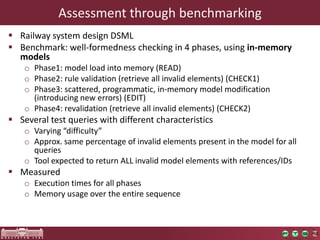
Assessment through benchmarking
 Railway system design DSML
 Benchmark: well-formedness checking in 4 phases, using in-memory
  models
    o Phase1: model load into memory (READ)
    o Phase2: rule validation (retrieve all invalid elements) (CHECK1)
    o Phase3: scattered, programmatic, in-memory model modification
      (introducing new errors) (EDIT)
    o Phase4: revalidation (retrieve all invalid elements) (CHECK2)
 Several test queries with different characteristics
    o Varying “difficulty”
    o Approx. same percentage of invalid elements present in the model for all
      queries
    o Tool expected to return ALL invalid model elements with references/IDs
 Measured
    o Execution times for all phases
    o Memory usage over the entire sequence
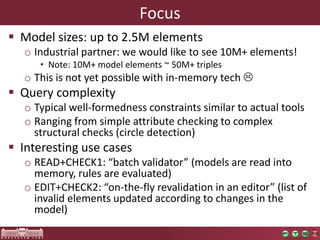
Focus
 Model sizes: up to 2.5M elements
  o Industrial partner: we would like to see 10M+ elements!
     • Note: 10M+ model elements ~ 50M+ triples
  o This is not yet possible with in-memory tech 
 Query complexity
  o Typical well-formedness constraints similar to actual tools
  o Ranging from simple attribute checking to complex
    structural checks (circle detection)
 Interesting use cases
  o READ+CHECK1: “batch validator” (models are read into
    memory, rules are evaluated)
  o EDIT+CHECK2: “on-the-fly revalidation in an editor” (list of
    invalid elements updated according to changes in the
    model)
RESULTS
Disclaimer
 This is still work in progress
 External audits (not complete yet)
   o OCL: Ed Willink
   o Drools: Mark Proctor
   o Java: our industrial partner (Eclipse-based tool
     development)
   o OWL/SPARQL: technology experts at an academic
     partner
 Detailed results, analysis and the corpus will be
  available online
   o This is just an appetizer 
Question 1
 Q: How does model size affect query
  performance?
Batch validation

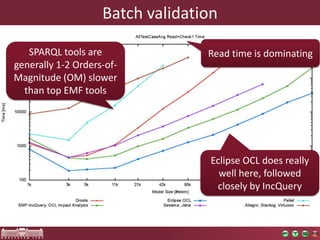
   SPARQL tools are               Read time is dominating
generally 1-2 Orders-of-
Magnitude (OM) slower
  than top EMF tools


                                   Eclipse OCL does really
                                     well here, followed
                                    closely by IncQuery
Revalidation on-the-fly

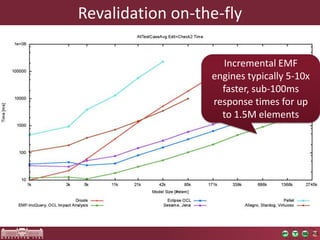
                    Incremental EMF
                  engines typically 5-10x
                    faster, sub-100ms
                  response times for up
                    to 1.5M elements
A closer look to the top

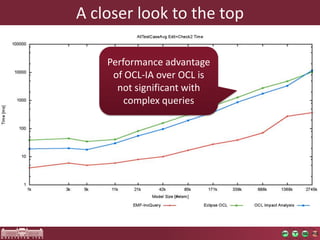
    Performance advantage
     of OCL-IA over OCL is
      not significant with
        complex queries
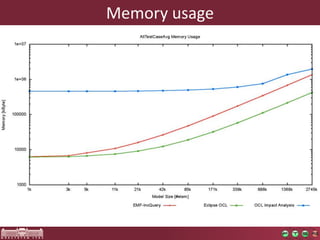
Memory usage
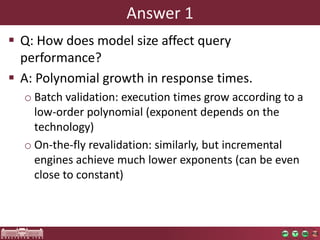
Answer 1
 Q: How does model size affect query
  performance?
 A: Polynomial growth in response times.
  o Batch validation: execution times grow according to a
    low-order polynomial (exponent depends on the
    technology)
  o On-the-fly revalidation: similarly, but incremental
    engines achieve much lower exponents (can be even
    close to constant)
Question 2
 Q: How does the complexity of the query affect
  performance?
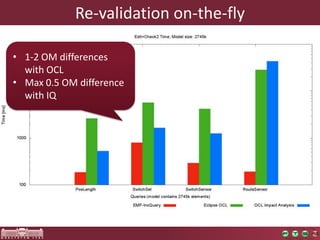
Re-validation on-the-fly

• 1-2 OM differences
  with OCL
• Max 0.5 OM difference
  with IQ
Answer 2
 Q: How does the complexity of the query affect
  performance?
 A: Significantly!
  o Metamodel and contents of the query together
    determine the overall performance
     • E.g. inverse relations and model navigation
     • Metamodel and queries should be optimized together
  o RETE-based tools (Drools, IncQuery) can get around
    this
     • High performance regardless of metamodel & query
       structure
     • At the cost of increased memory overhead
        – But (much) less than OCL-IA!
Results
 Fastest batch validator: Eclipse OCL
 Fastest incremental validator: EMF-IncQuery
 Fast OWL tools (RDF reasoners): Sesame, Jena
  o Significantly better than commercial SPARQL engines
  o But at least 1-2 OM slower than top EMF technologies
 (In-memory) RDBMS are slow
  o Due to ORM overhead
  o Omitted for simplicity, full report will be online
How to build a scalable modeling tool?
 If everything fits into your workstations’ RAM
   o 8GB RAM  1-2M model elements
   o You can (& should) (continue to) use EMF
         • EMF tweaks (e.g. diet) have no significant impact
         • Instead, optimize queries and metamodels
   o Use Eclipse OCL for batch validation
     EMF Query 1-2 has much less expressive power, not focused on
     in-memory models
   o Use incremental engines for on-the-fly queries
         • EMF-IncQuery supports on-the-fly validation, view maintenance, queries
           for frequently executed and performance sensitive model
           transformations, …
         • With RETE-based tools such as Drools or IncQuery, no manual
           metamodel/query etc. optimization necessary
         • Cost: additional memory requirements
 Else
   o To be investigated
EMF-INCQUERY
Overview
 A model query engine
  o Supports batch queries
  o Optimized for incremental queries!
 Incremental evaluation
  o   Based on the RETE algorithm
  o   Compute once, update afterwards
  o   Gain: Instant re-evaluation
  o   Price: Uses some more memory
       • Manageable with proper life cycles
Benefits
 Makes on-the-fly well-formedness validation, view maintenance, …
  feasible over really large instance models
 Simplifies writing really complex queries
   o Graph pattern language
       • Capture local & global constraints
       • Compositions, reusable constructs
       • Arbitrary recursion, negation
   o Highly reusable, you can even build query libraries
 Easy-to-integrate into existing apps
   o works with any EMF DSL
   o Integration through standard EMF APIs
New features: IncQuery v0.7
 Tooling
    o Xtext2-based tooling
    o New language features (w.i.p.)
        •   Unlimited recursion and transitive closure
        •   Short attribute notation
        •   Aggregate functions
        •   Match/exceed the expressive power of OCL, while providing more flexible re-use
 Runtime
    o Generic queries
        • Build and execute queries on-the-fly, using Java and IQ PL
    o RETE construction optimizations
        • memory footprint significantly reduced
    o SCC-based incremental transitive closure
 Extensions / add-ons
    o Derived features
    o Efficient complex event processing over models
    o Design-space exploration
Final points
 EMF-IncQuery: proposal submission process
  underway
  o New sub-project under EMFT

 Pointers
  o   http://viatra.inf.mit.bme.hu/publications/trainbenchmark
  o   http://viatra.inf.mit.bme.hu/incquery
  o   http://viatra.inf.mit.bme.hu/incquery/examples
  o   http://viatra.inf.mit.bme.hu/incquery/new


 Thank you very much!

High-performance model queries

  • 1.
    High performance modelqueries and their novel applications Benedek Izsó Zoltán Szatmári István Ráth Budapest University of Technology and Economics Workshop on Eclipse Open Source Software and OMG Open Specifications Fault Tolerant Systems Research Group EclipseCon 2012, Reston, VA, USA 2012. 03. 25.
  • 2.
    The speaker’s background Research @ academia o Metamodeling, DSMLs, model transformations, … • The VIATRA2 Model Transformation Framework (2004-) o Model queries • The EMF-IncQuery project (2010-)  Consulting & Development @ industry o Eclipse consultant and trainer (2006-) o Architect, model-driven tools and projects (2008-)
  • 3.
    The problem  Scalablemodeling tools o Issues encountered by several industrial partners using EMF-based tools o Modeling scenarios can get really complex really quickly • Instance models of size 1-10M and beyond • Performance issues with model transformations and code generators have an adverse effect on everyday development tasks  Scalability o Complex (meta)models o Large instance models o High performance model I/O
  • 4.
    Focus: model queries Model queries o “a piece of code that retrieves a given set of the model”  Ubiquitous o Every model access/read is a (simple) query o More complex: Views, content providers o Most complex: Model transformations, code generators  In interactive (user-driven) use cases, queries are far more common than model manipulation o  query performance is crucial  Query performance o The speed of content retrieval • First vs consecutive vs throughput • Query result vs query contents  Essence of performance issues o slow queries o Considerable programming effort necessary to get complex queries right
  • 5.
    Technology landscape –what to build a modeling tool on?  Eclipse Modeling o EMF (&variants, CDO, …) o Proven tools: Plain Java queries, OCL (&variants), EMF Query (1-2) o New/experimental technologies: EMF-IncQuery, JBoss Drools, …  Triple stores / graph databases o OWL/RDF, SPARQL o RacerPro, Pellet, Sesame, Jena, OpenVirtuoso, Allegro, StarDog o Modeling tools: not (yet) a traditional use case o But… • Huge, distributed knowledge bases Further options • Highly optimized SPARQL engines (not covered yet) • Expensive commercial tools • Modeling frameworks other  Relational DB than EMF o SQL, PL/SQL, In-memory • Plain XML/XPath o Overhead: ORM layers • OO DB • K-V (NoSQL) …
  • 6.
    Assessment through benchmarking Railway system design DSML  Benchmark: well-formedness checking in 4 phases, using in-memory models o Phase1: model load into memory (READ) o Phase2: rule validation (retrieve all invalid elements) (CHECK1) o Phase3: scattered, programmatic, in-memory model modification (introducing new errors) (EDIT) o Phase4: revalidation (retrieve all invalid elements) (CHECK2)  Several test queries with different characteristics o Varying “difficulty” o Approx. same percentage of invalid elements present in the model for all queries o Tool expected to return ALL invalid model elements with references/IDs  Measured o Execution times for all phases o Memory usage over the entire sequence
  • 7.
    Focus  Model sizes:up to 2.5M elements o Industrial partner: we would like to see 10M+ elements! • Note: 10M+ model elements ~ 50M+ triples o This is not yet possible with in-memory tech   Query complexity o Typical well-formedness constraints similar to actual tools o Ranging from simple attribute checking to complex structural checks (circle detection)  Interesting use cases o READ+CHECK1: “batch validator” (models are read into memory, rules are evaluated) o EDIT+CHECK2: “on-the-fly revalidation in an editor” (list of invalid elements updated according to changes in the model)
  • 8.
  • 9.
    Disclaimer  This isstill work in progress  External audits (not complete yet) o OCL: Ed Willink o Drools: Mark Proctor o Java: our industrial partner (Eclipse-based tool development) o OWL/SPARQL: technology experts at an academic partner  Detailed results, analysis and the corpus will be available online o This is just an appetizer 
  • 10.
    Question 1  Q:How does model size affect query performance?
  • 11.
    Batch validation SPARQL tools are Read time is dominating generally 1-2 Orders-of- Magnitude (OM) slower than top EMF tools Eclipse OCL does really well here, followed closely by IncQuery
  • 12.
    Revalidation on-the-fly Incremental EMF engines typically 5-10x faster, sub-100ms response times for up to 1.5M elements
  • 13.
    A closer lookto the top Performance advantage of OCL-IA over OCL is not significant with complex queries
  • 14.
  • 15.
    Answer 1  Q:How does model size affect query performance?  A: Polynomial growth in response times. o Batch validation: execution times grow according to a low-order polynomial (exponent depends on the technology) o On-the-fly revalidation: similarly, but incremental engines achieve much lower exponents (can be even close to constant)
  • 16.
    Question 2  Q:How does the complexity of the query affect performance?
  • 17.
    Re-validation on-the-fly • 1-2OM differences with OCL • Max 0.5 OM difference with IQ
  • 18.
    Answer 2  Q:How does the complexity of the query affect performance?  A: Significantly! o Metamodel and contents of the query together determine the overall performance • E.g. inverse relations and model navigation • Metamodel and queries should be optimized together o RETE-based tools (Drools, IncQuery) can get around this • High performance regardless of metamodel & query structure • At the cost of increased memory overhead – But (much) less than OCL-IA!
  • 19.
    Results  Fastest batchvalidator: Eclipse OCL  Fastest incremental validator: EMF-IncQuery  Fast OWL tools (RDF reasoners): Sesame, Jena o Significantly better than commercial SPARQL engines o But at least 1-2 OM slower than top EMF technologies  (In-memory) RDBMS are slow o Due to ORM overhead o Omitted for simplicity, full report will be online
  • 20.
    How to builda scalable modeling tool?  If everything fits into your workstations’ RAM o 8GB RAM  1-2M model elements o You can (& should) (continue to) use EMF • EMF tweaks (e.g. diet) have no significant impact • Instead, optimize queries and metamodels o Use Eclipse OCL for batch validation EMF Query 1-2 has much less expressive power, not focused on in-memory models o Use incremental engines for on-the-fly queries • EMF-IncQuery supports on-the-fly validation, view maintenance, queries for frequently executed and performance sensitive model transformations, … • With RETE-based tools such as Drools or IncQuery, no manual metamodel/query etc. optimization necessary • Cost: additional memory requirements  Else o To be investigated
  • 21.
  • 22.
    Overview  A modelquery engine o Supports batch queries o Optimized for incremental queries!  Incremental evaluation o Based on the RETE algorithm o Compute once, update afterwards o Gain: Instant re-evaluation o Price: Uses some more memory • Manageable with proper life cycles
  • 23.
    Benefits  Makes on-the-flywell-formedness validation, view maintenance, … feasible over really large instance models  Simplifies writing really complex queries o Graph pattern language • Capture local & global constraints • Compositions, reusable constructs • Arbitrary recursion, negation o Highly reusable, you can even build query libraries  Easy-to-integrate into existing apps o works with any EMF DSL o Integration through standard EMF APIs
  • 24.
    New features: IncQueryv0.7  Tooling o Xtext2-based tooling o New language features (w.i.p.) • Unlimited recursion and transitive closure • Short attribute notation • Aggregate functions • Match/exceed the expressive power of OCL, while providing more flexible re-use  Runtime o Generic queries • Build and execute queries on-the-fly, using Java and IQ PL o RETE construction optimizations • memory footprint significantly reduced o SCC-based incremental transitive closure  Extensions / add-ons o Derived features o Efficient complex event processing over models o Design-space exploration
  • 25.
    Final points  EMF-IncQuery:proposal submission process underway o New sub-project under EMFT  Pointers o http://viatra.inf.mit.bme.hu/publications/trainbenchmark o http://viatra.inf.mit.bme.hu/incquery o http://viatra.inf.mit.bme.hu/incquery/examples o http://viatra.inf.mit.bme.hu/incquery/new  Thank you very much!