Bibliotherapy & Book Prescription Service : Using Books and Literature for Growth and Healing Philippine Association Of School Libraries (PASLI)  Summer Conference Baguio City May 10-12, 2011 Zarah C. Gagatiga http://lovealibrarian.blogspot.com [email_address]
Objectives Acquire tips, hints, experiences in setting up a bibliotherapy program; Develop a basic book collection that can be used for bibliotherapy; Create a bibliotherapy program based on technical principles and guidelines.
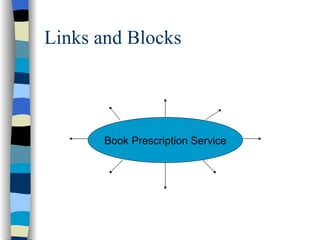
Links and Blocks Book Prescription Service
Story Time! The Generous Tree  an Adaptation from  Shel Silverstien’s  classic story,  The Giving Tree Characters: a tree and a little boy Narrator
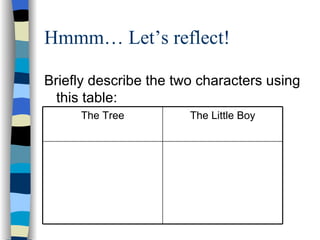
Hmmm… Let’s reflect! Briefly describe the two characters using this table: The Little Boy The Tree
Great job! Let’s ruminate some more. Between the tree and the boy, who could you relate with strongly? What similarities can you identify with to the character of your choice? Think of a time in your life when you gave so generously like the tree. How did you feel? Think of a time in your life when you were generously been given like the boy. How did you feel? Which is better: to be the giver or to be the receiver? Support your answer.
Buzz group: Let’s talk! Small buzz group  Big buzz group Take home activity: Thank a person in your life, a family member, a friend or a colleague, who has greatly helped you. What acts of love can you show to others?
Bibliotherapy “ The healing place for the soul” - Inscription over the library of Thebes Greek words (Rubin, 1979) Biblion = books Therapeia = healing    A  technique  of  prescribing books  to  patients  who need  help  in understanding their  problems  (Crothers, 1916).
Bibliotherapy Is the assistance given to a youngster in overcoming the emotional turmoil related to a real-life problem by having him or her  read  literature on the topic. Is the therapeutic use of the written word to help people in any situation in life. Is the provision of health information and support through books (Brewster, 2008) Guidance in the solution of personal problems through directed reading (ALA, 1966) Encourages change with in the individual.
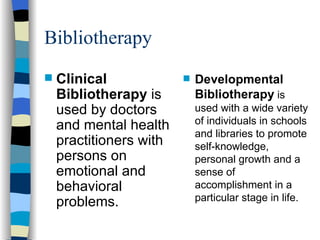
Bibliotherapy Clinical Bibliotherapy  is used by doctors and mental health practitioners with persons on emotional and behavioral problems. Developmental Bibliotherapy  is used with a wide variety of individuals in schools and libraries to promote self-knowledge, personal growth and a sense of accomplishment in a particular stage in life.
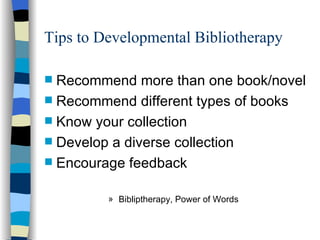
Tips to Developmental Bibliotherapy Recommend more than one book/novel Recommend different types of books Know your collection Develop a diverse collection Encourage feedback Bibliptherapy, Power of Words
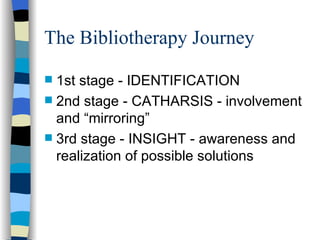
The Bibliotherapy Journey 1st stage - IDENTIFICATION 2nd stage - CATHARSIS - involvement and “mirroring” 3rd stage - INSIGHT - awareness and realization of possible solutions
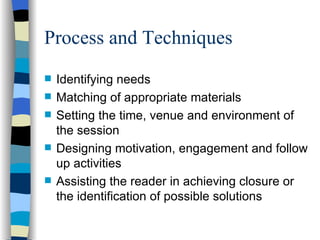
Process and Techniques Identifying needs Matching of appropriate materials Setting the time, venue and environment of the session Designing motivation, engagement and follow up activities Assisting the reader in achieving closure or the identification of possible solutions
Process and Techniques (Pelias 2005) READ - Nothing beats personal knowledge of a story;  Identify significant points of the story that touches on the theme.  Be keen to connections you know the student/reader can make with the selection at hand.
Requirements for a Bibliotherapy Program Training  and  Manpower Budget for the development of resources and bibliotherapy collection A working knowledge of the library’s client/readers Administrative and staff support Linkages and connections with health care professionals and allied fields/institutions
BP Models/Examples The Well Being Collection (The Royal Borough of Kensington and Chelsea Brompton Library, London)
Booktalks and Chit-chats Book Break - a facilitator led reading group for adults Bibliotherapy Book Slam - bibliotherapy service for kids, young adults and their families Australian and Canadian BPS-BP models BPS Study by Brewster, 2009 Bibliotherapy for abused children, Aligada and Ocampo, 2009
Open Forum Insights Response Questions