Tunisian Republic
Ministry of Higher Education and Scientic Research
Higher Institute of Technological Studies of Rades
End of semester Project Report
Design and development of
Sales BI Project
Host Organization:Intern
Student:
Hlel Abdelhedi
Master's Degree in Business Intelligence
College year 2017 - 2018
Dedications
To my parents,
for being my biggest inspiration and for being supportive and encouraging in
all my life stages .
My brothers and sisters,
For being Showing me support and big trust in me .
And my friends ,
For being very kind and helpful
i
Acknowledgment
Before presenting our work,we would like to thank all the people who contributed
to the success of our internship and who helped us in the drafting of this report.
We would also like to thank all the professors of the Business intelligence
Master degree at ISET rades .
Finally, my profound gratitude to the Director of the Higher Institute of
Information and Communication Technologies Mr. Mohamed Abdallah and all
members of the administration for the eort they are given .
ii
Contents
Dedications i
Acknowledgments ii
General Introduction 1
1 Project context 2
1.1 introduction . . . . . . . . . . . . . . . . . . . . . . . . . . . . . . 2
1.2 Operational Systems . . . . . . . . . . . . . . . . . . . . . . . . . 2
1.2.1 Online Website . . . . . . . . . . . . . . . . . . . . . . . . 2
1.2.2 Mobile App . . . . . . . . . . . . . . . . . . . . . . . . . . 3
1.2.3 Desktop App . . . . . . . . . . . . . . . . . . . . . . . . . 4
1.3 Limits of Operational Systems . . . . . . . . . . . . . . . . . . . 4
2 Requirements Analysis And application design 5
2.1 Existing Slutions . . . . . . . . . . . . . . . . . . . . . . . . . . . 5
2.2 Requirements Analysis . . . . . . . . . . . . . . . . . . . . . . . . 5
2.3 Metrics . . . . . . . . . . . . . . . . . . . . . . . . . . . . . . . . 6
2.4 Project Design . . . . . . . . . . . . . . . . . . . . . . . . . . . . 6
2.4.1 Sales Fact . . . . . . . . . . . . . . . . . . . . . . . . . . 7
2.4.2 cancelled Sales Fact . . . . . . . . . . . . . . . . . . . . . 7
3 Implementation 8
3.1 Implementation environment . . . . . . . . . . . . . . . . . . . . 8
3.1.1 hardware environment : . . . . . . . . . . . . . . . . . . . 8
3.1.2 Software environment: . . . . . . . . . . . . . . . . . . . 8
3.2 ETL Implementation . . . . . . . . . . . . . . . . . . . . . . . . . 8
3.2.1 Used Techniques . . . . . . . . . . . . . . . . . . . . . . . 8
3.3 Implementation . . . . . . . . . . . . . . . . . . . . . . . . . . . . 9
3.3.1 Staging . . . . . . . . . . . . . . . . . . . . . . . . . . . . 9
3.3.2 Transformation and Load . . . . . . . . . . . . . . . . . . 11
3.3.3 Transformation Throw Views . . . . . . . . . . . . . . . . 12
4 Data Visualization 15
4.1 Intoduction . . . . . . . . . . . . . . . . . . . . . . . . . . . . . . 15
4.2 Tableau Software . . . . . . . . . . . . . . . . . . . . . . . . . . . 15
4.3 Dashboards . . . . . . . . . . . . . . . . . . . . . . . . . . . . . . 16
Bibliographie 21
iii
List of Figures
1.1 My SQL database Schema . . . . . . . . . . . . . . . . . . . . . . 3
1.2 SQL Server database Schema . . . . . . . . . . . . . . . . . . . . 4
2.1 KPI vs KRI . . . . . . . . . . . . . . . . . . . . . . . . . . . . . . 6
2.2 Sales fact and dimensions . . . . . . . . . . . . . . . . . . . . . . 7
2.3 cancelled sales fact and dimensions . . . . . . . . . . . . . . . . . 7
3.1 Stging ETL . . . . . . . . . . . . . . . . . . . . . . . . . . . . . . 9
3.2 Orders cancelled staging job . . . . . . . . . . . . . . . . . . . . . 9
3.3 Stock mangement staging job . . . . . . . . . . . . . . . . . . . . 10
3.4 Orders online staging job . . . . . . . . . . . . . . . . . . . . . . 10
3.5 Region staging job . . . . . . . . . . . . . . . . . . . . . . . . . . 11
3.6 Changing Gender . . . . . . . . . . . . . . . . . . . . . . . . . . 11
3.7 Changing Region . . . . . . . . . . . . . . . . . . . . . . . . . . . 12
3.8 Date Dimension Specication . . . . . . . . . . . . . . . . . . . . 12
4.1 KPI vs KRI . . . . . . . . . . . . . . . . . . . . . . . . . . . . . . 15
4.2 KPI : Product Performance . . . . . . . . . . . . . . . . . . . . . 16
4.3 KPI : Sales To Date . . . . . . . . . . . . . . . . . . . . . . . . . 16
4.4 KPI : Sales By Region . . . . . . . . . . . . . . . . . . . . . . . . 17
4.5 KPI : Sales By Region / Government . . . . . . . . . . . . . . . . 17
4.6 KPI : Revenue Gained from Top Customers . . . . . . . . . . . . 18
4.7 KRI : Orders Canceled by reason . . . . . . . . . . . . . . . . . . 18
iv
General Introduction
Intelligence is the ability to solve problems to make decisions.We all make de-
cisions and on all occasions; for example, when we have to go to an appoint-
ment, we always try to take the shortest route to arrive on time.To make good
decisions, we help ourselves with the information that is available to us.The
information will provide answers and allow us to make good decisions.Business
Intelligence is responding to problems related to the company.
In the next few pages i will talk with details about the context of my business
intelligence project , the existing solutions and the design and the development
of the ETL .
1
Chapter 1
Project context
1.1 introduction
The mission of this project is to provide strategic and tactical support to the
Marketing-Sales of a fast fashion company through the acquisition and analysis
of data pertaining to their customers and markets.
1.2 Operational Systems
An operational information system has the primary objective of serve as a sup-
port for carrying out the activities of a set of business process .
1.2.1 Online Website
This company uses an e-commerce web site to sale their products online .The
main use cases of this application are :
Customer
• Prole management
• cart management
• orders management
• Browse Products
Administrator
• Prole management
• Products management
• Store information management
2
ISET Rades 1.2. OPERATIONAL SYSTEMS
1.2.2 Mobile App
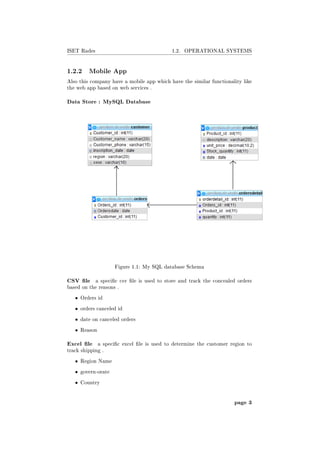
Also this company have a mobile app which have the similar functionality like
the web app based on web services .
Data Store : MySQL Database
Figure 1.1: My SQL database Schema
CSV le a specic csv le is used to store and track the concealed orders
based on the reasons .
• Orders id
• orders canceled id
• date on canceled orders
• Reason
Excel le a specic excel le is used to determine the customer region to
track shipping .
• Region Name
• govern-orate
• Country
page 3
ISET Rades 1.3. LIMITS OF OPERATIONAL SYSTEMS
1.2.3 Desktop App
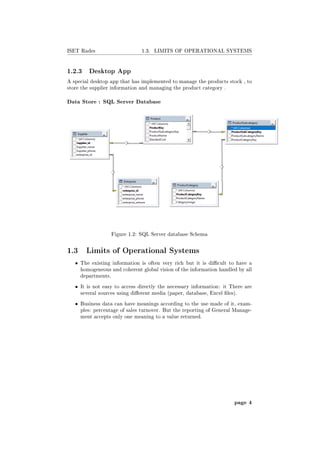
A special desktop app that has implemented to manage the products stock , to
store the supplier information and managing the product category .
Data Store : SQL Server Database
Figure 1.2: SQL Server database Schema
1.3 Limits of Operational Systems
• The existing information is often very rich but it is dicult to have a
homogeneous and coherent global vision of the information handled by all
departments.
• It is not easy to access directly the necessary information: it There are
several sources using dierent media (paper, database, Excel les).
• Business data can have meanings according to the use made of it, exam-
ples: percentage of sales turnover. But the reporting of General Manage-
ment accepts only one meaning to a value returned.
page 4
Chapter 2
Requirements Analysis And
application design
2.1 Existing Slutions
In this subsection we will focus the company requirement analysis , the key per-
formance indications (KPI) and metrics (KRI) and nally we will introduce the
design of my projects studying some applications which have the same context
as my project .
2.2 Requirements Analysis
• Better access to data
• Improved quality of information.
• Integration and analysis of data from systems dierent
• Centralized System of Data
• Better access to historical data
5
ISET Rades 2.3. METRICS
2.3 Metrics
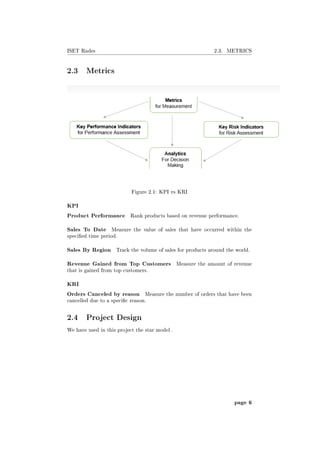
Figure 2.1: KPI vs KRI
KPI
Product Performance Rank products based on revenue performance.
Sales To Date Measure the value of sales that have occurred within the
specied time period.
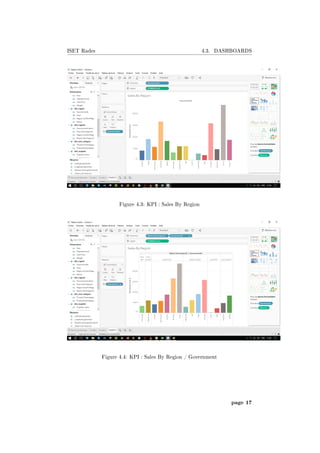
Sales By Region Track the volume of sales for products around the world.
Revenue Gained from Top Customers Measure the amount of revenue
that is gained from top customers.
KRI
Orders Canceled by reason Measure the number of orders that have been
cancelled due to a specic reason.
2.4 Project Design
We have used in this project the star model .
page 6
ISET Rades 2.4. PROJECT DESIGN
2.4.1 Sales Fact
Figure 2.2: Sales fact and dimensions
2.4.2 cancelled Sales Fact
Figure 2.3: cancelled sales fact and dimensions
page 7
Chapter 3
Implementation
3.1 Implementation environment
3.1.1 hardware environment :
To implement the project i have used my portable pc
• Intel (R) Core i5-5217 CPU
• 8GB RAM
• 1000GB Hard Disk
• 15 inch lcd screen
3.1.2 Software environment:
• windows 10
• Sql Server (Datawarehouse)
• Talend Studio 6.4.1
3.2 ETL Implementation
3.2.1 Used Techniques
Stging ETL A much better approach is to keep extraction and transformation
as two strictly separated steps. First you extract data from the external data
source and store a raw copy of the data in staging tables in the data warehouse.
With raw I mean that you keep the column names the same as in the source
database and you don't convert data, calculate new data elds, etc. You may
however lter unneeded rows and columns as you extract data so that you don't
waste resources on unneeded data. That being said, if size and performance are
not an issue it's more convenient to just load the entire source tables.
8
ISET Rades 3.3. IMPLEMENTATION
Figure 3.1: Stging ETL
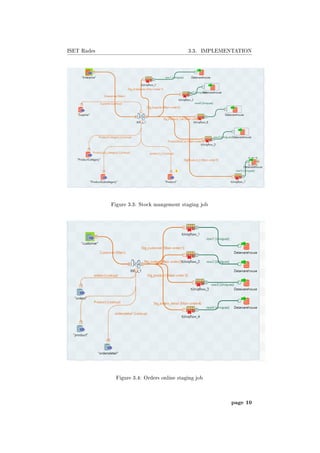
As with the obvious approach, we use data talend jobs to pull the data
from the data sources. However, since they are now only used to extract data,
the ows will be much simpler. Instead of using data operations (talend) to
transform the data to dimension and fact tables, we can now use database
views to convert the raw data in the staging tables to dimension and fact views.
At some point before deploying to production you will likely replace views by
tables and stored procedures. I'll come back to that later.
3.3 Implementation
3.3.1 Staging
Figure 3.2: Orders cancelled staging job
page 9
ISET Rades 3.3. IMPLEMENTATION
Figure 3.3: Stock mangement staging job
Figure 3.4: Orders online staging job
page 10
ISET Rades 3.3. IMPLEMENTATION
Figure 3.5: Region staging job
3.3.2 Transformation and Load
Gender Changing
Figure 3.6: Changing Gender
Column Pattern Value
Customer.sexe Homme H
Customer.sexe Male H
Customer.sexe 1 H
Customer.sexe h H
Customer.sexe Femme F
Customer.sexe Female F
Customer.sexe 0 F
Customer.sexe f F
Table 3.1: Data Quality (Gender)
page 11
ISET Rades 3.3. IMPLEMENTATION
Gender Changing
Figure 3.7: Changing Region
Column Pattern Value
Customer.region tn Tunis
Customer.region Tunisia Tunis
Customer.region sfx Sfax
Table 3.2: Data Quality (Regions)
Date Dimension
Figure 3.8: Date Dimension Specication
3.3.3 Transformation Throw Views
CREATE view [dbo].[fact_sales] as
select e.enterprise_id,
sp.Supplier_id,
p.products_ref,
sub_cat.ProductSubCategoryKey,
cat.ProductCategoryKey,
cs.Customer_id,
t.id_temps,
rg.region_id,
od.quantity*p.unit_price as 'cout'
page 12
ISET Rades 3.3. IMPLEMENTATION
from enterprise e inner join supplier sp on e.enterprise_id = sp.enterprise_id
inner join
product p on p.supplier_id = sp.Supplier_id
inner join
sub_category sub_cat on p.ProductSubcategoryKey = sub_cat.ProductSubCategoryKey
inner join
category cat on sub_cat.ProductCategoryKey = cat.ProductCategoryKey
inner join
orders_full od on od.Product_id = p.ProductKey
inner join
customer cs on cs.Customer_id = od.Customer_id
inner join
dim_temps t on od.Ordersdate = t.Ordersdate
inner join
region rg on cs.region = rg.Gouvernorat
Stored procedure
USE [Talend_DW]
GO
/****** Object: StoredProcedure [dbo].[from_dim_to_fact]
Script Date: 25/12/2017 18:25:59 ******/
SET ANSI_NULLS ON
GO
SET QUOTED_IDENTIFIER ON
GO
ALTER proc [dbo].[from_dim_to_fact] as
begin
IF (EXISTS (SELECT *
FROM INFORMATION_SCHEMA.TABLES
WHERE
TABLE_NAME = 'fact'))
BEGIN
drop table fact ;
END
--Sales
select * into fact from fact_sales;
alter table fact
add foreign key (enterprise_id) references dim_enterprise(enterprise_id) ;
alter table fact
add foreign key (Supplier_id) references dim_supplier(supplier_id) ;
alter table fact
add foreign key (Customer_id) references dim_customer(Customer_id) ;
alter table fact
add foreign key (products_ref) references dim_product(products_ref) ;
alter table fact
add foreign key (ProductSubCategoryKey) references
page 13
ISET Rades 3.3. IMPLEMENTATION
dim_sub_category (ProductSubCategoryKey) ;
alter table fact
add foreign key (ProductCategoryKey) references dim_category (ProductCategoryKey) ;
alter table fact
add foreign key (id_temps) references dim_temps (id_temps) ;
alter table fact
add foreign key (region_id) references dim_region (region_id) ;
/*
add primary key (
enterprise_id,
Supplier_id,
Customer_id,
products_ref,
ProductSubCategoryKey,
ProductCategoryKey
)
*/
--truncating here
---Begin
--End
End
page 14
Chapter 4
Data Visualization
4.1 Intoduction
In this chapter we will about the software that we have used for the visualization
and nally we will display The dashboards that we have developed .
4.2 Tableau Software
Tableau is a Business Intelligence tool for visually analyzing the data.The
software allows data blending and real-time collaboration, which makes it very
unique. It is used by businesses, academic researchers, and many government
organizations for visual data analysis.
15
ISET Rades 4.3. DASHBOARDS
4.3 Dashboards
Figure 4.1: KPI : Product Performance
Figure 4.2: KPI : Sales To Date
page 16
ISET Rades 4.3. DASHBOARDS
Figure 4.3: KPI : Sales By Region
Figure 4.4: KPI : Sales By Region / Government
page 17
ISET Rades 4.3. DASHBOARDS
Figure 4.5: KPI : Revenue Gained from Top Customers
Figure 4.6: KRI : Orders Canceled by reason
page 18
General conclusion et
Perspectives
For me it was a very nice and wonderful experience to pass my winter holiday
discovering new technologies . I learned new things such as how to code with
java , how to use Talend and tableau software,develop specif sql views and
implement data warehouse in SQL server .
I learned extend also my previous skills and took the to a new level such as
staging techniques , data quality and BI project life cycle . In the future I can
see my application more optimized and more performing .
19
ISET Rades 4.3. DASHBOARDS
page 20
Bibliographie
les sites et Forums :
https://blogs.msdn.microsoft.com/andreasderuiter/2012/12/05/designing-an-
etl-process-with-ssis-two-approaches-to-extracting-and-transforming-data/
http://stackoverow.com
http://www.w3schools.com/asp/default.asp
21

BI Project report

  • 1.
    Tunisian Republic Ministry ofHigher Education and Scientic Research Higher Institute of Technological Studies of Rades End of semester Project Report Design and development of Sales BI Project Host Organization:Intern Student: Hlel Abdelhedi Master's Degree in Business Intelligence College year 2017 - 2018
  • 2.
    Dedications To my parents, forbeing my biggest inspiration and for being supportive and encouraging in all my life stages . My brothers and sisters, For being Showing me support and big trust in me . And my friends , For being very kind and helpful i
  • 3.
    Acknowledgment Before presenting ourwork,we would like to thank all the people who contributed to the success of our internship and who helped us in the drafting of this report. We would also like to thank all the professors of the Business intelligence Master degree at ISET rades . Finally, my profound gratitude to the Director of the Higher Institute of Information and Communication Technologies Mr. Mohamed Abdallah and all members of the administration for the eort they are given . ii
  • 4.
    Contents Dedications i Acknowledgments ii GeneralIntroduction 1 1 Project context 2 1.1 introduction . . . . . . . . . . . . . . . . . . . . . . . . . . . . . . 2 1.2 Operational Systems . . . . . . . . . . . . . . . . . . . . . . . . . 2 1.2.1 Online Website . . . . . . . . . . . . . . . . . . . . . . . . 2 1.2.2 Mobile App . . . . . . . . . . . . . . . . . . . . . . . . . . 3 1.2.3 Desktop App . . . . . . . . . . . . . . . . . . . . . . . . . 4 1.3 Limits of Operational Systems . . . . . . . . . . . . . . . . . . . 4 2 Requirements Analysis And application design 5 2.1 Existing Slutions . . . . . . . . . . . . . . . . . . . . . . . . . . . 5 2.2 Requirements Analysis . . . . . . . . . . . . . . . . . . . . . . . . 5 2.3 Metrics . . . . . . . . . . . . . . . . . . . . . . . . . . . . . . . . 6 2.4 Project Design . . . . . . . . . . . . . . . . . . . . . . . . . . . . 6 2.4.1 Sales Fact . . . . . . . . . . . . . . . . . . . . . . . . . . 7 2.4.2 cancelled Sales Fact . . . . . . . . . . . . . . . . . . . . . 7 3 Implementation 8 3.1 Implementation environment . . . . . . . . . . . . . . . . . . . . 8 3.1.1 hardware environment : . . . . . . . . . . . . . . . . . . . 8 3.1.2 Software environment: . . . . . . . . . . . . . . . . . . . 8 3.2 ETL Implementation . . . . . . . . . . . . . . . . . . . . . . . . . 8 3.2.1 Used Techniques . . . . . . . . . . . . . . . . . . . . . . . 8 3.3 Implementation . . . . . . . . . . . . . . . . . . . . . . . . . . . . 9 3.3.1 Staging . . . . . . . . . . . . . . . . . . . . . . . . . . . . 9 3.3.2 Transformation and Load . . . . . . . . . . . . . . . . . . 11 3.3.3 Transformation Throw Views . . . . . . . . . . . . . . . . 12 4 Data Visualization 15 4.1 Intoduction . . . . . . . . . . . . . . . . . . . . . . . . . . . . . . 15 4.2 Tableau Software . . . . . . . . . . . . . . . . . . . . . . . . . . . 15 4.3 Dashboards . . . . . . . . . . . . . . . . . . . . . . . . . . . . . . 16 Bibliographie 21 iii
  • 5.
    List of Figures 1.1My SQL database Schema . . . . . . . . . . . . . . . . . . . . . . 3 1.2 SQL Server database Schema . . . . . . . . . . . . . . . . . . . . 4 2.1 KPI vs KRI . . . . . . . . . . . . . . . . . . . . . . . . . . . . . . 6 2.2 Sales fact and dimensions . . . . . . . . . . . . . . . . . . . . . . 7 2.3 cancelled sales fact and dimensions . . . . . . . . . . . . . . . . . 7 3.1 Stging ETL . . . . . . . . . . . . . . . . . . . . . . . . . . . . . . 9 3.2 Orders cancelled staging job . . . . . . . . . . . . . . . . . . . . . 9 3.3 Stock mangement staging job . . . . . . . . . . . . . . . . . . . . 10 3.4 Orders online staging job . . . . . . . . . . . . . . . . . . . . . . 10 3.5 Region staging job . . . . . . . . . . . . . . . . . . . . . . . . . . 11 3.6 Changing Gender . . . . . . . . . . . . . . . . . . . . . . . . . . 11 3.7 Changing Region . . . . . . . . . . . . . . . . . . . . . . . . . . . 12 3.8 Date Dimension Specication . . . . . . . . . . . . . . . . . . . . 12 4.1 KPI vs KRI . . . . . . . . . . . . . . . . . . . . . . . . . . . . . . 15 4.2 KPI : Product Performance . . . . . . . . . . . . . . . . . . . . . 16 4.3 KPI : Sales To Date . . . . . . . . . . . . . . . . . . . . . . . . . 16 4.4 KPI : Sales By Region . . . . . . . . . . . . . . . . . . . . . . . . 17 4.5 KPI : Sales By Region / Government . . . . . . . . . . . . . . . . 17 4.6 KPI : Revenue Gained from Top Customers . . . . . . . . . . . . 18 4.7 KRI : Orders Canceled by reason . . . . . . . . . . . . . . . . . . 18 iv
  • 6.
    General Introduction Intelligence isthe ability to solve problems to make decisions.We all make de- cisions and on all occasions; for example, when we have to go to an appoint- ment, we always try to take the shortest route to arrive on time.To make good decisions, we help ourselves with the information that is available to us.The information will provide answers and allow us to make good decisions.Business Intelligence is responding to problems related to the company. In the next few pages i will talk with details about the context of my business intelligence project , the existing solutions and the design and the development of the ETL . 1
  • 7.
    Chapter 1 Project context 1.1introduction The mission of this project is to provide strategic and tactical support to the Marketing-Sales of a fast fashion company through the acquisition and analysis of data pertaining to their customers and markets. 1.2 Operational Systems An operational information system has the primary objective of serve as a sup- port for carrying out the activities of a set of business process . 1.2.1 Online Website This company uses an e-commerce web site to sale their products online .The main use cases of this application are : Customer • Prole management • cart management • orders management • Browse Products Administrator • Prole management • Products management • Store information management 2
  • 8.
    ISET Rades 1.2.OPERATIONAL SYSTEMS 1.2.2 Mobile App Also this company have a mobile app which have the similar functionality like the web app based on web services . Data Store : MySQL Database Figure 1.1: My SQL database Schema CSV le a specic csv le is used to store and track the concealed orders based on the reasons . • Orders id • orders canceled id • date on canceled orders • Reason Excel le a specic excel le is used to determine the customer region to track shipping . • Region Name • govern-orate • Country page 3
  • 9.
    ISET Rades 1.3.LIMITS OF OPERATIONAL SYSTEMS 1.2.3 Desktop App A special desktop app that has implemented to manage the products stock , to store the supplier information and managing the product category . Data Store : SQL Server Database Figure 1.2: SQL Server database Schema 1.3 Limits of Operational Systems • The existing information is often very rich but it is dicult to have a homogeneous and coherent global vision of the information handled by all departments. • It is not easy to access directly the necessary information: it There are several sources using dierent media (paper, database, Excel les). • Business data can have meanings according to the use made of it, exam- ples: percentage of sales turnover. But the reporting of General Manage- ment accepts only one meaning to a value returned. page 4
  • 10.
    Chapter 2 Requirements AnalysisAnd application design 2.1 Existing Slutions In this subsection we will focus the company requirement analysis , the key per- formance indications (KPI) and metrics (KRI) and nally we will introduce the design of my projects studying some applications which have the same context as my project . 2.2 Requirements Analysis • Better access to data • Improved quality of information. • Integration and analysis of data from systems dierent • Centralized System of Data • Better access to historical data 5
  • 11.
    ISET Rades 2.3.METRICS 2.3 Metrics Figure 2.1: KPI vs KRI KPI Product Performance Rank products based on revenue performance. Sales To Date Measure the value of sales that have occurred within the specied time period. Sales By Region Track the volume of sales for products around the world. Revenue Gained from Top Customers Measure the amount of revenue that is gained from top customers. KRI Orders Canceled by reason Measure the number of orders that have been cancelled due to a specic reason. 2.4 Project Design We have used in this project the star model . page 6
  • 12.
    ISET Rades 2.4.PROJECT DESIGN 2.4.1 Sales Fact Figure 2.2: Sales fact and dimensions 2.4.2 cancelled Sales Fact Figure 2.3: cancelled sales fact and dimensions page 7
  • 13.
    Chapter 3 Implementation 3.1 Implementationenvironment 3.1.1 hardware environment : To implement the project i have used my portable pc • Intel (R) Core i5-5217 CPU • 8GB RAM • 1000GB Hard Disk • 15 inch lcd screen 3.1.2 Software environment: • windows 10 • Sql Server (Datawarehouse) • Talend Studio 6.4.1 3.2 ETL Implementation 3.2.1 Used Techniques Stging ETL A much better approach is to keep extraction and transformation as two strictly separated steps. First you extract data from the external data source and store a raw copy of the data in staging tables in the data warehouse. With raw I mean that you keep the column names the same as in the source database and you don't convert data, calculate new data elds, etc. You may however lter unneeded rows and columns as you extract data so that you don't waste resources on unneeded data. That being said, if size and performance are not an issue it's more convenient to just load the entire source tables. 8
  • 14.
    ISET Rades 3.3.IMPLEMENTATION Figure 3.1: Stging ETL As with the obvious approach, we use data talend jobs to pull the data from the data sources. However, since they are now only used to extract data, the ows will be much simpler. Instead of using data operations (talend) to transform the data to dimension and fact tables, we can now use database views to convert the raw data in the staging tables to dimension and fact views. At some point before deploying to production you will likely replace views by tables and stored procedures. I'll come back to that later. 3.3 Implementation 3.3.1 Staging Figure 3.2: Orders cancelled staging job page 9
  • 15.
    ISET Rades 3.3.IMPLEMENTATION Figure 3.3: Stock mangement staging job Figure 3.4: Orders online staging job page 10
  • 16.
    ISET Rades 3.3.IMPLEMENTATION Figure 3.5: Region staging job 3.3.2 Transformation and Load Gender Changing Figure 3.6: Changing Gender Column Pattern Value Customer.sexe Homme H Customer.sexe Male H Customer.sexe 1 H Customer.sexe h H Customer.sexe Femme F Customer.sexe Female F Customer.sexe 0 F Customer.sexe f F Table 3.1: Data Quality (Gender) page 11
  • 17.
    ISET Rades 3.3.IMPLEMENTATION Gender Changing Figure 3.7: Changing Region Column Pattern Value Customer.region tn Tunis Customer.region Tunisia Tunis Customer.region sfx Sfax Table 3.2: Data Quality (Regions) Date Dimension Figure 3.8: Date Dimension Specication 3.3.3 Transformation Throw Views CREATE view [dbo].[fact_sales] as select e.enterprise_id, sp.Supplier_id, p.products_ref, sub_cat.ProductSubCategoryKey, cat.ProductCategoryKey, cs.Customer_id, t.id_temps, rg.region_id, od.quantity*p.unit_price as 'cout' page 12
  • 18.
    ISET Rades 3.3.IMPLEMENTATION from enterprise e inner join supplier sp on e.enterprise_id = sp.enterprise_id inner join product p on p.supplier_id = sp.Supplier_id inner join sub_category sub_cat on p.ProductSubcategoryKey = sub_cat.ProductSubCategoryKey inner join category cat on sub_cat.ProductCategoryKey = cat.ProductCategoryKey inner join orders_full od on od.Product_id = p.ProductKey inner join customer cs on cs.Customer_id = od.Customer_id inner join dim_temps t on od.Ordersdate = t.Ordersdate inner join region rg on cs.region = rg.Gouvernorat Stored procedure USE [Talend_DW] GO /****** Object: StoredProcedure [dbo].[from_dim_to_fact] Script Date: 25/12/2017 18:25:59 ******/ SET ANSI_NULLS ON GO SET QUOTED_IDENTIFIER ON GO ALTER proc [dbo].[from_dim_to_fact] as begin IF (EXISTS (SELECT * FROM INFORMATION_SCHEMA.TABLES WHERE TABLE_NAME = 'fact')) BEGIN drop table fact ; END --Sales select * into fact from fact_sales; alter table fact add foreign key (enterprise_id) references dim_enterprise(enterprise_id) ; alter table fact add foreign key (Supplier_id) references dim_supplier(supplier_id) ; alter table fact add foreign key (Customer_id) references dim_customer(Customer_id) ; alter table fact add foreign key (products_ref) references dim_product(products_ref) ; alter table fact add foreign key (ProductSubCategoryKey) references page 13
  • 19.
    ISET Rades 3.3.IMPLEMENTATION dim_sub_category (ProductSubCategoryKey) ; alter table fact add foreign key (ProductCategoryKey) references dim_category (ProductCategoryKey) ; alter table fact add foreign key (id_temps) references dim_temps (id_temps) ; alter table fact add foreign key (region_id) references dim_region (region_id) ; /* add primary key ( enterprise_id, Supplier_id, Customer_id, products_ref, ProductSubCategoryKey, ProductCategoryKey ) */ --truncating here ---Begin --End End page 14
  • 20.
    Chapter 4 Data Visualization 4.1Intoduction In this chapter we will about the software that we have used for the visualization and nally we will display The dashboards that we have developed . 4.2 Tableau Software Tableau is a Business Intelligence tool for visually analyzing the data.The software allows data blending and real-time collaboration, which makes it very unique. It is used by businesses, academic researchers, and many government organizations for visual data analysis. 15
  • 21.
    ISET Rades 4.3.DASHBOARDS 4.3 Dashboards Figure 4.1: KPI : Product Performance Figure 4.2: KPI : Sales To Date page 16
  • 22.
    ISET Rades 4.3.DASHBOARDS Figure 4.3: KPI : Sales By Region Figure 4.4: KPI : Sales By Region / Government page 17
  • 23.
    ISET Rades 4.3.DASHBOARDS Figure 4.5: KPI : Revenue Gained from Top Customers Figure 4.6: KRI : Orders Canceled by reason page 18
  • 24.
    General conclusion et Perspectives Forme it was a very nice and wonderful experience to pass my winter holiday discovering new technologies . I learned new things such as how to code with java , how to use Talend and tableau software,develop specif sql views and implement data warehouse in SQL server . I learned extend also my previous skills and took the to a new level such as staging techniques , data quality and BI project life cycle . In the future I can see my application more optimized and more performing . 19
  • 25.
    ISET Rades 4.3.DASHBOARDS page 20
  • 26.
    Bibliographie les sites etForums : https://blogs.msdn.microsoft.com/andreasderuiter/2012/12/05/designing-an- etl-process-with-ssis-two-approaches-to-extracting-and-transforming-data/ http://stackoverow.com http://www.w3schools.com/asp/default.asp 21