National Political Situationer
John J. Carroll Institute on Church and Social Issues
October 7, 2013




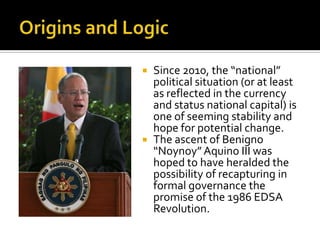
Since 2010, the “national”
political situation (or at least
as reflected in the currency
and status national capital) is
one of seeming stability and
hope for potential change.
The ascent of Benigno
“Noynoy” Aquino III was
hoped to have heralded the
possibility of recapturing in
formal governance the
promise of the 1986 EDSA
Revolution.




Government experienced
highest satisfaction
ratings over the past 3
years – due no less to its
relative competence in
key directions.
Perceived key “public
good bills” have been
passed or are now being
placed in the formal
legislative agenda (RH,
FOI, Sin Tax, etc.)




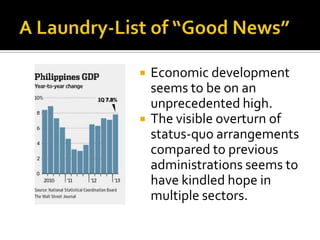
Economic development
seems to be on an
unprecedented high.
The visible overturn of
status-quo arrangements
compared to previous
administrations seems to
have kindled hope in
multiple sectors.
1.

2.

3.
4.

How palatable and applicable is the real quality
of governance that the Aquino administration
is practicing?
What kinds of policies is this administration
pursuing? Why these policies? What are the
implications of such policies?
How effective are these policies and directions
in achieving their desires, more or less?
Why is the general socio-economic status of
many Filipinos still unimproved despite these
supposed “gains”?






Prosecution of GMA and cohorts
The Sabah standoff
2013 Midterm Elections
The multifaceted PDAF/Pork Barrel scandals
Beleaguered Peace Processes
 Crisis and tensions in Zamboanga
 The continued presence of insurgencies/civil conflicts

– and their relevance



Contradictions in Government Policies


Economic Rights Violations Cases
 Specific Examples: PALEA & DEU
 Contractualization and Absence of Decent Work
 Dismantling of Informal Settler Communities



Land Appropriation
 APECO, Boracay & “enclave development”
 Transformations of the urban landscape



Continued vulnerabilities to financial shocks






Public discourse remains a monopoly of
“institutions”, “personalities,” personalized
institutions” and “institutionalized
personalities”; the “market of ideas” is pretty
much in dearth of new developments.
Public life remains a function of following
socially-sanctioned and institutionally-imposed
consumption patterns.
The result: the absence of public interest – or
simple-minded, pseudo-intellectualized
arrogance masquerading as such.




Integration into the ASEAN Economic
Community by 2015
Decline of U.S., Rise of China?
Personal Appraisal:
 Our position in the regional, international and

global bargaining table is actually very dire.
 We seem to have simply (and continuously)
played spectator in the existing socio-political
conflicts/upheavals in Asia and Europe over the
past few decade.
National Political Situationer
John J. Carroll Institute on Church and Social Issues
October 7, 2013

Beyond yellow optimism (icsi)

  • 1.
    National Political Situationer JohnJ. Carroll Institute on Church and Social Issues October 7, 2013
  • 2.
      Since 2010, the“national” political situation (or at least as reflected in the currency and status national capital) is one of seeming stability and hope for potential change. The ascent of Benigno “Noynoy” Aquino III was hoped to have heralded the possibility of recapturing in formal governance the promise of the 1986 EDSA Revolution.
  • 3.
      Government experienced highest satisfaction ratingsover the past 3 years – due no less to its relative competence in key directions. Perceived key “public good bills” have been passed or are now being placed in the formal legislative agenda (RH, FOI, Sin Tax, etc.)
  • 4.
      Economic development seems tobe on an unprecedented high. The visible overturn of status-quo arrangements compared to previous administrations seems to have kindled hope in multiple sectors.
  • 5.
    1. 2. 3. 4. How palatable andapplicable is the real quality of governance that the Aquino administration is practicing? What kinds of policies is this administration pursuing? Why these policies? What are the implications of such policies? How effective are these policies and directions in achieving their desires, more or less? Why is the general socio-economic status of many Filipinos still unimproved despite these supposed “gains”?
  • 6.
         Prosecution of GMAand cohorts The Sabah standoff 2013 Midterm Elections The multifaceted PDAF/Pork Barrel scandals Beleaguered Peace Processes  Crisis and tensions in Zamboanga  The continued presence of insurgencies/civil conflicts – and their relevance  Contradictions in Government Policies
  • 7.
     Economic Rights ViolationsCases  Specific Examples: PALEA & DEU  Contractualization and Absence of Decent Work  Dismantling of Informal Settler Communities  Land Appropriation  APECO, Boracay & “enclave development”  Transformations of the urban landscape  Continued vulnerabilities to financial shocks
  • 8.
       Public discourse remainsa monopoly of “institutions”, “personalities,” personalized institutions” and “institutionalized personalities”; the “market of ideas” is pretty much in dearth of new developments. Public life remains a function of following socially-sanctioned and institutionally-imposed consumption patterns. The result: the absence of public interest – or simple-minded, pseudo-intellectualized arrogance masquerading as such.
  • 9.
       Integration into theASEAN Economic Community by 2015 Decline of U.S., Rise of China? Personal Appraisal:  Our position in the regional, international and global bargaining table is actually very dire.  We seem to have simply (and continuously) played spectator in the existing socio-political conflicts/upheavals in Asia and Europe over the past few decade.
  • 13.
    National Political Situationer JohnJ. Carroll Institute on Church and Social Issues October 7, 2013