Beyond the Sky

NB-31-12-308-EN-C

Beyond the Sky

Space Research
Space Research projects under the
7th Framework Programme for Research
(5th call)

DOI: 10.2769/70531

Enterprise
and Industry
BEYOND THE SKY
Civilisations have always wondered what is beyond the sky. But it is only recently that the limitless
possibilities provided by space science and technology came into stronger spotlight and started to be
used to the full. The European Union has been playing a significant role in this process, in particular
through the FP7 Space Research Programme. The 5th FP7 Space call brochure – through presentation
of 50 projects divided into 4 categories (Copernicus applications and data; space technologies;
space science and data exploitation; cross-cutting issues) – aims at giving a comprehensive overview of
Europe’s endeavours to fully, yet sustainably, use space for purposes ranging from excellent reception
of TV signal to helping victims of earthquakes and other natural disasters.
The 5th call of the FP7 Space Programme is centred – in the domain of space-based applications
– on: (pre-)operational validation of Copernicus (formerly GMES) services and products, stimulating
development of downstream services and service evolution, and remote sensing methods. Other
important issues include: integration of satellite communication and satellite navigation solutions with
space-based observing systems, integrated downstream service activities and applications, support to
the coordinated provision of observation data and development of Earth observation satellites.
Equally important have been the efforts to strengthen the foundations of space science and
technology by offering funding to research supporting space science and exploration, data exploitation
and Earth-analogue research. Research supporting space transportation, space critical technologies,
research into reducing the vulnerability of space assets and space-weather events also constituted
important programme elements.
Last but not least, the importance of cross-cutting activities has been acknowledged by providing
financial support to SME space technology research and technology transfer and initiatives undertaken
in the framework of international cooperation, including cooperation with third countries. Moreover,
dissemination actions - especially transnational and international cooperation among National
Contact Points - and studies and events in support of European Space Policy have been envisaged and
funded.
You are invited to discover the 50 projects touching upon the above-mentioned subjects. This overview
will be followed by a 6th call brochure that will be the last one presenting the FP7 projects.

BEYOND THE SKY
Listed below are the projects co-financed by the European Commission and managed by
the Research Executive Agency (REA) under the 5th call of the 7th Framework Programme
for Space Research in the domains of Copernicus services and Space Foundations.

COPERNICUS Applications and Data
•
•
•
•
•
•
•
•
•
•
•
•
•
•

Characterization of metadata to allow high-quality climate applications and services (CHARMe)
Coordinating Earth observation data validation for RE-analysis for CLIMAte ServiceS (CORE-CLIMAX)
Ground Deformations Risk Scenarios: an Advanced Assessment Service (DORIS)
Euro-Argo Improvements for the GMES/Copernicus Marine Service (E-AIMS)
Global Lakes Sentinel Services (GLaSS)
GMES-Partnership for User Requirements Evaluation (GMES-PURE)
Pre-operational Copernicus Services in support of EU External Action (G-NEXT)
IAGOS for the GMES (Copernicus) Atmospheric Service (IGAS)
Implementation of Multi-scale Agricultural Indicators Exploiting Sentinels (IMAGINES)
Increasing Resilience through Earth Observation (IncREO)
Low time critical Border Surveillance (LOBOS)
Preparing Land and Ocean Take Up from Sentinel-3 (LOTUS)
Space-based Information Support for Prevention and REcovery of Forest Fires Emergency in the MediteRranean Area (PREFER)
Framework to integrate Space-based and in-situ sENSing for dynamic vUlnerability and recovery Monitoring (SENSUM)

3
5
7
9
11
13
15
17
19
21
23
25
27
29

Space Technologies
•
•
•
•
•
•
•
•
•
•
•
•
•
•
•
•
•
•
•
•

Advanced Ablation Characterization and Modelling (ABLAMOD)
High Brightness Semiconductor Laser Sources for Space Applications in Earth Observation (BRITESPACE)
Gaia-Photonics Front-End For Next-Generation SAR Applications (GAIA)
Generic SDR-based Multifunctional space Link (GAMALINK)
Megawatt Highly Efficient Technologies for Space Power and Propulsion Systems for Long-duration Exploration Missions (MEGAHIT)
Modular CMOS Photonic Integrated Micro-Gyroscope (MERMIG)
Methodology and assessment for the applicability of ARINC-664 (AFDX) in Satellite/Spacecraft on-board communication networks (MISSION)
Utilizing the potential of NANOSATellites for the implementation of European Space Policy and space innovation (NANOSAT)
Photonic Biosensor for Space Application (PBSA)
PiezoElectric Assisted Smart Satellite Structure (PEASSS)
Pulsed Chemical Rocket with Green High Performance Propellants (PulCheR)
Quick Image Interpretation System (QI2S)
Self-deployable Habitat for Extreme Environments (SHEE)
Kinetic Inductance Detectors: A New Imaging Technology for Observations In and From Space (SPACEKIDS)
Space Thermo acoustic Radio-Isotopic Power System (Space TRIPS)
Smart technology for artificial muscle applications in space (SPAMUS)
Space Radiation Superconductive Shield (SR2S)
Support to the developmenT of a European SSA caPability (STEP)
Space Wireless sensor networks for Planetary Exploration (SWIPE)
Innovative Thermal Management Concepts for Thermal Protection of Future Space Vehicles (THOR)

31
33
35
37
49
41
43
45
47
49
51
53
55
57
59
61
63
65
67
69

Space Science and Data Exploitation
•
•
•
•
•
•
•
•
•
•
•

Astronomical Resource Cross-matching for High Energy Studies (ARCHES)
Unveiling the power of the deepest images of the Universe (ASTRODEEP)
Astrobiology and Space Missions Road Mapping (AstRoMap)
Measuring ŋ : Characterization of Terrestrial Planetary Systems with Kepler, HARPS-N and Gaia (ETAEARTH)
Far Infrared Space Interferometer Critical Assessment (FISICA)
Planetary Robotics Vision Data Exploitation (PRoViDE)
First European comprehensive SOLar Irradiance Data exploitation (SOLID)
Exploitation of Space Data for Innovative Helio- and Asteroseismology (SPACEINN)
Space technology road-mapping and planning for Europe (SpacePLAN-2020)
Solar system plasma Turbulence: Observations, inteRmittency and Multifractals (STORM)
Probing Strong Gravity by Black Holes Across the Range of Masses (STRONGGRAVITY)

71
73
75
77
79
81
83
85
87
89
91

Cross-cutting Issues
•
•
•
•
•

Service Provision of Geospatial Intelligence in EU External Actions Support (G-SEXTANT)
Integrated Carbon Observation System (ICOS)
Service Activations for GRowing Eurosur’s Success (SAGRES)
Sentinels Synergy Framework (SENSYF)
Small and Medium Enterprise Satellite (SME-SAT)

93
95
97
99
101

“Beyond the Sky” is the fifth in an existing series of brochures featuring EU Space Research projects funded under the FP7.
In view of continuity, this publication was produced to include the projects supported under the 5th FP7 Space call.
All electronic versions of the brochure series are available on the EU bookshop website: www.bookshop.europa.eu
Prepared by the European Commission, Directorate-General Enterprise & Industry, Unit Policy and Space Research (G1).
Pictures originating with the European Union are offered free of charge for EU-related communication, information, dissemination and educational purposes. For any other use, prior clearance must be
obtained from the Central Audiovisual Library of the European Commission. In no case may this material be sold or rented.
© European Union, 2013 - Reproduction is authorized provided the source is aknowledged.
CHARMe

© NEODAAS/University of Dundee, Scotland http://www.sat.dundee.ac.uk/

Characterization of metadata to allow high-quality climate
applications and services

CHARMe – sharing knowledge about climate data.

The objective of CHARMe is to help users to judge whether climate data is fit for their purpose, by enabling this
information to be consistently encoded and discovered. The project will develop tools to enable users to access this
information to aid decision making and exploitation by the downstream sector, and produce applications that show
how this information can be used to tackle real scientific problems.

PROVIDING ESSENTIAL LINKS BETWEEN
CLIMATE
DATA
AND
SUPPORTING
INFORMATION TO ENABLE A VARIETY OF
USERS TO FIND THE DATA THEY NEED

Much work has been done on producing aspects
of Commentary metadata, but there is as yet no
robust and consistent mechanism to link it to the
datasets themselves. CHARMe will provide these
essential links.

Project Coordinator

QUESTIONS & ANSWERS

ABSTRACT

A challenge faced by potential users of climate
data is how to judge whether the data is
fit for purpose. This challenge is a serious
impediment to widening the use of climate data
by both expert and non-expert users for diverse
applications. Different users require different
kinds of supporting information; we term this
‘Commentary’ metadata. For this project, we
define the scope of Commentary metadata
to include post-fact annotations, results of
assessments, provenance, properties of data
distribution such as data policy and licensing and
external events that may affect the data, such as
volcanic eruptions.

Rhona PHIPPS

CHARMe will create a repository of Commentary
metadata (hosted by CHARMe or elsewhere)
plus a set of interfaces through which users can
interrogate the information over the Internet. The
project will build some example applications that
show the value of exploiting this information in
real scientific problems.
The significant and lasting legacy of the project
will be: robust and reusable frameworks for linking
datasets with Commentary metadata, wherever it
is held; reusable software tools that allow climate
scientists and users to exploit this information
in their own applications; development of bestpractice procedures for owners of data archives
to exploit these innovations to maximum effect;
improved search, intercomparison and timeseries analysis tools for large and diverse
datasets.

COPERNICUS APPLICATIONS AND DATA

What is the project designed
to achieve ?
We aim to widen the accessibility
and usability of climate data,
particularly
to
new
user
communities, by linking datasets
to the key pieces of supporting
information required to allow
those users to judge whether the
data is fit for their purpose.
Why is this project important
for Europe and how does it
benefit European citizens ?
Europe
has
made
large
investments
in
gathering
climate data, yet it can still be
difficult for users of that data
to exploit it to its full potential.
Environmental concerns affect
all of us, and better use of the
data we already have will serve
all European citizens, through
better science, better evidencebased policymaking and more
cost-effective
and
efficient
commercial services.
How
does
the
project
exceed the current state of
knowledge ?
Although many types and
sources
of
supporting
information for climate data
currently exist, a mechanism to
link this information to the data
itself does not. This project will
build on existing knowledge and
practice to allow data centres
around the world to harvest this
key supporting information and
supply it to the users of their
data.

PAGE 3
CHARMe

Characterization of metadata to allow high-quality climate
applications and services
LIST OF PARTNERS
•
•
•
•
•
•
•
•
•

University of Reading, United Kingdom
Infoterra Ltd (trading as ASTRIUM Geo-Information Services), United Kingdom
Science and Technology Facilities Council, United Kingdom
Deutscher Wetterdienst, Germany
European Centre for Medium-Range Weather Forecasts (ECMWF)
Koninklijk Nederlands Meteorologisch Instituut, the Netherlands
Logica, United Kingdom
Spot Infoterra Hellas (trading as ASTRIUM Geo-Information Services), Greece
UK Met Office, United Kingdom

COORDINATOR

CONTACT

University of Reading, United Kingdom

Rhona Phipps
National Centre for Earth Observation,
Department of Meteorology, University of
Reading Earley Gate, Reading, RG6 6BB, UK
Tel: +44 (0)118 378 7356
Email: r.a.phipps@reading.ac.uk

PROJECT INFORMATION
Characterization of metadata to allow high-quality climate applications and services (CHARMe)
Contract N°: 312641
Starting Date: 01/01/2013
Duration: 24 months
EU Contribution: €1.911.294,65
Estimated total cost: €2.737.429,00

Page 4

COPERNICUS APPLICATIONS AND DATA
CORE-CLIMAX
Coordinating Earth observation data validation for RE-analysis for
CLIMAte ServiceS

© CORE-CLIMAX

Zhongbo (Bob) SU

Decomposition of the four pillars of a logical view for an architecture for Climate Monitoring, where the project
will focus on “Climate Record Creation” and “Application”.

ABSTRACT
CORE-CLIMAX aims to coordinate the identification of essential climate variables and the creation of long term
climate data records. The project will help to substantiate how Copernicus observations and products can contribute
to climate change analyses.

PRODUCE UNIFORM AND CONSISTENT
CALIBRATION AND VALIDATION STRATEGIES
FOR CDRS AND ECVS
CORE-CLIMAX will coordinate the identification of
available physical measurements, which can be
reconciled with previously existing data records, to
form long time series. It will help to substantiate
how Copernicus (former GMES) observations
and products can contribute to climate change
analyses, by establishing the extent to which
Copernicus observations complement existing
Climate Data Records (CDR).
CORE-CLIMAX will coordinate with GCOS,
Copernicus and ESA CCI projects, and EUMETSAT
including its Satellite Application Facility (SAF)
network, as well as with specific efforts to be
undertaken by new FP7 projects to further
upgrade their product catalogues to include the
climate relevant validation and information and
lay the observational basis for service activities.

CORE-CLIMAX will identify the integration of
Essential Climate Variables (ECVs) into the
reanalysis chain by proposing a feedback
mechanism ensuring that the results of the reanalysis process get appropriately reflected into
updates of the ECVs. Together with intercomparing
different reanalyses, CORE-CLIMAX will contribute
to establishing a European truly coupled gridded
re-analysis which incorporates full exchanges
and interactions between atmosphere, ocean,
land, including the hydrological cycle.

COPERNICUS APPLICATIONS AND DATA

Project Coordinator

QUESTIONS & ANSWERS
What is the project designed to
achieve ?
The aim of this project is to
coordinate global observation
initiatives and products that are
related to climate change analysis.
This is in order to come up with a
structured process for delivering
ECVs, a validation process aimed
at qualifying the accuracy of these
products, a feedback mechanism
for re-analysis purposes and
a process to compare these
reanalyses.
Why is this project important
for Europe and how does it
benefit European citizens ?
The project contributes to the
European ambition articulated by
the 2011 European Commission
report on the Global Monitoring for
Environment and Security (GMES)
Climate Service by providing
protocols and strategies that will
deliver information products of
climate quality. European citizens
will benefit from an improved
monitoring of the climate system
and an improved detection and
impact assessment of climate
change.
How does the project exceed
the current state of knowledge?
The project will coordinate
the identification of available
physical measurements, which
can be reconciled with previously
existing data records, to form
long time series. As such this
project will help to substantiate
how Copernicus observations and
products can contribute to climate
change analyses by establishing
the extent to which Copernicus
observations complement existing
climate data records.

PAGE 5
CORE-CLIMAX
Coordinating Earth observation data validation for RE-analysis for
CLIMAte ServiceS
LIST OF PARTNERS
•
•
•
•
•
•
•
•
•

Faculty of Geo-Information Science and Earth Observation, University of Twente, the Netherlands
The European Organisation for the Exploitation of Meteorological Satellites, International
European Centre for Medium-Range Weather Forecasts, International
Deutscher Wetterdienst, Germany
Flemish Institute for technological research, Belgium
Finnish Meteorological Institute, Finland
Meteo France, France
Institute of Tibetan Plateau Research, Chinese Academy of Sciences, China
Cold and Arid Regions Environmental and Engineering Research Institute, Chinese Academy of
Sciences, China

COORDINATOR

CONTACT

Faculty of Geo-Information Science and
Earth Observation, University of Twente, the
Netherlands

Prof. Zhongbo (Bob) SU
Tel: +31 534874311
Email: z.su@utwente.nl

PROJECT INFORMATION
Coordinating Earth observation data validation for RE-analysis for CLIMAte ServiceS (CORE-CLIMAX)
Contract N°: 313085
Starting Date: 01/01/2013
Duration: 30 months
EU Contribution: € 1.997.635,00
Estimated total cost: € 2.783.125,74

Page 6

COPERNICUS APPLICATIONS AND DATA
DORIS

Ground Deformations Risk Scenarios: an Advanced Assessment
Service

Fausto Guzzetti
© DORIS

Project Coordinator

View of the Ivancich Landslide, Assisi, Italy. Coloured dots show points where the rate of deformation was measured
from February 2009 to February 2012 using Cosmo-SkyMed SAR data.

ABSTRACT
DORIS intends: (i) to develop an advanced downstream service for the detection, mapping, monitoring and forecasting
of ground deformations, including landslides and ground subsidence, at different temporal and spatial scales and
in various physiographic and environmental settings by exploiting multiple Earth Observation and ground based
technologies, (ii) to improve the preparedness and response capability of civil protection authorities by increasing
our understanding of the phenomena that cause ground deformations.

EXPLOIT EARTH OBSERVATION DATA AND
TECHNOLOGIES TO DETECT, MAP AND
MONITOR LANDSLIDES AND GROUND
SUBSIDENCE
DORIS is an advanced downstream service for the
detection, mapping, monitoring and forecasting
of ground deformations, including landslides
and ground subsidence, at different temporal
and spatial scales and in various physiographic
and environmental settings. DORIS integrates
traditional and innovative Earth Observation (EO)
and ground based (non-EO) data and technologies
to improve our understanding of the complex
phenomena that result in ground deformations,
and to foster the ability of Environmental and
Civil Protection authorities to manage the risks
posed by ground deformations. DORIS delivers
innovative products at the regional and local
levels, tailored to the needs of national and local
civil protection authorities.
DORIS exploits the unique ESA ERS-1/2 and
ENVISAT C-band, ALOS L-band, COSMO-SkyMed
and TerraSAR-X X-band Synthetic Aperture Radar
(SAR) archives to provide unprecedented, very
long time-series of ground deformations.

DORIS moves forward the combined application
of satellite and ground-based differential
SAR interferometry, coupled with GPS
measurements and geophysical probing, for an
improved monitoring and forecasting of ground
deformations. DORIS also exploits high and
very-high resolution multi-spectral images to
help map ground deformations, to identify and
classify the elements at risk, for a timely and
accurate assessment of the damage, and in the
design of dynamic risk scenarios.
A specific action of DORIS is dedicated to the
design of an appropriate business model for
the long term self-sustainability of the service,
in order to deliver a service that is useful,
economically viable, reproducible, and beneficial
to a wide range of stakeholders in Europe.

COPERNICUS APPLICATIONS AND DATA

QUESTIONS & ANSWERS
What is the project designed
to achieve ?
DORIS intends to realise an
advanced downstream GMES
service for the detection, mapping,
monitoring and forecasting of
ground deformation (primarily
landslides
and
ground
subsidence) by exploiting and
integrating satellite data and
technology already in use,
ground-based information and
innovative modelling tools.
Why is this project important
for Europe and how does it
benefit European citizens ?
DORIS is advancing the current
capabilities of detecting and
mapping landslides in different
physiographical and climatic
environments. The results will
be beneficial for civil protection
and environmental authorities
interested in knowing the extent
of a landslide event and in
assessing the impact of ground
deformations shortly after an
event.
How
does
the
project
exceed the current state of
knowledge ?
DORIS goes beyond the stateof-the-art in the science and
technology
currently
used
to detect, map, monitor, and
forecast ground deformations.
Improvements consist in the
innovative exploitation of EO data
and technologies like Synthetic
Aperture Radar (SAR) archives
to provide unprecedented, very
long time-series of ground
deformations and optical images
for semi-automatic landslide
map production.

PAGE 7
DORIS
Ground Deformations Risk Scenarios: an Advanced Assessment
Service
LIST OF PARTNERS
•
•
•
•
•
•
•
•
•
•
•
•
•

National Research Council, Italy
University of Florence, Italy
Italian Space Agency, Italy
Dipartimento della Protezione Civile, Italy
Tele-Rilevamento Europa, Italy
ALTAMIRA Information, Spain
Gamma Remote Sensing, Switzerland
Institute of Geology and Mineralogy of Spain, Spain
Booz & Company GMBH, Germany
Eotvos Lorand Geophysical Institute of Hungary, Hungary
Federal Office for the Environment, Switzerland
Polish Geological Institute, National Research Institute, Poland
Technologies for Earth Observations and Natural Hazards, Italy

COORDINATOR

CONTACT

National Research Council, Italy

Dr. Fausto Guzzetti
Tel: +39 075 5014 402
Email: Fausto.Guzzetti@irpi.cnr.it

PROJECT INFORMATION
Ground Deformations Risk Scenarios: an Advanced Assessment Service (DORIS)
Contract N°: 242212
Starting Date: 01/10/2010
Duration: 36 months
EU Contribution: € 3.395.865,98
Estimated total cost: € 4.574.904,12

Page 8

COPERNICUS APPLICATIONS AND DATA
E-AIMS

Euro-Argo Improvements for the GMES/Copernicus Marine Service

Pierre-Yves LE TRAON
© Ifremer

Project Coordinator

An Argo profiling float superimposed on a global map of ocean temperature derived from Argo observations.

ABSTRACT
E-AIMS goal is to organise an end-to-end evaluation of improved and new float capabilities required for the
Copernicus Marine Service. E-AIMS will demonstrate the capability of the Euro-Argo infrastructure to conduct R&D
driven by Copernicus needs and demonstrate that procurement, deployment and processing of floats for Copernicus
can be organised at European level. These are key aspects for the long term sustainability of the Copernicus in-situ
component.

RESEARCH AND DEVELOPMENT FOR IN-SITU
COMPONENT
Argo is an international array of 3000 profiling
floats that measure temperature and salinity
throughout the global oceans, down to 2,000
metres. It is the single most important global
in-situ observing system providing critical
observations of the ocean interior that are
required to constrain, together with satellite
observations, Coperninus Marine Service
modelling and forecasting systems.

E-AIMS will organise an end-to-end evaluation of
these floats - from float design down to the use
by Copernicus. Observing System Evaluations and
Sensitivity Experiments will also be conducted to
provide robust recommendations for the next
phase of Argo.

The European long-term contribution to Argo
is organised as part of the Euro-Argo research
infrastructure (Euro-Argo ERIC). The main
challenges for Argo and Euro-Argo are: to
maintain the global array and to prepare the next
phase of Argo (biogeochemistry, polar oceans,
marginal seas and deep ocean measurements).
This requires major improvements in Argo
float technology. New floats with improved
capabilities are or will be soon available from
float manufacturers. They require, however,
extensive testing at sea before they can be used
for operational monitoring. The Euro-Argo data
centers need also to be upgraded so that they
can handle these new floats.

COPERNICUS APPLICATIONS AND DATA

QUESTIONS & ANSWERS
What is the project designed
to achieve ?
The main goal is to prepare
the evolutions of Argo floats
for the next decade: improved
reliability
and
life
time,
telecommunication capabilities,
biogeochemical
observations,
deeper measurements, under
ice operations in the polar seas,
sampling of marginal seas.
Why is this project important
for Europe and how does it
benefit European citizens ?
Understanding and predicting
climate change are needed to
guide European actions and to
optimise governments’ policies.
Oceans play a dominant role
in Earth’s climate and, hence,
the evolution and long-term
sustainability of Argo as a
European
contribution
to
the international program is
indispensable to improve our
knowledge on climate change
and for the Copernicus Marine
Service.
How
does
the
project
exceed the current state of
knowledge ?
Improved and new capabilities
in Argo float technology require
extensive testing at sea and
evolution of data processing
centres before these new float
data can be used for operational
monitoring. Observing System
Evaluations
and
Sensitivity
Experiments will also be
conducted to provide robust
recommendations for the next
phase of Argo.

PAGE 9
E-AIMS
Euro-Argo Improvements for the GMES/Copernicus Marine Service
LIST OF PARTNERS
•
•
•
•
•
•
•
•
•
•
•
•
•
•
•
•

Institut Français de Recherche pour l'Exploitation de la MER, France
Met Office, United Kingdom
National Institute of Oceanography and Applied Geophysics, Italy
Natural Environment Research Council, United Kingdom
Royal Netherlands Meteorological Institute, the Netherlands
Spanish Oceanographic Institute, Spain
Institute of Marine Research, Norway
University of Sofia - Department of Meteorology and Geophysics, Bulgaria
Institute of Oceanology - Polish Academy of Science, Poland
Helmholtz Centre for Ocean Research Kiel, Germany
Mercator Océan - Ocean Forecasters, France
National Institute of Geophysics and Volcanology, Italy
Collecte Localisation Satellite SA, France
ACRI-ST SA, France
Consejo Superior de Investigaciones Científicas (CSIC), Spain
Institute of Oceanology - Bulgarian Academy of Sciences, Bulgaria

COORDINATOR

CONTACT

Institut Français de Recherche pour l’Exploitation
de la Mer (IFREMER), France

Dr. Pierre-Yves Le Traon
Tel: +33 561393875
Email: pierre.yves.le.traon@ifremer.fr

PROJECT INFORMATION
Euro-Argo Improvements for the GMES Marine Service (E-AIMS)
Contract N°: 312642
Starting Date: 01/01/2013
Duration: 36 months
EU Contribution: € 1.990.817,00
Estimated total cost: € 2.872.863,00

Page 10

COPERNICUS APPLICATIONS AND DATA
GLaSS

MERIS image © ESA

Global Lakes Sentinel Services

Turning water colour observations into water quality information.

The objective of GLaSS is to prepare for the use of Sentinel 2 and 3 data for monitoring of lakes and reservoirs.
To turn the satellite data into water quality products that are easily accessible, GLaSS will develop a system for
the ingestion, archiving, processing and distribution of data. This system will have innovative functionalities for the
integrated use of Sentinel 2 and 3 data, time series generation and data mining.

GETTING READY TO USE SENTINEL 2 AND
3 FOR INLAND WATER MONITORING

The upcoming ESA satellites Sentinel 2 and 3 will
provide unprecedented monitoring capabilities
for inland waters, thanks to the high overpass
frequency of Sentinel 3 and the high spatial
resolution of Sentinel 2. However, the large
amounts of data they will produce also pose a
number of challenges: systems are needed that
allow for the ingestion, archiving, processing and
distribution of these data efficiently. To be turned
into information useful for water management,
the large quantity of data also requires new
methods of data mining and aggregation.

Project Coordinator

QUESTIONS & ANSWERS

ABSTRACT

Lakes are important ecosystems providing many
beneficial goods and services, but they are under
significant pressure from agriculture, economical
development and climate change. Monitoring
changes in the ecological status of lakes is an
important part of water resource management.
Optical remote sensing techniques can provide
water quality information at the high spatial and
temporal resolution required for monitoring.

Steef PETERS

The GLaSS project will develop such a prototype
enhanced service infrastructure for Sentinel 2
and Sentinel 3 data to make them accessible to
a larger user community in a harmonised and
user-friendly way. Particular focus will be put
on adaptation of water quality algorithms to
Sentinel 2 and 3 data, and on the development
of user-relevant value adding services.
The quality of the GLaSS system and its products
will be ensured by testing it against simulated
datasets, and by validating the products through
a number of field studies and demonstration
cases. The global case studies will demonstrate
the applicability of the GLaSS system to very
different lake types and management questions.

COPERNICUS APPLICATIONS AND DATA

What is the project designed to
achieve ?
The GLaSS project aims at
developing an integrated system
to ingest, archive, process and
distribute large quantities of data
from the upcoming ESA satellites
Sentinel 2 and 3 for lake and
reservoir monitoring. The GLaSS
system will have innovative
functionalities for integrated use
of Sentinel 2 and 3 data, time
series generation, data mining and
further analysis.
Why is this project important
for Europe and how does it
benefit European citizens ?
Lakes and reservoirs provide many
beneficial goods and services,
but are under high pressure from
pollution and global warming.
GLaSS will help to make use of the
large amounts of data produced
by the Sentinel 2 and 3 satellites
to derive aggregated information
products such as the frequency,
extent and intensity of harmful
algal blooms to support water
management from a local to
global scale.
How
does
the
project
exceed the current state of
knowledge ?
GLaSS will develop algorithms for
atmospheric correction, lake type
classification and synergistic use
of the high overpass frequency
of Sentinel 3 and the high spatial
resolution of Sentinel 2 to produce
inland water quality data of
unprecedented coverage and
accuracy. Moreover, GLaSS will
develop innovative data mining
techniques to turn these data
into information products at an
aggregation level useful for water
management.

PAGE 11
GLaSS
Global Lakes Sentinel Services
LIST OF PARTNERS
•
•
•
•
•
•
•
•

Water Insight BV, the Netherlands
Suomen Ymparistokeskus, Finland
EOMAP GmbH & Co KG, Germany
Vereniging voor Christelijk Hoger Onderwijs Wetenschappelijk Onderzoek en Patientenzorg,
the Netherlands
Brockmann Consult GmbH, Germany
Consiglio Nazionale delle Ricerche, Italy
Tartu Observatory – Estonian Ministry of Education and Research, Estonia
Brockmann Geomatics Sweden AB, Sweden

COORDINATOR

CONTACT

Water Insight BV, Netherlands

Dr Steef WM Peters
Tel: +31- 317-210004
Email: peters@waterinsight.nl

PROJECT INFORMATION
Global Lakes Sentinel Services (GLaSS)
Contract N°: 313256
Starting Date: 01/03/2013
Duration: 36 months
EU Contribution: € 1.999.961,00
Estimated total cost: € 2.540.625,00

Page 12

COPERNICUS APPLICATIONS AND DATA
GMES-PURE

GMES-Partnership for User Requirements Evaluation

© GMES-PURE

Lorenzo SARLO

Copernicus (formerly GMES) aims to ensure operational monitoring of atmosphere, oceans and continental surfaces,
and to provide information services for environmental and security applications.

ABSTRACT
GMES-PURE has two objectives: 1) The definition and documentation of a process for involving users in a transparent
and coherent definition of emerging user requirements and service specifications for Copernicus services. This
includes their translation into service data requirements and technical requirements, focusing on the space
component of the observation infrastructure; 2) The application of such a process for the Copernicus marine and
atmosphere service.

A PROCESS FOR COPERNICUS USER,
SERVICE, AND DATA REQUIREMENTS
Copernicus, a joint initiative of the EU and ESA,
aims to ensure operational monitoring of the
atmosphere, oceans, and continental surfaces,
and to provide reliable, validated information
services for environmental and security
applications. Based on the exploitation of data
from space-based and in-situ observation
systems, Copernicus will provide six main services
– land, marine, and atmospheric monitoring,
emergency management, security and climate
change. Full operations of Copernicus will start
in 2014, funded by the EU under its Multiannual
Financial Framework 2014-2020. Copernicus
services which address the monitoring of the
ocean and atmospheric composition will become
operational in 2014, capitalizing on demonstrated
pre-operational projects, funded by the EC under
the 7th Framework Programme.
Looking at the long-term future of Copernicus,
the EC released a call for a two-year project
aimed at consulting the users of the services on
their prospective needs.

GMES-PURE constitutes a unique opportunity for
users to ensure that their current and emerging
requirements are captured in time and eventually
guide the future evolution of the Copernicus
services and the necessary space observation
infrastructure.
EuroGOOS, the European Global Ocean Observing
System, leads the user requirements definition
for the marine service.
RAL, the Rutherford Appleton Laboratory,
supported by FMI, the Finnish Meteorological
Institute, leads the user requirements definition
for the atmosphere service.
EUMETSAT, the European Organisation for
the Exploitation of Meteorological Satellites,
coordinates the project and provides and
manages the overall process, based on the
experience gained during the user requirement
definition for its future satellite programmes.

COPERNICUS APPLICATIONS AND DATA

Project Coordinator

QUESTIONS & ANSWERS
What is the project designed to
achieve ?
The aim of this project is two-fold: To
allow the EC to successfully capture
user requirements for shaping the
future evolution of their services
and the supporting observation
infrastructure, and to show that the
proposed process actually works and
brings good and useful results.
Why is this project important for
Europe and how does it benefit
European citizens ?
Reliable and validated information is
crucial to understand environmental
change, and to allow well-informed
decisions to be made which affect
the daily lives of many. The current
Copernicus services already provide
very valuable information in different
thematic domains, e.g. to ensure
sustainable fisheries, to monitor oil
spills, to identify optimal locations
for offshore windmill parks, to
monitor the ozone hole, greenhouse
gases and air quality . However, the
user requirements and the technical
and scientific capabilities evolve
continuously, and the continued
success requires regular reanalysis
of the requirements to make the
best possible future investments in
the observation infrastructure.
How does the project exceed the
current state of knowledge ?
The current user requirements
for the Copernicus services are
formulated with the current
technological
and
scientific
capabilities in mind. GMES-PURE
will analyse the expected evolutions
both in the application and the
service areas. In close interaction
with the users, supported by leading
experts in the field, GMES-PURE
will create the foundation for the
long-term evolution of the services,
and of the supporting space-based
observation infrastructure.

PAGE 13
GMES-PURE
GMES-Partnership for User Requirements Evaluation
LIST OF PARTNERS
•
•
•
•

EUMETSAT, Europe
EuroGOOS, Europe
Rutherford Appleton Laboratory / Science and Technology Facilities Council , United Kingdom
Finnish Meteorological Institute, Finland

COORDINATOR

CONTACT

EUMETSAT, Europe

Dr. Lorenzo Sarlo
Tel: +49 6151 807-5820
Email: Lorenzo.Sarlo@eumetsat.int

PROJECT INFORMATION
GMES - Partnership for User Requirements Evaluation (GMES-PURE)
Contract N°: 312256
Starting Date: 01/01/2013
Duration: 24 months
EU Contribution: € 1.974.372,44
Estimated total cost: € 2.554.890,00

Page 14

COPERNICUS APPLICATIONS AND DATA
G-NEXT

© Cruz Roja Espanola

Pre-operational Copernicus Services in support of EU External Action

Services provided by G-NEXT will support crisis management operations.

ABSTRACT
G-NEXT aims to develop a set of Earth Observation information services in order to support the operations of EU
External Action users and stakeholders. It will focus on the enhancement of geo-spatial crisis management services
in both rush (event-driven) and non-rush (periodic or non-event driven) modes.

Enhancing geospatial crisis management
services (rush and non-rush mode) in support
to EU external action
G-NEXT aims to develop a set of Earth
Observation information services to support
the operations of EU External Action users and
stakeholders. Building on the capacities and
service components developed within G-MOSAIC,
and the potential application areas identified by
the Copernicus Security working group in Support
of External Action, G-NEXT will focus on the
enhancement of geo-spatial crisis management
services in both rush (event-driven response) and
non-rush (periodic or non-event-driven) modes.
The objective of G-NEXT is to address the gap
between research-based and operational services
in the programmatic context of Copernicus
Services for Security Applications.
G-NEXT addresses six categories of services:
reference mapping/contingency plan preparation,
event mapping, critical assets monitoring,
crisis area monitoring/mapping, monitoring
of settlements (population movements and
temporary settlements), and damage assessment.

The reference users will include the main actors
and stakeholders involved in the context of
Missions and Operations in support of EU External
Action (European External Action Service, national
institutions, Law Enforcement and Intelligence
entities, and international institutions).
The main goals are: demonstrate the benefits
of integrating EO products with in situ data and
intelligence in response to the needs expressed
within SEA user-driven scenarios; collect user
feedback, measuring the adequacy of the services
and products in relation to the future operational
phase; ensure the continuity of the work
performed in previous GMES projects; implement
synergies with future Copernicus projects and
initiatives; perform a comprehensive cost-benefit
analysis of the future services; address the
potential service evolution from 2014 onwards.

COPERNICUS APPLICATIONS AND DATA

Francesca LORENZON
Project Coordinator

QUESTIONS & ANSWERS
What is the project designed to
achieve ?
G-NEXT will enhance the geospatial crisis management services
identified by previous projects as
having reached a maturity level
that would allow them to become
operational after 2014. These
services are performed either
in rush (event-driven response)
or non-rush (periodic or nonevent-driven) modes. G-NEXT will
address the relevant gaps (both
technological and governancerelated) in order to ease the
transition from the pre-operational
to the operational phase.
Why is this project important
for Europe and how does it
benefit European citizens ?
The project is important for Europe
as it facilitates the transition of
Copernicus services in Support of
EU External Action from a preoperational state into operations.
European citizens will benefit
from the enhancement of those
services supporting intelligence
and early warning as well as crisis
management operations (such as
EU Member State interventions
during crises, for the protection of
EU citizens).
How does the project exceed
the current state of knowledge?
G-NEXT will go beyond the current
state-of-the-art on a number of
subjects, including tackling issues
of confidentiality while accessing
products and services in a preoperational framework, updating
user requirements in the service
access phase and addressing
economic and governance issues,
in the context of transitioning from
research to operations.

PAGE 15
G-NEXT
Pre-operational Copernicus Services in support of EU External Action
LIST OF PARTNERS
•
•
•
•
•
•
•
•
•
•
•
•
•
•
•

e-Geos Spa, Italy
European Union Satellite Centre, Spain
Paris – Lodron – Universitat Salzburg, Austria
Istituto Affari Internazionali, Italy
Deutsches Zentrum für Luft – und Raumfahrt, Germany
Indra Sistemas S.A., Spain
Gisat S.R.O., Czech Republic
GMV Aerospace and Defence SA, Spain
Joanneum Research Forschungsgesellschaft MbH, Austria
Centrum Badan Kosmicznych Polskiej Akedemii Nauk, Poland
SpaceTec Partners SPRL, Belgium
Systèmes d’Information à Référence Spatiale SAS, France
Planetek Hellas, Greece
Telespazio Iberica Unipersonal, Spain
Trabajos Catastrales S.A., Spain

COORDINATOR

CONTACT

E-GEOS SPA (Italy)

Francesca LORENZON
Tel: +39 (06) 4079 3045
francesca.lorenzon@e-geos.it

PROJECT INFORMATION
Pre-operational Copernicus Services in support of EU External Action (G-NEXT)
Contract N°: 312703
Starting Date: 01/01/2013
Duration: 27 months
EU Contribution: € 4.000.000,00
Estimated total cost: € 5.981.822,61

Page 16

COPERNICUS APPLICATIONS AND DATA
IGAS

Photo Inlet plate: © Hans Werner Pätz; Photo Lufthansa A340: © Hans Schulze; Photo China Airlines A340:
© Kimono Kuu.

IAGOS for the GMES (Copernicus) Atmospheric Service

Passenger aircraft equipped with atmospheric measurement systems and air sampling plate.

ABSTRACT
The objective of IGAS is to better link data streams of atmospheric measurements from a fleet of globally operating
commercial airliners provided by IAGOS to the Copernicus Atmosphere Service. IGAS will focus on transmitting these
data in near-real-time, harmonizing the data quality and documentation, and developing database tools to ensure
that the measurements are accessible. Furthermore, the observational capabilities of IAGOS will be enhanced
through targeted instrument development.

PROVISION, HARMONIZATION AND ENHANCEMENT OF IN-SITU MEASUREMENTS
FROM PASSENGER AIRCRAFT
The project IGAS (IAGOS for the GMES Atmospheric
Service) aims to better link data streams of
atmospheric measurements from commercial
airliners provided by IAGOS (In-service Aircraft for
a Global Observing System) to scientific users and
to the Copernicus Atmospheric Service. IAGOS is
establishing a distributed infrastructure for longterm observations of atmospheric composition
on a global scale from an initial fleet of 10-20
long-range in-service aircraft of internationally
operating airlines. IAGOS will provide accurate
in-situ observations of greenhouse gases (GHGs),
reactive gases, aerosols, and cloud particles
at high spatial resolution, thereby covering
the essential climate variables (ECVs) for
atmospheric composition as designated by the
GCOS programme (Implementation Plan for the
Global Observing System for Climate in Support
of the UNFCCC, 2010).

The IGAS project aims to provide data streams
in both near-real-time and delayed mode
to the Copernicus Atmospheric Service,
currently represented by MACC-II in its preoperational state. A major focus is to increase
accessibility and interoperability by developing
and implementing data base tools, as well as
to evaluate and harmonize the data quality.
Furthermore, IGAS seeks to enhance IAGOS
measurement capabilities through targeted
instrument development for the measurement
of aerosols, VOCs, speciated cloud water/ice/
volcanic ash particles, and water vapour.

COPERNICUS APPLICATIONS AND DATA

Christoph GERBIG
Project Coordinator

QUESTIONS & ANSWERS
What is the project designed to
achieve ?
The objective of this project
is to significantly enhance the
accessibility,
capability,
and
scientific application of global
atmospheric
observations
already being made from a fleet
of passenger aircraft within the
IAGOS research infrastructure. This
will be achieved by harmonizing
databases and data quality,
implementing
near-real-time
data transfer, and developing new
instrumentation to augment the
current suite of observations.
Why is this project important
for Europe and how does it
benefit European citizens ?
Long-term observations are key to
understanding on-going changes in
the atmosphere associated with a
changing climate. The IGAS project
brings together a group of experts
on atmospheric observations and
modelling that will realize the
utilization of climate-relevant gas,
pollutant, and aerosol observations
in the Copernicus Atmospheric
Service. This will help improve air
quality forecasts and simulations
of our future climate.
How does the project exceed
the current state of knowledge?
The measurements made by
IAGOS and made available by
IGAS represent a new data stream,
providing observations of important
climate variables in critical and
under-sampled areas of the world.
The
airborne
measurements
provide representative information
about
the
climate-sensitive
tropopause region, and the globally
distributed vertical profiles help
us understand factors influencing
local and regional air quality.

PAGE 17
IGAS
IAGOS for the GMES (Copernicus) Atmospheric Service
LIST OF PARTNERS
•
•
•
•
•
•
•
•
•
•
•
•

Max Planck Institute for Biogeochemistry and Max Planck Institute for Chemistry, Germany
Forschungszentrum Jülich, Germany
European Centre for Medium-Range Weather Forecasts, United Kingdom
Météo-France CNRM, France
Karlsruhe Institut für Technologie, Germany
University of Manchester, United Kingdom
Deutsches Zentrum für Luft- und Raumfahrt, Germany
Koninklijk Nederlands Meteorologisch Instituut, the Netherlands
Université Paul Sabatier Toulouse III and CNRS, France
HILASE Fejlesztő, Gyártó, Szolgáltató és Kereskedelmi, Hungary
Tropos: Leibniz Institut für Troposphärenforschung, Germany
World Meteorological Organization, International

COORDINATOR

CONTACT

Max Planck Institute for Biogeochemistry
(MPI-BGC), Jena, Germany

Dr. Christoph Gerbig
Tel: +49 3641576373
Email: cgerbig@bgc-jena.mpg.de

PROJECT INFORMATION
IAGOS for the GMES Atmospheric Service (IGAS)
Contract N°: 312311
Starting Date: 01/01/2013
Duration: 36 months
EU Contribution: € 1.999.175,00
Estimated total cost: € 2.649.681,00

Page 18

COPERNICUS APPLICATIONS AND DATA
IMAGINES

© Roselyne Lacaze

Implementation of Multi-scale Agricultural Indicators Exploiting
Sentinels

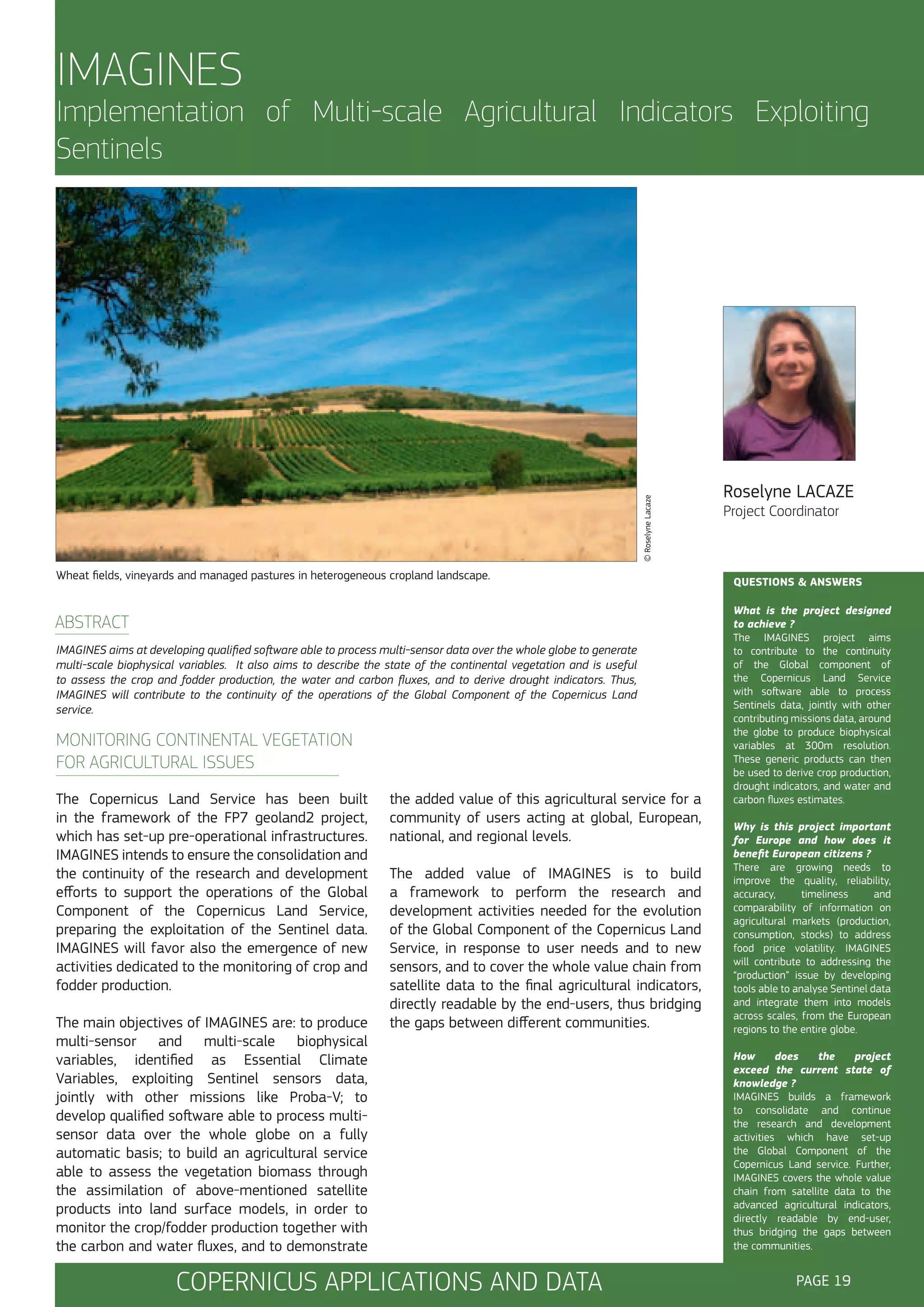
Wheat fields, vineyards and managed pastures in heterogeneous cropland landscape.

ABSTRACT
IMAGINES aims at developing qualified software able to process multi-sensor data over the whole globe to generate
multi-scale biophysical variables. It also aims to describe the state of the continental vegetation and is useful
to assess the crop and fodder production, the water and carbon fluxes, and to derive drought indicators. Thus,
IMAGINES will contribute to the continuity of the operations of the Global Component of the Copernicus Land
service.

MONITORING CONTINENTAL VEGETATION
FOR AGRICULTURAL ISSUES
The Copernicus Land Service has been built
in the framework of the FP7 geoland2 project,
which has set-up pre-operational infrastructures.
IMAGINES intends to ensure the consolidation and
the continuity of the research and development
efforts to support the operations of the Global
Component of the Copernicus Land Service,
preparing the exploitation of the Sentinel data.
IMAGINES will favor also the emergence of new
activities dedicated to the monitoring of crop and
fodder production.
The main objectives of IMAGINES are: to produce
multi-sensor and multi-scale biophysical
variables, identified as Essential Climate
Variables, exploiting Sentinel sensors data,
jointly with other missions like Proba-V; to
develop qualified software able to process multisensor data over the whole globe on a fully
automatic basis; to build an agricultural service
able to assess the vegetation biomass through
the assimilation of above-mentioned satellite
products into land surface models, in order to
monitor the crop/fodder production together with
the carbon and water fluxes, and to demonstrate

the added value of this agricultural service for a
community of users acting at global, European,
national, and regional levels.
The added value of IMAGINES is to build
a framework to perform the research and
development activities needed for the evolution
of the Global Component of the Copernicus Land
Service, in response to user needs and to new
sensors, and to cover the whole value chain from
satellite data to the final agricultural indicators,
directly readable by the end-users, thus bridging
the gaps between different communities.

COPERNICUS APPLICATIONS AND DATA

Roselyne LACAZE
Project Coordinator

QUESTIONS & ANSWERS
What is the project designed
to achieve ?
The IMAGINES project aims
to contribute to the continuity
of the Global component of
the Copernicus Land Service
with software able to process
Sentinels data, jointly with other
contributing missions data, around
the globe to produce biophysical
variables at 300m resolution.
These generic products can then
be used to derive crop production,
drought indicators, and water and
carbon fluxes estimates.
Why is this project important
for Europe and how does it
benefit European citizens ?
There are growing needs to
improve the quality, reliability,
accuracy,
timeliness
and
comparability of information on
agricultural markets (production,
consumption, stocks) to address
food price volatility. IMAGINES
will contribute to addressing the
“production” issue by developing
tools able to analyse Sentinel data
and integrate them into models
across scales, from the European
regions to the entire globe.
How
does
the
project
exceed the current state of
knowledge ?
IMAGINES builds a framework
to consolidate and continue
the research and development
activities which have set-up
the Global Component of the
Copernicus Land service. Further,
IMAGINES covers the whole value
chain from satellite data to the
advanced agricultural indicators,
directly readable by end-user,
thus bridging the gaps between
the communities.

PAGE 19
IMAGINES
Implementation of Multi-scale Agricultural Indicators Exploiting
Sentinels
LIST OF PARTNERS
•
•
•
•
•
•
•
•
•

HYGEOS, France
Le Centre national d’études spatiales, France
European Centre for Medium-Range Weather Forecasts, United Kingdom
Earth Observation Laboratory, Spain
French National Institute for Agricultural Research, France
Meteo-France, France
Országos Meteorológiai Szolgálat, Hungary
Université Catholique de Louvain, Belgium
VITO Vision on technology, Belgium

COORDINATOR

CONTACT

HYGEOS, France

Dr. Roselyne LACAZE
Tel: +33 632799459
Email: rl@hygeos.com

PROJECT INFORMATION
Implementation of Multi-scale Agricultural Indicators Exploiting Sentinels (IMAGINES)
Contract N°: 311766
Starting Date: 01/11/2012
Duration: 40 months
EU Contribution: € 1.998.246,09
Estimated total cost: € 2.851.285,28

Page 20

COPERNICUS APPLICATIONS AND DATA
IncREO

© geomer GmbH & Astrium GEO

Increasing Resilience through Earth Observation

BEAM products (Basic European Assets Maps) for Hungary and Romania - enabling cross-border evaluation of
damage potential.

ABSTRACT
The objective of IncREO is to provide actors responsible for civil protection and disaster management with EObased solutions, contributing to an improved preparedness and mitigation planning for areas highly vulnerable to
natural disasters and already noticeable climate change trends. As a multi-risk designed project, any type of natural
disaster is addressed. However, selected use cases and the transfer of solutions to a specifically multi-risk prone
area are covered as well.

ASSETS MAPPING, MULTI-RISK AND
VULNERABILITY MAPPING ENHANCING
MITIGATION AND PREPAREDNESS
Within IncREO, “Resilience” is understood as
the capacity of a system, community or society
(potentially) exposed to hazards to adapt – by
resisting or changing – in order to reach and
maintain an acceptable level of functioning and
structure.

Relevant national and European legislature plus
national and supranational legal frameworks incl.
global mechanisms, if applicable, are taken into
account as well to provide solutions, meeting
the respective administrative and technical user
requirements.

The “Increase” of resilience is achieved by providing
actors responsible for civil protection and disaster
management with Earth Observation (EO)-based
solutions contributing particularly to an improved
preparedness and mitigation planning in areas
highly vulnerable to natural disasters and with
already noticeable climate change trends.

The types of products to be provided are mainly
“assets maps” and “hazard / risk and vulnerability
maps”. Whereas “crisis phase” products, such as
damage extent / assessment maps and emergency
support maps are already based on consolidated
user requirements with corresponding product
specifications available, there is still a certain R&D
need in this regard concerning the aforementioned
“non crisis phase” products.

Besides the objective to increase resilience,
IncREO also pursues a multi-hazard approach –
either hazards triggered simultaneously (coupled
hazards) or concatenated hazards (domino effect)
– as a fundamental basis to identify highly
vulnerable and risk-prone areas.

The geo-information content of the final products
usually corresponds to a multiple set incl. valueadding of EO data and various geo-formation
layers, among them, for example, optical and / or
radar satellite data, information about topography,
population density and critical infrastructure.

COPERNICUS APPLICATIONS AND DATA

Marc MUELLER

Project Coordinator

QUESTIONS & ANSWERS
What is the project designed to
achieve ?
The project is designed to achieve
a significant contribution to
the operational capacities
of
Copernicus (formerly GMES) by
developing customized mapping
and geo-information products ready
for deployment in the prevention
and preparedness phases – as a
complementary to the Emergency
Management (crisis) Service of
the Copernicus Initial Operations.
To achieve this, the transferability
of solutions to other geographical
areas is essential.
Why is this project important
for Europe and how does it
benefit European citizens ?
IncREO is important for Europe
because it contributes to an upto-date assessment of areas
vulnerable to natural disaster(s)
incl. state-of-the-art mapping,
supporting civil protection, disaster
management and spatial planning
actors, for the benefit of every
single European citizen. The latter
applies also to the project’s assets
mapping approach, as it provides
cross-border and regional/local
solutions.
How does the project exceed
the current state of knowledge?
By reviewing existing Copernicus
solutions and defining those as the
starting point. Progress will then
be achieved by the use of new
EO data with higher resolution,
refined mapping concepts (e.g.
assets mapping) and customized
workflows (e.g. for producing
[multi-]risk and vulnerability maps).
The analysis of newly available EObased products (e.g. terrain data)
for risk-related applications is the
purpose of the research, too.

PAGE 21
IncREO
Increasing Resilience through Earth Observation
LIST OF PARTNERS
•
•
•
•
•
•
•
•
•

Spot Image SA (Astrium GEO), France
geomer GmbH, Germany
GeoVille, Austria
University Twente (ITC), the Netherlands
UNESCO, France/Italy
NIMH, Bulgaria
Meteo France, France
Romanian Space Agency, Romania
Infoterra GmbH (Astrium GEO), Germany

COORDINATOR

CONTACT

Spot Image SA (Astrium GEO), France

Dr. Marc MUELLER
Tel: +33 (0)5 62 19 84 69
Email: marc.mueller@astrium.eads.net

PROJECT INFORMATION
Increasing Resilience through Earth Observation (IncREO)
Contract N°: 312461
Starting Date: 01/01/2013
Duration: 24 months
EU Contribution: € 1.924.718,00
Estimated total cost: € 2.890.082,00

Page 22

COPERNICUS APPLICATIONS AND DATA
LOBOS

Low time critical Border Surveillance

© Infoterra Ltd

David HALBERT

Space and Border Surveillance.

QUESTIONS & ANSWERS

ABSTRACT
The objective of LOBOS is to design and build a pre-operational border surveillance system using satellite imagery
and other data. The project only deals with those elements that are low time critical. The sister project SAGRES deals
with the high time critical element.

BORDER SURVEILLANCE
The LOBOS project involves a consortium of
fourteen partners including large companies,
SMEs and institutional entities from eight
European countries.
LOBOS aims at testing the low time critical
scenarios of the CONOPS in order to deliver a
draft of specifications for a GMES operational
border surveillance support service in 2014.
Thus LOBOS will implement an initial preoperational service three months after the
contract kick-off, which will be evaluated and
refined through a phased development all along
the project. Three successive upgraded versions
of the service will be run during the two year
project time period. This pre-operational service
is designed to be activated by FRONTEX, through
EUSC or EMSA over any geographical location.

Project Coordinator

LOBOS will put emphasis on modelling, statistics
and analysis, relying on satellite imagery but
also on Open Source Intelligence and other
environmental information (meteorology, sea
currents) to produce CONOPS products.
In the LOBOS approach, the R&D outcome aims
at improving the services performance along
its phased implementation, in terms of content,
cost (automation) and delivery time capabilities.
It will not prevent the delivery of the core preoperational service.
The progress of the project will be permanently
available on a dedicated web site. Moreover, the
results of the project will be presented during
a workshop in Warsaw in conjunction with the
annual European Border Guards day in May 2014.

What is the project designed
to achieve ?
The project is designed to
achieve a pre-operational border
surveillance system utilising
satellite data and other imagery.
Why is this project important
for Europe and how does it
benefit European citizens ?
Illegal immigration and cross
border crime are a major
detriment to the economy
of Europe and the safety of
its citizens. This project will
allow a more complete border
surveillance system to be put in
place.
How
does
the
project
exceed the current state of
knowledge ?
Except for militarised borders,
and in case of a crisis event,
the use of satellite data to
support border surveillance is
uncommon. LOBOS will lead to a
system that will be the state of
the art in border surveillance and
monitoring.

Around 60 activations using more than 450
satellites images and ancillary data are foreseen.

COPERNICUS APPLICATIONS AND DATA

PAGE 23
LOBOS
Low time critical Border Surveillance
LIST OF PARTNERS
•
•
•
•
•
•
•
•
•
•
•
•
•
•

Spot Image, France
Infoterra Ltd, United Kingdom
TNO, the Netherlands
GMV Aerospace and Defence SA, Spain
GMVIS Skysoft, Portugal
Cassidian, France
Spot Infoterra Hellas, Greece
IABG, Germany
European Union Satellite Centre, Spain
Infoterra GmbH, Germany
Astri Polska, Poland
Center for Security Studies, Greece
Mercator, France
Interdisciplinary Centre for Mathematical and Computational Modelling, University of Warsaw,
Poland

COORDINATOR

CONTACT

Spot Image

Dave Halbert
Tel: +44 (0)1252 362104
Dave.halbert@astrium.eads.net

PROJECT INFORMATION
Low time critical Border Surveillance (LOBOS)
Contract N°: 312584
Starting Date: 01/01/2013
Duration: 24 months
EU Contribution: € 2.000.000,00
Estimated total cost: € 3.371.352,40

Page 24

COPERNICUS APPLICATIONS AND DATA
LOTUS

Preparing Land and Ocean Take Up from Sentinel-3

Per Knudsen
© ESA

Project Coordinator

The Sentinel-3 satellite.

QUESTIONS & ANSWERS

ABSTRACT
The objective of the LOTUS project is to support the development of Copernicus (former GMES) by developing
applications of Sentinel-3 to complete the space observation infrastructure that are designed for land and ocean
monitoring for Copernicus.

NEW PRODUCTS FOR COPERNICUS FROM
SENTINEL-3: SEA LEVEL, RIVER & LAKE LEVELS,
WAVES, WIND, SOIL MOISTURE, SNOW
The radar altimeter onboard Sentinel-3 will
provide observations of sea-surface and landice topography, in continuation of altimeter
missions such as ENVISAT, Jason-1 and Jason-2.
This instrument will operate in a SAR mode and
provide along-track high-resolution heights of
the sea surface in the open oceans, in the coastal
seas, in-land water and sea ice areas. The SAR
capability is a new feature and no data products
based on this SAR mode data are provided or
used operationally.
New methodologies and new data processing
chains need to be developed to prepare the takeup of the Copernicus Sentinel-3 data. The LOTUS
project will develop new methodologies, data
processing chains, and applications of the SAR
mode data for the high resolution sea surface
heights, wave heights and wind speeds in the
open oceans, coastal seas as well as in sea ice
covered regions for operational marine services.

For the operational land services, the LOTUS
project will develop new methodologies, data
processing chains, and applications of the
SAR mode data for the in-land water levels in
rivers and lakes, soil moisture, and snow water
equivalents. In turn, the new products based
on the SAR mode data will support operational
services for emergency response and security
in the events of, e.g., storm surges and flooding.
The new land products will support services on
monitoring hydrological parameters for climate
change.
Through a strong involvement of innovative
companies and SMEs the LOTUS project will
stimulate new commercial activities in the valueadding sectors.

COPERNICUS APPLICATIONS AND DATA

What is the project designed to
achieve ?
The LOTUS project is designed
to support the development of
the land and ocean monitoring
of Copernicus utilising the full
potential of the new space based
technologies and infrastructures.
LOTUS will develop innovative
applications of the new radar
altimeter onboard the Sentinel-3
satellite such as sea surface
heights, wave heights and river
and lake levels.
Why is this project important
for Europe and how does it
benefit European citizens ?
The European citizens will
benefit from the improved ocean
monitoring service through its
support of shipping, fisheries and
off-shore activities. The monitoring
of land hydrology will support
fresh water supplies and farming
worldwide. A majority of the LOTUS
partners are active in the valueadding sectors. To further promote
the commercial use LOTUS will
disseminate information to a wide
range of SMEs.
How
does
the
project
exceed the current state of
knowledge ?
The LOTUS project will develop
new
methodologies
and
applications of the new alongtrack
high-resolution
data.
The radar altimeter onboard
Sentinel-3 will apply the delay
Doppler technology and operate
in a SAR mode, providing high
resolution data along track at 20
Hz or every 300 m compared to
7 km for conventional altimetry,
hence improving the observation
capabilities substantially.

PAGE 25
LOTUS
Preparing Land and Ocean Take Up from Sentinel-3
LIST OF PARTNERS
•
•
•
•

Technical University of Denmark, Denmark
Starlab Barcelona SL, Spain
Collecte Localisation Satellites SA, France
DHI, Denmark

COORDINATOR

CONTACT

Technical University of Denmark, Denmark

Per Knudsen
Tel: +45 23603518
Email: pk@space.dtu.dk

PROJECT INFORMATION
Preparing Land and Ocean Take Up from Sentinel-3 (LOTUS)
Contract N°: 313238
Starting Date: 01/01/2013
Duration: 36 months
EU Contribution: € 1.994.162,00
Estimated total cost: € 2.912.435,26

Page 26

COPERNICUS APPLICATIONS AND DATA
PREFER

Space-based Information Support for Prevention and REcovery of
Forest Fires Emergency in the MediteRranean Area

Giovanni LANEVE
© PREFER

Project Coordinator

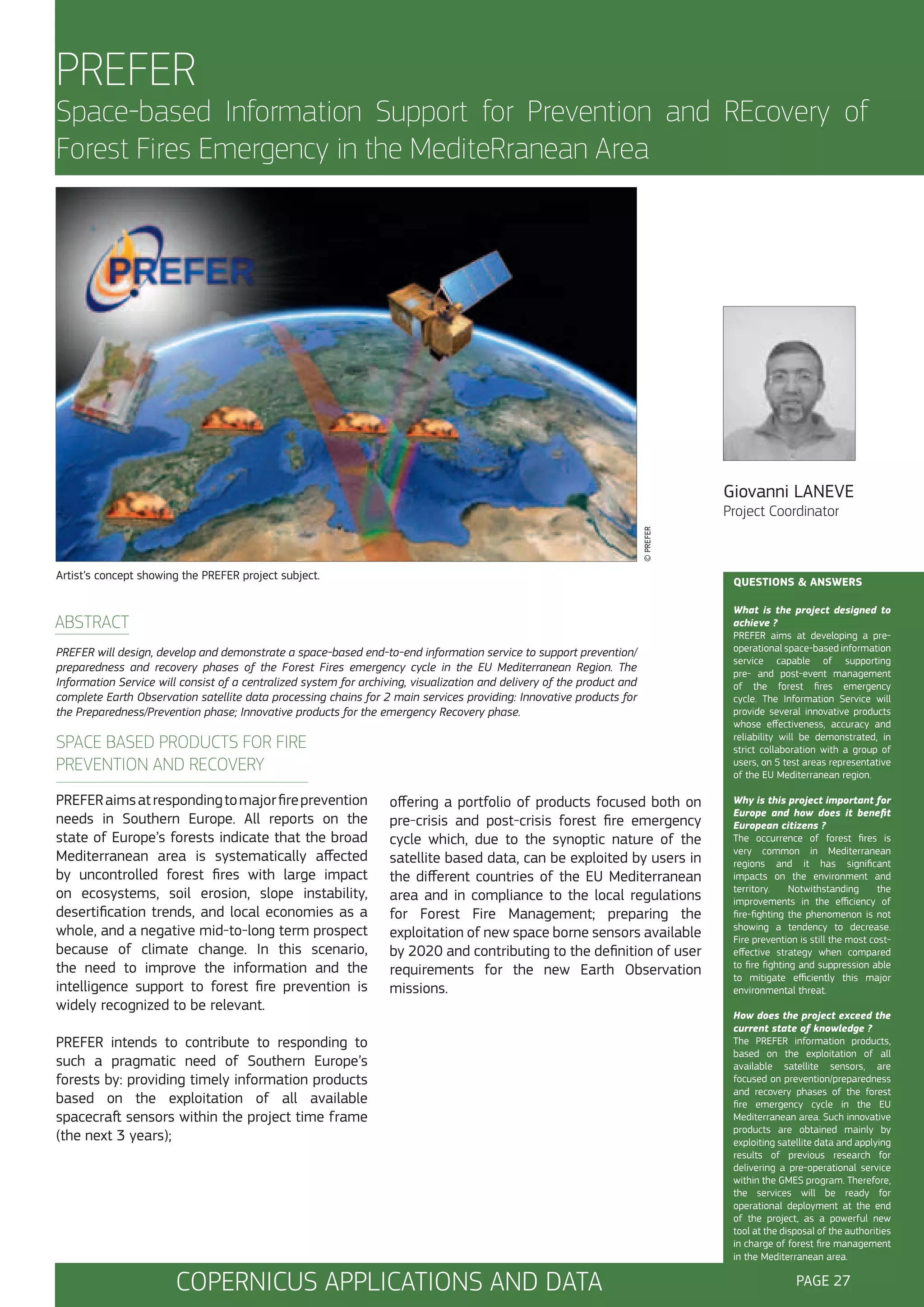
Artist’s concept showing the PREFER project subject.

QUESTIONS & ANSWERS

ABSTRACT
PREFER will design, develop and demonstrate a space-based end-to-end information service to support prevention/
preparedness and recovery phases of the Forest Fires emergency cycle in the EU Mediterranean Region. The
Information Service will consist of a centralized system for archiving, visualization and delivery of the product and
complete Earth Observation satellite data processing chains for 2 main services providing: Innovative products for
the Preparedness/Prevention phase; Innovative products for the emergency Recovery phase.

SPACE BASED PRODUCTS FOR FIRE
PREVENTION AND RECOVERY
PREFER aims at responding to major fire prevention
needs in Southern Europe. All reports on the
state of Europe’s forests indicate that the broad
Mediterranean area is systematically affected
by uncontrolled forest fires with large impact
on ecosystems, soil erosion, slope instability,
desertification trends, and local economies as a
whole, and a negative mid-to-long term prospect
because of climate change. In this scenario,
the need to improve the information and the
intelligence support to forest fire prevention is
widely recognized to be relevant.

offering a portfolio of products focused both on
pre-crisis and post-crisis forest fire emergency
cycle which, due to the synoptic nature of the
satellite based data, can be exploited by users in
the different countries of the EU Mediterranean
area and in compliance to the local regulations
for Forest Fire Management; preparing the
exploitation of new space borne sensors available
by 2020 and contributing to the definition of user
requirements for the new Earth Observation
missions.

PREFER intends to contribute to responding to
such a pragmatic need of Southern Europe’s
forests by: providing timely information products
based on the exploitation of all available
spacecraft sensors within the project time frame
(the next 3 years);

COPERNICUS APPLICATIONS AND DATA

What is the project designed to
achieve ?
PREFER aims at developing a preoperational space-based information
service capable of supporting
pre- and post-event management
of the forest fires emergency
cycle. The Information Service will
provide several innovative products
whose effectiveness, accuracy and
reliability will be demonstrated, in
strict collaboration with a group of
users, on 5 test areas representative
of the EU Mediterranean region.
Why is this project important for
Europe and how does it benefit
European citizens ?
The occurrence of forest fires is
very common in Mediterranean
regions and it has significant
impacts on the environment and
territory.
Notwithstanding
the
improvements in the efficiency of
fire-fighting the phenomenon is not
showing a tendency to decrease.
Fire prevention is still the most costeffective strategy when compared
to fire fighting and suppression able
to mitigate efficiently this major
environmental threat.
How does the project exceed the
current state of knowledge ?
The PREFER information products,
based on the exploitation of all
available satellite sensors, are
focused on prevention/preparedness
and recovery phases of the forest
fire emergency cycle in the EU
Mediterranean area. Such innovative
products are obtained mainly by
exploiting satellite data and applying
results of previous research for
delivering a pre-operational service
within the GMES program. Therefore,
the services will be ready for
operational deployment at the end
of the project, as a powerful new
tool at the disposal of the authorities
in charge of forest fire management
in the Mediterranean area.

PAGE 27
PREFER
Space-based Information Support for Prevention and REcovery of
Forest Fires Emergency in the MediteRranean Area
LIST OF PARTNERS
•
•
•
•

CGS SpA - Compagnia Generale per lo Spazio, Italy
Intelligence for Environment and Security- IES Consulting S.r.l., Italy
GMV Aerospace and Defence SA, Spain
Satways- Proionta Kai Ypiresies Tilematikis Diktyakon Kai Tilepikinoniakon Efarmogon Etairia
Periorismenis Efthinis Epe, Greece
• Center for Security Studies, Greece
• University of Strasbourg, France
• University of Coimbra, Portugal

COORDINATOR

CONTACT

University of Rome, Italy

Prof. Giovanni LANEVE
Tel: +39 0688346430
Email: laneve@psm.uniroma1.it

PROJECT INFORMATION
Space-based Information Support for Prevention and REcovery of Forest Fires Emergency in the
MediteRranean Area (PREFER)
Contract N°: 312931
Starting Date: 01/12/2012
Duration: 36 months
EU Contribution: € 1.906.357,88
Estimated total cost: € 2.844.994,08

Page 28

COPERNICUS APPLICATIONS AND DATA
SENSUM

Framework to integrate Space-based and in-situ sENSing for dynamic
vUlnerability and recovery Monitoring

© Marc Wieland

Massimiliano PITTORE

General scheme of the SENSUM project, involving the use of space- and ground-based observing platforms and
images of different scales and resolutions.

ABSTRACT
The SENSUM goals involve developing methods for continuous urban vulnerability assessment and analysis involving
remote sensing and ground-based methods for multi-type risk analysis, the application of space technologies to
disaster recovery, applying the developed tools to the specific hazards of earthquakes and landslides, including their
temporal and spatial relationships, and the enhancement of the scientific and technical capacities of the Central
Asian partner countries for disaster risk management and mitigation.

GROUND- AND SPACE-BASED METHODOLOGIES
FOR URBAN VULNERABILITY ASSESSMENT
The SENSUM project is a response to the fact that
human society is becoming increasingly exposed
to natural hazards through urbanisation, greater
dependency on technological infrastructures and
environmental change. It is therefore essential to
understand the changes in society’s vulnerability,
and to integrate this into robust estimates of
risk and of losses that follow an extreme natural
event. This is especially important in countries
such as those in Central Asia, where area-wide
knowledge of the existing building stock is lacking,
and the urban environment is rapidly changing.

However, the availability of the necessary data
and information is not uniformly distributed.
Hence, SENSUM will consider both “data poor”
areas, such as the Isfara-Batken region between
Kyrgyzstan and Tajikistan which is prone to
earthquakes and landslides, and “data rich” areas
such as Cologne, Germany, which is prone to
seismic events.

It is this lack of information about an urban
area’s vulnerability, in fact even the extent and
makeup of a given town or city, which is the
fundamental problem confronted by SENSUM.
It is for this reason that innovative methods of
integrating observations and data from Earth
Observing satellites and ground based methods
such as omni-directional camera surveys will be
a primary focus.

COPERNICUS APPLICATIONS AND DATA

Project Coordinator

QUESTIONS & ANSWERS
What is the project designed to
achieve ?
SENSUM is setting out to develop
tools for the exploitation of remote
sensing and ground-based imaging
to assess the vulnerability of the
urban environment.
While the
project’s focus is on landslides
and earthquakes, the methods
are being designed to be utilised
when considering other natural
and
anthropogenic
disasters.
These tools will be tuned towards
the needs of end-users and
practitioners.
Why is this project important
for Europe and how does it
benefit European citizens ?
Despite having some of the
most complete records of urban
development in the world, civil
protection and disaster response
and mitigation planners still
lack sufficient information about
the vulnerability of the urban
environment for truly efficient
response
measures.
The
development of cost effective
methods by SENSUM will help to
remedy this problem, leading to
the enhancement of European
society’s resilience.
How does the project exceed
the current state of knowledge?
SENSUM will contribute to a better
understanding of how risk can
be estimated in rapidly changing
urban environments prone to
multiple types of disasters. This will
be achieved by advancing methods
for integrating ground- and spaceborne observations, with the
resulting software tools developed
on a Free and Open Source basis,
allowing their wider dissemination
to the disaster management and
mitigation communities.

PAGE 29
SENSUM
Framework to integrate Space-based and in-situ sENSing for dynamic
vUlnerability and recovery Monitoring
LIST OF PARTNERS
•
•
•
•
•
•

Helmholtz-Zentrum Potsdam Deutsches GeoForschungsZentrum, Germany
Centro Europeo di Formazione e Ricera in Ingegneria Sismic, Italy
Deutsches Zentrum für Luft und Raumfarht, Germany
Stiftelsen Norges Geotekniske Institutt, Norway
University of Cambridge, England
Institute of Geology, Earthquake Engineering and Seismology of the Academy of Sciences of the
Republic of Tajikistan, Tajikistan
• Central Asian Institute of Applied Geosciences, Kyrgyzstan
• ImageCat Ltd., England

COORDINATOR

CONTACT

Helmholtz-Zentrum Potsdam Deutsches
GeoForschungsZentrum, Potsdam, Germany

Dr. Massimiliano PITTORE
Tel: +49 (0) 331 288 28668
Email: pittore@gfz-potsdam.de

PROJECT INFORMATION
Framework to integrate Space-based and in-situ sENSing for dynamic vUlnerability and recovery
Monitoring (SENSUM)
Contract N°:312972
Starting Date: 01/01/2013
Duration: 24 months
EU Contribution: €1.931.683,00
Estimated total cost: €2.439.074,00

Page 30

COPERNICUS APPLICATIONS AND DATA
ABLAMOD

Advanced Ablation Characterization and Modelling

© ESA

Ali Gülhan

ESA ARD re-entry capsule.

Project Coordinator
QUESTIONS & ANSWERS

ABSTRACT
The overall objective of ABLAMOD is the improvement of the characterization and modelling of the ablation
materials in flight relevant high temperature environments. The new physical models will be integrated in a modular
code. For the validation advanced measurement techniques will be used to measure the ablator and flow properties
during testing in most powerful European facilities.

DEVELOPMENT OF A NEW EUROPEAN
TOOL FOR RELIABLE DESIGN OF ABLATIVE
THERMAL PROTECTION SYSTEMS
Ablative thermal protection materials are a
key technology for current and future space
exploration missions. However, today the mission
feasibility is determined by the materials
available, and the development of new materials
is performed, essentially, by an iterative trialand-error process. This is due to the absence of
validated predictive models for ablative material
behaviour – models are tuned to bulk material
properties from tests. For each new material,
this tuning has to be redone because the models
are not of sufficiently high fidelity to be able to
make even small extrapolations. This means that
materials cannot be designed to a specification to
fulfil the needs of a particular mission.

The new model will be validated by applying
advanced and sophisticated measurement
techniques for the characterization of an ablator’s
behaviour inside a severe thermo-mechanical
environment in most powerful European facilities.
After its validation with experimental data the
new modelling code will be used to estimate the
performance of the ablative thermal protection
system for realistic flight configurations.

Therefore the main aim of this project is to make a
substantial progress for the design of an ablative
thermal protection system by incorporating
aspects of high fidelity mesoscale ablator physics
within a modular framework.

SPACE TECHNOLOGIES

What is the project designed to
achieve ?
Development of reliable prediction
tools to assess the performance
of ablative thermal protection
materials for severe aerothermal
environments.
Why is this project important
for Europe and how does it
benefit European citizens ?
Improvement of the European
non-dependent access to space
ability by developing a high fidelity
simulation tool for the design
of ablative thermal protection
systems.
How
does
the
project
exceed the current state of
knowledge ?
- A European team with excellent
skills in modelling, instrumentation
and characterization of materials,
with validation experiments in
most powerful facilities using
novel diagnostic techniques will
be formed,
--The European dependency on
ITAR restricted space components
will be reduced,
--Consideration
of
system
requirements for space vehicles
due to the involvement of four
industrial teams, who are strongly
involved in on-going European
projects and creation of an
industrial use plan,
- Dissemination activities beyond
the consortium, of the numerical
tools and technology produced,
including publications, conferences
and exploitation of the results
produced by the team,
--Education of young European
scientists due to the use of the
results for Ph. D, M.Sc and B.Sc
theses.

PAGE 31
ABLAMOD

Advanced Ablation Characterization and Modelling
LIST OF PARTNERS
•
•
•
•
•
•
•
•
•
•

Deutsches Zentrum für Luft- und Raumfahrt, Germany
Astrium, France
Avio, Italy
Centro Italiano Ricerche Aerospaziali, Italy
Fluid Gravity Engineering, United Kingdom
University of Strathclyde, United Kingdom
VKI, Belgium
AMORIM CORK COMPOSITES, Portugal
Austrian Institute of Technology, Austria
Österreichisches Gießerei-Institut, Austria

COORDINATOR

CONTACT

German Aerospace Center (DLR)

Dr.-Ing. Ali Gülhan
German Aerospace Center
Supersonic and Hypersonic Technology Department
51147 Cologne, Germany
Tel: +49 2203 6012363
Email: ali.guelhan@dlr.de

PROJECT INFORMATION
Advanced Ablation Characterization and Modelling (ABLAMOD)
Contract N°: 312987
Starting Date: 01/01/2013
Duration: 36 months
EU Contribution: € 1.981.906,00
Estimated total cost: € 2.735.124,20

Page 32

SPACE TECHNOLOGIES
BRITESPACE

© Universidad Politécnica de Madrid

High Brightness Semiconductor Laser Sources for Space Applications
in Earth Observation

Artist view of spaceborne LIDAR for earth observation.

Project Coordinator

QUESTIONS & ANSWERS

ABSTRACT
The BRITESPACE objective is the design, realization and validation of a semiconductor laser transmitter for
monitoring greenhouse gases in future earth observation space missions. The transmitter, based on a fully integrated
Master Oscillator Power Amplifier, will be a component of a LIDAR system. The project aims to demonstrate that
semiconductor lasers can be used as optical sources in space applications requiring simultaneously high power,
beam quality and spectral purity.

SEMICONDUCTOR LASERS FOR EARTH
OBSERVATION FROM SPACE
The availability of suitable laser sources is
one of the key issues for the development
of active optical instruments in future earth
observation space missions. The new generation
of high brightness semiconductor lasers brings
advantages over other sources due to their
compact size, reduced mass, high reliability and
high conversion efficiency. The main objective of
this project is to demonstrate the feasibility of
a semiconductor based laser source to be used
as a laser transmitter in a Differential-Absorption
LIDAR system for the observation and monitoring
of greenhouse gases in the atmosphere.

Ignacio ESQUIVIAS

The entire laser source will be designed to
be used as the transmitter unit of a Random
Modulated CW LIDAR system enabling the
integrated-path measurements of atmospheric
CO2 concentration. The receiver unit will be also
developed in order to validate the approach by
performing CO2 concentration measurements on
ground.
In a more general context the project will pave
the way for using high brightness semiconductor
lasers
in
space
applications
requiring
simultaneously high power, beam quality and
spectral purity.

The basic building block of the project is a
monolithic Master Oscillator Power Amplifier
consisting of a frequency stabilized singlemode laser diode and a multi-section tapered
semiconductor amplifier emitting at two
wavelengths in the 1500-1600 nm region. It will
be mounted in a space-compatible laser module
with the beam forming optics and completed with
the stabilization and control electronics.

SPACE TECHNOLOGIES

What is the project designed
to achieve ?
The objective of BRITESPACE is
the realization and testing of
a laser source based on a fully
integrated semiconductor Master
Oscillator Power Amplifier to
be used for CO2 monitoring.
This includes the design of
the complete system, at chip,
module and transmitter level, its
realization and the final testing
on the field in a complete LIDAR
system.
Why is this project important
for Europe and how does it
benefit European citizens ?
BRITESPACE will be a step
forward in the development of
space borne laser sources for
Earth observation from space. It
will contribute to strengthening of
the European leadership position
in
photonics
technologies,
focusing on relevant issues in our
daily lives, such as greenhouse
gas emissions in the atmosphere
and its impact on climate and
global warming.
How
does
the
project
exceed the current state of
knowledge ?
Laser sources used in space
missions have been traditionally
based on solid state lasers.
BRITESPACE aims to demonstrate
the suitability of semiconductor
lasers for their use in space, thus
improving the current state of the
art technologies, with smaller,
more efficient and more reliable
devices based on semiconductor
materials.

PAGE 33
BRITESPACE
High Brightness Semiconductor Laser Sources for Space Applications
in Earth Observation
LIST OF PARTNERS
•
•
•
•
•
•

Universidad Politécnica de Madrid, Spain
III-V Lab GIE, France
Fraunhofer Institute for Laser Technology ILT, Germany
Alter Technology TUV Nord SA, Spain
University of Bristol, United Kingdom
Deutsches Zentrums für Luft- und Raumfahrt, Germany

COORDINATOR

CONTACT

Universidad Politécnica de Madrid

Prof. Ignacio ESQUIVIAS
Tel: +34 913367339
Email: ignacio.esquivias@upm.es

PROJECT INFORMATION
High Brightness Semiconductor Laser Sources for Space Applications in Earth Observation
(BRITESPACE)
Contract N°: 313200
Starting Date: 01/12/2012
Duration: 36 months
EU Contribution: € 1.995.040,00
Estimated total cost: € 3.086.352,00

Page 34

SPACE TECHNOLOGIES
GAIA

© GAIA Consortium

Gaia-Photonics Front-End For Next-Generation SAR Applications

GAIA Technical approach.

Alejandro MARTÍNEZ
Project Coordinator

QUESTIONS & ANSWERS

ABSTRACT
The objective of GAIA is the development of the photonic technology required in future array antenna systems
for SAR applications. It will provide new true-time-delay control of the signal for each antenna element by using
integrated photonics in both transmission and reception, the design of the optical harness suitable for large,
deployable antennas and the development of an antenna array module in the X band.

COMPACT RADAR / SAR TECHNOLOGY FOR
FUTURE EARTH OBSERVATION MISSIONS
The evolution of future generation of Syntheticaperture radar (SAR) has shown a clear trend
towards systems with better performance
resulting in higher complexity (larger antennas,
operating bandwidth and/or different frequencies)
at lower cost as well as less mass, size and
power consumption. This trend imposes strong
requirements on today’s technology of antennas
and Radio Frequency (RF) components.
Satellite systems with larger antennas will
require more complex, bulky and difficultto-route harness to transport the RF signals
from the processing unit of the satellite to the
antenna. It could also impose strong mechanical
and thermal requirements, especially when the
antennas should be deployed in-orbit.
On the other hand, larger bandwidths associated
with larger antennas and scanning angles require
True-Time-Delay (TTD) beamforming, resulting
in bulky and complex solutions (and very limited
for lower frequencies – larger delays) impacting
directly the size, mass and integration cost.

In this scenario, the implementation of the
TTD beamforming network of the antenna by
photonic integrated circuits (PIC) technology
could potentially provide an order-of-magnitude
reduction in both size and mass when compared
with the traditional implementation with RF
technology. This photonic approach opens the
door for the use of optical fibre in the antenna
harness, which is more lightweight than RF
harness and with very low attenuation with
distance, which could reduce the risks associated
to the in-orbit antenna deployment.
Additionally, the broadband nature of the
photonic technology related to the transport and
processing of RF signals enormously simplifies
the beamforming network. Moreover, unlike the
traditional RF implementation in which different
substrates, waveguides and technologies must
be used for different frequencies, applications or
even missions, a unique common medium is used
in the GAIA’s approach, which also contributes to
the reduction in cost and complexity of the whole
system.

SPACE TECHNOLOGIES

What is the project designed to
achieve ?
This project aims at developing
new concepts and technologies
for deployable SAR antenna. The
final design will be a complete
modular antenna system with
TTD characteristics photonically
controlled which will be the base
of a large, deployable SAR antenna
with a net gain in bandwidth/
resolution size, mass, complexity
and cost when compared with
traditional implementations.
Why is this project important
for Europe and how does it
benefit European citizens ?
The achievement of GAIA goals
will strengthen the European
leading position in Copernicus
(former GMES - Global Monitoring
for Environment and Security)
by developing state-of-the-art
antenna systems improving the
capabilities of the European SAR
instrumentation applicable for
Earth observation missions, which
are useful for areas such as
environment, security, agriculture,
forestry and meteorology, civil
protection and risk management.
How does the project exceed
the current state of knowledge?
For the first time, this kind of TTD
antenna system (complete modular
with a net gain in bandwidth/
resolution size, mass, complexity
and cost) will be developed.
Moreover, the underlying photonic
monolithic technology required for
this application represents a clear
and disruptive step ahead in the
state-of-the-art of the photonic
technology with a very wide range
of applications in fields such as
space, telecom or sensing.

PAGE 35
GAIA

Gaia-Photonics Front-End For Next-Generation SAR Applications
LIST OF PARTNERS
•
•
•
•

Universitat Politècnica De València, Spain
Das Photonics S.L., Spain
Space Engineering, S.P.A., Italy
Gesellschaft Fuer Angewandte Mikro Und Optoelektronik Mit Beschrankterhaftung Amo Gmbh,
Germany
• Science And Technology Facilities Council, United Kingdom

COORDINATOR

CONTACT

UNIVERSITAT POLITÈCNICA DE VALÈNCIA, Spain

Project Coordinator
Associate Professor Alejandro MARTINEZ
Tel: +34 963877000
Email: amartinez@ntc.upv.es
Technical and Scientific Manager
Miguel Ángel PIQUERAS
Tel: +34 625454570
Email: mapiqueras@dasphotonics.com

PROJECT INFORMATION
PROJECT INFORMATION

Photonics Front-End For Next-Generation SAR Applications (GAIA)
Contract N°: 313290
Starting Date: 01/10/2012
Duration: 36 months
EU Contribution: € 1.434.432,75
Estimated total cost: € 1.961.317,41

Page 36

SPACE TECHNOLOGIES
GAMALINK

© GAMALINK - TEKEVER

Generic SDR-based Multifunctional space Link

Artist’s impression of the GAMALINK concept.

The objective of GAMALINK is to develop an Inter Satellite Link (ISL) based on Software-Defined Radio (SDR)
technology capable of supporting mobile ad hoc networking, GPS, and attitude determination using the VOR (VHF
Omni directional Radio) concept, for nano- and pico-satellite platforms. The end result will be a prototype ready for
integration in a Cubesat launch opportunity.

A SOFTWARE-DEFINED RADIO (SDR) INTER
SATELLITE LINK (ISL) WITH NETWORKING AND
ATTITUDE DETERMINATION CAPABILITIES

GAMALINK will combine satellite navigation, ad
hoc networking, attitude determination, antenna
design and beam forming into a compact
common technological platform, suitable for
small satellite LEO missions. This platform will
be based on Software-Defined Radio (SDR), an
innovative terrestrial concept that enables the
development of various waveforms using a
common hardware platform.

Project Coordinator

QUESTIONS & ANSWERS

ABSTRACT

In the field of communications, terrestrial
technologies are far more advanced than those
applied in space. Spin-in of terrestrial technologies
can be pursued to provide the technology push
that will lead space markets beyond the current
state of the art.

André OLIVEIRA

A set of different techniques will be implemented
on top of this: mobile ad hoc networking, an
enabler for ISLs, attitude determination of
one station relative to another, through the
measurement of carrier phase delays between
signals, transmitted from multiple antennas,
GPS waveform reading and signal decoding and
ranging between different satellites, based solely
on the transmission of radio signals. GAMALINK
will also focus on innovative antenna, RF frontend design and beam forming techniques.
On the one hand, it proposes to bring SDR to
space, a breakthrough terrestrial technology
acting as basis for laying several other state of
the art techniques on top. On the other hand, it
offers an integrated solution for communications
and attitude and orbit control purposes, targeting
the increasingly popular small satellites’ market.
Nevertheless, GAMALINK’s ultimate goal is
to prove the applicability of a wide range of
technologies in space, in an attempt to increase
their technology maturity level both in terrestrial
and in space applications.

SPACE TECHNOLOGIES

What is the project designed to
achieve ?
GAMALINK is designed to develop
a prototype of an Inter Satellite
Link (ISL) based on SoftwareDefined Radio (SDR) technology
capable of supporting mobile ad
hoc networking, GPS, and attitude
determination using the VOR (VHF
Omni directional Radio) concept, for
nano- and pico-satellite platforms.
This prototype will be prepared
for integration in a subsequent
Cubesat launch opportunity after
project conclusion.
Why is this project important
for Europe and how does it
benefit European citizens ?
Faster validation of innovative
technologies for space use is
key in opening opportunities for
new space players and fostering
space
technology
progress.
GAMALINK will improve small
satellite technology, accelerate
technology maturing and enable
high impact, high risk missions
(like formation flying, in-orbit
servicing or networked science)
with benefits to citizens (e.g. better
satellite communications or deeper
understanding of space and our
solar system).
How does the project exceed
the current state of knowledge?
The use of multiple waveform
SDR in space to support multiple
applications is innovative in the
small satellite world. The concurrent
application of VOR for attitude
determination, ad hoc networking
using inter-satellite links in LEO
constellations, and precise ranging
with differential GPS are beyond
the state of knowledge. This
progress will be demonstrated in a
prototype capable of all the above.

PAGE 37
GAMALINK

Generic SDR-based Multifunctional space Link
LIST OF PARTNERS
•
•
•
•
•
•

TEKEVER, Portugal
DVLX, Turkey
TTI Norte, Spain
Universidade do Porto, Portugal
Fraunhofer-Gesellschaft zur Förderung der Angewandten Forschung, Germany
TUBITAK Uzay, Turkey

COORDINATOR

CONTACT

TEKEVER, Portugal

Mr. André Oliveira
Tel: +351 213 304 300
Email: andre.oliveira@tekever.com

PROJECT INFORMATION
Generic SDR-based Multifunctional Space Link (GAMALINK)
Contract N°: 312830
Starting Date: 01/01/2013
Duration: 24 months
EU Contribution: € 1.484.973,20
Estimated total cost: € 1.914.826,17

Page 38

SPACE TECHNOLOGIES
MEGAHIT

© CNES/ill./SZAMES Alexandre, 2006

Megawatt Highly Efficient Technologies for Space Power and Propulsion
Systems for Long-duration Exploration Missions

Artistic impression of a spacecraft with nuclear-electric propulsion.

ABSTRACT
MEGAHIT will address the European development plan for high-power nuclear electric propulsion technology,
preparing a potential future international cooperation through coordination action with potential partners, leading
to the establishment of a common European roadmap involving all stakeholders. The roadmap will be driven by
technological choices that suit the long term objectives of space exploration. It should be the supporting tool in
defining common research objectives and initiating research alliances.

DEVELOPMENT PLAN FOR HIGH-POWER
NUCLEAR
ELECTRIC
PROPULSION
TECHNOLOGY
Space exploration is one of Europe’s priorities.
Numerous successful missions (Mars Express,
Cassini-Huygens, SOHO…) have proved that
this field is often a privileged ground for intraEuropean
and
international
cooperation.
Advanced propulsion and energy sources are
at the core of solar system exploration efforts.
Indeed, very ambitious missions to the outer
solar system, like sample return from moons of
giant planets or manned Mars exploration, are
challenges that are difficult, if not impossible,
to undertake with current propulsion means.
Conventional propulsion modes for such missions
also have other important drawbacks: transfer
times to Mars cannot be reasonably lowered
below a minimum of 6 months and launch
windows are scarce and tight.

Among them high power electric propulsion seems
to be one of the most promising candidates.
The objective of MEGAHIT is to address the
development plan for high-power nuclear electric
propulsion technology that has been recognised
internationally as a key enabling technology for the
future, preparing a potential future international
cooperation through adequate coordination
action with potential partners, leading to the
establishment of a common roadmap involving
all stakeholders. The roadmap will be driven by
technological choices that suit the long term
objectives of space exploration. It should be the
supporting tool for defining common research
objectives, drawing-up research agendas and
initiating research alliances.

This can be generalized to all exploration missions,
either robotic or manned, to other celestial bodies.
Several solutions are being studied to overcome
the limits of classical propulsion.

SPACE TECHNOLOGIES

Jean-Claude WORMS
Project Coordinator

QUESTIONS & ANSWERS
What is the project designed
to achieve ?
MEGAHIT aims to develop a
roadmap for high-power nuclear
electric propulsion technology
and prepare the ground for
future international cooperation
between the partners. It should
be the supporting tool for
defining
common
research
objectives, drawing-up research
agendas and initiating research
alliances.
Why is this project important
for Europe and how does it
benefit European citizens ?
High power nuclear electric
propulsion is probably the most
viable candidate for enabling
ambitious missions and human
exploration to the solar system.
MEGAHIT will help guide Europe
to a leadership position in Solar
System exploration and enhance
international cooperation within
and outside the European Union.
How
does
the
project
exceed the current state of
knowledge ?
European expertise exists in this
field but it is neither consolidated
nor focused. MEGAHIT will
connect European experts in
the field of advanced nuclear
propulsion and will set the basis
for future collaborations. The
final roadmap will provide Europe
with the first consolidated plan
for
developing
high-power
propulsion for solar system
exploration.

PAGE 39
MEGAHIT

Megawatt Highly Efficient Technologies for Space Power and Propulsion
Systems for Long-duration Exploration Missions
LIST OF PARTNERS
•
•
•
•
•
•

European Science Foundation, France
Deutsches Zentrum für Luft- und Raumfahrt, Germany
Centre national d’études spatiales, France
Thales Alenia Space Italia, Italy
Keldysh Research Center, Russia
National Nuclear Laboratory, United Kingdom

COORDINATOR

CONTACT

European Science Foundation, France

Dr Jean-Claude Worms
Tel: +33 (0) 388 76 71
Email: jcworms@esf.org

PROJECT INFORMATION
Megawatt Highly Efficient Technologies for Space Power and Propulsion Systems for Long-duration
Exploration Missions (MEGAHIT)
Contract N°: 313096
Starting Date: 01/01/2013
Duration: 18 months
EU Contribution: € 495.382,83
Estimated total cost: € 565.903,60

Page 40

SPACE TECHNOLOGIES
MERMIG

Modular CMOS Photonic Integrated Micro-Gyroscope

Leontios Stampoulidis
© MERMIG

Project Coordinator

The figure shows the artistic view of the MERMIG chip-scale gyroscope incorporating splitters, gratings, cavities and interferometers in integrated on a silicon substrate. The inset shows an optical resonator component integrated using the
silicon nano-photonic platform.

ABSTRACT
MERMIG is focused on five main objectives related to the development of a silicon micro-gyroscope photonic
integrated circuit (SGPIC): Ultra compactness by building a optical gyroscope on a photonic chip; Low cost and
reliable CMOS-compatible fabrication using SOI nano-photonic platform; Fibre-coupled 1.55 micron high-power
gyroscope laser module; Compact, power efficient and modular gyroscope system; SGPIC system evaluation and
exploitation.

DEVELOPMENT OF A NEW GENERATION
PHOTONIC GYROSCOPE-ON-A-CHIP FOR
SPACE
Space system vendors seek solutions to deliver
small-size and cost-effective sensor systems
to “de-congest” satellite payloads, drastically
reduce the equipment cost and open the
possibility for new generation of micro-payload
systems. MERMIG aims to provide this technology
replacing current expensive, bulky, heavy and
power-consuming fibre optic gyroscopes (FOGs).

MERMIG will develop the first 1550nm highpower laser with a fiber-coupled power of 150mW
using an integrated laser MOPA, fabricated with
advanced nano-imprint lithography. The 150mW
delivered will enable a modular architecture
for 3-axis sensing. The single-step NIL process
ensures low-cost and high-volume laser
production.

To address these key challenges, MERMIG
invests in the right mix of silicon photonic
CMOS-compatible component fabrication and
nano-imprint lithography laser fabrication. Both
technologies are being adopted by the terrestrial
telecom market and MERMIG will develop them
for bringing their unique advantages into space
sensor systems. MERMIG will squeeze the bulky
FOG into a couple of cm2, integrating a cavity,
pin junctions and a phase decoder into compact
sub-micron waveguides. The MERMIG “smart”
packaging technique will allow power-efficient
optical pumping and hermetic packaging of the
gyro-photonic chip.

MERMIG will bring together photonics and
electronics on a fully-functional opto-electronic
gyroscope system prototype. MERMIG will deliver
to ASTRIUM a new generation gyroscope that will
weigh <1kg, consume <5W electrical power in a
few cm3 footprint. The angle random walk range
that will be feasible within MERMIG is 0.1–0.01
deg/sqrt(hr) suitable for telecommunications and
scientific satellites. The technology fully allows
for future integration of photonic “gyroscopeson-a-chip”.

SPACE TECHNOLOGIES

QUESTIONS & ANSWERS
What is the project designed to
achieve ?
MERMIG is a technology-intensive
project that aims to exploit silicon
photonic integration on CMOS
and Nano-Imprint Lithography
used in telecoms. It provides a
modular, compact and low cost
optical gyroscope that meets the
requirements of new generation
micro-sensors for space robotics,
micro-payloads and power/costefficient satellite systems.
Why is this project important
for Europe and how does it
benefit European citizens ?
European citizens will be able to
benefit from the new MERMIG space
technology, enabling more efficient
and lighter space components.
The introduction of photonics in
space is directly linked with the
prospect of reducing the mass,
volume and power consumption
of
satellite
systems
with
the
associated
performance
improvement and cost reduction
How does the project exceed
the current state of knowledge?
CMOS compatible fabrication and
nano-imprint lithography will play
a key role in advancing the current
state-of-the-art.. The photonic
gyroscope circuit can be fabricated
in high volumes and at a very low
cost with the strong potential of
electronics optics co-integration on
CMOS that will bring about even
smaller and more functional sensor
chipsets. Cost-effective nanoimprint lithography for fabrication
of high performance gyroscope
laser module (GLM). It is technically
possible to fabricate GLM modules
in high volumes and at low-cost
with the ability to couple >100 mW
into a fibre.

PAGE 41
MERMIG

Modular CMOS Photonic Integrated Micro-Gyroscope
LIST OF PARTNERS
•
•
•
•
•

Universitat Politecnica de Valencia, Spain
Astrium S.A.S, France
Constelex Technology Enablers LTD, Greece
Modulight OY, Finland
IHP GMBH – Innovations for High Performance Microelectronics / Leibniz-Institut Fuer Innovative
Mikroelektronik, Germany
• DAS Photonics SL, Spain
• Politecnico di Bari, Italy

COORDINATOR

CONTACT

Universitat Politecnica de Valencia, Spain

Dr. Leontios Stampoulidis
Tel: + 30 (211) 800 5152
Email: ls@constelex.eu

PROJECT INFORMATION
Modular CMOS Photonic Integrated Micro-Gyroscope (MERMIG)
Contract N°: 313037
Starting Date: 01/10/2012
Duration: 36 months
EU Contribution: € 1.495.364,00
Estimated total cost: € 1.1951.103,20

Page 42

SPACE TECHNOLOGIES
MISSION

© European Union Satellite Centre (EUSatCen)

Methodology and assessment for the applicability of ARINC-664
(AFDX) in Satellite/Spacecraft on-board communication networks

Example of Satellite Overflight.

Vangelis KOLLIAS
Project Coordinator

QUESTIONS & ANSWERS

ABSTRACT
MISSION aims: (a) to define the methodology for applying ARINC-664 (AFDX) in on-board spacecraft/satellite
communication networks; (b) to define the interfaces/modifications to existing on-board I/O subsystems and
(c) to implement and validate an experimental prototype ARINC-664 (AFDX) network for spacecraft on-board
communications.

APPLICABILITY OF ARINC-664 (AFDX)
IN SATELLITE/SPACECRAFT ON-BOARD
COMMUNICATION NETWORKS
ARINC-664 Part 7 specification (AFDX) provides
the enabling technology for network I/O in
Integrated Modular Avionics (IMA) architectures,
since it is designed based on the IMA concepts
and requirements (ARINC 653 specification),
already an ESA roadmap (i.e. IMA4Space project).
In order to avoid the lack of flexibility, scalability,
reliability and to improve security and qualification
process in spacecraft on-board data networks,
ARINC-664 (AFDX) could be the solution by
offering hardware assisted service, determinism
and standardisation as a minimum. Additionally
AFDX has been validated and is in use today in
the European avionics industry, which has, in
some areas, quite similar requirements with the
space domain, and could be more easily adopted
(over SpW, or directly Ethernet for space).

MISSION aims are following: to define the
methodology for applying ARINC-664 (AFDX) in
on-board spacecraft/satellite communication
networks; to define the interfaces/modifications
to existing on-board I/O subsystems and to
implement and validate an experimental
prototype ARINC-664 (AFDX) network for
spacecraft on-board communications.
The MISSION project aims to apply the IMA
avionics concept on spacecrafts, together with
highly deterministic interconnected on-board
network (ARINC-664, AFDX). It will constitute
an enabling technology harmonization and
standardization action, together with an intrinsic
improvement of systems performance, product
assurance and reliability. It is expected to
provide multiple benefits at all industrial levels,
such as standardized and configurable systems,
products and technology elements, easier and
faster integration of complex systems, larger
procurement basis, easier sub-contracting
scheme.

SPACE TECHNOLOGIES

What is the project designed to
achieve ?
MISSION aims to apply the IMA
avionics concept on spacecraft,
together with highly deterministic
interconnected on-board network
(ARINC-664, AFDX). The objective
of this project is to implement
and validate an experimental
prototype
ARINC-664
(AFDX)
network for spacecraft on-board
communications (based on the
operational spacecraft bus profile).
Why is this project important
for Europe and how does it
benefit European citizens ?
MISSION will pave the way for the
entire European ARINC-664 (AFDX)
community to exploit its know-how
in the space market, thus providing
them with significant competitive
advantages and offering new
business opportunities in the
space sector. It will allow the
development of new SW, HW
subsystems,
solutions
and
products to be developed for the
space market, thus its impact on
the European Hi-Tech industry is
expected to be high.
How does the project exceed
the current state of knowledge?
MISSION will constitute an enabling
technology harmonization and
standardization action, together
with an intrinsic improvement of
systems performance, product
assurance and reliability. It is
expected to provide multiple
benefits at all industrial levels,
such
as
standardized
and
configurable systems, products
and technology elements, easier
and faster integration of complex
systems, larger procurement basis,
easier sub-contracting scheme.

PAGE 43
MISSION
Methodology and assessment for the applicability of ARINC-664
(AFDX) in Satellite/Spacecraft on-board communication networks
LIST OF PARTNERS
•
•
•
•
•

TELETEL S.A. – Telecommunications and Information Technology, Greece
Creative Electronic Systems, Switzerland
GTD Sistemas de Informacion, Spain
Astrium S.A.S., France
University of Surrey, United Kingdom

COORDINATOR

CONTACT

TELETEL S.A., Greece

Dr. Vangelis KOLLIAS
Tel: +30 2106983393
Email: v.kollias@teletel.eu

PROJECT INFORMATION
Methodology and assessment for the applicability of ARINC-664 (AFDX) in Satellite/Spacecraft
on-board communication networks (MISSION)
Contract N°: 312746
Starting Date: 01/01/2013
Duration: 24 months
EU Contribution: € 1.332.674,25
Estimated total cost: € 1.800.037,00

Page 44

SPACE TECHNOLOGIES
NANOSAT

Utilizing the potential of NANOSATellites for the implementation of
European Space Policy and space innovation

© ESA/ESTEC

Kristo REINSALU

ESTCube-1 - a new addition to the European nanosatellites. Pushing the limits of nanosatellite technology,
ESTCube-1 sets out to demonstrate the Electric Solar Wind Sail technology for the first time in space.

ABSTRACT
The main objective of the NANOSAT project is to contribute to a roadmap for space and innovation in Europe
through studies and events and support highly capable small satellites and thereby innovative space applications
and new business models for space missions in Europe.

NANOSATELLITES IN SUPPORT OF
EUROPEAN SPACE POLICY
Nanosatellites serve to be a cost-effective
science and technology platform to make a
sustainable contribution to a roadmap for
space and innovation in Europe, which includes
realising the potential of new and innovative
space applications and stimulating the evolution
of new business models for space missions.
NANOSAT project brings together partners from
nanosatellite development networks in Europe:
• to create opportunities for continuous
collaboration between nanosatellite players;
• further the advancement of a nanosatellite
platform;
• to speed up development of innovative space
applications and share the best practice amongst
space community.

European nanosatellites landscape by creating a
functional network, showcasing best practices and
potential markets thereby serving the objectives
of the European Space Policy; demonstrate the
potential of nanosatellites in Europe by proposing
innovative services, which will complement and
create synergy with Copernicus (formerly GMES)
services by addressing information needs faster
and more flexibly; draw “proof of concept” missions
that will realise the ability of nanosatellites to
perform missions like communications and Earth
observation in support of the European Space
Policy.

The main objective of the NANOSAT project is to
contribute to a roadmap for space and innovation
in Europe through studies and events in support
of highly capable small satellites and thereby
innovative space applications and new business
models for space missions in Europe. In order to
reach to desired impact, the NANOSAT project
aims to: consolidate the main actors in the

SPACE TECHNOLOGIES

Project Coordinator

QUESTIONS & ANSWERS
What is the project designed
to achieve ?
NANOSAT project focuses on
the consolidation of the main
European actors in the field
of nanosatellites by creating
a functional network and by
showcasing best practices and
potential markets. The project
also demonstrates the potential
of nanosatellites in Europe by
proposing innovative services
and roadmap for nanosatellites
missions.
Why is this project important
for Europe and how does it
benefit European citizens ?
Although
the
size
of
nanosatellites constrains their
capability, they are still viable
science platforms and the fidelity
and range of applications will
continue to grow. This will be
supported by the integration of
advances in miniature, micro-,
and nanotechnologies, which will
enable ever more sophisticated
nanosatellite applications for the
citizens of Europe in coming years.
How
does
the
project
exceed the current state of
knowledge ?
Mapping the current status
and analysing the potential of
nanosatellites versus needs and
costs would provide an important
input to decision makers at the
European and international levels.
Furthermore, NANOSAT project is
expected to give valuable insights
to EC and ESA in areas such as
technological
competitiveness,
autonomous access to space,
cost-effective
S&T
platform,
adding value to Copernicus.

PAGE 45
NANOSAT

Utilizing the potential of NANOSATellites for the implementation of
European Space Policy and space innovation
LIST OF PARTNERS
•
•
•
•
•

Invent Baltics, Estonia
Orbitale Hochtechnologie Bremen-System AG – OHB, Germany
Nanospace AB, Sweden
Tartu Observatory, Estonia
Aalborg University, Denmark

COORDINATOR

CONTACT

Invent Baltics (Estonia)

Kristo REINSALU
Tel: +37 25 108 736
Email: kristo.reinsalu@invent.ee

PROJECT INFORMATION
Utilizing the potential of NANOSATellites for the implementation of European Space Policy and
space innovation (NANOSAT)
Contract N°: 313116
Starting Date: 01/01/2013
Duration: 24 months
EU Contribution: € 498.216,00
Estimated total cost: € 498.216,00

Page 46

SPACE TECHNOLOGIES
PBSA

Photonic Biosensor for Space Application

Víctor Parro
© Victor Parro

Project Coordinator

Photonic microrings and waveguides functionalized with antibodies (blue Y form in the small insert) to detect
molecular biomarkers.

ABSTRACT
The objective of the PBSA project is the implementation of a photonic, label-free and real time immunosensor for
the detection of microbial life markers for space and planetary exploration. A compact PBSA device with integrated
microfluidics, photonic components and biosensing elements (antibodies or other capturing molecules) will be
constructed and tested. The subsystems and the whole device will be tested under space-relevant conditions: high
energy radiation or Martian conditions.

INSTRUMENT TO DETECT MOLECULAR
BIOMARKERS BY PHOTONIC INTEGRATED
IMMUNOSENSOR FOR SPACE AND
PLANETARY EXPLORATION
There are a number of applications in space
that require rapid, robust, light and automatic
biosensing techniques. For example, for checking
the microbial contamination in space stations or to
search for life in planetary exploration. The PBSA
proposal aims to implement a Lab-on-a-chip
(LoC) device with a photonic immunosensor and
to demonstrate its use for microbial monitoring
and life detection missions. Advanced terrestrial
technologies in the field of biosensors are
combined for the development of a novel solution
ready and tested for the space environment. This
approach employs recent advances in antibody
microarray-based immunosensors with two
powerful technologies, photonic integrated
circuits (PICs) and microfluidics.
The use of PIC enables the implementation of
highly integrated solutions for the implementation
of a LoC. Multiple detection can be integrated into
a single chip for multiple parallel analyses.

That is, multiple microbial targets or biomolecules
can be detected simultaneously. This technology
has shown to be very sensitive and improves the
protocol simplicity compared to other techniques
such as the fluorescent approach that requires
labelling steps. The PIC based solution permits
direct and real time measurement of the target
analytes (molecules or whole microbes) in
just a few minutes. This feature, together with
microfluidics, makes PBSA suitable for remote
sensing in space applications, where savings in
reagents are very valuable.
Both photonic and microfluidic systems optimize
critical parameters in space applications (volume
and mass), enabling new opportunities. These
benefits apply also to terrestrial markets, such as
veterinary or biomedical purposes.

SPACE TECHNOLOGIES

QUESTIONS & ANSWERS
What is the project designed to
achieve ?
The project target is to develop and
build a prototype instrument capable
of analyzing complex liquid samples by
means of a photonic integrated circuit
immunosensor. Antibodies will be
immobilized onto a photonic ring chip
allocated in a microfluidic chamber
and connected to microfluidic conduits.
Analytes will be detected in a real time
and label-free mode by recording the
resonant signal produced by the bound
analyte to antibody after a laser beam
light passes next to the rings.
Why is this project important for
Europe and how does it benefit
European citizens ?
Developing quick, robust and light
biosensors capable of working under
space relevant conditions would put
Europe in the lead in the development
of biosensing technology for space
applications, such as monitoring space
station or for the search for life in
planetary exploration. Additionally,
it would strength the capacity of the
European industry, and particularly
of the aerospace industry. New
biosensing technology can be applied
to environmental, veterinary or
biomedical monitoring.
How does the project exceed the
current state of knowledge ?
The aim of the call was to bring
terrestrial
sensors
to
space
applications. So, the current knowledge
will be exceed by
- Adapting integrated photonic circuits,
including the sensor, light source and
light detector for space applications.
For example by developing a high
sensitive, label-free and real time
biosensor for biomolecules or microbes
for planetary exploration or to monitor
the contamination of space satiations.
--Testing a compact and light
microfluidic system (deposits, pumping
and valves) under space relevant
conditions. E.g. in a Mars simulation
chamber. This will allow new portable
devices for space and planetary
exploration.

PAGE 47
PBSA

Photonic Biosensor for Space Application
LIST OF PARTNERS
•
•
•
•

Instituto Nacional de Técnica Aeroespacial (INTA), Spain
DAS Photonics, Spain
Fraunhofer-Gesellschaft zur Förderung der Angewandten Forschung, Germany
EVOLEO Technologies LDA, Portugal

COORDINATOR

CONTACT

Instituto Nacional de Técnica Aeroespacial
(INTA), Spain

Dr. Víctor Parro
Tel: +34-915201071
Email: parrogv@inta.es

PROJECT INFORMATION
Photonic Biosensor for Space Application (PBSA)
Contract N°: 312942
Starting Date: 01/12/2012
Duration: 24 months
EU Contribution: € 1.469.847,49
Estimated total cost: € 1.879.851,00

Page 48

SPACE TECHNOLOGIES
PEASSS

PiezoElectric Assisted Smart Satellite Structure

© ISIS

Matthew
MANISCALCO
Conceptual view of PEASSS CubeSat.

Project Coordinator
QUESTIONS & ANSWERS

ABSTRACT
The objective of the PEASSS project is to develop, manufacture, test and qualify “smart structures” which combine
composite panels, piezoelectric materials, and next generation sensors, for autonomously improved pointing
accuracy and power generation in space. Smart structures will enable fine angle control, thermal and vibration
compensation, improving all types of future Earth observations, such as environmental and planetary mapping,
border and regional imaging.

COMPOSITE STRUCTURES WITH EMBEDDED
SENSORS, PIEZOELECTRIC ACTUATORS AND
POWER GENERATION FOR SPACE
The objective of the PEASSS project is to develop,
manufacture, test and qualify “smart structures”
which combine composite panels, piezoelectric
materials, and next generation sensors, for
autonomously improved pointing accuracy and
power generation in space. Smart structures will
enable fine angle control, thermal and vibration
compensation, improving all types of future
Earth observations, such as environmental and
planetary mapping, border and regional imaging.
This new technology will help keep Europe on
the cutting edge of space research, potentially
improving the cost and development time for
more accurate future sensor platforms, including
synthetic aperture optics, moving target detection
and identification, and compact radars.

Following completion of operational breadboards,
components will evolve to flight-test ready
hardware and related software, ready to be
integrated into a working satellite. Once the
nanosatellite is assembled, on-ground tests
will be performed. Finally, the satellite will be
launched and tested in space.
Results of the program will be disseminated
to industry through a project website, papers,
courses, and presentations. Actuated “smart
structure” technology will take the first steps
toward space qualification in the PEASSS project,
making it a proven viable technology, with a
high TRL available to improve future European
space missions. PEASSS technologies will give
European space, aviation, and other industries a
new tool in their design repertoire.

The system components include new nanosatellite
electronics, a piezo power generation system, a
piezo actuated smart structure, and a fiber-optic
sensor and interrogator system. The designs
will be prototyped into breadboard models for
functional development and testing.

SPACE TECHNOLOGIES

What is the project designed to
achieve ?
The main objective of the PEASSS
project is the development,
manufacturing,
testing
and
qualification
in
a
space
environment of “smart structures”
which combine composite panels,
piezoelectric actuators/generators,
and next generation sensors for
accurate pointing and power
generation.
Why is this project important
for Europe and how does it
benefit European citizens ?
The project directly enables
European space observation and
in-space activities, by improving
power, accuracy and stability
of Earth Observation sensor
platforms, to monitor the health
and impacts of human activities,
including industrialisation, farming,
mining, smuggling, terrorism and
immigration. This new “smart
structure”
technology
may
also provide positive economic
impacts on other industries, such
as automotive,
aviation and
consumer products.
How does the project exceed
the current state of knowledge?
Piezoelectric actuators embedded
in a composite structure is a new
technology for space, which aims
to increase pointing accuracy
and stability, while decreasing
mass and power consumption.
Embedded fiber optic sensors
are also cutting edge, allowing
structural monitoring without
wiring and related electromagnetic
interference.
Piezo
power
generation can be incorporated
into structures, allowing power for
distributed sensor networks.

PAGE 49
PEASSS

PiezoElectric Assisted Smart Satellite Structure
LIST OF PARTNERS
•
•
•
•
•
•

TNO, the Netherlands
ISIS, the Netherlands
NSL Satellites, Israel
Active Space Technologies, Germany
Technion, Israel
SONACA, Belgium

COORDINATOR

CONTACT

TNO, Netherlands

Matthew Maniscalco
Tel: +31 888666378
Email: matthew.maniscalco@tno.nl

PROJECT INFORMATION
PiezoElectric Assisted Smart Satellite Structure (PEASSS)
Contract N°: 312216
Starting Date: 01/01/2013
Duration: 36 months
EU Contribution: € 1.994.537,00
Estimated total cost: € 2.667.403,80

Page 50

SPACE TECHNOLOGIES
PulCheR

Pulsed Chemical Rocket with Green High Performance Propellants

© Alta S.p.A.

Lucio TORRE

A picture of the “green” monopropellant set-up at Alta S.p.A.

QUESTIONS & ANSWERS

ABSTRACT
The PulCheR project aims at demonstrating the feasibility of a new propulsion concept that can substitute today’s
propulsion system in particular for satellite applications. The feasibility of the new propulsion concept will be
investigated using “green” propellants, both in mono and bipropellant configurations, at breadboard level through
the design, realization, assembly and testing of a platform of the overall propulsion system that will include all its
main components.

A NEW PROPULSION CONCEPT USING
“GREEN” PROPELLANTS
PulCheR is a new propulsion concept in which the
propellants are fed in the combustion chamber
at low pressure and the thrust is generated by
means of high frequency pulses, reproducing
the defence mechanism of a notable insect: the
bombardier beetle.
The radical innovation introduced by PulCheR
is the elimination of any external pressurizing
system even if the thruster works at high
pressure inside the combustion chamber. At each
pulse, pressurization of the combustion chamber
gases takes place due to the decomposition or
combustion reaction, and the final pressure
is much higher than the one at which the
propellants are stored. The weight of the feeding
system is significantly reduced because the
propellants are fed at low pressure, and there is
no need for turbopumps, high pressure propellant
tanks or gas vessels. The feed pressure becomes
independent on the chamber pressure and the
performance degradation typical of the blow
down mode in monopropellant thrusters can be
avoided.

Project Coordinator
Project Coordinator

The PulCheR concept is able to substitute many
currently used propulsion systems for satellite
applications.
The feasibility of this new propulsion concept
will be investigated at breadboard level in both
mono and bipropellant configurations through
the design, realization and testing of a platform
of the overall propulsion system, including all
its main components. In addition, the concept
will be investigated using green propellants with
potential similar performance to the current stateof-the-art for monopropellant and bipropellant
thrusters. The test campaign will experimentally
investigate the propulsive performance of the
system.

SPACE TECHNOLOGIES

What is the project designed to
achieve ?
The project aims at demonstrating
the feasibility of the new propulsion
concept at a breadboard level
through the design, realization,
and testing of the overall
propulsion system including: One
monopropellant thruster (5-10 N);
One bipropellant thruster (20-100
N); Tanks, valves and lines.
As an additional challenge, the
project will employ “green” high
performance storable propellants.
Why is this project important
for Europe and how does it
benefit European citizens ?
Nowadays, European aerospace
industry is strongly interested
in finding different chemicals
(possibly “green”) for substituting
hydrazine. New frontiers of
research will be opened for
virtually all the propulsion system
components, due to the new
concepts developed for the thrust
generation (pulsed operation). All
the European space community
could benefit from the new
technology that will come out of
the project.
How does the project exceed
the current state of knowledge?
The PulCheR concept considerably
simplifies
the
propulsion
subsystem. Its main advantages
are: Low feeding pressure; Feeding/
chamber pressures independency;
Feeding system weight reduction
(almost halving the dry-mass)
and cost savings; Reduced “blow
down” performance degradation;
Increased reliability; Fine control
of Minimum Impulse Bit; Thrust
modulation;
High
propulsive
performance
with
“green”
propellants.

PAGE 51
PulCheR
Pulsed Chemical Rocket with Green High Performance Propellants
LIST OF PARTNERS
•
•
•
•
•
•
•
•
•

Alta S.p.A., Italy
Thales Alenia Space France, France
Moog Inc Coorporation, USA
Japan Aerospace Exploration Agency, Japan
Bradford Engineering B.V., the Netherlands
National Center for Scientific Research “Demokritos”, Greece
Institute of Aviation, Poland
Universität Bremen (ZARM), Germany
Università di Pisa (DCCI), Italy

COORDINATOR

CONTACT

Alta S.p.A., Italy

Lucio TORRE
Tel: +39 050967211
Email: l.torre@alta-space.com

PROJECT INFORMATION
Pulsed Chemical Rocket with Green High Performance Propellants (PulCheR)
Contract N°: 313271
Starting Date: 01/01/2013
Duration: 36 months
EU Contribution: € 1.853.667,15
Estimated total cost: € 2.600.592,60

Page 52

SPACE TECHNOLOGIES
QI2S

Quick Image Interpretation System

Ron NADLER
© ELOP

Project Coordinator

Overview of QI2S solution – input, process and outcome.

QUESTIONS & ANSWERS

ABSTRACT
QI2S will enable dramatic reductions of delay in the delivery of Earth Observation (EO) Hyperspectral (HS) data from
image capture to receipt by the end-user of end product on the ground, from days or weeks to real-time or nearreal-time which represents an improvement factor of 100x in delay and 420x in effective bandwidth.

SPACE BORNE HYPERSPECTRAL (HS) EARTH
OBSERVATION (EO)
Hyperspectral (HS) Earth Observation (EO) is used
by applications such as environmental protection,
farming, ocean monitoring, observing climate
changes, mining, etc. Information is collected
across the optical electromagnetic spectrum
which enables identification of the various
materials. However HS imaging did not reach its
full potential due to long delays in response time
resulting from the complex interpretation process
to produce the useful information from the raw
HS data.
QI2S will usher in dramatic reductions of delay in
the delivery of EO HS interpreted data to the end
user, from days or weeks to real-time or near-realtime by designing, developing, integrating and
validating a highly innovative and comprehensive
ITAR-free technology platform with a many-core
computing engine, software building blocks and
a mission definition language, all adapted to
onboard processing and interpretation of HS or
spectral EO data, and integrated with standard
satellite HS payload.

So finally when target data is collected and
analysed by QI2S, it will be in tens to hundreds
of hyperspectral bands and at higher spatial
resolution, for example 10 m / pixel or higher, in
contrast to SOTA typical limitations to a smaller
number of bands and lower spatial resolution, e.g.
ca. 36 spectral bands and/or 30 meters / pixel.
This will help realise the tremendous potential
of hyperspectral imaging, dramatically reduce
the delay in delivery of its interpreted data to
end-users, increase viability of evolving incident
interpretation (natural disaster information
processing, etc.) and make accessible to a wider
public applications, which under the present
limitations, often require weeks or months and
carry prohibitive costs.

SPACE TECHNOLOGIES

What is the project designed
to achieve ?
The QI2S solution can be
represented along three main
axes:
--The downlink communication
bandwidth requirements needed
for QI2S drops dramatically to
Mbits/Sec from Gbits/Sec
--The response time from when
a user submits an EO information
request until they are served with
the response will be hours instead
of weeks.
--In QI2S the interpretation
reconfiguration will take minutes.
Why is this project important
for Europe and how does it
benefit European citizens ?
Europe is not able to provide
competitive onboard processing
solutions which would exploit
the full capabilities of modern
hyperspectral technology.
QI2S’ impact will enable future
discoveries with regard to the
environment we live in, by opening
the door to rapid hyperspectral
interpretation of images, whether
looking inward to our own planet
(weather, science, ocean, etc.) or
outward onto the universe.
How
does
the
project
exceed the current state of
knowledge ?
QI2S will offer a substantial
advance beyond the SOTA of HS
imaging. QI2S HS processing will
be performed onboard, requiring a
thin slice of the satellite’s downlink
communication
bandwidth,
estimated in Mbits/Sec, the delay
in responding to an end-user’s
request will drop to hours and the
interpretation reconfiguration will
take minutes.

PAGE 53
QI2S

Quick Image Interpretation System
LIST OF PARTNERS
•
•
•
•
•

Digital Signalprocessing & Information Technology DSI GmbH, Germany
Compagnia Generale per lo Spazio, Italy
Ramon Chips, Israel
ARTTIC SAS, France
Technical University Braunschweig, Germany

COORDINATOR

CONTACT

Elbit Systems Electro-optics ELOP Ltd, Israel

Ron NADLER
Tel: +972-8-9386307
Email: QI2S-coordinator@eurtd.com

PROJECT INFORMATION
Quick Image Interpretation System (QI2S)
Contract N°: 313102
Starting Date: 01/01/2013
Duration 30 month
EU Contribution : € 1.883.170,00
Estimated total cost: € 2.789.588,00

Page 54

SPACE TECHNOLOGIES
SHEE

© Space Innovations, v.o.s.

Self-deployable Habitat for Extreme Environments

Mars Base 10 analogue base.

Angelia P. BUKLEY
Project Coordinator

QUESTIONS & ANSWERS

ABSTRACT
The objective of the SHEE project is the development and the design of a robotically, self-deployable habitat
architecture in the form of a physical habitat test-bed. The habitat will serve for terrestrial analogue simulations
and further research and development of emergency habitats on Earth and planetary bases on Moon and Mars.
Due to its compact self-folding capability, the habitat will be used on simulation sites in Europe and worldwide.

DEVELOP AN AUTONOMOUSLY DEPLOYABLE
ARCHITECTURE TECHNOLOGY TEST BED FOR
TERRESTRIAL ANALOGUE SIMULATIONS IN
EXTREME ENVIRONMENTS
Self-deployable autonomous habitats are
needed, in particular, in extreme environments
where there is no infrastructure and heavy
machinery available. Self-deployable habitats
will mitigate construction safety risks and reduce
costs due to their subsystems coupling and
compact transportation size. Robotic construction
integrated into architecture is currently at a very
low level of technology readiness. SHEE will
address significant gaps in this area to progress
the research of extra-terrestrial habitats and
provide a feasible solution for near term human
space exploration.
The understanding of self-constructible and fully
self-sustainable habitats for space also provides
a knowledge base for terrestrial applications. The
potential of SHEE in terrestrial applications lies in
the support and protection of humans exposed to
natural disasters.

The utilisation of rapidly self-deployable habitats
that do not require any infrastructure for their
operation may become an essential part of a
post-disaster management.
The SHEE habitat test-bed will be composed of a
deployable (flexible) structure of approximately 5
m in diameter surrounding a 1.5 - 2.5m diameter
rigid core structure. The habitat will be up to 4m
tall including robotic deployment of subsystems
and an external power generation system. The
habitat test bed will be conceived as a temporary
living module for two people. The folding capability
of the habitat will allow interdisciplinary research
and tests of various technologies in different
locations in Europe and worldwide.

SPACE TECHNOLOGIES

What is the project designed to
achieve ?
SHEE
will
provide
major
advancement in habitat technology
research through identification
of design principles for selfdeployable robotics integrated into
architecture for remote and harsh
environments without connection
to basic technical infrastructure.
Why is this project important
for Europe and how does it
benefit European citizens ?
Self-deployable
and
selfsustainable emergency habitats
may significantly help during and
after natural disaster scenarios.
The SHEE compact architecture
will point out how aspects of
self-sustainability and autonomy
providing subsystems may be
leveraged in future buildings in
daily life.
The SHEE will significantly
contribute to human spaceflight
research in Europe and world wide
by providing an innovative habitat
analogue test bed.
How
does
the
project
exceed the current state of
knowledge ?
Robotics integrated in architecture
is a novel topic that has not yet
been thoroughly explored. Robotics
may significantly mitigate human
risks during construction, decrease
cost and construction time. The
integration of flexible, deployable
and rigid structures represents a
base for a hybrid structure habitat
that has not been developed and
tested before. Full autonomy of
a compact habitat is another
important and still underdeveloped
topic the SHEE project aims to
address.

PAGE 55
SHEE

Self-deployable Habitat for Extreme Environments
LIST OF PARTNERS
•
•
•
•
•
•
•

International Space University, France
LIQUIFER Systems Group GmbH, Austria
Space Applications Services N.V., Belgium
Institute of Technology, University of Tartu, Estonia
Compagnie Maritime D Expertises S.A., France
Sobriety s.r.o., Czech Republic
Space Innovations, v.o.s., Czech Republic

COORDINATOR

CONTACT

International Space University, France

Dr. Angelia P. Bukley
Tel: +33 (0)3 88 65 54 41
Email: bukley@isu.isunet.edu

PROJECT INFORMATION
Self-deployable Habitat for Extreme Environments (SHEE)
Contract N°: 312747
Starting Date: 01/01/2013
Duration: 36 months
EU Contribution: € 1.984.972,00
Estimated total cost: € 2.281.210,28

Page 56

SPACE TECHNOLOGIES
SPACEKIDS

© SRON / Jochem Baselmans

Kinetic Inductance Detectors: A New Imaging Technology for
Observations In and From Space

An array of KID detectors manufactured at SRON. The large chip in the centre has 5400 KID pixels.

ABSTRACT
The Kinetic Inductance Detector (KID) is a new superconducting detector technology suitable for detection of
electromagnetic radiation at far infrared to millimetre wavelengths. It offers the promise of excellent sensitivity
combined with ease of operation in space. The SPACEKIDS project will focus on developments needed to enable this
technology for space. Two demonstrator systems will be built and evaluated, representative of both astronomy
and Earth observing applications.

A NEW DETECTOR TECHNOLOGY FOR SPACE
Space satellites for astronomy, solar system
exploration, and Earth observation need
sensitive, robust, and versatile detectors covering
a large part of the electromagnetic spectrum.
Current detector technology in the far infrared millimetre wavelength range (30 micrometres - 3
mm) is inadequate in several respects. For the
shorter wavelengths there is currently no highperformance technology with space heritage, and
for longer wavelengths, detectors are complex
and difficult to manufacture and operate.
The Kinetic Inductance Detector (KID) is a new
superconducting detector sensor technology
offering the promise of excellent sensitivity and
ease of operation in space. Only a few simple
metal deposition and patterning processing
steps are needed in the manufacture, and many
pixels can be read out simultaneously and very
simply. These features make KID detectors very
attractive for future space missions.

SPACEKIDS will focus on developments needed
to enable this technology for space. This will
include optimisation of the design to improve
imaging performance and uniformity and ability
to cope with the presence of cosmic rays in
a space environment, and the demonstration
of specialised digital electronics suitable for
operating them in a satellite.
Two demonstrator systems will be built
and evaluated, one representative of space
astronomy observations, which require detection
of very faint light levels, and one representative
of Earth observing applications, for which the
detectors must be able to cope with a much more
intense signal level and to respond very rapidly to
changing illumination.

KIDs have already been demonstrated to give
state-of-the-art performance in ground-based
instruments.

SPACE TECHNOLOGIES

Matt GRIFFIN

Project Coordinator

QUESTIONS & ANSWERS
What is the project designed
to achieve ?
The purpose of this project is to
develop and demonstrate the
capabilities and the suitability of
Kinetic Inductance Detectors for
use in future space science and
Earth observing missions working
at far infrared to millimetre
wavelengths.
Why is this project important
for Europe and how does it
benefit European citizens ?
The project brings together worldleading groups from several
European countries, and will
consolidate and extend Europe’s
expertise and capabilities in
state-of-the-art far infrared
detectors and instrumentation.
Besides
opening
up
new
scientific possibilities for future
space satellites, this will help to
establish European capability and
independence in key technologies
and sustain a technically
advanced economy in Europe.
How
does
the
project
exceed the current state of
knowledge ?
Kinetic Inductance Detectors
are relatively new. So far, basic
manufacturing and operating
techniques,
and
excellent
scientific
performance
have
been demonstrated for groundbased applications. SPACEKIDS
will advance this to the next
stage, in which complete
systems, representative of space
instruments will be built and
evaluated – bringing it to the
level of maturity and credibility
needed for implementation in
space missions.

PAGE 57
SPACEKIDS

Kinetic Inductance Detectors: A New Imaging Technology for
Observations In and From Space
LIST OF PARTNERS
•
•
•
•
•
•
•

Cardiff University, United Kingdom
Space Research Organisation of the Netherlands, the Netherlands
Technische Universiteit, Delft, the Netherlands
CNRS-NEEL, France
Consejo Superior de Investigaciones Científicas (CSIC), Spain
AimSys BV, the Netherlands
QMC Instruments Ltd., United Kingdom

COORDINATOR

CONTACT

Cardiff University, UK

Prof. Matt Griffin
Tel: +44 29 2087 4203
Email: matt.griffin@astro.cf.ac.uk

PROJECT INFORMATION
Kinetic Inductance Detectors: A New Imaging Technology for Observations In and From Space
(SPACEKIDS)
Contract N°: 313320
Starting Date: 01/01/2013
Duration: 36 months
EU Contribution: € 1.995.286,55
Estimated total cost: € 2.462.026,60

Page 58

SPACE TECHNOLOGIES
Space TRIPS

Space Thermo acoustic Radio-Isotopic Power System

Hot exchanger

Cold exchanger

Thermo acoustic loop
with two arms and
the MHD generator
between both

The voltage (lower
curve) is collected
by two electrodes on
the both sides of the
MHD channel

Antoine ALEMANY
© Space TRIPS

MHD generator equipped
with permanent magnet
(in red)

The facility tested at the CNRS (Grenoble) concerns the production of electricity by combination of thermo acoustic loop and MHD
generator. The photograph of the two signals represents the pressure wave (upper) and the resulting voltage (lower).

ABSTRACT
The project aims to demonstrate the feasibility of an advanced radioisotopic power system for space exploration,
with high efficiency and free of moving parts. The concept relies on thermo acoustic engine, coupled with an MHD
electrical generator. The project involves four main tasks: theoretical modelling, design and construction of the
engine, experimentation, and design for assessment of a space system.

DEMONSTRATION OF AN ADVANCED
GENERATOR, RADIO-ISOTOPIC TYPE, FOR
ON-BOARD ELECTRICITY PRODUCTION FOR
SPACECRAFT OR PLANETARY ROVERS
On-board energy is key for exploration of the
solar system. Beyond Jupiter radio-isotopic
power systems (RPSs) are really necessary as the
solar power is very low. Space Trips is focused on
the feasibility of an electrical generator for the
energy production in space, with high efficiency
and free of moving parts.

The heat source will be radio isotopic elements
and the cold source a radiative cooler. The energy
transfer from the heat source and cold source
will use either conducting elements or high pipes.
One of the best advantages of the combination
of the two engines is due to the fact that it does
not use any moving mechanical part.

The project is based on the use of two elements:
A Thermo Acoustic engine (TAc) to convert
thermal power of a hot source, in mechanical
energy produced in closed loop by a gas on the
form of a pressure and velocity waves; This
mechanical energy will be transformed in AC
current by a liquid metal Magneto hydrodynamic
(MHD) electrical generator. It will use the induced
AC magnetic field produced by thermo acoustic
oscillations to produce an induced magnetic flux
inside a coil delivering an AC current.
The best choice of the two fluids seems to be
Helium as the gas to produce TAc mechanical
energy and sodium as liquid metal to produce
electricity by MHD.

The objective of the project is to assess the
performances of the process in terms of efficiency,
volume and mass.

SPACE TECHNOLOGIES

Project Coordinator

QUESTIONS & ANSWERS
What is the project designed to
achieve ?
This project aims at demonstrating
the feasibility of a highly efficient
and reliable electrical generator
for space, using radio isotopic heat
source. The project is based on the
modelling, design, construction and
experimentation of a prototype of
MHD electrical generator driven by
a thermo acoustic engine. A design
implementing this technology
will be completed to asses the
performance of a space system.
Why is this project important
for Europe and how does it
benefit European citizens ?
Space exploration will improve the
knowledge of our environment
and our origins and improve our
understanding of the Earth’s
climate.
The system object of the project is
adaptable to renewable energies
as for example solar energy, waste
recovering etc.
In the framework of the project,
a summer school and an
international
conference
are
planned.
How
does
the
project
exceed the current state of
knowledge ?
Existing technologies are either
of low efficiency, or with moving
parts, i.e. with potential reliability
concerns. The Space Trips concept
will allow a high efficiency and no
moving parts. Thermo acoustic
engine is a very new concept. It
constitutes a rupture technology
being a quasi static engine. It
is under development in many
countries: USA, Mexico, Japan,
China, France, Germany, Austria,
the Netherlands and England.

PAGE 59
Space TRIPS

Space Thermo acoustic Radio-Isotopic Power System
LIST OF PARTNERS
•
•
•
•
•
•

HEKYOM France
CNRS, France
IPUL, Latvia
AREVA TA, France
Thales Alenia Space, Italy
HZDR Germany

COORDINATOR

CONTACT

Hekyom Company, France

Dr. Antoine Alemany
Tel: 00 33 4 76 82 52 10
alemany@hekyom.com
antoine.alemany@simap.grenoble-inp.fr

PROJECT INFORMATION
Space Thermoacoustic Radio-Isotopic Power System (Space TRIPS)
Contract N°: 312639
Starting Date: 01/01/2013
Duration: 36 months
EU Contribution: € 1.877.981,75
Estimated total cost: € 2.603.350,40

Page 60

SPACE TECHNOLOGIES
SPAMUS

© ARQUIMEA INGENIERIA

Smart technology for artificial muscle applications in space

Conceptual design of the suit, upper and lower limb.

The objective of the project is to develop a new type of astronaut’s suit, so called smart suit, with at least two
functionalities: biofeedback monitoring and musculoskeletal degradation countermeasures based on feedback
forces. To address this goal, the consortium considers taking advantage of the promising benefits offered by smart
technologies to make the electromechanical actuators developed for biofeedback suits more efficient, safer, smaller
and lighter.

BRINGING TERRESTRIAL SME-RESEARCH
INTO THE SPACE DOMAIN

Within this framework the consortium involved
in SPAMUS project, led by ARQUIMEA, has
identified the need for developing a new type of
astronaut’s suit, so called intelligent. Thus, the
overall objective of the project is to analyse the
suitability and gain information on the Shape
Memory Alloys (SMA) and Electroactive Polymer
(EAP) based actuation technologies, terrestrial
applications, in order to research new concepts
of artificial muscles for biofeedback suits for
astronauts, as an alternative to currently used
technologies.

Project Coordinator

QUESTIONS & ANSWERS

ABSTRACT

In the context of European Space Policy and
its requirements regarding achieving solid
technological base and competitive space
industry, the SME relevant research, is a key point
to develop key generic technologies.

Ramiro CABÁS

To address this goal, the consortium will take
advantage of the promising benefits offered by the
smart technology to make the electromechanical
actuators of the artificial muscles developed for
biofeedback suits more efficient, safer, smaller
and lighter, in order to adapt the technology to
the on board requirements for space. The key
elements of smart actuators are the SMA and
the EAP.
The SPAMUS project will entail, amongst other
specific objectives, the contribution of the existing
experience on SMA/EAP technologies to the
space domain, adapting consolidated terrestrial
technologies to the space domain. It will also
contribute to the substitution of the conventional
hydraulic actuators by taking into account control
and biometric sensors related aspects.

SPACE TECHNOLOGIES

What is the project designed to
achieve ?
The aim of the project is to
improve the actual technology
and make it more efficient, safer,
smaller and lighter, which resists
space conditions. This technology
will be used to obtain a smart
suit for astronauts, which will
mitigate the pernicious effect of
microgravity and motor inactivity.
In the future, it will be possible to
use it for commercial purposes.
Why is this project important
for Europe and how does it
benefit European citizens ?
As a response to the user demands,
the smart suit will automatically
adjust its mechanical resistance,
in order to fine-tune the intensity
of the user exercise when working
in its resistive configuration. The
suit will also be able to assist the
user in his work when working
in a collaborative configuration.
It will turn into an improvement
of freedom degrees, a higher
flexibility and a reduction of
weight and volume with respect to
existing options.
How does the project exceed
the current state of knowledge?
SMAs and EAPs are different
from other electromechanical
technologies and are immune to
electromagnetic interferences and
do not produce noise. Furthermore,
these technologies will favour
the substitution of traditional
exoskeleton functionalities by
introducing a new concept of
suit, lighter and less bulky than
current exoskeletons, which will
be capable of moving and exerting
forces opposite to the support and
limited joint movements.

PAGE 61
SPAMUS

Smart technology for artificial muscle applications in space
LIST OF PARTNERS
•
•
•
•
•
•

Arquimea Ingenieria S.L.U., Spain
Deutsches Zentrum für Luft- und Raumfahrt, Germany
Eidegenossissche Technische Hochschule Zürich (ETH), Switzerland
University of Pisa, Italy
Sensodrive GmbH, Germany
Universidad Carlos III de Madrid, Spain

COORDINATOR

CONTACT

Arquimea Ingenieria S.L.U., Spain

Ramiro CABÁS
Tel: +34 91 689 80 94
Email : rcabas@arquimea.com

PROJECT INFORMATION
Technology for artificial muscle applications in space (SPAMUS)
Contract N°: 312815
Starting Date: 13/12/2012
Duration: 36 months
EU Contribution: € 1.460.287,35
Estimated total cost: € 2.073.415,00

Page 62

SPACE TECHNOLOGIES
SR2S

© Valerio Calvelli

Space Radiation Superconductive Shield

Front view of a spacecraft equipped with a set of superconducting magnetic coils creating a torodial field shielding
the habitat from the galactic cosmic ray to protect the astronauts.

ABSTRACT
SR2S will assess active radiation shield requirements, key technologies for development of an active, space
bor magnetic shield, identify solutions for magnetic/coil configurations. It will also design a configuration for
demonstration units of active shields, provide a roadmap to develop active shield technologies, review radiation
doses for exploration travel and compute shield effectiveness, design cables for active shield applications, study/
compare coils configurations for assembly in space and improve superconducting cables.

TO DEVELOP, VALIDATE AND INCREASE THE
TECHNOLOGY READINESS LEVEL (TRL) OF
THE CRITICAL TECHNOLOGIES RELATED TO
A MAGNETIC SHIELDING SYSTEM
An astronaut’s survivability in space, especially
on long duration missions such as the ones
targeted to Mars or to Near Earth Asteroids
(NEA), is currently based on the use of passive
radiation protection techniques which are based
on ionisation energy loss through a thin amount
of material.
Shelters using specified materials based on
criteria accepted by the scientific community
can provide acceptable protection from particles
produced by Solar-Particle Events (SPE).
As a result of energetic Galactic Cosmic Rays
(GCR), exploration missions will, however, expose
crews to levels far exceeding doses received
during any mission currently being carried on at
the International Space Station (ISS) or in the past
Apollo, Low Earth Orbit (LEO), and ISS missions.

GCR have an energy spectrum which cannot be
stopped by the relatively thin passive shields
which can be used in space. In addition, GCR
produce secondary particles interacting with the
spacecraft and shield materials that increase
significantly the dose delivered after the shield.
It follows, therefore, that in space, where only
a limited amount of passive shields can be
considered, that passive protection is totally
ineffective in reducing the dose due to GCR.
From a health perspective it is clear that the
relationship between radiation exposure and
risk is both age and gender specific, due to
latency effects and differences in tissue types,
sensitivities, and life spans between genders.

SPACE TECHNOLOGIES

Roberto Battiston
Project Coordinator

QUESTIONS & ANSWERS
What is the project designed
to achieve ?
Develop, validate and increase
the Technology Readiness Level
of the most critical technologies
related to a magnetic shielding
system for protecting astronauts’
lives during long duration space
missions.
Why is this project important
for Europe and how does it
benefit European citizens ?
The next generation of radiation
protection systems for astronauts
will require technical, managerial
and financial resources that
national programs cannot meet.
Developing these technologies,
as in SR2S, will ensure astronaut
survivability during deep space
missions.
Developing
the
technology
will enable Europe to be a
strategic partner in cooperative
exploration missions and to setup bartering agreements with
other space faring nations.
How
does
the
project
exceed the current state of
knowledge ?
SR2S will provide the rationale
for new assessments of dose
exposure, evaluate shielding
efficiency for different mission
scenarios and develop the
concept for new magnetic
configurations.
It
will
also
develop
superconducting
cables,
improve the engineering value
of density of superconducting
cables, develop/test a new coil
configuration and provide results
on the cryogenic operation.

PAGE 63
SR2S

Space Radiation Superconductive Shield
LIST OF PARTNERS
•
•
•
•
•
•
•

Istituto Nazionale di Fisica Nucleare, Italy
Compagnia Generale per lo Spazio, Italy
Columbus Superconductors, Italy
Thales Alenia Space – Italia, Italy
Commissariat à l’energie atomique et aux energies alternatives, France
European Organisation for Nuclear Research (CERN), Switzerland
Carr Communications Ltd, Ireland

COORDINATOR

CONTACT

Istituto Nazionale di Fisica Nucleare, Italy

Prof. Roberto Battiston
Tel : +39 0461 281590
Email : battiston@science.unitn.it

PROJECT INFORMATION
Space Radiation Superconductive Shield (SR2S)
Contract N°: 313224
Starting Date: 01/01/2013
Duration: 36 months
EU Contribution: € 1.996.102,00
Estimated total cost: € 2.711.180,00

Page 64

SPACE TECHNOLOGIES
STEP

© European Union Satellite Centre (EUSatCen)

Support to the developmenT of a European SSA caPability

Example of Satellite Overflight.

Juan-Luis VALERO
Project Coordinator

QUESTIONS & ANSWERS

ABSTRACT
The STEP support action contributes from a technical perspective to the development of a Data Policy for a future
European SSA capability. The EU SatCen offers a unique environment to discuss SSA’s challenging issues, covering
simultaneously institutional, national, civilian, military and technical actors, which contribute infrastructure elements
to develop an SSA capability. STEP aims also to bring the gap between technical and decision-making actors on
SSA matters.

SUPPORTING GOVERNANCE AND DATA
POLICY FOR THE DEVELOPMENT OF A
EUROPEAN SSA CAPABILITY
Space is a key strategic sector for European
competitiveness and economic growth. Spacebased applications are essential for a wide range
of activities in modern societies. The European
Space Policy, in line with the Europe 2020 Flagship
Initiative Innovation Union, has highlighted the
importance to improve the knowledge of the
space object population and space environment
also known as Space Situational Awareness (SSA).
SSA capabilities support the protection of
European space infrastructure and guarantee
safe operations by providing alerts of potential
hazards (e.g. space debris, near-earth objects
and space weather) in a sufficient time to allow
preventive actions to be taken.
The STEP support action is striving to provide a
technical perspective for the development of SSA
data policy.

In this regard, actions are addressed to
facilitate the elaboration of coordinated
information exchanges, data handling processes,
operational interfaces and best practices for
the implementation of an SSA capability in
Europe. STEP facilitates the dialogue among key
SSA Stakeholders, contributing infrastructure
elements in Europe, by catalysing a common
understanding of organisational and governance
issues.
To support the said dialogue with efficient and
hands-on appreciation of organisational and data
policy issues, in a multi-national and complex
environment, indicative SSA services are being
simulated using an experimental platform to
perform scenario-based assessments.
To achieve these goals, the STEP support action
benefits from the fruitful cooperation already
established with key SSA Stakeholders. STEP
capitalises on the existing EU SatCen assets and
unique expertise in data security policies.

SPACE TECHNOLOGIES

What is the project designed
to achieve ?
The STEP support action is
striving to catalyse a common
understanding
of
technical
challenges to SSA through an
organised dialogue among key
SSA stakeholders. STEP pays
special attention to specific
pressing issues related to the
development of Data Policy
to support a European SSA
development.
Why is this project important
for Europe and how does it
benefit European citizens ?
STEP gives benefit to diverse
European arenas where SSA is a
key element and the EU SatCen is
participating directly or indirectly.
STEP provides a forum, enabling
a technical dialogue to bridge the
gap between decision makers
and technical audiences.
European citizens will benefit
from the proper protection of
strategic assets and space-based
applications that translates into
important economic savings and
security preservation.
How
does
the
project
exceed the current state of
knowledge ?
There is a need to define a
common technical ground on
SSA in order to facilitate the
decision making process in policy
areas. The STEP project address
issues on SSA Governance and
Data Policy in Europe, like the
elaboration
of
coordinated
information exchanges among
different SSA stakeholders, data
handling processes or operational
interfaces.

PAGE 65
STEP

Support to the developmenT of a European SSA caPability
LIST OF PARTNERS
• European Union Satellite Centre, Spain

COORDINATOR

CONTACT

European Union Satellite Centre, Spain

Juan-Luis VALERO
Tel: +34 91 6786042
Email: juanluis.valero@satcen.europa.eu

PROJECT INFORMATION
Support to the developmenT of a European SSA capability (STEP)
Contract N°: 312249
Starting Date: 01/11/2013
Duration: 18 months
EU Contribution: € 500.000,00
Estimated total cost: € 622.310,00

Page 66

SPACE TECHNOLOGIES
SWIPE

© SWIPE - TEKEVER

Space Wireless sensor networks for Planetary Exploration

Artist’s impression of the SWIPE concept.

Project Coordinator

QUESTIONS & ANSWERS

ABSTRACT
SWIPE’s main goal is to prove the applicability of ad hoc networking in space and particularly on a planetary
exploration scenario, based on a Wireless Sensor Network. Even though the main target of the project will be the
network and the associated communications, the project will complement this with the development of a set of
sensors that will allow the project to show the scientific benefit of the SWIPE concept.

A MANET WIRELESS SENSOR NETWORKS
(WSNS) FOR PLANETARY EXPLORATION
In order to prepare for manned missions to other
planets, it is necessary to monitor permanently
the surface environment and have a clear notion
of its conditions. Hundreds or thousands of
small wireless sensors could be dropped from a
satellite orbiting the planet onto the surface to
assure a uniform and sufficient coverage. These
autonomous sensors would then create their own
ad hoc network, while some of them, equipped
with satellite communication capabilities, would
establish a link between the sensor network and
the satellite or directly to Earth.

André OLIVEIRA

SWIPE’s philosophy relies on terrestrial
technology. The communications concept for
instance is based on a terrestrial networking
technology, not yet validated in space. The
hardware communications platform will be based
on Software-Defined Radio, another promising
terrestrial technology already deserving the
attention of the major space players. By
combining these concepts, SWIPE intends to take
a leap forward in bringing innovative terrestrial
research and technology to the demanding space
environment.

SWIPE will define this mission scenario in detail
and will also perform system level design of the
different communication segments. However,
SWIPE’s main effort is put on designing and
developing several functional node prototypes,
focused on three main areas: communications,
sensors and data processing techniques. These
nodes will be used to validate and evaluate the
concept under controlled conditions and later in a
field test on a terrestrial environment with similar
characteristics as those in other neighbouring
planets.

SPACE TECHNOLOGIES

What is the project designed
to achieve ?
SWIPE intends to prove the
applicability and benefits of using
two innovative and promising
terrestrial technologies, Wireless
Sensor Networks and Ad hoc
Networks, in future planetary
exploration missions. It will
prepare a reference mission,
design and develop ad hoc
sensors and data processing
algorithms and finally validate
the concept in a relevant
environment on Earth.
Why is this project important
for Europe and how does it
benefit European citizens ?
The concept proposed in SWIPE
can be used in the future to
support astronauts or robotic
missions in better understanding
the environment around them.
It will contribute to faster and
cheaper missions and increase
substantially the knowledge
about
other
planets.
The
technology can also be used
back in terrestrial applications for
early detection and monitoring of
forest fires for instance.
How
does
the
project
exceed the current state of
knowledge ?
The two terrestrial technologies
addressed in SWIPE have not yet
been applied in space, which will
mean a major step for Europe
to take the lead in terms of
space networking technologies.
The mission concept of using a
network of sensors to map and
monitor planetary surfaces is
also innovative and can be crucial
in long term manned endeavours.

PAGE 67
SWIPE

Space Wireless sensor networks for Planetary Exploration
LIST OF PARTNERS
•
•
•
•
•

Tekever, Portugal
Arquimea Ingenieria S.L, Spain
Astrium SAS, France
University of Leicester, United Kingdom
Consorzio per la Ricerca nell' Automatica e nelle Telecomunicazioni C.R.A.T., Italy

COORDINATOR

CONTACT

TEKEVER, Portugal

Mr. André Oliveira
Tel: +351 213 304 300
Email: andre.oliveira@tekever.com

PROJECT INFORMATION
Space WIreless sensor networks for Planetary Exploration (SWIPE)
Contract N°: 312826
Starting Date: 01/04/2013
Duration: 31 months
EU Contribution: € 1.495.852,00
Estimated total cost: € 2.056.245,36

Page 68

SPACE TECHNOLOGIES
THOR

© DLR, CC-BY 3.0

Innovative Thermal Management Concepts for Thermal Protection of
Future Space Vehicles

Atmospheric Entry of the Sharp-Edge Flight Experiment SHEFEX.

The main objective of THOR is to design, develop, implement, test and validate new thermal management concepts
for future re-usable space vehicles that can meet the flight performance requirements during atmospheric entry.
Four different concepts are considered that are based on recent progress in material development, e.g. SiC based
ceramic foams and carbon-based fibres with a huge thermal conductivity. All concepts will be verified by ground
tests under realistic entry conditions.

NEW CONCEPTS FOR THERMAL MANAGEMENT
OF RE-USABLE SPACE VEHICLES

Future space vehicles, in particular next generation
orbiters, will need improved flight performance
for efficient operation, a requirement that cannot
be met with extremely blunted components.
Considerable reduction of bluntness, however,
causes significantly higher heat loads far
beyond the capabilities of conventional thermal
management.

Project Coordinator

QUESTIONS & ANSWERS

ABSTRACT

When entering a planetary atmosphere space
vehicles are exposed to extreme thermal loads. To
protect the vehicle’s interior, a thermal protection
system (TPS) is required for manned missions,
as well as for unmanned missions. For state-ofthe-art re-usable vehicles, e.g. the Space Shuttle
orbiter, the thermal management concept is
mainly based on the fact that heat loads can be
controlled by choosing a blunt shape for highly
loaded vehicle components, e.g. the nose and the
wings’ leading edges.

Burkard ESSER

Four different concepts are considered in detail.
Two concepts are aiming at an equilibration of
thermal loading by transferring heat efficiently
from highly loaded surface areas to less loaded
regions, in particular by using innovative composite
materials with integrated highly conductive fibres
and TPS structures with intensive radiative heat
exchange.
Active cooling is the key element of the other THOR
concepts which are based on a ceramic sandwich
TPS, including ceramic foams, and transpiration
cooling of an external vehicle surface.
For each concept, models will be designed
and manufactured to qualify the thermal
management approach under realistic entry
conditions in DLR’s arc heated facilities LBK and
JAXA’s shock tunnel HIEST.

THOR is focussing on the development of new
disruptive thermal management concepts for
future re-usable space vehicles.

SPACE TECHNOLOGIES

What is the project designed
to achieve ?
The objective of THOR is to
design,
develop,
implement,
test and validate new thermal
management concepts for future
re-usable space vehicles. Four
concepts are considered that
are based on recent progress in
material development, e.g. SiC
based ceramic foams and carbonbased fibres with a huge thermal
conductivity. All concepts will be
verified by ground tests under
realistic entry conditions.
Why is this project important
for Europe and how does it
benefit European citizens ?
THOR will help to maintain
Europe’s leadership in thermal
protection. With the integral
thermal management approach
European industry will be able to
significantly improve safety during
atmospheric re-entry from orbital
flight. The same technologies
are beneficial for planetary
exploitation missions, as well
by reducing system mass and
enhancing scientific capabilities
correspondingly.
How
does
the
project
exceed the current state of
knowledge ?
Currently, thermal management
of re-usable space vehicles, e.g.
the Space Shuttle orbiter, is based
on local control of heat loads by
choosing a blunt shape for highly
loaded vehicle components, e.g.
the wings’ leading edges. THOR
will introduce non-local aspects
into
thermal
management
concepts by considering an
equilibration of thermal loads as
well as active cooling.

PAGE 69
THOR

Innovative Thermal Management Concepts for Thermal Protection of
Future Space Vehicles
LIST OF PARTNERS
•
•
•
•
•
•
•
•
•

Deutsches Zentrum für Luft- und Raumfahrt, Germany
Fundación Tecnalia Research & Innovation, Spain
TUBITAK UZAY, Turkey
Fluid Gravity Engineering, United Kingdom
Erbicol, Switzerland
Scuola Universitaria Professionale della Svizzera Italiana, Switzerland
Aerospace & Advanced Composites, Austria
Thales Alenia Space - Italia , Italy
Japan Aerospace Exploration Agency (JAXA), Japan

COORDINATOR

CONTACT

DLR, Germany

Dr. Burkard ESSER
Tel: +49 2203 601 2198
Email: burkard.esser@dlr.de

PROJECT INFORMATION
Innovative Thermal Management Concepts for Thermal Protection of Future Space Vehicles
(THOR)
Contract N°: 312807
Starting Date: 01/01/2013
Duration: 36 months
EU Contribution: € 1.967.767,75
Estimated total cost: € 2.715.741,40

Page 70

SPACE TECHNOLOGIES
ARCHES

© Leibniz-Institut für Astrophysik Potsdam

Astronomical Resource Cross-matching for High Energy Studies

Optical red image of the cluster of galaxies RBS825 with X-ray intensity contours overlaid in green.

ABSTRACT
ARCHES will focus on the X-ray survey catalogue data from the XMM-Newton mission. New tools will be developed
for cross-correlation with extensive archival resources, producing well-characterised multi-wavelength data in the
form of spectral energy distributions for large sets of objects. These enhanced resources will significantly broaden
the effective exploitation of the data by the scientific community in the exploration of a wide range of forefront
astrophysical questions.

BUILDING AN ENHANCED MULTI-WAVELENGTH
VIEW OF THE XMM-NEWTON CATALOGUE OF
COSMIC X-RAY EMITTERS
Observational astronomy has dramatically
evolved over the last few decades as a result of
the opening up of new observing windows in the
electromagnetic spectrum and the development
of efficient and large area detectors. Groundbased and space-borne all-sky surveys have
provided an essential astrometric and photometric
reference frame and the first true maps of the
entire sky.
This ever-increasing wealth of multi-wavelength
data has fundamentally changed the way
astronomers now tackle scientific problems. The
previous paradigm, typically focusing on a single
wavelength range, has now evolved towards a
systematic fully multi-wavelength approach.
In fact, our understanding of the physics of
stars and galaxies now essentially rests on the
modelling of their electromagnetic spectra over
the widest range of frequencies, spanning from
radio to the highest energy gamma-rays.

Despite the paramount scientific importance
of large-scale multi-wavelength observational
studies, obstacles still remain for their efficient
utilisation by a large majority of astronomers.
The high-energy window to the Universe has
strongly benefited from the recent availability
of the European Space Agency (ESA) XMMNewton space observatory. This large X-ray
telescope routinely observes the sky with an
image quality approaching that of ground-based
optical telescopes, generating one of the key ESA
astrophysical databases, the XMM-Newton X-ray
catalogue, now extending to a half million entries.
ARCHES will considerably increase the usability
and research potential of the XMM-Newton
X-ray catalogue, enhancing it with key multiwavelength resources and distributing these
results to the international community.

SPACE SCIENCE AND DATA EXPLOITATION

Christian Motch
Project Coordinator

QUESTIONS & ANSWERS
What is the project designed to
achieve ?
The objective of ARCHES is to build
scientifically-validated
spectral
distributions for the many stars,
galaxies and clusters of galaxies
detected by the ESA X-ray space
observatory XMM-Newton. These
multi-wavelength enhanced data
sets will open new avenues of
investigation and will be distributed
to the international community
through Virtual Observatory tools
in order to ensure the largest
audience.
Why is this project important
for Europe and how does it
benefit European citizens ?
The XMM-Newton satellite is the
most
scientifically
productive
European
X-ray
observatory
ever flown and is currently one
of the flagships of the European
Space
Agency’s
astronomical
programme. By bringing together
expertise from leading institutes
in the field of multi-wavelength
analysis, ARCHES will investigate
new, exciting domains of research,
which will significantly increase
the overall scientific return of this
highly successful European space
observatory at a modest cost.
How does the project exceed
the current state of knowledge?
Identifying the properties of a
given star or galaxy in collections
of
astronomical
catalogues
with billions of entries and
heterogeneous spatial resolutions
is a complex process which requires
the development of sophisticated
software tools. Searching for new
clusters of galaxies will also rely
on novel tools that will associate
potentially extended XMM-Newton
objects to groups of faint optical
galaxies.

PAGE 71
ARCHES
Astronomical Resource Cross-matching for High Energy Studies
LIST OF PARTNERS
•
•
•
•
•

Université de Strasbourg, France
Leibniz-Institut für Astrophysik Potsdam, Germany
University of Leicester, United Kingdom
Universidad de Cantabria, Spain
Instituto Nacional de Técnica Aeroespacial (INTA), Spain

COORDINATOR

CONTACT

Université de Strasbourg, France

Dr. Christian Motch
Tel: +33 (0)368852428
Email: christian.motch@unistra.fr

PROJECT INFORMATION
Astronomical Resource Cross-matching for High Energy Studies (ARCHES)
Contract N°: 313146
Starting Date: 01/01/2013
Duration: 32 months
EU Contribution: € 1.720.367,30
Estimated total cost: € 2.228.233,46

PAGE 72

SPACE SCIENCE AND DATA EXPLOITATION
ASTRODEEP

© NASA, ESA, R. Ellis (Caltech), and the HUDF 2012 Team

Unveiling the power of the deepest images of the Universe

Recent image from the Hubble Ultra Deep Field 2012, showing many galaxies caught as they appeared billions of
years ago.

ABSTRACT
ASTRODEEP is a coordinated and comprehensive programme of i) algorithm/software development and testing;
ii) data reduction/release, and iii) scientific analysis aimed at making Europe the world leader in the exploitation of
the deepest astronomical data. It will develop new, revolutionary tools for image analysis and – at the same time
– address fundamental questions related to the early life of galaxies.

BIRTH AND EVOLUTION OF GALAXIES;
COSMOLOGY; ADVANCED TOOLS FOR
IMAGE ANALYSIS
The ultimate goal of modern cosmology is
to answer fundamental questions such as
how galaxies and super-massive black holes
assembled from the very earliest times, or when
the universe was re-ionized. For this purpose,
the most advanced telescopes from ground
and space have been extensively used in recent
years to observe a few, selected regions of the
sky, where the faintest and farthest objects
in the Universe can be observed with minimal
obstruction from our Galaxy.
However, it is abundantly clear that the full
potential of the data will not be unlocked unless
they can be properly and robustly combined and
analysed.
The conceptual and technological challenges that
must be overcome relate to the varying depth
and, most importantly, widely varying angular
resolution of the data delivered by various
observatories.

ASTRODEEP aims to achieve this. The focus of
our project is to develop, refine and combine
advanced algorithms for image analysis, test
and properly validate their effectiveness on the
deepest multi-frequency data, and apply them
to produce uniquely powerful homogenized
data products. We will deliver to the worldwide
astronomical community the final data as well
as the software specifically developed for our
analysis.
We ourselves plan to use this unrivalled database
to address several of the key outstanding issues
in present-day extragalactic astronomy, related
to how galaxies formed and evolved in the postBig Bang Universe.
Finally, we will use the gained experience to
maximize the scientific return from the next
generation of space surveys, especially ESA’s
planned EUCLID Deep survey.

SPACE SCIENCE AND DATA EXPLOITATION

Adriano FONTANA
Project Coordinator

QUESTIONS & ANSWERS
What is the project designed
to achieve ?
We will make crucial progress in
two fields. First, we will develop
new, advanced algorithms and
tools for image analysis, which
we will apply to a unique set of
astronomical data. This unrivalled
database will be fundamental to
address several key outstanding
issues in present-day cosmology,
related to how galaxies formed
and evolved in the post-Big Bang
Universe.
Why is this project important
for Europe and how does it
benefit European citizens ?
Astronomy and cosmology are
among the most popular sciences,
as witnessed by the huge media
coverage of recent discoveries.
They also provide an ideal arena
for the development of the most
advanced technologies. As such
they receive significant funding
from European agencies. Our
program aims at extracting their
full potential, and disseminating
their results to all European
citizens.
How
does
the
project
exceed the current state of
knowledge ?
Our
new
algorithms
and
tools for image analysis will
enable scientists to extract the
whole information from the
astronomical data, and will also
be adopted in other research field.
Applying these techniques to the
wealth of data coming from the
most modern telescopes and
satellites, we will explore the
history of the first galaxies in
the Universe with unprecedented
accuracy.

PAGE 73
ASTRODEEP
Unveiling the power of the deepest images of the Universe
LIST OF PARTNERS
•
•
•
•

INAF – Rome Astronomical Observatory, Italy
University of Edinburgh, Institute for Astronomy, United Kingdom
CEA-Saclay, France
CNRS, CDS, Strasbourg, France

COORDINATOR

CONTACT

Istituto Nazionale di Astro Fisica, Italy

Dr. Adriano FONTANA
Tel: +39 0694286456
Email: adriano.fontana@oa-roma.inaf.it
Web site : http://www.oa-roma.inaf.it/astrodeep

PROJECT INFORMATION
Unveiling the power of the deepest images of the Universe (ASTRODEEP)
Contract N°: 312725
Starting Date: 01-01-2013
Duration: 48 months
EU Contribution: € 1.968.710,00
Estimated total cost: € 2.579.646,00

PAGE 74

SPACE SCIENCE AND DATA EXPLOITATION
AstRoMap
Astrobiology and Space Missions Road Mapping

© ESA and NASA

Felipe GÓMEZ GÓMEZ

M16 Eagle Nebula: new technologies will allow us to tackle important unresolved scientific questions.

ABSTRACT
AstRoMap (Astrobiology Road Mapping activity) is a coordination action that aims at providing the European
Planetary Science Community with a road map in space science and astrobiology. Goals of the project are following:
(i) to pose big scientific questions that could be answered with the help of space missions, and (ii) to identify
according space missions to be developed in future programs. Project work includes the organisation of expert
panels and international workshops.

TACKLING OF KNOWLEDGE GAPS IN THE
FIELD OF ASTROBIOLOGY AND DEPICTION
OF FUTURE SPACE MISSIONS TO ANSWER
THOSE GAPS
AstRoMap tackles the issue of definition of future
scientific priorities and recommendation of
research activities in the field of astrobiology and
the improvement of the knowledge of this field
in Europe and beyond. It will also provide new
networking tools.
AstRoMap will span over four areas of activities:
Community consultation
The aim is to: perform a wide consultation on
current and future research perspectives and
priorities in astrobiology; map the astrobiology
and planetary sciences landscape in Europe and
beyond; develop modern tools for networking and
exchange of information.
Foresight
On the basis of the feedback from the community
consultation, expert workshops will be organised
to discuss and reach consensus on research
priorities in the field of astrobiology. Four
workshops will be organised, each with a different
topic: Origin of organic compounds, steps to life;

Physico-chemical boundary conditions for
habitability; Biosignatures as facilitating
life detection; Origin of Solar system. Each
workshop will be structured according to the
following steps: definition of the science goals;
identification of knowledge gaps - science and
technology; suggested missions/instrumentation
and experiments to reach the goals. Three crosscutting activities will be discussed during the
workshops: Earth analogues in the context of
astrobiology, planetary protection and planetary
ethics, new technologies for space missions.
Astrobiology road-mapping
Based on the results and conclusions elaborated
during the workshops, an astrobiology roadmap
will be defined, taking into account the European
needs and competences.
Education and public outreach
AstRoMap will provide a comprehensive education
and outreach program and disseminate the
results through its website.

SPACE SCIENCE AND DATA EXPLOITATION

Project Coordinator

QUESTIONS & ANSWERS
What is the project designed
to achieve ?
The main deliverable would be
a road map which will include,
at least, the following aspects:
the identification of a minimum
number of missions, ordered by
priority, which could shed light
over the questions identified as
the big challenges for the next
decades of space exploration; the
identification of Earth Analogues
to test scientific hypothesis and
instrumentation for future space
missions.
Why is this project important
for Europe and how does it
benefit European citizens ?
AstRoMap will provide the
ideal scientific and technical
environment to fully analyse the
new technological developments
and instruments for preparing
the next generation of space
missions. AstRoMap will play
a vital role in establishing the
European Community as a
leading player in planetary and
space exploration.
How
does
the
project
exceed the current state of
knowledge ?
AstRoMap exceeds the current
state of knowledge due to its
focus on the identification of
cutting-edge questions and
knowledge gaps in the field of
astrobiology. The project will try
to answer those questions and
gaps, proposing new techniques
and tools for space missions
to be developed in the next
decades.

PAGE 75
AstRoMap
Astrobiology and Space Missions Road Mapping
LIST OF PARTNERS
•
•
•
•
•
•

Instituto Nacional de Técnica Aeroespacial (INTA), Spain
European Science Foundation, France
Association pour un Réseau Européen d’Exo/Astrobiology, France
Belgian User Support and Operations Centre, Belgium
Deutsches Zentrum für Luft- und Raumfahrt, Germany
National Institute for Astrophysics, Italy

COORDINATOR

CONTACT

Centro de Astrobiologica (INTA-CSIC), Torrejón de
Ardoz, Madrid, Spain

Dr. Felipe GÓMEZ GÓMEZ
Tel: +34 915205461
Email: gomezgf@cab.inta-csic.es

PROJECT INFORMATION
Astrobiology and Space Missions Road Mapping (AstRoMap)
Contract N°: 313102
Starting Date: 01/10/2012
Duration: 36 months
EU Contribution: € 499.575,44
Estimated total cost: € 665.585,50

PAGE 76

SPACE SCIENCE AND DATA EXPLOITATION
ETAEARTH
Measuring ŋ : Characterization of Terrestrial Planetary Systems with
Kepler, HARPS-N and Gaia

Alessandro SOZZETTI
© NASA

Project Coordinator

Candidate planets in the Habitable Zone detected by Kepler.

QUESTIONS & ANSWERS

ABSTRACT
ETAEARTH will provide the first ever quantitative answer to an age-old question of mankind: ‘How common are
Earth analogs in our Galaxy?’. This goal will be achieved by combining the unprecedented photometric precision of
NASA’s Kepler mission, the unrivalled precision of ground-based radial-velocities from the HARPS-N spectrograph,
and ESA’s Gaia mission’s exquisitely accurate parallaxes, which underpin the physical properties and occurrence
rates of terrestrial extrasolar planets with unprecedented accuracy.

CHARACTERIZATION OF EARTH ANALOGS
The ETAEARTH project is a transnational
collaboration between European countries and
the United States setup to optimize the synergy
between space- and ground-based data whose
scientific potential for the characterization of
extrasolar planets can only be fully exploited
when analyzed together.
We will use the HARPS-N spectrograph for
5 years to measure dynamical masses of
terrestrial planet candidates identified by the
Kepler mission. With the unique combination of
Kepler photometric and HARPS-N spectroscopic
data we will learn for the first time about the
physics of their interiors. Some of these planets
will have characteristics (masses, radii) similar
to Earth, and they might be orbiting within the
habitable zone of stars much like our Sun. We will
carry out selected experiments in the Kepler field
(mass measurements of multiple-planet systems
and circumbinary planets) to probe models of
planet formation, orbital migration, and longterm dynamical evolution.

We will search for planets similar to Earth
orbiting a carefully selected sample of nearby
bright solar-type stars, providing suitable
candidates for spectroscopic characterization of
their atmospheres with next-generation space
observatories. We will combine Kepler, HARPS-N
and Gaia data products of stars in the Kepler field
to underpin the occurrence rates of terrestrial
planets (ŋ ) as a function of stellar properties
with unprecedented accuracy. ETAEARTH will
finally provide the first ever quantitative answer
to an age-old question of mankind: ‘How common
are Earth analogs in our Galaxy?’.
Our unique team expertise in observations and
modelling of exoplanetary systems will allow us
to fully exploit the potential for breakthrough
science intrinsic to this cutting-edge, multitechniques, interdisciplinary project, making the
best use of data of the highest quality gathered
from NASA and ESA space missions and groundbased instrumentation.

SPACE SCIENCE AND DATA EXPLOITATION

What is the project designed to
achieve ?
ETAEARTH will make the best use
of data collection techniques of
the highest quality gathered from
NASA and ESA space missions and
ground-based
instrumentation:
Kepler photometry; HARPS-N
spectroscopy; Gaia astrometry.
Within the 5 years of the project,
ETAEARTH will determine physical
properties and occurrence rates
of terrestrial planets (ŋ ) as a
function of stellar characteristics
with unprecedented accuracy.
Why is this project important
for Europe and how does it
benefit European citizens ?
The ETAEARTH project will help
place the European community in
the future of planetary science,
and it will provide inspiration
for younger scientists in crossdisciplinary fields. ETAEARTH will
allow transferring the scientist’s
curiosity towards some of the
most fundamental questions of
modern astronomy (is the Earth
unique? How varied is the class
of potentially habitable terrestrial
planets?) across European society.
How
does
the
project
exceed the current state of
knowledge ?
The ETAEARTH project will, for the
first time, combine the highestprecision datasets available to
the scientific community working
on exoplanets, gathered with
three different ground-based, as
well as space-borne techniques.
ETAEARTH will ultimately bring
us closer to finding answers to
age-old questions concerning
the uniqueness of the Earth as a
habitat.

PAGE 77
ETAEARTH
Measuring ŋ : Characterization of Terrestrial Planetary Systems with
Kepler, HARPS-N and Gaia
LIST OF PARTNERS
•
•
•
•
•
•
•
•

Istituto Nazionale di Astrofisica, Italy
Università degli Studi di Padova, Italy
Université de Genève, Switzerland
The University Court of the University of St. Andrews, United Kingdom
The Queen’s University of Belfast, United Kingdom
The University of Edinburgh, United Kingdom
Smithsonian Institution, United States
The Warwick University, United Kingdom

COORDINATOR

CONTACT

Istituto Nazionale di Astrofisica, Italy

Dr. Alessandro SOZZETTI
Tel: +39 0118101923
Email: sozzetti@oato.inaf.it

PROJECT INFORMATION
Measuring ŋ : Characterization of Terrestrial Planetary Systems with Kepler, HARPS-N, and Gaia
(ETAEARTH)
Contract N°: 313014
Starting Date: 01/01/2013
Duration: 60 months
EU Contribution: € 1.994.359,00
Estimated total cost: € 2.957.200,00

PAGE 78

SPACE SCIENCE AND DATA EXPLOITATION
FISICA
Far Infrared Space Interferometer Critical Assessment

Giorgio SAVINI
© FISICA

Project Coordinator

Concept figure of a free flying Far Infrared Space Interferometer. Single telescopes receiving light from weak distant object relay the
light to a central hub satellite which combines these beams accounting for the small positional variations of these satellites. FISICA will
investigate many of the technology aspects required.

ABSTRACT
The objective of FISICA is to provide the foundations of the technology development required for a far-infrared
interferometer mission. We will develop far infrared optical and mechanical components, construct an end-to-end
instrument simulator, and assess the feasibility of launching and operating a broadband far infrared interferometer
in space.

STUDY OF FEASIBILITY OF A FAR INFRARED
SPACE INTERFEROMETER AND ADVANCEMENT
IN THE REQUIRED KEY TECHNOLOGIES
Impressive advancements in our understanding
of the environments in our own (Milky Way) and
other galaxies have been made by the Herschel
space observatory with its unprecedented
combination of spectral coverage and sensitivity,
and its high angular resolution compared to
previous facilities. But its angular resolution,
which struggles to match the spatial detail which
Newton had with his optical telescopes, is poor
compared to that currently achieved in the optical
and radio regions. This is problematic since the
Far Infrared (FIR) is precisely the spectral region
where most of the energy from star and exoplanetary systems and from galaxy clusters deep
in space is radiated. To understand the nature of
these objects it is thus crucial to get the clearest
view by enhancing the spatial fidelity.

A key difference to the radio system is that the
proposed interferometer will be able to provide
both the spectral and spatial detail necessary
to understand the physical nature of the
astronomical sources.
Performing interferometry in space will be
challenging as individual telescopes will be
large (3m diameter) and we need several of
them linked together. Options to consider for
the interferometer telescope system include
formation flying, large booms or tethered
satellites. The FISICA team will study these and
many other technical requirements to pave the
way for such a pioneering mission.

The FISICA team have proposed a novel
instrument which is similar to the large ground
based radio interferometers but which is designed
to be placed outside the Earth’s atmosphere to
overcome absorption at these wavelengths.

SPACE SCIENCE AND DATA EXPLOITATION

QUESTIONS & ANSWERS
What is the project designed
to achieve ?
The project will define the
science requirements for a
FIR space interferometer and
outline a feasible design while
advancing some of the required
key technologies such as beam
combining, optical delay lines
and calibration sources.
Why is this project important
for Europe and how does it
benefit European citizens ?
This
project
takes
good
advantage of existing facilities
and
expertise
throughout
Europe to develop and test key
technologies.
It will position
Europe at the forefront of highangular resolution FIR astronomy
and thus enable to lead the way
in understanding the nature of
star and exo-planet formation
and the evolution of galactic
clusters in the universe.
How
does
the
project
exceed the current state of
knowledge ?
It is not currently conceivable to
launch telescopes with dishes
much greater than the Herschel
Space Telescope into space. The
instrument concept proposed
by the FISICA team is novel and
represents a credible solution
to providing the detailed maps
necessary to explore our universe.
Each of the relevant technology
development activities will be
pushing the boundaries of what
has been achieved so far in this
field.

PAGE 79
FISICA
Far Infrared Space Interferometer Critical Assessment
LIST OF PARTNERS
•
•
•
•
•
•
•
•
•

University College London, United Kingdom
Cardiff University, United Kingdom
Science Technology and Facilities Council, United Kingdom
Glyndwr University, United Kingdom
National University of Ireland Maynooth, Ireland
University of Lethbridge, Canada
Istituto Nazionale di Astro-Fisica, Italy
Laboratoire d’Astrophysique de Marseille, CNRS, France
Assist in Gravitation and Instrumentation s.r.l., Italy

COORDINATOR

CONTACT

University College London, United Kingdom

Dr. Giorgio SAVINI
Tel: +44 2076797788
Email: g.savini@ucl.ac.uk

PROJECT INFORMATION
Far Infrared Space Interferometer Critical Assesment (FISICA)
Contract N°: 312818
Starting Date: 01/01/2013
Duration: 36 months
EU Contribution: € 1.996.585,85
Estimated total cost: € 2.607.612,00

PAGE 80

SPACE SCIENCE AND DATA EXPLOITATION
PRoViDE
Planetary Robotics Vision Data Exploitation

Gerhard PAAR
© PRoVisG

Project Coordinator

Rover Bridget on its way through the desert in the caldera of Tenerife.

ABSTRACT
PRoViDE will assemble a major portion of the imaging data gathered so far from vehicles and probes on planetary
surfaces into a unique database. It processes a complete set of 3D vision products, brings them into spatial context
and provides seamless and immersive real-time access to them by a multi-resolution visualization engine that
combines various levels of detail for a dynamically rendered 3D scene representation.

PROVIDE PLANETARY ROBOTICS VISION DATA AND A
COMPLETE SET OF 3D VISION PRODUCTS BROUGHT
INTO A SPATIAL CONTEXT. DEVELOP A MULTIRESOLUTION VISUALIZATION ENGINE AND A WEBBASED GEOGRAPHIC INFORMATION SYSTEM (GIS)
The international community of planetary science
and exploration has launched, landed and
operated dozens of human and robotic missions
to the planets and the Moon. They have collected
various surface imagery that has only been
partially utilized for further scientific application
purposes. Few attempts have been made so far
to bring these data into a unified spatial context,
or to exploit spatial relationships implicit in these
images, including orbiter data.
PRoViDE will assemble a major portion of the
imaging data gathered so far from vehicles
and probes on planetary surfaces into a unique
database, bringing them into a spatial context
and providing access to a complete set of 3D
vision products. Processing is complemented
by a multi-resolution visualization engine that
combines various levels of detail for a seamless
and immersive real-time access to dynamically
rendered 3D scene representations.

PRoViDE aims to: complete relevant 3D vision
processing of planetary surface missions; provide
highest resolution orbital vision data processing
results for these sites to embed the robotic
imagery and its products into spatial planetary
context; collect 3D vision processing and remote
sensing products within a single coherent spatial
data base; realize seamless fusion between
orbital and ground vision data; demonstrate the
potential of planetary surface vision data by
maximising image quality visualisation in a 3D
publishing platform; collect and formulate use
cases for novel scientific application scenarios;
realize on-line dissemination of key data and
its presentation by means of a web-based
Geographic Information System and rendering
tool.

SPACE SCIENCE AND DATA EXPLOITATION

QUESTIONS & ANSWERS
What is the project designed to
achieve ?
Within PRoViDE all available
(usable) images taken on the
surface of celestial bodies in
the Solar System are embedded
into the spatial context of orbiter
imagery and fully processed into
3D vision products. A real-time
rendering tool for seamlessly
accessing all available (3D) image
data resolutions is established for
expert visualisation. A web-based
geographic information system
provides online data presentation
and access.
Why is this project important
for Europe and how does it
benefit European citizens ?
The PRoViDE initiative will boost the
efficiency of information extraction
about planetary environments from
the raw science and engineering
data returned to Earth. The ultimate
impact will help lower the costs of
operation and improve the quality
and quantity of the scientific
return from space missions. The
provided www front-end for data
visualisation ensures public access
to selected project results.
How does the project exceed
the current state of knowledge?
PRoViDE
presents
the
first
comprehensive 3D vision processing
of all surface image data sets
available from planetary missions
on Mars, the Moon and other
planetary bodies. The resulting 3D
surface data are supplemented by
spatial information, which allow
mapping these planets by the
superimposition of orbiter images,
surface images and the gained 3D
vision products. A novel real-time
rendering tool allows immersive
data visualisation similar to Google
Earth, but with much higher data
richness.

PAGE 81
PRoViDE
Planetary Robotics Vision Data Exploitation
LIST OF PARTNERS
•
•
•
•
•
•

Joanneum Research, Austria
University College London, United Kingdom
Czech Technical University, Czech Republic
The University of Nottingham, United Kingdom
Technical University Berlin, Germany
Federal State Educational Budget Institution of Higher Vocational Training Moscow State University
of Geodesy and Cartography (MIIGAiK), Russia
• VRVis Centre for Virtual Reality & Visualisation, Austria
• Aberystwyth University, United Kingdom
• Imperial College of Science, Technology and Medicine, United Kingdom

COORDINATOR

CONTACT

Joanneum Research, Austria

Gerhard PAAR
Tel: +43 316 876-1716
Email: gerhard.paar@joanneum.at

PROJECT INFORMATION
Planetary Robotics Vision Data Exploitation (PRoviDE)
Contract N°: 312377
Starting Date: 01/01/2013
Duration: 36 months
EU Contribution: € 1.999.954,00
Estimated total cost: € 2.498.562,00

PAGE 82

SPACE SCIENCE AND DATA EXPLOITATION
SOLID
First European comprehensive SOLar Irradiance Data exploitation

Margit HABERREITER
© ESA

Project Coordinator

Artist’s impression of the ESA PROBA2 satellite in space.

QUESTIONS & ANSWERS

ABSTRACT
SOLID will concentrate on providing a complete and consistent time series of solar spectral radiation incident on
the Earth’s atmosphere from the XUV/EUV to the radio wavelength regions. This will be achieved by combining all
existing European space observations of the solar spectral irradiance and complement them through state-of-the
art irradiance modelling.

PROVIDE A COMPREHENSIVE SOLAR SPECTRAL
IRRADIANCE DATA SET BASED ON SPACE
OBSERVATIONS ALONG WITH STATE-OF-THE
ART IRRADIANCE MODELLING
Variations of the solar radiation incident on the
Earth’s atmosphere are the most important
natural factor in the terrestrial climate. Therefore,
the time dependent spectral solar irradiance (SSI)
is a crucial input to any climate model. The main
difficulty, however, is that the observations of
the spectral radiation incident at the top of the
Earth’s atmosphere to date only exist in numerous
diverse data sets. SOLID will make an important
contribution to this field, as the major objective
of the project is to analyse and merge existing
European irradiance observations, complemented
by non-European space data.
In addition, modelling results will be used to
bridge observational gaps in wavelength and
time. This will allow the SOLID team to reduce
the uncertainties in the irradiance time series and
to provide a consistent data set focusing on the
period from the beginning of the space era to the
present but also including the pre-space era.

Most importantly, the irradiance product will
contain a detailed error analysis, which is an
essential requirement by the user communities.
Besides the climate community, further users of
the SSI data product will be the stellar, planetary,
and lunar communities, as well as modellers of
the Earth’s ionosphere. The SOLID-consortium
includes representatives from all European solar
space experiments; European teams specialized
in multi-wavelength solar image processing, as
well as European experts in irradiance modelling.
Finally, representatives from the climate
community, who will accompany the project with
wide dissemination activities, complement the
SOLID team.

SPACE SCIENCE AND DATA EXPLOITATION

What is the project designed to
achieve ?
The objective of SOLID is to provide
the first comprehensive solar
spectral irradiance data set based
on European space observations
along
with
state-of-the
art
image processing and irradiance
modelling. The data product will
be tailored to the specific needs of
user communities, in particular the
climate modelling community, via
interaction throughout the course of
the project.
Why is this project important
for Europe and how does it
benefit European citizens ?
SOLID is important for Europe as it
brings added value to the already
existing data obtained through
European space experiments. As
a consequence, the impact of
European space research with all
its national contributions from the
space agencies will be increased.
Climate models will benefit from
more precise descriptions of the
natural forcing of climate change,
thereby allowing scientists to
characterise past climate changes
and also assess future climate
scenarios more precisely. This
timely issue has important societal
implications in and outside Europe.
How does the project exceed the
current state of knowledge ?
To date the solar spectral
irradiance time series only existed
as scattered data sets with
considerable gaps in wavelength
and time. As a consequence there
are still numerous open questions
as to how much the SSI varies over
time scales from days to decades
and longer. By combining all existing
data series and complementing
them with state-of-the-art models,
SOLID will increase our knowledge
about variations in solar irradiance.

PAGE 83
SOLID
First European comprehensive SOLar Irradiance Data exploitation
LIST OF PARTNERS
•
•
•
•
•
•
•
•

Centre National de la Recherche Scientifique, France
Royal Observatory Belgium, Belgium
University of Bradford, United Kingdom
Universität Bremen, Germany
Imperial College London, United Kingdom
Max Planck Institut für Sonnensystemforschung, Germany
Istituto Nationale di Astrofisica, Italy
Aristotle University, Thessaloniki, Greece

COORDINATOR

CONTACT

Physikalisch-Meteorologisches Observatorium
Davos / World Radiation Center, Davos,
Switzerland

Dr. Margit HABERREITER
Tel: +41 814175152
Email: margit.haberreiter@pmodwrc.ch

PROJECT INFORMATION
First European Comprehensive SOLar Irradiance Data exploitation (SOLID)
Contract N°: 313188
Starting Date: 01/12/2012
Duration: 36 months
EU Contribution: € 1.994.373,60
Estimated total cost: € 2.579.598,40

PAGE 84

SPACE SCIENCE AND DATA EXPLOITATION
SPACEINN

© NASA, CNES, ESA

Exploitation of Space Data for Innovative Helio- and Asteroseismology

Space missions: Kepler (top left), CoRoT (top right), SOHO (lower left), and SDO (lower right).

ABSTRACT
The main goal of SPACEINN is the full exploitation of space data and complementary ground-based data to allow for
innovative approaches in helio- and asteroseismology. Therefore, the overall strategy of the project to accomplish
this, focuses on developing innovative approaches for handling, archiving, processing, and the analysis of helio- and
asteroseismic data. The work plan includes new developments in seismic analysis, namely, in signal processing,
data analysis and stellar modelling.

THE INTERIORS OF THE SUN AND THE STARS
Observations of oscillations on the solar and
stellar surfaces are a unique and powerful tool
to gain information on the processes in the Sun
and stars.
Through helio- and asteroseismology we can
obtain detailed inferences of the conditions
inside the Sun, and extensive information
on the properties of a broad range of stars.
Knowledge about the solar interior increases
the understanding of structure and evolution
for our central star. Also, it gives insight into the
operation of the solar magnetic activity which
has an important impact on our technological
society through the potentially harmful solar
eruptions, and which may play a significant
role in the Earth’s climate variations. The stellar
results put the Sun into a broader context and
provide an extensive possibility for testing and
understanding the physical processes in stars. The
resulting improvements in stellar characterization
and modelling are crucial for broad areas of
astrophysics, including the investigation of the
structure and evolution of the Galaxy and the
understanding of the formation of elements in
the Universe.

With the organization of the large and increasing
volume of space- and ground-based data for
helio- and asteroseismology, it will become
possible to study in depth the interiors of the
Sun and the stars. This project will strengthen
the cooperation of the major groups working in
this important discipline, where Europe plays a
leading role.

SPACE SCIENCE AND DATA EXPLOITATION

Markus ROTH

Project Coordinator

QUESTIONS & ANSWERS
What is the project designed to
achieve ?
To contribute towards the bestoptimised impacts in terms of
international scope and synergies
in the fields of helio- and
asteroseismology. This will be done
through improved access and use
of data and data products from
the Solar Heliospheric Observatory
(SOHO), the Solar Dynamics
Observatory (SDO), CoRoT and
Kepler combined with groundbased data from GONG, BiSON,
and follow-up observations of
stars.
Why is this project important
for Europe and how does it
benefit European citizens ?
SPACEINN will enhance the
effectiveness of the European
scientific community by promoting
the use of space assets to increase
the knowledge in helio- and
asteroseismology.
This will create new insights in the
generation of the Sun’s magnetic
field with its influences on nearEarth space and Earth’s climate,
and on stellar activity, stellar
evolution, and the material cycle in
the universe.
How
does
the
project
exceed the current state of
knowledge ?
Space missions such as SOHO,
CoRoT, SDO, and Kepler have
provided new insights in the
structure and dynamics of the
solar and stellar interiors. This
project will allow the community to
go far beyond the present scientific
accomplishments by extending the
usage of available space data, and
developing better tools to process
and interpret data obtained from
various assets.

PAGE 85
SPACEINN
Exploitation of Space Data for Innovative Helio- and Asteroseismology
LIST OF PARTNERS
•
•
•
•
•
•
•
•
•
•
•
•
•
•
•
•
•

Kiepenheuer-Institut für Sonnenphysik, Germany
Instituto de Astrofísica de Canarias, Spain
Commissariat à l’Énergie Atomique et aux Énergies Alternatives, France
Max-Planck-Gesellschaft zur Förderung der Wissenschaften, Germany
Istituto Nazionale di Astrofisica, Italy
Katholieke Universiteit Leuven, Belgium
Observatoire de Paris, France
Centro de Astrofisica da Universidade do Porto, Portugal
University of Birmingham, United Kingdom
Aarhus Universitet, Denmark
Université Paris-Sud / Institute Astrophysique Spatial, France
Consejo Superior de Investigaciones Científicas (CSIC), Spain
Det Kongelige Bibliotek – Nationalbibliotek og Kobenhavns Universitetsbibliotek / Royal Library, Denmark
Magyar Tudomanyos Akademia Csillagaszati Es Foldtudomanyi Kutatokozpont / Konkoloy Observatory, Hungary
National Solar Observatory, United States of America
University Corporation for Atmospheric Research / High Altitude Observatory, United States of America
Université Paul Sabatier Toulouse III, France

COORDINATOR

CONTACT

Kiepenheuer-Institut für Sonnenphysik, Germany

Dr. Markus Roth
Tel: + 49-761-3198-228
Email: mroth@kis.uni-freiburg.de

PROJECT INFORMATION
Exploitation of Space Data for Innovative Helio- and Asteroseismology (SPACEINN)
Contract N°: 312844
Starting Date: 01/01/2013
Duration: 48 months
EU Contribution: € 1.994.615,00
Estimated total cost: € 3.218.568,53

PAGE 86

SPACE SCIENCE AND DATA EXPLOITATION
SpacePLAN-2020

© University of Surrey-Tom Harle

Space technology road-mapping and planning for Europe

Vaios LAPPAS

Project Coordinator

SpacePLAN 2020: Pushing Space Technology Forward.

QUESTIONS & ANSWERS

ABSTRACT
The SpacePLAN 2020 project will focus on: Analysis of existing space technology roadmaps in Europe and
internationally on the areas of space technology such as: guidance, navigation and control, propulsion, launch
vehicle technology, small satellite and space exploration; Foster dialogue between European and international
space technology stakeholders, to identify areas of possible collaboration in space technology and missions;
Identify and prioritise future developments in space technology, according to technology readiness, mission needs
and implementation readiness levels.

DEVELOPING A COMPREHENSIVE AND
INTERNATIONAL TECHNOLOGY ROADMAP FOR
THE EU ON KEY AREAS OF SPACE TECHNOLOGY
Space is part of our everyday life. Space
applications, missions, space exploration, with
or without humans, are fully dependant on
the technology we develop. Technology, which
needs to be robust, reliable, low cost, effective,
should lead to the successful and sustainable
exploitation of the benefits, we get from space
and from our planet.
SpacePLAN 2020 promises to develop one
of the first independent, comprehensive and
international technology roadmaps for the EU on
key areas of space technology such as: guidance,
navigation and control, propulsion, launch vehicle
technology, small satellite and space exploration.

The SpacePLAN 2020 project will answer various
questions towards the EU mandate to develop a
robust and sustainable space research capability
in Europe such as:
What space technologies need to be further
developed and how?
What should be the space technology agenda in
Europe towards 2020?
In which areas and how can Europe collaborate
with international partners and for what type of
space missions and space applications?
Can a comprehensive technology roadmap be
drawn with strong European and complimentary
international inputs?

SpacePLAN will fill in a gap which exists in the
European community, by providing a long-term
(up to 2020) research and technology roadmap for
key space technologies, while using inputs from
all stakeholders in Europe and internationally by
fostering dialogue and collaboration.

SPACE SCIENCE AND DATA EXPLOITATION

What is the project designed to
achieve ?
SpacePLAN 2020 aims to develop
one of the first independent,
comprehensive and international
technology roadmaps for the EU
on key areas of space technology
such as: guidance, navigation and
control, propulsion, launch vehicle
technology, small satellite and
space exploration.
Why is this project important
for Europe and how does it
benefit European citizens ?
The global financial crisis forces
more collaboration to fulfil space
missions; the EU and ESA are
expanding and adapting to new
emerging needs for providing
higher quality of life to its citizens
through space. There is a need
for a comprehensive roadmap for
space technologies to identify gaps,
needs, synergies and areas where
Europe can take the lead while
forging new alliances. For example
joining efforts on common goals
(e.g Mars) on space exploration can
maximise mission success while
reducing costs.
How does the project exceed the
current state of knowledge ?
Currently
Europe
and
its
international partners have various
technologies and mission roadmaps
which are not necessarily interlinked.
This non-coordinated situation often
leads to duplication of technologies
and space missions, and reduces
benefit from technology efforts and
developments taking place in other
parts of Europe or internationally.
The project will analyse current
space
technology
roadmaps,
foster dialogue within Europe and
internationally and identify areas
where joint activities, developments
and missions can take place.

PAGE 87
SpacePLAN-2020
Space technology road-mapping and planning for Europe
LIST OF PARTNERS
• University of Surrey, United Kingdom
• Astrium S.A.S, France
• Athena - Space Programmes Unit (SPU), Greece

COORDINATOR

CONTACT

University of Surrey, United Kingdom

Prof. Vaios LAPPAS
Tel: +44 1483683412
Email: v.lappas@surrey.ac.uk

PROJECT INFORMATION
Space Research Road-mapping and Planning for Europe (SpacePLAN 2020)
Contract N°: 312768
Starting Date: 01/01/2013
Duration: 36 months
EU Contribution: € 486.129,63
Estimated total cost: € 674.573,00

PAGE 88

SPACE SCIENCE AND DATA EXPLOITATION
STORM

© SOHO LASCO, EIT and MDI teams

Solar system plasma Turbulence: Observations, inteRmittency and
Multifractals

Satellites investigate turbulence within the solar system, from the Sun, into the solar wind and the planetary
magnetospheres of the inner and outer planets.

ABSTRACT
The objective of STORM is to develop and apply a full package of advanced analysis methods on plasma data
acquired by European satellites in key-regions of the solar system, like the solar wind, the magnetospheres of
Venus, Earth, Mars and Saturn, as well as comets, e.g. Halley. STORM will advance the understanding of turbulence
in an astrophysical context and reveal the impact of the solar cycle on plasma turbulent properties.

EXPLORATION OF THE SOLAR SYSTEM,
SATELLITE DATABASES, ENERGY TRANSFER AND
TURBULENCE IN SPACE, SOLAR VARIABILITY
AND PLANETARY MAGNETOSPHERES
Turbulence is one of the unsolved fundamental
processes that is found in many physical systems.
The solar system plasmas exhibit turbulence in
various different environments (the interplanetary
medium, the planetary magnetospheres) and can
be seen as a cosmic scale plasma laboratory,
the only one where we can study turbulence in
an astrophysical context. The data acquired by
the fleet of spacecraft launched during the last
decade provide a rich reservoir of knowledge not
yet fully exploited.

In STORM we analyse data from European
missions launched to study the solar wind
(Ulysses), the planetary plasma environment
of Venus (Venus Express) and the Earth’s
magnetosphere (Cluster). STORM will provide
data products that will be available for the space
science community and also provide new insight
on turbulent processes in key-regions of the solar
system and how the turbulence varies with the
solar cycle.

Developing advanced data analysis techniques
is one of the keys to advance knowledge of
turbulence from the existing satellite databases.
In STORM we will apply on data from European
spacecraft a package of analysis methods, like
the Fourier analysis or the statistical methods
able to reveal hidden tendencies and correlations.
Thus, STORM will provide unprecedented views on
the variability of turbulent plasmas in the solar
system, on the probability of extreme events and
the topology of the energy transfer.

SPACE SCIENCE AND DATA EXPLOITATION

Marius ECHIM

Project Coordinator

QUESTIONS & ANSWERS
What is the project designed
to achieve ?
STORM joins a team of world
class specialists from nine
European space science institutes
and universities, who will build
on their mutual expertise as
well as on the high quality of
data provided by European
satellites, launched to explore
the solar system. The project
adds value to existing databases
and advances the understanding
on fundamental processes like
turbulence and intermittency.
Why is this project important
for Europe and how does it
benefit European citizens ?
Europe has made important
investments in solar system
exploration that lead to the
accumulation of an important
quantity of data. The analysis of
these data by advanced, modern
algorithms and methods will
increase the return value of this
investment and will contribute
to scientific breakthroughs that
will consolidate Europe’s major
position in space exploration.
How
does
the
project
exceed the current state of
knowledge ?
STORM makes a systematic
survey of the existing databases
on which it applies for the first
time an integrated package of
advanced analysis methods.
It investigates turbulence in
various key-regions of the solar
system and during different
phases of the solar cycle.

PAGE 89
STORM
Solar system plasma Turbulence: Observations, inteRmittency and
Multifractals
LIST OF PARTNERS
•
•
•
•
•
•
•
•
•

The Belgian Institute for Space Aeronomy, Belgium
Technical University Braunschweig, Germany
Space Physics Institute Kiruna, Sweden
Center for Space Science of the Polish Academy of Sciences, Poland
Institute for Space Sciences, Romania
University of Oulu, Finland
Hungarian Institute for Geophysics, Hungary
National Institute for Astrophysics, Italy
Space Research Institute Graz of the Austrian Academy of Sciences, Austria

COORDINATOR

CONTACT

Belgian Institute for Space Aeronomy, Belgium

Dr. Marius Echim
Tel: +32 23730418
Email: marius.echim@oma.be

PROJECT INFORMATION
Solar system plasma Turbulence: Observations, inteRmittency and Multifractals (STORM)
Contract N°: 313038
Starting Date: 01/01/2013
Duration: 36 months
EU Contribution: € 1.998.200,00
Estimated total cost: € 2.450.280,00

PAGE 90

SPACE SCIENCE AND DATA EXPLOITATION
STRONGGRAVITY

© Michal Bursa, Astronomical Institute AS CR, Prague

Probing Strong Gravity by Black Holes Across the Range of Masses

The artistic view of a black hole and its inner accretion disc.

The objective of STRONGGRAVITY is to develop analytical tools to study processes occurring near astrophysical
black holes, acquire observational data on the Galactic solar-mass black holes in binary systems, super-massive
black holes in the centres of galaxies and our central black hole of the Milky Way, and use the created tools
together with the new and archival data for better understanding the properties of black holes and their immediate
neighbourhood.

ASTROPHYSICS OF BLACK HOLES THROUGH
DEVELOPMENT OF ANALYTICAL TOOLS AND
USE OF OBSERVATIONAL DATA

It is almost impossible to see black holes directly,
therefore it is the observation of the matter
moving in close vicinity of these objects, either
orbiting them, falling down upon them or being
ejected from their neighbourhood that can reveal
their properties.

Project Coordinator

QUESTIONS & ANSWERS

ABSTRACT

Black holes provide a crucial link between
Einstein’s theory of gravity and real cosmic
objects which astronomers can observe and
study in the Universe. This project is oriented
towards legacy of the cornerstone XMM-Newton
X-ray satellite mission of European Space Agency
in synergy with relevant data in other spectral
domains that are covered by ground-based
infrared and radio interferometric techniques at
European Southern Observatory and elsewhere.
Information in different wavelengths will be
gathered and explored in order to understand
radiation processes in places of strong gravity,
near black holes.

Michal DOVČIAK

In this project we will analyse and interpret multiwavelength spectral and fast timing observations
of systems containing different kinds of black
holes, according to their mass – the solar-mass
black holes in the binary systems in our Galaxy
and the supermassive black holes in the centres
of galaxies with masses of more than billion suns.
We will include valuable data from archives
and complement them by performing new
observations where needed. Our main objective
is to use and enhance computational tools that
the participating groups have been developing
over two decades, and to join our effort in a
dedicated program of data analysis and science
interpretation of the most bizarre cosmic objects
– black holes.

SPACE SCIENCE AND DATA EXPLOITATION

What is the project designed
to achieve ?
The objective of this project is
to enhance our understanding
of astrophysical black holes and
to determine their properties. In
this regard, we will develop new
analytical tools, to be used freely
by the astronomical community,
carry out new observations and
utilise the archival data.
Why is this project important
for Europe and how does it
benefit European citizens ?
Black holes are fascinating
astronomical objects that catch
the imagination of the humanity
since their discovery last century.
The project will get together
a group of leading European
experts in the field of blackhole astrophysics to push our
knowledge further and to create
new analytical tools for use by
the world-wide astronomical
community.
How
does
the
project
exceed the current state of
knowledge ?
We will develop new tools for
the computation of the spectral,
timing and polarization properties
of the radiation emitted close
to the black hole and apply
them to data, either from the
public archives or obtained via
dedicated proposals, mainly but
not exclusively from current and
near-future X-ray satellites.

PAGE 91
STRONGGRAVITY
Probing Strong Gravity by Black Holes Across the Range of Masses
LIST OF PARTNERS
•
•
•
•
•
•
•

Astronomický ústav AV ČR v.v.i., Czech Republic
Centre National De La Recherche Scientifique, France
Università Degli Studi Roma Tre, Italy
The Chancellor, Masters and Scholars of the University of Cambridge, United Kingdom
Consejo Superior de Investigaciones Científicas (CSIC), Spain
Universität zu Köln, Germany
Centrum Astronomiczne Im. Mikolaja Kopernika Polskiej Akademii Nauk, Poland

COORDINATOR

CONTACT

Astronomický ústav AV ČR v.v.i., Czech Republic

Dr. Michal DOVČIAK
Tel: +420 226258425
Email: michal.dovciak@asu.cas.cz

PROJECT INFORMATION
Probing Strong Gravity by Black Holes Across the Range of Masses (STRONGGRAVITY)
Contract N°: 312789
Starting Date: 01/01/2013
Duration: 60 months
EU Contribution: € 1.989.320,00
Estimated total cost: € 2.644.556,40

PAGE 92

SPACE SCIENCE AND DATA EXPLOITATION
G-SEXTANT

© Crown, Amis de la Terre, UN-John Isaac., UNHCR, G.Ventura/M. Palacios, UN-Tim McKulka

Service Provision of Geospatial Intelligence in EU External Actions
Support

G-SEXTANT will benefit the development of services in support of EU External Action by addressing several
selected scenarios.

ABSTRACT
G-SEXTANT aims to develop a portfolio of Earth Observation products and services to support the geo-spatial
information needs of EU External Action stakeholders, such as the European External Action Service, building on the
lessons learned in previous projects.

DEVELOPING
EARTH
OBSERVATION
PRODUCTS AND SERVICES TO SUPPORT
GEOSPATIAL INFORMATION NEEDS OF EU
EXTERNAL ACTION
G-SEXTANT aims to develop a portfolio of Earth
Observation (EO) products and services to
support the geo-spatial information needs of EU
External Action users and stakeholders, such as
the European External Action Service.
Building on the lessons learned in previous
projects (such as G-MOSAIC), G-SEXTANT will
enhance existing services through continued R&D
and on the basis of user needs, identified during
the course of the project. Horizontal issues,
such as the implementation of an appropriate
governance model, will also be examined.
The main goals of the project are: The preparation
and delivery of pre-operational services in userdriven Support to External Action (SEA) scenarios;
The enhancement of mature products and
services, as requested by users; The development
of a standardised portfolio of products and
services.

G-SEXTANT addresses the following proposed
scenarios in the context of support to EU
External Action: intelligence for humanitarian
aid and civil protection operations, exploitation
of natural resources, monitoring of land use,
treaty compliance and nuclear non-proliferation
monitoring, monitoring of illicit crops, and border
monitoring outside the EU.
The G-SEXTANT project will take into account the
skills and experience of the various stakeholders
involved: industry (in terms of production and
implementation capacity), academic and research
organisations (in terms of scientific expertise),
and EU bodies and institutions (in terms of
coherence with existing policies and operations,
and access to intelligence data).
Finally, users will be involved in the validation of
products and services, so that the impact of the
project on the Security user community can be
measured.

CROSS-CUTTING ISSUES

Marino PALACIOS
MORERA
Project Coordinator

QUESTIONS & ANSWERS
What is the project designed to
achieve ?
The G-SEXTANT project will
develop EO services and products
in support of EU External Action.
Currently, the services considered
in G-SEXTANT have not proven
mature enough to enter the
operational phase. The project will
address the corresponding areas
of research and development in
order to bring the services closer
to operational deployment. The
goal is to develop a standardised
portfolio
of
pre-operational
services.
Why is this project important
for Europe and how does it
benefit European citizens ?
The project is important for Europe
as the extraction of intelligence
information from EO data and
other sources provides support
to EU decision makers. European
citizens will benefit from the
development
of
operational
Copernicus services in support to
External Action, in particular from
services such as the support to
treaty compliance and nuclear
non-proliferation monitoring, or
monitoring of illicit crops.
How does the project exceed
the current state of knowledge?
The G-SEXTANT project specifically
addresses services for Security
applications that are not yet
‘mature’ and therefore need further
research and analysis in order to
become operational. The project
will develop both technological
tools and thematic studies in
selected scenarios, whilst building
on the results already achieved by
other projects. All results will be
subject to external validation and
user verification.

Page 93
G-SEXTANT

Service Provision of Geospatial Intelligence in EU External Actions
Support
LIST OF PARTNERS
•
•
•
•
•
•
•
•
•
•
•
•
•
•

Indra Sistemas S.A., Spain
Deutsches Zentrum für Luft – und Raumfahrt, Germany
European Union Satellite Centre, Spain
Joint Research Centre – European Commission, Belgium
Paris – Lodron – Universitat Salzburg, Austria
e-Geos SPA, Italy
SpaceTec Partners SPRL, Belgium
Eurosense Belfotop N.V., Belgium
Centrum Badan Kosmicznych Polskiej Akedemii Nauk, Poland
Forschungszentrum Juelich GmbH, Germany
Internationales Konversionszentrum Bonn GmbH, Germany
Università degli Studi di Pavia, Italy
Istituto Affari Internazionali, Italy
Commissariat à l’Energie Atomique et aux Energies Alternatives, France

COORDINATOR

CONTACT

INDRA SISTEMAS S.A. (Spain)

Dr Marino PALACIOS MORERA
Tel: +34 916 273 296
Email: mpalacios@indra.es

PROJECT INFORMATION
Service Provision of Geospatial Intelligence in EU External Actions Support (G-SEXTANT)
Contract N°: 312912
Starting Date: 01/01/2013
Duration: 24 months
EU Contribution: € 4.000.000,00
Estimated total cost: € 5.699.911,26

PAGE 94

CROSS-CUTTING ISSUES
ICOS

© Philippe Peylin, LSCE 2011

Integrated Carbon Observation System

Map of the flow of carbon over Europe from 2001-2004 using 5 independent atmospheric models. Graph depicts
how the models ICOS uses within it’s partnership can be used to show an overall picture of CO2 distribution.

ABSTRACT
The ICOS project will build an infrastructure for co-ordinated, integrated, long-term high quality observation data of
the greenhouse balance of Europe and of adjacent key regions of Siberia and Africa. Consisting of a centre for coordination, calibration and data in conjunction with networks of atmospheric, ecosystem and oceanic observations,
ICOS is designed to create the scientific backbone for a better understanding and quantification of greenhouse gas
sources and sinks and their feedback with climate change.

ENABLING MORE ACCURATE CLIMATE
CHANGE PREDICTIONS
ICOS will provide the long-term observations
required to understand the present state and
predict future behaviour of the global carbon
cycle and greenhouse gas emissions. ICOS will
additionally monitor and assess the effectiveness
of greenhouse gas mitigation activities on
atmospheric composition levels, including
attribution of sources and sinks by region and
sector. The ICOS measurements will be combined
using advanced carbon cycle models in an
operational information system which permit:
the detection of systematic changes in regional
greenhouse gas fluxes despite their high level of
internal variability; the reduction of uncertainties
in Earth system models; early warning of
negative developments; the timely introduction
of mitigation and adaptation measures and the
evaluation of their successes.

The routine flux diagnostics will be generated
both by research institutes, members of ICOS,
and by other institutes that will benefit from
free access to the observations provided by the
infrastructure. Regular assessment and synthesis
of the different flux products, and interaction with
policy will be organized by ICOS.
ICOS will strengthen the position of Europe
as a global player for in situ observations of
greenhouse gases, data processing and userfriendly access to data products for validation of
remote sensing products, scientific assessments,
modeling and data assimilation.

This system will establish a world class standard
for understanding the exchange processes
between the atmosphere, the terrestrial surface
and the ocean.

CROSS-CUTTING ISSUES

Philippe CIAIS

Project Coordinator

QUESTIONS & ANSWERS
What is the project designed to
achieve ?
The overarching goal of ICOS is
to provide the future research
infrastructure with the data
required to understand the
greenhouse gas budgets and
perturbations. As such, ICOS will
provide long-term observations
required to understand the present
state and predict future behaviour
of the global carbon cycle and
greenhouse gas emissions. ICOS
will provide the link necessary to
join together research, education
and innovation to promote
technological development related
to greenhouse gas quantification.
Why is this project important
for Europe and how does it
benefit European citizens ?
ICOS will provide the necessary
high-precision continuous and
harmonized data for the global
climate modelling community
to understand the European and
global greenhouse gas budgets
and their potential fluctuations
under changing climatic and
economic conditions. It will secure
the availability of these important
data for the next decades.
How does the project exceed
the current state of knowledge?
Research efforts to deduce the
best possible estimate of the
greenhouse gasses of Europe and
their uncertainties has not been
homogenous across Europe. With
ICOS and its data assimilation and
data fusion techniques as well
as the continuous development
of realistic model development,
we are now reaching a stage in
which accurate, homogenous and
reliable GHG measurements can
be quantified.

Page 95
ICOS

Integrated Carbon Observation System
LIST OF PARTNERS
•
•
•
•
•
•
•
•
•
•
•
•
•
•
•
•
•
•
•

Commissariat à l’Energie Atomique, France
Max-Planck-Gesellschaft, Germany
University of Tuscia, Italy
University of Heidelberg, Germany
Vrije University Amsterdam, the Netherlands
University of Helsinki, Finland
University of Edinburgh, United Kingdom
Centre National de la Recherche Scientifique-Institut National des Sciences de l’Univers, France
Lunds universitet, Sweden
Forskningscenter Riso, Danmarks Tekniske Universitet, Denmark
SJ Berwin LLP, Belgium
Universiteit Antwerpen, Belgium
Fundacion Centro de Estudios Ambientales del Mediterraneo, Spain
Centrum vyzkumu globalni změny AV ČR, vvi, Czech Republic
Eidgenoessische Technische Hochschule, Switzerland
Institut National de Recherche Agronomique, France
UniResearch, Norway
Weizmann Institute of Sciences, Israel
Future Partner: Poznan University, Poland

COORDINATOR

CONTACT

Commissariat à l’Energie Atomique, France

Cecilia Garrec, Project Administrator
Tel: +33 (0) 1 69 08 71 21
Email: cecilia.garrec@cea.fr

PROJECT INFORMATION
Integrated Carbon Observation System (ICOS)
Contract N°: 211574
Starting Date: 01/04/2008
Duration: 60 months
EU Contribution: € 4.300.000,00
Estimated total cost: € 5.700.000,00

PAGE 96

CROSS-CUTTING ISSUES
SAGRES

Service Activations for GRowing Eurosur’s Success

Gerard MARGARIT
© GMV

Project Coordinator

SAGRES: providing a multi-source data processing approach.

QUESTIONS & ANSWERS

ABSTRACT
The project pursues a fourfold goal: To test the reliability of the CONOPS services in support of operational border
surveillance; To run campaigns where the main key actors are involved; To bridge the gap between research and the
operational set-up by drafting a system design; To provide answers to key technical drawbacks that currently limit
the involvement of EO technology in operational missions.

PRE-OPERATIONAL TEST OF THE HIGH-TIME
CRITICAL BORDER SURVEILLANCE SERVICES:
FRONTEX’S CONCEPT OF OPERATIONS (CONOPS)
SAGRES will support the pre-operational
deployment of the high-time critical Concept
of Operations (CONOPS) components via the
EUROSUR network. CONOPS refers to a document
defined by key EU agencies that describes the
set of services foreseen by the Member States
to cover a set of operational needs in the field
of border surveillance. The reference scenarios
are: 1) tracking vessels on the high seas and 2)
punctual monitoring of third-country port and
coasts.
The pre-operational services that will be managed
by SAGRES are:
S3: probability of departure of a target within a
3rd country port
S4: probability of departure of a target within a
3rd country shore
S5: track targets of interest at open seas
> 40NM from EU coast
S6: monitor targets with anomalous behaviour at
open seas > 40NM from EU coast
S7: monitor a buffer area at open seas > 40NM
from EU coast

S8: maritime environmental assessment to label
areas of interest
S12: land environmental assessment to label
areas of interest
The services will be delivered to FRONTEX via
EUSC and EMSA, which will complement the endproduct with confidential reports. The work will
not start from scratch as SAGRES will re-use the
technological resources available at EU agencies.
The principle of “use, comment, upgrade, use”
applies, which will result in a cyclic development
of five service versions.

CROSS-CUTTING ISSUES

What is the project designed
to achieve ?
The project is designed to show
the importance of EO technology,
combined
with
cooperative
reporting streams, to support
border surveillance operational
missions. It aims at confirming
that an increased efficiency
in tracking/avoiding specific
scenarios can be achieved
with an improved resource
management.
Why is this project important
for Europe and how does it
benefit European citizens ?
This project would provide
European citizens with a system
that would increase the security
and safety levels that are
currently deployed at maritime
EU borders. The main drivers are
to fight against the losses of life
at EU borders and to increase
law verification efficiency.
How
does
the
project
exceed the current state of
knowledge ?
The project will provide the
means to understand how
two
different
technological
approaches would work together
in the field of border surveillance.
Certainly, the times and methods
of local deployable means and
of remote sensing devices are
completely different. Trying to
integrate all of them together
into the same scenario is the
challenge of SAGRES.

Page 97
SAGRES

Service Activations for GRowing Eurosur’s Success
LIST OF PARTNERS
•
•
•
•
•
•
•
•
•
•
•
•
•
•
•
•
•

GMV Aerospace and Defence S.A.U., Spain
European Satellite Centre, Spain
GMV Skysoft, Portugal
Deutsches Zentrum für Luft- und Raumfahrt, Germany
Spot Image S.A., France
Fraunhofer FKIE, Germany
Guarda Nacional Republicana, Portugal
National Space Centre, Ireland
NATO’s Centre for Maritime Research and Experimentation, Italy
European Space Imaging, Germany
Spot Image Hellas, Greece
Infoterra GmbH, Germany
Engineering, Italy
Hisdesat, Spain
KEMEA- Centre for Security Studies, Greece
CNR, Italy
Guardia Civil, Spain

COORDINATOR

CONTACT

GMV Aerospace and Defence S.A.U., Spain

PhD. Gerard MARGARIT
Tel: +34 93 292 24 84
Email: gmargarit@gmv.com

PROJECT INFORMATION
Service Activation for Growing EUROSUR’s Success (SAGRES)
Contract N°: 313305
Starting Date: 01/01/2013
Duration: 24 months
EU Contribution: € 3.400.000,00
Estimated total cost: € 5.600.000,00

PAGE 98

CROSS-CUTTING ISSUES
SENSYF

© www.shutterstock.com

Sentinels Synergy Framework

SENSYF will explore Copernicus (formerly GMES) synergistic services using cloud computing infrastructure.

ABSTRACT
The SNSYF operational objectives are twofold: Develop and operate an acquisition and processing framework
allowing easy access to Sentinel datasets, in which the novel Services for exploitation of Synergetic Sentinel data
can be built; Develop a set of pre-selected Services that address both the system capabilities and provide feedback
on it, and at the same time assess the coverage of each Service’s driving needs.

CLOUD BASED INFRASTRUCTURE FOR
EXPLOITATION OF SENTINEL SYNERGETIC
SERVICES
Earth Observation (EO) satellites generate huge
amounts of data that are not easily integrated
into processing chains outside space agencies
ground segments, which is particularly true for
the Sentinel missions. Very often, scientists or
small/medium enterprises (SME) do not have
access to the computing and storage capacity
required to handle the amount of data needed
to implement, test and deliver end-user services
based on EO data, or will need to re-size their
infrastructure in view of the increased volume of
Sentinel data.
SENSYF project shall establish a complete
system for fully automated data acquisition
and processing, including a specialized Sandbox
Service with tools and development/validation
platforms where Service developers are able to
implement and test their applications, and then
tap into a distributed pool of cloud resources
when ready for the exploitation phase.

This project will allow for the development
and testing of new Services and Applications
for Sentinel and Copernicus (former) GMES
contributing mission data, as well as assisting in
the delivery of higher-level products and services
complementing the information provided by the
(pre-) operational services. SENSYF shall be based
on a dynamic parallel processing infrastructure,
where the capabilities of grid computing applied
to Sentinel data processing can be exploited and
demonstrated.
On top of the Synergy Framework proposed, a
selected set of demonstrative services were also
selected, which will: demonstrate the system’s
potential; provide valuable development feedback
for the framework improvement, and prove the
overall concept by addressing specific services
needs within the European and global settings.

CROSS-CUTTING ISSUES

Antonio GUTIERREZ
PEÑA
Project Coordinator

QUESTIONS & ANSWERS
What is the project designed to
achieve ?
SENSYF aims to furnish a
framework similar to space
agencies operational environments,
where applications are run against
large EO datasets, and where the
“time-to-market” or the applications
readiness for production can
be streamlined. The distributed
processing services will bridge the
exploitation gap by offering access
to EO data and processing power,
bringing processors and applications
closer to the data.
Why is this project important for
Europe and how does it benefit
European citizens ?
By using the same model behind
the European Space Agency (ESA)
Grid
Processing
on-Demand
environment, SENSYF will enable the
collaborative sharing of data and
processing power from commercial
or/and private clouds. SENSYF will
provide an infrastructure where
SME and scientists can develop and
deploy Earth Science applications
with a lower overall cost of
data, infrastructure setup and
maintenance.
How does the project exceed the
current state of knowledge ?
SENSYF framework will allow,
for the first time in EO domain,
any interested scientific and/
or
commercial
partners
to
take advantage of distributed
computational
and
storage
resources without any particular
technological investments and a
clear cost model.
SENSYF will go beyond state-ofthe-art by achieving a common
infrastructure with large EO data
series, high performance/throughput
computing solutions and near-realtime satellite data ingestion.

Page 99
SENSYF

Sentinels Synergy Framework
LIST OF PARTNERS
•
•
•
•
•
•
•
•
•

DEIMOS Engenharia, Portugal
DEIMOS Space, Spain
Terradue SRL, Italy
Centro Nacional de Información Geográfica, Spain
ACRI-ST SAS, France
Northern Research Institute Tromsø AS, Norway
ARGANS Limited, United Kingdom
Instituto Superior Técnico, Portugal
Universitat de Valencia, Spain

COORDINATOR

CONTACT

DEIMOS Engenharia, Portugal

Mr. Antonio GUTIERREZ PEÑA
Tel: +351 218933010
Email: antonio.gutierrez@deimos.com.pt

PROJECT INFORMATION
Sentinels Synergy Framework (SENSYF)
Contract N°: 313117
Starting Date: 01/11/2012
Duration: 36 months
EU Contribution: € 1.992.967,00
Estimated total cost: € 2.545.421,90

PAGE 100

CROSS-CUTTING ISSUES
SME-SAT

© University of Surrey-Tom Harle

Small and Medium Enterprise Satellite

SMESAT Nanosatellite in Low Earth Orbit.

The primary purpose of this spacecraft is as a technology demonstrator. Each SME in the consortium will be
responsible for contributing a particular spacecraft subsystem. These systems/subsystems will be integrated into
a nanosatellite forming SME-SAT and allow Small to Medium Enterprises to space qualify and characterise their
technologies in the environment of space.

FLIGHT QUALIFYING OF SME DEVELOPED
TECHNOLOGIES IN A NANO-SATELLITE
DEMONSTRATION MISSION

A trend toward smaller and cheaper satellites
allows for a novel approach to space qualification
and testing. Nanosatellites (1kg to 10kg) can be
launched at a relatively low cost as piggy back
payloads for larger satellite missions. Since the
cost of failure is significantly lower, nanosatellites
offer an ideal platform for high risk demonstration
missions.

Project Coordinator

QUESTIONS & ANSWERS

ABSTRACT

Fuelled by mass market demand, terrestrial
consumer electronics continue to drive technology
advancement in the field of microelectronics
devices. Many of these technologies are
spearheaded by the contributions of Small and
Medium Enterprises (SME). There is a clear
opportunity to revolutionize space technologies
by leveraging advancement in the commercial
electronics market. However, despite the benefits
to the space industry, it remains difficult for SMEs
to get involved due to the significant cost, effort,
time, and paper work to qualify parts for space
applications.

Vaios LAPPAS

What is the project designed
to achieve ?
The aim of this project is
develop and space qualify
technologies developed by SME’s
and universities in a low cost
nanosatellite
demonstration
mission. This provides low
cost access to space and will
demonstrate the performance
and viability of commercially
available off the shelf terrestrial
components for use in space.

The primary purpose of this spacecraft is as
a technology demonstrator. Each SME in the
consortium will be responsible for contributing
a particular spacecraft subsystem. Systems that
will be demonstrated in this project include:
High precision ADCS (Nano-Control Moment
Gyros for agility, Gyros, Accelerometers, Star
sensor, Failure Detection, Isolation and Recovery);
Power system, Structures, Magnetometer, GPS.

Why is this project important
for Europe and how does it
benefit European citizens ?
This project represents a unique,
unprecedented space mission,
fostering a new alliance between
European SME’s, universities
and a large scale space prime/
integrator, in which high risk
technologies will be developed
and fully tested in space using a
3U cubesat.

The primary objective of this project is to involve
SMEs from the terrestrial sector on a space
project and allow them to space qualify their
technology. SME-SAT brings together one of the
largest SME based consortiums ever to develop
advanced space technologies based on terrestrial
applications.

How
does
the
project
exceed the current state of
knowledge ?
SME-SAT will demonstrate a
low cost startracker compatible
with nanosatellite markets and
technical constraints, reduced
magnetometer noise to the
level of ~20 pT/Hz-1/2 at 1 Hz;
a target previously achievable
only by ground-based flux-gate
magnetometers. It will also
demonstrate the performance of
a number of COTS devices.

CROSS-CUTTING ISSUES

Page 101
SME-SAT

Small and Medium Enterprise Satellite
LIST OF PARTNERS
•
•
•
•
•
•
•
•
•
•

University of Surrey, United Kingdom
Sensonor, Norway
Innovative Solutions in Space (ISIS), the Netherlands
Astrium, France
THEON SENSORS, Greece
Hellenic Space Systems, Greece
Systematic Design, the Netherlands
SSBV Space & Ground Systems, United Kingdom
MPB Communications, Canada
Laboratory of Electro-Magnetic Innovations, Ukraine

COORDINATOR

CONTACT

University of Surrey, United Kingdom

Prof. Vaios LAPPAS
Tel: +44 1483683412
Email: v.lappas@surrey.ac.uk

PROJECT INFORMATION
Small and Medium Enterprise Satellite (SME-SAT)
Contract N°: 312993
Starting Date: 01/01/2013
Duration: 36 months
EU Contribution: € 1.420.867,00
Estimated total cost: € 1.869.025,19

PAGE 102

CROSS-CUTTING ISSUES
Beyond the Sky

NB-31-12-308-EN-C

Beyond the Sky

Space Research
Space Research projects under the
7th Framework Programme for Research
(5th call)

DOI: 10.2769/70531

Enterprise
and Industry

Beyond the sky

  • 1.
    Beyond the Sky NB-31-12-308-EN-C Beyondthe Sky Space Research Space Research projects under the 7th Framework Programme for Research (5th call) DOI: 10.2769/70531 Enterprise and Industry
  • 3.
    BEYOND THE SKY Civilisationshave always wondered what is beyond the sky. But it is only recently that the limitless possibilities provided by space science and technology came into stronger spotlight and started to be used to the full. The European Union has been playing a significant role in this process, in particular through the FP7 Space Research Programme. The 5th FP7 Space call brochure – through presentation of 50 projects divided into 4 categories (Copernicus applications and data; space technologies; space science and data exploitation; cross-cutting issues) – aims at giving a comprehensive overview of Europe’s endeavours to fully, yet sustainably, use space for purposes ranging from excellent reception of TV signal to helping victims of earthquakes and other natural disasters. The 5th call of the FP7 Space Programme is centred – in the domain of space-based applications – on: (pre-)operational validation of Copernicus (formerly GMES) services and products, stimulating development of downstream services and service evolution, and remote sensing methods. Other important issues include: integration of satellite communication and satellite navigation solutions with space-based observing systems, integrated downstream service activities and applications, support to the coordinated provision of observation data and development of Earth observation satellites. Equally important have been the efforts to strengthen the foundations of space science and technology by offering funding to research supporting space science and exploration, data exploitation and Earth-analogue research. Research supporting space transportation, space critical technologies, research into reducing the vulnerability of space assets and space-weather events also constituted important programme elements. Last but not least, the importance of cross-cutting activities has been acknowledged by providing financial support to SME space technology research and technology transfer and initiatives undertaken in the framework of international cooperation, including cooperation with third countries. Moreover, dissemination actions - especially transnational and international cooperation among National Contact Points - and studies and events in support of European Space Policy have been envisaged and funded. You are invited to discover the 50 projects touching upon the above-mentioned subjects. This overview will be followed by a 6th call brochure that will be the last one presenting the FP7 projects. BEYOND THE SKY
  • 4.
    Listed below arethe projects co-financed by the European Commission and managed by the Research Executive Agency (REA) under the 5th call of the 7th Framework Programme for Space Research in the domains of Copernicus services and Space Foundations. COPERNICUS Applications and Data • • • • • • • • • • • • • • Characterization of metadata to allow high-quality climate applications and services (CHARMe) Coordinating Earth observation data validation for RE-analysis for CLIMAte ServiceS (CORE-CLIMAX) Ground Deformations Risk Scenarios: an Advanced Assessment Service (DORIS) Euro-Argo Improvements for the GMES/Copernicus Marine Service (E-AIMS) Global Lakes Sentinel Services (GLaSS) GMES-Partnership for User Requirements Evaluation (GMES-PURE) Pre-operational Copernicus Services in support of EU External Action (G-NEXT) IAGOS for the GMES (Copernicus) Atmospheric Service (IGAS) Implementation of Multi-scale Agricultural Indicators Exploiting Sentinels (IMAGINES) Increasing Resilience through Earth Observation (IncREO) Low time critical Border Surveillance (LOBOS) Preparing Land and Ocean Take Up from Sentinel-3 (LOTUS) Space-based Information Support for Prevention and REcovery of Forest Fires Emergency in the MediteRranean Area (PREFER) Framework to integrate Space-based and in-situ sENSing for dynamic vUlnerability and recovery Monitoring (SENSUM) 3 5 7 9 11 13 15 17 19 21 23 25 27 29 Space Technologies • • • • • • • • • • • • • • • • • • • • Advanced Ablation Characterization and Modelling (ABLAMOD) High Brightness Semiconductor Laser Sources for Space Applications in Earth Observation (BRITESPACE) Gaia-Photonics Front-End For Next-Generation SAR Applications (GAIA) Generic SDR-based Multifunctional space Link (GAMALINK) Megawatt Highly Efficient Technologies for Space Power and Propulsion Systems for Long-duration Exploration Missions (MEGAHIT) Modular CMOS Photonic Integrated Micro-Gyroscope (MERMIG) Methodology and assessment for the applicability of ARINC-664 (AFDX) in Satellite/Spacecraft on-board communication networks (MISSION) Utilizing the potential of NANOSATellites for the implementation of European Space Policy and space innovation (NANOSAT) Photonic Biosensor for Space Application (PBSA) PiezoElectric Assisted Smart Satellite Structure (PEASSS) Pulsed Chemical Rocket with Green High Performance Propellants (PulCheR) Quick Image Interpretation System (QI2S) Self-deployable Habitat for Extreme Environments (SHEE) Kinetic Inductance Detectors: A New Imaging Technology for Observations In and From Space (SPACEKIDS) Space Thermo acoustic Radio-Isotopic Power System (Space TRIPS) Smart technology for artificial muscle applications in space (SPAMUS) Space Radiation Superconductive Shield (SR2S) Support to the developmenT of a European SSA caPability (STEP) Space Wireless sensor networks for Planetary Exploration (SWIPE) Innovative Thermal Management Concepts for Thermal Protection of Future Space Vehicles (THOR) 31 33 35 37 49 41 43 45 47 49 51 53 55 57 59 61 63 65 67 69 Space Science and Data Exploitation • • • • • • • • • • • Astronomical Resource Cross-matching for High Energy Studies (ARCHES) Unveiling the power of the deepest images of the Universe (ASTRODEEP) Astrobiology and Space Missions Road Mapping (AstRoMap) Measuring ŋ : Characterization of Terrestrial Planetary Systems with Kepler, HARPS-N and Gaia (ETAEARTH) Far Infrared Space Interferometer Critical Assessment (FISICA) Planetary Robotics Vision Data Exploitation (PRoViDE) First European comprehensive SOLar Irradiance Data exploitation (SOLID) Exploitation of Space Data for Innovative Helio- and Asteroseismology (SPACEINN) Space technology road-mapping and planning for Europe (SpacePLAN-2020) Solar system plasma Turbulence: Observations, inteRmittency and Multifractals (STORM) Probing Strong Gravity by Black Holes Across the Range of Masses (STRONGGRAVITY) 71 73 75 77 79 81 83 85 87 89 91 Cross-cutting Issues • • • • • Service Provision of Geospatial Intelligence in EU External Actions Support (G-SEXTANT) Integrated Carbon Observation System (ICOS) Service Activations for GRowing Eurosur’s Success (SAGRES) Sentinels Synergy Framework (SENSYF) Small and Medium Enterprise Satellite (SME-SAT) 93 95 97 99 101 “Beyond the Sky” is the fifth in an existing series of brochures featuring EU Space Research projects funded under the FP7. In view of continuity, this publication was produced to include the projects supported under the 5th FP7 Space call. All electronic versions of the brochure series are available on the EU bookshop website: www.bookshop.europa.eu Prepared by the European Commission, Directorate-General Enterprise & Industry, Unit Policy and Space Research (G1). Pictures originating with the European Union are offered free of charge for EU-related communication, information, dissemination and educational purposes. For any other use, prior clearance must be obtained from the Central Audiovisual Library of the European Commission. In no case may this material be sold or rented. © European Union, 2013 - Reproduction is authorized provided the source is aknowledged.
  • 5.
    CHARMe © NEODAAS/University ofDundee, Scotland http://www.sat.dundee.ac.uk/ Characterization of metadata to allow high-quality climate applications and services CHARMe – sharing knowledge about climate data. The objective of CHARMe is to help users to judge whether climate data is fit for their purpose, by enabling this information to be consistently encoded and discovered. The project will develop tools to enable users to access this information to aid decision making and exploitation by the downstream sector, and produce applications that show how this information can be used to tackle real scientific problems. PROVIDING ESSENTIAL LINKS BETWEEN CLIMATE DATA AND SUPPORTING INFORMATION TO ENABLE A VARIETY OF USERS TO FIND THE DATA THEY NEED Much work has been done on producing aspects of Commentary metadata, but there is as yet no robust and consistent mechanism to link it to the datasets themselves. CHARMe will provide these essential links. Project Coordinator QUESTIONS & ANSWERS ABSTRACT A challenge faced by potential users of climate data is how to judge whether the data is fit for purpose. This challenge is a serious impediment to widening the use of climate data by both expert and non-expert users for diverse applications. Different users require different kinds of supporting information; we term this ‘Commentary’ metadata. For this project, we define the scope of Commentary metadata to include post-fact annotations, results of assessments, provenance, properties of data distribution such as data policy and licensing and external events that may affect the data, such as volcanic eruptions. Rhona PHIPPS CHARMe will create a repository of Commentary metadata (hosted by CHARMe or elsewhere) plus a set of interfaces through which users can interrogate the information over the Internet. The project will build some example applications that show the value of exploiting this information in real scientific problems. The significant and lasting legacy of the project will be: robust and reusable frameworks for linking datasets with Commentary metadata, wherever it is held; reusable software tools that allow climate scientists and users to exploit this information in their own applications; development of bestpractice procedures for owners of data archives to exploit these innovations to maximum effect; improved search, intercomparison and timeseries analysis tools for large and diverse datasets. COPERNICUS APPLICATIONS AND DATA What is the project designed to achieve ? We aim to widen the accessibility and usability of climate data, particularly to new user communities, by linking datasets to the key pieces of supporting information required to allow those users to judge whether the data is fit for their purpose. Why is this project important for Europe and how does it benefit European citizens ? Europe has made large investments in gathering climate data, yet it can still be difficult for users of that data to exploit it to its full potential. Environmental concerns affect all of us, and better use of the data we already have will serve all European citizens, through better science, better evidencebased policymaking and more cost-effective and efficient commercial services. How does the project exceed the current state of knowledge ? Although many types and sources of supporting information for climate data currently exist, a mechanism to link this information to the data itself does not. This project will build on existing knowledge and practice to allow data centres around the world to harvest this key supporting information and supply it to the users of their data. PAGE 3
  • 6.
    CHARMe Characterization of metadatato allow high-quality climate applications and services LIST OF PARTNERS • • • • • • • • • University of Reading, United Kingdom Infoterra Ltd (trading as ASTRIUM Geo-Information Services), United Kingdom Science and Technology Facilities Council, United Kingdom Deutscher Wetterdienst, Germany European Centre for Medium-Range Weather Forecasts (ECMWF) Koninklijk Nederlands Meteorologisch Instituut, the Netherlands Logica, United Kingdom Spot Infoterra Hellas (trading as ASTRIUM Geo-Information Services), Greece UK Met Office, United Kingdom COORDINATOR CONTACT University of Reading, United Kingdom Rhona Phipps National Centre for Earth Observation, Department of Meteorology, University of Reading Earley Gate, Reading, RG6 6BB, UK Tel: +44 (0)118 378 7356 Email: r.a.phipps@reading.ac.uk PROJECT INFORMATION Characterization of metadata to allow high-quality climate applications and services (CHARMe) Contract N°: 312641 Starting Date: 01/01/2013 Duration: 24 months EU Contribution: €1.911.294,65 Estimated total cost: €2.737.429,00 Page 4 COPERNICUS APPLICATIONS AND DATA
  • 7.
    CORE-CLIMAX Coordinating Earth observationdata validation for RE-analysis for CLIMAte ServiceS © CORE-CLIMAX Zhongbo (Bob) SU Decomposition of the four pillars of a logical view for an architecture for Climate Monitoring, where the project will focus on “Climate Record Creation” and “Application”. ABSTRACT CORE-CLIMAX aims to coordinate the identification of essential climate variables and the creation of long term climate data records. The project will help to substantiate how Copernicus observations and products can contribute to climate change analyses. PRODUCE UNIFORM AND CONSISTENT CALIBRATION AND VALIDATION STRATEGIES FOR CDRS AND ECVS CORE-CLIMAX will coordinate the identification of available physical measurements, which can be reconciled with previously existing data records, to form long time series. It will help to substantiate how Copernicus (former GMES) observations and products can contribute to climate change analyses, by establishing the extent to which Copernicus observations complement existing Climate Data Records (CDR). CORE-CLIMAX will coordinate with GCOS, Copernicus and ESA CCI projects, and EUMETSAT including its Satellite Application Facility (SAF) network, as well as with specific efforts to be undertaken by new FP7 projects to further upgrade their product catalogues to include the climate relevant validation and information and lay the observational basis for service activities. CORE-CLIMAX will identify the integration of Essential Climate Variables (ECVs) into the reanalysis chain by proposing a feedback mechanism ensuring that the results of the reanalysis process get appropriately reflected into updates of the ECVs. Together with intercomparing different reanalyses, CORE-CLIMAX will contribute to establishing a European truly coupled gridded re-analysis which incorporates full exchanges and interactions between atmosphere, ocean, land, including the hydrological cycle. COPERNICUS APPLICATIONS AND DATA Project Coordinator QUESTIONS & ANSWERS What is the project designed to achieve ? The aim of this project is to coordinate global observation initiatives and products that are related to climate change analysis. This is in order to come up with a structured process for delivering ECVs, a validation process aimed at qualifying the accuracy of these products, a feedback mechanism for re-analysis purposes and a process to compare these reanalyses. Why is this project important for Europe and how does it benefit European citizens ? The project contributes to the European ambition articulated by the 2011 European Commission report on the Global Monitoring for Environment and Security (GMES) Climate Service by providing protocols and strategies that will deliver information products of climate quality. European citizens will benefit from an improved monitoring of the climate system and an improved detection and impact assessment of climate change. How does the project exceed the current state of knowledge? The project will coordinate the identification of available physical measurements, which can be reconciled with previously existing data records, to form long time series. As such this project will help to substantiate how Copernicus observations and products can contribute to climate change analyses by establishing the extent to which Copernicus observations complement existing climate data records. PAGE 5
  • 8.
    CORE-CLIMAX Coordinating Earth observationdata validation for RE-analysis for CLIMAte ServiceS LIST OF PARTNERS • • • • • • • • • Faculty of Geo-Information Science and Earth Observation, University of Twente, the Netherlands The European Organisation for the Exploitation of Meteorological Satellites, International European Centre for Medium-Range Weather Forecasts, International Deutscher Wetterdienst, Germany Flemish Institute for technological research, Belgium Finnish Meteorological Institute, Finland Meteo France, France Institute of Tibetan Plateau Research, Chinese Academy of Sciences, China Cold and Arid Regions Environmental and Engineering Research Institute, Chinese Academy of Sciences, China COORDINATOR CONTACT Faculty of Geo-Information Science and Earth Observation, University of Twente, the Netherlands Prof. Zhongbo (Bob) SU Tel: +31 534874311 Email: z.su@utwente.nl PROJECT INFORMATION Coordinating Earth observation data validation for RE-analysis for CLIMAte ServiceS (CORE-CLIMAX) Contract N°: 313085 Starting Date: 01/01/2013 Duration: 30 months EU Contribution: € 1.997.635,00 Estimated total cost: € 2.783.125,74 Page 6 COPERNICUS APPLICATIONS AND DATA
  • 9.
    DORIS Ground Deformations RiskScenarios: an Advanced Assessment Service Fausto Guzzetti © DORIS Project Coordinator View of the Ivancich Landslide, Assisi, Italy. Coloured dots show points where the rate of deformation was measured from February 2009 to February 2012 using Cosmo-SkyMed SAR data. ABSTRACT DORIS intends: (i) to develop an advanced downstream service for the detection, mapping, monitoring and forecasting of ground deformations, including landslides and ground subsidence, at different temporal and spatial scales and in various physiographic and environmental settings by exploiting multiple Earth Observation and ground based technologies, (ii) to improve the preparedness and response capability of civil protection authorities by increasing our understanding of the phenomena that cause ground deformations. EXPLOIT EARTH OBSERVATION DATA AND TECHNOLOGIES TO DETECT, MAP AND MONITOR LANDSLIDES AND GROUND SUBSIDENCE DORIS is an advanced downstream service for the detection, mapping, monitoring and forecasting of ground deformations, including landslides and ground subsidence, at different temporal and spatial scales and in various physiographic and environmental settings. DORIS integrates traditional and innovative Earth Observation (EO) and ground based (non-EO) data and technologies to improve our understanding of the complex phenomena that result in ground deformations, and to foster the ability of Environmental and Civil Protection authorities to manage the risks posed by ground deformations. DORIS delivers innovative products at the regional and local levels, tailored to the needs of national and local civil protection authorities. DORIS exploits the unique ESA ERS-1/2 and ENVISAT C-band, ALOS L-band, COSMO-SkyMed and TerraSAR-X X-band Synthetic Aperture Radar (SAR) archives to provide unprecedented, very long time-series of ground deformations. DORIS moves forward the combined application of satellite and ground-based differential SAR interferometry, coupled with GPS measurements and geophysical probing, for an improved monitoring and forecasting of ground deformations. DORIS also exploits high and very-high resolution multi-spectral images to help map ground deformations, to identify and classify the elements at risk, for a timely and accurate assessment of the damage, and in the design of dynamic risk scenarios. A specific action of DORIS is dedicated to the design of an appropriate business model for the long term self-sustainability of the service, in order to deliver a service that is useful, economically viable, reproducible, and beneficial to a wide range of stakeholders in Europe. COPERNICUS APPLICATIONS AND DATA QUESTIONS & ANSWERS What is the project designed to achieve ? DORIS intends to realise an advanced downstream GMES service for the detection, mapping, monitoring and forecasting of ground deformation (primarily landslides and ground subsidence) by exploiting and integrating satellite data and technology already in use, ground-based information and innovative modelling tools. Why is this project important for Europe and how does it benefit European citizens ? DORIS is advancing the current capabilities of detecting and mapping landslides in different physiographical and climatic environments. The results will be beneficial for civil protection and environmental authorities interested in knowing the extent of a landslide event and in assessing the impact of ground deformations shortly after an event. How does the project exceed the current state of knowledge ? DORIS goes beyond the stateof-the-art in the science and technology currently used to detect, map, monitor, and forecast ground deformations. Improvements consist in the innovative exploitation of EO data and technologies like Synthetic Aperture Radar (SAR) archives to provide unprecedented, very long time-series of ground deformations and optical images for semi-automatic landslide map production. PAGE 7
  • 10.
    DORIS Ground Deformations RiskScenarios: an Advanced Assessment Service LIST OF PARTNERS • • • • • • • • • • • • • National Research Council, Italy University of Florence, Italy Italian Space Agency, Italy Dipartimento della Protezione Civile, Italy Tele-Rilevamento Europa, Italy ALTAMIRA Information, Spain Gamma Remote Sensing, Switzerland Institute of Geology and Mineralogy of Spain, Spain Booz & Company GMBH, Germany Eotvos Lorand Geophysical Institute of Hungary, Hungary Federal Office for the Environment, Switzerland Polish Geological Institute, National Research Institute, Poland Technologies for Earth Observations and Natural Hazards, Italy COORDINATOR CONTACT National Research Council, Italy Dr. Fausto Guzzetti Tel: +39 075 5014 402 Email: Fausto.Guzzetti@irpi.cnr.it PROJECT INFORMATION Ground Deformations Risk Scenarios: an Advanced Assessment Service (DORIS) Contract N°: 242212 Starting Date: 01/10/2010 Duration: 36 months EU Contribution: € 3.395.865,98 Estimated total cost: € 4.574.904,12 Page 8 COPERNICUS APPLICATIONS AND DATA
  • 11.
    E-AIMS Euro-Argo Improvements forthe GMES/Copernicus Marine Service Pierre-Yves LE TRAON © Ifremer Project Coordinator An Argo profiling float superimposed on a global map of ocean temperature derived from Argo observations. ABSTRACT E-AIMS goal is to organise an end-to-end evaluation of improved and new float capabilities required for the Copernicus Marine Service. E-AIMS will demonstrate the capability of the Euro-Argo infrastructure to conduct R&D driven by Copernicus needs and demonstrate that procurement, deployment and processing of floats for Copernicus can be organised at European level. These are key aspects for the long term sustainability of the Copernicus in-situ component. RESEARCH AND DEVELOPMENT FOR IN-SITU COMPONENT Argo is an international array of 3000 profiling floats that measure temperature and salinity throughout the global oceans, down to 2,000 metres. It is the single most important global in-situ observing system providing critical observations of the ocean interior that are required to constrain, together with satellite observations, Coperninus Marine Service modelling and forecasting systems. E-AIMS will organise an end-to-end evaluation of these floats - from float design down to the use by Copernicus. Observing System Evaluations and Sensitivity Experiments will also be conducted to provide robust recommendations for the next phase of Argo. The European long-term contribution to Argo is organised as part of the Euro-Argo research infrastructure (Euro-Argo ERIC). The main challenges for Argo and Euro-Argo are: to maintain the global array and to prepare the next phase of Argo (biogeochemistry, polar oceans, marginal seas and deep ocean measurements). This requires major improvements in Argo float technology. New floats with improved capabilities are or will be soon available from float manufacturers. They require, however, extensive testing at sea before they can be used for operational monitoring. The Euro-Argo data centers need also to be upgraded so that they can handle these new floats. COPERNICUS APPLICATIONS AND DATA QUESTIONS & ANSWERS What is the project designed to achieve ? The main goal is to prepare the evolutions of Argo floats for the next decade: improved reliability and life time, telecommunication capabilities, biogeochemical observations, deeper measurements, under ice operations in the polar seas, sampling of marginal seas. Why is this project important for Europe and how does it benefit European citizens ? Understanding and predicting climate change are needed to guide European actions and to optimise governments’ policies. Oceans play a dominant role in Earth’s climate and, hence, the evolution and long-term sustainability of Argo as a European contribution to the international program is indispensable to improve our knowledge on climate change and for the Copernicus Marine Service. How does the project exceed the current state of knowledge ? Improved and new capabilities in Argo float technology require extensive testing at sea and evolution of data processing centres before these new float data can be used for operational monitoring. Observing System Evaluations and Sensitivity Experiments will also be conducted to provide robust recommendations for the next phase of Argo. PAGE 9
  • 12.
    E-AIMS Euro-Argo Improvements forthe GMES/Copernicus Marine Service LIST OF PARTNERS • • • • • • • • • • • • • • • • Institut Français de Recherche pour l'Exploitation de la MER, France Met Office, United Kingdom National Institute of Oceanography and Applied Geophysics, Italy Natural Environment Research Council, United Kingdom Royal Netherlands Meteorological Institute, the Netherlands Spanish Oceanographic Institute, Spain Institute of Marine Research, Norway University of Sofia - Department of Meteorology and Geophysics, Bulgaria Institute of Oceanology - Polish Academy of Science, Poland Helmholtz Centre for Ocean Research Kiel, Germany Mercator Océan - Ocean Forecasters, France National Institute of Geophysics and Volcanology, Italy Collecte Localisation Satellite SA, France ACRI-ST SA, France Consejo Superior de Investigaciones Científicas (CSIC), Spain Institute of Oceanology - Bulgarian Academy of Sciences, Bulgaria COORDINATOR CONTACT Institut Français de Recherche pour l’Exploitation de la Mer (IFREMER), France Dr. Pierre-Yves Le Traon Tel: +33 561393875 Email: pierre.yves.le.traon@ifremer.fr PROJECT INFORMATION Euro-Argo Improvements for the GMES Marine Service (E-AIMS) Contract N°: 312642 Starting Date: 01/01/2013 Duration: 36 months EU Contribution: € 1.990.817,00 Estimated total cost: € 2.872.863,00 Page 10 COPERNICUS APPLICATIONS AND DATA
  • 13.
    GLaSS MERIS image ©ESA Global Lakes Sentinel Services Turning water colour observations into water quality information. The objective of GLaSS is to prepare for the use of Sentinel 2 and 3 data for monitoring of lakes and reservoirs. To turn the satellite data into water quality products that are easily accessible, GLaSS will develop a system for the ingestion, archiving, processing and distribution of data. This system will have innovative functionalities for the integrated use of Sentinel 2 and 3 data, time series generation and data mining. GETTING READY TO USE SENTINEL 2 AND 3 FOR INLAND WATER MONITORING The upcoming ESA satellites Sentinel 2 and 3 will provide unprecedented monitoring capabilities for inland waters, thanks to the high overpass frequency of Sentinel 3 and the high spatial resolution of Sentinel 2. However, the large amounts of data they will produce also pose a number of challenges: systems are needed that allow for the ingestion, archiving, processing and distribution of these data efficiently. To be turned into information useful for water management, the large quantity of data also requires new methods of data mining and aggregation. Project Coordinator QUESTIONS & ANSWERS ABSTRACT Lakes are important ecosystems providing many beneficial goods and services, but they are under significant pressure from agriculture, economical development and climate change. Monitoring changes in the ecological status of lakes is an important part of water resource management. Optical remote sensing techniques can provide water quality information at the high spatial and temporal resolution required for monitoring. Steef PETERS The GLaSS project will develop such a prototype enhanced service infrastructure for Sentinel 2 and Sentinel 3 data to make them accessible to a larger user community in a harmonised and user-friendly way. Particular focus will be put on adaptation of water quality algorithms to Sentinel 2 and 3 data, and on the development of user-relevant value adding services. The quality of the GLaSS system and its products will be ensured by testing it against simulated datasets, and by validating the products through a number of field studies and demonstration cases. The global case studies will demonstrate the applicability of the GLaSS system to very different lake types and management questions. COPERNICUS APPLICATIONS AND DATA What is the project designed to achieve ? The GLaSS project aims at developing an integrated system to ingest, archive, process and distribute large quantities of data from the upcoming ESA satellites Sentinel 2 and 3 for lake and reservoir monitoring. The GLaSS system will have innovative functionalities for integrated use of Sentinel 2 and 3 data, time series generation, data mining and further analysis. Why is this project important for Europe and how does it benefit European citizens ? Lakes and reservoirs provide many beneficial goods and services, but are under high pressure from pollution and global warming. GLaSS will help to make use of the large amounts of data produced by the Sentinel 2 and 3 satellites to derive aggregated information products such as the frequency, extent and intensity of harmful algal blooms to support water management from a local to global scale. How does the project exceed the current state of knowledge ? GLaSS will develop algorithms for atmospheric correction, lake type classification and synergistic use of the high overpass frequency of Sentinel 3 and the high spatial resolution of Sentinel 2 to produce inland water quality data of unprecedented coverage and accuracy. Moreover, GLaSS will develop innovative data mining techniques to turn these data into information products at an aggregation level useful for water management. PAGE 11
  • 14.
    GLaSS Global Lakes SentinelServices LIST OF PARTNERS • • • • • • • • Water Insight BV, the Netherlands Suomen Ymparistokeskus, Finland EOMAP GmbH & Co KG, Germany Vereniging voor Christelijk Hoger Onderwijs Wetenschappelijk Onderzoek en Patientenzorg, the Netherlands Brockmann Consult GmbH, Germany Consiglio Nazionale delle Ricerche, Italy Tartu Observatory – Estonian Ministry of Education and Research, Estonia Brockmann Geomatics Sweden AB, Sweden COORDINATOR CONTACT Water Insight BV, Netherlands Dr Steef WM Peters Tel: +31- 317-210004 Email: peters@waterinsight.nl PROJECT INFORMATION Global Lakes Sentinel Services (GLaSS) Contract N°: 313256 Starting Date: 01/03/2013 Duration: 36 months EU Contribution: € 1.999.961,00 Estimated total cost: € 2.540.625,00 Page 12 COPERNICUS APPLICATIONS AND DATA
  • 15.
    GMES-PURE GMES-Partnership for UserRequirements Evaluation © GMES-PURE Lorenzo SARLO Copernicus (formerly GMES) aims to ensure operational monitoring of atmosphere, oceans and continental surfaces, and to provide information services for environmental and security applications. ABSTRACT GMES-PURE has two objectives: 1) The definition and documentation of a process for involving users in a transparent and coherent definition of emerging user requirements and service specifications for Copernicus services. This includes their translation into service data requirements and technical requirements, focusing on the space component of the observation infrastructure; 2) The application of such a process for the Copernicus marine and atmosphere service. A PROCESS FOR COPERNICUS USER, SERVICE, AND DATA REQUIREMENTS Copernicus, a joint initiative of the EU and ESA, aims to ensure operational monitoring of the atmosphere, oceans, and continental surfaces, and to provide reliable, validated information services for environmental and security applications. Based on the exploitation of data from space-based and in-situ observation systems, Copernicus will provide six main services – land, marine, and atmospheric monitoring, emergency management, security and climate change. Full operations of Copernicus will start in 2014, funded by the EU under its Multiannual Financial Framework 2014-2020. Copernicus services which address the monitoring of the ocean and atmospheric composition will become operational in 2014, capitalizing on demonstrated pre-operational projects, funded by the EC under the 7th Framework Programme. Looking at the long-term future of Copernicus, the EC released a call for a two-year project aimed at consulting the users of the services on their prospective needs. GMES-PURE constitutes a unique opportunity for users to ensure that their current and emerging requirements are captured in time and eventually guide the future evolution of the Copernicus services and the necessary space observation infrastructure. EuroGOOS, the European Global Ocean Observing System, leads the user requirements definition for the marine service. RAL, the Rutherford Appleton Laboratory, supported by FMI, the Finnish Meteorological Institute, leads the user requirements definition for the atmosphere service. EUMETSAT, the European Organisation for the Exploitation of Meteorological Satellites, coordinates the project and provides and manages the overall process, based on the experience gained during the user requirement definition for its future satellite programmes. COPERNICUS APPLICATIONS AND DATA Project Coordinator QUESTIONS & ANSWERS What is the project designed to achieve ? The aim of this project is two-fold: To allow the EC to successfully capture user requirements for shaping the future evolution of their services and the supporting observation infrastructure, and to show that the proposed process actually works and brings good and useful results. Why is this project important for Europe and how does it benefit European citizens ? Reliable and validated information is crucial to understand environmental change, and to allow well-informed decisions to be made which affect the daily lives of many. The current Copernicus services already provide very valuable information in different thematic domains, e.g. to ensure sustainable fisheries, to monitor oil spills, to identify optimal locations for offshore windmill parks, to monitor the ozone hole, greenhouse gases and air quality . However, the user requirements and the technical and scientific capabilities evolve continuously, and the continued success requires regular reanalysis of the requirements to make the best possible future investments in the observation infrastructure. How does the project exceed the current state of knowledge ? The current user requirements for the Copernicus services are formulated with the current technological and scientific capabilities in mind. GMES-PURE will analyse the expected evolutions both in the application and the service areas. In close interaction with the users, supported by leading experts in the field, GMES-PURE will create the foundation for the long-term evolution of the services, and of the supporting space-based observation infrastructure. PAGE 13
  • 16.
    GMES-PURE GMES-Partnership for UserRequirements Evaluation LIST OF PARTNERS • • • • EUMETSAT, Europe EuroGOOS, Europe Rutherford Appleton Laboratory / Science and Technology Facilities Council , United Kingdom Finnish Meteorological Institute, Finland COORDINATOR CONTACT EUMETSAT, Europe Dr. Lorenzo Sarlo Tel: +49 6151 807-5820 Email: Lorenzo.Sarlo@eumetsat.int PROJECT INFORMATION GMES - Partnership for User Requirements Evaluation (GMES-PURE) Contract N°: 312256 Starting Date: 01/01/2013 Duration: 24 months EU Contribution: € 1.974.372,44 Estimated total cost: € 2.554.890,00 Page 14 COPERNICUS APPLICATIONS AND DATA
  • 17.
    G-NEXT © Cruz RojaEspanola Pre-operational Copernicus Services in support of EU External Action Services provided by G-NEXT will support crisis management operations. ABSTRACT G-NEXT aims to develop a set of Earth Observation information services in order to support the operations of EU External Action users and stakeholders. It will focus on the enhancement of geo-spatial crisis management services in both rush (event-driven) and non-rush (periodic or non-event driven) modes. Enhancing geospatial crisis management services (rush and non-rush mode) in support to EU external action G-NEXT aims to develop a set of Earth Observation information services to support the operations of EU External Action users and stakeholders. Building on the capacities and service components developed within G-MOSAIC, and the potential application areas identified by the Copernicus Security working group in Support of External Action, G-NEXT will focus on the enhancement of geo-spatial crisis management services in both rush (event-driven response) and non-rush (periodic or non-event-driven) modes. The objective of G-NEXT is to address the gap between research-based and operational services in the programmatic context of Copernicus Services for Security Applications. G-NEXT addresses six categories of services: reference mapping/contingency plan preparation, event mapping, critical assets monitoring, crisis area monitoring/mapping, monitoring of settlements (population movements and temporary settlements), and damage assessment. The reference users will include the main actors and stakeholders involved in the context of Missions and Operations in support of EU External Action (European External Action Service, national institutions, Law Enforcement and Intelligence entities, and international institutions). The main goals are: demonstrate the benefits of integrating EO products with in situ data and intelligence in response to the needs expressed within SEA user-driven scenarios; collect user feedback, measuring the adequacy of the services and products in relation to the future operational phase; ensure the continuity of the work performed in previous GMES projects; implement synergies with future Copernicus projects and initiatives; perform a comprehensive cost-benefit analysis of the future services; address the potential service evolution from 2014 onwards. COPERNICUS APPLICATIONS AND DATA Francesca LORENZON Project Coordinator QUESTIONS & ANSWERS What is the project designed to achieve ? G-NEXT will enhance the geospatial crisis management services identified by previous projects as having reached a maturity level that would allow them to become operational after 2014. These services are performed either in rush (event-driven response) or non-rush (periodic or nonevent-driven) modes. G-NEXT will address the relevant gaps (both technological and governancerelated) in order to ease the transition from the pre-operational to the operational phase. Why is this project important for Europe and how does it benefit European citizens ? The project is important for Europe as it facilitates the transition of Copernicus services in Support of EU External Action from a preoperational state into operations. European citizens will benefit from the enhancement of those services supporting intelligence and early warning as well as crisis management operations (such as EU Member State interventions during crises, for the protection of EU citizens). How does the project exceed the current state of knowledge? G-NEXT will go beyond the current state-of-the-art on a number of subjects, including tackling issues of confidentiality while accessing products and services in a preoperational framework, updating user requirements in the service access phase and addressing economic and governance issues, in the context of transitioning from research to operations. PAGE 15
  • 18.
    G-NEXT Pre-operational Copernicus Servicesin support of EU External Action LIST OF PARTNERS • • • • • • • • • • • • • • • e-Geos Spa, Italy European Union Satellite Centre, Spain Paris – Lodron – Universitat Salzburg, Austria Istituto Affari Internazionali, Italy Deutsches Zentrum für Luft – und Raumfahrt, Germany Indra Sistemas S.A., Spain Gisat S.R.O., Czech Republic GMV Aerospace and Defence SA, Spain Joanneum Research Forschungsgesellschaft MbH, Austria Centrum Badan Kosmicznych Polskiej Akedemii Nauk, Poland SpaceTec Partners SPRL, Belgium Systèmes d’Information à Référence Spatiale SAS, France Planetek Hellas, Greece Telespazio Iberica Unipersonal, Spain Trabajos Catastrales S.A., Spain COORDINATOR CONTACT E-GEOS SPA (Italy) Francesca LORENZON Tel: +39 (06) 4079 3045 francesca.lorenzon@e-geos.it PROJECT INFORMATION Pre-operational Copernicus Services in support of EU External Action (G-NEXT) Contract N°: 312703 Starting Date: 01/01/2013 Duration: 27 months EU Contribution: € 4.000.000,00 Estimated total cost: € 5.981.822,61 Page 16 COPERNICUS APPLICATIONS AND DATA
  • 19.
    IGAS Photo Inlet plate:© Hans Werner Pätz; Photo Lufthansa A340: © Hans Schulze; Photo China Airlines A340: © Kimono Kuu. IAGOS for the GMES (Copernicus) Atmospheric Service Passenger aircraft equipped with atmospheric measurement systems and air sampling plate. ABSTRACT The objective of IGAS is to better link data streams of atmospheric measurements from a fleet of globally operating commercial airliners provided by IAGOS to the Copernicus Atmosphere Service. IGAS will focus on transmitting these data in near-real-time, harmonizing the data quality and documentation, and developing database tools to ensure that the measurements are accessible. Furthermore, the observational capabilities of IAGOS will be enhanced through targeted instrument development. PROVISION, HARMONIZATION AND ENHANCEMENT OF IN-SITU MEASUREMENTS FROM PASSENGER AIRCRAFT The project IGAS (IAGOS for the GMES Atmospheric Service) aims to better link data streams of atmospheric measurements from commercial airliners provided by IAGOS (In-service Aircraft for a Global Observing System) to scientific users and to the Copernicus Atmospheric Service. IAGOS is establishing a distributed infrastructure for longterm observations of atmospheric composition on a global scale from an initial fleet of 10-20 long-range in-service aircraft of internationally operating airlines. IAGOS will provide accurate in-situ observations of greenhouse gases (GHGs), reactive gases, aerosols, and cloud particles at high spatial resolution, thereby covering the essential climate variables (ECVs) for atmospheric composition as designated by the GCOS programme (Implementation Plan for the Global Observing System for Climate in Support of the UNFCCC, 2010). The IGAS project aims to provide data streams in both near-real-time and delayed mode to the Copernicus Atmospheric Service, currently represented by MACC-II in its preoperational state. A major focus is to increase accessibility and interoperability by developing and implementing data base tools, as well as to evaluate and harmonize the data quality. Furthermore, IGAS seeks to enhance IAGOS measurement capabilities through targeted instrument development for the measurement of aerosols, VOCs, speciated cloud water/ice/ volcanic ash particles, and water vapour. COPERNICUS APPLICATIONS AND DATA Christoph GERBIG Project Coordinator QUESTIONS & ANSWERS What is the project designed to achieve ? The objective of this project is to significantly enhance the accessibility, capability, and scientific application of global atmospheric observations already being made from a fleet of passenger aircraft within the IAGOS research infrastructure. This will be achieved by harmonizing databases and data quality, implementing near-real-time data transfer, and developing new instrumentation to augment the current suite of observations. Why is this project important for Europe and how does it benefit European citizens ? Long-term observations are key to understanding on-going changes in the atmosphere associated with a changing climate. The IGAS project brings together a group of experts on atmospheric observations and modelling that will realize the utilization of climate-relevant gas, pollutant, and aerosol observations in the Copernicus Atmospheric Service. This will help improve air quality forecasts and simulations of our future climate. How does the project exceed the current state of knowledge? The measurements made by IAGOS and made available by IGAS represent a new data stream, providing observations of important climate variables in critical and under-sampled areas of the world. The airborne measurements provide representative information about the climate-sensitive tropopause region, and the globally distributed vertical profiles help us understand factors influencing local and regional air quality. PAGE 17
  • 20.
    IGAS IAGOS for theGMES (Copernicus) Atmospheric Service LIST OF PARTNERS • • • • • • • • • • • • Max Planck Institute for Biogeochemistry and Max Planck Institute for Chemistry, Germany Forschungszentrum Jülich, Germany European Centre for Medium-Range Weather Forecasts, United Kingdom Météo-France CNRM, France Karlsruhe Institut für Technologie, Germany University of Manchester, United Kingdom Deutsches Zentrum für Luft- und Raumfahrt, Germany Koninklijk Nederlands Meteorologisch Instituut, the Netherlands Université Paul Sabatier Toulouse III and CNRS, France HILASE Fejlesztő, Gyártó, Szolgáltató és Kereskedelmi, Hungary Tropos: Leibniz Institut für Troposphärenforschung, Germany World Meteorological Organization, International COORDINATOR CONTACT Max Planck Institute for Biogeochemistry (MPI-BGC), Jena, Germany Dr. Christoph Gerbig Tel: +49 3641576373 Email: cgerbig@bgc-jena.mpg.de PROJECT INFORMATION IAGOS for the GMES Atmospheric Service (IGAS) Contract N°: 312311 Starting Date: 01/01/2013 Duration: 36 months EU Contribution: € 1.999.175,00 Estimated total cost: € 2.649.681,00 Page 18 COPERNICUS APPLICATIONS AND DATA
  • 21.
    IMAGINES © Roselyne Lacaze Implementationof Multi-scale Agricultural Indicators Exploiting Sentinels Wheat fields, vineyards and managed pastures in heterogeneous cropland landscape. ABSTRACT IMAGINES aims at developing qualified software able to process multi-sensor data over the whole globe to generate multi-scale biophysical variables. It also aims to describe the state of the continental vegetation and is useful to assess the crop and fodder production, the water and carbon fluxes, and to derive drought indicators. Thus, IMAGINES will contribute to the continuity of the operations of the Global Component of the Copernicus Land service. MONITORING CONTINENTAL VEGETATION FOR AGRICULTURAL ISSUES The Copernicus Land Service has been built in the framework of the FP7 geoland2 project, which has set-up pre-operational infrastructures. IMAGINES intends to ensure the consolidation and the continuity of the research and development efforts to support the operations of the Global Component of the Copernicus Land Service, preparing the exploitation of the Sentinel data. IMAGINES will favor also the emergence of new activities dedicated to the monitoring of crop and fodder production. The main objectives of IMAGINES are: to produce multi-sensor and multi-scale biophysical variables, identified as Essential Climate Variables, exploiting Sentinel sensors data, jointly with other missions like Proba-V; to develop qualified software able to process multisensor data over the whole globe on a fully automatic basis; to build an agricultural service able to assess the vegetation biomass through the assimilation of above-mentioned satellite products into land surface models, in order to monitor the crop/fodder production together with the carbon and water fluxes, and to demonstrate the added value of this agricultural service for a community of users acting at global, European, national, and regional levels. The added value of IMAGINES is to build a framework to perform the research and development activities needed for the evolution of the Global Component of the Copernicus Land Service, in response to user needs and to new sensors, and to cover the whole value chain from satellite data to the final agricultural indicators, directly readable by the end-users, thus bridging the gaps between different communities. COPERNICUS APPLICATIONS AND DATA Roselyne LACAZE Project Coordinator QUESTIONS & ANSWERS What is the project designed to achieve ? The IMAGINES project aims to contribute to the continuity of the Global component of the Copernicus Land Service with software able to process Sentinels data, jointly with other contributing missions data, around the globe to produce biophysical variables at 300m resolution. These generic products can then be used to derive crop production, drought indicators, and water and carbon fluxes estimates. Why is this project important for Europe and how does it benefit European citizens ? There are growing needs to improve the quality, reliability, accuracy, timeliness and comparability of information on agricultural markets (production, consumption, stocks) to address food price volatility. IMAGINES will contribute to addressing the “production” issue by developing tools able to analyse Sentinel data and integrate them into models across scales, from the European regions to the entire globe. How does the project exceed the current state of knowledge ? IMAGINES builds a framework to consolidate and continue the research and development activities which have set-up the Global Component of the Copernicus Land service. Further, IMAGINES covers the whole value chain from satellite data to the advanced agricultural indicators, directly readable by end-user, thus bridging the gaps between the communities. PAGE 19
  • 22.
    IMAGINES Implementation of Multi-scaleAgricultural Indicators Exploiting Sentinels LIST OF PARTNERS • • • • • • • • • HYGEOS, France Le Centre national d’études spatiales, France European Centre for Medium-Range Weather Forecasts, United Kingdom Earth Observation Laboratory, Spain French National Institute for Agricultural Research, France Meteo-France, France Országos Meteorológiai Szolgálat, Hungary Université Catholique de Louvain, Belgium VITO Vision on technology, Belgium COORDINATOR CONTACT HYGEOS, France Dr. Roselyne LACAZE Tel: +33 632799459 Email: rl@hygeos.com PROJECT INFORMATION Implementation of Multi-scale Agricultural Indicators Exploiting Sentinels (IMAGINES) Contract N°: 311766 Starting Date: 01/11/2012 Duration: 40 months EU Contribution: € 1.998.246,09 Estimated total cost: € 2.851.285,28 Page 20 COPERNICUS APPLICATIONS AND DATA
  • 23.
    IncREO © geomer GmbH& Astrium GEO Increasing Resilience through Earth Observation BEAM products (Basic European Assets Maps) for Hungary and Romania - enabling cross-border evaluation of damage potential. ABSTRACT The objective of IncREO is to provide actors responsible for civil protection and disaster management with EObased solutions, contributing to an improved preparedness and mitigation planning for areas highly vulnerable to natural disasters and already noticeable climate change trends. As a multi-risk designed project, any type of natural disaster is addressed. However, selected use cases and the transfer of solutions to a specifically multi-risk prone area are covered as well. ASSETS MAPPING, MULTI-RISK AND VULNERABILITY MAPPING ENHANCING MITIGATION AND PREPAREDNESS Within IncREO, “Resilience” is understood as the capacity of a system, community or society (potentially) exposed to hazards to adapt – by resisting or changing – in order to reach and maintain an acceptable level of functioning and structure. Relevant national and European legislature plus national and supranational legal frameworks incl. global mechanisms, if applicable, are taken into account as well to provide solutions, meeting the respective administrative and technical user requirements. The “Increase” of resilience is achieved by providing actors responsible for civil protection and disaster management with Earth Observation (EO)-based solutions contributing particularly to an improved preparedness and mitigation planning in areas highly vulnerable to natural disasters and with already noticeable climate change trends. The types of products to be provided are mainly “assets maps” and “hazard / risk and vulnerability maps”. Whereas “crisis phase” products, such as damage extent / assessment maps and emergency support maps are already based on consolidated user requirements with corresponding product specifications available, there is still a certain R&D need in this regard concerning the aforementioned “non crisis phase” products. Besides the objective to increase resilience, IncREO also pursues a multi-hazard approach – either hazards triggered simultaneously (coupled hazards) or concatenated hazards (domino effect) – as a fundamental basis to identify highly vulnerable and risk-prone areas. The geo-information content of the final products usually corresponds to a multiple set incl. valueadding of EO data and various geo-formation layers, among them, for example, optical and / or radar satellite data, information about topography, population density and critical infrastructure. COPERNICUS APPLICATIONS AND DATA Marc MUELLER Project Coordinator QUESTIONS & ANSWERS What is the project designed to achieve ? The project is designed to achieve a significant contribution to the operational capacities of Copernicus (formerly GMES) by developing customized mapping and geo-information products ready for deployment in the prevention and preparedness phases – as a complementary to the Emergency Management (crisis) Service of the Copernicus Initial Operations. To achieve this, the transferability of solutions to other geographical areas is essential. Why is this project important for Europe and how does it benefit European citizens ? IncREO is important for Europe because it contributes to an upto-date assessment of areas vulnerable to natural disaster(s) incl. state-of-the-art mapping, supporting civil protection, disaster management and spatial planning actors, for the benefit of every single European citizen. The latter applies also to the project’s assets mapping approach, as it provides cross-border and regional/local solutions. How does the project exceed the current state of knowledge? By reviewing existing Copernicus solutions and defining those as the starting point. Progress will then be achieved by the use of new EO data with higher resolution, refined mapping concepts (e.g. assets mapping) and customized workflows (e.g. for producing [multi-]risk and vulnerability maps). The analysis of newly available EObased products (e.g. terrain data) for risk-related applications is the purpose of the research, too. PAGE 21
  • 24.
    IncREO Increasing Resilience throughEarth Observation LIST OF PARTNERS • • • • • • • • • Spot Image SA (Astrium GEO), France geomer GmbH, Germany GeoVille, Austria University Twente (ITC), the Netherlands UNESCO, France/Italy NIMH, Bulgaria Meteo France, France Romanian Space Agency, Romania Infoterra GmbH (Astrium GEO), Germany COORDINATOR CONTACT Spot Image SA (Astrium GEO), France Dr. Marc MUELLER Tel: +33 (0)5 62 19 84 69 Email: marc.mueller@astrium.eads.net PROJECT INFORMATION Increasing Resilience through Earth Observation (IncREO) Contract N°: 312461 Starting Date: 01/01/2013 Duration: 24 months EU Contribution: € 1.924.718,00 Estimated total cost: € 2.890.082,00 Page 22 COPERNICUS APPLICATIONS AND DATA
  • 25.
    LOBOS Low time criticalBorder Surveillance © Infoterra Ltd David HALBERT Space and Border Surveillance. QUESTIONS & ANSWERS ABSTRACT The objective of LOBOS is to design and build a pre-operational border surveillance system using satellite imagery and other data. The project only deals with those elements that are low time critical. The sister project SAGRES deals with the high time critical element. BORDER SURVEILLANCE The LOBOS project involves a consortium of fourteen partners including large companies, SMEs and institutional entities from eight European countries. LOBOS aims at testing the low time critical scenarios of the CONOPS in order to deliver a draft of specifications for a GMES operational border surveillance support service in 2014. Thus LOBOS will implement an initial preoperational service three months after the contract kick-off, which will be evaluated and refined through a phased development all along the project. Three successive upgraded versions of the service will be run during the two year project time period. This pre-operational service is designed to be activated by FRONTEX, through EUSC or EMSA over any geographical location. Project Coordinator LOBOS will put emphasis on modelling, statistics and analysis, relying on satellite imagery but also on Open Source Intelligence and other environmental information (meteorology, sea currents) to produce CONOPS products. In the LOBOS approach, the R&D outcome aims at improving the services performance along its phased implementation, in terms of content, cost (automation) and delivery time capabilities. It will not prevent the delivery of the core preoperational service. The progress of the project will be permanently available on a dedicated web site. Moreover, the results of the project will be presented during a workshop in Warsaw in conjunction with the annual European Border Guards day in May 2014. What is the project designed to achieve ? The project is designed to achieve a pre-operational border surveillance system utilising satellite data and other imagery. Why is this project important for Europe and how does it benefit European citizens ? Illegal immigration and cross border crime are a major detriment to the economy of Europe and the safety of its citizens. This project will allow a more complete border surveillance system to be put in place. How does the project exceed the current state of knowledge ? Except for militarised borders, and in case of a crisis event, the use of satellite data to support border surveillance is uncommon. LOBOS will lead to a system that will be the state of the art in border surveillance and monitoring. Around 60 activations using more than 450 satellites images and ancillary data are foreseen. COPERNICUS APPLICATIONS AND DATA PAGE 23
  • 26.
    LOBOS Low time criticalBorder Surveillance LIST OF PARTNERS • • • • • • • • • • • • • • Spot Image, France Infoterra Ltd, United Kingdom TNO, the Netherlands GMV Aerospace and Defence SA, Spain GMVIS Skysoft, Portugal Cassidian, France Spot Infoterra Hellas, Greece IABG, Germany European Union Satellite Centre, Spain Infoterra GmbH, Germany Astri Polska, Poland Center for Security Studies, Greece Mercator, France Interdisciplinary Centre for Mathematical and Computational Modelling, University of Warsaw, Poland COORDINATOR CONTACT Spot Image Dave Halbert Tel: +44 (0)1252 362104 Dave.halbert@astrium.eads.net PROJECT INFORMATION Low time critical Border Surveillance (LOBOS) Contract N°: 312584 Starting Date: 01/01/2013 Duration: 24 months EU Contribution: € 2.000.000,00 Estimated total cost: € 3.371.352,40 Page 24 COPERNICUS APPLICATIONS AND DATA
  • 27.
    LOTUS Preparing Land andOcean Take Up from Sentinel-3 Per Knudsen © ESA Project Coordinator The Sentinel-3 satellite. QUESTIONS & ANSWERS ABSTRACT The objective of the LOTUS project is to support the development of Copernicus (former GMES) by developing applications of Sentinel-3 to complete the space observation infrastructure that are designed for land and ocean monitoring for Copernicus. NEW PRODUCTS FOR COPERNICUS FROM SENTINEL-3: SEA LEVEL, RIVER & LAKE LEVELS, WAVES, WIND, SOIL MOISTURE, SNOW The radar altimeter onboard Sentinel-3 will provide observations of sea-surface and landice topography, in continuation of altimeter missions such as ENVISAT, Jason-1 and Jason-2. This instrument will operate in a SAR mode and provide along-track high-resolution heights of the sea surface in the open oceans, in the coastal seas, in-land water and sea ice areas. The SAR capability is a new feature and no data products based on this SAR mode data are provided or used operationally. New methodologies and new data processing chains need to be developed to prepare the takeup of the Copernicus Sentinel-3 data. The LOTUS project will develop new methodologies, data processing chains, and applications of the SAR mode data for the high resolution sea surface heights, wave heights and wind speeds in the open oceans, coastal seas as well as in sea ice covered regions for operational marine services. For the operational land services, the LOTUS project will develop new methodologies, data processing chains, and applications of the SAR mode data for the in-land water levels in rivers and lakes, soil moisture, and snow water equivalents. In turn, the new products based on the SAR mode data will support operational services for emergency response and security in the events of, e.g., storm surges and flooding. The new land products will support services on monitoring hydrological parameters for climate change. Through a strong involvement of innovative companies and SMEs the LOTUS project will stimulate new commercial activities in the valueadding sectors. COPERNICUS APPLICATIONS AND DATA What is the project designed to achieve ? The LOTUS project is designed to support the development of the land and ocean monitoring of Copernicus utilising the full potential of the new space based technologies and infrastructures. LOTUS will develop innovative applications of the new radar altimeter onboard the Sentinel-3 satellite such as sea surface heights, wave heights and river and lake levels. Why is this project important for Europe and how does it benefit European citizens ? The European citizens will benefit from the improved ocean monitoring service through its support of shipping, fisheries and off-shore activities. The monitoring of land hydrology will support fresh water supplies and farming worldwide. A majority of the LOTUS partners are active in the valueadding sectors. To further promote the commercial use LOTUS will disseminate information to a wide range of SMEs. How does the project exceed the current state of knowledge ? The LOTUS project will develop new methodologies and applications of the new alongtrack high-resolution data. The radar altimeter onboard Sentinel-3 will apply the delay Doppler technology and operate in a SAR mode, providing high resolution data along track at 20 Hz or every 300 m compared to 7 km for conventional altimetry, hence improving the observation capabilities substantially. PAGE 25
  • 28.
    LOTUS Preparing Land andOcean Take Up from Sentinel-3 LIST OF PARTNERS • • • • Technical University of Denmark, Denmark Starlab Barcelona SL, Spain Collecte Localisation Satellites SA, France DHI, Denmark COORDINATOR CONTACT Technical University of Denmark, Denmark Per Knudsen Tel: +45 23603518 Email: pk@space.dtu.dk PROJECT INFORMATION Preparing Land and Ocean Take Up from Sentinel-3 (LOTUS) Contract N°: 313238 Starting Date: 01/01/2013 Duration: 36 months EU Contribution: € 1.994.162,00 Estimated total cost: € 2.912.435,26 Page 26 COPERNICUS APPLICATIONS AND DATA
  • 29.
    PREFER Space-based Information Supportfor Prevention and REcovery of Forest Fires Emergency in the MediteRranean Area Giovanni LANEVE © PREFER Project Coordinator Artist’s concept showing the PREFER project subject. QUESTIONS & ANSWERS ABSTRACT PREFER will design, develop and demonstrate a space-based end-to-end information service to support prevention/ preparedness and recovery phases of the Forest Fires emergency cycle in the EU Mediterranean Region. The Information Service will consist of a centralized system for archiving, visualization and delivery of the product and complete Earth Observation satellite data processing chains for 2 main services providing: Innovative products for the Preparedness/Prevention phase; Innovative products for the emergency Recovery phase. SPACE BASED PRODUCTS FOR FIRE PREVENTION AND RECOVERY PREFER aims at responding to major fire prevention needs in Southern Europe. All reports on the state of Europe’s forests indicate that the broad Mediterranean area is systematically affected by uncontrolled forest fires with large impact on ecosystems, soil erosion, slope instability, desertification trends, and local economies as a whole, and a negative mid-to-long term prospect because of climate change. In this scenario, the need to improve the information and the intelligence support to forest fire prevention is widely recognized to be relevant. offering a portfolio of products focused both on pre-crisis and post-crisis forest fire emergency cycle which, due to the synoptic nature of the satellite based data, can be exploited by users in the different countries of the EU Mediterranean area and in compliance to the local regulations for Forest Fire Management; preparing the exploitation of new space borne sensors available by 2020 and contributing to the definition of user requirements for the new Earth Observation missions. PREFER intends to contribute to responding to such a pragmatic need of Southern Europe’s forests by: providing timely information products based on the exploitation of all available spacecraft sensors within the project time frame (the next 3 years); COPERNICUS APPLICATIONS AND DATA What is the project designed to achieve ? PREFER aims at developing a preoperational space-based information service capable of supporting pre- and post-event management of the forest fires emergency cycle. The Information Service will provide several innovative products whose effectiveness, accuracy and reliability will be demonstrated, in strict collaboration with a group of users, on 5 test areas representative of the EU Mediterranean region. Why is this project important for Europe and how does it benefit European citizens ? The occurrence of forest fires is very common in Mediterranean regions and it has significant impacts on the environment and territory. Notwithstanding the improvements in the efficiency of fire-fighting the phenomenon is not showing a tendency to decrease. Fire prevention is still the most costeffective strategy when compared to fire fighting and suppression able to mitigate efficiently this major environmental threat. How does the project exceed the current state of knowledge ? The PREFER information products, based on the exploitation of all available satellite sensors, are focused on prevention/preparedness and recovery phases of the forest fire emergency cycle in the EU Mediterranean area. Such innovative products are obtained mainly by exploiting satellite data and applying results of previous research for delivering a pre-operational service within the GMES program. Therefore, the services will be ready for operational deployment at the end of the project, as a powerful new tool at the disposal of the authorities in charge of forest fire management in the Mediterranean area. PAGE 27
  • 30.
    PREFER Space-based Information Supportfor Prevention and REcovery of Forest Fires Emergency in the MediteRranean Area LIST OF PARTNERS • • • • CGS SpA - Compagnia Generale per lo Spazio, Italy Intelligence for Environment and Security- IES Consulting S.r.l., Italy GMV Aerospace and Defence SA, Spain Satways- Proionta Kai Ypiresies Tilematikis Diktyakon Kai Tilepikinoniakon Efarmogon Etairia Periorismenis Efthinis Epe, Greece • Center for Security Studies, Greece • University of Strasbourg, France • University of Coimbra, Portugal COORDINATOR CONTACT University of Rome, Italy Prof. Giovanni LANEVE Tel: +39 0688346430 Email: laneve@psm.uniroma1.it PROJECT INFORMATION Space-based Information Support for Prevention and REcovery of Forest Fires Emergency in the MediteRranean Area (PREFER) Contract N°: 312931 Starting Date: 01/12/2012 Duration: 36 months EU Contribution: € 1.906.357,88 Estimated total cost: € 2.844.994,08 Page 28 COPERNICUS APPLICATIONS AND DATA
  • 31.
    SENSUM Framework to integrateSpace-based and in-situ sENSing for dynamic vUlnerability and recovery Monitoring © Marc Wieland Massimiliano PITTORE General scheme of the SENSUM project, involving the use of space- and ground-based observing platforms and images of different scales and resolutions. ABSTRACT The SENSUM goals involve developing methods for continuous urban vulnerability assessment and analysis involving remote sensing and ground-based methods for multi-type risk analysis, the application of space technologies to disaster recovery, applying the developed tools to the specific hazards of earthquakes and landslides, including their temporal and spatial relationships, and the enhancement of the scientific and technical capacities of the Central Asian partner countries for disaster risk management and mitigation. GROUND- AND SPACE-BASED METHODOLOGIES FOR URBAN VULNERABILITY ASSESSMENT The SENSUM project is a response to the fact that human society is becoming increasingly exposed to natural hazards through urbanisation, greater dependency on technological infrastructures and environmental change. It is therefore essential to understand the changes in society’s vulnerability, and to integrate this into robust estimates of risk and of losses that follow an extreme natural event. This is especially important in countries such as those in Central Asia, where area-wide knowledge of the existing building stock is lacking, and the urban environment is rapidly changing. However, the availability of the necessary data and information is not uniformly distributed. Hence, SENSUM will consider both “data poor” areas, such as the Isfara-Batken region between Kyrgyzstan and Tajikistan which is prone to earthquakes and landslides, and “data rich” areas such as Cologne, Germany, which is prone to seismic events. It is this lack of information about an urban area’s vulnerability, in fact even the extent and makeup of a given town or city, which is the fundamental problem confronted by SENSUM. It is for this reason that innovative methods of integrating observations and data from Earth Observing satellites and ground based methods such as omni-directional camera surveys will be a primary focus. COPERNICUS APPLICATIONS AND DATA Project Coordinator QUESTIONS & ANSWERS What is the project designed to achieve ? SENSUM is setting out to develop tools for the exploitation of remote sensing and ground-based imaging to assess the vulnerability of the urban environment. While the project’s focus is on landslides and earthquakes, the methods are being designed to be utilised when considering other natural and anthropogenic disasters. These tools will be tuned towards the needs of end-users and practitioners. Why is this project important for Europe and how does it benefit European citizens ? Despite having some of the most complete records of urban development in the world, civil protection and disaster response and mitigation planners still lack sufficient information about the vulnerability of the urban environment for truly efficient response measures. The development of cost effective methods by SENSUM will help to remedy this problem, leading to the enhancement of European society’s resilience. How does the project exceed the current state of knowledge? SENSUM will contribute to a better understanding of how risk can be estimated in rapidly changing urban environments prone to multiple types of disasters. This will be achieved by advancing methods for integrating ground- and spaceborne observations, with the resulting software tools developed on a Free and Open Source basis, allowing their wider dissemination to the disaster management and mitigation communities. PAGE 29
  • 32.
    SENSUM Framework to integrateSpace-based and in-situ sENSing for dynamic vUlnerability and recovery Monitoring LIST OF PARTNERS • • • • • • Helmholtz-Zentrum Potsdam Deutsches GeoForschungsZentrum, Germany Centro Europeo di Formazione e Ricera in Ingegneria Sismic, Italy Deutsches Zentrum für Luft und Raumfarht, Germany Stiftelsen Norges Geotekniske Institutt, Norway University of Cambridge, England Institute of Geology, Earthquake Engineering and Seismology of the Academy of Sciences of the Republic of Tajikistan, Tajikistan • Central Asian Institute of Applied Geosciences, Kyrgyzstan • ImageCat Ltd., England COORDINATOR CONTACT Helmholtz-Zentrum Potsdam Deutsches GeoForschungsZentrum, Potsdam, Germany Dr. Massimiliano PITTORE Tel: +49 (0) 331 288 28668 Email: pittore@gfz-potsdam.de PROJECT INFORMATION Framework to integrate Space-based and in-situ sENSing for dynamic vUlnerability and recovery Monitoring (SENSUM) Contract N°:312972 Starting Date: 01/01/2013 Duration: 24 months EU Contribution: €1.931.683,00 Estimated total cost: €2.439.074,00 Page 30 COPERNICUS APPLICATIONS AND DATA
  • 33.
    ABLAMOD Advanced Ablation Characterizationand Modelling © ESA Ali Gülhan ESA ARD re-entry capsule. Project Coordinator QUESTIONS & ANSWERS ABSTRACT The overall objective of ABLAMOD is the improvement of the characterization and modelling of the ablation materials in flight relevant high temperature environments. The new physical models will be integrated in a modular code. For the validation advanced measurement techniques will be used to measure the ablator and flow properties during testing in most powerful European facilities. DEVELOPMENT OF A NEW EUROPEAN TOOL FOR RELIABLE DESIGN OF ABLATIVE THERMAL PROTECTION SYSTEMS Ablative thermal protection materials are a key technology for current and future space exploration missions. However, today the mission feasibility is determined by the materials available, and the development of new materials is performed, essentially, by an iterative trialand-error process. This is due to the absence of validated predictive models for ablative material behaviour – models are tuned to bulk material properties from tests. For each new material, this tuning has to be redone because the models are not of sufficiently high fidelity to be able to make even small extrapolations. This means that materials cannot be designed to a specification to fulfil the needs of a particular mission. The new model will be validated by applying advanced and sophisticated measurement techniques for the characterization of an ablator’s behaviour inside a severe thermo-mechanical environment in most powerful European facilities. After its validation with experimental data the new modelling code will be used to estimate the performance of the ablative thermal protection system for realistic flight configurations. Therefore the main aim of this project is to make a substantial progress for the design of an ablative thermal protection system by incorporating aspects of high fidelity mesoscale ablator physics within a modular framework. SPACE TECHNOLOGIES What is the project designed to achieve ? Development of reliable prediction tools to assess the performance of ablative thermal protection materials for severe aerothermal environments. Why is this project important for Europe and how does it benefit European citizens ? Improvement of the European non-dependent access to space ability by developing a high fidelity simulation tool for the design of ablative thermal protection systems. How does the project exceed the current state of knowledge ? - A European team with excellent skills in modelling, instrumentation and characterization of materials, with validation experiments in most powerful facilities using novel diagnostic techniques will be formed, --The European dependency on ITAR restricted space components will be reduced, --Consideration of system requirements for space vehicles due to the involvement of four industrial teams, who are strongly involved in on-going European projects and creation of an industrial use plan, - Dissemination activities beyond the consortium, of the numerical tools and technology produced, including publications, conferences and exploitation of the results produced by the team, --Education of young European scientists due to the use of the results for Ph. D, M.Sc and B.Sc theses. PAGE 31
  • 34.
    ABLAMOD Advanced Ablation Characterizationand Modelling LIST OF PARTNERS • • • • • • • • • • Deutsches Zentrum für Luft- und Raumfahrt, Germany Astrium, France Avio, Italy Centro Italiano Ricerche Aerospaziali, Italy Fluid Gravity Engineering, United Kingdom University of Strathclyde, United Kingdom VKI, Belgium AMORIM CORK COMPOSITES, Portugal Austrian Institute of Technology, Austria Österreichisches Gießerei-Institut, Austria COORDINATOR CONTACT German Aerospace Center (DLR) Dr.-Ing. Ali Gülhan German Aerospace Center Supersonic and Hypersonic Technology Department 51147 Cologne, Germany Tel: +49 2203 6012363 Email: ali.guelhan@dlr.de PROJECT INFORMATION Advanced Ablation Characterization and Modelling (ABLAMOD) Contract N°: 312987 Starting Date: 01/01/2013 Duration: 36 months EU Contribution: € 1.981.906,00 Estimated total cost: € 2.735.124,20 Page 32 SPACE TECHNOLOGIES
  • 35.
    BRITESPACE © Universidad Politécnicade Madrid High Brightness Semiconductor Laser Sources for Space Applications in Earth Observation Artist view of spaceborne LIDAR for earth observation. Project Coordinator QUESTIONS & ANSWERS ABSTRACT The BRITESPACE objective is the design, realization and validation of a semiconductor laser transmitter for monitoring greenhouse gases in future earth observation space missions. The transmitter, based on a fully integrated Master Oscillator Power Amplifier, will be a component of a LIDAR system. The project aims to demonstrate that semiconductor lasers can be used as optical sources in space applications requiring simultaneously high power, beam quality and spectral purity. SEMICONDUCTOR LASERS FOR EARTH OBSERVATION FROM SPACE The availability of suitable laser sources is one of the key issues for the development of active optical instruments in future earth observation space missions. The new generation of high brightness semiconductor lasers brings advantages over other sources due to their compact size, reduced mass, high reliability and high conversion efficiency. The main objective of this project is to demonstrate the feasibility of a semiconductor based laser source to be used as a laser transmitter in a Differential-Absorption LIDAR system for the observation and monitoring of greenhouse gases in the atmosphere. Ignacio ESQUIVIAS The entire laser source will be designed to be used as the transmitter unit of a Random Modulated CW LIDAR system enabling the integrated-path measurements of atmospheric CO2 concentration. The receiver unit will be also developed in order to validate the approach by performing CO2 concentration measurements on ground. In a more general context the project will pave the way for using high brightness semiconductor lasers in space applications requiring simultaneously high power, beam quality and spectral purity. The basic building block of the project is a monolithic Master Oscillator Power Amplifier consisting of a frequency stabilized singlemode laser diode and a multi-section tapered semiconductor amplifier emitting at two wavelengths in the 1500-1600 nm region. It will be mounted in a space-compatible laser module with the beam forming optics and completed with the stabilization and control electronics. SPACE TECHNOLOGIES What is the project designed to achieve ? The objective of BRITESPACE is the realization and testing of a laser source based on a fully integrated semiconductor Master Oscillator Power Amplifier to be used for CO2 monitoring. This includes the design of the complete system, at chip, module and transmitter level, its realization and the final testing on the field in a complete LIDAR system. Why is this project important for Europe and how does it benefit European citizens ? BRITESPACE will be a step forward in the development of space borne laser sources for Earth observation from space. It will contribute to strengthening of the European leadership position in photonics technologies, focusing on relevant issues in our daily lives, such as greenhouse gas emissions in the atmosphere and its impact on climate and global warming. How does the project exceed the current state of knowledge ? Laser sources used in space missions have been traditionally based on solid state lasers. BRITESPACE aims to demonstrate the suitability of semiconductor lasers for their use in space, thus improving the current state of the art technologies, with smaller, more efficient and more reliable devices based on semiconductor materials. PAGE 33
  • 36.
    BRITESPACE High Brightness SemiconductorLaser Sources for Space Applications in Earth Observation LIST OF PARTNERS • • • • • • Universidad Politécnica de Madrid, Spain III-V Lab GIE, France Fraunhofer Institute for Laser Technology ILT, Germany Alter Technology TUV Nord SA, Spain University of Bristol, United Kingdom Deutsches Zentrums für Luft- und Raumfahrt, Germany COORDINATOR CONTACT Universidad Politécnica de Madrid Prof. Ignacio ESQUIVIAS Tel: +34 913367339 Email: ignacio.esquivias@upm.es PROJECT INFORMATION High Brightness Semiconductor Laser Sources for Space Applications in Earth Observation (BRITESPACE) Contract N°: 313200 Starting Date: 01/12/2012 Duration: 36 months EU Contribution: € 1.995.040,00 Estimated total cost: € 3.086.352,00 Page 34 SPACE TECHNOLOGIES
  • 37.
    GAIA © GAIA Consortium Gaia-PhotonicsFront-End For Next-Generation SAR Applications GAIA Technical approach. Alejandro MARTÍNEZ Project Coordinator QUESTIONS & ANSWERS ABSTRACT The objective of GAIA is the development of the photonic technology required in future array antenna systems for SAR applications. It will provide new true-time-delay control of the signal for each antenna element by using integrated photonics in both transmission and reception, the design of the optical harness suitable for large, deployable antennas and the development of an antenna array module in the X band. COMPACT RADAR / SAR TECHNOLOGY FOR FUTURE EARTH OBSERVATION MISSIONS The evolution of future generation of Syntheticaperture radar (SAR) has shown a clear trend towards systems with better performance resulting in higher complexity (larger antennas, operating bandwidth and/or different frequencies) at lower cost as well as less mass, size and power consumption. This trend imposes strong requirements on today’s technology of antennas and Radio Frequency (RF) components. Satellite systems with larger antennas will require more complex, bulky and difficultto-route harness to transport the RF signals from the processing unit of the satellite to the antenna. It could also impose strong mechanical and thermal requirements, especially when the antennas should be deployed in-orbit. On the other hand, larger bandwidths associated with larger antennas and scanning angles require True-Time-Delay (TTD) beamforming, resulting in bulky and complex solutions (and very limited for lower frequencies – larger delays) impacting directly the size, mass and integration cost. In this scenario, the implementation of the TTD beamforming network of the antenna by photonic integrated circuits (PIC) technology could potentially provide an order-of-magnitude reduction in both size and mass when compared with the traditional implementation with RF technology. This photonic approach opens the door for the use of optical fibre in the antenna harness, which is more lightweight than RF harness and with very low attenuation with distance, which could reduce the risks associated to the in-orbit antenna deployment. Additionally, the broadband nature of the photonic technology related to the transport and processing of RF signals enormously simplifies the beamforming network. Moreover, unlike the traditional RF implementation in which different substrates, waveguides and technologies must be used for different frequencies, applications or even missions, a unique common medium is used in the GAIA’s approach, which also contributes to the reduction in cost and complexity of the whole system. SPACE TECHNOLOGIES What is the project designed to achieve ? This project aims at developing new concepts and technologies for deployable SAR antenna. The final design will be a complete modular antenna system with TTD characteristics photonically controlled which will be the base of a large, deployable SAR antenna with a net gain in bandwidth/ resolution size, mass, complexity and cost when compared with traditional implementations. Why is this project important for Europe and how does it benefit European citizens ? The achievement of GAIA goals will strengthen the European leading position in Copernicus (former GMES - Global Monitoring for Environment and Security) by developing state-of-the-art antenna systems improving the capabilities of the European SAR instrumentation applicable for Earth observation missions, which are useful for areas such as environment, security, agriculture, forestry and meteorology, civil protection and risk management. How does the project exceed the current state of knowledge? For the first time, this kind of TTD antenna system (complete modular with a net gain in bandwidth/ resolution size, mass, complexity and cost) will be developed. Moreover, the underlying photonic monolithic technology required for this application represents a clear and disruptive step ahead in the state-of-the-art of the photonic technology with a very wide range of applications in fields such as space, telecom or sensing. PAGE 35
  • 38.
    GAIA Gaia-Photonics Front-End ForNext-Generation SAR Applications LIST OF PARTNERS • • • • Universitat Politècnica De València, Spain Das Photonics S.L., Spain Space Engineering, S.P.A., Italy Gesellschaft Fuer Angewandte Mikro Und Optoelektronik Mit Beschrankterhaftung Amo Gmbh, Germany • Science And Technology Facilities Council, United Kingdom COORDINATOR CONTACT UNIVERSITAT POLITÈCNICA DE VALÈNCIA, Spain Project Coordinator Associate Professor Alejandro MARTINEZ Tel: +34 963877000 Email: amartinez@ntc.upv.es Technical and Scientific Manager Miguel Ángel PIQUERAS Tel: +34 625454570 Email: mapiqueras@dasphotonics.com PROJECT INFORMATION PROJECT INFORMATION Photonics Front-End For Next-Generation SAR Applications (GAIA) Contract N°: 313290 Starting Date: 01/10/2012 Duration: 36 months EU Contribution: € 1.434.432,75 Estimated total cost: € 1.961.317,41 Page 36 SPACE TECHNOLOGIES
  • 39.
    GAMALINK © GAMALINK -TEKEVER Generic SDR-based Multifunctional space Link Artist’s impression of the GAMALINK concept. The objective of GAMALINK is to develop an Inter Satellite Link (ISL) based on Software-Defined Radio (SDR) technology capable of supporting mobile ad hoc networking, GPS, and attitude determination using the VOR (VHF Omni directional Radio) concept, for nano- and pico-satellite platforms. The end result will be a prototype ready for integration in a Cubesat launch opportunity. A SOFTWARE-DEFINED RADIO (SDR) INTER SATELLITE LINK (ISL) WITH NETWORKING AND ATTITUDE DETERMINATION CAPABILITIES GAMALINK will combine satellite navigation, ad hoc networking, attitude determination, antenna design and beam forming into a compact common technological platform, suitable for small satellite LEO missions. This platform will be based on Software-Defined Radio (SDR), an innovative terrestrial concept that enables the development of various waveforms using a common hardware platform. Project Coordinator QUESTIONS & ANSWERS ABSTRACT In the field of communications, terrestrial technologies are far more advanced than those applied in space. Spin-in of terrestrial technologies can be pursued to provide the technology push that will lead space markets beyond the current state of the art. André OLIVEIRA A set of different techniques will be implemented on top of this: mobile ad hoc networking, an enabler for ISLs, attitude determination of one station relative to another, through the measurement of carrier phase delays between signals, transmitted from multiple antennas, GPS waveform reading and signal decoding and ranging between different satellites, based solely on the transmission of radio signals. GAMALINK will also focus on innovative antenna, RF frontend design and beam forming techniques. On the one hand, it proposes to bring SDR to space, a breakthrough terrestrial technology acting as basis for laying several other state of the art techniques on top. On the other hand, it offers an integrated solution for communications and attitude and orbit control purposes, targeting the increasingly popular small satellites’ market. Nevertheless, GAMALINK’s ultimate goal is to prove the applicability of a wide range of technologies in space, in an attempt to increase their technology maturity level both in terrestrial and in space applications. SPACE TECHNOLOGIES What is the project designed to achieve ? GAMALINK is designed to develop a prototype of an Inter Satellite Link (ISL) based on SoftwareDefined Radio (SDR) technology capable of supporting mobile ad hoc networking, GPS, and attitude determination using the VOR (VHF Omni directional Radio) concept, for nano- and pico-satellite platforms. This prototype will be prepared for integration in a subsequent Cubesat launch opportunity after project conclusion. Why is this project important for Europe and how does it benefit European citizens ? Faster validation of innovative technologies for space use is key in opening opportunities for new space players and fostering space technology progress. GAMALINK will improve small satellite technology, accelerate technology maturing and enable high impact, high risk missions (like formation flying, in-orbit servicing or networked science) with benefits to citizens (e.g. better satellite communications or deeper understanding of space and our solar system). How does the project exceed the current state of knowledge? The use of multiple waveform SDR in space to support multiple applications is innovative in the small satellite world. The concurrent application of VOR for attitude determination, ad hoc networking using inter-satellite links in LEO constellations, and precise ranging with differential GPS are beyond the state of knowledge. This progress will be demonstrated in a prototype capable of all the above. PAGE 37
  • 40.
    GAMALINK Generic SDR-based Multifunctionalspace Link LIST OF PARTNERS • • • • • • TEKEVER, Portugal DVLX, Turkey TTI Norte, Spain Universidade do Porto, Portugal Fraunhofer-Gesellschaft zur Förderung der Angewandten Forschung, Germany TUBITAK Uzay, Turkey COORDINATOR CONTACT TEKEVER, Portugal Mr. André Oliveira Tel: +351 213 304 300 Email: andre.oliveira@tekever.com PROJECT INFORMATION Generic SDR-based Multifunctional Space Link (GAMALINK) Contract N°: 312830 Starting Date: 01/01/2013 Duration: 24 months EU Contribution: € 1.484.973,20 Estimated total cost: € 1.914.826,17 Page 38 SPACE TECHNOLOGIES
  • 41.
    MEGAHIT © CNES/ill./SZAMES Alexandre,2006 Megawatt Highly Efficient Technologies for Space Power and Propulsion Systems for Long-duration Exploration Missions Artistic impression of a spacecraft with nuclear-electric propulsion. ABSTRACT MEGAHIT will address the European development plan for high-power nuclear electric propulsion technology, preparing a potential future international cooperation through coordination action with potential partners, leading to the establishment of a common European roadmap involving all stakeholders. The roadmap will be driven by technological choices that suit the long term objectives of space exploration. It should be the supporting tool in defining common research objectives and initiating research alliances. DEVELOPMENT PLAN FOR HIGH-POWER NUCLEAR ELECTRIC PROPULSION TECHNOLOGY Space exploration is one of Europe’s priorities. Numerous successful missions (Mars Express, Cassini-Huygens, SOHO…) have proved that this field is often a privileged ground for intraEuropean and international cooperation. Advanced propulsion and energy sources are at the core of solar system exploration efforts. Indeed, very ambitious missions to the outer solar system, like sample return from moons of giant planets or manned Mars exploration, are challenges that are difficult, if not impossible, to undertake with current propulsion means. Conventional propulsion modes for such missions also have other important drawbacks: transfer times to Mars cannot be reasonably lowered below a minimum of 6 months and launch windows are scarce and tight. Among them high power electric propulsion seems to be one of the most promising candidates. The objective of MEGAHIT is to address the development plan for high-power nuclear electric propulsion technology that has been recognised internationally as a key enabling technology for the future, preparing a potential future international cooperation through adequate coordination action with potential partners, leading to the establishment of a common roadmap involving all stakeholders. The roadmap will be driven by technological choices that suit the long term objectives of space exploration. It should be the supporting tool for defining common research objectives, drawing-up research agendas and initiating research alliances. This can be generalized to all exploration missions, either robotic or manned, to other celestial bodies. Several solutions are being studied to overcome the limits of classical propulsion. SPACE TECHNOLOGIES Jean-Claude WORMS Project Coordinator QUESTIONS & ANSWERS What is the project designed to achieve ? MEGAHIT aims to develop a roadmap for high-power nuclear electric propulsion technology and prepare the ground for future international cooperation between the partners. It should be the supporting tool for defining common research objectives, drawing-up research agendas and initiating research alliances. Why is this project important for Europe and how does it benefit European citizens ? High power nuclear electric propulsion is probably the most viable candidate for enabling ambitious missions and human exploration to the solar system. MEGAHIT will help guide Europe to a leadership position in Solar System exploration and enhance international cooperation within and outside the European Union. How does the project exceed the current state of knowledge ? European expertise exists in this field but it is neither consolidated nor focused. MEGAHIT will connect European experts in the field of advanced nuclear propulsion and will set the basis for future collaborations. The final roadmap will provide Europe with the first consolidated plan for developing high-power propulsion for solar system exploration. PAGE 39
  • 42.
    MEGAHIT Megawatt Highly EfficientTechnologies for Space Power and Propulsion Systems for Long-duration Exploration Missions LIST OF PARTNERS • • • • • • European Science Foundation, France Deutsches Zentrum für Luft- und Raumfahrt, Germany Centre national d’études spatiales, France Thales Alenia Space Italia, Italy Keldysh Research Center, Russia National Nuclear Laboratory, United Kingdom COORDINATOR CONTACT European Science Foundation, France Dr Jean-Claude Worms Tel: +33 (0) 388 76 71 Email: jcworms@esf.org PROJECT INFORMATION Megawatt Highly Efficient Technologies for Space Power and Propulsion Systems for Long-duration Exploration Missions (MEGAHIT) Contract N°: 313096 Starting Date: 01/01/2013 Duration: 18 months EU Contribution: € 495.382,83 Estimated total cost: € 565.903,60 Page 40 SPACE TECHNOLOGIES
  • 43.
    MERMIG Modular CMOS PhotonicIntegrated Micro-Gyroscope Leontios Stampoulidis © MERMIG Project Coordinator The figure shows the artistic view of the MERMIG chip-scale gyroscope incorporating splitters, gratings, cavities and interferometers in integrated on a silicon substrate. The inset shows an optical resonator component integrated using the silicon nano-photonic platform. ABSTRACT MERMIG is focused on five main objectives related to the development of a silicon micro-gyroscope photonic integrated circuit (SGPIC): Ultra compactness by building a optical gyroscope on a photonic chip; Low cost and reliable CMOS-compatible fabrication using SOI nano-photonic platform; Fibre-coupled 1.55 micron high-power gyroscope laser module; Compact, power efficient and modular gyroscope system; SGPIC system evaluation and exploitation. DEVELOPMENT OF A NEW GENERATION PHOTONIC GYROSCOPE-ON-A-CHIP FOR SPACE Space system vendors seek solutions to deliver small-size and cost-effective sensor systems to “de-congest” satellite payloads, drastically reduce the equipment cost and open the possibility for new generation of micro-payload systems. MERMIG aims to provide this technology replacing current expensive, bulky, heavy and power-consuming fibre optic gyroscopes (FOGs). MERMIG will develop the first 1550nm highpower laser with a fiber-coupled power of 150mW using an integrated laser MOPA, fabricated with advanced nano-imprint lithography. The 150mW delivered will enable a modular architecture for 3-axis sensing. The single-step NIL process ensures low-cost and high-volume laser production. To address these key challenges, MERMIG invests in the right mix of silicon photonic CMOS-compatible component fabrication and nano-imprint lithography laser fabrication. Both technologies are being adopted by the terrestrial telecom market and MERMIG will develop them for bringing their unique advantages into space sensor systems. MERMIG will squeeze the bulky FOG into a couple of cm2, integrating a cavity, pin junctions and a phase decoder into compact sub-micron waveguides. The MERMIG “smart” packaging technique will allow power-efficient optical pumping and hermetic packaging of the gyro-photonic chip. MERMIG will bring together photonics and electronics on a fully-functional opto-electronic gyroscope system prototype. MERMIG will deliver to ASTRIUM a new generation gyroscope that will weigh <1kg, consume <5W electrical power in a few cm3 footprint. The angle random walk range that will be feasible within MERMIG is 0.1–0.01 deg/sqrt(hr) suitable for telecommunications and scientific satellites. The technology fully allows for future integration of photonic “gyroscopeson-a-chip”. SPACE TECHNOLOGIES QUESTIONS & ANSWERS What is the project designed to achieve ? MERMIG is a technology-intensive project that aims to exploit silicon photonic integration on CMOS and Nano-Imprint Lithography used in telecoms. It provides a modular, compact and low cost optical gyroscope that meets the requirements of new generation micro-sensors for space robotics, micro-payloads and power/costefficient satellite systems. Why is this project important for Europe and how does it benefit European citizens ? European citizens will be able to benefit from the new MERMIG space technology, enabling more efficient and lighter space components. The introduction of photonics in space is directly linked with the prospect of reducing the mass, volume and power consumption of satellite systems with the associated performance improvement and cost reduction How does the project exceed the current state of knowledge? CMOS compatible fabrication and nano-imprint lithography will play a key role in advancing the current state-of-the-art.. The photonic gyroscope circuit can be fabricated in high volumes and at a very low cost with the strong potential of electronics optics co-integration on CMOS that will bring about even smaller and more functional sensor chipsets. Cost-effective nanoimprint lithography for fabrication of high performance gyroscope laser module (GLM). It is technically possible to fabricate GLM modules in high volumes and at low-cost with the ability to couple >100 mW into a fibre. PAGE 41
  • 44.
    MERMIG Modular CMOS PhotonicIntegrated Micro-Gyroscope LIST OF PARTNERS • • • • • Universitat Politecnica de Valencia, Spain Astrium S.A.S, France Constelex Technology Enablers LTD, Greece Modulight OY, Finland IHP GMBH – Innovations for High Performance Microelectronics / Leibniz-Institut Fuer Innovative Mikroelektronik, Germany • DAS Photonics SL, Spain • Politecnico di Bari, Italy COORDINATOR CONTACT Universitat Politecnica de Valencia, Spain Dr. Leontios Stampoulidis Tel: + 30 (211) 800 5152 Email: ls@constelex.eu PROJECT INFORMATION Modular CMOS Photonic Integrated Micro-Gyroscope (MERMIG) Contract N°: 313037 Starting Date: 01/10/2012 Duration: 36 months EU Contribution: € 1.495.364,00 Estimated total cost: € 1.1951.103,20 Page 42 SPACE TECHNOLOGIES
  • 45.
    MISSION © European UnionSatellite Centre (EUSatCen) Methodology and assessment for the applicability of ARINC-664 (AFDX) in Satellite/Spacecraft on-board communication networks Example of Satellite Overflight. Vangelis KOLLIAS Project Coordinator QUESTIONS & ANSWERS ABSTRACT MISSION aims: (a) to define the methodology for applying ARINC-664 (AFDX) in on-board spacecraft/satellite communication networks; (b) to define the interfaces/modifications to existing on-board I/O subsystems and (c) to implement and validate an experimental prototype ARINC-664 (AFDX) network for spacecraft on-board communications. APPLICABILITY OF ARINC-664 (AFDX) IN SATELLITE/SPACECRAFT ON-BOARD COMMUNICATION NETWORKS ARINC-664 Part 7 specification (AFDX) provides the enabling technology for network I/O in Integrated Modular Avionics (IMA) architectures, since it is designed based on the IMA concepts and requirements (ARINC 653 specification), already an ESA roadmap (i.e. IMA4Space project). In order to avoid the lack of flexibility, scalability, reliability and to improve security and qualification process in spacecraft on-board data networks, ARINC-664 (AFDX) could be the solution by offering hardware assisted service, determinism and standardisation as a minimum. Additionally AFDX has been validated and is in use today in the European avionics industry, which has, in some areas, quite similar requirements with the space domain, and could be more easily adopted (over SpW, or directly Ethernet for space). MISSION aims are following: to define the methodology for applying ARINC-664 (AFDX) in on-board spacecraft/satellite communication networks; to define the interfaces/modifications to existing on-board I/O subsystems and to implement and validate an experimental prototype ARINC-664 (AFDX) network for spacecraft on-board communications. The MISSION project aims to apply the IMA avionics concept on spacecrafts, together with highly deterministic interconnected on-board network (ARINC-664, AFDX). It will constitute an enabling technology harmonization and standardization action, together with an intrinsic improvement of systems performance, product assurance and reliability. It is expected to provide multiple benefits at all industrial levels, such as standardized and configurable systems, products and technology elements, easier and faster integration of complex systems, larger procurement basis, easier sub-contracting scheme. SPACE TECHNOLOGIES What is the project designed to achieve ? MISSION aims to apply the IMA avionics concept on spacecraft, together with highly deterministic interconnected on-board network (ARINC-664, AFDX). The objective of this project is to implement and validate an experimental prototype ARINC-664 (AFDX) network for spacecraft on-board communications (based on the operational spacecraft bus profile). Why is this project important for Europe and how does it benefit European citizens ? MISSION will pave the way for the entire European ARINC-664 (AFDX) community to exploit its know-how in the space market, thus providing them with significant competitive advantages and offering new business opportunities in the space sector. It will allow the development of new SW, HW subsystems, solutions and products to be developed for the space market, thus its impact on the European Hi-Tech industry is expected to be high. How does the project exceed the current state of knowledge? MISSION will constitute an enabling technology harmonization and standardization action, together with an intrinsic improvement of systems performance, product assurance and reliability. It is expected to provide multiple benefits at all industrial levels, such as standardized and configurable systems, products and technology elements, easier and faster integration of complex systems, larger procurement basis, easier sub-contracting scheme. PAGE 43
  • 46.
    MISSION Methodology and assessmentfor the applicability of ARINC-664 (AFDX) in Satellite/Spacecraft on-board communication networks LIST OF PARTNERS • • • • • TELETEL S.A. – Telecommunications and Information Technology, Greece Creative Electronic Systems, Switzerland GTD Sistemas de Informacion, Spain Astrium S.A.S., France University of Surrey, United Kingdom COORDINATOR CONTACT TELETEL S.A., Greece Dr. Vangelis KOLLIAS Tel: +30 2106983393 Email: v.kollias@teletel.eu PROJECT INFORMATION Methodology and assessment for the applicability of ARINC-664 (AFDX) in Satellite/Spacecraft on-board communication networks (MISSION) Contract N°: 312746 Starting Date: 01/01/2013 Duration: 24 months EU Contribution: € 1.332.674,25 Estimated total cost: € 1.800.037,00 Page 44 SPACE TECHNOLOGIES
  • 47.
    NANOSAT Utilizing the potentialof NANOSATellites for the implementation of European Space Policy and space innovation © ESA/ESTEC Kristo REINSALU ESTCube-1 - a new addition to the European nanosatellites. Pushing the limits of nanosatellite technology, ESTCube-1 sets out to demonstrate the Electric Solar Wind Sail technology for the first time in space. ABSTRACT The main objective of the NANOSAT project is to contribute to a roadmap for space and innovation in Europe through studies and events and support highly capable small satellites and thereby innovative space applications and new business models for space missions in Europe. NANOSATELLITES IN SUPPORT OF EUROPEAN SPACE POLICY Nanosatellites serve to be a cost-effective science and technology platform to make a sustainable contribution to a roadmap for space and innovation in Europe, which includes realising the potential of new and innovative space applications and stimulating the evolution of new business models for space missions. NANOSAT project brings together partners from nanosatellite development networks in Europe: • to create opportunities for continuous collaboration between nanosatellite players; • further the advancement of a nanosatellite platform; • to speed up development of innovative space applications and share the best practice amongst space community. European nanosatellites landscape by creating a functional network, showcasing best practices and potential markets thereby serving the objectives of the European Space Policy; demonstrate the potential of nanosatellites in Europe by proposing innovative services, which will complement and create synergy with Copernicus (formerly GMES) services by addressing information needs faster and more flexibly; draw “proof of concept” missions that will realise the ability of nanosatellites to perform missions like communications and Earth observation in support of the European Space Policy. The main objective of the NANOSAT project is to contribute to a roadmap for space and innovation in Europe through studies and events in support of highly capable small satellites and thereby innovative space applications and new business models for space missions in Europe. In order to reach to desired impact, the NANOSAT project aims to: consolidate the main actors in the SPACE TECHNOLOGIES Project Coordinator QUESTIONS & ANSWERS What is the project designed to achieve ? NANOSAT project focuses on the consolidation of the main European actors in the field of nanosatellites by creating a functional network and by showcasing best practices and potential markets. The project also demonstrates the potential of nanosatellites in Europe by proposing innovative services and roadmap for nanosatellites missions. Why is this project important for Europe and how does it benefit European citizens ? Although the size of nanosatellites constrains their capability, they are still viable science platforms and the fidelity and range of applications will continue to grow. This will be supported by the integration of advances in miniature, micro-, and nanotechnologies, which will enable ever more sophisticated nanosatellite applications for the citizens of Europe in coming years. How does the project exceed the current state of knowledge ? Mapping the current status and analysing the potential of nanosatellites versus needs and costs would provide an important input to decision makers at the European and international levels. Furthermore, NANOSAT project is expected to give valuable insights to EC and ESA in areas such as technological competitiveness, autonomous access to space, cost-effective S&T platform, adding value to Copernicus. PAGE 45
  • 48.
    NANOSAT Utilizing the potentialof NANOSATellites for the implementation of European Space Policy and space innovation LIST OF PARTNERS • • • • • Invent Baltics, Estonia Orbitale Hochtechnologie Bremen-System AG – OHB, Germany Nanospace AB, Sweden Tartu Observatory, Estonia Aalborg University, Denmark COORDINATOR CONTACT Invent Baltics (Estonia) Kristo REINSALU Tel: +37 25 108 736 Email: kristo.reinsalu@invent.ee PROJECT INFORMATION Utilizing the potential of NANOSATellites for the implementation of European Space Policy and space innovation (NANOSAT) Contract N°: 313116 Starting Date: 01/01/2013 Duration: 24 months EU Contribution: € 498.216,00 Estimated total cost: € 498.216,00 Page 46 SPACE TECHNOLOGIES
  • 49.
    PBSA Photonic Biosensor forSpace Application Víctor Parro © Victor Parro Project Coordinator Photonic microrings and waveguides functionalized with antibodies (blue Y form in the small insert) to detect molecular biomarkers. ABSTRACT The objective of the PBSA project is the implementation of a photonic, label-free and real time immunosensor for the detection of microbial life markers for space and planetary exploration. A compact PBSA device with integrated microfluidics, photonic components and biosensing elements (antibodies or other capturing molecules) will be constructed and tested. The subsystems and the whole device will be tested under space-relevant conditions: high energy radiation or Martian conditions. INSTRUMENT TO DETECT MOLECULAR BIOMARKERS BY PHOTONIC INTEGRATED IMMUNOSENSOR FOR SPACE AND PLANETARY EXPLORATION There are a number of applications in space that require rapid, robust, light and automatic biosensing techniques. For example, for checking the microbial contamination in space stations or to search for life in planetary exploration. The PBSA proposal aims to implement a Lab-on-a-chip (LoC) device with a photonic immunosensor and to demonstrate its use for microbial monitoring and life detection missions. Advanced terrestrial technologies in the field of biosensors are combined for the development of a novel solution ready and tested for the space environment. This approach employs recent advances in antibody microarray-based immunosensors with two powerful technologies, photonic integrated circuits (PICs) and microfluidics. The use of PIC enables the implementation of highly integrated solutions for the implementation of a LoC. Multiple detection can be integrated into a single chip for multiple parallel analyses. That is, multiple microbial targets or biomolecules can be detected simultaneously. This technology has shown to be very sensitive and improves the protocol simplicity compared to other techniques such as the fluorescent approach that requires labelling steps. The PIC based solution permits direct and real time measurement of the target analytes (molecules or whole microbes) in just a few minutes. This feature, together with microfluidics, makes PBSA suitable for remote sensing in space applications, where savings in reagents are very valuable. Both photonic and microfluidic systems optimize critical parameters in space applications (volume and mass), enabling new opportunities. These benefits apply also to terrestrial markets, such as veterinary or biomedical purposes. SPACE TECHNOLOGIES QUESTIONS & ANSWERS What is the project designed to achieve ? The project target is to develop and build a prototype instrument capable of analyzing complex liquid samples by means of a photonic integrated circuit immunosensor. Antibodies will be immobilized onto a photonic ring chip allocated in a microfluidic chamber and connected to microfluidic conduits. Analytes will be detected in a real time and label-free mode by recording the resonant signal produced by the bound analyte to antibody after a laser beam light passes next to the rings. Why is this project important for Europe and how does it benefit European citizens ? Developing quick, robust and light biosensors capable of working under space relevant conditions would put Europe in the lead in the development of biosensing technology for space applications, such as monitoring space station or for the search for life in planetary exploration. Additionally, it would strength the capacity of the European industry, and particularly of the aerospace industry. New biosensing technology can be applied to environmental, veterinary or biomedical monitoring. How does the project exceed the current state of knowledge ? The aim of the call was to bring terrestrial sensors to space applications. So, the current knowledge will be exceed by - Adapting integrated photonic circuits, including the sensor, light source and light detector for space applications. For example by developing a high sensitive, label-free and real time biosensor for biomolecules or microbes for planetary exploration or to monitor the contamination of space satiations. --Testing a compact and light microfluidic system (deposits, pumping and valves) under space relevant conditions. E.g. in a Mars simulation chamber. This will allow new portable devices for space and planetary exploration. PAGE 47
  • 50.
    PBSA Photonic Biosensor forSpace Application LIST OF PARTNERS • • • • Instituto Nacional de Técnica Aeroespacial (INTA), Spain DAS Photonics, Spain Fraunhofer-Gesellschaft zur Förderung der Angewandten Forschung, Germany EVOLEO Technologies LDA, Portugal COORDINATOR CONTACT Instituto Nacional de Técnica Aeroespacial (INTA), Spain Dr. Víctor Parro Tel: +34-915201071 Email: parrogv@inta.es PROJECT INFORMATION Photonic Biosensor for Space Application (PBSA) Contract N°: 312942 Starting Date: 01/12/2012 Duration: 24 months EU Contribution: € 1.469.847,49 Estimated total cost: € 1.879.851,00 Page 48 SPACE TECHNOLOGIES
  • 51.
    PEASSS PiezoElectric Assisted SmartSatellite Structure © ISIS Matthew MANISCALCO Conceptual view of PEASSS CubeSat. Project Coordinator QUESTIONS & ANSWERS ABSTRACT The objective of the PEASSS project is to develop, manufacture, test and qualify “smart structures” which combine composite panels, piezoelectric materials, and next generation sensors, for autonomously improved pointing accuracy and power generation in space. Smart structures will enable fine angle control, thermal and vibration compensation, improving all types of future Earth observations, such as environmental and planetary mapping, border and regional imaging. COMPOSITE STRUCTURES WITH EMBEDDED SENSORS, PIEZOELECTRIC ACTUATORS AND POWER GENERATION FOR SPACE The objective of the PEASSS project is to develop, manufacture, test and qualify “smart structures” which combine composite panels, piezoelectric materials, and next generation sensors, for autonomously improved pointing accuracy and power generation in space. Smart structures will enable fine angle control, thermal and vibration compensation, improving all types of future Earth observations, such as environmental and planetary mapping, border and regional imaging. This new technology will help keep Europe on the cutting edge of space research, potentially improving the cost and development time for more accurate future sensor platforms, including synthetic aperture optics, moving target detection and identification, and compact radars. Following completion of operational breadboards, components will evolve to flight-test ready hardware and related software, ready to be integrated into a working satellite. Once the nanosatellite is assembled, on-ground tests will be performed. Finally, the satellite will be launched and tested in space. Results of the program will be disseminated to industry through a project website, papers, courses, and presentations. Actuated “smart structure” technology will take the first steps toward space qualification in the PEASSS project, making it a proven viable technology, with a high TRL available to improve future European space missions. PEASSS technologies will give European space, aviation, and other industries a new tool in their design repertoire. The system components include new nanosatellite electronics, a piezo power generation system, a piezo actuated smart structure, and a fiber-optic sensor and interrogator system. The designs will be prototyped into breadboard models for functional development and testing. SPACE TECHNOLOGIES What is the project designed to achieve ? The main objective of the PEASSS project is the development, manufacturing, testing and qualification in a space environment of “smart structures” which combine composite panels, piezoelectric actuators/generators, and next generation sensors for accurate pointing and power generation. Why is this project important for Europe and how does it benefit European citizens ? The project directly enables European space observation and in-space activities, by improving power, accuracy and stability of Earth Observation sensor platforms, to monitor the health and impacts of human activities, including industrialisation, farming, mining, smuggling, terrorism and immigration. This new “smart structure” technology may also provide positive economic impacts on other industries, such as automotive, aviation and consumer products. How does the project exceed the current state of knowledge? Piezoelectric actuators embedded in a composite structure is a new technology for space, which aims to increase pointing accuracy and stability, while decreasing mass and power consumption. Embedded fiber optic sensors are also cutting edge, allowing structural monitoring without wiring and related electromagnetic interference. Piezo power generation can be incorporated into structures, allowing power for distributed sensor networks. PAGE 49
  • 52.
    PEASSS PiezoElectric Assisted SmartSatellite Structure LIST OF PARTNERS • • • • • • TNO, the Netherlands ISIS, the Netherlands NSL Satellites, Israel Active Space Technologies, Germany Technion, Israel SONACA, Belgium COORDINATOR CONTACT TNO, Netherlands Matthew Maniscalco Tel: +31 888666378 Email: matthew.maniscalco@tno.nl PROJECT INFORMATION PiezoElectric Assisted Smart Satellite Structure (PEASSS) Contract N°: 312216 Starting Date: 01/01/2013 Duration: 36 months EU Contribution: € 1.994.537,00 Estimated total cost: € 2.667.403,80 Page 50 SPACE TECHNOLOGIES
  • 53.
    PulCheR Pulsed Chemical Rocketwith Green High Performance Propellants © Alta S.p.A. Lucio TORRE A picture of the “green” monopropellant set-up at Alta S.p.A. QUESTIONS & ANSWERS ABSTRACT The PulCheR project aims at demonstrating the feasibility of a new propulsion concept that can substitute today’s propulsion system in particular for satellite applications. The feasibility of the new propulsion concept will be investigated using “green” propellants, both in mono and bipropellant configurations, at breadboard level through the design, realization, assembly and testing of a platform of the overall propulsion system that will include all its main components. A NEW PROPULSION CONCEPT USING “GREEN” PROPELLANTS PulCheR is a new propulsion concept in which the propellants are fed in the combustion chamber at low pressure and the thrust is generated by means of high frequency pulses, reproducing the defence mechanism of a notable insect: the bombardier beetle. The radical innovation introduced by PulCheR is the elimination of any external pressurizing system even if the thruster works at high pressure inside the combustion chamber. At each pulse, pressurization of the combustion chamber gases takes place due to the decomposition or combustion reaction, and the final pressure is much higher than the one at which the propellants are stored. The weight of the feeding system is significantly reduced because the propellants are fed at low pressure, and there is no need for turbopumps, high pressure propellant tanks or gas vessels. The feed pressure becomes independent on the chamber pressure and the performance degradation typical of the blow down mode in monopropellant thrusters can be avoided. Project Coordinator Project Coordinator The PulCheR concept is able to substitute many currently used propulsion systems for satellite applications. The feasibility of this new propulsion concept will be investigated at breadboard level in both mono and bipropellant configurations through the design, realization and testing of a platform of the overall propulsion system, including all its main components. In addition, the concept will be investigated using green propellants with potential similar performance to the current stateof-the-art for monopropellant and bipropellant thrusters. The test campaign will experimentally investigate the propulsive performance of the system. SPACE TECHNOLOGIES What is the project designed to achieve ? The project aims at demonstrating the feasibility of the new propulsion concept at a breadboard level through the design, realization, and testing of the overall propulsion system including: One monopropellant thruster (5-10 N); One bipropellant thruster (20-100 N); Tanks, valves and lines. As an additional challenge, the project will employ “green” high performance storable propellants. Why is this project important for Europe and how does it benefit European citizens ? Nowadays, European aerospace industry is strongly interested in finding different chemicals (possibly “green”) for substituting hydrazine. New frontiers of research will be opened for virtually all the propulsion system components, due to the new concepts developed for the thrust generation (pulsed operation). All the European space community could benefit from the new technology that will come out of the project. How does the project exceed the current state of knowledge? The PulCheR concept considerably simplifies the propulsion subsystem. Its main advantages are: Low feeding pressure; Feeding/ chamber pressures independency; Feeding system weight reduction (almost halving the dry-mass) and cost savings; Reduced “blow down” performance degradation; Increased reliability; Fine control of Minimum Impulse Bit; Thrust modulation; High propulsive performance with “green” propellants. PAGE 51
  • 54.
    PulCheR Pulsed Chemical Rocketwith Green High Performance Propellants LIST OF PARTNERS • • • • • • • • • Alta S.p.A., Italy Thales Alenia Space France, France Moog Inc Coorporation, USA Japan Aerospace Exploration Agency, Japan Bradford Engineering B.V., the Netherlands National Center for Scientific Research “Demokritos”, Greece Institute of Aviation, Poland Universität Bremen (ZARM), Germany Università di Pisa (DCCI), Italy COORDINATOR CONTACT Alta S.p.A., Italy Lucio TORRE Tel: +39 050967211 Email: l.torre@alta-space.com PROJECT INFORMATION Pulsed Chemical Rocket with Green High Performance Propellants (PulCheR) Contract N°: 313271 Starting Date: 01/01/2013 Duration: 36 months EU Contribution: € 1.853.667,15 Estimated total cost: € 2.600.592,60 Page 52 SPACE TECHNOLOGIES
  • 55.
    QI2S Quick Image InterpretationSystem Ron NADLER © ELOP Project Coordinator Overview of QI2S solution – input, process and outcome. QUESTIONS & ANSWERS ABSTRACT QI2S will enable dramatic reductions of delay in the delivery of Earth Observation (EO) Hyperspectral (HS) data from image capture to receipt by the end-user of end product on the ground, from days or weeks to real-time or nearreal-time which represents an improvement factor of 100x in delay and 420x in effective bandwidth. SPACE BORNE HYPERSPECTRAL (HS) EARTH OBSERVATION (EO) Hyperspectral (HS) Earth Observation (EO) is used by applications such as environmental protection, farming, ocean monitoring, observing climate changes, mining, etc. Information is collected across the optical electromagnetic spectrum which enables identification of the various materials. However HS imaging did not reach its full potential due to long delays in response time resulting from the complex interpretation process to produce the useful information from the raw HS data. QI2S will usher in dramatic reductions of delay in the delivery of EO HS interpreted data to the end user, from days or weeks to real-time or near-realtime by designing, developing, integrating and validating a highly innovative and comprehensive ITAR-free technology platform with a many-core computing engine, software building blocks and a mission definition language, all adapted to onboard processing and interpretation of HS or spectral EO data, and integrated with standard satellite HS payload. So finally when target data is collected and analysed by QI2S, it will be in tens to hundreds of hyperspectral bands and at higher spatial resolution, for example 10 m / pixel or higher, in contrast to SOTA typical limitations to a smaller number of bands and lower spatial resolution, e.g. ca. 36 spectral bands and/or 30 meters / pixel. This will help realise the tremendous potential of hyperspectral imaging, dramatically reduce the delay in delivery of its interpreted data to end-users, increase viability of evolving incident interpretation (natural disaster information processing, etc.) and make accessible to a wider public applications, which under the present limitations, often require weeks or months and carry prohibitive costs. SPACE TECHNOLOGIES What is the project designed to achieve ? The QI2S solution can be represented along three main axes: --The downlink communication bandwidth requirements needed for QI2S drops dramatically to Mbits/Sec from Gbits/Sec --The response time from when a user submits an EO information request until they are served with the response will be hours instead of weeks. --In QI2S the interpretation reconfiguration will take minutes. Why is this project important for Europe and how does it benefit European citizens ? Europe is not able to provide competitive onboard processing solutions which would exploit the full capabilities of modern hyperspectral technology. QI2S’ impact will enable future discoveries with regard to the environment we live in, by opening the door to rapid hyperspectral interpretation of images, whether looking inward to our own planet (weather, science, ocean, etc.) or outward onto the universe. How does the project exceed the current state of knowledge ? QI2S will offer a substantial advance beyond the SOTA of HS imaging. QI2S HS processing will be performed onboard, requiring a thin slice of the satellite’s downlink communication bandwidth, estimated in Mbits/Sec, the delay in responding to an end-user’s request will drop to hours and the interpretation reconfiguration will take minutes. PAGE 53
  • 56.
    QI2S Quick Image InterpretationSystem LIST OF PARTNERS • • • • • Digital Signalprocessing & Information Technology DSI GmbH, Germany Compagnia Generale per lo Spazio, Italy Ramon Chips, Israel ARTTIC SAS, France Technical University Braunschweig, Germany COORDINATOR CONTACT Elbit Systems Electro-optics ELOP Ltd, Israel Ron NADLER Tel: +972-8-9386307 Email: QI2S-coordinator@eurtd.com PROJECT INFORMATION Quick Image Interpretation System (QI2S) Contract N°: 313102 Starting Date: 01/01/2013 Duration 30 month EU Contribution : € 1.883.170,00 Estimated total cost: € 2.789.588,00 Page 54 SPACE TECHNOLOGIES
  • 57.
    SHEE © Space Innovations,v.o.s. Self-deployable Habitat for Extreme Environments Mars Base 10 analogue base. Angelia P. BUKLEY Project Coordinator QUESTIONS & ANSWERS ABSTRACT The objective of the SHEE project is the development and the design of a robotically, self-deployable habitat architecture in the form of a physical habitat test-bed. The habitat will serve for terrestrial analogue simulations and further research and development of emergency habitats on Earth and planetary bases on Moon and Mars. Due to its compact self-folding capability, the habitat will be used on simulation sites in Europe and worldwide. DEVELOP AN AUTONOMOUSLY DEPLOYABLE ARCHITECTURE TECHNOLOGY TEST BED FOR TERRESTRIAL ANALOGUE SIMULATIONS IN EXTREME ENVIRONMENTS Self-deployable autonomous habitats are needed, in particular, in extreme environments where there is no infrastructure and heavy machinery available. Self-deployable habitats will mitigate construction safety risks and reduce costs due to their subsystems coupling and compact transportation size. Robotic construction integrated into architecture is currently at a very low level of technology readiness. SHEE will address significant gaps in this area to progress the research of extra-terrestrial habitats and provide a feasible solution for near term human space exploration. The understanding of self-constructible and fully self-sustainable habitats for space also provides a knowledge base for terrestrial applications. The potential of SHEE in terrestrial applications lies in the support and protection of humans exposed to natural disasters. The utilisation of rapidly self-deployable habitats that do not require any infrastructure for their operation may become an essential part of a post-disaster management. The SHEE habitat test-bed will be composed of a deployable (flexible) structure of approximately 5 m in diameter surrounding a 1.5 - 2.5m diameter rigid core structure. The habitat will be up to 4m tall including robotic deployment of subsystems and an external power generation system. The habitat test bed will be conceived as a temporary living module for two people. The folding capability of the habitat will allow interdisciplinary research and tests of various technologies in different locations in Europe and worldwide. SPACE TECHNOLOGIES What is the project designed to achieve ? SHEE will provide major advancement in habitat technology research through identification of design principles for selfdeployable robotics integrated into architecture for remote and harsh environments without connection to basic technical infrastructure. Why is this project important for Europe and how does it benefit European citizens ? Self-deployable and selfsustainable emergency habitats may significantly help during and after natural disaster scenarios. The SHEE compact architecture will point out how aspects of self-sustainability and autonomy providing subsystems may be leveraged in future buildings in daily life. The SHEE will significantly contribute to human spaceflight research in Europe and world wide by providing an innovative habitat analogue test bed. How does the project exceed the current state of knowledge ? Robotics integrated in architecture is a novel topic that has not yet been thoroughly explored. Robotics may significantly mitigate human risks during construction, decrease cost and construction time. The integration of flexible, deployable and rigid structures represents a base for a hybrid structure habitat that has not been developed and tested before. Full autonomy of a compact habitat is another important and still underdeveloped topic the SHEE project aims to address. PAGE 55
  • 58.
    SHEE Self-deployable Habitat forExtreme Environments LIST OF PARTNERS • • • • • • • International Space University, France LIQUIFER Systems Group GmbH, Austria Space Applications Services N.V., Belgium Institute of Technology, University of Tartu, Estonia Compagnie Maritime D Expertises S.A., France Sobriety s.r.o., Czech Republic Space Innovations, v.o.s., Czech Republic COORDINATOR CONTACT International Space University, France Dr. Angelia P. Bukley Tel: +33 (0)3 88 65 54 41 Email: bukley@isu.isunet.edu PROJECT INFORMATION Self-deployable Habitat for Extreme Environments (SHEE) Contract N°: 312747 Starting Date: 01/01/2013 Duration: 36 months EU Contribution: € 1.984.972,00 Estimated total cost: € 2.281.210,28 Page 56 SPACE TECHNOLOGIES
  • 59.
    SPACEKIDS © SRON /Jochem Baselmans Kinetic Inductance Detectors: A New Imaging Technology for Observations In and From Space An array of KID detectors manufactured at SRON. The large chip in the centre has 5400 KID pixels. ABSTRACT The Kinetic Inductance Detector (KID) is a new superconducting detector technology suitable for detection of electromagnetic radiation at far infrared to millimetre wavelengths. It offers the promise of excellent sensitivity combined with ease of operation in space. The SPACEKIDS project will focus on developments needed to enable this technology for space. Two demonstrator systems will be built and evaluated, representative of both astronomy and Earth observing applications. A NEW DETECTOR TECHNOLOGY FOR SPACE Space satellites for astronomy, solar system exploration, and Earth observation need sensitive, robust, and versatile detectors covering a large part of the electromagnetic spectrum. Current detector technology in the far infrared millimetre wavelength range (30 micrometres - 3 mm) is inadequate in several respects. For the shorter wavelengths there is currently no highperformance technology with space heritage, and for longer wavelengths, detectors are complex and difficult to manufacture and operate. The Kinetic Inductance Detector (KID) is a new superconducting detector sensor technology offering the promise of excellent sensitivity and ease of operation in space. Only a few simple metal deposition and patterning processing steps are needed in the manufacture, and many pixels can be read out simultaneously and very simply. These features make KID detectors very attractive for future space missions. SPACEKIDS will focus on developments needed to enable this technology for space. This will include optimisation of the design to improve imaging performance and uniformity and ability to cope with the presence of cosmic rays in a space environment, and the demonstration of specialised digital electronics suitable for operating them in a satellite. Two demonstrator systems will be built and evaluated, one representative of space astronomy observations, which require detection of very faint light levels, and one representative of Earth observing applications, for which the detectors must be able to cope with a much more intense signal level and to respond very rapidly to changing illumination. KIDs have already been demonstrated to give state-of-the-art performance in ground-based instruments. SPACE TECHNOLOGIES Matt GRIFFIN Project Coordinator QUESTIONS & ANSWERS What is the project designed to achieve ? The purpose of this project is to develop and demonstrate the capabilities and the suitability of Kinetic Inductance Detectors for use in future space science and Earth observing missions working at far infrared to millimetre wavelengths. Why is this project important for Europe and how does it benefit European citizens ? The project brings together worldleading groups from several European countries, and will consolidate and extend Europe’s expertise and capabilities in state-of-the-art far infrared detectors and instrumentation. Besides opening up new scientific possibilities for future space satellites, this will help to establish European capability and independence in key technologies and sustain a technically advanced economy in Europe. How does the project exceed the current state of knowledge ? Kinetic Inductance Detectors are relatively new. So far, basic manufacturing and operating techniques, and excellent scientific performance have been demonstrated for groundbased applications. SPACEKIDS will advance this to the next stage, in which complete systems, representative of space instruments will be built and evaluated – bringing it to the level of maturity and credibility needed for implementation in space missions. PAGE 57
  • 60.
    SPACEKIDS Kinetic Inductance Detectors:A New Imaging Technology for Observations In and From Space LIST OF PARTNERS • • • • • • • Cardiff University, United Kingdom Space Research Organisation of the Netherlands, the Netherlands Technische Universiteit, Delft, the Netherlands CNRS-NEEL, France Consejo Superior de Investigaciones Científicas (CSIC), Spain AimSys BV, the Netherlands QMC Instruments Ltd., United Kingdom COORDINATOR CONTACT Cardiff University, UK Prof. Matt Griffin Tel: +44 29 2087 4203 Email: matt.griffin@astro.cf.ac.uk PROJECT INFORMATION Kinetic Inductance Detectors: A New Imaging Technology for Observations In and From Space (SPACEKIDS) Contract N°: 313320 Starting Date: 01/01/2013 Duration: 36 months EU Contribution: € 1.995.286,55 Estimated total cost: € 2.462.026,60 Page 58 SPACE TECHNOLOGIES
  • 61.
    Space TRIPS Space Thermoacoustic Radio-Isotopic Power System Hot exchanger Cold exchanger Thermo acoustic loop with two arms and the MHD generator between both The voltage (lower curve) is collected by two electrodes on the both sides of the MHD channel Antoine ALEMANY © Space TRIPS MHD generator equipped with permanent magnet (in red) The facility tested at the CNRS (Grenoble) concerns the production of electricity by combination of thermo acoustic loop and MHD generator. The photograph of the two signals represents the pressure wave (upper) and the resulting voltage (lower). ABSTRACT The project aims to demonstrate the feasibility of an advanced radioisotopic power system for space exploration, with high efficiency and free of moving parts. The concept relies on thermo acoustic engine, coupled with an MHD electrical generator. The project involves four main tasks: theoretical modelling, design and construction of the engine, experimentation, and design for assessment of a space system. DEMONSTRATION OF AN ADVANCED GENERATOR, RADIO-ISOTOPIC TYPE, FOR ON-BOARD ELECTRICITY PRODUCTION FOR SPACECRAFT OR PLANETARY ROVERS On-board energy is key for exploration of the solar system. Beyond Jupiter radio-isotopic power systems (RPSs) are really necessary as the solar power is very low. Space Trips is focused on the feasibility of an electrical generator for the energy production in space, with high efficiency and free of moving parts. The heat source will be radio isotopic elements and the cold source a radiative cooler. The energy transfer from the heat source and cold source will use either conducting elements or high pipes. One of the best advantages of the combination of the two engines is due to the fact that it does not use any moving mechanical part. The project is based on the use of two elements: A Thermo Acoustic engine (TAc) to convert thermal power of a hot source, in mechanical energy produced in closed loop by a gas on the form of a pressure and velocity waves; This mechanical energy will be transformed in AC current by a liquid metal Magneto hydrodynamic (MHD) electrical generator. It will use the induced AC magnetic field produced by thermo acoustic oscillations to produce an induced magnetic flux inside a coil delivering an AC current. The best choice of the two fluids seems to be Helium as the gas to produce TAc mechanical energy and sodium as liquid metal to produce electricity by MHD. The objective of the project is to assess the performances of the process in terms of efficiency, volume and mass. SPACE TECHNOLOGIES Project Coordinator QUESTIONS & ANSWERS What is the project designed to achieve ? This project aims at demonstrating the feasibility of a highly efficient and reliable electrical generator for space, using radio isotopic heat source. The project is based on the modelling, design, construction and experimentation of a prototype of MHD electrical generator driven by a thermo acoustic engine. A design implementing this technology will be completed to asses the performance of a space system. Why is this project important for Europe and how does it benefit European citizens ? Space exploration will improve the knowledge of our environment and our origins and improve our understanding of the Earth’s climate. The system object of the project is adaptable to renewable energies as for example solar energy, waste recovering etc. In the framework of the project, a summer school and an international conference are planned. How does the project exceed the current state of knowledge ? Existing technologies are either of low efficiency, or with moving parts, i.e. with potential reliability concerns. The Space Trips concept will allow a high efficiency and no moving parts. Thermo acoustic engine is a very new concept. It constitutes a rupture technology being a quasi static engine. It is under development in many countries: USA, Mexico, Japan, China, France, Germany, Austria, the Netherlands and England. PAGE 59
  • 62.
    Space TRIPS Space Thermoacoustic Radio-Isotopic Power System LIST OF PARTNERS • • • • • • HEKYOM France CNRS, France IPUL, Latvia AREVA TA, France Thales Alenia Space, Italy HZDR Germany COORDINATOR CONTACT Hekyom Company, France Dr. Antoine Alemany Tel: 00 33 4 76 82 52 10 alemany@hekyom.com antoine.alemany@simap.grenoble-inp.fr PROJECT INFORMATION Space Thermoacoustic Radio-Isotopic Power System (Space TRIPS) Contract N°: 312639 Starting Date: 01/01/2013 Duration: 36 months EU Contribution: € 1.877.981,75 Estimated total cost: € 2.603.350,40 Page 60 SPACE TECHNOLOGIES
  • 63.
    SPAMUS © ARQUIMEA INGENIERIA Smarttechnology for artificial muscle applications in space Conceptual design of the suit, upper and lower limb. The objective of the project is to develop a new type of astronaut’s suit, so called smart suit, with at least two functionalities: biofeedback monitoring and musculoskeletal degradation countermeasures based on feedback forces. To address this goal, the consortium considers taking advantage of the promising benefits offered by smart technologies to make the electromechanical actuators developed for biofeedback suits more efficient, safer, smaller and lighter. BRINGING TERRESTRIAL SME-RESEARCH INTO THE SPACE DOMAIN Within this framework the consortium involved in SPAMUS project, led by ARQUIMEA, has identified the need for developing a new type of astronaut’s suit, so called intelligent. Thus, the overall objective of the project is to analyse the suitability and gain information on the Shape Memory Alloys (SMA) and Electroactive Polymer (EAP) based actuation technologies, terrestrial applications, in order to research new concepts of artificial muscles for biofeedback suits for astronauts, as an alternative to currently used technologies. Project Coordinator QUESTIONS & ANSWERS ABSTRACT In the context of European Space Policy and its requirements regarding achieving solid technological base and competitive space industry, the SME relevant research, is a key point to develop key generic technologies. Ramiro CABÁS To address this goal, the consortium will take advantage of the promising benefits offered by the smart technology to make the electromechanical actuators of the artificial muscles developed for biofeedback suits more efficient, safer, smaller and lighter, in order to adapt the technology to the on board requirements for space. The key elements of smart actuators are the SMA and the EAP. The SPAMUS project will entail, amongst other specific objectives, the contribution of the existing experience on SMA/EAP technologies to the space domain, adapting consolidated terrestrial technologies to the space domain. It will also contribute to the substitution of the conventional hydraulic actuators by taking into account control and biometric sensors related aspects. SPACE TECHNOLOGIES What is the project designed to achieve ? The aim of the project is to improve the actual technology and make it more efficient, safer, smaller and lighter, which resists space conditions. This technology will be used to obtain a smart suit for astronauts, which will mitigate the pernicious effect of microgravity and motor inactivity. In the future, it will be possible to use it for commercial purposes. Why is this project important for Europe and how does it benefit European citizens ? As a response to the user demands, the smart suit will automatically adjust its mechanical resistance, in order to fine-tune the intensity of the user exercise when working in its resistive configuration. The suit will also be able to assist the user in his work when working in a collaborative configuration. It will turn into an improvement of freedom degrees, a higher flexibility and a reduction of weight and volume with respect to existing options. How does the project exceed the current state of knowledge? SMAs and EAPs are different from other electromechanical technologies and are immune to electromagnetic interferences and do not produce noise. Furthermore, these technologies will favour the substitution of traditional exoskeleton functionalities by introducing a new concept of suit, lighter and less bulky than current exoskeletons, which will be capable of moving and exerting forces opposite to the support and limited joint movements. PAGE 61
  • 64.
    SPAMUS Smart technology forartificial muscle applications in space LIST OF PARTNERS • • • • • • Arquimea Ingenieria S.L.U., Spain Deutsches Zentrum für Luft- und Raumfahrt, Germany Eidegenossissche Technische Hochschule Zürich (ETH), Switzerland University of Pisa, Italy Sensodrive GmbH, Germany Universidad Carlos III de Madrid, Spain COORDINATOR CONTACT Arquimea Ingenieria S.L.U., Spain Ramiro CABÁS Tel: +34 91 689 80 94 Email : rcabas@arquimea.com PROJECT INFORMATION Technology for artificial muscle applications in space (SPAMUS) Contract N°: 312815 Starting Date: 13/12/2012 Duration: 36 months EU Contribution: € 1.460.287,35 Estimated total cost: € 2.073.415,00 Page 62 SPACE TECHNOLOGIES
  • 65.
    SR2S © Valerio Calvelli SpaceRadiation Superconductive Shield Front view of a spacecraft equipped with a set of superconducting magnetic coils creating a torodial field shielding the habitat from the galactic cosmic ray to protect the astronauts. ABSTRACT SR2S will assess active radiation shield requirements, key technologies for development of an active, space bor magnetic shield, identify solutions for magnetic/coil configurations. It will also design a configuration for demonstration units of active shields, provide a roadmap to develop active shield technologies, review radiation doses for exploration travel and compute shield effectiveness, design cables for active shield applications, study/ compare coils configurations for assembly in space and improve superconducting cables. TO DEVELOP, VALIDATE AND INCREASE THE TECHNOLOGY READINESS LEVEL (TRL) OF THE CRITICAL TECHNOLOGIES RELATED TO A MAGNETIC SHIELDING SYSTEM An astronaut’s survivability in space, especially on long duration missions such as the ones targeted to Mars or to Near Earth Asteroids (NEA), is currently based on the use of passive radiation protection techniques which are based on ionisation energy loss through a thin amount of material. Shelters using specified materials based on criteria accepted by the scientific community can provide acceptable protection from particles produced by Solar-Particle Events (SPE). As a result of energetic Galactic Cosmic Rays (GCR), exploration missions will, however, expose crews to levels far exceeding doses received during any mission currently being carried on at the International Space Station (ISS) or in the past Apollo, Low Earth Orbit (LEO), and ISS missions. GCR have an energy spectrum which cannot be stopped by the relatively thin passive shields which can be used in space. In addition, GCR produce secondary particles interacting with the spacecraft and shield materials that increase significantly the dose delivered after the shield. It follows, therefore, that in space, where only a limited amount of passive shields can be considered, that passive protection is totally ineffective in reducing the dose due to GCR. From a health perspective it is clear that the relationship between radiation exposure and risk is both age and gender specific, due to latency effects and differences in tissue types, sensitivities, and life spans between genders. SPACE TECHNOLOGIES Roberto Battiston Project Coordinator QUESTIONS & ANSWERS What is the project designed to achieve ? Develop, validate and increase the Technology Readiness Level of the most critical technologies related to a magnetic shielding system for protecting astronauts’ lives during long duration space missions. Why is this project important for Europe and how does it benefit European citizens ? The next generation of radiation protection systems for astronauts will require technical, managerial and financial resources that national programs cannot meet. Developing these technologies, as in SR2S, will ensure astronaut survivability during deep space missions. Developing the technology will enable Europe to be a strategic partner in cooperative exploration missions and to setup bartering agreements with other space faring nations. How does the project exceed the current state of knowledge ? SR2S will provide the rationale for new assessments of dose exposure, evaluate shielding efficiency for different mission scenarios and develop the concept for new magnetic configurations. It will also develop superconducting cables, improve the engineering value of density of superconducting cables, develop/test a new coil configuration and provide results on the cryogenic operation. PAGE 63
  • 66.
    SR2S Space Radiation SuperconductiveShield LIST OF PARTNERS • • • • • • • Istituto Nazionale di Fisica Nucleare, Italy Compagnia Generale per lo Spazio, Italy Columbus Superconductors, Italy Thales Alenia Space – Italia, Italy Commissariat à l’energie atomique et aux energies alternatives, France European Organisation for Nuclear Research (CERN), Switzerland Carr Communications Ltd, Ireland COORDINATOR CONTACT Istituto Nazionale di Fisica Nucleare, Italy Prof. Roberto Battiston Tel : +39 0461 281590 Email : battiston@science.unitn.it PROJECT INFORMATION Space Radiation Superconductive Shield (SR2S) Contract N°: 313224 Starting Date: 01/01/2013 Duration: 36 months EU Contribution: € 1.996.102,00 Estimated total cost: € 2.711.180,00 Page 64 SPACE TECHNOLOGIES
  • 67.
    STEP © European UnionSatellite Centre (EUSatCen) Support to the developmenT of a European SSA caPability Example of Satellite Overflight. Juan-Luis VALERO Project Coordinator QUESTIONS & ANSWERS ABSTRACT The STEP support action contributes from a technical perspective to the development of a Data Policy for a future European SSA capability. The EU SatCen offers a unique environment to discuss SSA’s challenging issues, covering simultaneously institutional, national, civilian, military and technical actors, which contribute infrastructure elements to develop an SSA capability. STEP aims also to bring the gap between technical and decision-making actors on SSA matters. SUPPORTING GOVERNANCE AND DATA POLICY FOR THE DEVELOPMENT OF A EUROPEAN SSA CAPABILITY Space is a key strategic sector for European competitiveness and economic growth. Spacebased applications are essential for a wide range of activities in modern societies. The European Space Policy, in line with the Europe 2020 Flagship Initiative Innovation Union, has highlighted the importance to improve the knowledge of the space object population and space environment also known as Space Situational Awareness (SSA). SSA capabilities support the protection of European space infrastructure and guarantee safe operations by providing alerts of potential hazards (e.g. space debris, near-earth objects and space weather) in a sufficient time to allow preventive actions to be taken. The STEP support action is striving to provide a technical perspective for the development of SSA data policy. In this regard, actions are addressed to facilitate the elaboration of coordinated information exchanges, data handling processes, operational interfaces and best practices for the implementation of an SSA capability in Europe. STEP facilitates the dialogue among key SSA Stakeholders, contributing infrastructure elements in Europe, by catalysing a common understanding of organisational and governance issues. To support the said dialogue with efficient and hands-on appreciation of organisational and data policy issues, in a multi-national and complex environment, indicative SSA services are being simulated using an experimental platform to perform scenario-based assessments. To achieve these goals, the STEP support action benefits from the fruitful cooperation already established with key SSA Stakeholders. STEP capitalises on the existing EU SatCen assets and unique expertise in data security policies. SPACE TECHNOLOGIES What is the project designed to achieve ? The STEP support action is striving to catalyse a common understanding of technical challenges to SSA through an organised dialogue among key SSA stakeholders. STEP pays special attention to specific pressing issues related to the development of Data Policy to support a European SSA development. Why is this project important for Europe and how does it benefit European citizens ? STEP gives benefit to diverse European arenas where SSA is a key element and the EU SatCen is participating directly or indirectly. STEP provides a forum, enabling a technical dialogue to bridge the gap between decision makers and technical audiences. European citizens will benefit from the proper protection of strategic assets and space-based applications that translates into important economic savings and security preservation. How does the project exceed the current state of knowledge ? There is a need to define a common technical ground on SSA in order to facilitate the decision making process in policy areas. The STEP project address issues on SSA Governance and Data Policy in Europe, like the elaboration of coordinated information exchanges among different SSA stakeholders, data handling processes or operational interfaces. PAGE 65
  • 68.
    STEP Support to thedevelopmenT of a European SSA caPability LIST OF PARTNERS • European Union Satellite Centre, Spain COORDINATOR CONTACT European Union Satellite Centre, Spain Juan-Luis VALERO Tel: +34 91 6786042 Email: juanluis.valero@satcen.europa.eu PROJECT INFORMATION Support to the developmenT of a European SSA capability (STEP) Contract N°: 312249 Starting Date: 01/11/2013 Duration: 18 months EU Contribution: € 500.000,00 Estimated total cost: € 622.310,00 Page 66 SPACE TECHNOLOGIES
  • 69.
    SWIPE © SWIPE -TEKEVER Space Wireless sensor networks for Planetary Exploration Artist’s impression of the SWIPE concept. Project Coordinator QUESTIONS & ANSWERS ABSTRACT SWIPE’s main goal is to prove the applicability of ad hoc networking in space and particularly on a planetary exploration scenario, based on a Wireless Sensor Network. Even though the main target of the project will be the network and the associated communications, the project will complement this with the development of a set of sensors that will allow the project to show the scientific benefit of the SWIPE concept. A MANET WIRELESS SENSOR NETWORKS (WSNS) FOR PLANETARY EXPLORATION In order to prepare for manned missions to other planets, it is necessary to monitor permanently the surface environment and have a clear notion of its conditions. Hundreds or thousands of small wireless sensors could be dropped from a satellite orbiting the planet onto the surface to assure a uniform and sufficient coverage. These autonomous sensors would then create their own ad hoc network, while some of them, equipped with satellite communication capabilities, would establish a link between the sensor network and the satellite or directly to Earth. André OLIVEIRA SWIPE’s philosophy relies on terrestrial technology. The communications concept for instance is based on a terrestrial networking technology, not yet validated in space. The hardware communications platform will be based on Software-Defined Radio, another promising terrestrial technology already deserving the attention of the major space players. By combining these concepts, SWIPE intends to take a leap forward in bringing innovative terrestrial research and technology to the demanding space environment. SWIPE will define this mission scenario in detail and will also perform system level design of the different communication segments. However, SWIPE’s main effort is put on designing and developing several functional node prototypes, focused on three main areas: communications, sensors and data processing techniques. These nodes will be used to validate and evaluate the concept under controlled conditions and later in a field test on a terrestrial environment with similar characteristics as those in other neighbouring planets. SPACE TECHNOLOGIES What is the project designed to achieve ? SWIPE intends to prove the applicability and benefits of using two innovative and promising terrestrial technologies, Wireless Sensor Networks and Ad hoc Networks, in future planetary exploration missions. It will prepare a reference mission, design and develop ad hoc sensors and data processing algorithms and finally validate the concept in a relevant environment on Earth. Why is this project important for Europe and how does it benefit European citizens ? The concept proposed in SWIPE can be used in the future to support astronauts or robotic missions in better understanding the environment around them. It will contribute to faster and cheaper missions and increase substantially the knowledge about other planets. The technology can also be used back in terrestrial applications for early detection and monitoring of forest fires for instance. How does the project exceed the current state of knowledge ? The two terrestrial technologies addressed in SWIPE have not yet been applied in space, which will mean a major step for Europe to take the lead in terms of space networking technologies. The mission concept of using a network of sensors to map and monitor planetary surfaces is also innovative and can be crucial in long term manned endeavours. PAGE 67
  • 70.
    SWIPE Space Wireless sensornetworks for Planetary Exploration LIST OF PARTNERS • • • • • Tekever, Portugal Arquimea Ingenieria S.L, Spain Astrium SAS, France University of Leicester, United Kingdom Consorzio per la Ricerca nell' Automatica e nelle Telecomunicazioni C.R.A.T., Italy COORDINATOR CONTACT TEKEVER, Portugal Mr. André Oliveira Tel: +351 213 304 300 Email: andre.oliveira@tekever.com PROJECT INFORMATION Space WIreless sensor networks for Planetary Exploration (SWIPE) Contract N°: 312826 Starting Date: 01/04/2013 Duration: 31 months EU Contribution: € 1.495.852,00 Estimated total cost: € 2.056.245,36 Page 68 SPACE TECHNOLOGIES
  • 71.
    THOR © DLR, CC-BY3.0 Innovative Thermal Management Concepts for Thermal Protection of Future Space Vehicles Atmospheric Entry of the Sharp-Edge Flight Experiment SHEFEX. The main objective of THOR is to design, develop, implement, test and validate new thermal management concepts for future re-usable space vehicles that can meet the flight performance requirements during atmospheric entry. Four different concepts are considered that are based on recent progress in material development, e.g. SiC based ceramic foams and carbon-based fibres with a huge thermal conductivity. All concepts will be verified by ground tests under realistic entry conditions. NEW CONCEPTS FOR THERMAL MANAGEMENT OF RE-USABLE SPACE VEHICLES Future space vehicles, in particular next generation orbiters, will need improved flight performance for efficient operation, a requirement that cannot be met with extremely blunted components. Considerable reduction of bluntness, however, causes significantly higher heat loads far beyond the capabilities of conventional thermal management. Project Coordinator QUESTIONS & ANSWERS ABSTRACT When entering a planetary atmosphere space vehicles are exposed to extreme thermal loads. To protect the vehicle’s interior, a thermal protection system (TPS) is required for manned missions, as well as for unmanned missions. For state-ofthe-art re-usable vehicles, e.g. the Space Shuttle orbiter, the thermal management concept is mainly based on the fact that heat loads can be controlled by choosing a blunt shape for highly loaded vehicle components, e.g. the nose and the wings’ leading edges. Burkard ESSER Four different concepts are considered in detail. Two concepts are aiming at an equilibration of thermal loading by transferring heat efficiently from highly loaded surface areas to less loaded regions, in particular by using innovative composite materials with integrated highly conductive fibres and TPS structures with intensive radiative heat exchange. Active cooling is the key element of the other THOR concepts which are based on a ceramic sandwich TPS, including ceramic foams, and transpiration cooling of an external vehicle surface. For each concept, models will be designed and manufactured to qualify the thermal management approach under realistic entry conditions in DLR’s arc heated facilities LBK and JAXA’s shock tunnel HIEST. THOR is focussing on the development of new disruptive thermal management concepts for future re-usable space vehicles. SPACE TECHNOLOGIES What is the project designed to achieve ? The objective of THOR is to design, develop, implement, test and validate new thermal management concepts for future re-usable space vehicles. Four concepts are considered that are based on recent progress in material development, e.g. SiC based ceramic foams and carbonbased fibres with a huge thermal conductivity. All concepts will be verified by ground tests under realistic entry conditions. Why is this project important for Europe and how does it benefit European citizens ? THOR will help to maintain Europe’s leadership in thermal protection. With the integral thermal management approach European industry will be able to significantly improve safety during atmospheric re-entry from orbital flight. The same technologies are beneficial for planetary exploitation missions, as well by reducing system mass and enhancing scientific capabilities correspondingly. How does the project exceed the current state of knowledge ? Currently, thermal management of re-usable space vehicles, e.g. the Space Shuttle orbiter, is based on local control of heat loads by choosing a blunt shape for highly loaded vehicle components, e.g. the wings’ leading edges. THOR will introduce non-local aspects into thermal management concepts by considering an equilibration of thermal loads as well as active cooling. PAGE 69
  • 72.
    THOR Innovative Thermal ManagementConcepts for Thermal Protection of Future Space Vehicles LIST OF PARTNERS • • • • • • • • • Deutsches Zentrum für Luft- und Raumfahrt, Germany Fundación Tecnalia Research & Innovation, Spain TUBITAK UZAY, Turkey Fluid Gravity Engineering, United Kingdom Erbicol, Switzerland Scuola Universitaria Professionale della Svizzera Italiana, Switzerland Aerospace & Advanced Composites, Austria Thales Alenia Space - Italia , Italy Japan Aerospace Exploration Agency (JAXA), Japan COORDINATOR CONTACT DLR, Germany Dr. Burkard ESSER Tel: +49 2203 601 2198 Email: burkard.esser@dlr.de PROJECT INFORMATION Innovative Thermal Management Concepts for Thermal Protection of Future Space Vehicles (THOR) Contract N°: 312807 Starting Date: 01/01/2013 Duration: 36 months EU Contribution: € 1.967.767,75 Estimated total cost: € 2.715.741,40 Page 70 SPACE TECHNOLOGIES
  • 73.
    ARCHES © Leibniz-Institut fürAstrophysik Potsdam Astronomical Resource Cross-matching for High Energy Studies Optical red image of the cluster of galaxies RBS825 with X-ray intensity contours overlaid in green. ABSTRACT ARCHES will focus on the X-ray survey catalogue data from the XMM-Newton mission. New tools will be developed for cross-correlation with extensive archival resources, producing well-characterised multi-wavelength data in the form of spectral energy distributions for large sets of objects. These enhanced resources will significantly broaden the effective exploitation of the data by the scientific community in the exploration of a wide range of forefront astrophysical questions. BUILDING AN ENHANCED MULTI-WAVELENGTH VIEW OF THE XMM-NEWTON CATALOGUE OF COSMIC X-RAY EMITTERS Observational astronomy has dramatically evolved over the last few decades as a result of the opening up of new observing windows in the electromagnetic spectrum and the development of efficient and large area detectors. Groundbased and space-borne all-sky surveys have provided an essential astrometric and photometric reference frame and the first true maps of the entire sky. This ever-increasing wealth of multi-wavelength data has fundamentally changed the way astronomers now tackle scientific problems. The previous paradigm, typically focusing on a single wavelength range, has now evolved towards a systematic fully multi-wavelength approach. In fact, our understanding of the physics of stars and galaxies now essentially rests on the modelling of their electromagnetic spectra over the widest range of frequencies, spanning from radio to the highest energy gamma-rays. Despite the paramount scientific importance of large-scale multi-wavelength observational studies, obstacles still remain for their efficient utilisation by a large majority of astronomers. The high-energy window to the Universe has strongly benefited from the recent availability of the European Space Agency (ESA) XMMNewton space observatory. This large X-ray telescope routinely observes the sky with an image quality approaching that of ground-based optical telescopes, generating one of the key ESA astrophysical databases, the XMM-Newton X-ray catalogue, now extending to a half million entries. ARCHES will considerably increase the usability and research potential of the XMM-Newton X-ray catalogue, enhancing it with key multiwavelength resources and distributing these results to the international community. SPACE SCIENCE AND DATA EXPLOITATION Christian Motch Project Coordinator QUESTIONS & ANSWERS What is the project designed to achieve ? The objective of ARCHES is to build scientifically-validated spectral distributions for the many stars, galaxies and clusters of galaxies detected by the ESA X-ray space observatory XMM-Newton. These multi-wavelength enhanced data sets will open new avenues of investigation and will be distributed to the international community through Virtual Observatory tools in order to ensure the largest audience. Why is this project important for Europe and how does it benefit European citizens ? The XMM-Newton satellite is the most scientifically productive European X-ray observatory ever flown and is currently one of the flagships of the European Space Agency’s astronomical programme. By bringing together expertise from leading institutes in the field of multi-wavelength analysis, ARCHES will investigate new, exciting domains of research, which will significantly increase the overall scientific return of this highly successful European space observatory at a modest cost. How does the project exceed the current state of knowledge? Identifying the properties of a given star or galaxy in collections of astronomical catalogues with billions of entries and heterogeneous spatial resolutions is a complex process which requires the development of sophisticated software tools. Searching for new clusters of galaxies will also rely on novel tools that will associate potentially extended XMM-Newton objects to groups of faint optical galaxies. PAGE 71
  • 74.
    ARCHES Astronomical Resource Cross-matchingfor High Energy Studies LIST OF PARTNERS • • • • • Université de Strasbourg, France Leibniz-Institut für Astrophysik Potsdam, Germany University of Leicester, United Kingdom Universidad de Cantabria, Spain Instituto Nacional de Técnica Aeroespacial (INTA), Spain COORDINATOR CONTACT Université de Strasbourg, France Dr. Christian Motch Tel: +33 (0)368852428 Email: christian.motch@unistra.fr PROJECT INFORMATION Astronomical Resource Cross-matching for High Energy Studies (ARCHES) Contract N°: 313146 Starting Date: 01/01/2013 Duration: 32 months EU Contribution: € 1.720.367,30 Estimated total cost: € 2.228.233,46 PAGE 72 SPACE SCIENCE AND DATA EXPLOITATION
  • 75.
    ASTRODEEP © NASA, ESA,R. Ellis (Caltech), and the HUDF 2012 Team Unveiling the power of the deepest images of the Universe Recent image from the Hubble Ultra Deep Field 2012, showing many galaxies caught as they appeared billions of years ago. ABSTRACT ASTRODEEP is a coordinated and comprehensive programme of i) algorithm/software development and testing; ii) data reduction/release, and iii) scientific analysis aimed at making Europe the world leader in the exploitation of the deepest astronomical data. It will develop new, revolutionary tools for image analysis and – at the same time – address fundamental questions related to the early life of galaxies. BIRTH AND EVOLUTION OF GALAXIES; COSMOLOGY; ADVANCED TOOLS FOR IMAGE ANALYSIS The ultimate goal of modern cosmology is to answer fundamental questions such as how galaxies and super-massive black holes assembled from the very earliest times, or when the universe was re-ionized. For this purpose, the most advanced telescopes from ground and space have been extensively used in recent years to observe a few, selected regions of the sky, where the faintest and farthest objects in the Universe can be observed with minimal obstruction from our Galaxy. However, it is abundantly clear that the full potential of the data will not be unlocked unless they can be properly and robustly combined and analysed. The conceptual and technological challenges that must be overcome relate to the varying depth and, most importantly, widely varying angular resolution of the data delivered by various observatories. ASTRODEEP aims to achieve this. The focus of our project is to develop, refine and combine advanced algorithms for image analysis, test and properly validate their effectiveness on the deepest multi-frequency data, and apply them to produce uniquely powerful homogenized data products. We will deliver to the worldwide astronomical community the final data as well as the software specifically developed for our analysis. We ourselves plan to use this unrivalled database to address several of the key outstanding issues in present-day extragalactic astronomy, related to how galaxies formed and evolved in the postBig Bang Universe. Finally, we will use the gained experience to maximize the scientific return from the next generation of space surveys, especially ESA’s planned EUCLID Deep survey. SPACE SCIENCE AND DATA EXPLOITATION Adriano FONTANA Project Coordinator QUESTIONS & ANSWERS What is the project designed to achieve ? We will make crucial progress in two fields. First, we will develop new, advanced algorithms and tools for image analysis, which we will apply to a unique set of astronomical data. This unrivalled database will be fundamental to address several key outstanding issues in present-day cosmology, related to how galaxies formed and evolved in the post-Big Bang Universe. Why is this project important for Europe and how does it benefit European citizens ? Astronomy and cosmology are among the most popular sciences, as witnessed by the huge media coverage of recent discoveries. They also provide an ideal arena for the development of the most advanced technologies. As such they receive significant funding from European agencies. Our program aims at extracting their full potential, and disseminating their results to all European citizens. How does the project exceed the current state of knowledge ? Our new algorithms and tools for image analysis will enable scientists to extract the whole information from the astronomical data, and will also be adopted in other research field. Applying these techniques to the wealth of data coming from the most modern telescopes and satellites, we will explore the history of the first galaxies in the Universe with unprecedented accuracy. PAGE 73
  • 76.
    ASTRODEEP Unveiling the powerof the deepest images of the Universe LIST OF PARTNERS • • • • INAF – Rome Astronomical Observatory, Italy University of Edinburgh, Institute for Astronomy, United Kingdom CEA-Saclay, France CNRS, CDS, Strasbourg, France COORDINATOR CONTACT Istituto Nazionale di Astro Fisica, Italy Dr. Adriano FONTANA Tel: +39 0694286456 Email: adriano.fontana@oa-roma.inaf.it Web site : http://www.oa-roma.inaf.it/astrodeep PROJECT INFORMATION Unveiling the power of the deepest images of the Universe (ASTRODEEP) Contract N°: 312725 Starting Date: 01-01-2013 Duration: 48 months EU Contribution: € 1.968.710,00 Estimated total cost: € 2.579.646,00 PAGE 74 SPACE SCIENCE AND DATA EXPLOITATION
  • 77.
    AstRoMap Astrobiology and SpaceMissions Road Mapping © ESA and NASA Felipe GÓMEZ GÓMEZ M16 Eagle Nebula: new technologies will allow us to tackle important unresolved scientific questions. ABSTRACT AstRoMap (Astrobiology Road Mapping activity) is a coordination action that aims at providing the European Planetary Science Community with a road map in space science and astrobiology. Goals of the project are following: (i) to pose big scientific questions that could be answered with the help of space missions, and (ii) to identify according space missions to be developed in future programs. Project work includes the organisation of expert panels and international workshops. TACKLING OF KNOWLEDGE GAPS IN THE FIELD OF ASTROBIOLOGY AND DEPICTION OF FUTURE SPACE MISSIONS TO ANSWER THOSE GAPS AstRoMap tackles the issue of definition of future scientific priorities and recommendation of research activities in the field of astrobiology and the improvement of the knowledge of this field in Europe and beyond. It will also provide new networking tools. AstRoMap will span over four areas of activities: Community consultation The aim is to: perform a wide consultation on current and future research perspectives and priorities in astrobiology; map the astrobiology and planetary sciences landscape in Europe and beyond; develop modern tools for networking and exchange of information. Foresight On the basis of the feedback from the community consultation, expert workshops will be organised to discuss and reach consensus on research priorities in the field of astrobiology. Four workshops will be organised, each with a different topic: Origin of organic compounds, steps to life; Physico-chemical boundary conditions for habitability; Biosignatures as facilitating life detection; Origin of Solar system. Each workshop will be structured according to the following steps: definition of the science goals; identification of knowledge gaps - science and technology; suggested missions/instrumentation and experiments to reach the goals. Three crosscutting activities will be discussed during the workshops: Earth analogues in the context of astrobiology, planetary protection and planetary ethics, new technologies for space missions. Astrobiology road-mapping Based on the results and conclusions elaborated during the workshops, an astrobiology roadmap will be defined, taking into account the European needs and competences. Education and public outreach AstRoMap will provide a comprehensive education and outreach program and disseminate the results through its website. SPACE SCIENCE AND DATA EXPLOITATION Project Coordinator QUESTIONS & ANSWERS What is the project designed to achieve ? The main deliverable would be a road map which will include, at least, the following aspects: the identification of a minimum number of missions, ordered by priority, which could shed light over the questions identified as the big challenges for the next decades of space exploration; the identification of Earth Analogues to test scientific hypothesis and instrumentation for future space missions. Why is this project important for Europe and how does it benefit European citizens ? AstRoMap will provide the ideal scientific and technical environment to fully analyse the new technological developments and instruments for preparing the next generation of space missions. AstRoMap will play a vital role in establishing the European Community as a leading player in planetary and space exploration. How does the project exceed the current state of knowledge ? AstRoMap exceeds the current state of knowledge due to its focus on the identification of cutting-edge questions and knowledge gaps in the field of astrobiology. The project will try to answer those questions and gaps, proposing new techniques and tools for space missions to be developed in the next decades. PAGE 75
  • 78.
    AstRoMap Astrobiology and SpaceMissions Road Mapping LIST OF PARTNERS • • • • • • Instituto Nacional de Técnica Aeroespacial (INTA), Spain European Science Foundation, France Association pour un Réseau Européen d’Exo/Astrobiology, France Belgian User Support and Operations Centre, Belgium Deutsches Zentrum für Luft- und Raumfahrt, Germany National Institute for Astrophysics, Italy COORDINATOR CONTACT Centro de Astrobiologica (INTA-CSIC), Torrejón de Ardoz, Madrid, Spain Dr. Felipe GÓMEZ GÓMEZ Tel: +34 915205461 Email: gomezgf@cab.inta-csic.es PROJECT INFORMATION Astrobiology and Space Missions Road Mapping (AstRoMap) Contract N°: 313102 Starting Date: 01/10/2012 Duration: 36 months EU Contribution: € 499.575,44 Estimated total cost: € 665.585,50 PAGE 76 SPACE SCIENCE AND DATA EXPLOITATION
  • 79.
    ETAEARTH Measuring ŋ :Characterization of Terrestrial Planetary Systems with Kepler, HARPS-N and Gaia Alessandro SOZZETTI © NASA Project Coordinator Candidate planets in the Habitable Zone detected by Kepler. QUESTIONS & ANSWERS ABSTRACT ETAEARTH will provide the first ever quantitative answer to an age-old question of mankind: ‘How common are Earth analogs in our Galaxy?’. This goal will be achieved by combining the unprecedented photometric precision of NASA’s Kepler mission, the unrivalled precision of ground-based radial-velocities from the HARPS-N spectrograph, and ESA’s Gaia mission’s exquisitely accurate parallaxes, which underpin the physical properties and occurrence rates of terrestrial extrasolar planets with unprecedented accuracy. CHARACTERIZATION OF EARTH ANALOGS The ETAEARTH project is a transnational collaboration between European countries and the United States setup to optimize the synergy between space- and ground-based data whose scientific potential for the characterization of extrasolar planets can only be fully exploited when analyzed together. We will use the HARPS-N spectrograph for 5 years to measure dynamical masses of terrestrial planet candidates identified by the Kepler mission. With the unique combination of Kepler photometric and HARPS-N spectroscopic data we will learn for the first time about the physics of their interiors. Some of these planets will have characteristics (masses, radii) similar to Earth, and they might be orbiting within the habitable zone of stars much like our Sun. We will carry out selected experiments in the Kepler field (mass measurements of multiple-planet systems and circumbinary planets) to probe models of planet formation, orbital migration, and longterm dynamical evolution. We will search for planets similar to Earth orbiting a carefully selected sample of nearby bright solar-type stars, providing suitable candidates for spectroscopic characterization of their atmospheres with next-generation space observatories. We will combine Kepler, HARPS-N and Gaia data products of stars in the Kepler field to underpin the occurrence rates of terrestrial planets (ŋ ) as a function of stellar properties with unprecedented accuracy. ETAEARTH will finally provide the first ever quantitative answer to an age-old question of mankind: ‘How common are Earth analogs in our Galaxy?’. Our unique team expertise in observations and modelling of exoplanetary systems will allow us to fully exploit the potential for breakthrough science intrinsic to this cutting-edge, multitechniques, interdisciplinary project, making the best use of data of the highest quality gathered from NASA and ESA space missions and groundbased instrumentation. SPACE SCIENCE AND DATA EXPLOITATION What is the project designed to achieve ? ETAEARTH will make the best use of data collection techniques of the highest quality gathered from NASA and ESA space missions and ground-based instrumentation: Kepler photometry; HARPS-N spectroscopy; Gaia astrometry. Within the 5 years of the project, ETAEARTH will determine physical properties and occurrence rates of terrestrial planets (ŋ ) as a function of stellar characteristics with unprecedented accuracy. Why is this project important for Europe and how does it benefit European citizens ? The ETAEARTH project will help place the European community in the future of planetary science, and it will provide inspiration for younger scientists in crossdisciplinary fields. ETAEARTH will allow transferring the scientist’s curiosity towards some of the most fundamental questions of modern astronomy (is the Earth unique? How varied is the class of potentially habitable terrestrial planets?) across European society. How does the project exceed the current state of knowledge ? The ETAEARTH project will, for the first time, combine the highestprecision datasets available to the scientific community working on exoplanets, gathered with three different ground-based, as well as space-borne techniques. ETAEARTH will ultimately bring us closer to finding answers to age-old questions concerning the uniqueness of the Earth as a habitat. PAGE 77
  • 80.
    ETAEARTH Measuring ŋ :Characterization of Terrestrial Planetary Systems with Kepler, HARPS-N and Gaia LIST OF PARTNERS • • • • • • • • Istituto Nazionale di Astrofisica, Italy Università degli Studi di Padova, Italy Université de Genève, Switzerland The University Court of the University of St. Andrews, United Kingdom The Queen’s University of Belfast, United Kingdom The University of Edinburgh, United Kingdom Smithsonian Institution, United States The Warwick University, United Kingdom COORDINATOR CONTACT Istituto Nazionale di Astrofisica, Italy Dr. Alessandro SOZZETTI Tel: +39 0118101923 Email: sozzetti@oato.inaf.it PROJECT INFORMATION Measuring ŋ : Characterization of Terrestrial Planetary Systems with Kepler, HARPS-N, and Gaia (ETAEARTH) Contract N°: 313014 Starting Date: 01/01/2013 Duration: 60 months EU Contribution: € 1.994.359,00 Estimated total cost: € 2.957.200,00 PAGE 78 SPACE SCIENCE AND DATA EXPLOITATION
  • 81.
    FISICA Far Infrared SpaceInterferometer Critical Assessment Giorgio SAVINI © FISICA Project Coordinator Concept figure of a free flying Far Infrared Space Interferometer. Single telescopes receiving light from weak distant object relay the light to a central hub satellite which combines these beams accounting for the small positional variations of these satellites. FISICA will investigate many of the technology aspects required. ABSTRACT The objective of FISICA is to provide the foundations of the technology development required for a far-infrared interferometer mission. We will develop far infrared optical and mechanical components, construct an end-to-end instrument simulator, and assess the feasibility of launching and operating a broadband far infrared interferometer in space. STUDY OF FEASIBILITY OF A FAR INFRARED SPACE INTERFEROMETER AND ADVANCEMENT IN THE REQUIRED KEY TECHNOLOGIES Impressive advancements in our understanding of the environments in our own (Milky Way) and other galaxies have been made by the Herschel space observatory with its unprecedented combination of spectral coverage and sensitivity, and its high angular resolution compared to previous facilities. But its angular resolution, which struggles to match the spatial detail which Newton had with his optical telescopes, is poor compared to that currently achieved in the optical and radio regions. This is problematic since the Far Infrared (FIR) is precisely the spectral region where most of the energy from star and exoplanetary systems and from galaxy clusters deep in space is radiated. To understand the nature of these objects it is thus crucial to get the clearest view by enhancing the spatial fidelity. A key difference to the radio system is that the proposed interferometer will be able to provide both the spectral and spatial detail necessary to understand the physical nature of the astronomical sources. Performing interferometry in space will be challenging as individual telescopes will be large (3m diameter) and we need several of them linked together. Options to consider for the interferometer telescope system include formation flying, large booms or tethered satellites. The FISICA team will study these and many other technical requirements to pave the way for such a pioneering mission. The FISICA team have proposed a novel instrument which is similar to the large ground based radio interferometers but which is designed to be placed outside the Earth’s atmosphere to overcome absorption at these wavelengths. SPACE SCIENCE AND DATA EXPLOITATION QUESTIONS & ANSWERS What is the project designed to achieve ? The project will define the science requirements for a FIR space interferometer and outline a feasible design while advancing some of the required key technologies such as beam combining, optical delay lines and calibration sources. Why is this project important for Europe and how does it benefit European citizens ? This project takes good advantage of existing facilities and expertise throughout Europe to develop and test key technologies. It will position Europe at the forefront of highangular resolution FIR astronomy and thus enable to lead the way in understanding the nature of star and exo-planet formation and the evolution of galactic clusters in the universe. How does the project exceed the current state of knowledge ? It is not currently conceivable to launch telescopes with dishes much greater than the Herschel Space Telescope into space. The instrument concept proposed by the FISICA team is novel and represents a credible solution to providing the detailed maps necessary to explore our universe. Each of the relevant technology development activities will be pushing the boundaries of what has been achieved so far in this field. PAGE 79
  • 82.
    FISICA Far Infrared SpaceInterferometer Critical Assessment LIST OF PARTNERS • • • • • • • • • University College London, United Kingdom Cardiff University, United Kingdom Science Technology and Facilities Council, United Kingdom Glyndwr University, United Kingdom National University of Ireland Maynooth, Ireland University of Lethbridge, Canada Istituto Nazionale di Astro-Fisica, Italy Laboratoire d’Astrophysique de Marseille, CNRS, France Assist in Gravitation and Instrumentation s.r.l., Italy COORDINATOR CONTACT University College London, United Kingdom Dr. Giorgio SAVINI Tel: +44 2076797788 Email: g.savini@ucl.ac.uk PROJECT INFORMATION Far Infrared Space Interferometer Critical Assesment (FISICA) Contract N°: 312818 Starting Date: 01/01/2013 Duration: 36 months EU Contribution: € 1.996.585,85 Estimated total cost: € 2.607.612,00 PAGE 80 SPACE SCIENCE AND DATA EXPLOITATION
  • 83.
    PRoViDE Planetary Robotics VisionData Exploitation Gerhard PAAR © PRoVisG Project Coordinator Rover Bridget on its way through the desert in the caldera of Tenerife. ABSTRACT PRoViDE will assemble a major portion of the imaging data gathered so far from vehicles and probes on planetary surfaces into a unique database. It processes a complete set of 3D vision products, brings them into spatial context and provides seamless and immersive real-time access to them by a multi-resolution visualization engine that combines various levels of detail for a dynamically rendered 3D scene representation. PROVIDE PLANETARY ROBOTICS VISION DATA AND A COMPLETE SET OF 3D VISION PRODUCTS BROUGHT INTO A SPATIAL CONTEXT. DEVELOP A MULTIRESOLUTION VISUALIZATION ENGINE AND A WEBBASED GEOGRAPHIC INFORMATION SYSTEM (GIS) The international community of planetary science and exploration has launched, landed and operated dozens of human and robotic missions to the planets and the Moon. They have collected various surface imagery that has only been partially utilized for further scientific application purposes. Few attempts have been made so far to bring these data into a unified spatial context, or to exploit spatial relationships implicit in these images, including orbiter data. PRoViDE will assemble a major portion of the imaging data gathered so far from vehicles and probes on planetary surfaces into a unique database, bringing them into a spatial context and providing access to a complete set of 3D vision products. Processing is complemented by a multi-resolution visualization engine that combines various levels of detail for a seamless and immersive real-time access to dynamically rendered 3D scene representations. PRoViDE aims to: complete relevant 3D vision processing of planetary surface missions; provide highest resolution orbital vision data processing results for these sites to embed the robotic imagery and its products into spatial planetary context; collect 3D vision processing and remote sensing products within a single coherent spatial data base; realize seamless fusion between orbital and ground vision data; demonstrate the potential of planetary surface vision data by maximising image quality visualisation in a 3D publishing platform; collect and formulate use cases for novel scientific application scenarios; realize on-line dissemination of key data and its presentation by means of a web-based Geographic Information System and rendering tool. SPACE SCIENCE AND DATA EXPLOITATION QUESTIONS & ANSWERS What is the project designed to achieve ? Within PRoViDE all available (usable) images taken on the surface of celestial bodies in the Solar System are embedded into the spatial context of orbiter imagery and fully processed into 3D vision products. A real-time rendering tool for seamlessly accessing all available (3D) image data resolutions is established for expert visualisation. A web-based geographic information system provides online data presentation and access. Why is this project important for Europe and how does it benefit European citizens ? The PRoViDE initiative will boost the efficiency of information extraction about planetary environments from the raw science and engineering data returned to Earth. The ultimate impact will help lower the costs of operation and improve the quality and quantity of the scientific return from space missions. The provided www front-end for data visualisation ensures public access to selected project results. How does the project exceed the current state of knowledge? PRoViDE presents the first comprehensive 3D vision processing of all surface image data sets available from planetary missions on Mars, the Moon and other planetary bodies. The resulting 3D surface data are supplemented by spatial information, which allow mapping these planets by the superimposition of orbiter images, surface images and the gained 3D vision products. A novel real-time rendering tool allows immersive data visualisation similar to Google Earth, but with much higher data richness. PAGE 81
  • 84.
    PRoViDE Planetary Robotics VisionData Exploitation LIST OF PARTNERS • • • • • • Joanneum Research, Austria University College London, United Kingdom Czech Technical University, Czech Republic The University of Nottingham, United Kingdom Technical University Berlin, Germany Federal State Educational Budget Institution of Higher Vocational Training Moscow State University of Geodesy and Cartography (MIIGAiK), Russia • VRVis Centre for Virtual Reality & Visualisation, Austria • Aberystwyth University, United Kingdom • Imperial College of Science, Technology and Medicine, United Kingdom COORDINATOR CONTACT Joanneum Research, Austria Gerhard PAAR Tel: +43 316 876-1716 Email: gerhard.paar@joanneum.at PROJECT INFORMATION Planetary Robotics Vision Data Exploitation (PRoviDE) Contract N°: 312377 Starting Date: 01/01/2013 Duration: 36 months EU Contribution: € 1.999.954,00 Estimated total cost: € 2.498.562,00 PAGE 82 SPACE SCIENCE AND DATA EXPLOITATION
  • 85.
    SOLID First European comprehensiveSOLar Irradiance Data exploitation Margit HABERREITER © ESA Project Coordinator Artist’s impression of the ESA PROBA2 satellite in space. QUESTIONS & ANSWERS ABSTRACT SOLID will concentrate on providing a complete and consistent time series of solar spectral radiation incident on the Earth’s atmosphere from the XUV/EUV to the radio wavelength regions. This will be achieved by combining all existing European space observations of the solar spectral irradiance and complement them through state-of-the art irradiance modelling. PROVIDE A COMPREHENSIVE SOLAR SPECTRAL IRRADIANCE DATA SET BASED ON SPACE OBSERVATIONS ALONG WITH STATE-OF-THE ART IRRADIANCE MODELLING Variations of the solar radiation incident on the Earth’s atmosphere are the most important natural factor in the terrestrial climate. Therefore, the time dependent spectral solar irradiance (SSI) is a crucial input to any climate model. The main difficulty, however, is that the observations of the spectral radiation incident at the top of the Earth’s atmosphere to date only exist in numerous diverse data sets. SOLID will make an important contribution to this field, as the major objective of the project is to analyse and merge existing European irradiance observations, complemented by non-European space data. In addition, modelling results will be used to bridge observational gaps in wavelength and time. This will allow the SOLID team to reduce the uncertainties in the irradiance time series and to provide a consistent data set focusing on the period from the beginning of the space era to the present but also including the pre-space era. Most importantly, the irradiance product will contain a detailed error analysis, which is an essential requirement by the user communities. Besides the climate community, further users of the SSI data product will be the stellar, planetary, and lunar communities, as well as modellers of the Earth’s ionosphere. The SOLID-consortium includes representatives from all European solar space experiments; European teams specialized in multi-wavelength solar image processing, as well as European experts in irradiance modelling. Finally, representatives from the climate community, who will accompany the project with wide dissemination activities, complement the SOLID team. SPACE SCIENCE AND DATA EXPLOITATION What is the project designed to achieve ? The objective of SOLID is to provide the first comprehensive solar spectral irradiance data set based on European space observations along with state-of-the art image processing and irradiance modelling. The data product will be tailored to the specific needs of user communities, in particular the climate modelling community, via interaction throughout the course of the project. Why is this project important for Europe and how does it benefit European citizens ? SOLID is important for Europe as it brings added value to the already existing data obtained through European space experiments. As a consequence, the impact of European space research with all its national contributions from the space agencies will be increased. Climate models will benefit from more precise descriptions of the natural forcing of climate change, thereby allowing scientists to characterise past climate changes and also assess future climate scenarios more precisely. This timely issue has important societal implications in and outside Europe. How does the project exceed the current state of knowledge ? To date the solar spectral irradiance time series only existed as scattered data sets with considerable gaps in wavelength and time. As a consequence there are still numerous open questions as to how much the SSI varies over time scales from days to decades and longer. By combining all existing data series and complementing them with state-of-the-art models, SOLID will increase our knowledge about variations in solar irradiance. PAGE 83
  • 86.
    SOLID First European comprehensiveSOLar Irradiance Data exploitation LIST OF PARTNERS • • • • • • • • Centre National de la Recherche Scientifique, France Royal Observatory Belgium, Belgium University of Bradford, United Kingdom Universität Bremen, Germany Imperial College London, United Kingdom Max Planck Institut für Sonnensystemforschung, Germany Istituto Nationale di Astrofisica, Italy Aristotle University, Thessaloniki, Greece COORDINATOR CONTACT Physikalisch-Meteorologisches Observatorium Davos / World Radiation Center, Davos, Switzerland Dr. Margit HABERREITER Tel: +41 814175152 Email: margit.haberreiter@pmodwrc.ch PROJECT INFORMATION First European Comprehensive SOLar Irradiance Data exploitation (SOLID) Contract N°: 313188 Starting Date: 01/12/2012 Duration: 36 months EU Contribution: € 1.994.373,60 Estimated total cost: € 2.579.598,40 PAGE 84 SPACE SCIENCE AND DATA EXPLOITATION
  • 87.
    SPACEINN © NASA, CNES,ESA Exploitation of Space Data for Innovative Helio- and Asteroseismology Space missions: Kepler (top left), CoRoT (top right), SOHO (lower left), and SDO (lower right). ABSTRACT The main goal of SPACEINN is the full exploitation of space data and complementary ground-based data to allow for innovative approaches in helio- and asteroseismology. Therefore, the overall strategy of the project to accomplish this, focuses on developing innovative approaches for handling, archiving, processing, and the analysis of helio- and asteroseismic data. The work plan includes new developments in seismic analysis, namely, in signal processing, data analysis and stellar modelling. THE INTERIORS OF THE SUN AND THE STARS Observations of oscillations on the solar and stellar surfaces are a unique and powerful tool to gain information on the processes in the Sun and stars. Through helio- and asteroseismology we can obtain detailed inferences of the conditions inside the Sun, and extensive information on the properties of a broad range of stars. Knowledge about the solar interior increases the understanding of structure and evolution for our central star. Also, it gives insight into the operation of the solar magnetic activity which has an important impact on our technological society through the potentially harmful solar eruptions, and which may play a significant role in the Earth’s climate variations. The stellar results put the Sun into a broader context and provide an extensive possibility for testing and understanding the physical processes in stars. The resulting improvements in stellar characterization and modelling are crucial for broad areas of astrophysics, including the investigation of the structure and evolution of the Galaxy and the understanding of the formation of elements in the Universe. With the organization of the large and increasing volume of space- and ground-based data for helio- and asteroseismology, it will become possible to study in depth the interiors of the Sun and the stars. This project will strengthen the cooperation of the major groups working in this important discipline, where Europe plays a leading role. SPACE SCIENCE AND DATA EXPLOITATION Markus ROTH Project Coordinator QUESTIONS & ANSWERS What is the project designed to achieve ? To contribute towards the bestoptimised impacts in terms of international scope and synergies in the fields of helio- and asteroseismology. This will be done through improved access and use of data and data products from the Solar Heliospheric Observatory (SOHO), the Solar Dynamics Observatory (SDO), CoRoT and Kepler combined with groundbased data from GONG, BiSON, and follow-up observations of stars. Why is this project important for Europe and how does it benefit European citizens ? SPACEINN will enhance the effectiveness of the European scientific community by promoting the use of space assets to increase the knowledge in helio- and asteroseismology. This will create new insights in the generation of the Sun’s magnetic field with its influences on nearEarth space and Earth’s climate, and on stellar activity, stellar evolution, and the material cycle in the universe. How does the project exceed the current state of knowledge ? Space missions such as SOHO, CoRoT, SDO, and Kepler have provided new insights in the structure and dynamics of the solar and stellar interiors. This project will allow the community to go far beyond the present scientific accomplishments by extending the usage of available space data, and developing better tools to process and interpret data obtained from various assets. PAGE 85
  • 88.
    SPACEINN Exploitation of SpaceData for Innovative Helio- and Asteroseismology LIST OF PARTNERS • • • • • • • • • • • • • • • • • Kiepenheuer-Institut für Sonnenphysik, Germany Instituto de Astrofísica de Canarias, Spain Commissariat à l’Énergie Atomique et aux Énergies Alternatives, France Max-Planck-Gesellschaft zur Förderung der Wissenschaften, Germany Istituto Nazionale di Astrofisica, Italy Katholieke Universiteit Leuven, Belgium Observatoire de Paris, France Centro de Astrofisica da Universidade do Porto, Portugal University of Birmingham, United Kingdom Aarhus Universitet, Denmark Université Paris-Sud / Institute Astrophysique Spatial, France Consejo Superior de Investigaciones Científicas (CSIC), Spain Det Kongelige Bibliotek – Nationalbibliotek og Kobenhavns Universitetsbibliotek / Royal Library, Denmark Magyar Tudomanyos Akademia Csillagaszati Es Foldtudomanyi Kutatokozpont / Konkoloy Observatory, Hungary National Solar Observatory, United States of America University Corporation for Atmospheric Research / High Altitude Observatory, United States of America Université Paul Sabatier Toulouse III, France COORDINATOR CONTACT Kiepenheuer-Institut für Sonnenphysik, Germany Dr. Markus Roth Tel: + 49-761-3198-228 Email: mroth@kis.uni-freiburg.de PROJECT INFORMATION Exploitation of Space Data for Innovative Helio- and Asteroseismology (SPACEINN) Contract N°: 312844 Starting Date: 01/01/2013 Duration: 48 months EU Contribution: € 1.994.615,00 Estimated total cost: € 3.218.568,53 PAGE 86 SPACE SCIENCE AND DATA EXPLOITATION
  • 89.
    SpacePLAN-2020 © University ofSurrey-Tom Harle Space technology road-mapping and planning for Europe Vaios LAPPAS Project Coordinator SpacePLAN 2020: Pushing Space Technology Forward. QUESTIONS & ANSWERS ABSTRACT The SpacePLAN 2020 project will focus on: Analysis of existing space technology roadmaps in Europe and internationally on the areas of space technology such as: guidance, navigation and control, propulsion, launch vehicle technology, small satellite and space exploration; Foster dialogue between European and international space technology stakeholders, to identify areas of possible collaboration in space technology and missions; Identify and prioritise future developments in space technology, according to technology readiness, mission needs and implementation readiness levels. DEVELOPING A COMPREHENSIVE AND INTERNATIONAL TECHNOLOGY ROADMAP FOR THE EU ON KEY AREAS OF SPACE TECHNOLOGY Space is part of our everyday life. Space applications, missions, space exploration, with or without humans, are fully dependant on the technology we develop. Technology, which needs to be robust, reliable, low cost, effective, should lead to the successful and sustainable exploitation of the benefits, we get from space and from our planet. SpacePLAN 2020 promises to develop one of the first independent, comprehensive and international technology roadmaps for the EU on key areas of space technology such as: guidance, navigation and control, propulsion, launch vehicle technology, small satellite and space exploration. The SpacePLAN 2020 project will answer various questions towards the EU mandate to develop a robust and sustainable space research capability in Europe such as: What space technologies need to be further developed and how? What should be the space technology agenda in Europe towards 2020? In which areas and how can Europe collaborate with international partners and for what type of space missions and space applications? Can a comprehensive technology roadmap be drawn with strong European and complimentary international inputs? SpacePLAN will fill in a gap which exists in the European community, by providing a long-term (up to 2020) research and technology roadmap for key space technologies, while using inputs from all stakeholders in Europe and internationally by fostering dialogue and collaboration. SPACE SCIENCE AND DATA EXPLOITATION What is the project designed to achieve ? SpacePLAN 2020 aims to develop one of the first independent, comprehensive and international technology roadmaps for the EU on key areas of space technology such as: guidance, navigation and control, propulsion, launch vehicle technology, small satellite and space exploration. Why is this project important for Europe and how does it benefit European citizens ? The global financial crisis forces more collaboration to fulfil space missions; the EU and ESA are expanding and adapting to new emerging needs for providing higher quality of life to its citizens through space. There is a need for a comprehensive roadmap for space technologies to identify gaps, needs, synergies and areas where Europe can take the lead while forging new alliances. For example joining efforts on common goals (e.g Mars) on space exploration can maximise mission success while reducing costs. How does the project exceed the current state of knowledge ? Currently Europe and its international partners have various technologies and mission roadmaps which are not necessarily interlinked. This non-coordinated situation often leads to duplication of technologies and space missions, and reduces benefit from technology efforts and developments taking place in other parts of Europe or internationally. The project will analyse current space technology roadmaps, foster dialogue within Europe and internationally and identify areas where joint activities, developments and missions can take place. PAGE 87
  • 90.
    SpacePLAN-2020 Space technology road-mappingand planning for Europe LIST OF PARTNERS • University of Surrey, United Kingdom • Astrium S.A.S, France • Athena - Space Programmes Unit (SPU), Greece COORDINATOR CONTACT University of Surrey, United Kingdom Prof. Vaios LAPPAS Tel: +44 1483683412 Email: v.lappas@surrey.ac.uk PROJECT INFORMATION Space Research Road-mapping and Planning for Europe (SpacePLAN 2020) Contract N°: 312768 Starting Date: 01/01/2013 Duration: 36 months EU Contribution: € 486.129,63 Estimated total cost: € 674.573,00 PAGE 88 SPACE SCIENCE AND DATA EXPLOITATION
  • 91.
    STORM © SOHO LASCO,EIT and MDI teams Solar system plasma Turbulence: Observations, inteRmittency and Multifractals Satellites investigate turbulence within the solar system, from the Sun, into the solar wind and the planetary magnetospheres of the inner and outer planets. ABSTRACT The objective of STORM is to develop and apply a full package of advanced analysis methods on plasma data acquired by European satellites in key-regions of the solar system, like the solar wind, the magnetospheres of Venus, Earth, Mars and Saturn, as well as comets, e.g. Halley. STORM will advance the understanding of turbulence in an astrophysical context and reveal the impact of the solar cycle on plasma turbulent properties. EXPLORATION OF THE SOLAR SYSTEM, SATELLITE DATABASES, ENERGY TRANSFER AND TURBULENCE IN SPACE, SOLAR VARIABILITY AND PLANETARY MAGNETOSPHERES Turbulence is one of the unsolved fundamental processes that is found in many physical systems. The solar system plasmas exhibit turbulence in various different environments (the interplanetary medium, the planetary magnetospheres) and can be seen as a cosmic scale plasma laboratory, the only one where we can study turbulence in an astrophysical context. The data acquired by the fleet of spacecraft launched during the last decade provide a rich reservoir of knowledge not yet fully exploited. In STORM we analyse data from European missions launched to study the solar wind (Ulysses), the planetary plasma environment of Venus (Venus Express) and the Earth’s magnetosphere (Cluster). STORM will provide data products that will be available for the space science community and also provide new insight on turbulent processes in key-regions of the solar system and how the turbulence varies with the solar cycle. Developing advanced data analysis techniques is one of the keys to advance knowledge of turbulence from the existing satellite databases. In STORM we will apply on data from European spacecraft a package of analysis methods, like the Fourier analysis or the statistical methods able to reveal hidden tendencies and correlations. Thus, STORM will provide unprecedented views on the variability of turbulent plasmas in the solar system, on the probability of extreme events and the topology of the energy transfer. SPACE SCIENCE AND DATA EXPLOITATION Marius ECHIM Project Coordinator QUESTIONS & ANSWERS What is the project designed to achieve ? STORM joins a team of world class specialists from nine European space science institutes and universities, who will build on their mutual expertise as well as on the high quality of data provided by European satellites, launched to explore the solar system. The project adds value to existing databases and advances the understanding on fundamental processes like turbulence and intermittency. Why is this project important for Europe and how does it benefit European citizens ? Europe has made important investments in solar system exploration that lead to the accumulation of an important quantity of data. The analysis of these data by advanced, modern algorithms and methods will increase the return value of this investment and will contribute to scientific breakthroughs that will consolidate Europe’s major position in space exploration. How does the project exceed the current state of knowledge ? STORM makes a systematic survey of the existing databases on which it applies for the first time an integrated package of advanced analysis methods. It investigates turbulence in various key-regions of the solar system and during different phases of the solar cycle. PAGE 89
  • 92.
    STORM Solar system plasmaTurbulence: Observations, inteRmittency and Multifractals LIST OF PARTNERS • • • • • • • • • The Belgian Institute for Space Aeronomy, Belgium Technical University Braunschweig, Germany Space Physics Institute Kiruna, Sweden Center for Space Science of the Polish Academy of Sciences, Poland Institute for Space Sciences, Romania University of Oulu, Finland Hungarian Institute for Geophysics, Hungary National Institute for Astrophysics, Italy Space Research Institute Graz of the Austrian Academy of Sciences, Austria COORDINATOR CONTACT Belgian Institute for Space Aeronomy, Belgium Dr. Marius Echim Tel: +32 23730418 Email: marius.echim@oma.be PROJECT INFORMATION Solar system plasma Turbulence: Observations, inteRmittency and Multifractals (STORM) Contract N°: 313038 Starting Date: 01/01/2013 Duration: 36 months EU Contribution: € 1.998.200,00 Estimated total cost: € 2.450.280,00 PAGE 90 SPACE SCIENCE AND DATA EXPLOITATION
  • 93.
    STRONGGRAVITY © Michal Bursa,Astronomical Institute AS CR, Prague Probing Strong Gravity by Black Holes Across the Range of Masses The artistic view of a black hole and its inner accretion disc. The objective of STRONGGRAVITY is to develop analytical tools to study processes occurring near astrophysical black holes, acquire observational data on the Galactic solar-mass black holes in binary systems, super-massive black holes in the centres of galaxies and our central black hole of the Milky Way, and use the created tools together with the new and archival data for better understanding the properties of black holes and their immediate neighbourhood. ASTROPHYSICS OF BLACK HOLES THROUGH DEVELOPMENT OF ANALYTICAL TOOLS AND USE OF OBSERVATIONAL DATA It is almost impossible to see black holes directly, therefore it is the observation of the matter moving in close vicinity of these objects, either orbiting them, falling down upon them or being ejected from their neighbourhood that can reveal their properties. Project Coordinator QUESTIONS & ANSWERS ABSTRACT Black holes provide a crucial link between Einstein’s theory of gravity and real cosmic objects which astronomers can observe and study in the Universe. This project is oriented towards legacy of the cornerstone XMM-Newton X-ray satellite mission of European Space Agency in synergy with relevant data in other spectral domains that are covered by ground-based infrared and radio interferometric techniques at European Southern Observatory and elsewhere. Information in different wavelengths will be gathered and explored in order to understand radiation processes in places of strong gravity, near black holes. Michal DOVČIAK In this project we will analyse and interpret multiwavelength spectral and fast timing observations of systems containing different kinds of black holes, according to their mass – the solar-mass black holes in the binary systems in our Galaxy and the supermassive black holes in the centres of galaxies with masses of more than billion suns. We will include valuable data from archives and complement them by performing new observations where needed. Our main objective is to use and enhance computational tools that the participating groups have been developing over two decades, and to join our effort in a dedicated program of data analysis and science interpretation of the most bizarre cosmic objects – black holes. SPACE SCIENCE AND DATA EXPLOITATION What is the project designed to achieve ? The objective of this project is to enhance our understanding of astrophysical black holes and to determine their properties. In this regard, we will develop new analytical tools, to be used freely by the astronomical community, carry out new observations and utilise the archival data. Why is this project important for Europe and how does it benefit European citizens ? Black holes are fascinating astronomical objects that catch the imagination of the humanity since their discovery last century. The project will get together a group of leading European experts in the field of blackhole astrophysics to push our knowledge further and to create new analytical tools for use by the world-wide astronomical community. How does the project exceed the current state of knowledge ? We will develop new tools for the computation of the spectral, timing and polarization properties of the radiation emitted close to the black hole and apply them to data, either from the public archives or obtained via dedicated proposals, mainly but not exclusively from current and near-future X-ray satellites. PAGE 91
  • 94.
    STRONGGRAVITY Probing Strong Gravityby Black Holes Across the Range of Masses LIST OF PARTNERS • • • • • • • Astronomický ústav AV ČR v.v.i., Czech Republic Centre National De La Recherche Scientifique, France Università Degli Studi Roma Tre, Italy The Chancellor, Masters and Scholars of the University of Cambridge, United Kingdom Consejo Superior de Investigaciones Científicas (CSIC), Spain Universität zu Köln, Germany Centrum Astronomiczne Im. Mikolaja Kopernika Polskiej Akademii Nauk, Poland COORDINATOR CONTACT Astronomický ústav AV ČR v.v.i., Czech Republic Dr. Michal DOVČIAK Tel: +420 226258425 Email: michal.dovciak@asu.cas.cz PROJECT INFORMATION Probing Strong Gravity by Black Holes Across the Range of Masses (STRONGGRAVITY) Contract N°: 312789 Starting Date: 01/01/2013 Duration: 60 months EU Contribution: € 1.989.320,00 Estimated total cost: € 2.644.556,40 PAGE 92 SPACE SCIENCE AND DATA EXPLOITATION
  • 95.
    G-SEXTANT © Crown, Amisde la Terre, UN-John Isaac., UNHCR, G.Ventura/M. Palacios, UN-Tim McKulka Service Provision of Geospatial Intelligence in EU External Actions Support G-SEXTANT will benefit the development of services in support of EU External Action by addressing several selected scenarios. ABSTRACT G-SEXTANT aims to develop a portfolio of Earth Observation products and services to support the geo-spatial information needs of EU External Action stakeholders, such as the European External Action Service, building on the lessons learned in previous projects. DEVELOPING EARTH OBSERVATION PRODUCTS AND SERVICES TO SUPPORT GEOSPATIAL INFORMATION NEEDS OF EU EXTERNAL ACTION G-SEXTANT aims to develop a portfolio of Earth Observation (EO) products and services to support the geo-spatial information needs of EU External Action users and stakeholders, such as the European External Action Service. Building on the lessons learned in previous projects (such as G-MOSAIC), G-SEXTANT will enhance existing services through continued R&D and on the basis of user needs, identified during the course of the project. Horizontal issues, such as the implementation of an appropriate governance model, will also be examined. The main goals of the project are: The preparation and delivery of pre-operational services in userdriven Support to External Action (SEA) scenarios; The enhancement of mature products and services, as requested by users; The development of a standardised portfolio of products and services. G-SEXTANT addresses the following proposed scenarios in the context of support to EU External Action: intelligence for humanitarian aid and civil protection operations, exploitation of natural resources, monitoring of land use, treaty compliance and nuclear non-proliferation monitoring, monitoring of illicit crops, and border monitoring outside the EU. The G-SEXTANT project will take into account the skills and experience of the various stakeholders involved: industry (in terms of production and implementation capacity), academic and research organisations (in terms of scientific expertise), and EU bodies and institutions (in terms of coherence with existing policies and operations, and access to intelligence data). Finally, users will be involved in the validation of products and services, so that the impact of the project on the Security user community can be measured. CROSS-CUTTING ISSUES Marino PALACIOS MORERA Project Coordinator QUESTIONS & ANSWERS What is the project designed to achieve ? The G-SEXTANT project will develop EO services and products in support of EU External Action. Currently, the services considered in G-SEXTANT have not proven mature enough to enter the operational phase. The project will address the corresponding areas of research and development in order to bring the services closer to operational deployment. The goal is to develop a standardised portfolio of pre-operational services. Why is this project important for Europe and how does it benefit European citizens ? The project is important for Europe as the extraction of intelligence information from EO data and other sources provides support to EU decision makers. European citizens will benefit from the development of operational Copernicus services in support to External Action, in particular from services such as the support to treaty compliance and nuclear non-proliferation monitoring, or monitoring of illicit crops. How does the project exceed the current state of knowledge? The G-SEXTANT project specifically addresses services for Security applications that are not yet ‘mature’ and therefore need further research and analysis in order to become operational. The project will develop both technological tools and thematic studies in selected scenarios, whilst building on the results already achieved by other projects. All results will be subject to external validation and user verification. Page 93
  • 96.
    G-SEXTANT Service Provision ofGeospatial Intelligence in EU External Actions Support LIST OF PARTNERS • • • • • • • • • • • • • • Indra Sistemas S.A., Spain Deutsches Zentrum für Luft – und Raumfahrt, Germany European Union Satellite Centre, Spain Joint Research Centre – European Commission, Belgium Paris – Lodron – Universitat Salzburg, Austria e-Geos SPA, Italy SpaceTec Partners SPRL, Belgium Eurosense Belfotop N.V., Belgium Centrum Badan Kosmicznych Polskiej Akedemii Nauk, Poland Forschungszentrum Juelich GmbH, Germany Internationales Konversionszentrum Bonn GmbH, Germany Università degli Studi di Pavia, Italy Istituto Affari Internazionali, Italy Commissariat à l’Energie Atomique et aux Energies Alternatives, France COORDINATOR CONTACT INDRA SISTEMAS S.A. (Spain) Dr Marino PALACIOS MORERA Tel: +34 916 273 296 Email: mpalacios@indra.es PROJECT INFORMATION Service Provision of Geospatial Intelligence in EU External Actions Support (G-SEXTANT) Contract N°: 312912 Starting Date: 01/01/2013 Duration: 24 months EU Contribution: € 4.000.000,00 Estimated total cost: € 5.699.911,26 PAGE 94 CROSS-CUTTING ISSUES
  • 97.
    ICOS © Philippe Peylin,LSCE 2011 Integrated Carbon Observation System Map of the flow of carbon over Europe from 2001-2004 using 5 independent atmospheric models. Graph depicts how the models ICOS uses within it’s partnership can be used to show an overall picture of CO2 distribution. ABSTRACT The ICOS project will build an infrastructure for co-ordinated, integrated, long-term high quality observation data of the greenhouse balance of Europe and of adjacent key regions of Siberia and Africa. Consisting of a centre for coordination, calibration and data in conjunction with networks of atmospheric, ecosystem and oceanic observations, ICOS is designed to create the scientific backbone for a better understanding and quantification of greenhouse gas sources and sinks and their feedback with climate change. ENABLING MORE ACCURATE CLIMATE CHANGE PREDICTIONS ICOS will provide the long-term observations required to understand the present state and predict future behaviour of the global carbon cycle and greenhouse gas emissions. ICOS will additionally monitor and assess the effectiveness of greenhouse gas mitigation activities on atmospheric composition levels, including attribution of sources and sinks by region and sector. The ICOS measurements will be combined using advanced carbon cycle models in an operational information system which permit: the detection of systematic changes in regional greenhouse gas fluxes despite their high level of internal variability; the reduction of uncertainties in Earth system models; early warning of negative developments; the timely introduction of mitigation and adaptation measures and the evaluation of their successes. The routine flux diagnostics will be generated both by research institutes, members of ICOS, and by other institutes that will benefit from free access to the observations provided by the infrastructure. Regular assessment and synthesis of the different flux products, and interaction with policy will be organized by ICOS. ICOS will strengthen the position of Europe as a global player for in situ observations of greenhouse gases, data processing and userfriendly access to data products for validation of remote sensing products, scientific assessments, modeling and data assimilation. This system will establish a world class standard for understanding the exchange processes between the atmosphere, the terrestrial surface and the ocean. CROSS-CUTTING ISSUES Philippe CIAIS Project Coordinator QUESTIONS & ANSWERS What is the project designed to achieve ? The overarching goal of ICOS is to provide the future research infrastructure with the data required to understand the greenhouse gas budgets and perturbations. As such, ICOS will provide long-term observations required to understand the present state and predict future behaviour of the global carbon cycle and greenhouse gas emissions. ICOS will provide the link necessary to join together research, education and innovation to promote technological development related to greenhouse gas quantification. Why is this project important for Europe and how does it benefit European citizens ? ICOS will provide the necessary high-precision continuous and harmonized data for the global climate modelling community to understand the European and global greenhouse gas budgets and their potential fluctuations under changing climatic and economic conditions. It will secure the availability of these important data for the next decades. How does the project exceed the current state of knowledge? Research efforts to deduce the best possible estimate of the greenhouse gasses of Europe and their uncertainties has not been homogenous across Europe. With ICOS and its data assimilation and data fusion techniques as well as the continuous development of realistic model development, we are now reaching a stage in which accurate, homogenous and reliable GHG measurements can be quantified. Page 95
  • 98.
    ICOS Integrated Carbon ObservationSystem LIST OF PARTNERS • • • • • • • • • • • • • • • • • • • Commissariat à l’Energie Atomique, France Max-Planck-Gesellschaft, Germany University of Tuscia, Italy University of Heidelberg, Germany Vrije University Amsterdam, the Netherlands University of Helsinki, Finland University of Edinburgh, United Kingdom Centre National de la Recherche Scientifique-Institut National des Sciences de l’Univers, France Lunds universitet, Sweden Forskningscenter Riso, Danmarks Tekniske Universitet, Denmark SJ Berwin LLP, Belgium Universiteit Antwerpen, Belgium Fundacion Centro de Estudios Ambientales del Mediterraneo, Spain Centrum vyzkumu globalni změny AV ČR, vvi, Czech Republic Eidgenoessische Technische Hochschule, Switzerland Institut National de Recherche Agronomique, France UniResearch, Norway Weizmann Institute of Sciences, Israel Future Partner: Poznan University, Poland COORDINATOR CONTACT Commissariat à l’Energie Atomique, France Cecilia Garrec, Project Administrator Tel: +33 (0) 1 69 08 71 21 Email: cecilia.garrec@cea.fr PROJECT INFORMATION Integrated Carbon Observation System (ICOS) Contract N°: 211574 Starting Date: 01/04/2008 Duration: 60 months EU Contribution: € 4.300.000,00 Estimated total cost: € 5.700.000,00 PAGE 96 CROSS-CUTTING ISSUES
  • 99.
    SAGRES Service Activations forGRowing Eurosur’s Success Gerard MARGARIT © GMV Project Coordinator SAGRES: providing a multi-source data processing approach. QUESTIONS & ANSWERS ABSTRACT The project pursues a fourfold goal: To test the reliability of the CONOPS services in support of operational border surveillance; To run campaigns where the main key actors are involved; To bridge the gap between research and the operational set-up by drafting a system design; To provide answers to key technical drawbacks that currently limit the involvement of EO technology in operational missions. PRE-OPERATIONAL TEST OF THE HIGH-TIME CRITICAL BORDER SURVEILLANCE SERVICES: FRONTEX’S CONCEPT OF OPERATIONS (CONOPS) SAGRES will support the pre-operational deployment of the high-time critical Concept of Operations (CONOPS) components via the EUROSUR network. CONOPS refers to a document defined by key EU agencies that describes the set of services foreseen by the Member States to cover a set of operational needs in the field of border surveillance. The reference scenarios are: 1) tracking vessels on the high seas and 2) punctual monitoring of third-country port and coasts. The pre-operational services that will be managed by SAGRES are: S3: probability of departure of a target within a 3rd country port S4: probability of departure of a target within a 3rd country shore S5: track targets of interest at open seas > 40NM from EU coast S6: monitor targets with anomalous behaviour at open seas > 40NM from EU coast S7: monitor a buffer area at open seas > 40NM from EU coast S8: maritime environmental assessment to label areas of interest S12: land environmental assessment to label areas of interest The services will be delivered to FRONTEX via EUSC and EMSA, which will complement the endproduct with confidential reports. The work will not start from scratch as SAGRES will re-use the technological resources available at EU agencies. The principle of “use, comment, upgrade, use” applies, which will result in a cyclic development of five service versions. CROSS-CUTTING ISSUES What is the project designed to achieve ? The project is designed to show the importance of EO technology, combined with cooperative reporting streams, to support border surveillance operational missions. It aims at confirming that an increased efficiency in tracking/avoiding specific scenarios can be achieved with an improved resource management. Why is this project important for Europe and how does it benefit European citizens ? This project would provide European citizens with a system that would increase the security and safety levels that are currently deployed at maritime EU borders. The main drivers are to fight against the losses of life at EU borders and to increase law verification efficiency. How does the project exceed the current state of knowledge ? The project will provide the means to understand how two different technological approaches would work together in the field of border surveillance. Certainly, the times and methods of local deployable means and of remote sensing devices are completely different. Trying to integrate all of them together into the same scenario is the challenge of SAGRES. Page 97
  • 100.
    SAGRES Service Activations forGRowing Eurosur’s Success LIST OF PARTNERS • • • • • • • • • • • • • • • • • GMV Aerospace and Defence S.A.U., Spain European Satellite Centre, Spain GMV Skysoft, Portugal Deutsches Zentrum für Luft- und Raumfahrt, Germany Spot Image S.A., France Fraunhofer FKIE, Germany Guarda Nacional Republicana, Portugal National Space Centre, Ireland NATO’s Centre for Maritime Research and Experimentation, Italy European Space Imaging, Germany Spot Image Hellas, Greece Infoterra GmbH, Germany Engineering, Italy Hisdesat, Spain KEMEA- Centre for Security Studies, Greece CNR, Italy Guardia Civil, Spain COORDINATOR CONTACT GMV Aerospace and Defence S.A.U., Spain PhD. Gerard MARGARIT Tel: +34 93 292 24 84 Email: gmargarit@gmv.com PROJECT INFORMATION Service Activation for Growing EUROSUR’s Success (SAGRES) Contract N°: 313305 Starting Date: 01/01/2013 Duration: 24 months EU Contribution: € 3.400.000,00 Estimated total cost: € 5.600.000,00 PAGE 98 CROSS-CUTTING ISSUES
  • 101.
    SENSYF © www.shutterstock.com Sentinels SynergyFramework SENSYF will explore Copernicus (formerly GMES) synergistic services using cloud computing infrastructure. ABSTRACT The SNSYF operational objectives are twofold: Develop and operate an acquisition and processing framework allowing easy access to Sentinel datasets, in which the novel Services for exploitation of Synergetic Sentinel data can be built; Develop a set of pre-selected Services that address both the system capabilities and provide feedback on it, and at the same time assess the coverage of each Service’s driving needs. CLOUD BASED INFRASTRUCTURE FOR EXPLOITATION OF SENTINEL SYNERGETIC SERVICES Earth Observation (EO) satellites generate huge amounts of data that are not easily integrated into processing chains outside space agencies ground segments, which is particularly true for the Sentinel missions. Very often, scientists or small/medium enterprises (SME) do not have access to the computing and storage capacity required to handle the amount of data needed to implement, test and deliver end-user services based on EO data, or will need to re-size their infrastructure in view of the increased volume of Sentinel data. SENSYF project shall establish a complete system for fully automated data acquisition and processing, including a specialized Sandbox Service with tools and development/validation platforms where Service developers are able to implement and test their applications, and then tap into a distributed pool of cloud resources when ready for the exploitation phase. This project will allow for the development and testing of new Services and Applications for Sentinel and Copernicus (former) GMES contributing mission data, as well as assisting in the delivery of higher-level products and services complementing the information provided by the (pre-) operational services. SENSYF shall be based on a dynamic parallel processing infrastructure, where the capabilities of grid computing applied to Sentinel data processing can be exploited and demonstrated. On top of the Synergy Framework proposed, a selected set of demonstrative services were also selected, which will: demonstrate the system’s potential; provide valuable development feedback for the framework improvement, and prove the overall concept by addressing specific services needs within the European and global settings. CROSS-CUTTING ISSUES Antonio GUTIERREZ PEÑA Project Coordinator QUESTIONS & ANSWERS What is the project designed to achieve ? SENSYF aims to furnish a framework similar to space agencies operational environments, where applications are run against large EO datasets, and where the “time-to-market” or the applications readiness for production can be streamlined. The distributed processing services will bridge the exploitation gap by offering access to EO data and processing power, bringing processors and applications closer to the data. Why is this project important for Europe and how does it benefit European citizens ? By using the same model behind the European Space Agency (ESA) Grid Processing on-Demand environment, SENSYF will enable the collaborative sharing of data and processing power from commercial or/and private clouds. SENSYF will provide an infrastructure where SME and scientists can develop and deploy Earth Science applications with a lower overall cost of data, infrastructure setup and maintenance. How does the project exceed the current state of knowledge ? SENSYF framework will allow, for the first time in EO domain, any interested scientific and/ or commercial partners to take advantage of distributed computational and storage resources without any particular technological investments and a clear cost model. SENSYF will go beyond state-ofthe-art by achieving a common infrastructure with large EO data series, high performance/throughput computing solutions and near-realtime satellite data ingestion. Page 99
  • 102.
    SENSYF Sentinels Synergy Framework LISTOF PARTNERS • • • • • • • • • DEIMOS Engenharia, Portugal DEIMOS Space, Spain Terradue SRL, Italy Centro Nacional de Información Geográfica, Spain ACRI-ST SAS, France Northern Research Institute Tromsø AS, Norway ARGANS Limited, United Kingdom Instituto Superior Técnico, Portugal Universitat de Valencia, Spain COORDINATOR CONTACT DEIMOS Engenharia, Portugal Mr. Antonio GUTIERREZ PEÑA Tel: +351 218933010 Email: antonio.gutierrez@deimos.com.pt PROJECT INFORMATION Sentinels Synergy Framework (SENSYF) Contract N°: 313117 Starting Date: 01/11/2012 Duration: 36 months EU Contribution: € 1.992.967,00 Estimated total cost: € 2.545.421,90 PAGE 100 CROSS-CUTTING ISSUES
  • 103.
    SME-SAT © University ofSurrey-Tom Harle Small and Medium Enterprise Satellite SMESAT Nanosatellite in Low Earth Orbit. The primary purpose of this spacecraft is as a technology demonstrator. Each SME in the consortium will be responsible for contributing a particular spacecraft subsystem. These systems/subsystems will be integrated into a nanosatellite forming SME-SAT and allow Small to Medium Enterprises to space qualify and characterise their technologies in the environment of space. FLIGHT QUALIFYING OF SME DEVELOPED TECHNOLOGIES IN A NANO-SATELLITE DEMONSTRATION MISSION A trend toward smaller and cheaper satellites allows for a novel approach to space qualification and testing. Nanosatellites (1kg to 10kg) can be launched at a relatively low cost as piggy back payloads for larger satellite missions. Since the cost of failure is significantly lower, nanosatellites offer an ideal platform for high risk demonstration missions. Project Coordinator QUESTIONS & ANSWERS ABSTRACT Fuelled by mass market demand, terrestrial consumer electronics continue to drive technology advancement in the field of microelectronics devices. Many of these technologies are spearheaded by the contributions of Small and Medium Enterprises (SME). There is a clear opportunity to revolutionize space technologies by leveraging advancement in the commercial electronics market. However, despite the benefits to the space industry, it remains difficult for SMEs to get involved due to the significant cost, effort, time, and paper work to qualify parts for space applications. Vaios LAPPAS What is the project designed to achieve ? The aim of this project is develop and space qualify technologies developed by SME’s and universities in a low cost nanosatellite demonstration mission. This provides low cost access to space and will demonstrate the performance and viability of commercially available off the shelf terrestrial components for use in space. The primary purpose of this spacecraft is as a technology demonstrator. Each SME in the consortium will be responsible for contributing a particular spacecraft subsystem. Systems that will be demonstrated in this project include: High precision ADCS (Nano-Control Moment Gyros for agility, Gyros, Accelerometers, Star sensor, Failure Detection, Isolation and Recovery); Power system, Structures, Magnetometer, GPS. Why is this project important for Europe and how does it benefit European citizens ? This project represents a unique, unprecedented space mission, fostering a new alliance between European SME’s, universities and a large scale space prime/ integrator, in which high risk technologies will be developed and fully tested in space using a 3U cubesat. The primary objective of this project is to involve SMEs from the terrestrial sector on a space project and allow them to space qualify their technology. SME-SAT brings together one of the largest SME based consortiums ever to develop advanced space technologies based on terrestrial applications. How does the project exceed the current state of knowledge ? SME-SAT will demonstrate a low cost startracker compatible with nanosatellite markets and technical constraints, reduced magnetometer noise to the level of ~20 pT/Hz-1/2 at 1 Hz; a target previously achievable only by ground-based flux-gate magnetometers. It will also demonstrate the performance of a number of COTS devices. CROSS-CUTTING ISSUES Page 101
  • 104.
    SME-SAT Small and MediumEnterprise Satellite LIST OF PARTNERS • • • • • • • • • • University of Surrey, United Kingdom Sensonor, Norway Innovative Solutions in Space (ISIS), the Netherlands Astrium, France THEON SENSORS, Greece Hellenic Space Systems, Greece Systematic Design, the Netherlands SSBV Space & Ground Systems, United Kingdom MPB Communications, Canada Laboratory of Electro-Magnetic Innovations, Ukraine COORDINATOR CONTACT University of Surrey, United Kingdom Prof. Vaios LAPPAS Tel: +44 1483683412 Email: v.lappas@surrey.ac.uk PROJECT INFORMATION Small and Medium Enterprise Satellite (SME-SAT) Contract N°: 312993 Starting Date: 01/01/2013 Duration: 36 months EU Contribution: € 1.420.867,00 Estimated total cost: € 1.869.025,19 PAGE 102 CROSS-CUTTING ISSUES
  • 108.
    Beyond the Sky NB-31-12-308-EN-C Beyondthe Sky Space Research Space Research projects under the 7th Framework Programme for Research (5th call) DOI: 10.2769/70531 Enterprise and Industry