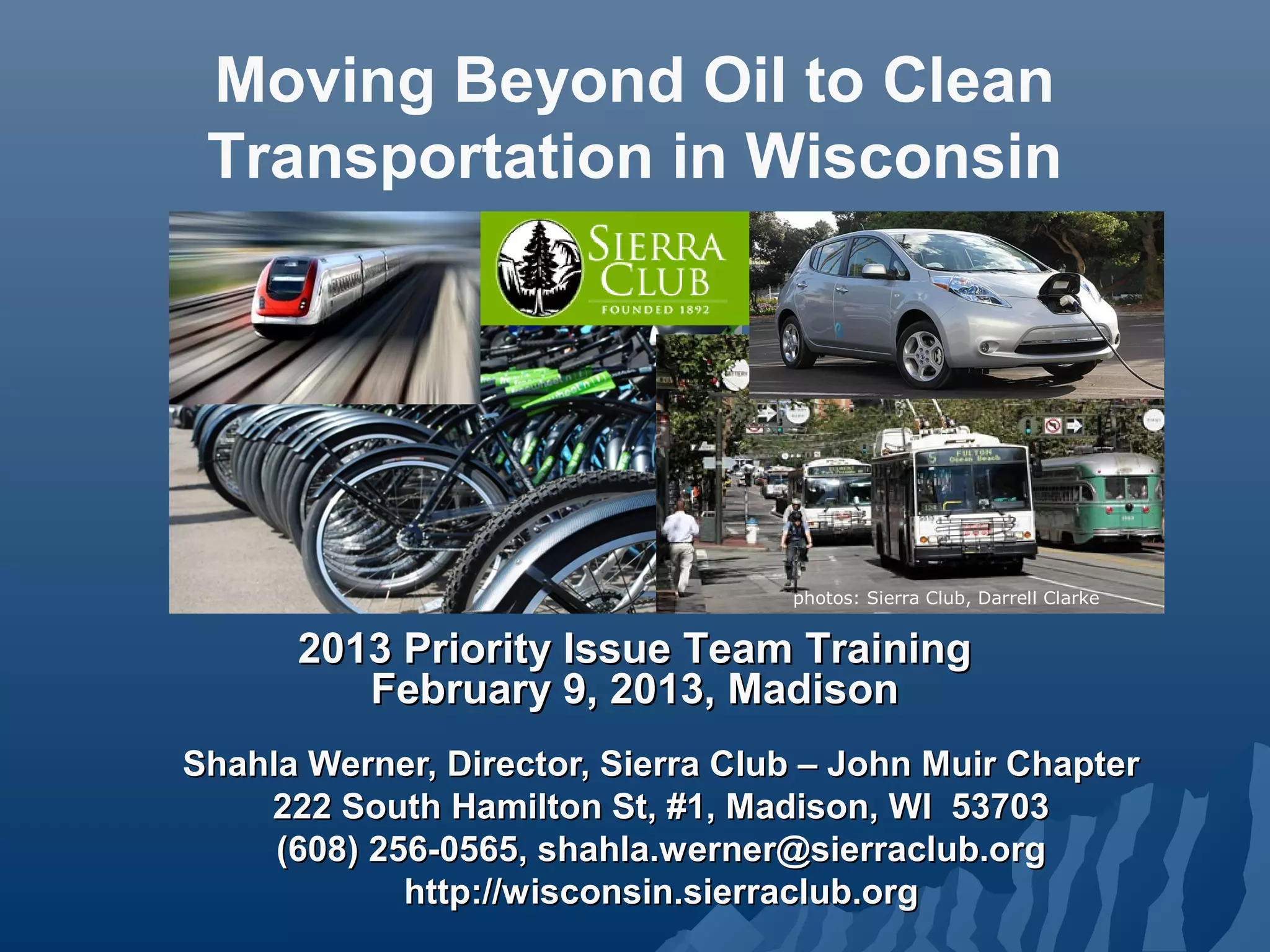
Moving Beyond Oil to Clean
 Transportation in Wisconsin


                                   photos: Sierra Club, Darrell Clarke


      2013 Priority Issue Team Training
         February 9, 2013, Madison
Shahla Werner, Director, Sierra Club – John Muir Chapter
    222 South Hamilton St, #1, Madison, WI 53703
     (608) 256-0565, shahla.werner@sierraclub.org
             http://wisconsin.sierraclub.org
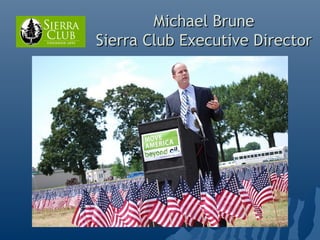
Michael Brune
Sierra Club Executive Director
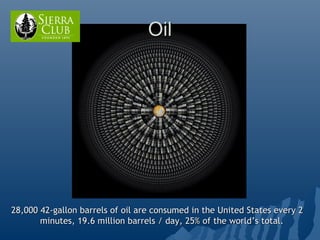
Oil


28,000 42-gallon barrels of oil are consumed in the United States every 2
       minutes, 19.6 million barrels / day, 25% of the world’s total.
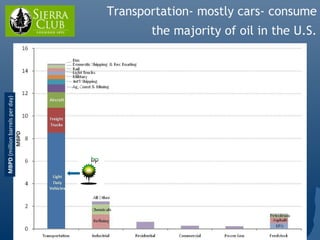
Transportation- mostly cars- consume
                                        the majority of oil in the U.S.
MBPD (million barrels per day)
Beyond Oil: Environmental Goal
Oil spills like the 1989 Exxon-Valdez and the 2010
BP disaster cause devastating environmental
damage and wreak havoc on coastal economies

Because the transportation sector contributes 1/3 of
all U.S. carbon dioxide emissions, it is a prime
target for greenhouse gas reductions.

Transportation choices that include walking, biking,
and public transit as well as cleaner, more efficient
cars and trucks can break our addiction to oil.
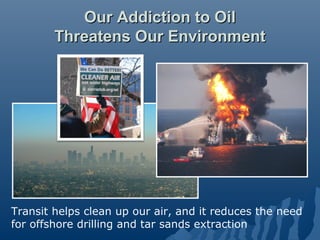
Our Addiction to Oil
        Threatens Our Environment


Transit helps clean up our air, and it reduces the need
for offshore drilling and tar sands extraction
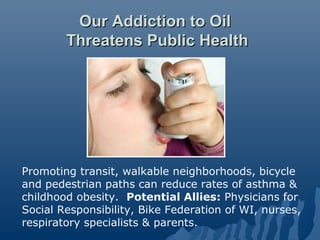
Our Addiction to Oil
        Threatens Public Health


Promoting transit, walkable neighborhoods, bicycle
and pedestrian paths can reduce rates of asthma &
childhood obesity. Potential Allies: Physicians for
Social Responsibility, Bike Federation of WI, nurses,
respiratory specialists & parents.
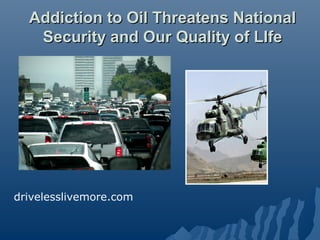
Addiction to Oil Threatens National
   Security and Our Quality of LIfe


drivelesslivemore.com
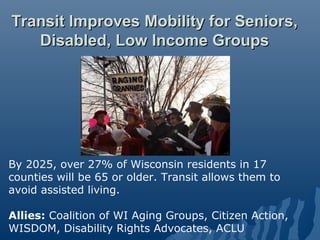
Transit Improves Mobility for Seniors,
   Disabled, Low Income Groups


By 2025, over 27% of Wisconsin residents in 17
counties will be 65 or older. Transit allows them to
avoid assisted living.

Allies: Coalition of WI Aging Groups, Citizen Action,
WISDOM, Disability Rights Advocates, ACLU
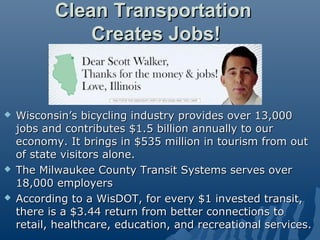
Clean Transportation
               Creates Jobs!


   Wisconsin’s bicycling industry provides over 13,000
    jobs and contributes $1.5 billion annually to our
    economy. It brings in $535 million in tourism from out
    of state visitors alone.
   The Milwaukee County Transit Systems serves over
    18,000 employers
   According to a WisDOT, for every $1 invested transit,
    there is a $3.44 return from better connections to
    retail, healthcare, education, and recreational services.
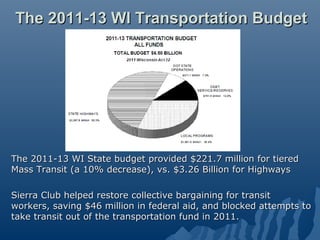
The 2011-13 WI Transportation Budget


The 2011-13 WI State budget provided $221.7 million for tiered
Mass Transit (a 10% decrease), vs. $3.26 Billion for Highways

Sierra Club helped restore collective bargaining for transit
workers, saving $46 million in federal aid, and blocked attempts to
take transit out of the transportation fund in 2011.
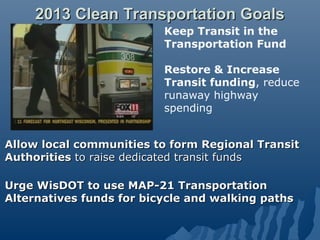
2013 Clean Transportation Goals
                          Keep Transit in the
                          Transportation Fund

                          Restore & Increase
                          Transit funding, reduce
                          runaway highway
                          spending


Allow local communities to form Regional Transit
Authorities to raise dedicated transit funds

Urge WisDOT to use MAP-21 Transportation
Alternatives funds for bicycle and walking paths
Environmental & Transit
     Organizational Allies
  WISPIRG
 One Thousand Friends of Wisconsin

 Wisconsin Urban & Rural Transit
  Association (WURTA)
 Wisconsin Counties Association

 Madison Metro, Valley Transit,
  Milwaukee Co. Transit System,
  Shoreline Metro (Sheboygan),
  Maritime Metro Transit (Manitowoc)
Key Decision-makers for Transit
           Funding
   Governor Walker, state budget released Feb.,
    legislators to pass by June

   The Joint Finance Committee

   The Senate Transportation Committee (Chair =
    Sen. Petrowski, Leibham, Cowles, Carpenter,
    Hansen).

   The Assembly Transportation Committee (Chair =
    Rep. Ripp, Vice Chair = Thiesfeldt, Stone, A. Ott)
Key Grasstops, or Powerful
  Allies who Can Influence
  Transit Funding Targets
 Mayors  (Hanna, Dickert)
 Transit Managers

 Coalition of Wisconsin Aging Groups

 Large Businesses / Employers (SC
  Johnson, Kohler, Aurora Medical
  Center, Miller, State of Wisconsin)
 Transportation Finance Commission
Wisconsin’s Transportation
      Finance Commission
Released Report, Keep Wisconsin Moving Jan. 23.

Wisconsinites are driving 3% less than in 2004, yet
report recommends increasing highway spending

Supports increasing transit funding, allowing Regional
Transit Authorities, raising gas tax, and charging
vehicle registration based on annual miles traveled.
http://www.dot.wisconsin.gov/about/tfp/docs/keep-wi-moving-report.pdf

http://www.wicounties.org/blog/wisconsin-transportation-and-finance-policy-
commission-release-final-report/
How Can Transit Compete with
Highways in the Next Budget?
   Draft a sign-on statement for mayors, businesses,
    transit managers, and organizations. Deliver to
    legislators and media by April.

   Organize in-district meetings with JFC members
    also on Transportation Committee

   Work with allies on the 10-10-10 solution to
    increase funds for transit and local roads by cutting
    highways by 10%; highlights imbalance
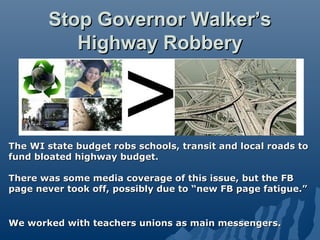
Stop Governor Walker’s
          Highway Robbery


The WI state budget robs schools, transit and local roads to
fund bloated highway budget.

There was some media coverage of this issue, but the FB
page never took off, possibly due to “new FB page fatigue.”


We worked with teachers unions as main messengers.
Environmental Justice & Transit:
   Zoo Interchange Lawsuit
ACLU & MEA filed suits against WisDOT & the US Dept.
of Transportation in 2012 for the way they designed the
$1.7 billion zoo interchange project.

The lawsuit was filed on behalf of Milwaukee Innercity
Congregations Allied for Hope and the Black Health
Coalition of Wisconsin.

It contends that the EIS failed to incorporate transit,
increased segregation, or barriers to work & medical
appointments for non-drivers caused by the project.

An injunction to halt construction was sought in Feb.
2013.
Grassroots Transit Tactics
Action Alerts to SC members, mentioning link
between oil addiction and climate change, tar sands,
& offshore drilling pollution. Phone bank to members
in key districts.

“Cash Cow” Rallies with Disability Rights, Labor,
Citizen Action, ACLU designed for negative attention
on runaway highway spending at transit’s expense

Highlight $2.4 billion in Big Oil tax deductions
(subsidies) that Exxon, Chevron, BP, Shell &
Conoco Phillips get each year, even as they rake
in record profits & cause devastating pollution.
Transportation Alternatives Funding
MAP-21, or Moving Ahead for Progress in the 21st
Century, is the federal transportation bill authorizes
$105 billion in spending through Sep. 2014.

MAP-21 includes the Transportation Alternatives
Program which funds Safe Routes to School (SRTS);
Transportation Enhancements (TE); and The Bicycle &
Pedestrian Facilities Program (BPFP). WisDOT can
opt out of using 50% of funding.

Gov. Walker announced $3.4 million in funding for 17
SRTS projects in Dec. 2012.

Decisionmakers: WisDOT Sec. Gottlieb, Wisconsin’s
14 Metropolitan Planning Organizations (MPOs)
Other Beyond Oil Activities
   Protesting the proposed Keystone XL Tar Sands
    pipeline
   Participating in Hands Across the Sand events
   Tracking expansion plans for Enbridge pipelines
    and Murphy Oil refinery. A pipeline ruptured in July
    2012 in Grand Marsh, WI.
   Expand Charging Stations for Electric Vehicles.
    Utilities can increase availability, sell more electrons.
    Companies can improve public image.
   Promoting Passenger Trains. MKE – MSN service
    would reduce traffic, create over 3,000 jobs, take
    500,000 cars of WI roads and cut carbon dioxide
    emissions by 190,000 metric tons per year.
Moving Beyond Oil by Protesting
               Keystone XL
   Tar Sands oil extraction causes 3x the GHG of
    conventional oil, destroys boreal forests, threatens
    public health, and jeopardizes Lake Athabasca

   The Keystone XL would transport tar sands oil from
    Alberta to Texas. A pipeline leak would
    contaminate the Nebraska Sandhills & the Ogallala
    Aquifer, which supplies drinking water to millions.

   The Sierra Club will join 350.org and the Hip Hop
    Caucus in Washington DC on February 17 to
    protest the Keystone XL pipeline and demand
    climate action
Questions?


   Shahla Werner, Director
Sierra Club – John Muir Chapter
222 South Hamilton St, #11,
      Madison, WI 53703
        (608) 256-0565
 shahla.werner@sierraclub.org

Beyond oil issuecommpresentation

  • 1.
    Moving Beyond Oilto Clean Transportation in Wisconsin photos: Sierra Club, Darrell Clarke 2013 Priority Issue Team Training February 9, 2013, Madison Shahla Werner, Director, Sierra Club – John Muir Chapter 222 South Hamilton St, #1, Madison, WI 53703 (608) 256-0565, shahla.werner@sierraclub.org http://wisconsin.sierraclub.org
  • 2.
    Michael Brune Sierra ClubExecutive Director
  • 3.
    Oil 28,000 42-gallon barrelsof oil are consumed in the United States every 2 minutes, 19.6 million barrels / day, 25% of the world’s total.
  • 4.
    Transportation- mostly cars-consume the majority of oil in the U.S. MBPD (million barrels per day)
  • 5.
    Beyond Oil: EnvironmentalGoal Oil spills like the 1989 Exxon-Valdez and the 2010 BP disaster cause devastating environmental damage and wreak havoc on coastal economies Because the transportation sector contributes 1/3 of all U.S. carbon dioxide emissions, it is a prime target for greenhouse gas reductions. Transportation choices that include walking, biking, and public transit as well as cleaner, more efficient cars and trucks can break our addiction to oil.
  • 6.
    Our Addiction toOil Threatens Our Environment Transit helps clean up our air, and it reduces the need for offshore drilling and tar sands extraction
  • 7.
    Our Addiction toOil Threatens Public Health Promoting transit, walkable neighborhoods, bicycle and pedestrian paths can reduce rates of asthma & childhood obesity. Potential Allies: Physicians for Social Responsibility, Bike Federation of WI, nurses, respiratory specialists & parents.
  • 8.
    Addiction to OilThreatens National Security and Our Quality of LIfe drivelesslivemore.com
  • 9.
    Transit Improves Mobilityfor Seniors, Disabled, Low Income Groups By 2025, over 27% of Wisconsin residents in 17 counties will be 65 or older. Transit allows them to avoid assisted living. Allies: Coalition of WI Aging Groups, Citizen Action, WISDOM, Disability Rights Advocates, ACLU
  • 10.
    Clean Transportation Creates Jobs!  Wisconsin’s bicycling industry provides over 13,000 jobs and contributes $1.5 billion annually to our economy. It brings in $535 million in tourism from out of state visitors alone.  The Milwaukee County Transit Systems serves over 18,000 employers  According to a WisDOT, for every $1 invested transit, there is a $3.44 return from better connections to retail, healthcare, education, and recreational services.
  • 11.
    The 2011-13 WITransportation Budget The 2011-13 WI State budget provided $221.7 million for tiered Mass Transit (a 10% decrease), vs. $3.26 Billion for Highways Sierra Club helped restore collective bargaining for transit workers, saving $46 million in federal aid, and blocked attempts to take transit out of the transportation fund in 2011.
  • 12.
    2013 Clean TransportationGoals Keep Transit in the Transportation Fund Restore & Increase Transit funding, reduce runaway highway spending Allow local communities to form Regional Transit Authorities to raise dedicated transit funds Urge WisDOT to use MAP-21 Transportation Alternatives funds for bicycle and walking paths
  • 13.
    Environmental & Transit Organizational Allies  WISPIRG  One Thousand Friends of Wisconsin  Wisconsin Urban & Rural Transit Association (WURTA)  Wisconsin Counties Association  Madison Metro, Valley Transit, Milwaukee Co. Transit System, Shoreline Metro (Sheboygan), Maritime Metro Transit (Manitowoc)
  • 14.
    Key Decision-makers forTransit Funding  Governor Walker, state budget released Feb., legislators to pass by June  The Joint Finance Committee  The Senate Transportation Committee (Chair = Sen. Petrowski, Leibham, Cowles, Carpenter, Hansen).  The Assembly Transportation Committee (Chair = Rep. Ripp, Vice Chair = Thiesfeldt, Stone, A. Ott)
  • 15.
    Key Grasstops, orPowerful Allies who Can Influence Transit Funding Targets  Mayors (Hanna, Dickert)  Transit Managers  Coalition of Wisconsin Aging Groups  Large Businesses / Employers (SC Johnson, Kohler, Aurora Medical Center, Miller, State of Wisconsin)  Transportation Finance Commission
  • 16.
    Wisconsin’s Transportation Finance Commission Released Report, Keep Wisconsin Moving Jan. 23. Wisconsinites are driving 3% less than in 2004, yet report recommends increasing highway spending Supports increasing transit funding, allowing Regional Transit Authorities, raising gas tax, and charging vehicle registration based on annual miles traveled. http://www.dot.wisconsin.gov/about/tfp/docs/keep-wi-moving-report.pdf http://www.wicounties.org/blog/wisconsin-transportation-and-finance-policy- commission-release-final-report/
  • 17.
    How Can TransitCompete with Highways in the Next Budget?  Draft a sign-on statement for mayors, businesses, transit managers, and organizations. Deliver to legislators and media by April.  Organize in-district meetings with JFC members also on Transportation Committee  Work with allies on the 10-10-10 solution to increase funds for transit and local roads by cutting highways by 10%; highlights imbalance
  • 18.
    Stop Governor Walker’s Highway Robbery The WI state budget robs schools, transit and local roads to fund bloated highway budget. There was some media coverage of this issue, but the FB page never took off, possibly due to “new FB page fatigue.” We worked with teachers unions as main messengers.
  • 19.
    Environmental Justice &Transit: Zoo Interchange Lawsuit ACLU & MEA filed suits against WisDOT & the US Dept. of Transportation in 2012 for the way they designed the $1.7 billion zoo interchange project. The lawsuit was filed on behalf of Milwaukee Innercity Congregations Allied for Hope and the Black Health Coalition of Wisconsin. It contends that the EIS failed to incorporate transit, increased segregation, or barriers to work & medical appointments for non-drivers caused by the project. An injunction to halt construction was sought in Feb. 2013.
  • 20.
    Grassroots Transit Tactics ActionAlerts to SC members, mentioning link between oil addiction and climate change, tar sands, & offshore drilling pollution. Phone bank to members in key districts. “Cash Cow” Rallies with Disability Rights, Labor, Citizen Action, ACLU designed for negative attention on runaway highway spending at transit’s expense Highlight $2.4 billion in Big Oil tax deductions (subsidies) that Exxon, Chevron, BP, Shell & Conoco Phillips get each year, even as they rake in record profits & cause devastating pollution.
  • 21.
    Transportation Alternatives Funding MAP-21,or Moving Ahead for Progress in the 21st Century, is the federal transportation bill authorizes $105 billion in spending through Sep. 2014. MAP-21 includes the Transportation Alternatives Program which funds Safe Routes to School (SRTS); Transportation Enhancements (TE); and The Bicycle & Pedestrian Facilities Program (BPFP). WisDOT can opt out of using 50% of funding. Gov. Walker announced $3.4 million in funding for 17 SRTS projects in Dec. 2012. Decisionmakers: WisDOT Sec. Gottlieb, Wisconsin’s 14 Metropolitan Planning Organizations (MPOs)
  • 22.
    Other Beyond OilActivities  Protesting the proposed Keystone XL Tar Sands pipeline  Participating in Hands Across the Sand events  Tracking expansion plans for Enbridge pipelines and Murphy Oil refinery. A pipeline ruptured in July 2012 in Grand Marsh, WI.  Expand Charging Stations for Electric Vehicles. Utilities can increase availability, sell more electrons. Companies can improve public image.  Promoting Passenger Trains. MKE – MSN service would reduce traffic, create over 3,000 jobs, take 500,000 cars of WI roads and cut carbon dioxide emissions by 190,000 metric tons per year.
  • 23.
    Moving Beyond Oilby Protesting Keystone XL  Tar Sands oil extraction causes 3x the GHG of conventional oil, destroys boreal forests, threatens public health, and jeopardizes Lake Athabasca  The Keystone XL would transport tar sands oil from Alberta to Texas. A pipeline leak would contaminate the Nebraska Sandhills & the Ogallala Aquifer, which supplies drinking water to millions.  The Sierra Club will join 350.org and the Hip Hop Caucus in Washington DC on February 17 to protest the Keystone XL pipeline and demand climate action
  • 24.
    Questions? Shahla Werner, Director Sierra Club – John Muir Chapter 222 South Hamilton St, #11, Madison, WI 53703 (608) 256-0565 shahla.werner@sierraclub.org