By Ali Afzal .
1
Beta Oxidation .
 In biochemistry and metabolism, beta-oxidation is
the catabolic process by which fatty acid molecules
are broken down in the cytosol in prokaryotes and
in the mitochondria in eukaryotes to generate
acetyl-CoA, which enters the citric acid cycle, and
NADH and FADH2, which are co-enzymes used in
the electron transport .
2
Beta Oxidation.
 It is named as such because the beta carbon of the
fatty acid undergoes oxidation to a carbonyl group.
Beta-oxidation is primarily facilitated by
the mitochondrial trifunctional protein, an enzyme
complex associated with the inner mitochondrial
membrane, although very long chain fatty acids are
oxidized in peroxisomes.
3
Steps of Beta Oxidation.
4
Beta Oxidation Steps.
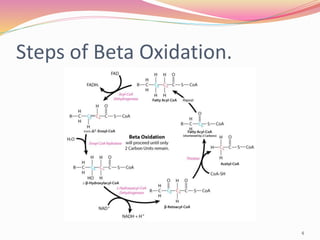
Beta oxidation takes place in four steps:
dehydrogenation, hydration, oxidation and thyolisis.
Each step is catalyzed by a distinct enzyme.
Briefly, each cycle of this process begins with an acyl-
CoA chain and ends with one acetyl-CoA, one FADH2,
one NADH and water, and the acyl-CoA chain becomes
two carbons shorter. The total energy yield per cycle is
17 ATP molecules (see below for details on the
breakdown). This cycle is repeated until two acetyl-CoA
molecules are formed as opposed to one acyl-CoA and
one acetyl-CoA.
5
Dehydrogenation
In the first step, acyl-CoA is oxidized by the enzyme acyl CoA
dehydrogenase. A double bond is formed between the second
and third carbons (C2 and C3) of the acyl-CoA chain
entering the beta oxidation cycle; the end product of this
reaction is trans-Δ2-enoyl-CoA (trans-delta 2-enoyl CoA).
This step uses FAD and produces FADH2, which will enter
the citric acid cycle and form ATP to be used as energy.
(Notice in the following figure that the carbon count starts
on the right side: the rightmost carbon below the oxygen
atom is C1, then C2 on the left forming a double bond with
C3, and so on.)
6
Hydration.
In the second step, the double bond between C2 and C3 of
trans-Δ2-enoyl-CoA is hydrated, forming the end
product L-β-hydroxyacyl CoA, which has a hydroxyl
group (OH) in C2, in place of the double bond. This
reaction is catalyzed by another enzyme: enoyl CoA
hydratase. This step requires water.
7
Oxidation.
In the third step, the hydroxyl group in C2 of L-β-
hydroxyacyl CoA is oxidized by NAD+ in a reaction that
is catalyzed by 3-hydroxyacyl-CoA dehydrogenase. The
end products are β-ketoacyl CoA and NADH + H.
NADH will enter the citric acid cycle and produce ATP
that will be used as energy.
8
Thiolysis.
Finally, in the fourth step, β-ketoacyl CoA is cleaved by a
thiol group (SH) of another CoA molecule (CoA-SH).
The enzyme that catalyzes this reaction is β-
ketothiolase. The cleavage takes place between C2 and
C3; therefore, the end products are an acetyl-CoA
molecule with the original two first carbons (C1 and
C2), and an acyl-CoA chain two carbons shorter than
the original acyl-CoA chain that entered the beta
oxidation cycle.
9
Energy Yield and End Products.
 Each beta oxidation cycle yields 1 FADH2, 1 NADH and
1 acetyl-CoA, which in terms of energy is equivalent to
17 ATP molecules:
 1 FADH2 (x 2 ATP) = 2 ATP
 1 NADH (x 3 ATP) = 3 ATP
 1 acetyl-CoA (x 12 ATP) = 12 ATP
 Total = 2 + 3 + 12 = 17 ATP.
10
Cont….
 However, the theoretical ATP yield is higher than the
real ATP yield. In reality, the equivalent of about 12 to 16
ATPs is produced in each beta oxidation cycle.
 Besides energy yield, the fatty acyl-CoaA chain becomes
two carbons shorter with each cycle. In addition, beta
oxidation yields great amounts of water; this is
beneficial for eukaryotic organisms such as camels
given their limited access to drinkable water.
11
The End..
12

Beta Oxidation By Ali Afzal.pptx

  • 1.
  • 2.
    Beta Oxidation . In biochemistry and metabolism, beta-oxidation is the catabolic process by which fatty acid molecules are broken down in the cytosol in prokaryotes and in the mitochondria in eukaryotes to generate acetyl-CoA, which enters the citric acid cycle, and NADH and FADH2, which are co-enzymes used in the electron transport . 2
  • 3.
    Beta Oxidation.  Itis named as such because the beta carbon of the fatty acid undergoes oxidation to a carbonyl group. Beta-oxidation is primarily facilitated by the mitochondrial trifunctional protein, an enzyme complex associated with the inner mitochondrial membrane, although very long chain fatty acids are oxidized in peroxisomes. 3
  • 4.
    Steps of BetaOxidation. 4
  • 5.
    Beta Oxidation Steps. Betaoxidation takes place in four steps: dehydrogenation, hydration, oxidation and thyolisis. Each step is catalyzed by a distinct enzyme. Briefly, each cycle of this process begins with an acyl- CoA chain and ends with one acetyl-CoA, one FADH2, one NADH and water, and the acyl-CoA chain becomes two carbons shorter. The total energy yield per cycle is 17 ATP molecules (see below for details on the breakdown). This cycle is repeated until two acetyl-CoA molecules are formed as opposed to one acyl-CoA and one acetyl-CoA. 5
  • 6.
    Dehydrogenation In the firststep, acyl-CoA is oxidized by the enzyme acyl CoA dehydrogenase. A double bond is formed between the second and third carbons (C2 and C3) of the acyl-CoA chain entering the beta oxidation cycle; the end product of this reaction is trans-Δ2-enoyl-CoA (trans-delta 2-enoyl CoA). This step uses FAD and produces FADH2, which will enter the citric acid cycle and form ATP to be used as energy. (Notice in the following figure that the carbon count starts on the right side: the rightmost carbon below the oxygen atom is C1, then C2 on the left forming a double bond with C3, and so on.) 6
  • 7.
    Hydration. In the secondstep, the double bond between C2 and C3 of trans-Δ2-enoyl-CoA is hydrated, forming the end product L-β-hydroxyacyl CoA, which has a hydroxyl group (OH) in C2, in place of the double bond. This reaction is catalyzed by another enzyme: enoyl CoA hydratase. This step requires water. 7
  • 8.
    Oxidation. In the thirdstep, the hydroxyl group in C2 of L-β- hydroxyacyl CoA is oxidized by NAD+ in a reaction that is catalyzed by 3-hydroxyacyl-CoA dehydrogenase. The end products are β-ketoacyl CoA and NADH + H. NADH will enter the citric acid cycle and produce ATP that will be used as energy. 8
  • 9.
    Thiolysis. Finally, in thefourth step, β-ketoacyl CoA is cleaved by a thiol group (SH) of another CoA molecule (CoA-SH). The enzyme that catalyzes this reaction is β- ketothiolase. The cleavage takes place between C2 and C3; therefore, the end products are an acetyl-CoA molecule with the original two first carbons (C1 and C2), and an acyl-CoA chain two carbons shorter than the original acyl-CoA chain that entered the beta oxidation cycle. 9
  • 10.
    Energy Yield andEnd Products.  Each beta oxidation cycle yields 1 FADH2, 1 NADH and 1 acetyl-CoA, which in terms of energy is equivalent to 17 ATP molecules:  1 FADH2 (x 2 ATP) = 2 ATP  1 NADH (x 3 ATP) = 3 ATP  1 acetyl-CoA (x 12 ATP) = 12 ATP  Total = 2 + 3 + 12 = 17 ATP. 10
  • 11.
    Cont….  However, thetheoretical ATP yield is higher than the real ATP yield. In reality, the equivalent of about 12 to 16 ATPs is produced in each beta oxidation cycle.  Besides energy yield, the fatty acyl-CoaA chain becomes two carbons shorter with each cycle. In addition, beta oxidation yields great amounts of water; this is beneficial for eukaryotic organisms such as camels given their limited access to drinkable water. 11
  • 12.