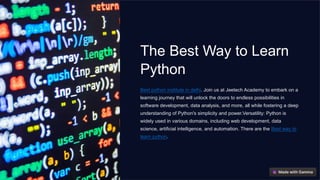
The Best Way to Learn
Python
Best python institute in delhi. Join us at Jeetech Academy to embark on a
learning journey that will unlock the doors to endless possibilities in
software development, data analysis, and more, all while fostering a deep
understanding of Python's simplicity and power.Versatility: Python is
widely used in various domains, including web development, data
science, artificial intelligence, and automation. There are the Best way to
learn python.
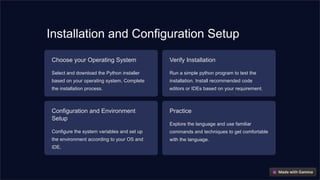
Installation and Configuration Setup
Choose your Operating System
Select and download the Python installer
based on your operating system. Complete
the installation process.
Verify Installation
Run a simple python program to test the
installation. Install recommended code
editors or IDEs based on your requirement.
Configuration and Environment
Setup
Configure the system variables and set up
the environment according to your OS and
IDE.
Practice
Explore the language and use familiar
commands and techniques to get comfortable
with the language.
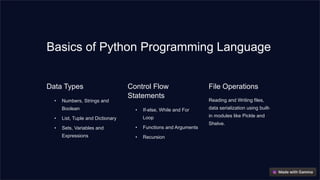
Basics of Python Programming Language
Data Types
• Numbers, Strings and
Boolean
• List, Tuple and Dictionary
• Sets, Variables and
Expressions
Control Flow
Statements
• If-else, While and For
Loop
• Functions and Arguments
• Recursion
File Operations
Reading and Writing files,
data serialization using built-
in modules like Pickle and
Shelve.
Python Data Structures
Lists
A collection of items which can be of multiple
datatypes. It can be changed, modified and
known for versatility and flexibility.
Dictionaries
A collection of key-value pairs. It is known for
fast operations such as searching and update.
Tuples
An immutable collection of ordered items. It is
Sets
An unordered and unindexed collection of
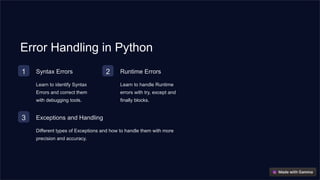
Error Handling in Python
1 Syntax Errors
Learn to identify Syntax
Errors and correct them
with debugging tools.
2 Runtime Errors
Learn to handle Runtime
errors with try, except and
finally blocks.
3 Exceptions and Handling
Different types of Exceptions and how to handle them with more
precision and accuracy.
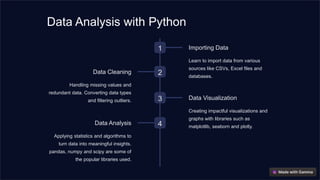
Data Analysis with Python
1 Importing Data
Learn to import data from various
sources like CSVs, Excel files and
databases.
2
Data Cleaning
Handling missing values and
redundant data. Converting data types
and filtering outliers. 3 Data Visualization
Creating impactful visualizations and
graphs with libraries such as
matplotlib, seaborn and plotly.
4
Data Analysis
Applying statistics and algorithms to
turn data into meaningful insights.
pandas, numpy and scipy are some of
the popular libraries used.
Conclusion
Python is a powerful language and an essential
tool for any aspiring programmer. With the help
of various resources and guidance, anyone can
learn and master the language. Remember,
practice makes perfect.
So, start your journey of learning Python and
explore the magic and potential of this amazing
language.

best source to learn python

  • 1.
    The Best Wayto Learn Python Best python institute in delhi. Join us at Jeetech Academy to embark on a learning journey that will unlock the doors to endless possibilities in software development, data analysis, and more, all while fostering a deep understanding of Python's simplicity and power.Versatility: Python is widely used in various domains, including web development, data science, artificial intelligence, and automation. There are the Best way to learn python.
  • 2.
    Installation and ConfigurationSetup Choose your Operating System Select and download the Python installer based on your operating system. Complete the installation process. Verify Installation Run a simple python program to test the installation. Install recommended code editors or IDEs based on your requirement. Configuration and Environment Setup Configure the system variables and set up the environment according to your OS and IDE. Practice Explore the language and use familiar commands and techniques to get comfortable with the language.
  • 3.
    Basics of PythonProgramming Language Data Types • Numbers, Strings and Boolean • List, Tuple and Dictionary • Sets, Variables and Expressions Control Flow Statements • If-else, While and For Loop • Functions and Arguments • Recursion File Operations Reading and Writing files, data serialization using built- in modules like Pickle and Shelve.
  • 4.
    Python Data Structures Lists Acollection of items which can be of multiple datatypes. It can be changed, modified and known for versatility and flexibility. Dictionaries A collection of key-value pairs. It is known for fast operations such as searching and update. Tuples An immutable collection of ordered items. It is Sets An unordered and unindexed collection of
  • 5.
    Error Handling inPython 1 Syntax Errors Learn to identify Syntax Errors and correct them with debugging tools. 2 Runtime Errors Learn to handle Runtime errors with try, except and finally blocks. 3 Exceptions and Handling Different types of Exceptions and how to handle them with more precision and accuracy.
  • 6.
    Data Analysis withPython 1 Importing Data Learn to import data from various sources like CSVs, Excel files and databases. 2 Data Cleaning Handling missing values and redundant data. Converting data types and filtering outliers. 3 Data Visualization Creating impactful visualizations and graphs with libraries such as matplotlib, seaborn and plotly. 4 Data Analysis Applying statistics and algorithms to turn data into meaningful insights. pandas, numpy and scipy are some of the popular libraries used.
  • 7.
    Conclusion Python is apowerful language and an essential tool for any aspiring programmer. With the help of various resources and guidance, anyone can learn and master the language. Remember, practice makes perfect. So, start your journey of learning Python and explore the magic and potential of this amazing language.