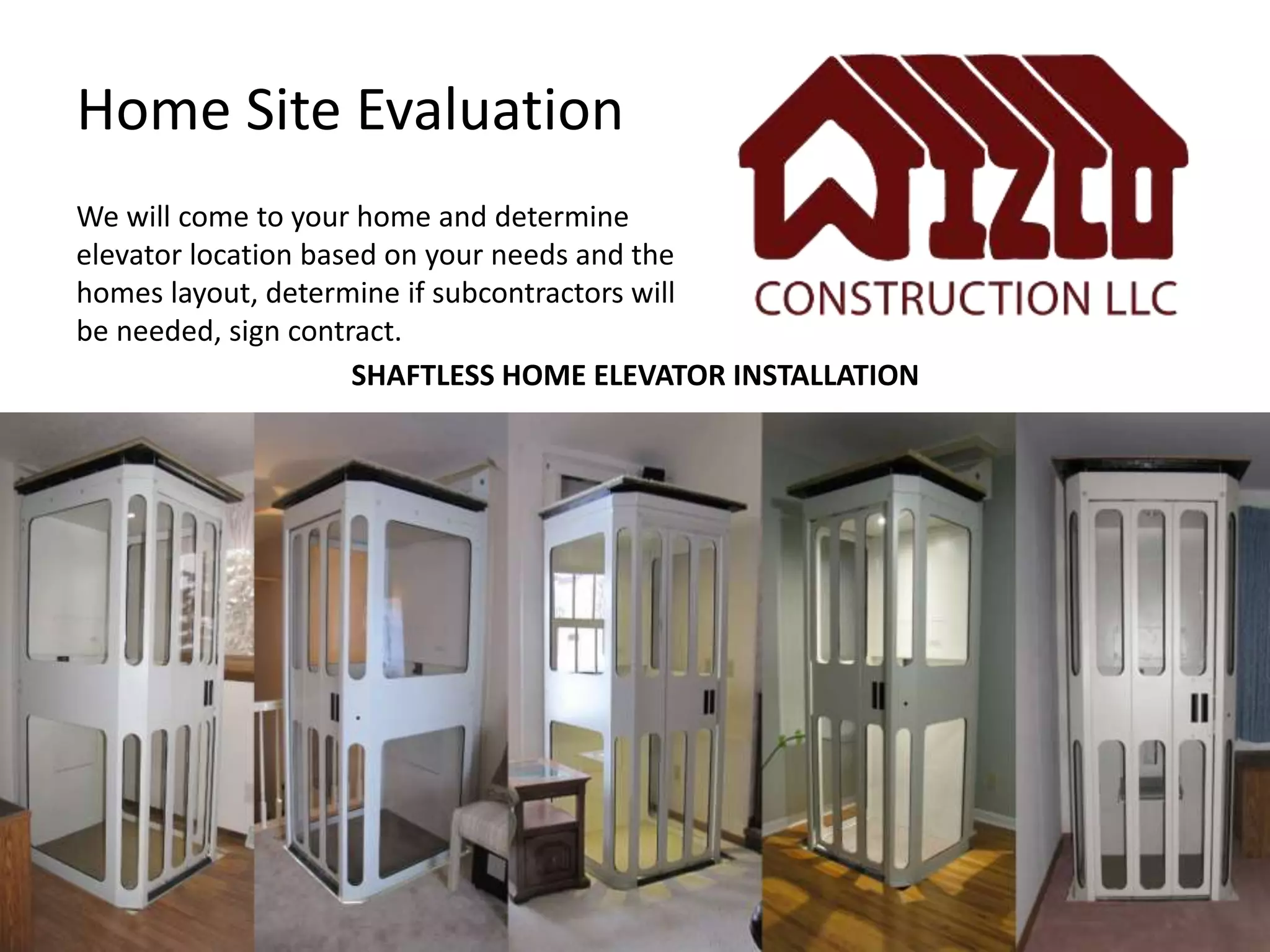
We will come to your home and determine
elevator location based on your needs and the
homes layout, determine if subcontractors will
be needed, sign contract.
Home Site Evaluation
SHAFTLESS HOME ELEVATOR INSTALLATION
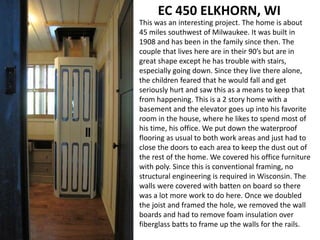
EC 450 ELKHORN, WI
This was an interesting project. The home is about
45 miles southwest of Milwaukee. It was built in
1908 and has been in the family since then. The
couple that lives here are in their 90’s but are in
great shape except he has trouble with stairs,
especially going down. Since they live there alone,
the children feared that he would fall and get
seriously hurt and saw this as a means to keep that
from happening. This is a 2 story home with a
basement and the elevator goes up into his favorite
room in the house, where he likes to spend most of
his time, his office. We put down the waterproof
flooring as usual to both work areas and just had to
close the doors to each area to keep the dust out of
the rest of the home. We covered his office furniture
with poly. Since this is conventional framing, no
structural engineering is required in Wisconsin. The
walls were covered with batten on board so there
was a lot more work to do here. Once we doubled
the joist and framed the hole, we removed the wall
boards and had to remove foam insulation over
fiberglass batts to frame up the walls for the rails.
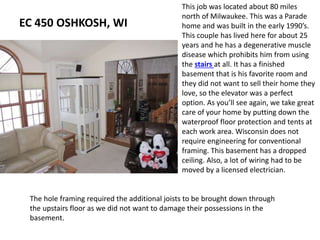
EC 450 OSHKOSH, WI
This job was located about 80 miles
north of Milwaukee. This was a Parade
home and was built in the early 1990’s.
This couple has lived here for about 25
years and he has a degenerative muscle
disease which prohibits him from using
the stairs at all. It has a finished
basement that is his favorite room and
they did not want to sell their home they
love, so the elevator was a perfect
option. As you’ll see again, we take great
care of your home by putting down the
waterproof floor protection and tents at
each work area. Wisconsin does not
require engineering for conventional
framing. This basement has a dropped
ceiling. Also, a lot of wiring had to be
moved by a licensed electrician.
The hole framing required the additional joists to be brought down through
the upstairs floor as we did not want to damage their possessions in the
basement.
ELEVATORS
Elevator Specifications
•See-through car
•No special wiring – runs off of 110V
household current
•Designed is meet ASME standards
•Battery operated – runs in BOTH directions
during power outages
•Capacity: 1-2 persons, 400 lbs
•Length: up to 14 feet of travel
•Footprint: 38” wide x 48” from wall, or 38”
wide x 39” from wall
•Car accommodates small wheelchair, rollator
or power chair
•Car controls: up/down, key-switch, E-stop,
alarm, diagnostic LED, car light control switch
•Wireless call-boxes enable rider to call or send
unit to either landing
•FOB control for remote use
•Telephone in car
•Pull down seat
Safety Devices & Features
•Safety hatch on top of car stops travel if 20 lbs
or more is on top of car.
•Safety pan under car stop travel if four lbs or
more of force is exerted underneath car.
•Two ¼” diameter 7 x 19 GAC cables support
the car. Each cable has a breaking strength of
7,000 lbs.
•Sliding radial door allows person to get in and
out of elevator in an emergency, even between
floors.
•Hand rails inside car to assist and stabilize
riders
•Emergency unlocking device for door lock
•UL Listed door interlock – senses door is both
closed and locked before allowing unit to
operate.
•Regular and final limit switches.
•Slack cable safety switches and broken cable
safety
Installation/Maintenance
•10-12 day complete installation, including
remodeling.
•Installs on any wall – even non-load bearing.
•Unassembled to fit any doorway.
•Can be installed in room with ceilings as low
as 7’6”.
•No pit, no machine room, no dedicated outlet
required.
•Electrical requirements are 110volt, 2 amps
•Only required maintenance is replacing
batteries every 2-3 years.
•Technical service support in the USA.
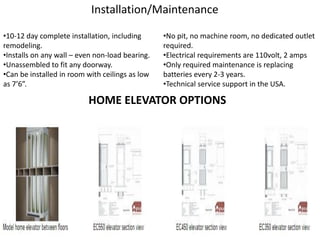
HOME ELEVATOR OPTIONS
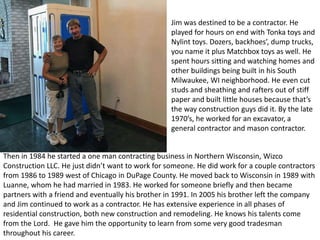
Jim was destined to be a contractor. He
played for hours on end with Tonka toys and
Nylint toys. Dozers, backhoes’, dump trucks,
you name it plus Matchbox toys as well. He
spent hours sitting and watching homes and
other buildings being built in his South
Milwaukee, WI neighborhood. He even cut
studs and sheathing and rafters out of stiff
paper and built little houses because that’s
the way construction guys did it. By the late
1970’s, he worked for an excavator, a
general contractor and mason contractor.
Then in 1984 he started a one man contracting business in Northern Wisconsin, Wizco
Construction LLC. He just didn’t want to work for someone. He did work for a couple contractors
from 1986 to 1989 west of Chicago in DuPage County. He moved back to Wisconsin in 1989 with
Luanne, whom he had married in 1983. He worked for someone briefly and then became
partners with a friend and eventually his brother in 1991. In 2005 his brother left the company
and Jim continued to work as a contractor. He has extensive experience in all phases of
residential construction, both new construction and remodeling. He knows his talents come
from the Lord. He gave him the opportunity to learn from some very good tradesman
throughout his career.
Best SHAFTLESS HOME ELEVATOR INSTALLATION

Best SHAFTLESS HOME ELEVATOR INSTALLATION

  • 1.
    We will cometo your home and determine elevator location based on your needs and the homes layout, determine if subcontractors will be needed, sign contract. Home Site Evaluation SHAFTLESS HOME ELEVATOR INSTALLATION
  • 2.
    EC 450 ELKHORN,WI This was an interesting project. The home is about 45 miles southwest of Milwaukee. It was built in 1908 and has been in the family since then. The couple that lives here are in their 90’s but are in great shape except he has trouble with stairs, especially going down. Since they live there alone, the children feared that he would fall and get seriously hurt and saw this as a means to keep that from happening. This is a 2 story home with a basement and the elevator goes up into his favorite room in the house, where he likes to spend most of his time, his office. We put down the waterproof flooring as usual to both work areas and just had to close the doors to each area to keep the dust out of the rest of the home. We covered his office furniture with poly. Since this is conventional framing, no structural engineering is required in Wisconsin. The walls were covered with batten on board so there was a lot more work to do here. Once we doubled the joist and framed the hole, we removed the wall boards and had to remove foam insulation over fiberglass batts to frame up the walls for the rails.
  • 3.
    EC 450 OSHKOSH,WI This job was located about 80 miles north of Milwaukee. This was a Parade home and was built in the early 1990’s. This couple has lived here for about 25 years and he has a degenerative muscle disease which prohibits him from using the stairs at all. It has a finished basement that is his favorite room and they did not want to sell their home they love, so the elevator was a perfect option. As you’ll see again, we take great care of your home by putting down the waterproof floor protection and tents at each work area. Wisconsin does not require engineering for conventional framing. This basement has a dropped ceiling. Also, a lot of wiring had to be moved by a licensed electrician. The hole framing required the additional joists to be brought down through the upstairs floor as we did not want to damage their possessions in the basement.
  • 4.
    ELEVATORS Elevator Specifications •See-through car •Nospecial wiring – runs off of 110V household current •Designed is meet ASME standards •Battery operated – runs in BOTH directions during power outages •Capacity: 1-2 persons, 400 lbs •Length: up to 14 feet of travel •Footprint: 38” wide x 48” from wall, or 38” wide x 39” from wall •Car accommodates small wheelchair, rollator or power chair •Car controls: up/down, key-switch, E-stop, alarm, diagnostic LED, car light control switch •Wireless call-boxes enable rider to call or send unit to either landing •FOB control for remote use •Telephone in car •Pull down seat Safety Devices & Features •Safety hatch on top of car stops travel if 20 lbs or more is on top of car. •Safety pan under car stop travel if four lbs or more of force is exerted underneath car. •Two ¼” diameter 7 x 19 GAC cables support the car. Each cable has a breaking strength of 7,000 lbs. •Sliding radial door allows person to get in and out of elevator in an emergency, even between floors. •Hand rails inside car to assist and stabilize riders •Emergency unlocking device for door lock •UL Listed door interlock – senses door is both closed and locked before allowing unit to operate. •Regular and final limit switches. •Slack cable safety switches and broken cable safety
  • 5.
    Installation/Maintenance •10-12 day completeinstallation, including remodeling. •Installs on any wall – even non-load bearing. •Unassembled to fit any doorway. •Can be installed in room with ceilings as low as 7’6”. •No pit, no machine room, no dedicated outlet required. •Electrical requirements are 110volt, 2 amps •Only required maintenance is replacing batteries every 2-3 years. •Technical service support in the USA. HOME ELEVATOR OPTIONS
  • 6.
    Jim was destinedto be a contractor. He played for hours on end with Tonka toys and Nylint toys. Dozers, backhoes’, dump trucks, you name it plus Matchbox toys as well. He spent hours sitting and watching homes and other buildings being built in his South Milwaukee, WI neighborhood. He even cut studs and sheathing and rafters out of stiff paper and built little houses because that’s the way construction guys did it. By the late 1970’s, he worked for an excavator, a general contractor and mason contractor. Then in 1984 he started a one man contracting business in Northern Wisconsin, Wizco Construction LLC. He just didn’t want to work for someone. He did work for a couple contractors from 1986 to 1989 west of Chicago in DuPage County. He moved back to Wisconsin in 1989 with Luanne, whom he had married in 1983. He worked for someone briefly and then became partners with a friend and eventually his brother in 1991. In 2005 his brother left the company and Jim continued to work as a contractor. He has extensive experience in all phases of residential construction, both new construction and remodeling. He knows his talents come from the Lord. He gave him the opportunity to learn from some very good tradesman throughout his career.