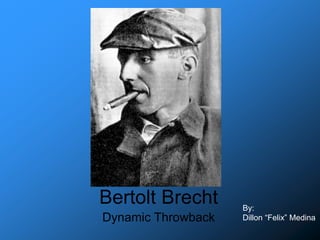
Bertolt Brecht
Dynamic Throwback
By:
Dillon “Felix” Medina
Quick Bio
• Born in Augsburg Bavaria to middle class
parents.
• Bright quiet student in grade school
• As a child, he visited folk festivals and saw
extremely detailed dioramas of historical
events. These simple, expressive images
captured his imagination and had a strong
influence on his artistic style later in life.
• Went to Medical school where he was
drafted into the German army near the end
of the first World War.
• He was stationed in a VD clinic, but was
still affected by the images he was
exposed to.
• This experience would greatly influence
his writing throughout his life and lead him
to adopting a pacifist philosophy.
Quick Bio (cont.)
Emerging Artist
• Around this time he began to write plays,
finishing his first full length piece, entitled
Baal, in 1919.
• Created in response to The Loner (Der
Einsame) by Hans Johst.
• The first of many works to be created in
response to another work.
“Anyone can be creative. It’s rewriting other
people that’s challenging.”
Berlin
• In September 1924, Brecht was hired as a
dramaturge at Max Reinhardt’s Deutsches
Theater in Berlin, one of the top theaters in the
world at the time.
• Around this time he met Elisabeth Hauptmann
who he remained romantically and
professionally involved with for the rest of his
life.
• Also during this time, he married Helene Weigel,
a successful actress with whom he remained
with for the rest of his life, albeit not faithfully.
Berlin (cont.)
• Around this time he began establishing the
“Brecht Collective.”
• First play produced by the “collective” was
Mann ist Mann.
• Marks the beginning of his “epic theatre.
• Began studying Marxist theory, and from
this point on remained an avid communist
in life and art.
Exile
• Because of Hitler’s rising
power, Brecht left Germany
in 1933 for Denmark, and
then on to Sweden, and
finally ending in America in
1941.
• He worked on several
screenplays for Hollywood
and hated every second of it.
HUAC
• Blacklisted and subpoenaed in 1947.
• Laughed through the whole proceedings
and contradicted everything he espoused,
which was defendable according to his
personal philosophy.
• Flabbergasted the board.
• Flew to Europe the day after the hearings
were finished.
Return
• Brecht returned to communist controlled
East Germany in 1949
• Established the Berliner Ensemble in his
very own theater in 1954.
• No new plays came out of this period, but
he continued to write poetry, and some of
his better known pieces came out of this
period.
Butting Heads
• Brecht and East German officials
continually bumped heads over the
years. Artistic censorship frustrated
Brecht, even as he was being held up
to the Western world as a shining
example of communist artistic
achievement.
Death
• Bertolt Brecht
died of heart
failure on August
14, 1956 at the
age of 58.
• In his will, he
requested that a
stiletto be placed
in his heart, and
that he be buried
in a steel coffin
to prevent the
worms from
eating his
corpse.
Epic Theatre
• Created in response to the Aristotelian
theatrical tradition, the melodrama of the
nineteenth century, and the Naturalistic
style promoted by Stanislavsky.
• Composed of ideas and conventions that
existed for hundreds or even thousands of
years before hand, from many different
cultures around the world.
Aristotle
384 – 332 B.C.
Circa 335 B.C.
Aristotelian Drama
• Single event presented over a short
period of time.
• Clear sequence of beginning, middle
and end.
• Scenes interdependent on one
another to convey plot.
• Subject primarily Man’s relation to
God.
Melodrama
• Easily digestible
schlock.
• Protagonist is
archetypical “good
guy” and Antagonist
is archetypical
“dastardly villain.”
• Endings all
wrapped up and
everyone goes
home happy.
Naturalism
• Stanislavsky attempted to overcome the
shallow, static style of melodrama with an
in-depth reflection of real life.
• Subject is Man and his relation to Himself.
• Great emphasis on characters “internal
life.”
• Aimed at pulling the audience into the
world of the play by suspending their
disbelief to the utmost extent.
• “Subtle Gradient.”
Aims of Epic Theatre
• Brecht felt that theatre should be used as
a vehicle for social change, a forum for
social issues to be examined and
discussed.
• Subject is Man and his relation to Society.
• He felt that the audience should retain
their critical thinking skills, and should
therefore be pulled from the world of the
play at all costs.
Conventions
• Play construction is “epic” in that it spans
large periods of time.
• Scenes are not dependant one another
and can be added, removed or reordered
with little overall effect to the plot.
• Sparse, non-realistic stage and lighting
design.
• Placards and projections.
Verfremdungseffekt
• “Alienation effect”
• Acting in the third person (traffic accident).
• Presentational as opposed to Representational.
• Actors and audience are encouraged to not, at
any point, feel that they are the character they
are portraying.
• Characters are not representative of individuals,
but of social groups or types.
• Attempts to create a space between audience
and actors.
Influence
• Writers like Thornton Wilder,
Tennessee Williams, and Jean Paul
Sartre.
• Theorists and Directors like David
Mamet and Peter Brook.
• Modern stage design.
• Anti-illusory presentation.
Sources
• Mews, Siegfried Critical Essays on Bertolt
Brecht. Princeton University Press, 1989
• Esslin, Martin Brecht: The Man and His
Work. Double Day and Company, 1960
• Bentley, Eric Seven Plays by Bertolt
Brecht. Grove Press 1961
• http://german.lss.wisc.edu/brecht/

BertoltBrecht.ppt

  • 1.
  • 2.
    Quick Bio • Bornin Augsburg Bavaria to middle class parents. • Bright quiet student in grade school • As a child, he visited folk festivals and saw extremely detailed dioramas of historical events. These simple, expressive images captured his imagination and had a strong influence on his artistic style later in life.
  • 3.
    • Went toMedical school where he was drafted into the German army near the end of the first World War. • He was stationed in a VD clinic, but was still affected by the images he was exposed to. • This experience would greatly influence his writing throughout his life and lead him to adopting a pacifist philosophy. Quick Bio (cont.)
  • 4.
    Emerging Artist • Aroundthis time he began to write plays, finishing his first full length piece, entitled Baal, in 1919. • Created in response to The Loner (Der Einsame) by Hans Johst. • The first of many works to be created in response to another work.
  • 5.
    “Anyone can becreative. It’s rewriting other people that’s challenging.”
  • 6.
    Berlin • In September1924, Brecht was hired as a dramaturge at Max Reinhardt’s Deutsches Theater in Berlin, one of the top theaters in the world at the time. • Around this time he met Elisabeth Hauptmann who he remained romantically and professionally involved with for the rest of his life. • Also during this time, he married Helene Weigel, a successful actress with whom he remained with for the rest of his life, albeit not faithfully.
  • 7.
    Berlin (cont.) • Aroundthis time he began establishing the “Brecht Collective.” • First play produced by the “collective” was Mann ist Mann. • Marks the beginning of his “epic theatre. • Began studying Marxist theory, and from this point on remained an avid communist in life and art.
  • 8.
    Exile • Because ofHitler’s rising power, Brecht left Germany in 1933 for Denmark, and then on to Sweden, and finally ending in America in 1941. • He worked on several screenplays for Hollywood and hated every second of it.
  • 9.
    HUAC • Blacklisted andsubpoenaed in 1947. • Laughed through the whole proceedings and contradicted everything he espoused, which was defendable according to his personal philosophy. • Flabbergasted the board. • Flew to Europe the day after the hearings were finished.
  • 10.
    Return • Brecht returnedto communist controlled East Germany in 1949 • Established the Berliner Ensemble in his very own theater in 1954. • No new plays came out of this period, but he continued to write poetry, and some of his better known pieces came out of this period.
  • 11.
    Butting Heads • Brechtand East German officials continually bumped heads over the years. Artistic censorship frustrated Brecht, even as he was being held up to the Western world as a shining example of communist artistic achievement.
  • 12.
    Death • Bertolt Brecht diedof heart failure on August 14, 1956 at the age of 58. • In his will, he requested that a stiletto be placed in his heart, and that he be buried in a steel coffin to prevent the worms from eating his corpse.
  • 13.
    Epic Theatre • Createdin response to the Aristotelian theatrical tradition, the melodrama of the nineteenth century, and the Naturalistic style promoted by Stanislavsky. • Composed of ideas and conventions that existed for hundreds or even thousands of years before hand, from many different cultures around the world.
  • 14.
    Aristotle 384 – 332B.C. Circa 335 B.C.
  • 15.
    Aristotelian Drama • Singleevent presented over a short period of time. • Clear sequence of beginning, middle and end. • Scenes interdependent on one another to convey plot. • Subject primarily Man’s relation to God.
  • 16.
    Melodrama • Easily digestible schlock. •Protagonist is archetypical “good guy” and Antagonist is archetypical “dastardly villain.” • Endings all wrapped up and everyone goes home happy.
  • 17.
    Naturalism • Stanislavsky attemptedto overcome the shallow, static style of melodrama with an in-depth reflection of real life. • Subject is Man and his relation to Himself. • Great emphasis on characters “internal life.” • Aimed at pulling the audience into the world of the play by suspending their disbelief to the utmost extent. • “Subtle Gradient.”
  • 18.
    Aims of EpicTheatre • Brecht felt that theatre should be used as a vehicle for social change, a forum for social issues to be examined and discussed. • Subject is Man and his relation to Society. • He felt that the audience should retain their critical thinking skills, and should therefore be pulled from the world of the play at all costs.
  • 19.
    Conventions • Play constructionis “epic” in that it spans large periods of time. • Scenes are not dependant one another and can be added, removed or reordered with little overall effect to the plot. • Sparse, non-realistic stage and lighting design. • Placards and projections.
  • 20.
    Verfremdungseffekt • “Alienation effect” •Acting in the third person (traffic accident). • Presentational as opposed to Representational. • Actors and audience are encouraged to not, at any point, feel that they are the character they are portraying. • Characters are not representative of individuals, but of social groups or types. • Attempts to create a space between audience and actors.
  • 21.
    Influence • Writers likeThornton Wilder, Tennessee Williams, and Jean Paul Sartre. • Theorists and Directors like David Mamet and Peter Brook. • Modern stage design. • Anti-illusory presentation.
  • 22.
    Sources • Mews, SiegfriedCritical Essays on Bertolt Brecht. Princeton University Press, 1989 • Esslin, Martin Brecht: The Man and His Work. Double Day and Company, 1960 • Bentley, Eric Seven Plays by Bertolt Brecht. Grove Press 1961 • http://german.lss.wisc.edu/brecht/