OESF GIS ONRC GIS TZA, Keven Bennett August 7, 2007
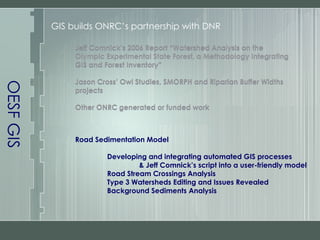
OESF GIS GIS builds ONRC’s partnership with DNR Jeff Comnick’s 2006 Report “Watershed Analysis on the Olympic Experimental State Forest, a Methodology Integrating GIS and Forest Inventory” Jason Cross’ Owl Studies, SMORPH and Riparian Buffer Widths projects Other ONRC generated or funded work Road Sedimentation Model Developing and integrating automated GIS processes & Jeff Comnick’s script into a user-friendly model Road Stream Crossings Analysis Type 3 Watersheds Editing and Issues Revealed Background Sediments Analysis Jeff Comnick’s 2006 Report “Watershed Analysis on the Olympic Experimental State Forest, a Methodology Integrating GIS and Forest Inventory” Jason Cross’ Owl Studies, SMORPH and Riparian Buffer Widths projects Other ONRC generated or funded work
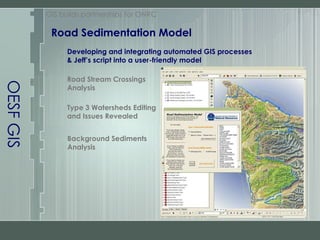
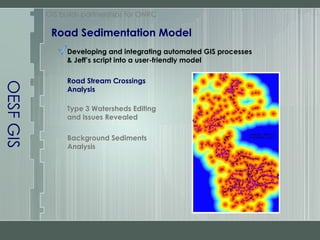
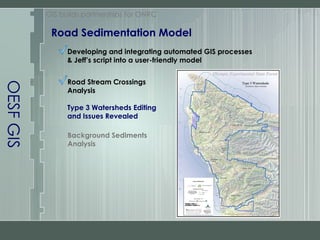
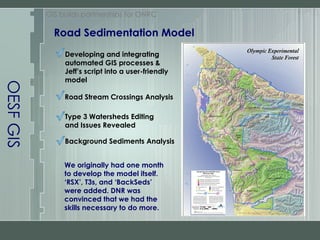
OESF GIS Road Sedimentation Model GIS builds partnerships for ONRC Developing and integrating automated GIS processes & Jeff’s script into a user-friendly model Road Stream Crossings Analysis Type 3 Watersheds Editing and Issues Revealed Background Sediments Analysis
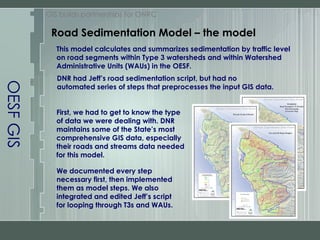
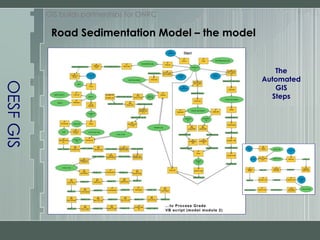
OESF GIS Road Sedimentation Model – the model GIS builds partnerships for ONRC This model calculates and summarizes sedimentation by traffic level on road segments within Type 3 watersheds and within Watershed Administrative Units (WAUs) in the OESF. First, we had to get to know the type of data we were dealing with. DNR maintains some of the State’s most comprehensive GIS data, especially their roads and streams data needed for this model. We documented every step necessary first, then implemented them as model steps. We also integrated and edited Jeff’s script for looping through T3s and WAUs. DNR had Jeff’s road sedimentation script, but had no automated series of steps that preprocesses the input GIS data.
OESF GIS GIS builds partnerships for ONRC The Automated GIS Steps Road Sedimentation Model – the model
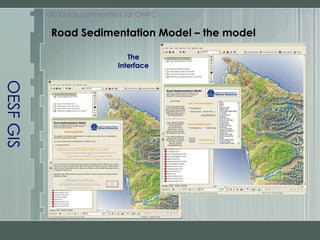
OESF GIS GIS builds partnerships for ONRC The Interface Road Sedimentation Model – the model
OESF GIS Road Sedimentation Model GIS builds partnerships for ONRC Developing and integrating automated GIS processes & Jeff’s script into a user-friendly model Road Stream Crossings Analysis Type 3 Watersheds Editing and Issues Revealed Background Sediments Analysis
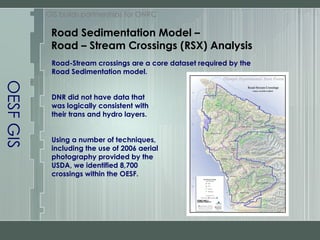
OESF GIS GIS builds partnerships for ONRC Road Sedimentation Model –  Road – Stream Crossings (RSX) Analysis Road-Stream crossings are a core dataset required by the  Road Sedimentation model.  DNR did not have data that  was logically consistent with  their trans and hydro layers. Using a number of techniques,  including the use of 2006 aerial  photography provided by the  USDA, we identified 8,700  crossings within the OESF.
OESF GIS Road Sedimentation Model GIS builds partnerships for ONRC Developing and integrating automated GIS processes & Jeff’s script into a user-friendly model Road Stream Crossings Analysis Type 3 Watersheds Editing and Issues Revealed Background Sediments Analysis
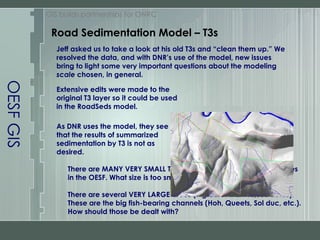
OESF GIS GIS builds partnerships for ONRC Jeff asked us to take a look at his old T3s and “clean them up.” We resolved the data, and with DNR’s use of the model, new issues bring to light some very important questions about the modeling  scale  chosen, in general. Extensive edits were made to the original T3 layer so it could be used in the RoadSeds model. As DNR uses the model, they see that the results of summarized sedimentation by T3 is not as desired.  There are MANY VERY SMALL Type 3 watersheds less than 100 acres in the OESF. What size is too small to delineate? There are several VERY LARGE areas (7 greater than 10,000 acres). These are the big fish-bearing channels (Hoh, Queets, Sol duc, etc.). How should those be dealt with?  Road Sedimentation Model – T3s
OESF GIS Road Sedimentation Model GIS builds partnerships for ONRC Developing and integrating automated GIS processes & Jeff’s script into a user-friendly model Road Stream Crossings Analysis Type 3 Watersheds Editing and Issues Revealed Background Sediments Analysis
OESF GIS GIS builds partnerships for ONRC HCP specifies that sedimentation contribution by roads in excess of 100% of background sediment value in any given watershed is considered negative impact on environment Background sediment values for each T3 were determined and compared to model output Analysis was based on Jeff’s previous study in 2006. DNR requested a new analysis be done based on the newly cleaned T3s Road Sedimentation Model – ‘BackSeds’ Analysis
OESF GIS Road Sedimentation Model GIS builds partnerships for ONRC Developing and integrating automated GIS processes & Jeff’s script into a user-friendly model Road Stream Crossings Analysis Type 3 Watersheds Editing and Issues Revealed Background Sediments Analysis We originally had one month to develop the model itself. ‘RSX’, T3s, and ‘BackSeds’ were added. DNR was convinced that we had the skills necessary to do more.
ONRC GIS ONRC GIS builds partnerships for ONRC In the past,   ONRC GIS has focused on Clearinghouse, professional workshops, a variety of projects for the ONRC Marine Program. This year, we were able to support ONRC’s Forest Program as well. GIS is a tool . It shows the relationships between geographically distributed resources and the associated data to manage them. We have garnered excellent relations with our partners in the region, and we’re known for producing innovative, results-oriented work and professional products. We routinely successfully fulfill our original program goals: GIS Analysis and Technical Support Regional Information Coordination (Clearinghouse, Marine Data Access Initiative) Education (Professional workshops, ForksGIS, and local high school Interns) GIS Lab Maintenance We help our clients use our GIS tools with extensive documentation and technical support. ONRC GIS learns the scientific and technical context that each of our clients work in,  then we design our GIS tools to match .
OESF GIS GIS builds partnerships for ONRC Thank you  Weikko Jaross at DNR Olympia Craig Magnusen, Scott Horton, and David Christiansen at DNR Forks Starla Delorey, DNR Consultant Jeff Comnick and Jason Cross at ONRC

OESF Logging Road Sedimentation GIS

  • 1.
    OESF GIS ONRCGIS TZA, Keven Bennett August 7, 2007
  • 2.
    OESF GIS GISbuilds ONRC’s partnership with DNR Jeff Comnick’s 2006 Report “Watershed Analysis on the Olympic Experimental State Forest, a Methodology Integrating GIS and Forest Inventory” Jason Cross’ Owl Studies, SMORPH and Riparian Buffer Widths projects Other ONRC generated or funded work Road Sedimentation Model Developing and integrating automated GIS processes & Jeff Comnick’s script into a user-friendly model Road Stream Crossings Analysis Type 3 Watersheds Editing and Issues Revealed Background Sediments Analysis Jeff Comnick’s 2006 Report “Watershed Analysis on the Olympic Experimental State Forest, a Methodology Integrating GIS and Forest Inventory” Jason Cross’ Owl Studies, SMORPH and Riparian Buffer Widths projects Other ONRC generated or funded work
  • 3.
    OESF GIS RoadSedimentation Model GIS builds partnerships for ONRC Developing and integrating automated GIS processes & Jeff’s script into a user-friendly model Road Stream Crossings Analysis Type 3 Watersheds Editing and Issues Revealed Background Sediments Analysis
  • 4.
    OESF GIS RoadSedimentation Model – the model GIS builds partnerships for ONRC This model calculates and summarizes sedimentation by traffic level on road segments within Type 3 watersheds and within Watershed Administrative Units (WAUs) in the OESF. First, we had to get to know the type of data we were dealing with. DNR maintains some of the State’s most comprehensive GIS data, especially their roads and streams data needed for this model. We documented every step necessary first, then implemented them as model steps. We also integrated and edited Jeff’s script for looping through T3s and WAUs. DNR had Jeff’s road sedimentation script, but had no automated series of steps that preprocesses the input GIS data.
  • 5.
    OESF GIS GISbuilds partnerships for ONRC The Automated GIS Steps Road Sedimentation Model – the model
  • 6.
    OESF GIS GISbuilds partnerships for ONRC The Interface Road Sedimentation Model – the model
  • 7.
    OESF GIS RoadSedimentation Model GIS builds partnerships for ONRC Developing and integrating automated GIS processes & Jeff’s script into a user-friendly model Road Stream Crossings Analysis Type 3 Watersheds Editing and Issues Revealed Background Sediments Analysis
  • 8.
    OESF GIS GISbuilds partnerships for ONRC Road Sedimentation Model – Road – Stream Crossings (RSX) Analysis Road-Stream crossings are a core dataset required by the Road Sedimentation model. DNR did not have data that was logically consistent with their trans and hydro layers. Using a number of techniques, including the use of 2006 aerial photography provided by the USDA, we identified 8,700 crossings within the OESF.
  • 9.
    OESF GIS RoadSedimentation Model GIS builds partnerships for ONRC Developing and integrating automated GIS processes & Jeff’s script into a user-friendly model Road Stream Crossings Analysis Type 3 Watersheds Editing and Issues Revealed Background Sediments Analysis
  • 10.
    OESF GIS GISbuilds partnerships for ONRC Jeff asked us to take a look at his old T3s and “clean them up.” We resolved the data, and with DNR’s use of the model, new issues bring to light some very important questions about the modeling scale chosen, in general. Extensive edits were made to the original T3 layer so it could be used in the RoadSeds model. As DNR uses the model, they see that the results of summarized sedimentation by T3 is not as desired. There are MANY VERY SMALL Type 3 watersheds less than 100 acres in the OESF. What size is too small to delineate? There are several VERY LARGE areas (7 greater than 10,000 acres). These are the big fish-bearing channels (Hoh, Queets, Sol duc, etc.). How should those be dealt with? Road Sedimentation Model – T3s
  • 11.
    OESF GIS RoadSedimentation Model GIS builds partnerships for ONRC Developing and integrating automated GIS processes & Jeff’s script into a user-friendly model Road Stream Crossings Analysis Type 3 Watersheds Editing and Issues Revealed Background Sediments Analysis
  • 12.
    OESF GIS GISbuilds partnerships for ONRC HCP specifies that sedimentation contribution by roads in excess of 100% of background sediment value in any given watershed is considered negative impact on environment Background sediment values for each T3 were determined and compared to model output Analysis was based on Jeff’s previous study in 2006. DNR requested a new analysis be done based on the newly cleaned T3s Road Sedimentation Model – ‘BackSeds’ Analysis
  • 13.
    OESF GIS RoadSedimentation Model GIS builds partnerships for ONRC Developing and integrating automated GIS processes & Jeff’s script into a user-friendly model Road Stream Crossings Analysis Type 3 Watersheds Editing and Issues Revealed Background Sediments Analysis We originally had one month to develop the model itself. ‘RSX’, T3s, and ‘BackSeds’ were added. DNR was convinced that we had the skills necessary to do more.
  • 14.
    ONRC GIS ONRCGIS builds partnerships for ONRC In the past, ONRC GIS has focused on Clearinghouse, professional workshops, a variety of projects for the ONRC Marine Program. This year, we were able to support ONRC’s Forest Program as well. GIS is a tool . It shows the relationships between geographically distributed resources and the associated data to manage them. We have garnered excellent relations with our partners in the region, and we’re known for producing innovative, results-oriented work and professional products. We routinely successfully fulfill our original program goals: GIS Analysis and Technical Support Regional Information Coordination (Clearinghouse, Marine Data Access Initiative) Education (Professional workshops, ForksGIS, and local high school Interns) GIS Lab Maintenance We help our clients use our GIS tools with extensive documentation and technical support. ONRC GIS learns the scientific and technical context that each of our clients work in, then we design our GIS tools to match .
  • 15.
    OESF GIS GISbuilds partnerships for ONRC Thank you Weikko Jaross at DNR Olympia Craig Magnusen, Scott Horton, and David Christiansen at DNR Forks Starla Delorey, DNR Consultant Jeff Comnick and Jason Cross at ONRC