The 2011 Belize Biospeleology ExpeditionThe Subterranean Ecology Institute, Inc.© SJTaylor/SEI 2011http://cavelife.org/
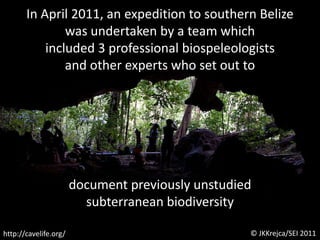
In April 2011, an expedition to southern Belizewas undertaken by a team whichincluded 3 professional biospeleologistsand other experts who set out todocument previously unstudiedsubterranean biodiversity© JKKrejca/SEI 2011http://cavelife.org/
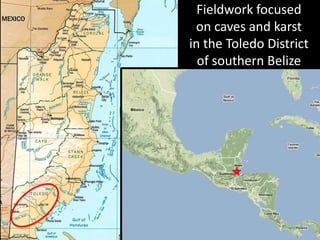
Fieldwork focusedon caves and karstin the Toledo Districtof southern Belize
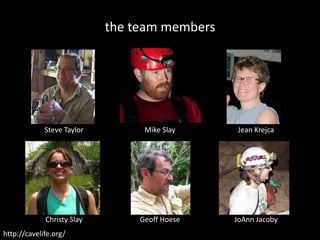
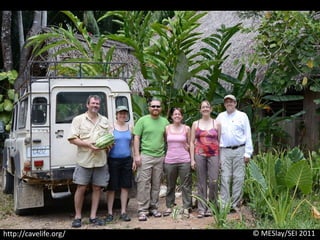
the team membershttp://cavelife.org/
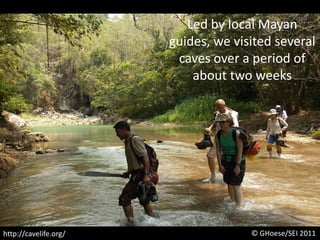
Led by local Mayan guides, we visited several caves over a period of about two weeks© GHoese/SEI 2011http://cavelife.org/
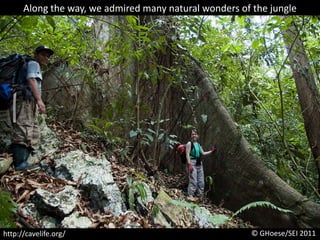
Along the way, we admired many natural wonders of the jungle© GHoese/SEI 2011http://cavelife.org/
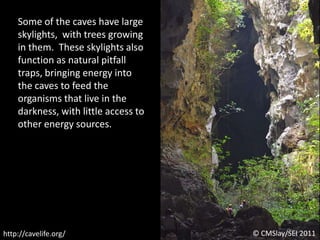
Some of the caves have large skylights,  with trees growing in them.  These skylights also function as natural pitfall traps, bringing energy into the caves to feed the organisms that live in the darkness, with little access to other energy sources.© CMSlay/SEI 2011http://cavelife.org/
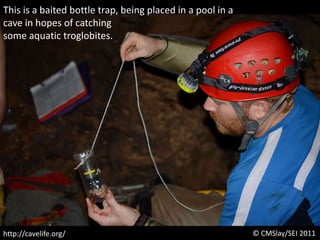
This is a baited bottle trap, being placed in a pool in a cave in hopes of catching some aquatic troglobites.© CMSlay/SEI 2011http://cavelife.org/
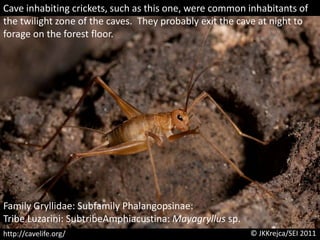
Cave inhabiting crickets, such as this one, were common inhabitants of the twilight zone of the caves.  They probably exit the cave at night to forage on the forest floor.Family Gryllidae: Subfamily Phalangopsinae: Tribe Luzarini: SubtribeAmphiacustina: Mayagryllus sp.© JKKrejca/SEI 2011http://cavelife.org/
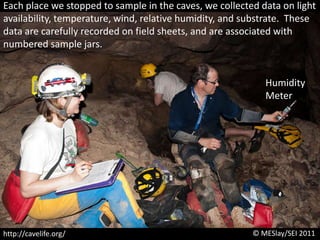
Each place we stopped to sample in the caves, we collected data on light availability, temperature, wind, relative humidity, and substrate.  These data are carefully recorded on field sheets, and are associated with numbered sample jars.HumidityMeter© MESlay/SEI 2011http://cavelife.org/
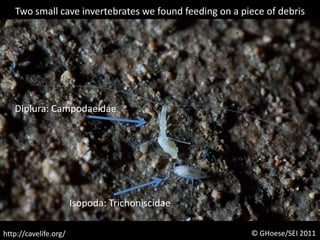
Two small cave invertebrates we found feeding on a piece of debrisDiplura: CampodaeidaeIsopoda: Trichoniscidae© GHoese/SEI 2011http://cavelife.org/
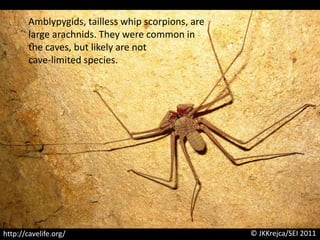
Amblypygids, tailless whip scorpions, arelarge arachnids. They were common in the caves, but likely are not cave-limited species.© JKKrejca/SEI 2011http://cavelife.org/
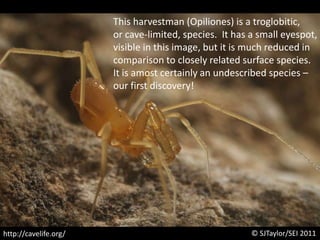
This harvestman (Opiliones) is a troglobitic,or cave-limited, species.  It has a small eyespot,visible in this image, but it is much reduced in comparison to closely related surface species.It is amost certainly an undescribed species –our first discovery! © SJTaylor/SEI 2011http://cavelife.org/
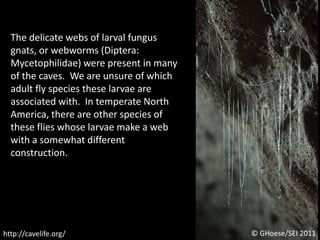
The delicate webs of larval fungus gnats, or webworms (Diptera: Mycetophilidae) were present in many of the caves.  We are unsure of which adult fly species these larvae are associated with.  In temperate North America, there are other species of these flies whose larvae make a web with a somewhat different construction.© GHoese/SEI 2011http://cavelife.org/
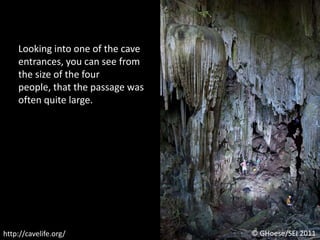
Looking into one of the cave entrances, you can see from the size of the four people, that the passage was often quite large.© GHoese/SEI 2011http://cavelife.org/
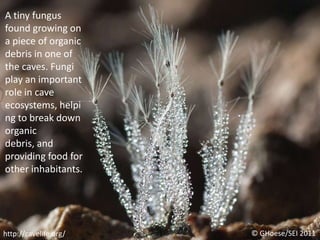
A tiny fungus found growing on a piece of organic debris in one of the caves. Fungi play an important role in cave ecosystems, helping to break down organic debris, and providing food for other inhabitants.© GHoese/SEI 2011http://cavelife.org/
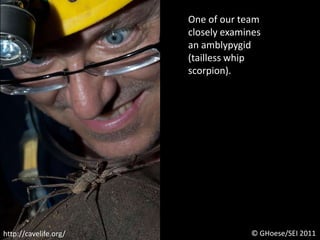
One of our team closely examines an amblypygid (tailless whip scorpion).© GHoese/SEI 2011http://cavelife.org/
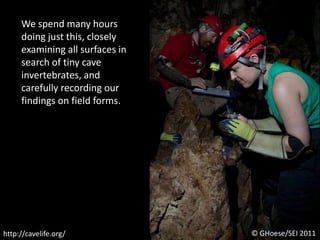
We spend many hours doing just this, closely examining all surfaces in search of tiny cave invertebrates, and carefully recording our findings on field forms.© GHoese/SEI 2011http://cavelife.org/
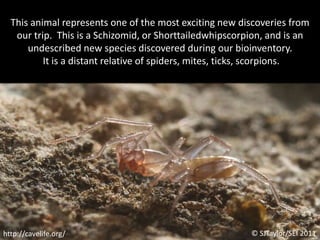
This animal represents one of the most exciting new discoveries from our trip.  This is a Schizomid, or Shorttailedwhipscorpion, and is an undescribed new species discovered during our bioinventory.  It is a distant relative of spiders, mites, ticks, scorpions. © SJTaylor/SEI 2011http://cavelife.org/
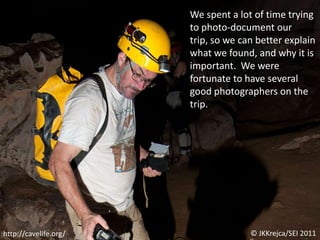
We spent a lot of time trying to photo-document our trip, so we can better explain what we found, and why it is important.  We were fortunate to have several good photographers on the trip.© JKKrejca/SEI 2011http://cavelife.org/
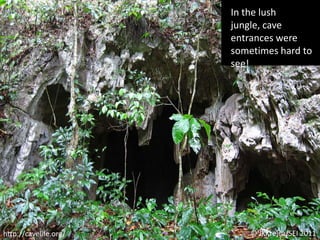
In the lush jungle, cave entrances were sometimes hard to see!© JKKrejca/SEI 2011http://cavelife.org/
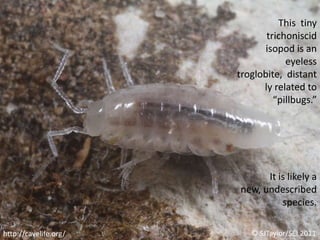
This  tiny trichoniscid isopod is an eyeless troglobite,  distantly related to “pillbugs.”It is likely a new, undescribed species.© SJTaylor/SEI 2011http://cavelife.org/
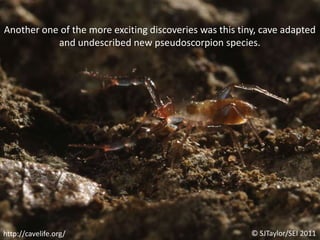
Another one of the more exciting discoveries was this tiny, cave adapted and undescribed new pseudoscorpion species.© SJTaylor/SEI 2011http://cavelife.org/
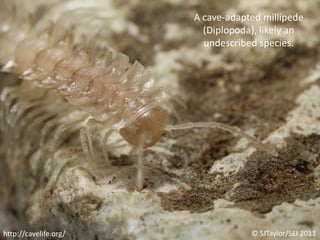
A cave-adapted millipede (Diplopoda), likely an undescribed species.© SJTaylor/SEI 2011http://cavelife.org/
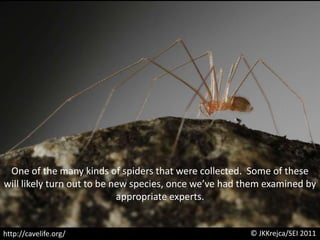
One of the many kinds of spiders that were collected.  Some of these will likely turn out to be new species, once we’ve had them examined by appropriate experts. © JKKrejca/SEI 2011http://cavelife.org/
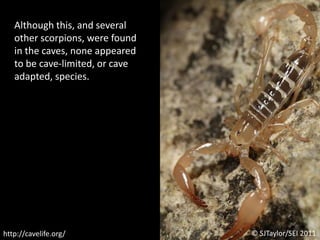
Although this, and several other scorpions, were found in the caves, none appeared to be cave-limited, or cave adapted, species.© SJTaylor/SEI 2011http://cavelife.org/
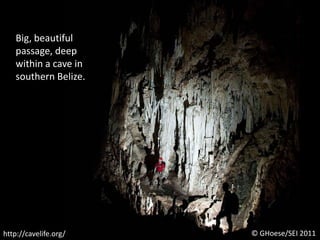
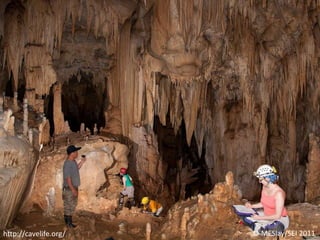
Big, beautiful passage, deep within a cave in southern Belize.© GHoese/SEI 2011http://cavelife.org/
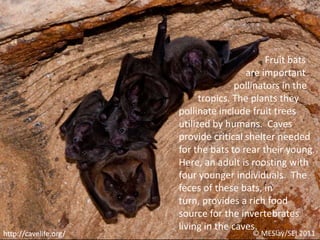
                                    Fruit bats                            are important                       pollinators in the        tropics. The plants they pollinate include fruit trees utilized by humans.  Caves provide critical shelter needed for the bats to rear their young.  Here, an adult is roosting with four younger individuals.  The feces of these bats, in turn, provides a rich food source for the invertebrates living in the caves.© MESlay/SEI 2011http://cavelife.org/
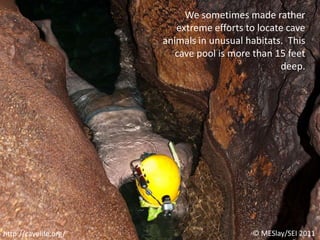
We sometimes made rather extreme efforts to locate cave animals in unusual habitats.  This cave pool is more than 15 feet deep.© MESlay/SEI 2011http://cavelife.org/
© MESlay/SEI 2011http://cavelife.org/
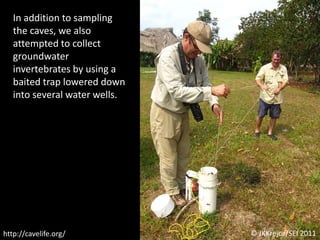
In addition to sampling the caves, we also attempted to collect groundwater invertebrates by using a baited trap lowered down into several water wells.© JKKrejca/SEI 2011http://cavelife.org/
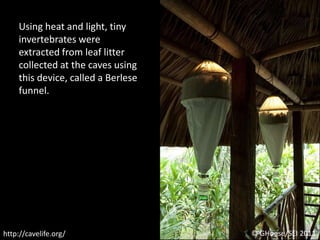
Using heat and light, tiny invertebrates were extracted from leaf litter collected at the caves using this device, called a Berlese funnel.© GHoese/SEI 2011http://cavelife.org/
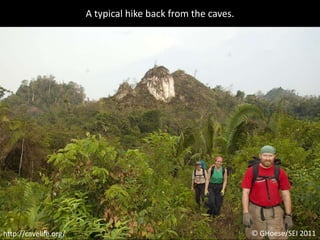
A typical hike back from the caves.© GHoese/SEI 2011http://cavelife.org/
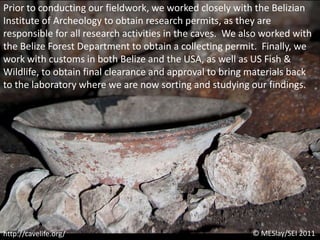
Prior to conducting our fieldwork, we worked closely with the Belizian Institute of Archeology to obtain research permits, as they are responsible for all research activities in the caves.  We also worked with the Belize Forest Department to obtain a collecting permit.  Finally, we work with customs in both Belize and the USA, as well as US Fish & Wildlife, to obtain final clearance and approval to bring materials back to the laboratory where we are now sorting and studying our findings. © MESlay/SEI 2011http://cavelife.org/
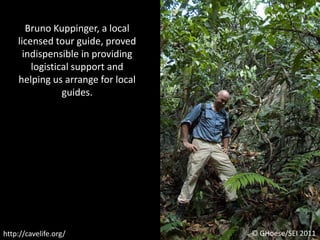
Bruno Kuppinger, a local licensed tour guide, proved indispensible in providing logistical support and helping us arrange for local guides.© GHoese/SEI 2011http://cavelife.org/
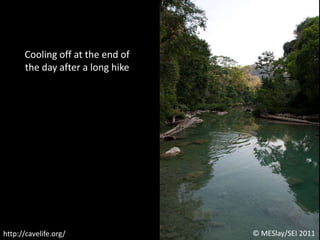
Cooling off at the end of the day after a long hike© MESlay/SEI 2011http://cavelife.org/
© MESlay/SEI 2011http://cavelife.org/
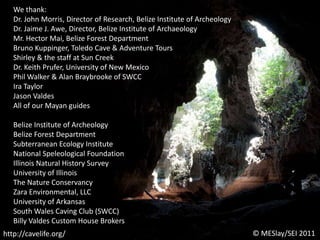
We thank:Dr. John Morris, Director of Research, Belize Institute of ArcheologyDr. Jaime J. Awe, Director, Belize Institute of Archaeology Mr. Hector Mai, Belize Forest DepartmentBruno Kuppinger, Toledo Cave & Adventure ToursShirley & the staff at Sun CreekDr. Keith Prufer, University of New MexicoPhil Walker & Alan Braybrooke of SWCCIra TaylorJason ValdesAll of our Mayan guidesBelize Institute of ArcheologyBelize Forest DepartmentSubterranean Ecology InstituteNational Speleological FoundationIllinois Natural History SurveyUniversity of Illinois The Nature ConservancyZara Environmental, LLCUniversity of ArkansasSouth Wales Caving Club (SWCC)Billy Valdes Custom House Brokers© MESlay/SEI 2011http://cavelife.org/
The 2011 Belize Biospeleogy Expeditionreceived major supportfrom theas well as a grant from theNational Speleological FoundationInternational Exploration Fundhttp://cavelife.org/© GHoese/SEI 2011

Belize sei2011forweb

  • 1.
    The 2011 BelizeBiospeleology ExpeditionThe Subterranean Ecology Institute, Inc.© SJTaylor/SEI 2011http://cavelife.org/
  • 2.
    In April 2011,an expedition to southern Belizewas undertaken by a team whichincluded 3 professional biospeleologistsand other experts who set out todocument previously unstudiedsubterranean biodiversity© JKKrejca/SEI 2011http://cavelife.org/
  • 3.
    Fieldwork focusedon cavesand karstin the Toledo Districtof southern Belize
  • 4.
  • 5.
    Led by localMayan guides, we visited several caves over a period of about two weeks© GHoese/SEI 2011http://cavelife.org/
  • 6.
    Along the way,we admired many natural wonders of the jungle© GHoese/SEI 2011http://cavelife.org/
  • 7.
    Some of thecaves have large skylights, with trees growing in them. These skylights also function as natural pitfall traps, bringing energy into the caves to feed the organisms that live in the darkness, with little access to other energy sources.© CMSlay/SEI 2011http://cavelife.org/
  • 8.
    This is abaited bottle trap, being placed in a pool in a cave in hopes of catching some aquatic troglobites.© CMSlay/SEI 2011http://cavelife.org/
  • 9.
    Cave inhabiting crickets,such as this one, were common inhabitants of the twilight zone of the caves. They probably exit the cave at night to forage on the forest floor.Family Gryllidae: Subfamily Phalangopsinae: Tribe Luzarini: SubtribeAmphiacustina: Mayagryllus sp.© JKKrejca/SEI 2011http://cavelife.org/
  • 10.
    Each place westopped to sample in the caves, we collected data on light availability, temperature, wind, relative humidity, and substrate. These data are carefully recorded on field sheets, and are associated with numbered sample jars.HumidityMeter© MESlay/SEI 2011http://cavelife.org/
  • 11.
    Two small caveinvertebrates we found feeding on a piece of debrisDiplura: CampodaeidaeIsopoda: Trichoniscidae© GHoese/SEI 2011http://cavelife.org/
  • 12.
    Amblypygids, tailless whipscorpions, arelarge arachnids. They were common in the caves, but likely are not cave-limited species.© JKKrejca/SEI 2011http://cavelife.org/
  • 13.
    This harvestman (Opiliones)is a troglobitic,or cave-limited, species. It has a small eyespot,visible in this image, but it is much reduced in comparison to closely related surface species.It is amost certainly an undescribed species –our first discovery! © SJTaylor/SEI 2011http://cavelife.org/
  • 14.
    The delicate websof larval fungus gnats, or webworms (Diptera: Mycetophilidae) were present in many of the caves. We are unsure of which adult fly species these larvae are associated with. In temperate North America, there are other species of these flies whose larvae make a web with a somewhat different construction.© GHoese/SEI 2011http://cavelife.org/
  • 15.
    Looking into oneof the cave entrances, you can see from the size of the four people, that the passage was often quite large.© GHoese/SEI 2011http://cavelife.org/
  • 16.
    A tiny fungusfound growing on a piece of organic debris in one of the caves. Fungi play an important role in cave ecosystems, helping to break down organic debris, and providing food for other inhabitants.© GHoese/SEI 2011http://cavelife.org/
  • 17.
    One of ourteam closely examines an amblypygid (tailless whip scorpion).© GHoese/SEI 2011http://cavelife.org/
  • 18.
    We spend manyhours doing just this, closely examining all surfaces in search of tiny cave invertebrates, and carefully recording our findings on field forms.© GHoese/SEI 2011http://cavelife.org/
  • 19.
    This animal representsone of the most exciting new discoveries from our trip. This is a Schizomid, or Shorttailedwhipscorpion, and is an undescribed new species discovered during our bioinventory. It is a distant relative of spiders, mites, ticks, scorpions. © SJTaylor/SEI 2011http://cavelife.org/
  • 20.
    We spent alot of time trying to photo-document our trip, so we can better explain what we found, and why it is important. We were fortunate to have several good photographers on the trip.© JKKrejca/SEI 2011http://cavelife.org/
  • 21.
    In the lushjungle, cave entrances were sometimes hard to see!© JKKrejca/SEI 2011http://cavelife.org/
  • 22.
    This tinytrichoniscid isopod is an eyeless troglobite, distantly related to “pillbugs.”It is likely a new, undescribed species.© SJTaylor/SEI 2011http://cavelife.org/
  • 23.
    Another one ofthe more exciting discoveries was this tiny, cave adapted and undescribed new pseudoscorpion species.© SJTaylor/SEI 2011http://cavelife.org/
  • 24.
    A cave-adapted millipede(Diplopoda), likely an undescribed species.© SJTaylor/SEI 2011http://cavelife.org/
  • 25.
    One of themany kinds of spiders that were collected. Some of these will likely turn out to be new species, once we’ve had them examined by appropriate experts. © JKKrejca/SEI 2011http://cavelife.org/
  • 26.
    Although this, andseveral other scorpions, were found in the caves, none appeared to be cave-limited, or cave adapted, species.© SJTaylor/SEI 2011http://cavelife.org/
  • 27.
    Big, beautiful passage,deep within a cave in southern Belize.© GHoese/SEI 2011http://cavelife.org/
  • 28.
    Fruit bats are important pollinators in the tropics. The plants they pollinate include fruit trees utilized by humans. Caves provide critical shelter needed for the bats to rear their young. Here, an adult is roosting with four younger individuals. The feces of these bats, in turn, provides a rich food source for the invertebrates living in the caves.© MESlay/SEI 2011http://cavelife.org/
  • 29.
    We sometimes maderather extreme efforts to locate cave animals in unusual habitats. This cave pool is more than 15 feet deep.© MESlay/SEI 2011http://cavelife.org/
  • 30.
  • 31.
    In addition tosampling the caves, we also attempted to collect groundwater invertebrates by using a baited trap lowered down into several water wells.© JKKrejca/SEI 2011http://cavelife.org/
  • 32.
    Using heat andlight, tiny invertebrates were extracted from leaf litter collected at the caves using this device, called a Berlese funnel.© GHoese/SEI 2011http://cavelife.org/
  • 33.
    A typical hikeback from the caves.© GHoese/SEI 2011http://cavelife.org/
  • 34.
    Prior to conductingour fieldwork, we worked closely with the Belizian Institute of Archeology to obtain research permits, as they are responsible for all research activities in the caves. We also worked with the Belize Forest Department to obtain a collecting permit. Finally, we work with customs in both Belize and the USA, as well as US Fish & Wildlife, to obtain final clearance and approval to bring materials back to the laboratory where we are now sorting and studying our findings. © MESlay/SEI 2011http://cavelife.org/
  • 35.
    Bruno Kuppinger, alocal licensed tour guide, proved indispensible in providing logistical support and helping us arrange for local guides.© GHoese/SEI 2011http://cavelife.org/
  • 36.
    Cooling off atthe end of the day after a long hike© MESlay/SEI 2011http://cavelife.org/
  • 37.
  • 38.
    We thank:Dr. JohnMorris, Director of Research, Belize Institute of ArcheologyDr. Jaime J. Awe, Director, Belize Institute of Archaeology Mr. Hector Mai, Belize Forest DepartmentBruno Kuppinger, Toledo Cave & Adventure ToursShirley & the staff at Sun CreekDr. Keith Prufer, University of New MexicoPhil Walker & Alan Braybrooke of SWCCIra TaylorJason ValdesAll of our Mayan guidesBelize Institute of ArcheologyBelize Forest DepartmentSubterranean Ecology InstituteNational Speleological FoundationIllinois Natural History SurveyUniversity of Illinois The Nature ConservancyZara Environmental, LLCUniversity of ArkansasSouth Wales Caving Club (SWCC)Billy Valdes Custom House Brokers© MESlay/SEI 2011http://cavelife.org/
  • 39.
    The 2011 BelizeBiospeleogy Expeditionreceived major supportfrom theas well as a grant from theNational Speleological FoundationInternational Exploration Fundhttp://cavelife.org/© GHoese/SEI 2011

Editor's Notes

  • #2 IMG_6472-SJT-Rebel
  • #3 IMG_1566-JKK-PointNShoot
  • #6 DSC_5835-GH-Nikon
  • #7 DSC_6567-GH-Nikon-Card2
  • #8 113-CMS-Nikon-Tiger
  • #9 145-CMS-Nikon-Tiger
  • #10 DSC_7263-JKK-Nikon
  • #11 DSC_0211-MES-D90-Card2
  • #12 DSC_6640-GH-Nikon-Card2
  • #13 IMG_1428-JKK-PointNShoot-Tiger2
  • #14 IMG_1853-SJT-7D
  • #15 DSC_6291-GH-Nikon
  • #16 DSC_6682-GH-Nikon-Card2
  • #17 DSC_6602-GH-Nikon-Card2
  • #18 DSC_5976-GH-Nikon
  • #19 DSC_7131-GH-Nikon-Card3
  • #20 IMG_1941-SJT-7dReddell, J.R. & Cokendolpher, J.C. (1995). Catalogue, bibliography, and generic revision of the order Schizomida (Arachnida). Tex. Mem. Mus., Speleol. Monogr. 4: 1-170Catalogue of the Smaller Arachnid Orders of the World: Amblypygi, Uropygi, Schizomida, Palpigradi, Ricinulei and Solifugae (Hardcover) by Mark S. Harvey
  • #21 DSC_7249-JKK-Nikon
  • #22 IMG_1568-JKK-PointNShoot
  • #23 IMG_2013-SJT-7D
  • #24 IMG_1899-SJT-7D
  • #25 IMG_2303-SJT-7D
  • #26 IMG_2254-SJT-7D-234-Linyphiid-jkkMaybe
  • #27 IMG_2336-SJT-7D
  • #28 DSC_7145-GH-Nikon-Card3
  • #29 DSC_0158-MES-D90-Card2
  • #30 DSC_0187-MES-D90-Card2
  • #31 DSC_0070-MES-D90-Card1
  • #32 IMG_1370-JKK-PointNShoot-Wells
  • #33 DSC_6462-GH-Nikon-Card2
  • #34 DSC_7203-GH-Nikon-Card3
  • #35 DSC_0118-MES-D90-Card1
  • #36 DSC_6756-GH-Nikon-Card2
  • #37 DSC_0023-MES-D90-Card3
  • #38 DSC_0681-CMS-Nikon-by MES?
  • #39 DSC_0019-MES-D90-Card3
  • #40 DSC_6398-GH-NikonSEI-Logo