ANGLOPHONE LITERATURE II 
READING GUIDE ON BEING MEAN 
BY GARY SOTO 
Maria Camila Obregón mobregon05@unisalle.edu.co 
Lina Marcela Quintero lquintero60@unisalle.edu.co 
Lorena Pinzón Rodríguez dpinzon18@unisalle.edu.co 
THE STORY 
PLOT 
“Being Mean” by Gary Soto is a story about three kids. They are brother and sisters and they are four, five, and six years old. The narrator tells us some bad ways that they learnt to entertain themselves at home while their parents are out working. They play with the neighbors of their block. Children climb trees; eat raw bacon, wrestle and jump in the entire house. But besides this, they do very malicious things; they throw around tomatoes, steal from neighbors, kick chickens, throw rocks at passing cars, fight with other kids in the neighborhood and set things on fire, even their house. At the end of the day, when their mother came home and saw all the mess, she raged and punished Rick (The older sibling). 
CHARACTERS 
Three Mexicans siblings: Rick, Chango (Narrator) and Debra. 
The Molinas: Mother and kids. Eight children on the block. 
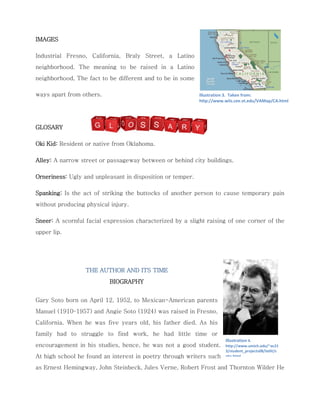
Illustration 1. Taken from: http://bookrackarcadia.com/index.php/books/new- books/living-up-the-street- new-by-gary-soto.html 
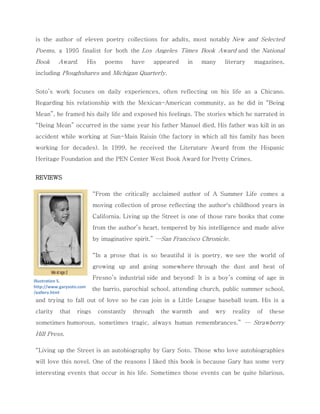
Illustration 2. Taken from: http://www.garysoto.com/gallery.html
IMAGES 
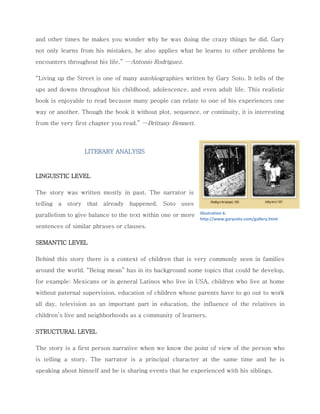
Industrial Fresno, California, Braly Street, a Latino neighborhood. The meaning to be raised in a Latino neighborhood, The fact to be different and to be in some ways apart from others. 
GLOSARY 
Oki Kid: Resident or native from Oklahoma. 
Alley: A narrow street or passageway between or behind city buildings. 
Orneriness: Ugly and unpleasant in disposition or temper. 
Spanking: Is the act of striking the buttocks of another person to cause temporary pain without producing physical injury. 
Sneer: A scornful facial expression characterized by a slight raising of one corner of the upper lip. 
THE AUTHOR AND ITS TIME 
BIOGRAPHY Gary Soto born on April 12, 1952, to Mexican-American parents Manuel (1910–1957) and Angie Soto (1924) was raised in Fresno, California. When he was five years old, his father died. As his family had to struggle to find work, he had little time or encouragement in his studies, hence, he was not a good student. At high school he found an interest in poetry through writers such as Ernest Hemingway, John Steinbeck, Jules Verne, Robert Frost and Thornton Wilder He 
Illustration 4. http://www.umich.edu/~ac213/student_projects08/latlit/soto.html 
Illustration 3. Taken from: http://www.wiis.cee.vt.edu/VAMap/CA.html
is the author of eleven poetry collections for adults, most notably New and Selected Poems, a 1995 finalist for both the Los Angeles Times Book Award and the National Book Award. His poems have appeared in many literary magazines, including Ploughshares and Michigan Quarterly. 
Soto’s work focuses on daily experiences, often reflecting on his life as a Chicano. Regarding his relationship with the Mexican-American community, as he did in “Being Mean”, he framed his daily life and exposed his feelings. The stories which he narrated in “Being Mean” occurred in the same year his father Manuel died, His father was kill in an accident while working at Sun-Main Raisin (the factory in which all his family has been working for decades). In 1999, he received the Literature Award from the Hispanic Heritage Foundation and the PEN Center West Book Award for Pretty Crimes. 
REVIEWS 
“From the critically acclaimed author of A Summer Life comes a moving collection of prose reflecting the author's childhood years in California. Living up the Street is one of those rare books that come from the author’s heart, tempered by his intelligence and made alive by imaginative spirit.” —San Francisco Chronicle. 
“In a prose that is so beautiful it is poetry, we see the world of growing up and going somewhere through the dust and heat of Fresno’s industrial side and beyond: It is a boy’s coming of age in the barrio, parochial school, attending church, public summer school, and trying to fall out of love so he can join in a Little League baseball team. His is a clarity that rings constantly through the warmth and wry reality of these sometimes humorous, sometimes tragic, always human remembrances.” — Strawberry Hill Press. “Living up the Street is an autobiography by Gary Soto. Those who love autobiographies will love this novel. One of the reasons I liked this book is because Gary has some very interesting events that occur in his life. Sometimes those events can be quite hilarious, 
Illustration 5. http://www.garysoto.com/gallery.html
and other times he makes you wonder why he was doing the crazy things he did. Gary not only learns from his mistakes, he also applies what he learns to other problems he encounters throughout his life.” —Antonio Rodríguez. “Living up the Street is one of many autobiographies written by Gary Soto. It tells of the ups and downs throughout his childhood, adolescence, and even adult life. This realistic book is enjoyable to read because many people can relate to one of his experiences one way or another. Though the book it without plot, sequence, or continuity, it is interesting from the very first chapter you read.” —Brittany Bennett. 
LITERARY ANALYSIS 
LINGUISTIC LEVEL 
The story was written mostly in past. The narrator is telling a story that already happened. Soto uses parallelism to give balance to the text within one or more sentences of similar phrases or clauses. 
SEMANTIC LEVEL 
Behind this story there is a context of children that is very commonly seen in families around the world. “Being mean” has in its background some topics that could be develop, for example: Mexicans or in general Latinos who live in USA, children who live at home without paternal supervision, education of children whose parents have to go out to work all day, television as an important part in education, the influence of the relatives in children’s live and neighborhoods as a community of learners. 
STRUCTURAL LEVEL The story is a first person narrative when we know the point of view of the person who is telling a story. The narrator is a principal character at the same time and he is speaking about himself and he is sharing events that he experienced with his siblings. 
Illustration 6. http://www.garysoto.com/gallery.html
CULTURAL LEVEL 
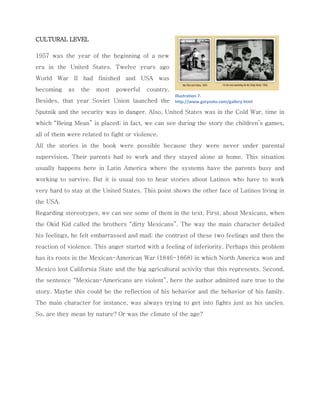
1957 was the year of the beginning of a new era in the United States. Twelve years ago World War II had finished and USA was becoming as the most powerful country. Besides, that year Soviet Union launched the Sputnik and the security was in danger. Also, United States was in the Cold War, time in which “Being Mean” is placed; in fact, we can see during the story the children’s games, all of them were related to fight or violence. 
All the stories in the book were possible because they were never under parental supervision. Their parents had to work and they stayed alone at home. This situation usually happens here in Latin America where the systems have the parents busy and working to survive. But it is usual too to hear stories about Latinos who have to work very hard to stay at the United States. This point shows the other face of Latinos living in the USA. 
Regarding stereotypes, we can see some of them in the text. First, about Mexicans, when the Okid Kid called the brothers “dirty Mexicans”. The way the main character detailed his feelings, he felt embarrassed and mad; the contrast of these two feelings and then the reaction of violence. This anger started with a feeling of inferiority. Perhaps this problem has its roots in the Mexican-American War (1846-1868) in which North America won and Mexico lost California State and the big agricultural activity that this represents. Second, the sentence “Mexican-Americans are violent”, here the author admitted sure true to the story. Maybe this could be the reflection of his behavior and the behavior of his family. The main character for instance, was always trying to get into fights just as his uncles. So, are they mean by nature? Or was the climate of the age? 
Illustration 7. http://www.garysoto.com/gallery.html
WORKSHEET 
QUESTIONS 
ARGUMENTATIVE QUESTIONS: 
1. What are some reasons why Gary Soto and his siblings act the 
way that they do in the story? 
2. Why do the Soto children call one another “Jap” and “Damn 
German” when playing war? 
3. How does the title of the chapter “Being mean” relate to the 
book? 
LITERARY QUESTIONS: 
4- Identify the main characters and characterize them. 
5- Is it the same being a girl and a boy in the story? 
PROPOSITIVE QUESTIONS: 
6- How is the setting of the chapter important to the theme? 
7- Does the chapter address broader social issues? How is the particular culture portrayed? 
8- How is growing up in Fresno, California similar to growing up in your city? 
BIBLIOGRAPHY 
http://www.garysoto.com/bio.html 
http://en.wikipedia.org/wiki/Gary_Soto 
http://www.notablebiographies.com/news/Sh-Z/Soto-Gary.html 
http://en.wikipedia.org/wiki/Cold_War_(1953%E2%80%9362) 
http://en.wikipedia.org/wiki/Mexican%E2%80%93American_War 
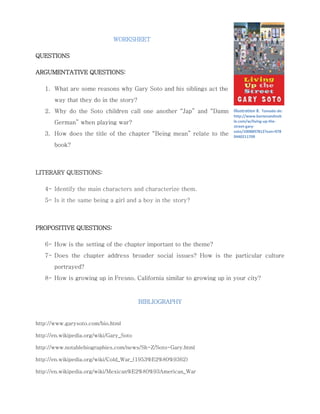
Illustration 8. Tomado de: http://www.barnesandnoble.com/w/living-up-the- street-gary- soto/1008897812?ean=9780440211709

Being mean, reading guide

  • 1.
    ANGLOPHONE LITERATURE II READING GUIDE ON BEING MEAN BY GARY SOTO Maria Camila Obregón mobregon05@unisalle.edu.co Lina Marcela Quintero lquintero60@unisalle.edu.co Lorena Pinzón Rodríguez dpinzon18@unisalle.edu.co THE STORY PLOT “Being Mean” by Gary Soto is a story about three kids. They are brother and sisters and they are four, five, and six years old. The narrator tells us some bad ways that they learnt to entertain themselves at home while their parents are out working. They play with the neighbors of their block. Children climb trees; eat raw bacon, wrestle and jump in the entire house. But besides this, they do very malicious things; they throw around tomatoes, steal from neighbors, kick chickens, throw rocks at passing cars, fight with other kids in the neighborhood and set things on fire, even their house. At the end of the day, when their mother came home and saw all the mess, she raged and punished Rick (The older sibling). CHARACTERS Three Mexicans siblings: Rick, Chango (Narrator) and Debra. The Molinas: Mother and kids. Eight children on the block. Illustration 1. Taken from: http://bookrackarcadia.com/index.php/books/new- books/living-up-the-street- new-by-gary-soto.html Illustration 2. Taken from: http://www.garysoto.com/gallery.html
  • 2.
    IMAGES Industrial Fresno,California, Braly Street, a Latino neighborhood. The meaning to be raised in a Latino neighborhood, The fact to be different and to be in some ways apart from others. GLOSARY Oki Kid: Resident or native from Oklahoma. Alley: A narrow street or passageway between or behind city buildings. Orneriness: Ugly and unpleasant in disposition or temper. Spanking: Is the act of striking the buttocks of another person to cause temporary pain without producing physical injury. Sneer: A scornful facial expression characterized by a slight raising of one corner of the upper lip. THE AUTHOR AND ITS TIME BIOGRAPHY Gary Soto born on April 12, 1952, to Mexican-American parents Manuel (1910–1957) and Angie Soto (1924) was raised in Fresno, California. When he was five years old, his father died. As his family had to struggle to find work, he had little time or encouragement in his studies, hence, he was not a good student. At high school he found an interest in poetry through writers such as Ernest Hemingway, John Steinbeck, Jules Verne, Robert Frost and Thornton Wilder He Illustration 4. http://www.umich.edu/~ac213/student_projects08/latlit/soto.html Illustration 3. Taken from: http://www.wiis.cee.vt.edu/VAMap/CA.html
  • 3.
    is the authorof eleven poetry collections for adults, most notably New and Selected Poems, a 1995 finalist for both the Los Angeles Times Book Award and the National Book Award. His poems have appeared in many literary magazines, including Ploughshares and Michigan Quarterly. Soto’s work focuses on daily experiences, often reflecting on his life as a Chicano. Regarding his relationship with the Mexican-American community, as he did in “Being Mean”, he framed his daily life and exposed his feelings. The stories which he narrated in “Being Mean” occurred in the same year his father Manuel died, His father was kill in an accident while working at Sun-Main Raisin (the factory in which all his family has been working for decades). In 1999, he received the Literature Award from the Hispanic Heritage Foundation and the PEN Center West Book Award for Pretty Crimes. REVIEWS “From the critically acclaimed author of A Summer Life comes a moving collection of prose reflecting the author's childhood years in California. Living up the Street is one of those rare books that come from the author’s heart, tempered by his intelligence and made alive by imaginative spirit.” —San Francisco Chronicle. “In a prose that is so beautiful it is poetry, we see the world of growing up and going somewhere through the dust and heat of Fresno’s industrial side and beyond: It is a boy’s coming of age in the barrio, parochial school, attending church, public summer school, and trying to fall out of love so he can join in a Little League baseball team. His is a clarity that rings constantly through the warmth and wry reality of these sometimes humorous, sometimes tragic, always human remembrances.” — Strawberry Hill Press. “Living up the Street is an autobiography by Gary Soto. Those who love autobiographies will love this novel. One of the reasons I liked this book is because Gary has some very interesting events that occur in his life. Sometimes those events can be quite hilarious, Illustration 5. http://www.garysoto.com/gallery.html
  • 4.
    and other timeshe makes you wonder why he was doing the crazy things he did. Gary not only learns from his mistakes, he also applies what he learns to other problems he encounters throughout his life.” —Antonio Rodríguez. “Living up the Street is one of many autobiographies written by Gary Soto. It tells of the ups and downs throughout his childhood, adolescence, and even adult life. This realistic book is enjoyable to read because many people can relate to one of his experiences one way or another. Though the book it without plot, sequence, or continuity, it is interesting from the very first chapter you read.” —Brittany Bennett. LITERARY ANALYSIS LINGUISTIC LEVEL The story was written mostly in past. The narrator is telling a story that already happened. Soto uses parallelism to give balance to the text within one or more sentences of similar phrases or clauses. SEMANTIC LEVEL Behind this story there is a context of children that is very commonly seen in families around the world. “Being mean” has in its background some topics that could be develop, for example: Mexicans or in general Latinos who live in USA, children who live at home without paternal supervision, education of children whose parents have to go out to work all day, television as an important part in education, the influence of the relatives in children’s live and neighborhoods as a community of learners. STRUCTURAL LEVEL The story is a first person narrative when we know the point of view of the person who is telling a story. The narrator is a principal character at the same time and he is speaking about himself and he is sharing events that he experienced with his siblings. Illustration 6. http://www.garysoto.com/gallery.html
  • 5.
    CULTURAL LEVEL 1957was the year of the beginning of a new era in the United States. Twelve years ago World War II had finished and USA was becoming as the most powerful country. Besides, that year Soviet Union launched the Sputnik and the security was in danger. Also, United States was in the Cold War, time in which “Being Mean” is placed; in fact, we can see during the story the children’s games, all of them were related to fight or violence. All the stories in the book were possible because they were never under parental supervision. Their parents had to work and they stayed alone at home. This situation usually happens here in Latin America where the systems have the parents busy and working to survive. But it is usual too to hear stories about Latinos who have to work very hard to stay at the United States. This point shows the other face of Latinos living in the USA. Regarding stereotypes, we can see some of them in the text. First, about Mexicans, when the Okid Kid called the brothers “dirty Mexicans”. The way the main character detailed his feelings, he felt embarrassed and mad; the contrast of these two feelings and then the reaction of violence. This anger started with a feeling of inferiority. Perhaps this problem has its roots in the Mexican-American War (1846-1868) in which North America won and Mexico lost California State and the big agricultural activity that this represents. Second, the sentence “Mexican-Americans are violent”, here the author admitted sure true to the story. Maybe this could be the reflection of his behavior and the behavior of his family. The main character for instance, was always trying to get into fights just as his uncles. So, are they mean by nature? Or was the climate of the age? Illustration 7. http://www.garysoto.com/gallery.html
  • 6.
    WORKSHEET QUESTIONS ARGUMENTATIVEQUESTIONS: 1. What are some reasons why Gary Soto and his siblings act the way that they do in the story? 2. Why do the Soto children call one another “Jap” and “Damn German” when playing war? 3. How does the title of the chapter “Being mean” relate to the book? LITERARY QUESTIONS: 4- Identify the main characters and characterize them. 5- Is it the same being a girl and a boy in the story? PROPOSITIVE QUESTIONS: 6- How is the setting of the chapter important to the theme? 7- Does the chapter address broader social issues? How is the particular culture portrayed? 8- How is growing up in Fresno, California similar to growing up in your city? BIBLIOGRAPHY http://www.garysoto.com/bio.html http://en.wikipedia.org/wiki/Gary_Soto http://www.notablebiographies.com/news/Sh-Z/Soto-Gary.html http://en.wikipedia.org/wiki/Cold_War_(1953%E2%80%9362) http://en.wikipedia.org/wiki/Mexican%E2%80%93American_War Illustration 8. Tomado de: http://www.barnesandnoble.com/w/living-up-the- street-gary- soto/1008897812?ean=9780440211709