Behavioral CEOs:
THE ROLE OF MANAGERIAL OVERCONFIDENCE
Kristen J. Freiburger – Laurence J. Pino
FIN7009: Corporate finance
DBA Class of 2020
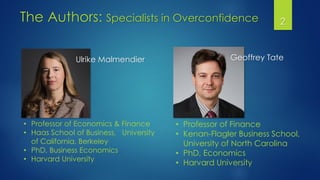
The Authors: Specialists in Overconfidence
Ulrike Malmendier Geoffrey Tate
• Professor of Finance
• Kenan-Flagler Business School,
University of North Carolina
• PhD, Economics
• Harvard University
• Professor of Economics & Finance
• Haas School of Business, University
of California, Berkeley
• PhD, Business Economics
• Harvard University
2
Research
Motivation
3
The authors, specialists in
managerial biases, are
interested in assessing
whether executive
overconfidence
influences decisions on
internal or external capital
investments and credit
allocations.
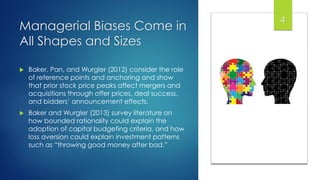
Managerial Biases Come in
All Shapes and Sizes
 Baker, Pan, and Wurgler (2012) consider the role
of reference points and anchoring and show
that prior stock price peaks affect mergers and
acquisitions through offer prices, deal success,
and bidders’ announcement effects.
 Baker and Wurgler (2013) survey literature on
how bounded rationality could explain the
adoption of capital budgeting criteria, and how
loss aversion could explain investment patterns
such as “throwing good money after bad.”
44
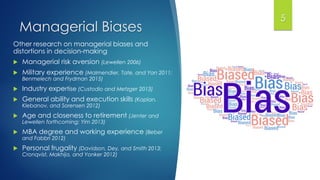
Managerial Biases
Other research on managerial biases and
distortions in decision-making
 Managerial risk aversion (Lewellen 2006)
 Military experience (Malmendier, Tate, and Yan 2011;
Benmelech and Frydman 2015)
 Industry expertise (Custodio and Metzger 2013)
 General ability and execution skills (Kaplan,
Klebanov, and Sorensen 2012)
 Age and closeness to retirement (Jenter and
Lewellen forthcoming; Yim 2013)
 MBA degree and working experience (Beber
and Fabbri 2012)
 Personal frugality (Davidson, Dey, and Smith 2013;
Cronqvist, Makhija, and Yonker 2012)
55
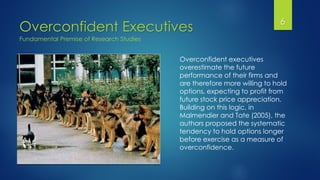
Overconfident Executives 6
Overconfident executives
overestimate the future
performance of their firms and
are therefore more willing to hold
options, expecting to profit from
future stock price appreciation.
Building on this logic, in
Malmendier and Tate (2005), the
authors proposed the systematic
tendency to hold options longer
before exercise as a measure of
overconfidence.
Fundamental Premise of Research Studies
Bueno 7
I’d Rather Be Flying
No Bueno 8
Overconfident CEO Crashes and Burns. News at 11:00 PM.
104°
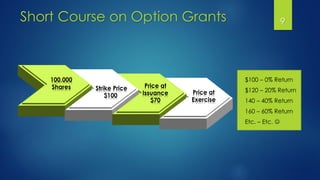
Short Course on Option Grants
 $100 – 0% Return
 $120 – 20% Return
 140 – 40% Return
 160 – 60% Return
 Etc. – Etc. ☺
9
100,000
Shares Strike Price
$100
Price at
Issuance
$70
Price at
Exercise
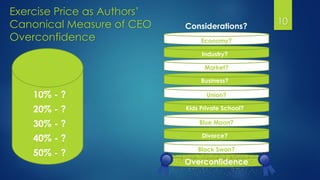
Exercise Price as Authors’
Canonical Measure of CEO
Overconfidence
 10% - ?
 20% - ?
 30% - ?
 40% - ?
 50% - ?
10Considerations?
Economy?
Market?
Union?
Blue Moon?
Black Swan?
Industry??
Business??
Kids Private School??
Divorce??
Overconfidence
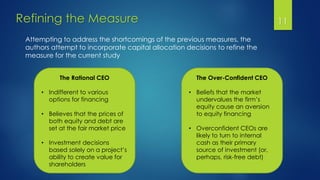
Refining the Measure 11
Attempting to address the shortcomings of the previous measures, the
authors attempt to incorporate capital allocation decisions to refine the
measure for the current study
The Rational CEO
• Indifferent to various
options for financing
• Believes that the prices of
both equity and debt are
set at the fair market price
• Investment decisions
based solely on a project’s
ability to create value for
shareholders
The Over-Confident CEO
• Beliefs that the market
undervalues the firm’s
equity cause an aversion
to equity financing
• Overconfident CEOs are
likely to turn to internal
cash as their primary
source of investment (or,
perhaps, risk-free debt)
Alternative Measures of CEO
Overconfidence
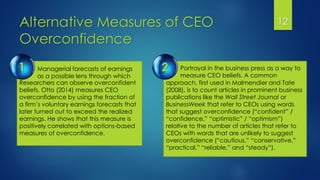
12
Portrayal in the business press as a way to
measure CEO beliefs. A common
Managerial forecasts of earnings
as a possible lens through which
Researchers can observe overconfident
beliefs. Otto (2014) measures CEO
overconfidence by using the fraction of
a firm’s voluntary earnings forecasts that
later turned out to exceed the realized
earnings. He shows that this measure is
positively correlated with options-based
measures of overconfidence.
approach, first used in Malmendier and Tate
(2008), is to count articles in prominent business
publications like the Wall Street Journal or
BusinessWeek that refer to CEOs using words
that suggest overconfidence (“confident” /
“confidence,” “optimistic” / “optimism”)
relative to the number of articles that refer to
CEOs with words that are unlikely to suggest
overconfidence (“cautious,” “conservative,”
“practical,” “reliable,” and “steady”).
1 2
Alternative Measures of CEO
Overconfidence
13
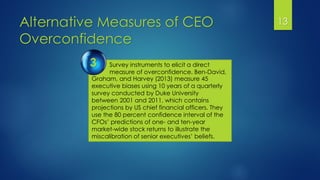
Survey instruments to elicit a direct
measure of overconfidence. Ben-David,
3
Graham, and Harvey (2013) measure 45
executive biases using 10 years of a quarterly
survey conducted by Duke University
between 2001 and 2011, which contains
projections by US chief financial officers. They
use the 80 percent confidence interval of the
CFOs’ predictions of one- and ten-year
market-wide stock returns to illustrate the
miscalibration of senior executives’ beliefs.
Overconfidence 14
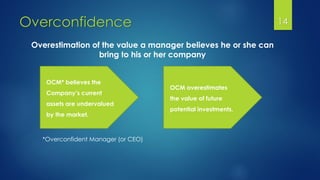
Overestimation of the value a manager believes he or she can
bring to his or her company
OCM* believes the
Company’s current
assets are undervalued
by the market.
OCM overestimates
the value of future
potential investments.
*Overconfident Manager (or CEO)
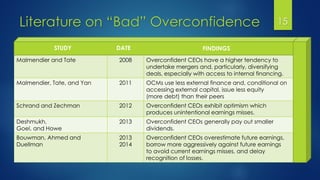
Literature on “Bad” Overconfidence 15
Malmendier and Tate 2008 Overconfident CEOs have a higher tendency to
undertake mergers and, particularly, diversifying
deals, especially with access to internal financing.
Malmendier, Tate, and Yan 2011 OCMs use less external finance and, conditional on
accessing external capital, issue less equity
(more debt) than their peers
Schrand and Zechman 2012 Overconfident CEOs exhibit optimism which
produces unintentional earnings misses.
Deshmukh,
Goel, and Howe
2013 Overconfident CEOs generally pay out smaller
dividends.
Bouwman, Ahmed and
Duellman
2013
2014
Overconfident CEOs overestimate future earnings,
borrow more aggressively against future earnings
to avoid current earnings misses, and delay
recognition of losses.
STUDY DATE FINDINGS
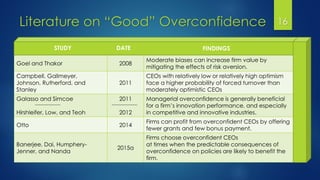
Literature on “Good” Overconfidence 16
Goel and Thakor 2008
Moderate biases can increase firm value by
mitigating the effects of risk aversion.
Campbell, Gallmeyer,
Johnson, Rutherford, and
Stanley
2011
CEOs with relatively low or relatively high optimism
face a higher probability of forced turnover than
moderately optimistic CEOs
Galasso and Simcoe
Hirshleifer, Low, and Teoh
2011
2012
Managerial overconfidence is generally beneficial
for a firm’s innovation performance, and especially
in competitive and innovative industries.
Otto 2014
Firms can profit from overconfident CEOs by offering
fewer grants and few bonus payment.
Banerjee, Dai, Humphery-
Jenner, and Nanda
2015a
Firms choose overconfident CEOs
at times when the predictable consequences of
overconfidence on policies are likely to benefit the
firm.
STUDY DATE FINDINGS
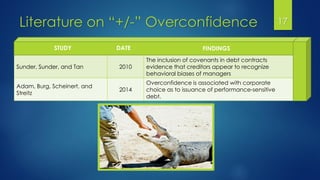
Literature on “+/-” Overconfidence 17
Sunder, Sunder, and Tan 2010
The inclusion of covenants in debt contracts
evidence that creditors appear to recognize
behavioral biases of managers
Adam, Burg, Scheinert, and
Streitz
2014
Overconfidence is associated with corporate
choice as to issuance of performance-sensitive
debt.
STUDY DATE FINDINGS
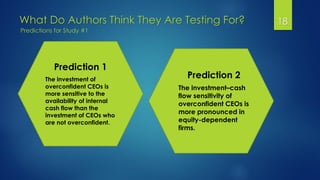
What Do Authors Think They Are Testing For? 18
Predictions for Study #1
Prediction 1
The investment of
overconfident CEOs is
more sensitive to the
availability of internal
cash flow than the
investment of CEOs who
are not overconfident.
Prediction 2
The investment–cash
flow sensitivity of
overconfident CEOs is
more pronounced in
equity-dependent
firms.
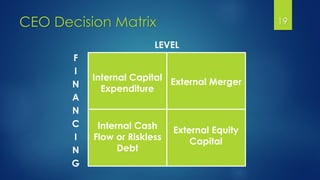
CEO Decision Matrix 19
Internal Capital
Expenditure
External Merger
Internal Cash
Flow or Riskless
Debt
External Equity
Capital
LEVEL
F
I
N
A
N
C
I
N
G
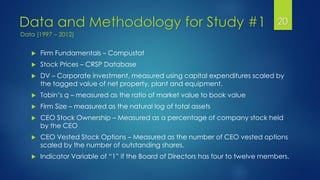
Data and Methodology for Study #1 20
 Firm Fundamentals – Compustat
 Stock Prices – CRSP Database
 DV – Corporate investment, measured using capital expenditures scaled by
the tagged value of net property, plant and equipment.
 Tobin’s q – measured as the ratio of market value to book value
 Firm Size – measured as the natural log of total assets
 CEO Stock Ownership – Measured as a percentage of company stock held
by the CEO
 CEO Vested Stock Options – Measured as the number of CEO vested options
scaled by the number of outstanding shares.
 Indicator Variable of “1” if the Board of Directors has four to twelve members.
Data (1997 – 2012)
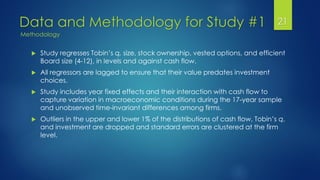
Data and Methodology for Study #1 21
 Study regresses Tobin’s q, size, stock ownership, vested options, and efficient
Board size (4-12), in levels and against cash flow.
 All regressors are lagged to ensure that their value predates investment
choices.
 Study includes year fixed effects and their interaction with cash flow to
capture variation in macroeconomic conditions during the 17-year sample
and unobserved time-invariant differences among firms.
 Outliers in the upper and lower 1% of the distributions of cash flow, Tobin’s q,
and investment are dropped and standard errors are clustered at the firm
level.
Methodology
CEO
Overconfidence
and the
Sensitivity of
Corporate
Investment to
Cash Flow
22
CEO
Overconfidence
and the Sensitivity
of Corporate
Investment to
Cash Flow (cont.)
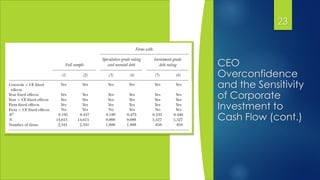
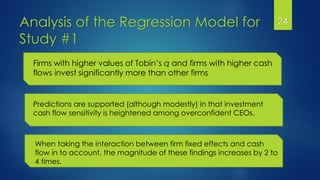
23
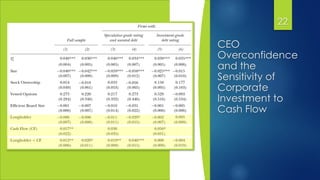
Analysis of the Regression Model for
Study #1
24
Predictions are supported (although modestly) in that investment
cash flow sensitivity is heightened among overconfident CEOs.
Firms with higher values of Tobin’s q and firms with higher cash
flows invest significantly more than other firms
When taking the interaction between firm fixed effects and cash
flow in to account, the magnitude of these findings increases by 2 to
4 times.
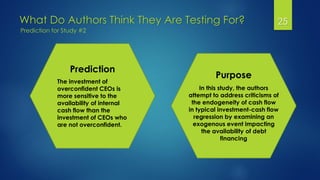
What Do Authors Think They Are Testing For? 25
Prediction for Study #2
Prediction
The investment of
overconfident CEOs is
more sensitive to the
availability of internal
cash flow than the
investment of CEOs who
are not overconfident.
Purpose
In this study, the authors
attempt to address criticisms of
the endogeneity of cash flow
in typical investment-cash flow
regression by examining an
exogenous event impacting
the availability of debt
financing
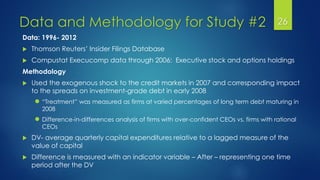
Data and Methodology for Study #2 26
Data: 1996- 2012
 Thomson Reuters’ Insider Filings Database
 Compustat Execucomp data through 2006: Executive stock and options holdings
Methodology
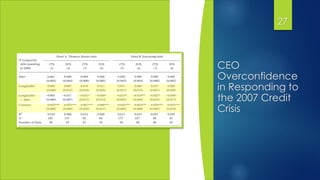
 Used the exogenous shock to the credit markets in 2007 and corresponding impact
to the spreads on investment-grade debt in early 2008
● “Treatment” was measured as firms at varied percentages of long term debt maturing in
2008
● Difference-in-differences analysis of firms with over-confident CEOs vs. firms with rational
CEOs
 DV- average quarterly capital expenditures relative to a lagged measure of the
value of capital
 Difference is measured with an indicator variable – After – representing one time
period after the DV
CEO
Overconfidence
in Responding to
the 2007 Credit
Crisis
27
Analysis of Regression Model for
Study #2
28
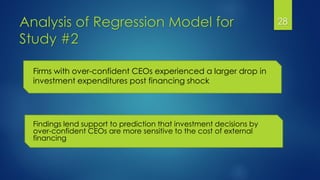
Findings lend support to prediction that investment decisions by
over-confident CEOs are more sensitive to the cost of external
financing
Firms with over-confident CEOs experienced a larger drop in
investment expenditures post financing shock
Conclusions & Implications 29
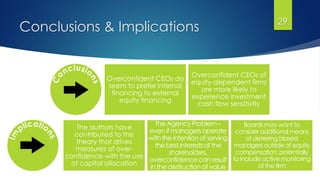
Overconfident CEOs do
seem to prefer internal
financing to external
equity financing
Overconfident CEOs of
equity-dependent firms
are more likely to
experience investment
cash flow sensitivity
The authors have
contributed to the
theory that drives
measures of over-
confidence with the use
of capital allocation
The Agency Problem –
even if managers operate
with the intention of serving
the best interests of the
shareholders,
overconfidence can result
in the destruction of value
Boards may want to
consider additional means
of deterring biased
managers outside of equity
compensation; potentially
to include active monitoring
of the firm
Limitations and Further Research 30
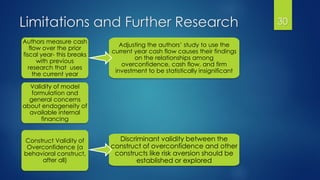
Authors measure cash
flow over the prior
fiscal year- this breaks
with previous
research that uses
the current year
Adjusting the authors’ study to use the
current year cash flow causes their findings
on the relationships among
overconfidence, cash flow, and firm
investment to be statistically insignificant
Validity of model
formulation and
general concerns
about endogeneity of
available internal
financing
Construct Validity of
Overconfidence (a
behavioral construct,
after all)
Discriminant validity between the
construct of overconfidence and other
constructs like risk aversion should be
established or explored
Evaluation: Teleological
The question is fairly simple – Is the

conclusion of overconfidence
teleological? Does it simply
depend on the outcomes? Said
differently, does it depend on
whether you came home or
crashed and burned?
31
Who Knows? Do the Authors?
What do you think?
32

Behavioral CEOs

  • 1.
    Behavioral CEOs: THE ROLEOF MANAGERIAL OVERCONFIDENCE Kristen J. Freiburger – Laurence J. Pino FIN7009: Corporate finance DBA Class of 2020
  • 2.
    The Authors: Specialistsin Overconfidence Ulrike Malmendier Geoffrey Tate • Professor of Finance • Kenan-Flagler Business School, University of North Carolina • PhD, Economics • Harvard University • Professor of Economics & Finance • Haas School of Business, University of California, Berkeley • PhD, Business Economics • Harvard University 2
  • 3.
    Research Motivation 3 The authors, specialistsin managerial biases, are interested in assessing whether executive overconfidence influences decisions on internal or external capital investments and credit allocations.
  • 4.
    Managerial Biases Comein All Shapes and Sizes  Baker, Pan, and Wurgler (2012) consider the role of reference points and anchoring and show that prior stock price peaks affect mergers and acquisitions through offer prices, deal success, and bidders’ announcement effects.  Baker and Wurgler (2013) survey literature on how bounded rationality could explain the adoption of capital budgeting criteria, and how loss aversion could explain investment patterns such as “throwing good money after bad.” 44
  • 5.
    Managerial Biases Other researchon managerial biases and distortions in decision-making  Managerial risk aversion (Lewellen 2006)  Military experience (Malmendier, Tate, and Yan 2011; Benmelech and Frydman 2015)  Industry expertise (Custodio and Metzger 2013)  General ability and execution skills (Kaplan, Klebanov, and Sorensen 2012)  Age and closeness to retirement (Jenter and Lewellen forthcoming; Yim 2013)  MBA degree and working experience (Beber and Fabbri 2012)  Personal frugality (Davidson, Dey, and Smith 2013; Cronqvist, Makhija, and Yonker 2012) 55
  • 6.
    Overconfident Executives 6 Overconfidentexecutives overestimate the future performance of their firms and are therefore more willing to hold options, expecting to profit from future stock price appreciation. Building on this logic, in Malmendier and Tate (2005), the authors proposed the systematic tendency to hold options longer before exercise as a measure of overconfidence. Fundamental Premise of Research Studies
  • 7.
  • 8.
    No Bueno 8 OverconfidentCEO Crashes and Burns. News at 11:00 PM. 104°
  • 9.
    Short Course onOption Grants  $100 – 0% Return  $120 – 20% Return  140 – 40% Return  160 – 60% Return  Etc. – Etc. ☺ 9 100,000 Shares Strike Price $100 Price at Issuance $70 Price at Exercise
  • 10.
    Exercise Price asAuthors’ Canonical Measure of CEO Overconfidence  10% - ?  20% - ?  30% - ?  40% - ?  50% - ? 10Considerations? Economy? Market? Union? Blue Moon? Black Swan? Industry?? Business?? Kids Private School?? Divorce?? Overconfidence
  • 11.
    Refining the Measure11 Attempting to address the shortcomings of the previous measures, the authors attempt to incorporate capital allocation decisions to refine the measure for the current study The Rational CEO • Indifferent to various options for financing • Believes that the prices of both equity and debt are set at the fair market price • Investment decisions based solely on a project’s ability to create value for shareholders The Over-Confident CEO • Beliefs that the market undervalues the firm’s equity cause an aversion to equity financing • Overconfident CEOs are likely to turn to internal cash as their primary source of investment (or, perhaps, risk-free debt)
  • 12.
    Alternative Measures ofCEO Overconfidence 12 Portrayal in the business press as a way to measure CEO beliefs. A common Managerial forecasts of earnings as a possible lens through which Researchers can observe overconfident beliefs. Otto (2014) measures CEO overconfidence by using the fraction of a firm’s voluntary earnings forecasts that later turned out to exceed the realized earnings. He shows that this measure is positively correlated with options-based measures of overconfidence. approach, first used in Malmendier and Tate (2008), is to count articles in prominent business publications like the Wall Street Journal or BusinessWeek that refer to CEOs using words that suggest overconfidence (“confident” / “confidence,” “optimistic” / “optimism”) relative to the number of articles that refer to CEOs with words that are unlikely to suggest overconfidence (“cautious,” “conservative,” “practical,” “reliable,” and “steady”). 1 2
  • 13.
    Alternative Measures ofCEO Overconfidence 13 Survey instruments to elicit a direct measure of overconfidence. Ben-David, 3 Graham, and Harvey (2013) measure 45 executive biases using 10 years of a quarterly survey conducted by Duke University between 2001 and 2011, which contains projections by US chief financial officers. They use the 80 percent confidence interval of the CFOs’ predictions of one- and ten-year market-wide stock returns to illustrate the miscalibration of senior executives’ beliefs.
  • 14.
    Overconfidence 14 Overestimation ofthe value a manager believes he or she can bring to his or her company OCM* believes the Company’s current assets are undervalued by the market. OCM overestimates the value of future potential investments. *Overconfident Manager (or CEO)
  • 15.
    Literature on “Bad”Overconfidence 15 Malmendier and Tate 2008 Overconfident CEOs have a higher tendency to undertake mergers and, particularly, diversifying deals, especially with access to internal financing. Malmendier, Tate, and Yan 2011 OCMs use less external finance and, conditional on accessing external capital, issue less equity (more debt) than their peers Schrand and Zechman 2012 Overconfident CEOs exhibit optimism which produces unintentional earnings misses. Deshmukh, Goel, and Howe 2013 Overconfident CEOs generally pay out smaller dividends. Bouwman, Ahmed and Duellman 2013 2014 Overconfident CEOs overestimate future earnings, borrow more aggressively against future earnings to avoid current earnings misses, and delay recognition of losses. STUDY DATE FINDINGS
  • 16.
    Literature on “Good”Overconfidence 16 Goel and Thakor 2008 Moderate biases can increase firm value by mitigating the effects of risk aversion. Campbell, Gallmeyer, Johnson, Rutherford, and Stanley 2011 CEOs with relatively low or relatively high optimism face a higher probability of forced turnover than moderately optimistic CEOs Galasso and Simcoe Hirshleifer, Low, and Teoh 2011 2012 Managerial overconfidence is generally beneficial for a firm’s innovation performance, and especially in competitive and innovative industries. Otto 2014 Firms can profit from overconfident CEOs by offering fewer grants and few bonus payment. Banerjee, Dai, Humphery- Jenner, and Nanda 2015a Firms choose overconfident CEOs at times when the predictable consequences of overconfidence on policies are likely to benefit the firm. STUDY DATE FINDINGS
  • 17.
    Literature on “+/-”Overconfidence 17 Sunder, Sunder, and Tan 2010 The inclusion of covenants in debt contracts evidence that creditors appear to recognize behavioral biases of managers Adam, Burg, Scheinert, and Streitz 2014 Overconfidence is associated with corporate choice as to issuance of performance-sensitive debt. STUDY DATE FINDINGS
  • 18.
    What Do AuthorsThink They Are Testing For? 18 Predictions for Study #1 Prediction 1 The investment of overconfident CEOs is more sensitive to the availability of internal cash flow than the investment of CEOs who are not overconfident. Prediction 2 The investment–cash flow sensitivity of overconfident CEOs is more pronounced in equity-dependent firms.
  • 19.
    CEO Decision Matrix19 Internal Capital Expenditure External Merger Internal Cash Flow or Riskless Debt External Equity Capital LEVEL F I N A N C I N G
  • 20.
    Data and Methodologyfor Study #1 20  Firm Fundamentals – Compustat  Stock Prices – CRSP Database  DV – Corporate investment, measured using capital expenditures scaled by the tagged value of net property, plant and equipment.  Tobin’s q – measured as the ratio of market value to book value  Firm Size – measured as the natural log of total assets  CEO Stock Ownership – Measured as a percentage of company stock held by the CEO  CEO Vested Stock Options – Measured as the number of CEO vested options scaled by the number of outstanding shares.  Indicator Variable of “1” if the Board of Directors has four to twelve members. Data (1997 – 2012)
  • 21.
    Data and Methodologyfor Study #1 21  Study regresses Tobin’s q, size, stock ownership, vested options, and efficient Board size (4-12), in levels and against cash flow.  All regressors are lagged to ensure that their value predates investment choices.  Study includes year fixed effects and their interaction with cash flow to capture variation in macroeconomic conditions during the 17-year sample and unobserved time-invariant differences among firms.  Outliers in the upper and lower 1% of the distributions of cash flow, Tobin’s q, and investment are dropped and standard errors are clustered at the firm level. Methodology
  • 22.
  • 23.
    CEO Overconfidence and the Sensitivity ofCorporate Investment to Cash Flow (cont.) 23
  • 24.
    Analysis of theRegression Model for Study #1 24 Predictions are supported (although modestly) in that investment cash flow sensitivity is heightened among overconfident CEOs. Firms with higher values of Tobin’s q and firms with higher cash flows invest significantly more than other firms When taking the interaction between firm fixed effects and cash flow in to account, the magnitude of these findings increases by 2 to 4 times.
  • 25.
    What Do AuthorsThink They Are Testing For? 25 Prediction for Study #2 Prediction The investment of overconfident CEOs is more sensitive to the availability of internal cash flow than the investment of CEOs who are not overconfident. Purpose In this study, the authors attempt to address criticisms of the endogeneity of cash flow in typical investment-cash flow regression by examining an exogenous event impacting the availability of debt financing
  • 26.
    Data and Methodologyfor Study #2 26 Data: 1996- 2012  Thomson Reuters’ Insider Filings Database  Compustat Execucomp data through 2006: Executive stock and options holdings Methodology  Used the exogenous shock to the credit markets in 2007 and corresponding impact to the spreads on investment-grade debt in early 2008 ● “Treatment” was measured as firms at varied percentages of long term debt maturing in 2008 ● Difference-in-differences analysis of firms with over-confident CEOs vs. firms with rational CEOs  DV- average quarterly capital expenditures relative to a lagged measure of the value of capital  Difference is measured with an indicator variable – After – representing one time period after the DV
  • 27.
  • 28.
    Analysis of RegressionModel for Study #2 28 Findings lend support to prediction that investment decisions by over-confident CEOs are more sensitive to the cost of external financing Firms with over-confident CEOs experienced a larger drop in investment expenditures post financing shock
  • 29.
    Conclusions & Implications29 Overconfident CEOs do seem to prefer internal financing to external equity financing Overconfident CEOs of equity-dependent firms are more likely to experience investment cash flow sensitivity The authors have contributed to the theory that drives measures of over- confidence with the use of capital allocation The Agency Problem – even if managers operate with the intention of serving the best interests of the shareholders, overconfidence can result in the destruction of value Boards may want to consider additional means of deterring biased managers outside of equity compensation; potentially to include active monitoring of the firm
  • 30.
    Limitations and FurtherResearch 30 Authors measure cash flow over the prior fiscal year- this breaks with previous research that uses the current year Adjusting the authors’ study to use the current year cash flow causes their findings on the relationships among overconfidence, cash flow, and firm investment to be statistically insignificant Validity of model formulation and general concerns about endogeneity of available internal financing Construct Validity of Overconfidence (a behavioral construct, after all) Discriminant validity between the construct of overconfidence and other constructs like risk aversion should be established or explored
  • 31.
    Evaluation: Teleological The questionis fairly simple – Is the conclusion of overconfidence teleological? Does it simply depend on the outcomes? Said differently, does it depend on whether you came home or crashed and burned? 31
  • 32.
    Who Knows? Dothe Authors? What do you think? 32