The Game
2
What We Will Cover in This Module
Basics of Field Lacrosse
• Shots on Goal
• Awarding Possession
• General Penalties
• Equipment
• Special Situations
• Time Outs
• The Field
• The Teams
• Game Times
• Substitutions
• Scoring
• Possession
• Ball Out of Bounds
3
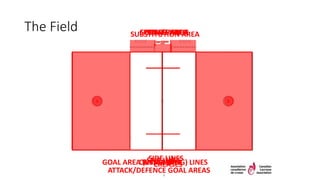
The Field
END LINES
CREASES
SCORE TABLEPENALTY BOXCOACH’S AREABENCH AREASUBSTITUTION AREA
SIDE LINES
CENTRE LINEWING LINESGOAL AREA (RESTAINING) LINES
ATTACK/DEFENCE GOAL AREAS4
Teams
EACH TEAM
• Up to 23 Players on Roster
• Up to 10 Players on the Field at a Time
• 1 Designated Goalie on the Field at all times
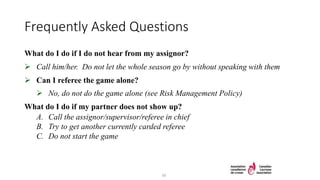
• Teams must have 10 players to start a game but can play
with less
GAME TIMES
• Often Different Locally Therefore Covered There
• FIL Rules – 4 X 20 Minute Quarters
• Run-Time except last 3 minutes of the game
5
Substitutions
• Substitution of players from the Bench to the Field –
during live play or stoppages (eg. penalties called)
• Must occur through the substitution area
• A bench player must wait for an imminent change before
entering the substitution area
• The field player must be completely off before the bench
player can enter
• Exceptions - Subs allowed anywhere
• After a goal
• During a time-out
6
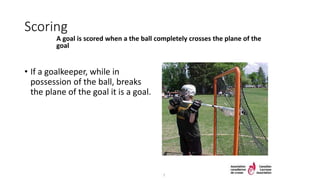
Scoring
A goal is scored when a the ball completely crosses the plane of the
goal
• If a goalkeeper, while in
possession of the ball, breaks
the plane of the goal it is a goal.
7
Disallowed Goals
• Goals are not allowed if the following occurs before
the goal:
• Time expires
• Referee blows whistle (even inadvertently)
• Too many attack players on field
• Attack team is offside or has too many long-poles
• Any attack player is in the crease (even if illegally pushed
in)
• Goal is scored by an illegal stick
• Head of the shooters stick comes off during the shot
8
Possession
• Player Possession
• When a player has the ball in their stick and can perform a
lacrosse action (pass, cradle, shoot)
• The designated goalie will also have possession if the goalie
and ball are in the crease and the goalie has the ball
trapped or is raking it with his stick
• Team Possession
• When any player on a team has possession or the ball is
passed between two team-mates (a pass can be a bounce
pass or rolling pass)
• Loose Ball – No team has possession
9
Ball Out of Bounds
• The ball is considered out of bounds when:
• The ball, or, the player carrying the ball:
• Touches a boundary line (Side line or End Line).
• Touches the ground outside the boundary line.
• Touches something out of bounds
(i.e. spectator, football/soccer posts).
• It has irretrievably left the field - i.e The ball
could not realistically be played.
10
Ball Out of Bounds - Possession
• The team that last touched the ball when it went out
of bounds loses possession when play restarts
• EXCEPT ON A SHOT ON GOAL
• When an attempted shot on goal goes out of bounds:
• The player closest to the ball when and where the ball goes
out of bounds gets possession
Not the player that is first to the end line
11
Shots on Goal
• When the offensive team takes a shot on goal the
“On” referee (the one closest to where the shot came
from) shall yell, “Shot”.
• A shot remains a shot until:
• It goes out-of-bounds.
• It comes to a stop on the field of play.
• A player gets possession of the ball
• A player deliberately causes (adds impetus to) the ball to
go out-of-bounds
• A deflected shot is still a shot.
12
Shots on Goal - ExamplesQ. The shot hits the pipe and deflects out of bounds at the
center line?
A. Award possession to the closest player when and where
the ball goes out.
Q. Shot taken and the ball hits a player or his stick then
goes out?
A. It is still a shot. Award possession to the closest player
when the ball goes out.
Q. The ball is shot and is rolling towards the sideline. As
the blue player tries to pick the ball up he pushes it out
of bounds?
A. Award possession to the red team.
13
Awarding Possession
• Possession is awarded to a team after:
• A foul by the opposing team
• The ball goes out of bounds
• When awarding Possession make sure:
• No other players are closer than 5 yards (4.57 metres)
(even team-mates)
• Not awarded closer than 20 yards (18 metres) from the
goal (the ball can’t start in the crease)
• Not awarded closer than 5 yards (4.57 metres) from the
substitution area
14
Penalties
• Three types of Penalties (Fouls)
1. Technical fouls (possession or 30 second penalty)
2. Personal fouls (1,2 or 3 minute penalty)
3. Expulsion fouls (3 minute penalty expelled)
• Results of Fouls:
• Non-offending team awarded possession
• Offending player (or team) may have to send a player to
the penalty box of some amount of time
• If a team has player(s) in the penalty box they must play
short-handed
15
Time-Outs
• CLA Time-Out Rules
• 2 Time-Outs per half of play
• Each time-out is 90 seconds long
• Cannot carry unused time-outs into the next half
• Often modified by Local Rules – Discussed later
• Overtime – Almost always modified by local rules so discussed
there entirely
16
Special Situations• Man-up/Man-down quarter change
• If the quarter ends with a man-up/down situation the
team in possession when the quarter ends will maintain
the ball at the start of the next quarter (Easy thing to
forget)
• Stick-Exchange
• Players on the field may exchange sticks
• If a player on the field wants to exchange sticks with the
sideline they must run off through the substitution area
to do it (they can’t receive a stick from their coach while
still on the field)
17
Special Situations• Bleeding (wet or dried blood on a player)
• Stop play immediately and the player must be replaced
until the blood is cleaned off)
• Ball mired in mud (exception for crease)
• Stop play and have a faceoff unless the ball is mired in
the crease in which case possession to the defensive
team (20 yards lateral from goal)
• Ball ensnared in the net (back of the goal)
• Stop play and award possession to the defensive team
(20 yards lateral from goal)
18
Special Situations• Ball Caught in Uniform
• Stop play and have a face-off
• Ball Caught in Stick
• Stop play – Technical Foul – award possession to the non-
offending team
• EXCEPT if the preceding 2 situations occur to the
designated goalie while in his crease
• Stop play and award possession to the defensive team
(20 yards lateral from the goal)
19
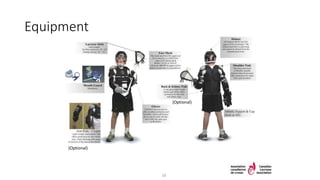
Equipment
20
(Optional)
(Optional)
Goalie Equipment
• In Addition to all of the player equipment the designated goalie
must also wear:
• A chest protector
• A throat gaurd
21
Local/Provincial
Information and Rules
22
What We Will Cover In This Module
• Provincial and Local Contacts and Assignors
• How you are assigned and paid
• Local Rules
23
Provincial Administration
SAMPLE
Saskatchewan Lacrosse
Bridget Pottle – Executive Director
• Address: 2205 Victoria Ave.,
Regina SK, S4P 0S4
• Telephone: 306-780-9216
• Email: lacrosse@sasktel.net
24
Provincial Administration
• Provincial Field RIC – Ian Wilson
• Provincial Clinician (s) – Ian Wilson, Terry Harding and Nathan Adams
25
Provincial Administration
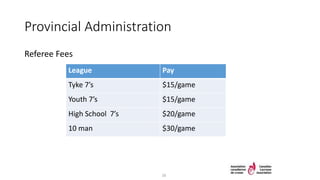
Referee Fees
26
League Pay
Tyke 7’s $15/game
Youth 7’s $15/game
High School 7’s $20/game
10 man $30/game
Local Administration
• Local RIC – Ian Wilson 306-222-5348
ianwilson555@gmail.com
• Assignor(s)– Nathan Adams 306-370-5494
n.a.lacrosse.ref@gmail.com
27
Local Administration
Assigning Procedure:
You must will email Nathan will all dates that you are unavailable. The
schedule will then be drawn up for a month at a time. If you are unable
to ref a scheduled game you need to find a replacement
28
Local Rules
SAMPLE:
Tyke and Youth Leagues.
• Play is 7 on 7 format on a smaller field (80X40yds.)
• 4 Goal Rule – When a team is losing by 4 goals or more and they are
scored upon they receive the ball at centre rather than having a
faceoff. Other faceoff restrictions still apply.
29
Frequently Asked Questions
What do I do if I do not hear from my assignor?
 Call him/her. Do not let the whole season go by without speaking with them
 Can I referee the game alone?
 No, do not do the game alone (see Risk Management Policy)
What do I do if my partner does not show up?
A. Call the assignor/supervisor/referee in chief
B. Try to get another currently carded referee
C. Do not start the game
30
Referee Uniform
31
What We Will Cover in This Module
• Minimum Referee Uniform Requirements
• Warm weather uniform
• Cold weather uniform
32
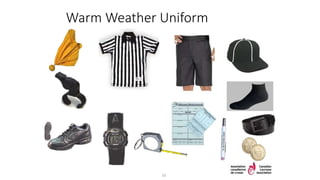
Warm Weather Uniform
33
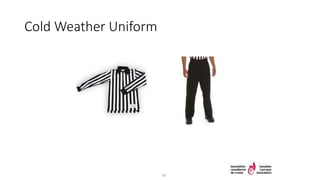
Cold Weather Uniform
34
Uniform
• Clinicians please include any local exceptions to the uniform
requirements here………….
35
Uniform
Where can I get this stuff?
• The Officials Corner ww.theofficialscorner.com
• The World of Sports www.worldofsports.com
• Honig’s Whistle Stop www.honigs.com
36

Beginner online2015

  • 2.
  • 3.
    What We WillCover in This Module Basics of Field Lacrosse • Shots on Goal • Awarding Possession • General Penalties • Equipment • Special Situations • Time Outs • The Field • The Teams • Game Times • Substitutions • Scoring • Possession • Ball Out of Bounds 3
  • 4.
    The Field END LINES CREASES SCORETABLEPENALTY BOXCOACH’S AREABENCH AREASUBSTITUTION AREA SIDE LINES CENTRE LINEWING LINESGOAL AREA (RESTAINING) LINES ATTACK/DEFENCE GOAL AREAS4
  • 5.
    Teams EACH TEAM • Upto 23 Players on Roster • Up to 10 Players on the Field at a Time • 1 Designated Goalie on the Field at all times • Teams must have 10 players to start a game but can play with less GAME TIMES • Often Different Locally Therefore Covered There • FIL Rules – 4 X 20 Minute Quarters • Run-Time except last 3 minutes of the game 5
  • 6.
    Substitutions • Substitution ofplayers from the Bench to the Field – during live play or stoppages (eg. penalties called) • Must occur through the substitution area • A bench player must wait for an imminent change before entering the substitution area • The field player must be completely off before the bench player can enter • Exceptions - Subs allowed anywhere • After a goal • During a time-out 6
  • 7.
    Scoring A goal isscored when a the ball completely crosses the plane of the goal • If a goalkeeper, while in possession of the ball, breaks the plane of the goal it is a goal. 7
  • 8.
    Disallowed Goals • Goalsare not allowed if the following occurs before the goal: • Time expires • Referee blows whistle (even inadvertently) • Too many attack players on field • Attack team is offside or has too many long-poles • Any attack player is in the crease (even if illegally pushed in) • Goal is scored by an illegal stick • Head of the shooters stick comes off during the shot 8
  • 9.
    Possession • Player Possession •When a player has the ball in their stick and can perform a lacrosse action (pass, cradle, shoot) • The designated goalie will also have possession if the goalie and ball are in the crease and the goalie has the ball trapped or is raking it with his stick • Team Possession • When any player on a team has possession or the ball is passed between two team-mates (a pass can be a bounce pass or rolling pass) • Loose Ball – No team has possession 9
  • 10.
    Ball Out ofBounds • The ball is considered out of bounds when: • The ball, or, the player carrying the ball: • Touches a boundary line (Side line or End Line). • Touches the ground outside the boundary line. • Touches something out of bounds (i.e. spectator, football/soccer posts). • It has irretrievably left the field - i.e The ball could not realistically be played. 10
  • 11.
    Ball Out ofBounds - Possession • The team that last touched the ball when it went out of bounds loses possession when play restarts • EXCEPT ON A SHOT ON GOAL • When an attempted shot on goal goes out of bounds: • The player closest to the ball when and where the ball goes out of bounds gets possession Not the player that is first to the end line 11
  • 12.
    Shots on Goal •When the offensive team takes a shot on goal the “On” referee (the one closest to where the shot came from) shall yell, “Shot”. • A shot remains a shot until: • It goes out-of-bounds. • It comes to a stop on the field of play. • A player gets possession of the ball • A player deliberately causes (adds impetus to) the ball to go out-of-bounds • A deflected shot is still a shot. 12
  • 13.
    Shots on Goal- ExamplesQ. The shot hits the pipe and deflects out of bounds at the center line? A. Award possession to the closest player when and where the ball goes out. Q. Shot taken and the ball hits a player or his stick then goes out? A. It is still a shot. Award possession to the closest player when the ball goes out. Q. The ball is shot and is rolling towards the sideline. As the blue player tries to pick the ball up he pushes it out of bounds? A. Award possession to the red team. 13
  • 14.
    Awarding Possession • Possessionis awarded to a team after: • A foul by the opposing team • The ball goes out of bounds • When awarding Possession make sure: • No other players are closer than 5 yards (4.57 metres) (even team-mates) • Not awarded closer than 20 yards (18 metres) from the goal (the ball can’t start in the crease) • Not awarded closer than 5 yards (4.57 metres) from the substitution area 14
  • 15.
    Penalties • Three typesof Penalties (Fouls) 1. Technical fouls (possession or 30 second penalty) 2. Personal fouls (1,2 or 3 minute penalty) 3. Expulsion fouls (3 minute penalty expelled) • Results of Fouls: • Non-offending team awarded possession • Offending player (or team) may have to send a player to the penalty box of some amount of time • If a team has player(s) in the penalty box they must play short-handed 15
  • 16.
    Time-Outs • CLA Time-OutRules • 2 Time-Outs per half of play • Each time-out is 90 seconds long • Cannot carry unused time-outs into the next half • Often modified by Local Rules – Discussed later • Overtime – Almost always modified by local rules so discussed there entirely 16
  • 17.
    Special Situations• Man-up/Man-downquarter change • If the quarter ends with a man-up/down situation the team in possession when the quarter ends will maintain the ball at the start of the next quarter (Easy thing to forget) • Stick-Exchange • Players on the field may exchange sticks • If a player on the field wants to exchange sticks with the sideline they must run off through the substitution area to do it (they can’t receive a stick from their coach while still on the field) 17
  • 18.
    Special Situations• Bleeding(wet or dried blood on a player) • Stop play immediately and the player must be replaced until the blood is cleaned off) • Ball mired in mud (exception for crease) • Stop play and have a faceoff unless the ball is mired in the crease in which case possession to the defensive team (20 yards lateral from goal) • Ball ensnared in the net (back of the goal) • Stop play and award possession to the defensive team (20 yards lateral from goal) 18
  • 19.
    Special Situations• BallCaught in Uniform • Stop play and have a face-off • Ball Caught in Stick • Stop play – Technical Foul – award possession to the non- offending team • EXCEPT if the preceding 2 situations occur to the designated goalie while in his crease • Stop play and award possession to the defensive team (20 yards lateral from the goal) 19
  • 20.
  • 21.
    Goalie Equipment • InAddition to all of the player equipment the designated goalie must also wear: • A chest protector • A throat gaurd 21
  • 22.
  • 23.
    What We WillCover In This Module • Provincial and Local Contacts and Assignors • How you are assigned and paid • Local Rules 23
  • 24.
    Provincial Administration SAMPLE Saskatchewan Lacrosse BridgetPottle – Executive Director • Address: 2205 Victoria Ave., Regina SK, S4P 0S4 • Telephone: 306-780-9216 • Email: lacrosse@sasktel.net 24
  • 25.
    Provincial Administration • ProvincialField RIC – Ian Wilson • Provincial Clinician (s) – Ian Wilson, Terry Harding and Nathan Adams 25
  • 26.
    Provincial Administration Referee Fees 26 LeaguePay Tyke 7’s $15/game Youth 7’s $15/game High School 7’s $20/game 10 man $30/game
  • 27.
    Local Administration • LocalRIC – Ian Wilson 306-222-5348 ianwilson555@gmail.com • Assignor(s)– Nathan Adams 306-370-5494 n.a.lacrosse.ref@gmail.com 27
  • 28.
    Local Administration Assigning Procedure: Youmust will email Nathan will all dates that you are unavailable. The schedule will then be drawn up for a month at a time. If you are unable to ref a scheduled game you need to find a replacement 28
  • 29.
    Local Rules SAMPLE: Tyke andYouth Leagues. • Play is 7 on 7 format on a smaller field (80X40yds.) • 4 Goal Rule – When a team is losing by 4 goals or more and they are scored upon they receive the ball at centre rather than having a faceoff. Other faceoff restrictions still apply. 29
  • 30.
    Frequently Asked Questions Whatdo I do if I do not hear from my assignor?  Call him/her. Do not let the whole season go by without speaking with them  Can I referee the game alone?  No, do not do the game alone (see Risk Management Policy) What do I do if my partner does not show up? A. Call the assignor/supervisor/referee in chief B. Try to get another currently carded referee C. Do not start the game 30
  • 31.
  • 32.
    What We WillCover in This Module • Minimum Referee Uniform Requirements • Warm weather uniform • Cold weather uniform 32
  • 33.
  • 34.
  • 35.
    Uniform • Clinicians pleaseinclude any local exceptions to the uniform requirements here…………. 35
  • 36.
    Uniform Where can Iget this stuff? • The Officials Corner ww.theofficialscorner.com • The World of Sports www.worldofsports.com • Honig’s Whistle Stop www.honigs.com 36

Editor's Notes

  • #4 This will module will be pretty basic for most people that are familiar with Field Lacrosse. Generally this can be gone through quickly. Perhaps put online.
  • #5 It is a good idea to Draw or have access to the Field Diagram so it can be referred to throughout the clinic
  • #7 -We are lenient with injured players and do not insist that they go through the substitution area -Players coming off the field have the right-of-way should a collision occur -Often illegal substitution occurs after penalties are called because the power play unit just runs onto the field without waiting for players to come off first (because play is stopped). This is illegal. Talk the teams through this early if possible.
  • #8 In theory an long pole could stand outside the crease with the ball and reach in and score without actually shooting the ball. With the ball in his stick the whole time. However a player is not allowed to throw their stick so you couldn’t score by throwing your stick with the ball into the net. Previously a ball had to be loose to score and the picture here wouldn’t have been a goal.
  • #10 As soon as a player shoots the ball, the ball is considered loose.
  • #12 It is actually the team of the player that is closest that gets possession after a shot For the player to be the closest to the ball they have to be in bounds when the ball goes out of bounds AND they have to all their legal equipment (they can’t have dropped their stick for example). If this occurs than the next closest legal player is closest to the ball We judge the players body being closest not their stick By rule if you don’t know who was closest to the ball you have a faceoff away from centre. In practice, pick a player that was closest.
  • #13 We will discuss the ‘On’ referee further in the mechanics and positioning module. If a shot is called in Error you can yell “Not a Shot”. Don’t yell ‘Pass’ because it confuses the teams If you think the team is trying to shoot then yell (referee’s judgment). Often yell it as the player is shooting. A shot does NOT have to hit the goal or the goalie to be a shot (unlike box lacrosse) 3. Most shots go out on the endline however it is very possible for a shot to go out on the sideline or perhaps even near centre (shot off the post for example). In these cases it is still the player that is closest to the ball when and where the ball went out of bounds.
  • #14 Ask the class.
  • #15 We will discuss fouls later in much more detail 2. If the ball goes out of bounds directly behind the goal you can award possession closer than 20 yards.
  • #16 We will discuss penalties in much more detail later
  • #17 Will also be discussed in Local Rules as it is often modified
  • #18 Do not spend too much time on Special Situations. With the exception of the ManUp/Down quarter change the rest don’t occur that often.
  • #19 A team could call a timeout so they could fix the blood issue without having to take the player off. Make sure ball is actually ensnared in the net because both teams are allowed to play the ball
  • #21 If a player loses a piece of essential equipment in the scrimmage area – stop play and fix the situations (no penalty). If the player is not in the scrimmage area let the scoring play continue and then stop play to fix the situation. Approved Helmet and Facemask Oral Mouthgaurd Shoulder Pads Back and Kidney pads (optional) Arm Pads Gloves Cup Shoes Lacrosse Stick (Crosse)
  • #23 The Provincial MA, RIC or clinician will be responsible for filling the required information for your province and local association.
  • #26 Each province may have different roles and so they may need to be adjusted as required. Please include contact information such as email and cell phones
  • #27 Insert age groups and amounts as appropriate.
  • #34 The standard uniform is a short sleeved striped jersey, black shorts, black hat with white piping, two flags and a whistle. This is the minimum standard for entry level officials. Referees should also have black ankle socks, black belt and black shoes, a spare whistle, a tape measure, coin, a watch, a scorecard and a pencil. While we don’t expect every new referee to have all of the required items we want referees to have the same ‘look’. Bright pink shoes, coloured shorts or the wrong type of hat makes you look less than professional. Do your best to get the gear that gives a good first impression.
  • #35 All other parts of the uniform remain the same except Long sleeved jersey and long black pants. Depending on the severity of the weather, black gloves, a black balaclava and/or black toque may also be worn. Once again, the uniform decision will be made by the head referee.