Introduction
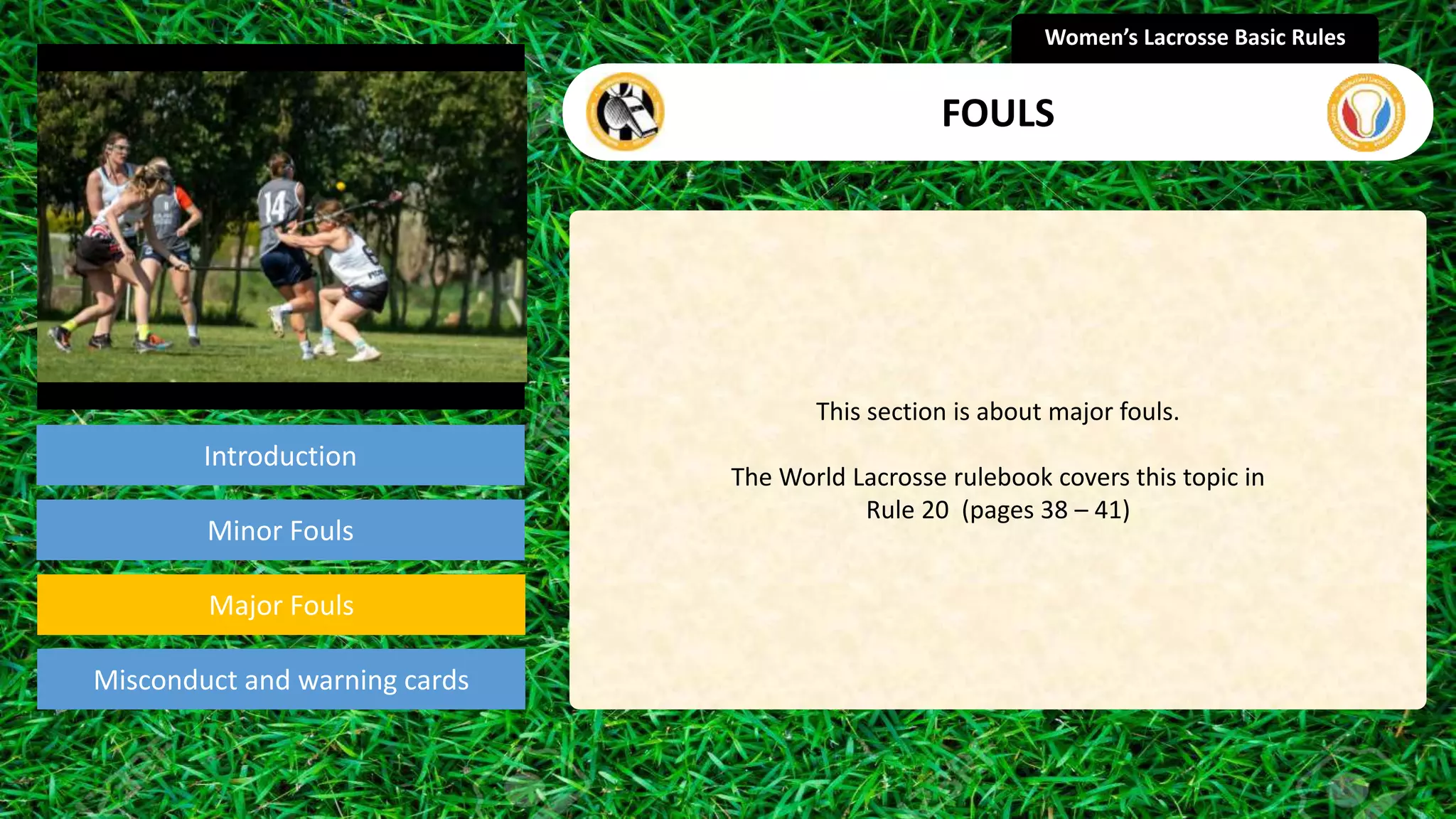
This section is about major fouls.
The World Lacrosse rulebook covers this topic in
Rule 20 (pages 38 – 41)
Women’s Lacrosse Basic Rules
FOULS
section
Minor Fouls
Misconduct and warning cards
Major Fouls
Introduction
Major fouls:
• More serious in nature
• Dangerous situations, unnecessarily or intentionally rough
• There are 25 types of major fouls
• The most common major fouls are explained, but read up on
the others in the Rulebook!
Women’s Lacrosse Basic Rules
FOULS
section
Minor Fouls
Misconduct and warning cards
Major Fouls
Introduction
In this section:
• Rough/ dangerous check
• Check across the body
• Blocking
• Charging
• Illegal contact
• Dangerous shot
• Shooting Space
• Three second rule
• Set up play after a major foul
Women’s Lacrosse Basic Rules
FOULS
section
Minor Fouls
Misconduct and warning cards
Major Fouls
Introduction
Rough/ dangerous check
• The direction of a check must always be away from the body, head
and neck, and must be controlled; not intimidating or dangerous
• Players must not check an opponent’s crosse within the ‘bubble’
• The bubble is the space around a player’s head from shoulder
to shoulder and a stick head’s width
Women’s Lacrosse Basic Rules
FOULS
section
Minor Fouls
Misconduct and warning cards
Major Fouls
Introduction
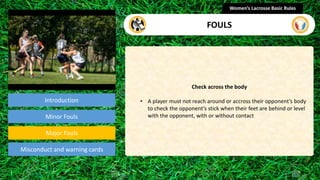
Check across the body
• A player must not reach around or accross their opponent’s body
to check the opponent’s stick when their feet are behind or level
with the opponent, with or without contact
Women’s Lacrosse Basic Rules
FOULS
section
Minor Fouls
Misconduct and warning cards
Major Fouls
Introduction
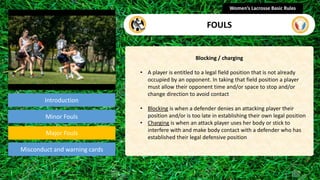
Blocking / charging
• A player is entitled to a legal field position that is not already
occupied by an opponent. In taking that field position a player
must allow their opponent time and/or space to stop and/or
change direction to avoid contact
• Blocking is when a defender denies an attacking player their
position and/or is too late in establishing their own legal position
• Charging is when an attack player uses her body or stick to
interfere with and make body contact with a defender who has
established their legal defensive position
Women’s Lacrosse Basic Rules
FOULS
section
Minor Fouls
Misconduct and warning cards
Major Fouls
Introduction
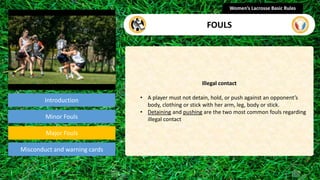
Illegal contact
• A player must not detain, hold, or push against an opponent’s
body, clothing or stick with her arm, leg, body or stick.
• Detaining and pushing are the two most common fouls regarding
illegal contact
Women’s Lacrosse Basic Rules
FOULS
section
Minor Fouls
Misconduct and warning cards
Major Fouls
Introduction
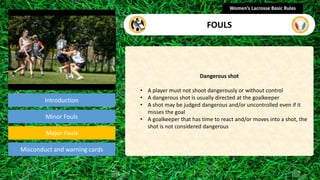
Dangerous shot
• A player must not shoot dangerously or without control
• A dangerous shot is usually directed at the goalkeeper
• A shot may be judged dangerous and/or uncontrolled even if it
misses the goal
• A goalkeeper that has time to react and/or moves into a shot, the
shot is not considered dangerous
Women’s Lacrosse Basic Rules
FOULS
section
Minor Fouls
Misconduct and warning cards
Major Fouls
Introduction
Shooting space
• Obstruction of free space to goal
• Only when the attacking team is in possession of the ball within
the MA
• The defender must not block or guard the goal with any part
of her body for the purpose of obstructing the shooting space
• Occurs when a defender is illegally in shooting space at her
own initiation
• The ball carrier must be looking to shoot and have the
opportunity to shoot
• A defender is not obstructing the free space to goal if they are:
• Legally marking within a sticks length (+/- 1,5 m)
• Standing below the GLE
Women’s Lacrosse Basic Rules
FOULS
section
Minor Fouls
Misconduct and warning cards
Major Fouls
Introduction
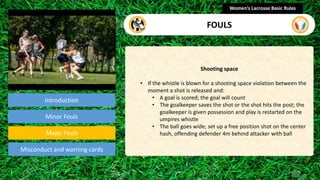
Shooting space
• If the whistle is blown for a shooting space violation between the
moment a shot is released and:
• A goal is scored; the goal will count
• The goalkeeper saves the shot or the shot hits the post; the
goalkeeper is given possession and play is restarted on the
umpires whistle
• The ball goes wide; set up a free position shot on the center
hash, offending defender 4m behind attacker with ball
Women’s Lacrosse Basic Rules
FOULS
section
Minor Fouls
Misconduct and warning cards
Major Fouls
Introduction
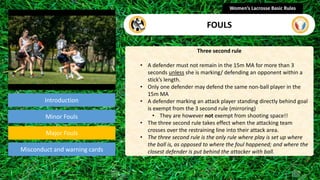
Three second rule
• A defender must not remain in the 15m MA for more than 3
seconds unless she is marking/ defending an opponent within a
stick’s length.
• Only one defender may defend the same non-ball player in the
15m MA
• A defender marking an attack player standing directly behind goal
is exempt from the 3 second rule (mirroring)
• They are however not exempt from shooting space!!
• The three second rule takes effect when the attacking team
crosses over the restraining line into their attack area.
• The three second rule is the only rule where play is set up where
the ball is, as opposed to where the foul happened; and where the
closest defender is put behind the attacker with ball.
Women’s Lacrosse Basic Rules
FOULS
section
Minor Fouls
Misconduct and warning cards
Major Fouls
Introduction
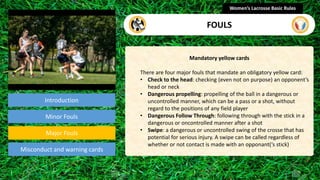
Mandatory yellow cards
There are four major fouls that mandate an obligatory yellow card:
• Check to the head: checking (even not on purpose) an opponent’s
head or neck
• Dangerous propelling: propelling of the ball in a dangerous or
uncontrolled manner, which can be a pass or a shot, without
regard to the positions of any field player
• Dangerous Follow Through: following through with the stick in a
dangerous or oncontrolled manner after a shot
• Swipe: a dangerous or uncontrolled swing of the crosse that has
potential for serious injury. A swipe can be called regardless of
whether or not contact is made with an opponant(‘s stick)
Women’s Lacrosse Basic Rules
FOULS
section
Minor Fouls
Misconduct and warning cards
Major Fouls
Introduction
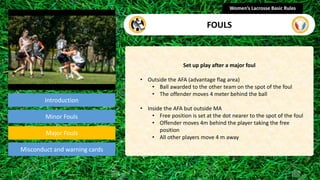
Set up play after a major foul
• Outside the AFA (advantage flag area)
• Ball awarded to the other team on the spot of the foul
• The offender moves 4 meter behind the ball
• Inside the AFA but outside MA
• Free position is set at the dot nearer to the spot of the foul
• Offender moves 4m behind the player taking the free
position
• All other players move 4 m away
Women’s Lacrosse Basic Rules
FOULS
section
Minor Fouls
Misconduct and warning cards
Major Fouls
Introduction
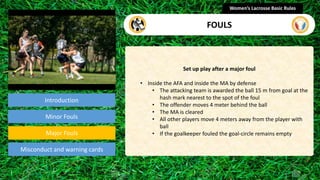
Set up play after a major foul
• Inside the AFA and inside the MA by defense
• The attacking team is awarded the ball 15 m from goal at the
hash mark nearest to the spot of the foul
• The offender moves 4 meter behind the ball
• The MA is cleared
• All other players move 4 meters away from the player with
ball
• If the goalkeeper fouled the goal-circle remains empty
Women’s Lacrosse Basic Rules
FOULS
section
Minor Fouls
Misconduct and warning cards
Major Fouls
Introduction
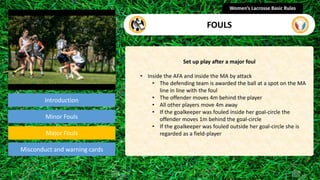
Set up play after a major foul
• Inside the AFA and inside the MA by attack
• The defending team is awarded the ball at a spot on the MA
line in line with the foul
• The offender moves 4m behind the player
• All other players move 4m away
• If the goalkeeper was fouled inside her goal-circle the
offender moves 1m behind the goal-circle
• If the goalkeeper was fouled outside her goal-circle she is
regarded as a field-player
Women’s Lacrosse Basic Rules
FOULS
section
Minor Fouls
Misconduct and warning cards
Major Fouls

Fouls - major fouls.pptx

  • 1.
    Introduction This section isabout major fouls. The World Lacrosse rulebook covers this topic in Rule 20 (pages 38 – 41) Women’s Lacrosse Basic Rules FOULS section Minor Fouls Misconduct and warning cards Major Fouls
  • 2.
    Introduction Major fouls: • Moreserious in nature • Dangerous situations, unnecessarily or intentionally rough • There are 25 types of major fouls • The most common major fouls are explained, but read up on the others in the Rulebook! Women’s Lacrosse Basic Rules FOULS section Minor Fouls Misconduct and warning cards Major Fouls
  • 3.
    Introduction In this section: •Rough/ dangerous check • Check across the body • Blocking • Charging • Illegal contact • Dangerous shot • Shooting Space • Three second rule • Set up play after a major foul Women’s Lacrosse Basic Rules FOULS section Minor Fouls Misconduct and warning cards Major Fouls
  • 4.
    Introduction Rough/ dangerous check •The direction of a check must always be away from the body, head and neck, and must be controlled; not intimidating or dangerous • Players must not check an opponent’s crosse within the ‘bubble’ • The bubble is the space around a player’s head from shoulder to shoulder and a stick head’s width Women’s Lacrosse Basic Rules FOULS section Minor Fouls Misconduct and warning cards Major Fouls
  • 5.
    Introduction Check across thebody • A player must not reach around or accross their opponent’s body to check the opponent’s stick when their feet are behind or level with the opponent, with or without contact Women’s Lacrosse Basic Rules FOULS section Minor Fouls Misconduct and warning cards Major Fouls
  • 6.
    Introduction Blocking / charging •A player is entitled to a legal field position that is not already occupied by an opponent. In taking that field position a player must allow their opponent time and/or space to stop and/or change direction to avoid contact • Blocking is when a defender denies an attacking player their position and/or is too late in establishing their own legal position • Charging is when an attack player uses her body or stick to interfere with and make body contact with a defender who has established their legal defensive position Women’s Lacrosse Basic Rules FOULS section Minor Fouls Misconduct and warning cards Major Fouls
  • 7.
    Introduction Illegal contact • Aplayer must not detain, hold, or push against an opponent’s body, clothing or stick with her arm, leg, body or stick. • Detaining and pushing are the two most common fouls regarding illegal contact Women’s Lacrosse Basic Rules FOULS section Minor Fouls Misconduct and warning cards Major Fouls
  • 8.
    Introduction Dangerous shot • Aplayer must not shoot dangerously or without control • A dangerous shot is usually directed at the goalkeeper • A shot may be judged dangerous and/or uncontrolled even if it misses the goal • A goalkeeper that has time to react and/or moves into a shot, the shot is not considered dangerous Women’s Lacrosse Basic Rules FOULS section Minor Fouls Misconduct and warning cards Major Fouls
  • 9.
    Introduction Shooting space • Obstructionof free space to goal • Only when the attacking team is in possession of the ball within the MA • The defender must not block or guard the goal with any part of her body for the purpose of obstructing the shooting space • Occurs when a defender is illegally in shooting space at her own initiation • The ball carrier must be looking to shoot and have the opportunity to shoot • A defender is not obstructing the free space to goal if they are: • Legally marking within a sticks length (+/- 1,5 m) • Standing below the GLE Women’s Lacrosse Basic Rules FOULS section Minor Fouls Misconduct and warning cards Major Fouls
  • 10.
    Introduction Shooting space • Ifthe whistle is blown for a shooting space violation between the moment a shot is released and: • A goal is scored; the goal will count • The goalkeeper saves the shot or the shot hits the post; the goalkeeper is given possession and play is restarted on the umpires whistle • The ball goes wide; set up a free position shot on the center hash, offending defender 4m behind attacker with ball Women’s Lacrosse Basic Rules FOULS section Minor Fouls Misconduct and warning cards Major Fouls
  • 11.
    Introduction Three second rule •A defender must not remain in the 15m MA for more than 3 seconds unless she is marking/ defending an opponent within a stick’s length. • Only one defender may defend the same non-ball player in the 15m MA • A defender marking an attack player standing directly behind goal is exempt from the 3 second rule (mirroring) • They are however not exempt from shooting space!! • The three second rule takes effect when the attacking team crosses over the restraining line into their attack area. • The three second rule is the only rule where play is set up where the ball is, as opposed to where the foul happened; and where the closest defender is put behind the attacker with ball. Women’s Lacrosse Basic Rules FOULS section Minor Fouls Misconduct and warning cards Major Fouls
  • 12.
    Introduction Mandatory yellow cards Thereare four major fouls that mandate an obligatory yellow card: • Check to the head: checking (even not on purpose) an opponent’s head or neck • Dangerous propelling: propelling of the ball in a dangerous or uncontrolled manner, which can be a pass or a shot, without regard to the positions of any field player • Dangerous Follow Through: following through with the stick in a dangerous or oncontrolled manner after a shot • Swipe: a dangerous or uncontrolled swing of the crosse that has potential for serious injury. A swipe can be called regardless of whether or not contact is made with an opponant(‘s stick) Women’s Lacrosse Basic Rules FOULS section Minor Fouls Misconduct and warning cards Major Fouls
  • 13.
    Introduction Set up playafter a major foul • Outside the AFA (advantage flag area) • Ball awarded to the other team on the spot of the foul • The offender moves 4 meter behind the ball • Inside the AFA but outside MA • Free position is set at the dot nearer to the spot of the foul • Offender moves 4m behind the player taking the free position • All other players move 4 m away Women’s Lacrosse Basic Rules FOULS section Minor Fouls Misconduct and warning cards Major Fouls
  • 14.
    Introduction Set up playafter a major foul • Inside the AFA and inside the MA by defense • The attacking team is awarded the ball 15 m from goal at the hash mark nearest to the spot of the foul • The offender moves 4 meter behind the ball • The MA is cleared • All other players move 4 meters away from the player with ball • If the goalkeeper fouled the goal-circle remains empty Women’s Lacrosse Basic Rules FOULS section Minor Fouls Misconduct and warning cards Major Fouls
  • 15.
    Introduction Set up playafter a major foul • Inside the AFA and inside the MA by attack • The defending team is awarded the ball at a spot on the MA line in line with the foul • The offender moves 4m behind the player • All other players move 4m away • If the goalkeeper was fouled inside her goal-circle the offender moves 1m behind the goal-circle • If the goalkeeper was fouled outside her goal-circle she is regarded as a field-player Women’s Lacrosse Basic Rules FOULS section Minor Fouls Misconduct and warning cards Major Fouls

Editor's Notes

  • #2 Title: Caps Calibri (body) 28 Sub titles: Calibri (body) 20
  • #3 Title: Caps Calibri (body) 28 Sub titles: Calibri (body) 20
  • #4 Title: Caps Calibri (body) 28 Sub titles: Calibri (body) 20
  • #5 Title: Caps Calibri (body) 28 Sub titles: Calibri (body) 20
  • #6 Title: Caps Calibri (body) 28 Sub titles: Calibri (body) 20
  • #7 Title: Caps Calibri (body) 28 Sub titles: Calibri (body) 20
  • #8 Title: Caps Calibri (body) 28 Sub titles: Calibri (body) 20
  • #9 Title: Caps Calibri (body) 28 Sub titles: Calibri (body) 20
  • #10 Title: Caps Calibri (body) 28 Sub titles: Calibri (body) 20
  • #11 Title: Caps Calibri (body) 28 Sub titles: Calibri (body) 20
  • #12 Title: Caps Calibri (body) 28 Sub titles: Calibri (body) 20
  • #13 Title: Caps Calibri (body) 28 Sub titles: Calibri (body) 20
  • #14 Title: Caps Calibri (body) 28 Sub titles: Calibri (body) 20
  • #15 Title: Caps Calibri (body) 28 Sub titles: Calibri (body) 20
  • #16 Title: Caps Calibri (body) 28 Sub titles: Calibri (body) 20