Beef Cattle
YEAR 10 AGRICULTURE
Introduction
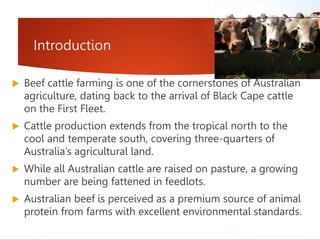
 Beef cattle farming is one of the cornerstones of Australian
agriculture, dating back to the arrival of Black Cape cattle
on the First Fleet.
 Cattle production extends from the tropical north to the
cool and temperate south, covering three-quarters of
Australia’s agricultural land.
 While all Australian cattle are raised on pasture, a growing
number are being fattened in feedlots.
 Australian beef is perceived as a premium source of animal
protein from farms with excellent environmental standards.
Introduction
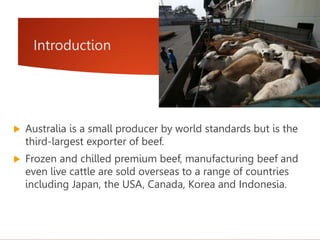
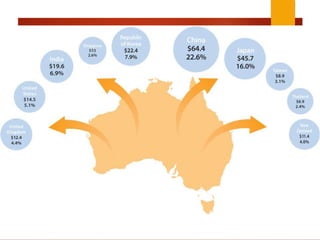
 Australia is a small producer by world standards but is the
third-largest exporter of beef.
 Frozen and chilled premium beef, manufacturing beef and
even live cattle are sold overseas to a range of countries
including Japan, the USA, Canada, Korea and Indonesia.
Introduction
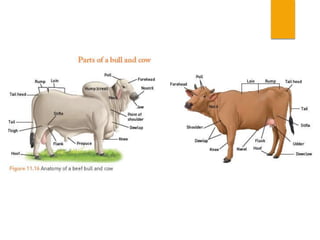
Functions and anatomy
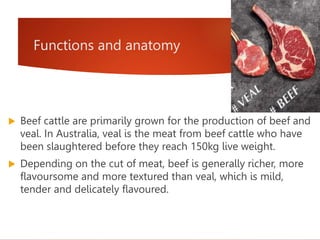
 Beef cattle are primarily grown for the production of beef and
veal. In Australia, veal is the meat from beef cattle who have
been slaughtered before they reach 150kg live weight.
 Depending on the cut of meat, beef is generally richer, more
flavoursome and more textured than veal, which is mild,
tender and delicately flavoured.
Functions and
anatomy
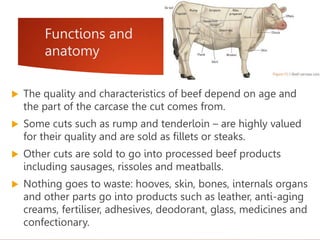
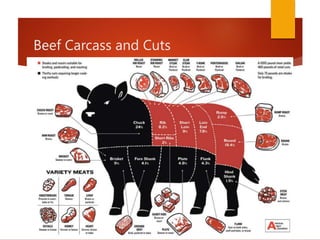
 The quality and characteristics of beef depend on age and
the part of the carcase the cut comes from.
 Some cuts such as rump and tenderloin – are highly valued
for their quality and are sold as fillets or steaks.
 Other cuts are sold to go into processed beef products
including sausages, rissoles and meatballs.
 Nothing goes to waste: hooves, skin, bones, internals organs
and other parts go into products such as leather, anti-aging
creams, fertiliser, adhesives, deodorant, glass, medicines and
confectionary.
Beef Cattle Breeds
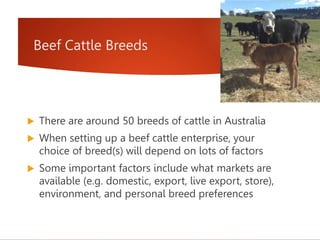
 There are around 50 breeds of cattle in Australia
 When setting up a beef cattle enterprise, your
choice of breed(s) will depend on lots of factors
 Some important factors include what markets are
available (e.g. domestic, export, live export, store),
environment, and personal breed preferences
Beef Cattle Breeds
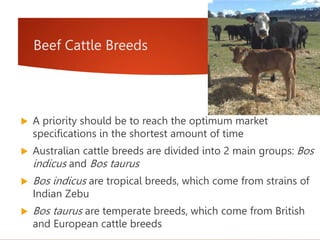
 A priority should be to reach the optimum market
specifications in the shortest amount of time
 Australian cattle breeds are divided into 2 main groups: Bos
indicus and Bos taurus
 Bos indicus are tropical breeds, which come from strains of
Indian Zebu
 Bos taurus are temperate breeds, which come from British
and European cattle breeds
Beef Cattle Breeds
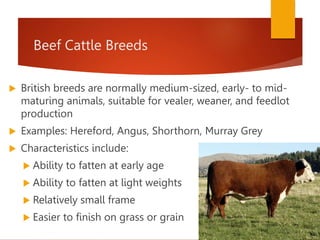
 British breeds are normally medium-sized, early- to mid-
maturing animals, suitable for vealer, weaner, and feedlot
production
 Examples: Hereford, Angus, Shorthorn, Murray Grey
 Characteristics include:
 Ability to fatten at early age
 Ability to fatten at light weights
 Relatively small frame
 Easier to finish on grass or grain
Beef Cattle Breeds
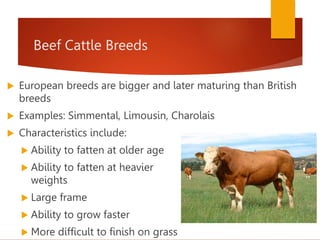
 European breeds are bigger and later maturing than British
breeds
 Examples: Simmental, Limousin, Charolais
 Characteristics include:
 Ability to fatten at older age
 Ability to fatten at heavier
weights
 Large frame
 Ability to grow faster
 More difficult to finish on grass
Beef Cattle Breeds
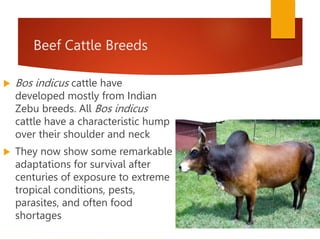
 Bos indicus cattle have
developed mostly from Indian
Zebu breeds. All Bos indicus
cattle have a characteristic hump
over their shoulder and neck
 They now show some remarkable
adaptations for survival after
centuries of exposure to extreme
tropical conditions, pests,
parasites, and often food
shortages
Beef Cattle Breeds
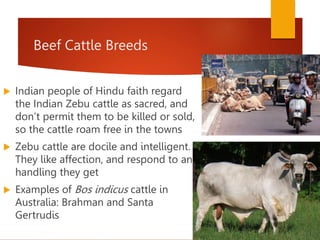
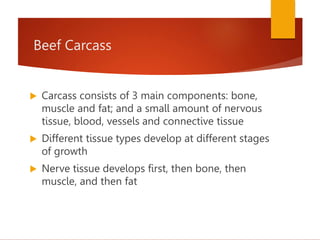
 Indian people of Hindu faith regard
the Indian Zebu cattle as sacred, and
don’t permit them to be killed or sold,
so the cattle roam free in the towns
 Zebu cattle are docile and intelligent.
They like affection, and respond to any
handling they get
 Examples of Bos indicus cattle in
Australia: Brahman and Santa
Gertrudis
Beef Carcass
 Carcass consists of 3 main components: bone,
muscle and fat; and a small amount of nervous
tissue, blood, vessels and connective tissue
 Different tissue types develop at different stages
of growth
 Nerve tissue develops first, then bone, then
muscle, and then fat
Beef Carcass and Cuts
Beef Carcass
 Once an animal has reached its maximum
muscle production, it will convert any extra feed
into fat
 It’s important that the farmer sells the animal for
slaughter before it puts on too much fat
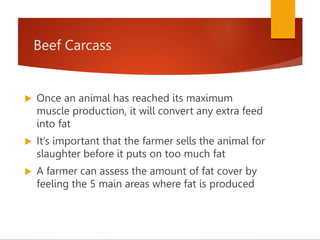
 A farmer can assess the amount of fat cover by
feeling the 5 main areas where fat is produced
4
1
5
Beef Carcass
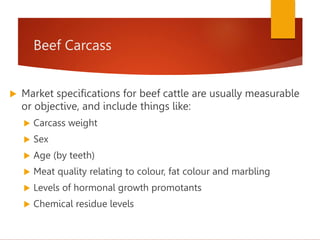
 Market specifications for beef cattle are usually measurable
or objective, and include things like:
 Carcass weight
 Sex
 Age (by teeth)
 Meat quality relating to colour, fat colour and marbling
 Levels of hormonal growth promotants
 Chemical residue levels
Factors Affecting Meat Quality
 Main aim throughout production and marketing process is
to maximise meat quality
 It can take months or even years to produce an animal for a
specific market
 Quality = colour, texture and distribution of muscle and fat,
smell, tenderness and flavour of meat
Factors Affecting Meat Quality
 Meat quality can be affected by:
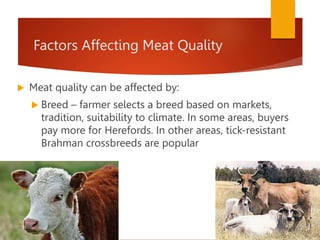
 Breed – farmer selects a breed based on markets,
tradition, suitability to climate. In some areas, buyers
pay more for Herefords. In other areas, tick-resistant
Brahman crossbreeds are popular
Factors Affecting Meat Quality
 Meat quality can be affected by:
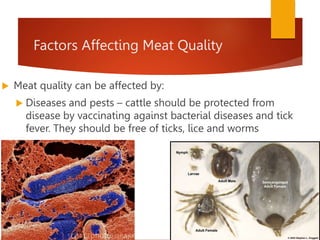
 Diseases and pests – cattle should be protected from
disease by vaccinating against bacterial diseases and tick
fever. They should be free of ticks, lice and worms
Factors Affecting Meat Quality
 Meat quality can be affected by:
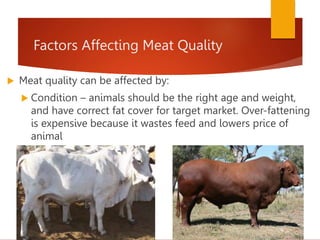
 Condition – animals should be the right age and weight,
and have correct fat cover for target market. Over-fattening
is expensive because it wastes feed and lowers price of
animal
Factors Affecting Meat Quality
 Meat quality can be affected by:
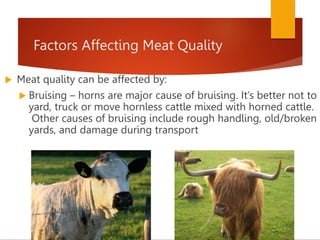
 Bruising – horns are major cause of bruising. It’s better not to
yard, truck or move hornless cattle mixed with horned cattle.
Other causes of bruising include rough handling, old/broken
yards, and damage during transport
Factors Affecting Meat Quality
 Meat quality can be affected by:
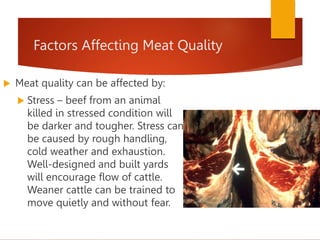
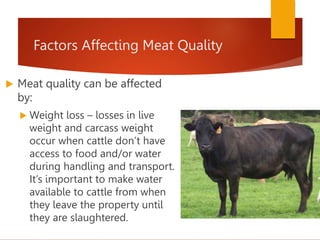
 Stress – beef from an animal
killed in stressed condition will
be darker and tougher. Stress can
be caused by rough handling,
cold weather and exhaustion.
Well-designed and built yards
will encourage flow of cattle.
Weaner cattle can be trained to
move quietly and without fear.
Factors Affecting Meat Quality
 Meat quality can be affected
by:
 Weight loss – losses in live
weight and carcass weight
occur when cattle don’t have
access to food and/or water
during handling and transport.
It’s important to make water
available to cattle from when
they leave the property until
they are slaughtered.
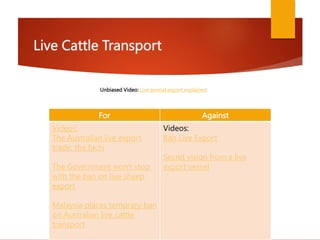
Live Cattle Transport
For Against
Videos:
The Australian live export
trade: the facts
The Government won't stop
with the ban on live sheep
export
Malaysia places temprary ban
on Australian live cattle
transport
Videos:
Ban Live Export
Secret vision from a live
export vessel
Unbiased Video: Live animal export explained
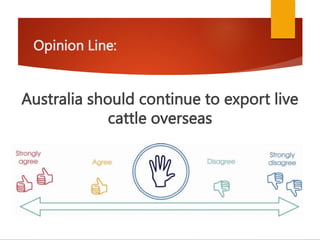
Opinion Line:
Australia should continue to export live
cattle overseas
Production Cycle
 The production cycle of beef cattle is based on
the reproductive cycle of the cow.
 Cows are joined by bulls for a 6-12 week period.

Beef-Cattle.pptx

  • 1.
  • 2.
    Introduction  Beef cattlefarming is one of the cornerstones of Australian agriculture, dating back to the arrival of Black Cape cattle on the First Fleet.  Cattle production extends from the tropical north to the cool and temperate south, covering three-quarters of Australia’s agricultural land.  While all Australian cattle are raised on pasture, a growing number are being fattened in feedlots.  Australian beef is perceived as a premium source of animal protein from farms with excellent environmental standards.
  • 3.
    Introduction  Australia isa small producer by world standards but is the third-largest exporter of beef.  Frozen and chilled premium beef, manufacturing beef and even live cattle are sold overseas to a range of countries including Japan, the USA, Canada, Korea and Indonesia.
  • 4.
  • 5.
    Functions and anatomy Beef cattle are primarily grown for the production of beef and veal. In Australia, veal is the meat from beef cattle who have been slaughtered before they reach 150kg live weight.  Depending on the cut of meat, beef is generally richer, more flavoursome and more textured than veal, which is mild, tender and delicately flavoured.
  • 6.
    Functions and anatomy  Thequality and characteristics of beef depend on age and the part of the carcase the cut comes from.  Some cuts such as rump and tenderloin – are highly valued for their quality and are sold as fillets or steaks.  Other cuts are sold to go into processed beef products including sausages, rissoles and meatballs.  Nothing goes to waste: hooves, skin, bones, internals organs and other parts go into products such as leather, anti-aging creams, fertiliser, adhesives, deodorant, glass, medicines and confectionary.
  • 7.
    Beef Cattle Breeds There are around 50 breeds of cattle in Australia  When setting up a beef cattle enterprise, your choice of breed(s) will depend on lots of factors  Some important factors include what markets are available (e.g. domestic, export, live export, store), environment, and personal breed preferences
  • 8.
    Beef Cattle Breeds A priority should be to reach the optimum market specifications in the shortest amount of time  Australian cattle breeds are divided into 2 main groups: Bos indicus and Bos taurus  Bos indicus are tropical breeds, which come from strains of Indian Zebu  Bos taurus are temperate breeds, which come from British and European cattle breeds
  • 9.
    Beef Cattle Breeds British breeds are normally medium-sized, early- to mid- maturing animals, suitable for vealer, weaner, and feedlot production  Examples: Hereford, Angus, Shorthorn, Murray Grey  Characteristics include:  Ability to fatten at early age  Ability to fatten at light weights  Relatively small frame  Easier to finish on grass or grain
  • 10.
    Beef Cattle Breeds European breeds are bigger and later maturing than British breeds  Examples: Simmental, Limousin, Charolais  Characteristics include:  Ability to fatten at older age  Ability to fatten at heavier weights  Large frame  Ability to grow faster  More difficult to finish on grass
  • 11.
    Beef Cattle Breeds Bos indicus cattle have developed mostly from Indian Zebu breeds. All Bos indicus cattle have a characteristic hump over their shoulder and neck  They now show some remarkable adaptations for survival after centuries of exposure to extreme tropical conditions, pests, parasites, and often food shortages
  • 12.
    Beef Cattle Breeds Indian people of Hindu faith regard the Indian Zebu cattle as sacred, and don’t permit them to be killed or sold, so the cattle roam free in the towns  Zebu cattle are docile and intelligent. They like affection, and respond to any handling they get  Examples of Bos indicus cattle in Australia: Brahman and Santa Gertrudis
  • 13.
    Beef Carcass  Carcassconsists of 3 main components: bone, muscle and fat; and a small amount of nervous tissue, blood, vessels and connective tissue  Different tissue types develop at different stages of growth  Nerve tissue develops first, then bone, then muscle, and then fat
  • 14.
  • 15.
    Beef Carcass  Oncean animal has reached its maximum muscle production, it will convert any extra feed into fat  It’s important that the farmer sells the animal for slaughter before it puts on too much fat  A farmer can assess the amount of fat cover by feeling the 5 main areas where fat is produced
  • 16.
  • 17.
    Beef Carcass  Marketspecifications for beef cattle are usually measurable or objective, and include things like:  Carcass weight  Sex  Age (by teeth)  Meat quality relating to colour, fat colour and marbling  Levels of hormonal growth promotants  Chemical residue levels
  • 18.
    Factors Affecting MeatQuality  Main aim throughout production and marketing process is to maximise meat quality  It can take months or even years to produce an animal for a specific market  Quality = colour, texture and distribution of muscle and fat, smell, tenderness and flavour of meat
  • 19.
    Factors Affecting MeatQuality  Meat quality can be affected by:  Breed – farmer selects a breed based on markets, tradition, suitability to climate. In some areas, buyers pay more for Herefords. In other areas, tick-resistant Brahman crossbreeds are popular
  • 20.
    Factors Affecting MeatQuality  Meat quality can be affected by:  Diseases and pests – cattle should be protected from disease by vaccinating against bacterial diseases and tick fever. They should be free of ticks, lice and worms
  • 21.
    Factors Affecting MeatQuality  Meat quality can be affected by:  Condition – animals should be the right age and weight, and have correct fat cover for target market. Over-fattening is expensive because it wastes feed and lowers price of animal
  • 22.
    Factors Affecting MeatQuality  Meat quality can be affected by:  Bruising – horns are major cause of bruising. It’s better not to yard, truck or move hornless cattle mixed with horned cattle. Other causes of bruising include rough handling, old/broken yards, and damage during transport
  • 23.
    Factors Affecting MeatQuality  Meat quality can be affected by:  Stress – beef from an animal killed in stressed condition will be darker and tougher. Stress can be caused by rough handling, cold weather and exhaustion. Well-designed and built yards will encourage flow of cattle. Weaner cattle can be trained to move quietly and without fear.
  • 24.
    Factors Affecting MeatQuality  Meat quality can be affected by:  Weight loss – losses in live weight and carcass weight occur when cattle don’t have access to food and/or water during handling and transport. It’s important to make water available to cattle from when they leave the property until they are slaughtered.
  • 25.
    Live Cattle Transport ForAgainst Videos: The Australian live export trade: the facts The Government won't stop with the ban on live sheep export Malaysia places temprary ban on Australian live cattle transport Videos: Ban Live Export Secret vision from a live export vessel Unbiased Video: Live animal export explained
  • 26.
    Opinion Line: Australia shouldcontinue to export live cattle overseas
  • 27.
    Production Cycle  Theproduction cycle of beef cattle is based on the reproductive cycle of the cow.  Cows are joined by bulls for a 6-12 week period.