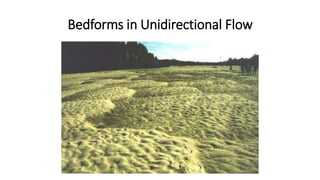
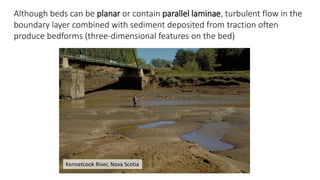
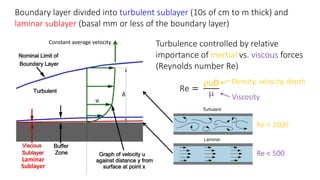
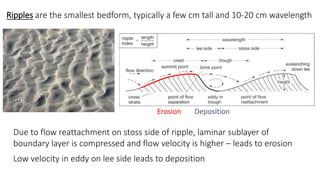
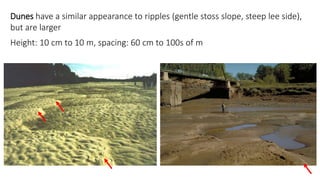
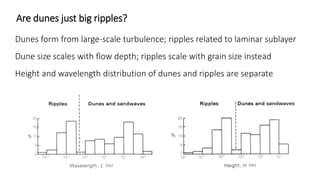
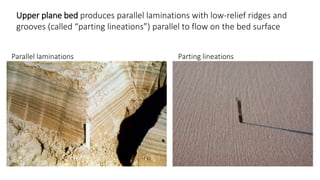
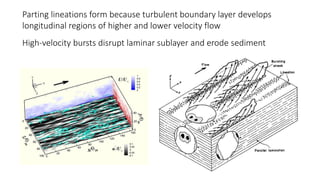
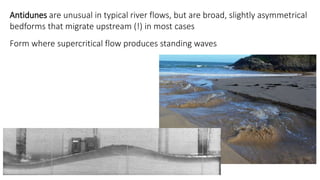
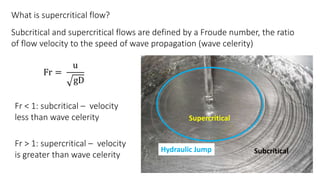
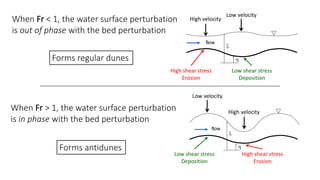
This document discusses different types of bedforms that can form in rivers due to sediment deposition patterns from water flow. Ripples are the smallest bedforms at only a few cm tall and form due to differences in flow velocity on the lee and stoss sides. Dunes are larger bedforms from 10 cm to 10 m tall that form from large scale turbulence. When flow is supercritical with a Froude number greater than 1, antidunes can form that migrate upstream as standing waves produce alternating high and low velocity zones causing erosion and deposition.