BEDBUGS ANDTHEIR BIOLOGY
Prepared by Jack Launius and narrated by Shaun Reeves Associate Certified Entomologist
Treat Treat for bed bugs and eradicate them
Perform Perform an inspection for bed bugs
Discuss Discuss the life cycle of bed bugs
Explain Explain how to identify bed bugs by body size and shape
SHORT HISTORY OF BEDBUGS
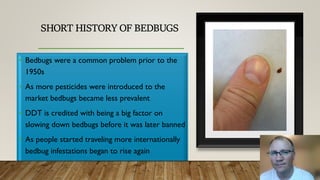
• Bedbugs were a common problem prior to the
1950s
• As more pesticides were introduced to the
market bedbugs became less prevalent
• DDT is credited with being a big factor on
slowing down bedbugs before it was later banned
• As people started traveling more internationally
bedbug infestations began to rise again
BEDBUG BIOLOGY
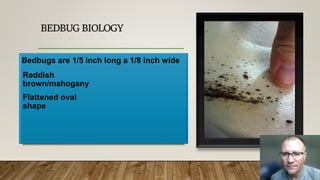
Bedbugs are 1/5 inch long a 1/8 inch wide
Reddish
brown/mahogany
Flattened oval
shape
BEDBUG BIOLOGY
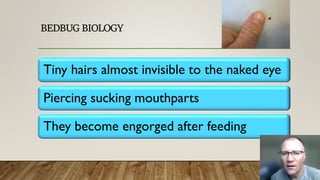
Tiny hairs almost invisible to the naked eye
Piercing sucking mouthparts
They become engorged after feeding
BEDBUG
BIOLOGY
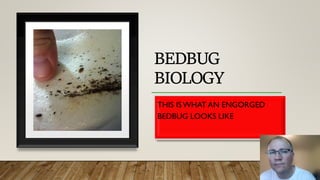
THIS ISWHAT AN ENGORGED
BEDBUG LOOKS LIKE
BEDBUG EGGS
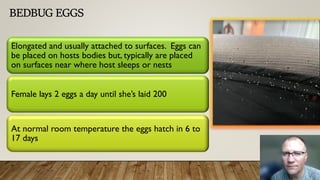
Elongated and usually attached to surfaces. Eggs can
be placed on hosts bodies but, typically are placed
on surfaces near where host sleeps or nests
Female lays 2 eggs a day until she’s laid 200
At normal room temperature the eggs hatch in 6 to
17 days
BEDBUG
GROWTH
They have 5 instar stages before
becoming adults
The nymph period lasts 14 to 30 days
From egg to egg takes 4 to 9 weeks with
the hatched bug finally laying her own
A blood meal is required for them to
molt
Eggs, nymphs and adults
BEFORE YOU INSPECT FOR BEDBUGS
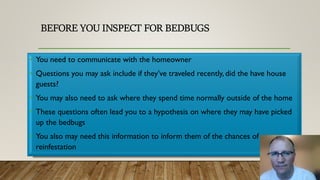
• You need to communicate with the homeowner
• Questions you may ask include if they’ve traveled recently, did the have house
guests?
• You may also need to ask where they spend time normally outside of the home
• These questions often lead you to a hypothesis on where they may have picked
up the bedbugs
• You also may need this information to inform them of the chances of
reinfestation
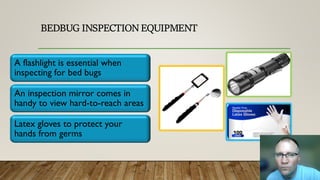
BEDBUG INSPECTION EQUIPMENT
A flashlight is essential when
inspecting for bed bugs
An inspection mirror comes in
handy to view hard-to-reach areas
Latex gloves to protect your
hands from germs
BEDBUG INSPECTION
Their flat bodies provide
them with the ability to hide
in many areas
Remember to check
headboards, dressers,
televisions, nightstands, lamps,
behind pictures, closet rod
holders, under the edge of
carpet along tack strips.
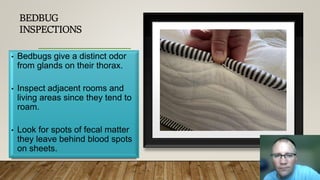
BEDBUG
INSPECTIONS
• Bedbugs give a distinct odor
from glands on their thorax.
• Inspect adjacent rooms and
living areas since they tend to
roam.
• Look for spots of fecal matter
they leave behind blood spots
on sheets.
• It’s exceptionally important to do proper inspections in multifamily
housing situations
• Inspecting adjacent rooms and units is very important to achieve long-
term control within a structure
• It’s a good idea to keep a logbook of inspections, sightings and treatments
performed in these types of structures
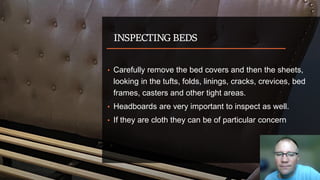
INSPECTING BEDS
• Carefully remove the bed covers and then the sheets,
looking in the tufts, folds, linings, cracks, crevices, bed
frames, casters and other tight areas.
• Headboards are very important to inspect as well.
• If they are cloth they can be of particular concern
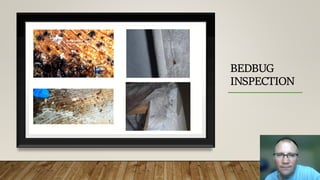
BEDBUG
INSPECTION
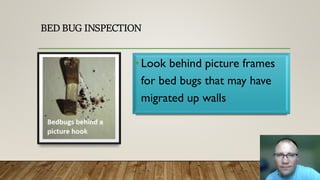
BED BUG INSPECTION
•Look behind picture frames
for bed bugs that may have
migrated up walls
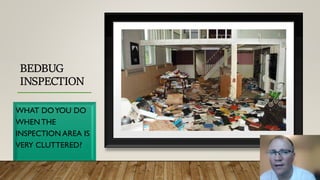
BEDBUG
INSPECTION
WHAT DOYOU DO
WHEN THE
INSPECTION AREA IS
VERY CLUTTERED?
BEDBUG TREATMENT
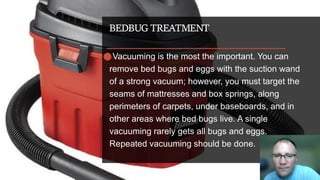
⚫Vacuuming is the most the important. You can

remove bed bugs and eggs with the suction wand
of a strong vacuum; however, you must target the
seams of mattresses and box springs, along
perimeters of carpets, under baseboards, and in
other areas where bed bugs live. A single
vacuuming rarely gets all bugs and eggs.
Repeated vacuuming should be done.
BEDBUG TREATMENT
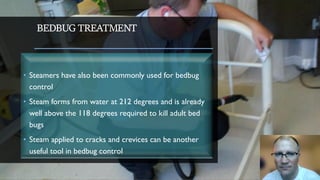
• Steamers have also been commonly used for bedbug
control
• Steam forms from water at 212 degrees and is already
well above the 118 degrees required to kill adult bed
bugs
• Steam applied to cracks and crevices can be another
useful tool in bedbug control
BEDBUG TREATMENT
• Heat treatments have been a common way to eradicate bedbugs
• Heat treatments can be used as an entire-room treatment or as a small
chamber for items
• One of the disadvantages to heat treatment is the is NO residual effect
BEDBUG TREATMENT
Products with a dual mode of action work well –
Temprid, Bedlam, Zenprox, etc
Other low toxicity products may also be very
effective such as Cirkil which is made from plant
oils.
It’s important in cases where you may return
frequently that you focus on what products you
are using and rotate the use of products as
needed.
BEDBUG TREATMENT
BEDBUG
TREATMENT
• IGRs such as Nygard and Gentrol are
generally ineffective against bed bugs.
BEDBUG
TREATMENT
It’s important that you be thorough and treat
every possible place they may be hiding.
MORE
TREATMENT
AREAS
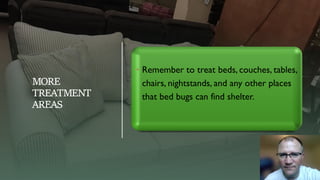
• Remember to treat beds, couches, tables,
chairs, nightstands, and any other places
that bed bugs can find shelter.
BEDBUG
TREATMENT
Insecticides may be applied as liquids
directly to cracks, crevices, bed frames,
baseboards, and other similar sites, or
they may be applied as dusts in cracks
and crevices.
Bug glue traps, and other types of lures
should be used so that control can be
properly measured.
BEDBUG
TREATMENT
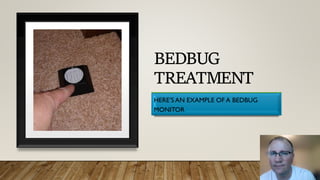
HERE’S AN EXAMPLE OF A BEDBUG
MONITOR
BEDBUG TREATMENT
Liquid insecticide formulations, many of which are available for use only by PMPs,
include:
Products containing the botanical insecticide pyrethrin, which gives quick
knockdown but little long-term control.Various synthetic pyrethroid products (e.g.,
cyhalothrin, bifenthrin, deltamethrin, and permethrin). Mixtures of pyrethroids and
neonicotinoids (e.g.,Temprid andTransport)Various botanical oils.
BEDBUG
TREATMENTS
• Products including the pyrole insecticide
chlorfenapyr (Phantom) and the insect
growth regulator (IGR) hydroprene
(Gentrol).
BEDBUG
TREATMENT
• Fumigation using the active ingredient sulfuryl
fluoride is commercially available for bed bug
control can be highly effective. The dosage
requirement for the treatments is 1.9 X.
However, this is a highly specialized and
regulated treatment method, best for remedial
control only. Since fumigants have no residual
effects, other methods or a combination of
methods will be needed to prevent
reinfestations.
BEDBUG
TREATMENTS
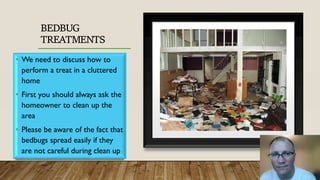
• We need to discuss how to
perform a treat in a cluttered
home
• First you should always ask the
homeowner to clean up the
area
• Please be aware of the fact that
bedbugs spread easily if they
are not careful during clean up
BEDBUG
TREATMENTS
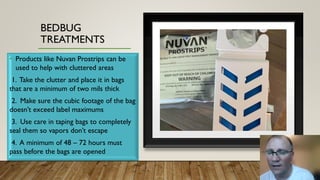
• Products like Nuvan Prostrips can be
used to help with cluttered areas
1. Take the clutter and place it in bags
that are a minimum of two mils thick
2. Make sure the cubic footage of the bag
doesn’t exceed label maximums
3. Use care in taping bags to completely
seal them so vapors don’t escape
4. A minimum of 48 – 72 hours must
pass before the bags are opened
BEDBUG
TREATMENTS
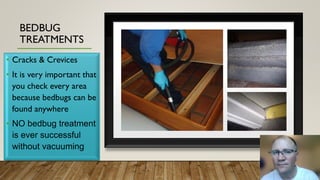
• Cracks & Crevices
• It is very important that
you check every area
because bedbugs can be
found anywhere
• NO bedbug treatment
is ever successful
without vacuuming
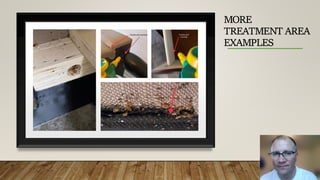
MORE
TREATMENT AREA
EXAMPLES
EMERGING TECHNOLOGIES IN BEDBUG CONTROL
• A company named Allergy Technologies is rolling out a new program that
significantly reduces hard-to-control bedbug problems
• Industry magazines like PCT are touting the new program
• Pest management professionals need to constantly be learning new
technologies and using the best control method for bedbugs
BEDBUGS SUMMARY
You should always use a bright flashlight during your inspection.
Taking things apart and looking deep into important areas will help
you identify the real source of the problem.
Vacuuming is the most the important step and should be done
repeatedly.
BEDBUGS
SUMMARY
Product Selection is important – and as you keep
returning you should rotate your selection of
products as needed.
Proper monitoring is a necessity – the customer
should note all instances of issues, and the
property should be re-inspected on each visit.
Even when the best products are used, and the
most thorough work is done follow-ups are
needed. These follow up inspections and
treatments are the key to success.
CONGRATULATIONS!
• You have completed the lesson portion of this course.
• Please continue to the quiz and complete all questions
• You will receive your certificate within 24 hours of successfully completing the exam with
a score of 70% or higher.
• Thank you for choosing American Pest CEUs
• You can visit us on the web at Americanpestceus.com

Bed Bugs and their biology (1).pdf

  • 1.
    BEDBUGS ANDTHEIR BIOLOGY Preparedby Jack Launius and narrated by Shaun Reeves Associate Certified Entomologist
  • 2.
    Treat Treat forbed bugs and eradicate them Perform Perform an inspection for bed bugs Discuss Discuss the life cycle of bed bugs Explain Explain how to identify bed bugs by body size and shape
  • 3.
    SHORT HISTORY OFBEDBUGS • Bedbugs were a common problem prior to the 1950s • As more pesticides were introduced to the market bedbugs became less prevalent • DDT is credited with being a big factor on slowing down bedbugs before it was later banned • As people started traveling more internationally bedbug infestations began to rise again
  • 4.
    BEDBUG BIOLOGY Bedbugs are1/5 inch long a 1/8 inch wide Reddish brown/mahogany Flattened oval shape
  • 5.
    BEDBUG BIOLOGY Tiny hairsalmost invisible to the naked eye Piercing sucking mouthparts They become engorged after feeding
  • 6.
    BEDBUG BIOLOGY THIS ISWHAT ANENGORGED BEDBUG LOOKS LIKE
  • 7.
    BEDBUG EGGS Elongated andusually attached to surfaces. Eggs can be placed on hosts bodies but, typically are placed on surfaces near where host sleeps or nests Female lays 2 eggs a day until she’s laid 200 At normal room temperature the eggs hatch in 6 to 17 days
  • 8.
    BEDBUG GROWTH They have 5instar stages before becoming adults The nymph period lasts 14 to 30 days From egg to egg takes 4 to 9 weeks with the hatched bug finally laying her own A blood meal is required for them to molt Eggs, nymphs and adults
  • 9.
    BEFORE YOU INSPECTFOR BEDBUGS • You need to communicate with the homeowner • Questions you may ask include if they’ve traveled recently, did the have house guests? • You may also need to ask where they spend time normally outside of the home • These questions often lead you to a hypothesis on where they may have picked up the bedbugs • You also may need this information to inform them of the chances of reinfestation
  • 10.
    BEDBUG INSPECTION EQUIPMENT Aflashlight is essential when inspecting for bed bugs An inspection mirror comes in handy to view hard-to-reach areas Latex gloves to protect your hands from germs
  • 11.
    BEDBUG INSPECTION Their flatbodies provide them with the ability to hide in many areas Remember to check headboards, dressers, televisions, nightstands, lamps, behind pictures, closet rod holders, under the edge of carpet along tack strips.
  • 12.
    BEDBUG INSPECTIONS • Bedbugs givea distinct odor from glands on their thorax. • Inspect adjacent rooms and living areas since they tend to roam. • Look for spots of fecal matter they leave behind blood spots on sheets.
  • 13.
    • It’s exceptionallyimportant to do proper inspections in multifamily housing situations • Inspecting adjacent rooms and units is very important to achieve long- term control within a structure • It’s a good idea to keep a logbook of inspections, sightings and treatments performed in these types of structures
  • 14.
    INSPECTING BEDS • Carefullyremove the bed covers and then the sheets, looking in the tufts, folds, linings, cracks, crevices, bed frames, casters and other tight areas. • Headboards are very important to inspect as well. • If they are cloth they can be of particular concern
  • 15.
  • 16.
    BED BUG INSPECTION •Lookbehind picture frames for bed bugs that may have migrated up walls
  • 17.
    BEDBUG INSPECTION WHAT DOYOU DO WHENTHE INSPECTION AREA IS VERY CLUTTERED?
  • 18.
    BEDBUG TREATMENT ⚫Vacuuming isthe most the important. You can remove bed bugs and eggs with the suction wand of a strong vacuum; however, you must target the seams of mattresses and box springs, along perimeters of carpets, under baseboards, and in other areas where bed bugs live. A single vacuuming rarely gets all bugs and eggs. Repeated vacuuming should be done.
  • 19.
    BEDBUG TREATMENT • Steamershave also been commonly used for bedbug control • Steam forms from water at 212 degrees and is already well above the 118 degrees required to kill adult bed bugs • Steam applied to cracks and crevices can be another useful tool in bedbug control
  • 20.
    BEDBUG TREATMENT • Heattreatments have been a common way to eradicate bedbugs • Heat treatments can be used as an entire-room treatment or as a small chamber for items • One of the disadvantages to heat treatment is the is NO residual effect
  • 21.
    BEDBUG TREATMENT Products witha dual mode of action work well – Temprid, Bedlam, Zenprox, etc Other low toxicity products may also be very effective such as Cirkil which is made from plant oils. It’s important in cases where you may return frequently that you focus on what products you are using and rotate the use of products as needed.
  • 22.
  • 23.
    BEDBUG TREATMENT • IGRs suchas Nygard and Gentrol are generally ineffective against bed bugs.
  • 24.
    BEDBUG TREATMENT It’s important thatyou be thorough and treat every possible place they may be hiding.
  • 25.
    MORE TREATMENT AREAS • Remember totreat beds, couches, tables, chairs, nightstands, and any other places that bed bugs can find shelter.
  • 26.
    BEDBUG TREATMENT Insecticides may beapplied as liquids directly to cracks, crevices, bed frames, baseboards, and other similar sites, or they may be applied as dusts in cracks and crevices. Bug glue traps, and other types of lures should be used so that control can be properly measured.
  • 27.
  • 28.
    BEDBUG TREATMENT Liquid insecticideformulations, many of which are available for use only by PMPs, include: Products containing the botanical insecticide pyrethrin, which gives quick knockdown but little long-term control.Various synthetic pyrethroid products (e.g., cyhalothrin, bifenthrin, deltamethrin, and permethrin). Mixtures of pyrethroids and neonicotinoids (e.g.,Temprid andTransport)Various botanical oils.
  • 29.
    BEDBUG TREATMENTS • Products includingthe pyrole insecticide chlorfenapyr (Phantom) and the insect growth regulator (IGR) hydroprene (Gentrol).
  • 30.
    BEDBUG TREATMENT • Fumigation usingthe active ingredient sulfuryl fluoride is commercially available for bed bug control can be highly effective. The dosage requirement for the treatments is 1.9 X. However, this is a highly specialized and regulated treatment method, best for remedial control only. Since fumigants have no residual effects, other methods or a combination of methods will be needed to prevent reinfestations.
  • 31.
    BEDBUG TREATMENTS • We needto discuss how to perform a treat in a cluttered home • First you should always ask the homeowner to clean up the area • Please be aware of the fact that bedbugs spread easily if they are not careful during clean up
  • 32.
    BEDBUG TREATMENTS • Products likeNuvan Prostrips can be used to help with cluttered areas 1. Take the clutter and place it in bags that are a minimum of two mils thick 2. Make sure the cubic footage of the bag doesn’t exceed label maximums 3. Use care in taping bags to completely seal them so vapors don’t escape 4. A minimum of 48 – 72 hours must pass before the bags are opened
  • 33.
    BEDBUG TREATMENTS • Cracks &Crevices • It is very important that you check every area because bedbugs can be found anywhere • NO bedbug treatment is ever successful without vacuuming
  • 34.
  • 35.
    EMERGING TECHNOLOGIES INBEDBUG CONTROL • A company named Allergy Technologies is rolling out a new program that significantly reduces hard-to-control bedbug problems • Industry magazines like PCT are touting the new program • Pest management professionals need to constantly be learning new technologies and using the best control method for bedbugs
  • 36.
    BEDBUGS SUMMARY You shouldalways use a bright flashlight during your inspection. Taking things apart and looking deep into important areas will help you identify the real source of the problem. Vacuuming is the most the important step and should be done repeatedly.
  • 37.
    BEDBUGS SUMMARY Product Selection isimportant – and as you keep returning you should rotate your selection of products as needed. Proper monitoring is a necessity – the customer should note all instances of issues, and the property should be re-inspected on each visit. Even when the best products are used, and the most thorough work is done follow-ups are needed. These follow up inspections and treatments are the key to success.
  • 38.
    CONGRATULATIONS! • You havecompleted the lesson portion of this course. • Please continue to the quiz and complete all questions • You will receive your certificate within 24 hours of successfully completing the exam with a score of 70% or higher. • Thank you for choosing American Pest CEUs • You can visit us on the web at Americanpestceus.com