
BEWARE THE BUSY
MANAGER
Syndicate 12
We all know that being busy isn’t the
same as being productive. Or do we?
• executives are under incredible pressure to
perform.
• very few managers use their time as
effectively as they could.
• Eully 90% of managers squander their time in
all sorts of ineffective activities. In other
words, a mere 10% of managers spend their
time in a committed, purposeful, and
reflective manner.
Focus and Energy
• Think of focus as concentrated attention - the
ability to zero in on a goal and see the task
through to completion.
• energy-as the vigor that is fueled by intense
personal commitment. Energy is what pushes
managers to go the extra mile when tackling
heavy workloads and meeting tight deadlines.
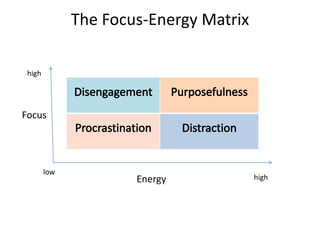
• "The Focus-Energy Matrix" identifies four
types of behavior: disengagement,
procrastination, distraction, and
purposefulness.
The Focus-Energy Matrix
high
high
low
Energy
Focus
The Procrastinators
• we studied, some 30% suffered from low
levels of both energy and focus; we call these
managers the procrastinators.
• They dutifully perform routine tasks-attending
meetings, writing memos, making phone calls,
and so on -they fail to take initiative, raise the
level of performance, or engage with strategy.
The Disengaged
• Roughly 20% of managers fall into the
disengaged cate- gory; they exhibit high focus
but have low levels of energy.
• Disengaged managers have strong
reservations about the jobs they are asked to
do.
• Many managers in this group practice a form
of denial we call "defensive avoidance.
The Distracted
• those well- intentioned, highly energetic but
unfocused people who confuse frenetic
motion with constructive action.
• 40%-fall into the distracted quadran.
• When they're under pressure, distracted
managers feel a des- perate need to do
something-anything.
The Purposeful
• The both highly energetic and highly focused
managers are around 10%.
• more effort , achieve critical long-term goals
more often , more self- aware , strong
willpower.
• They pick their goals-and their battles-with far
more care than other managers do.
THE MANAGER’S JOB: FOLKLORE
AND FACTS
BY HENRY MINTZBERG
OUTLINE
• Folklore
• Findings
• Primary Managerial Roles
– Interpersonal Roles
– Informational Roles
– Decisional Roles
• Summary
FOLKLORE
• Common beliefs
1. Managers are reflective, systematic planners
2. The effective manager has no regular duties
3. Senior managers need aggregated information
4. Management is a science and a profession
FINDINGS
• Misconception:
– “Managers are a reflective, systematic planners”
• Fact:
– Managers work at an unrelenting pace
– Activities are brief, varied, action-oriented and
discontinuous
FINDINGS
• Misconception:
– “Senior managers need aggregated information,
which are best provided by formal management
information systems”
• Fact:
– Managers favor verbal media, telephone calls, and
meetings over documents
FINDINGS
• Misconception:
– “Management is, or at least is quickly becoming, a
science and a profession”
• Fact:
– It is hardly known what procedures managers use
– Managers’ programs – to process information,
make decisions, etc. – are locked deep inside their
brain
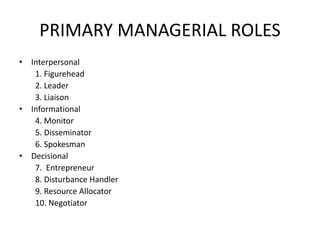
PRIMARY MANAGERIAL ROLES
• Interpersonal
1. Figurehead
2. Leader
3. Liaison
• Informational
4. Monitor
5. Disseminator
6. Spokesman
• Decisional
7. Entrepreneur
8. Disturbance Handler
9. Resource Allocator
10. Negotiator
INTERPERSONAL ROLES
• Figurehead
• Leader
• Liaison
INFORMATIONAL ROLES
• Monitor
• Disseminator
• Spokesperson
DECISIONAL ROLES
• Entrepreneur
• Disturbance Handler
• Resource Allocator
• Negotiator
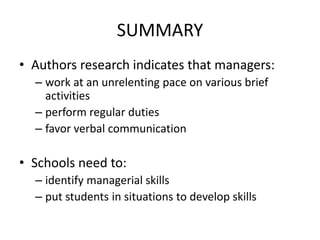
SUMMARY
• Authors research indicates that managers:
– work at an unrelenting pace on various brief
activities
– perform regular duties
– favor verbal communication
• Schools need to:
– identify managerial skills
– put students in situations to develop skills
beware of busy managers

beware of busy managers

  • 1.
  • 2.
    We all knowthat being busy isn’t the same as being productive. Or do we? • executives are under incredible pressure to perform. • very few managers use their time as effectively as they could. • Eully 90% of managers squander their time in all sorts of ineffective activities. In other words, a mere 10% of managers spend their time in a committed, purposeful, and reflective manner.
  • 3.
    Focus and Energy •Think of focus as concentrated attention - the ability to zero in on a goal and see the task through to completion. • energy-as the vigor that is fueled by intense personal commitment. Energy is what pushes managers to go the extra mile when tackling heavy workloads and meeting tight deadlines.
  • 4.
    • "The Focus-EnergyMatrix" identifies four types of behavior: disengagement, procrastination, distraction, and purposefulness.
  • 5.
  • 6.
    The Procrastinators • westudied, some 30% suffered from low levels of both energy and focus; we call these managers the procrastinators. • They dutifully perform routine tasks-attending meetings, writing memos, making phone calls, and so on -they fail to take initiative, raise the level of performance, or engage with strategy.
  • 7.
    The Disengaged • Roughly20% of managers fall into the disengaged cate- gory; they exhibit high focus but have low levels of energy. • Disengaged managers have strong reservations about the jobs they are asked to do. • Many managers in this group practice a form of denial we call "defensive avoidance.
  • 8.
    The Distracted • thosewell- intentioned, highly energetic but unfocused people who confuse frenetic motion with constructive action. • 40%-fall into the distracted quadran. • When they're under pressure, distracted managers feel a des- perate need to do something-anything.
  • 9.
    The Purposeful • Theboth highly energetic and highly focused managers are around 10%. • more effort , achieve critical long-term goals more often , more self- aware , strong willpower. • They pick their goals-and their battles-with far more care than other managers do.
  • 10.
    THE MANAGER’S JOB:FOLKLORE AND FACTS BY HENRY MINTZBERG
  • 11.
    OUTLINE • Folklore • Findings •Primary Managerial Roles – Interpersonal Roles – Informational Roles – Decisional Roles • Summary
  • 12.
    FOLKLORE • Common beliefs 1.Managers are reflective, systematic planners 2. The effective manager has no regular duties 3. Senior managers need aggregated information 4. Management is a science and a profession
  • 13.
    FINDINGS • Misconception: – “Managersare a reflective, systematic planners” • Fact: – Managers work at an unrelenting pace – Activities are brief, varied, action-oriented and discontinuous
  • 14.
    FINDINGS • Misconception: – “Seniormanagers need aggregated information, which are best provided by formal management information systems” • Fact: – Managers favor verbal media, telephone calls, and meetings over documents
  • 15.
    FINDINGS • Misconception: – “Managementis, or at least is quickly becoming, a science and a profession” • Fact: – It is hardly known what procedures managers use – Managers’ programs – to process information, make decisions, etc. – are locked deep inside their brain
  • 16.
    PRIMARY MANAGERIAL ROLES •Interpersonal 1. Figurehead 2. Leader 3. Liaison • Informational 4. Monitor 5. Disseminator 6. Spokesman • Decisional 7. Entrepreneur 8. Disturbance Handler 9. Resource Allocator 10. Negotiator
  • 17.
  • 18.
    INFORMATIONAL ROLES • Monitor •Disseminator • Spokesperson
  • 19.
    DECISIONAL ROLES • Entrepreneur •Disturbance Handler • Resource Allocator • Negotiator
  • 20.
    SUMMARY • Authors researchindicates that managers: – work at an unrelenting pace on various brief activities – perform regular duties – favor verbal communication • Schools need to: – identify managerial skills – put students in situations to develop skills