BE GOING TO:
A SIMPLIFIED GUIDE
By Teacher David.
BE GOING TO
Se usa:
-Para hablar de intenciones o de decisiones ya
tomadas:
. I’m going to the movies tomorrow, do you want
to come?
.We are going to the book’s fair this afternoon.
BE GOING TO
• -Para hablar de situaciones futuras
predecibles a partir de la situación actual:
• .Look at those clouds! It’s going to rain!
BE GOING TO
• Affirmative form:
• Subject + am/is/are + going to +verb +complement
I am going to study for the exam.
Mary is going to graduate in July.
My friends are going to play soccer tomorrow.
BE GOING TO
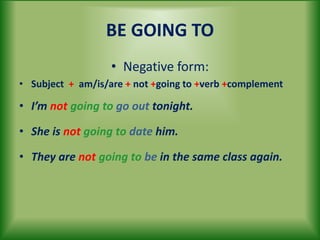
• Negative form:
• Subject + am/is/are + not +going to +verb +complement
• I’m not going to go out tonight.
• She is not going to date him.
• They are not going to be in the same class again.
BE GOING TO
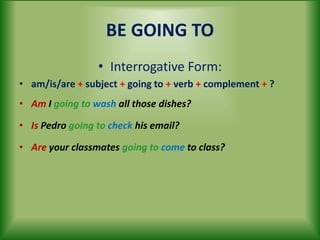
• Interrogative Form:
• am/is/are + subject + going to + verb + complement + ?
• Am I going to wash all those dishes?
• Is Pedro going to check his email?
• Are your classmates going to come to class?
BE GOING TO
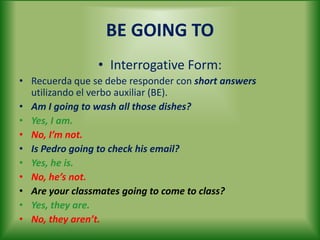
• Interrogative Form:
• Recuerda que se debe responder con short answers
utilizando el verbo auxiliar (BE).
• Am I going to wash all those dishes?
• Yes, I am.
• No, I’m not.
• Is Pedro going to check his email?
• Yes, he is.
• No, he’s not.
• Are your classmates going to come to class?
• Yes, they are.
• No, they aren’t.
BE GOING TO
• Contractions:
• Is not going =
• ‘s not going
• Isn’t going
• Are not going =
• ‘re not going
• aren’t going
BE GOING TO
• Assignment
• Write 10 sentences about future plans with be
going to.
• Examples:
• I’m going to have pizza for dinner.
• She’s going to graduate in July.
• They’re going to travel to France next year.
BE GOING TO
• Reference:
• Swan, M. (1995). Practical English Usage. Oxford: Oxford
University Press.
• (2008)Diccionario Cambridge Pocket. Madrid: Cambridge
University Press.
• Saslow, J; Ascher, A. Top Notch Fundamentals. New York:
Pearson Education

Be going to

  • 1.
    BE GOING TO: ASIMPLIFIED GUIDE By Teacher David.
  • 2.
    BE GOING TO Seusa: -Para hablar de intenciones o de decisiones ya tomadas: . I’m going to the movies tomorrow, do you want to come? .We are going to the book’s fair this afternoon.
  • 3.
    BE GOING TO •-Para hablar de situaciones futuras predecibles a partir de la situación actual: • .Look at those clouds! It’s going to rain!
  • 4.
    BE GOING TO •Affirmative form: • Subject + am/is/are + going to +verb +complement I am going to study for the exam. Mary is going to graduate in July. My friends are going to play soccer tomorrow.
  • 5.
    BE GOING TO •Negative form: • Subject + am/is/are + not +going to +verb +complement • I’m not going to go out tonight. • She is not going to date him. • They are not going to be in the same class again.
  • 6.
    BE GOING TO •Interrogative Form: • am/is/are + subject + going to + verb + complement + ? • Am I going to wash all those dishes? • Is Pedro going to check his email? • Are your classmates going to come to class?
  • 7.
    BE GOING TO •Interrogative Form: • Recuerda que se debe responder con short answers utilizando el verbo auxiliar (BE). • Am I going to wash all those dishes? • Yes, I am. • No, I’m not. • Is Pedro going to check his email? • Yes, he is. • No, he’s not. • Are your classmates going to come to class? • Yes, they are. • No, they aren’t.
  • 8.
    BE GOING TO •Contractions: • Is not going = • ‘s not going • Isn’t going • Are not going = • ‘re not going • aren’t going
  • 9.
    BE GOING TO •Assignment • Write 10 sentences about future plans with be going to. • Examples: • I’m going to have pizza for dinner. • She’s going to graduate in July. • They’re going to travel to France next year.
  • 10.
    BE GOING TO •Reference: • Swan, M. (1995). Practical English Usage. Oxford: Oxford University Press. • (2008)Diccionario Cambridge Pocket. Madrid: Cambridge University Press. • Saslow, J; Ascher, A. Top Notch Fundamentals. New York: Pearson Education