Downloaded 124 times
![Breadth-First Search, Depth-First Search and
Backtracking Depth-First Search Algorithms
Fernando Rodrigues Junior
College of Science and Engineering
University of Minnesota - Twin Cities
Minneapolis, Minnesota 554550
Email: rodri987@umn.edu
Abstract—This study concludes that the B-DFS is designated
to applications that have a big state space which requires a
great amount of memory. Using a practical problem as a Sudoku
Puzzle, was possible to demonstrate that the Backtracking Depth-
First Search (B-DFS) has a lower bounded space complexity than
the regular Depth-First Search (DFS) algorithm. It saves more
memory, but in some applications requires more computational
effort due to the necessity to backtrack the actions many times.
There are different approaches in respect of how to store the
informations in each step throughout the expansion process, thus
the best search algorithm depends on the nature of the problem.
I. INTRODUCTION
Search algorithms are used to solve problems from puzzles
(e.g. Sudoku, KenKen, Towers of Hanoi) to more complex
problems such as Video-Game, Signal Management [3] and
Path-Planning for Robots [4]. Time and physical space is
important to decide which algorithm is designated to solve
certain problem. In many applications the state-space is big
and is expected to find a solution fast. There are different
kinds of search algorithms and this paper will briefly cover
three of them. The Breadth-First Search, Depth-First Search
and the Backtraking Depth-Search First.
A standard search algorithm such as Breadth-First Search
(BFS) is considered a complete algorithm representing that
if a solution exists, it certainly will be found. However, BFS
may be a big challenge in terms of performance and memory
allocation. Some applications using this kind of approach
requires a big amount of memory and time which sometimes
are not compatible with the requisites for an expected solution.
Looking for an alternative, this paper presents the Backtrack-
ing Depth-First Search (B-DFS), another approach to solve
search problems using less memory. It is important to be aware
that every algorithm has limitations to be respected, otherwise
the solution may not be guaranteed.
In the next sections, is possible to understand the differences
between the algorithms. Also, a practical application with met-
rics and conclusion is presented to the different approaches.
II. THE SUDOKU PUZZLE
Sudoku consists in a puzzle game that you have a board
of nine by nine squares (there are different sizes, but 9X9 is
the most common). The board already contains some random
numbers allocated and the final objective is filling all the
remaining empty spaces. For that there are some rules the
player have to follow. First, only integer values are acceptable,
for example, in the conventional puzzle, the player can choose
numbers from one to nine to fill each square. Second, it is
required to all the squares from the same row and column
to have different numbers. Third, each one of the nine boxes
has to have different numbers. The boxes are nine 3X3 sub-
grids that compose the grid [1]. The main idea to solve the
game is to try each combination of numbers in each empty
spot making sure that the rules are not violated. The Sudoku
puzzle will be used as a practical example of the BDS, DFS
and B-DFS applications in this paper.
III. BREADTH-FIRST SEARCH, DEPTH-FIRST SEARCH
AND BACKTRACKING DEPTH-FIRST SEARCH
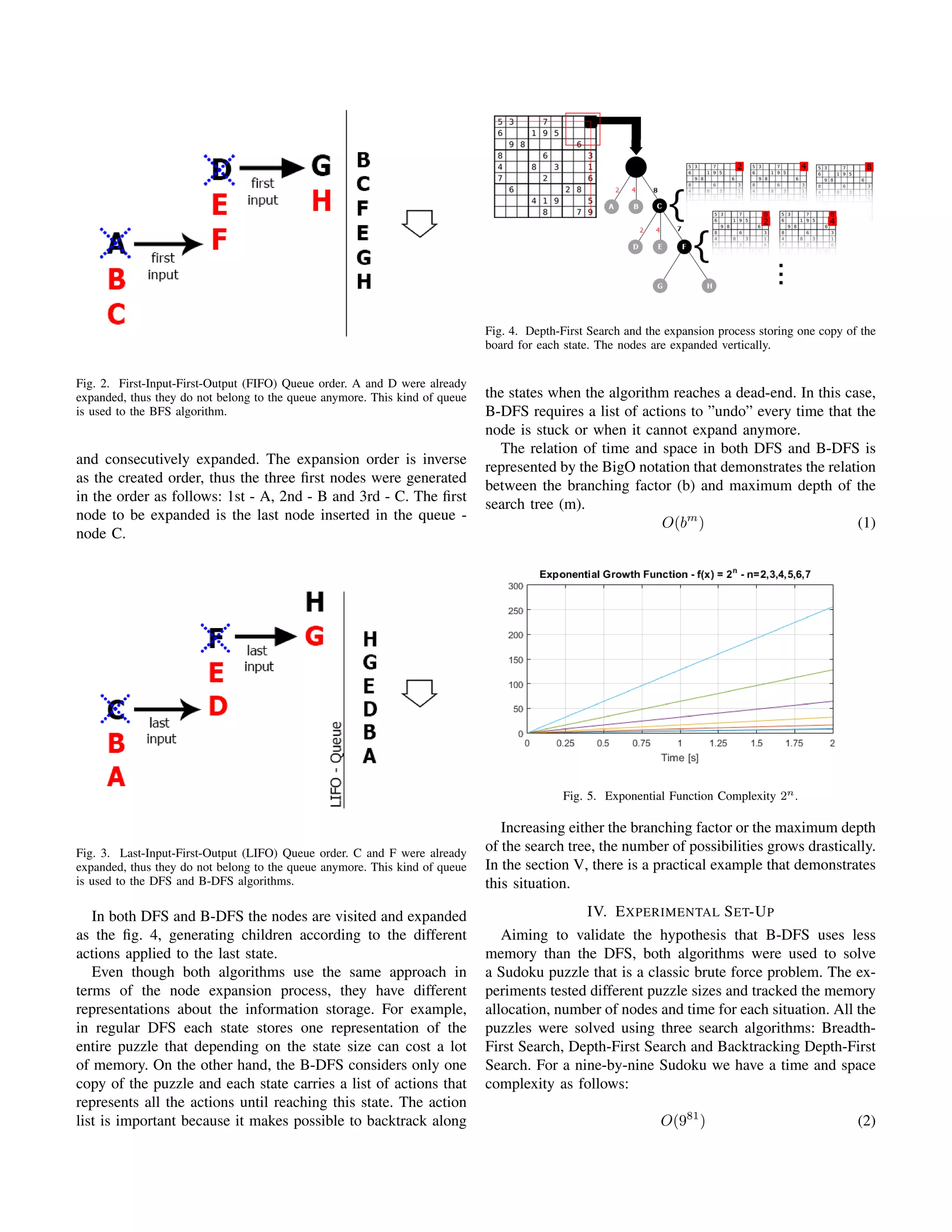
Breadth-First Search, Depth-First Search (DFS) and Back-
tracking Depth-First Search (B-DFS) are uninformed search
strategies that use the concept of a queue to expand the states
from a graph or a tree structure. The Breadth-First Search
expands the nodes horizontally fig. 1. It means that before
expanding the next level to the bottom, it expands all the
nodes from the same level first. Furthermore, BFS uses a FIFO
(First-In-First-Out) queue fig. 2, to guarantee that the nodes
are going to be expanded in the same order that they were
created.
Fig. 1. Breadth-First Search and the expansion process storing one copy of
the board for each state. The nodes are expanded horizontally.
Differently, DFS and B-DFS expands nodes vertically and
stop increasing the depth only if a goal or a dead-end is
reached. To make this mechanic possible, the algorithm uses
the concept of a Last-In-First-Out (LIFO) Queue Fig. 3. This
queue represents the next nodes that are going to be visited](https://image.slidesharecdn.com/8dd085e7-e878-40c9-90f4-492cff21b672-160106234402/75/Breadth-First-Search-Depth-First-Search-and-Backtracking-Depth-First-Search-Algorithms-applied-on-a-Sudoku-Puzzle-Solver-1-2048.jpg)
![Where 9 represents the branching factor or the number of
possibilities in each square and 81 represents the maximum
depth of the search tree. To reduce the search tree space
was applied a pruning technique that is explained in the next
section.
A. Pruning
Pruning is important in terms of state space reduction.
Sudoku demonstrates this idea when we show that the state-
space size without pruning is equal to O(bm
). In a nine-by-
nine puzzle, this number is 981
= 1.96627050475553 ∗ 1077
representing that finding a solution without pruning may be a
problem in terms of memory and time requirements.
The idea is checking the row, column and box to evaluate
which numbers are available to fit the square without violating
the rules. As you can see in fig. 6, the possibilities before
pruning were the numbers 1, 2, 3, 4, 5, 6, 7, 8 and 9. However,
applying the rule that the number cannot be repeated in a row,
column and a box, the new possibilities become the numbers
7, 4 and 8. The possibilities were reduced from nine to three.
As long as you repeat this process for every square, the puzzle
complexity reduces drastically.
Fig. 6. Pruning technique in a Sudoku puzzle. It reduced 33% of the space
complexity in the first line of the graph. The results can be even better as
long as the graph goes deeper.
B. Algorithm and Coding
As a motivation, a Sudoku Solver was coded to validate
the different approaches covered throughout this paper. The
algorithm was developed using Python v.3.4 and was based on
the generic search algorithm from AIMA[2]. This algorithm
fits for BFS, DFS and B-DFS, the difference is the node
representation and how it is going to be stored in the queue. As
explained in section III, BFS and DFS have the entire board
as a node representation.
Using Python is possible to consider the board as a list of
lists which each of them contains one row of the puzzle. As
a convention, it is a good practice to name the rows using
a literal name and columns using numbers. For example,
the element in the first row and first column can be called
A1, the second element in a row and first column, B1. The
variables formation are created as follows:
rows = [ A , B , C , D , E , F , G , H , I ]
cols = [ 1 , 2 , 3 , 4 , 5 , 6 , 7 , 8 , 9 ]
varNames = [x + y for x in rows for y in cols]
With this structure the initial state can be stored and one
action can be applied. It is important to keep in mind that only
one action can be applied per time. Each action represents
the application of one number into an empty spot, changing
the previous board state and generating a new node. All the
generated nodes pass for a test which checks the consistent of
the board. If the board list is completely filled, the puzzle is
solved.
In the B-DFS, sometimes the sequence of actions lead to an
inconsistence of the board. Then, it is required to backtrack
the actions and go through another path. For this instance, the
nodes have to store all the actions that were applied into the
puzzle. The actions can be stored using a list containing the
location and which action was applied. For example, if the
number one was applied on the square located on the first line
and second column, then the list are going to store (A2, 1).
Algorithm 1 Search
1: procedure SEARCH(problem) returns a solution, or failure
2: node ← a node with STATE = problem.Initial
3: if problem.Goal −Test(node.STATE) then return
Solution(node)
4: frontier ← a FIFO / LIFO queue with node element
5: explored ← an empty set
6: loop do:
7: if EMPTY(frontier) then return failure
8: node ← POP(frontier)
9: add node.STATE to explored
10: for each action in problem.ACTIONS(node.STATE)
11: child ← CHILD-NODE(problem, node, action)
12: if child.STATE is not in frontier then
13: if problem GOAL-TEST(child.STATE)
then return SOLUTION(child)
14: frontier INSERT(child,frontier)
15: end if
16: end if
17: end if
18: end if
19: end procedure](https://image.slidesharecdn.com/8dd085e7-e878-40c9-90f4-492cff21b672-160106234402/75/Breadth-First-Search-Depth-First-Search-and-Backtracking-Depth-First-Search-Algorithms-applied-on-a-Sudoku-Puzzle-Solver-3-2048.jpg)
![V. RESULTS
After solving more than 1000 puzzles from different
characteristics as size of the puzzle and number of empty
spaces, was possible to collect enough metrics to compare the
results. The puzzles were solved using all the three algorithms
and using a computer with the specifications as follows:
Operational System: Windows 10 - 64bits
Processor: Intel I7 - 4710 HQ - 2.5Ghz
Memory: 16Gb - DDR3L
Storage: 500Gb - SSD EVO850
The data was separated in easy and hard puzzles and
normalized using a simple average algorithm. The data from
the easy puzzles is presented in the table I and the hard puzzles
in the table II
The experiments concluded that B-DFS used less memory
and time to solve all the puzzles when compared to others
algorithms. According to the fig. 7, the BFS was the algorithm
that required more memory allocation. Comparing both BFS
and DFS, the DFS expanded less nodes in all puzzles fig. 9,
thus it required less memory to store the nodes.
The result depends on the location of the solution on the
search tree. For example, if the solution is near the initial node
or the does not grow quickly (e.g small number of children),
then the BFS can be better than the DFS. It is important
to notice that the DFS and B-DFS use the same expansion
approach, then they reached the same number of expanded
nodes.
TABLE I
RESULTS FOR DIFFERENT SUDOKU PUZZLES SIZES AND ALGORITHMS
(EASY)
Puzzle Size 6x6 9x9 10x10
Breadth-First Search
Total allocated size [KiB] 7.3 24.2 27.9
Time to solve [s] 0.011 0.057 0.059
# of Nodes with pruning 58 129 149
Depth-First Search
Total allocated size [KiB] 4.8 14.3 22.9
Time to solve [s] 0.007 0.026 0.044
# of Nodes with pruning 38 76 122
Backtracking Depth-First Search
Total allocated size [KiB] 3.4 7.4 11.8
Time to solve [s] 0.005 0.025 0.029
# of Nodes with pruning 38 76 122
# of Backtracking 7 12 306
For a more detailed experiment, hard puzzles were tested
exhaustively. The table II demonstrates that finding a solution
for bigger and harder puzzles are challenging. According to the
data collected, as long as the puzzle size increases, the number
of nodes grow drastically and more memory is required. For
the 16x16 puzzles, the BFS could not reach a solution and
the computer ran out of memory after five hours running. On
the other hand, the DFS and B-DFS solved the problem. The
DFS required 2878s - approximately 48min and about 670mb
(megabytes) of memory to solve the puzzle. The B-DFS solved
the puzzle with only 1641s - approximately 27.3min and used
only 420mb of memory.
As discussed on Section IV, these algorithms follow an
exponential equation, thus the branching factor changes the
size of the search space quickly. From a 12x12 puzzle to a
16x16 there is a huge increase in the numbers of possible
combinations. One way to demonstrate this increase is through
the fig. 13, which the difference between the number of
backtracking from 12x12 to 16x16 increased a lot.
Fig. 7. The different levels of Memory Allocation according to the puzzle
sizes and algorithm used.
Fig. 8. Number of nodes related to different puzzle sizes and algorithms.](https://image.slidesharecdn.com/8dd085e7-e878-40c9-90f4-492cff21b672-160106234402/75/Breadth-First-Search-Depth-First-Search-and-Backtracking-Depth-First-Search-Algorithms-applied-on-a-Sudoku-Puzzle-Solver-4-2048.jpg)
![Fig. 9. Time to reach the solution. The BDFS is faster than the BFS and
DFS algorithms.
TABLE II
RESULTS FOR DIFFERENT SUDOKU PUZZLES SIZES AND ALGORITHMS
(HARD)
Puzzle Size 12x12 16x16
Breadth-First Search
Total allocated size [KiB] 45408.8 Out of Memory
Time to solve [s] 119.628 Out of Memory
# of Nodes with pruning 242180 Out of Memory
Depth-First Search
Total allocated size [KiB] 20671.5 671508.0
Time to solve [s] 54.647 2878.601
# of Nodes with pruning 110248 3581376
Backtracking Depth-First Search
Total allocated size [KiB] 33603 420099.2
Time to solve [s] 30.592 1641.31
# of Nodes with pruning 110248 3581376
# of Backtracking 33603 976601
VI. CONCLUSION AND FUTURE WORK
As a conclusion, the Backtracking-Depth Search algorithm
is considered an alternative to solve problems that have a big
search-tree. However, is important to know that the search
approach has limitations. Even though was possible to solve
the most number of puzzles using the regular DFS and
the B-DFS, these techniques belong to the group of brute
force algorithms. It means that there is no knowledge or
heuristic to help the algorithm to find a solution. To solve
more sophisticated problems, a new approach may be needed.
Algorithms such as Constraint Satisfaction and A* may be
good alternatives to solve this particular problem.
Fig. 10. Memory Allocation of two different hard puzzles. The BFS was not
capable to solve the 16x16 (computer ran out of memory).
Fig. 11. Number of nodes related to different puzzle sizes and algorithms. The
BFS expanded more nodes than the others. Both DFS and B-DFS expanded
the same number of nodes. BFS was not capable to solve the 16x16 puzzle.
Fig. 12. Time to reach the solution. The BDFS was faster than all BFS and
DFS algorithms.](https://image.slidesharecdn.com/8dd085e7-e878-40c9-90f4-492cff21b672-160106234402/75/Breadth-First-Search-Depth-First-Search-and-Backtracking-Depth-First-Search-Algorithms-applied-on-a-Sudoku-Puzzle-Solver-5-2048.jpg)
![Fig. 13. Time to reach the solution. The BDFS was faster than all BFS and
DFS algorithms.
As a future work, the application of the CSP (Constraint
Satisfaction Problem) to the Sudoku puzzle would be
interesting. CSP uses constraints to reduce the domains of
each variable which may be faster than using only the search
algorithm. Note that CSP will not solve some puzzles by
itself, then it will be needed to combine both techniques to
find a solution.
REFERENCES
[1] Sudoku wikipedia https://en.wikipedia.org/wiki/sudoku.
[2] Stuart J. Russell and Peter Norvig. Artificial Intelligence: A Modern
Approach. Pearson Education, 2 edition, 2003.
[3] Wen-Lin Yang and Wan-Ting Hong. Backtracking and best-first based
channel assignment strategy for multicast in multi-radio wireless mesh
networks. In Multimedia Technology (ICMT), 2011 International Confer-
ence on, pages 2984–2987, July 2011.
[4] Guoyu Zuo, Peng Zhang, and Junfei Qiao. Path planning algorithm
based on sub-region for agricultural robot. In Informatics in Control,
Automation and Robotics (CAR), 2010 2nd International Asia Conference
on, volume 2, pages 197–200, March 2010.](https://image.slidesharecdn.com/8dd085e7-e878-40c9-90f4-492cff21b672-160106234402/75/Breadth-First-Search-Depth-First-Search-and-Backtracking-Depth-First-Search-Algorithms-applied-on-a-Sudoku-Puzzle-Solver-6-2048.jpg)

This document studies three search algorithms: breadth-first search (BFS), depth-first search (DFS), and backtracking depth-first search (B-DFS), particularly in the context of solving Sudoku puzzles. It concludes that B-DFS generally requires less memory and time compared to BFS and DFS, though each algorithm may perform differently based on the problem's specific characteristics. The findings emphasize the importance of pruning techniques in optimizing search space and highlight the limitations of brute force algorithms like DFS and B-DFS, suggesting future exploration of constraint satisfaction methods.


