Welcome To Our Presentation
Group Name : Quantative
 Depth First Search (DFS)
 Breadth First Search (BFS)
Topics
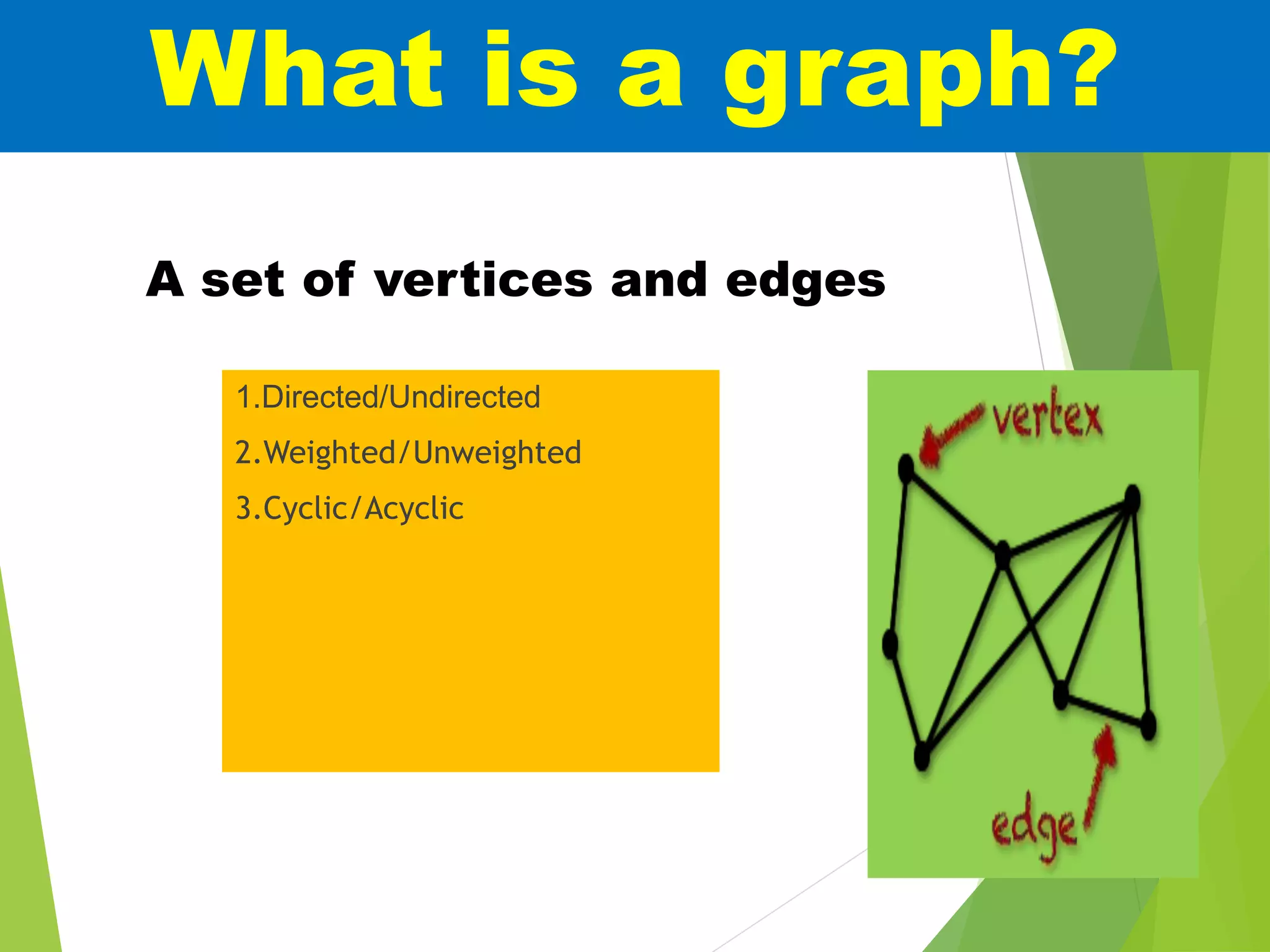
What is a graph?
1.Directed/Undirected
2.Weighted/Unweighted
3.Cyclic/Acyclic
A set of vertices and edges
 Breadth First Search (BFS)
Start several paths at a time, and advance in each one step at a time
The breadth-first search uses a FIFO queue.
 Depth First Search (DFS)
Once a possible path is found, continue the search until the end of the path
The Depth-first search uses a LIFO Stack.
Graph Traversal
How It Works?
1.Pick a source vertex S to start.
2.Discover the vertices that are adjacent to S.
Depth-first:
visit all neighbors of
a neighbor before
visiting your other
neighbors
Breadth First:
Pick each child of
S in turn and
discover their
vertices adjacent
to that child.
Done when all
children have been
discovered and
examined.
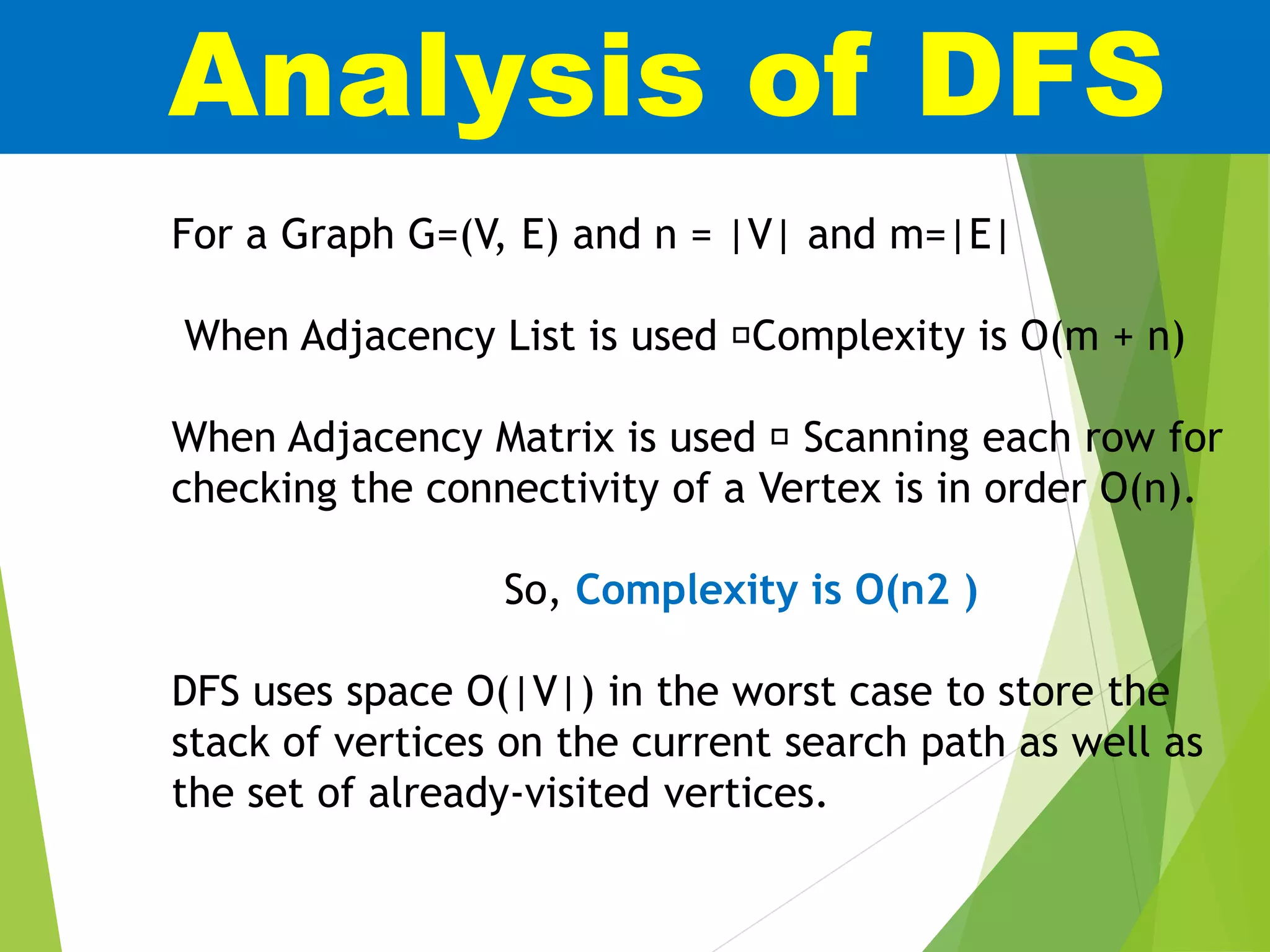
For a Graph G=(V, E) and n = |V| and m=|E|
When Adjacency List is used Complexity is O(m + n)
When Adjacency Matrix is used Scanning each row for
checking the connectivity of a Vertex is in order O(n).
So, Complexity is O(n2 )
DFS uses space O(|V|) in the worst case to store the
stack of vertices on the current search path as well as
the set of already-visited vertices.
Analysis of DFS
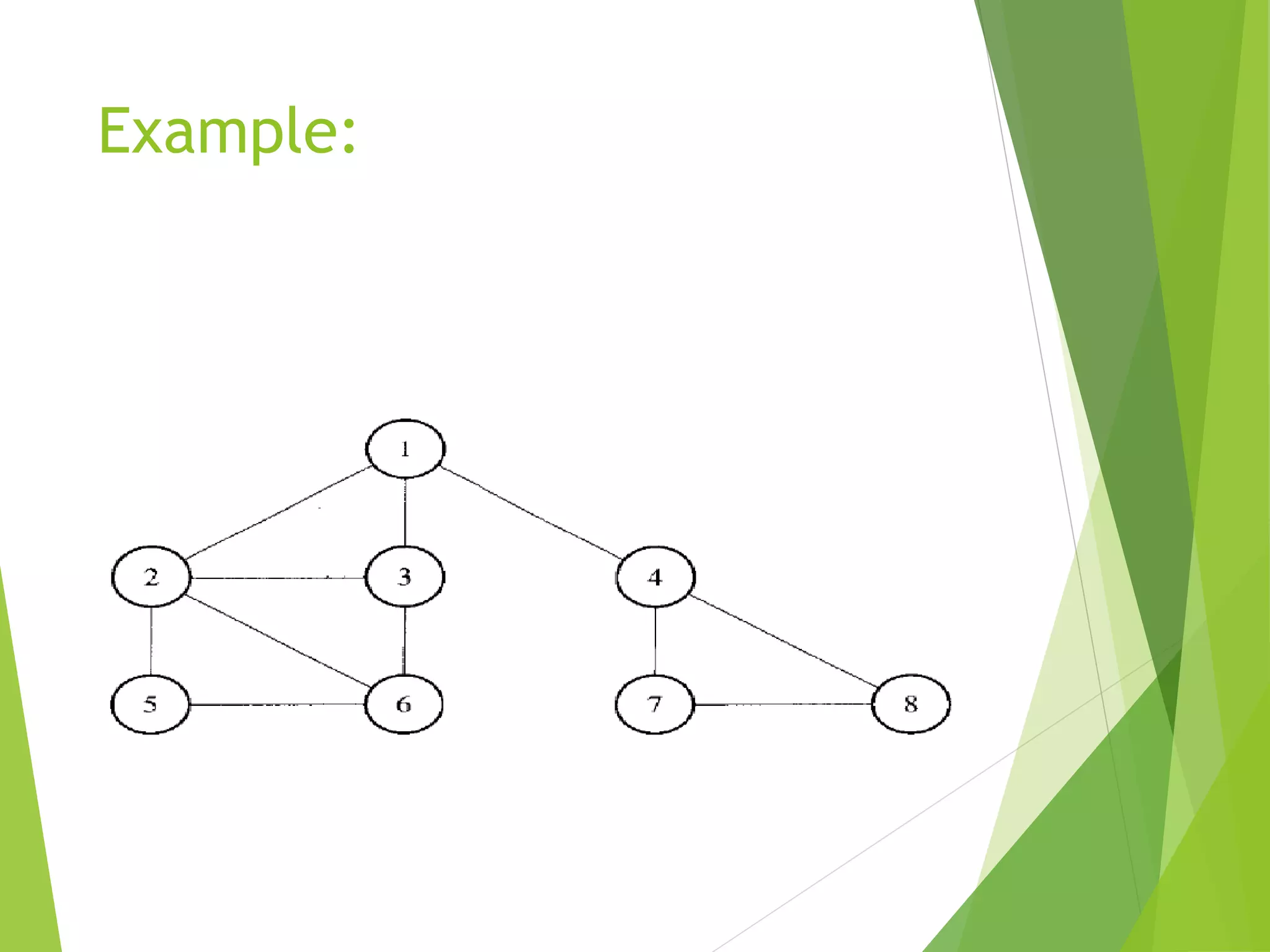
Example:
Depth-first search: Directed
graphs
 The algorithm is essentially the same as for undirected
graphs, the difference residing in the interpretation of the
word "adjacent".
 In a directed graph, node w is adjacent to node v if the
directed edge (v, w) exists.
 If (v, w) exists but (w, v) does not, then w is adjacent to v
but v is not adjacent to w.
 With this change of interpretation the procedures dfs and
search apply equally well in the case of a directed graph.
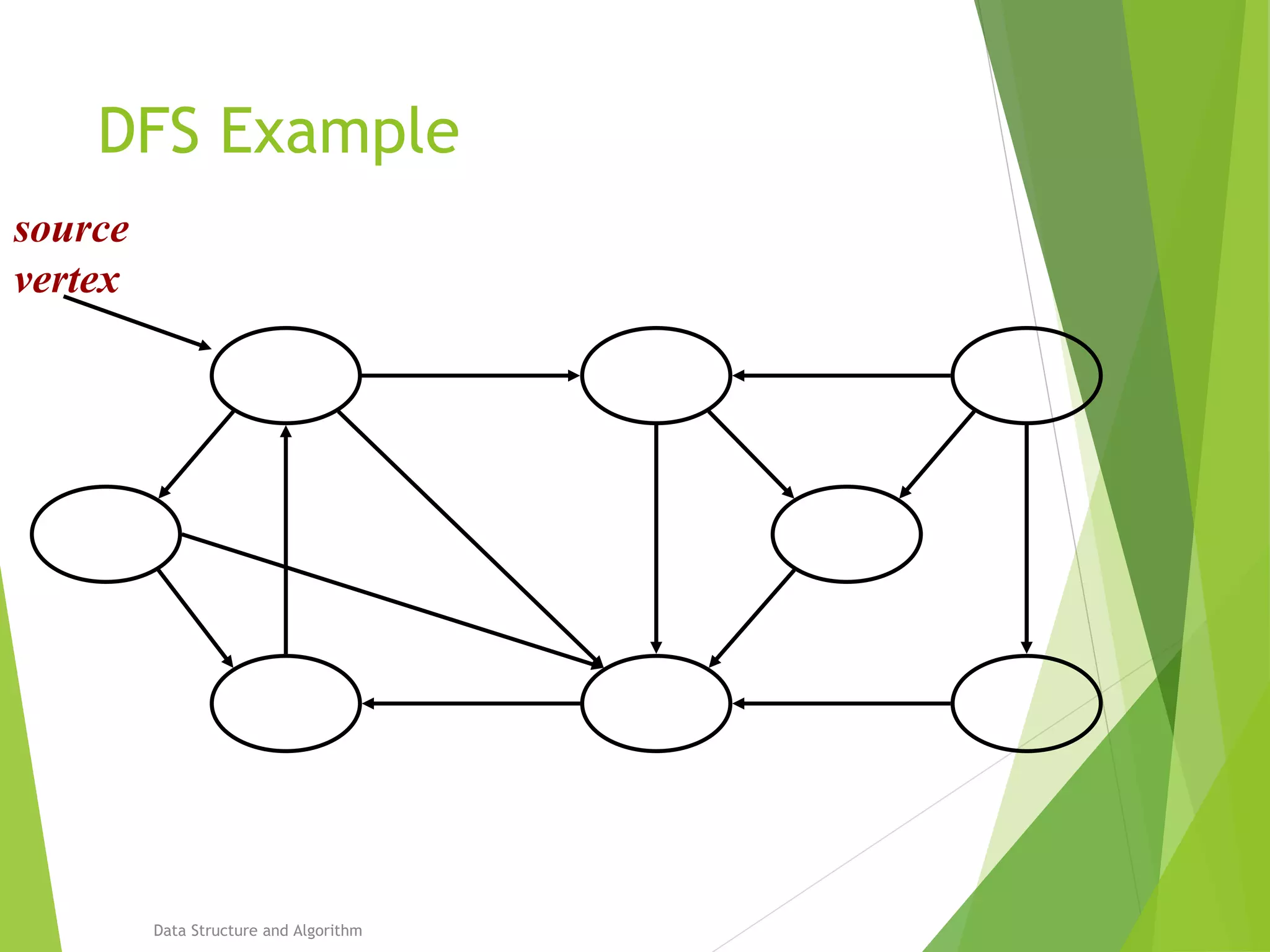
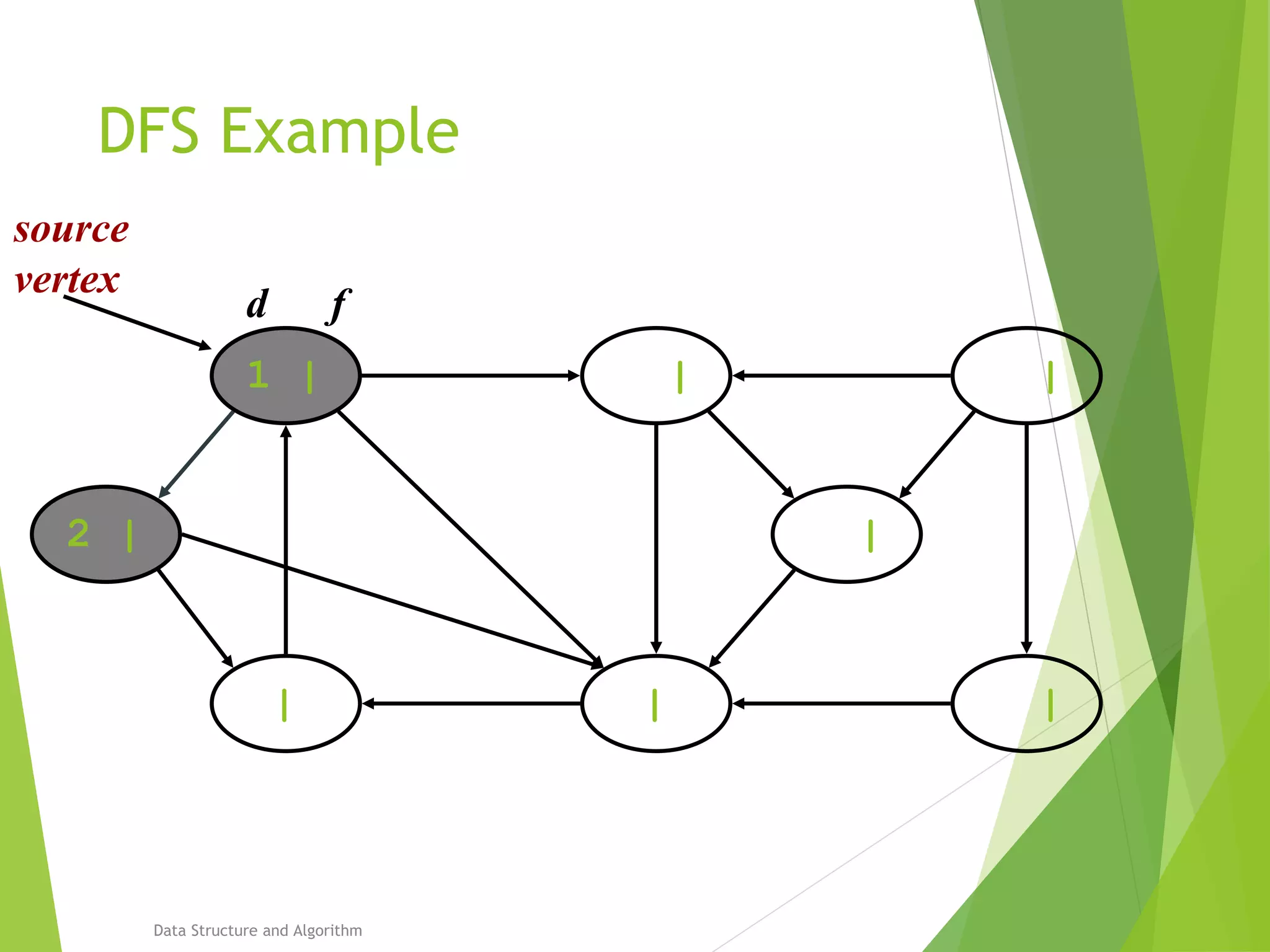
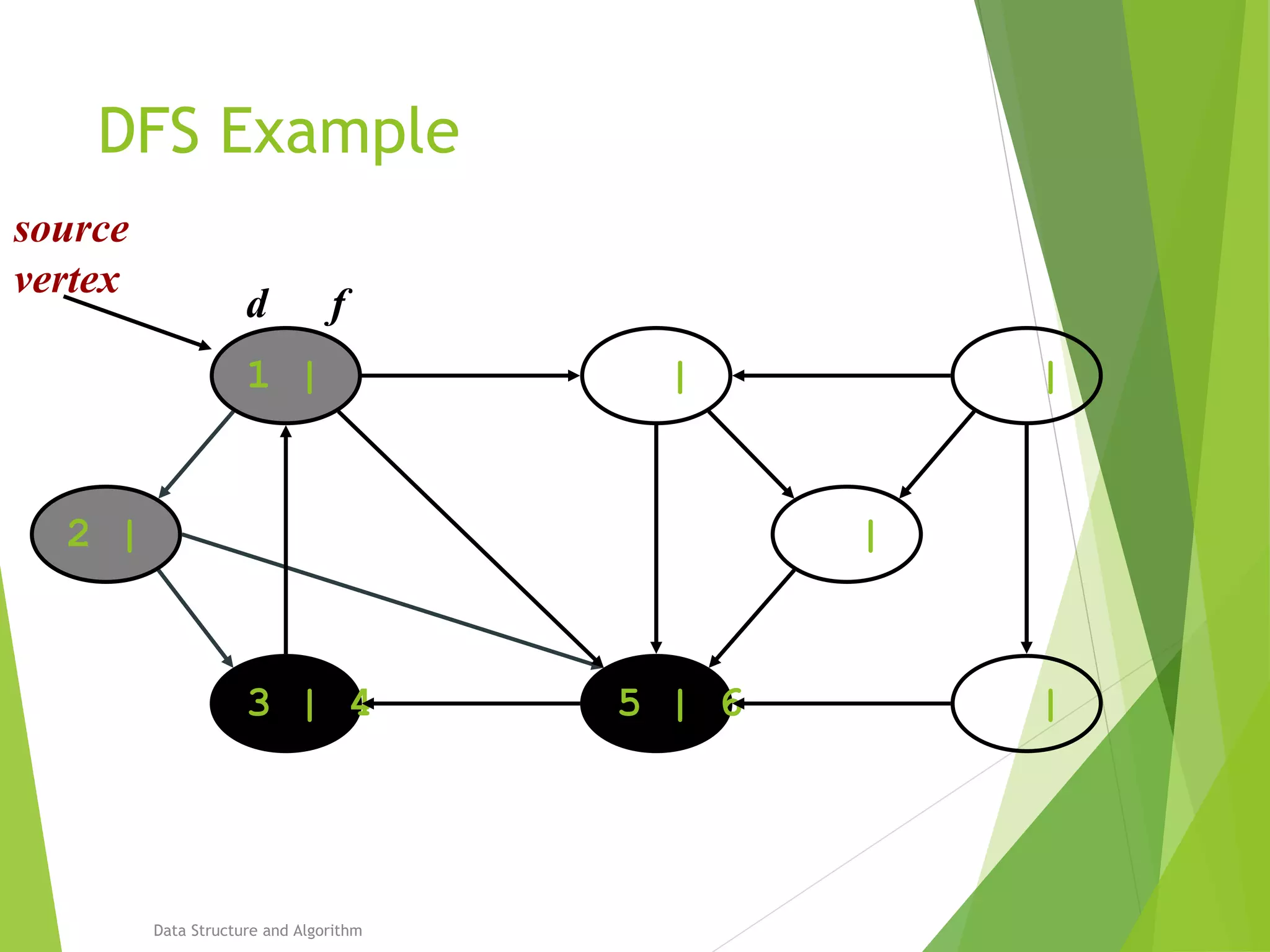
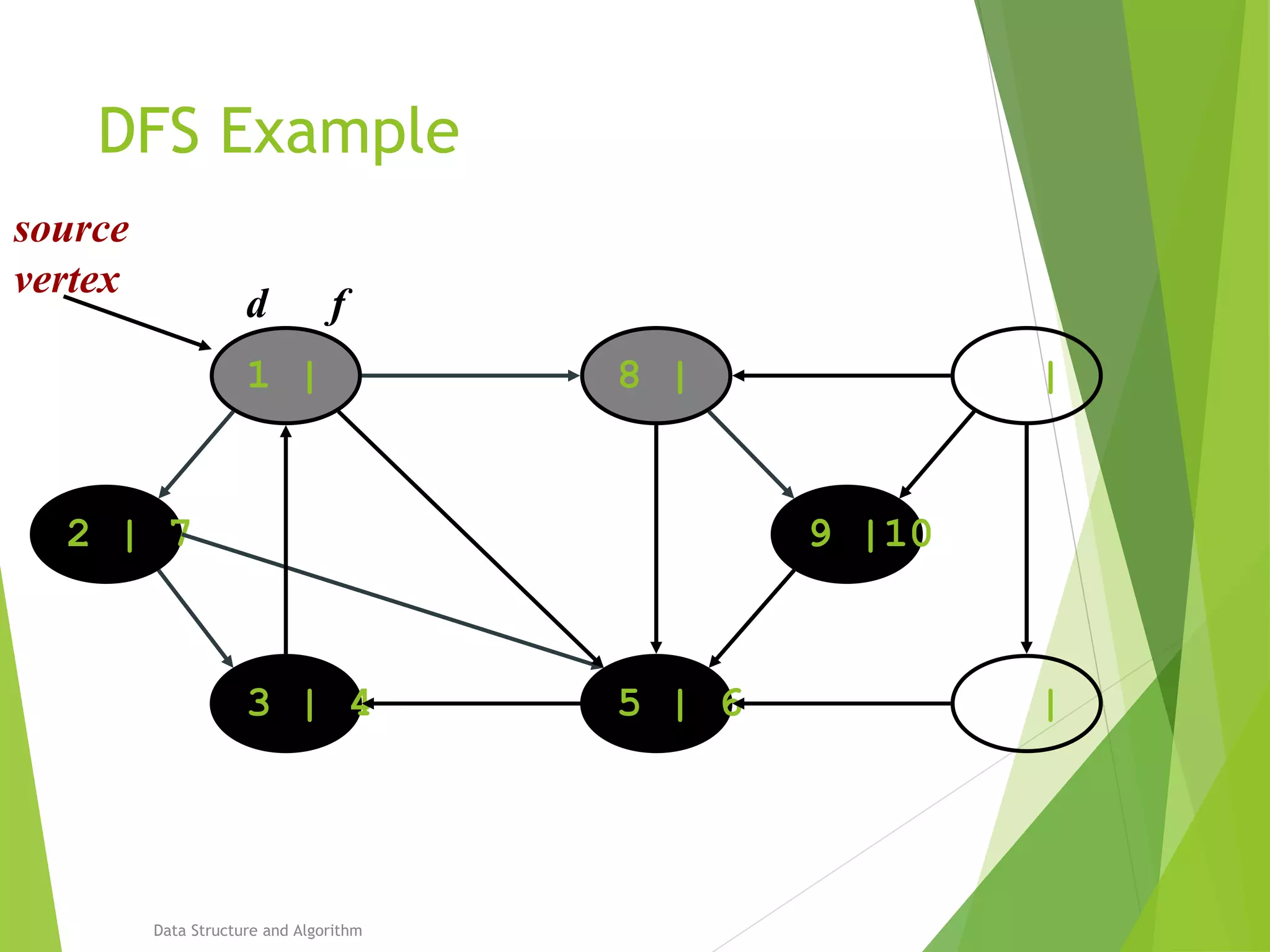
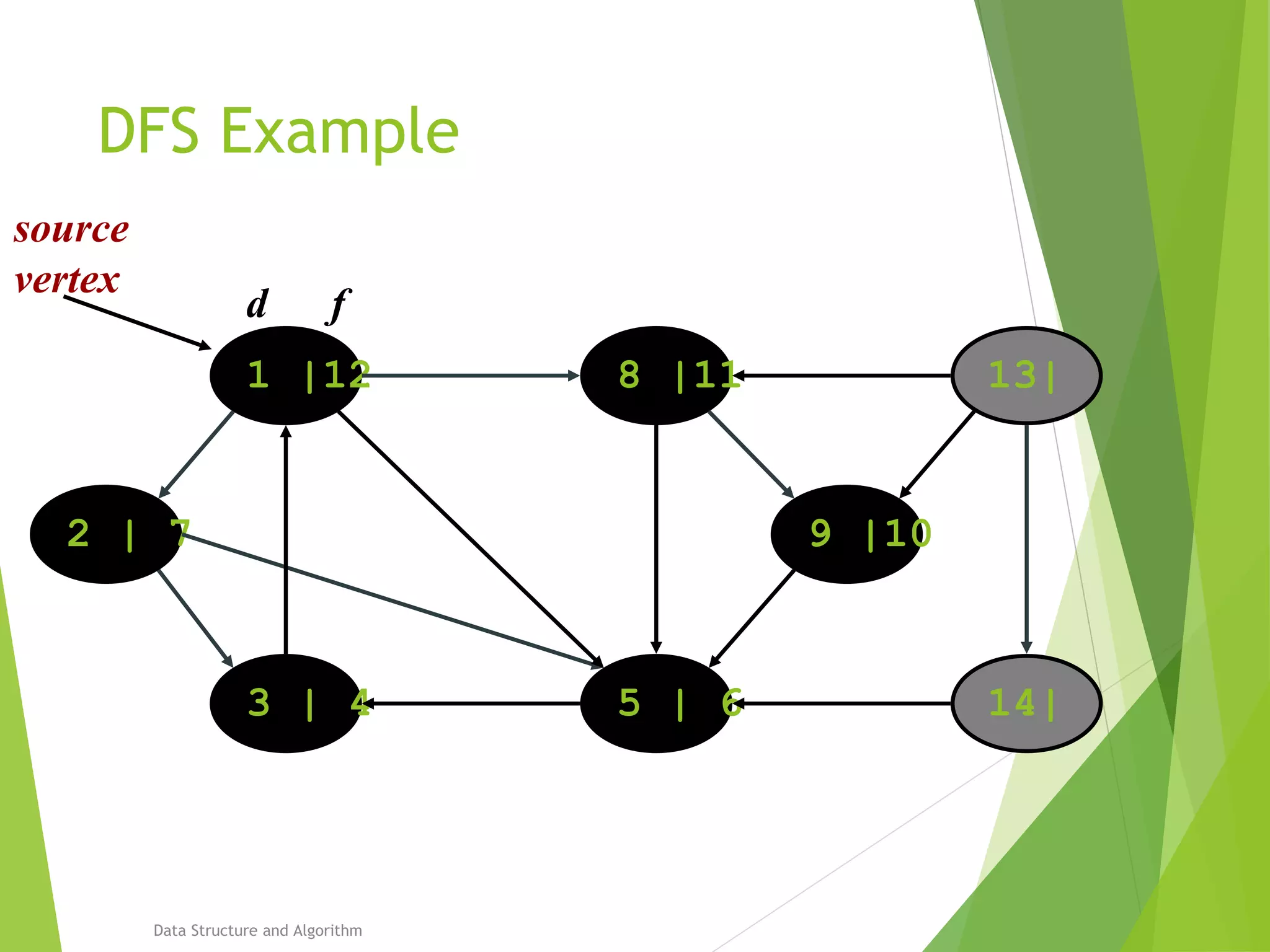
DFS Example
Data Structure and Algorithm
source
vertex
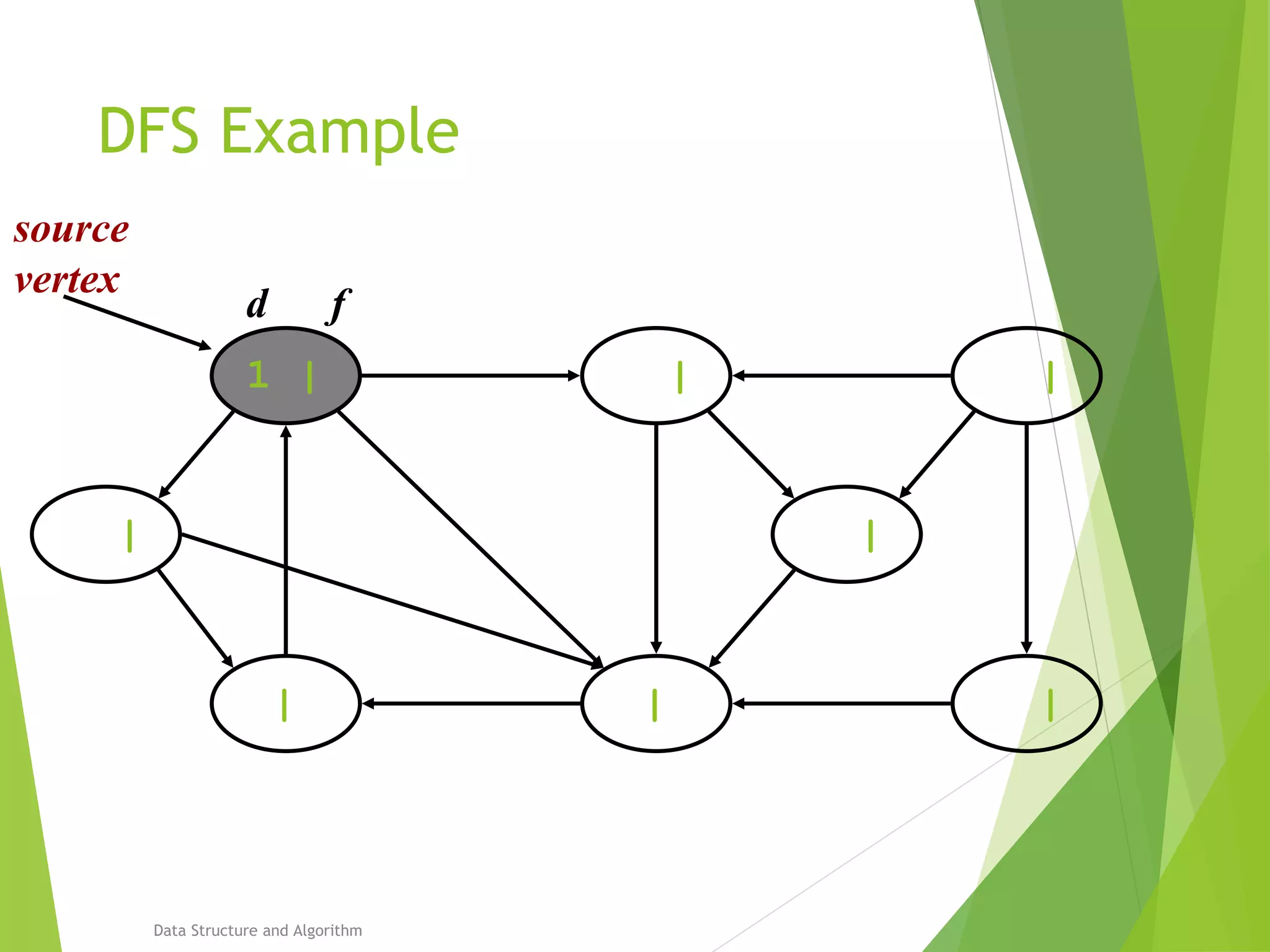
DFS Example
Data Structure and Algorithm
1 | | |
|||
| |
source
vertex
d f
DFS Example
Data Structure and Algorithm
1 | | |
|||
2 | |
source
vertex
d f
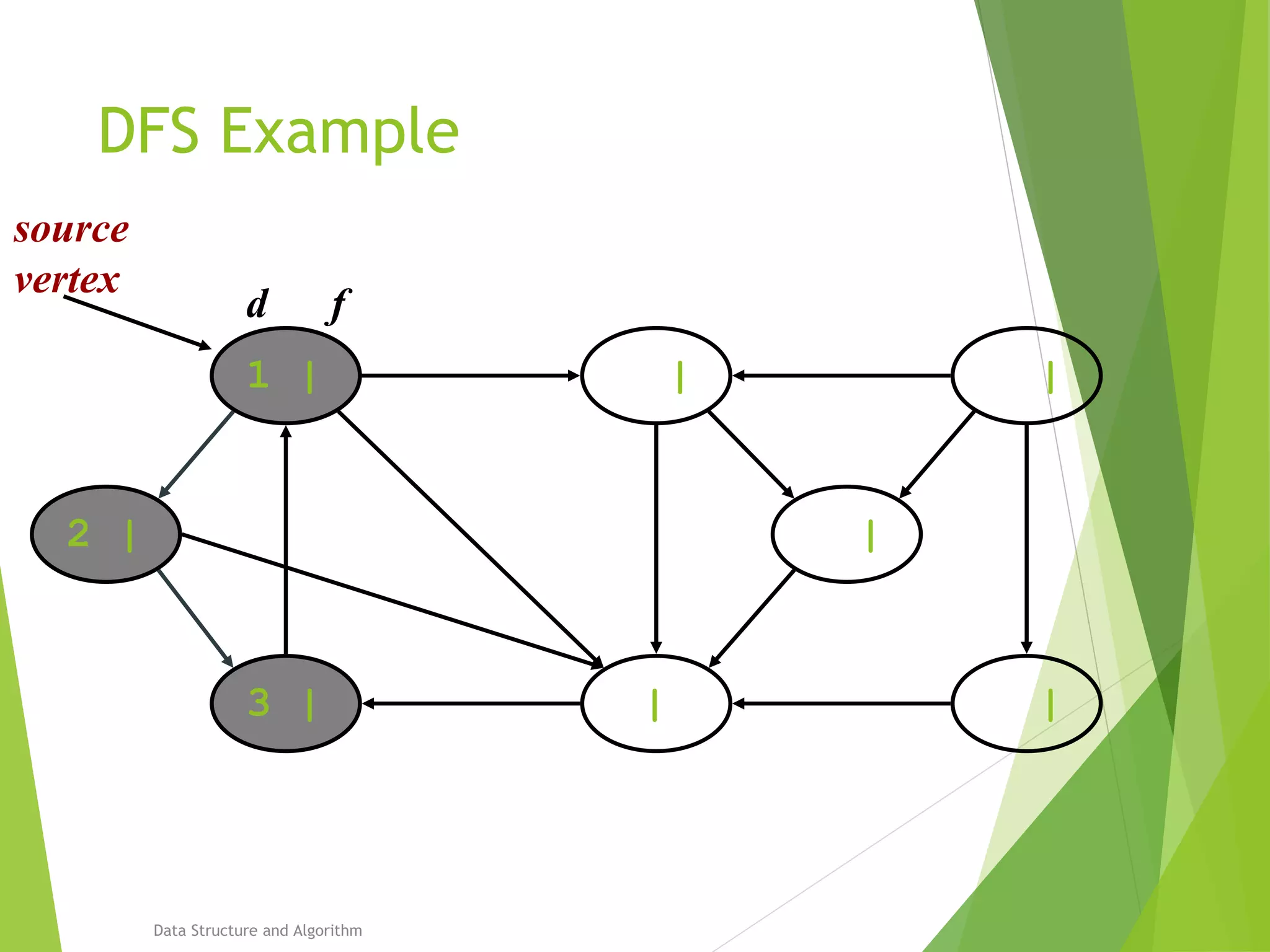
DFS Example
Data Structure and Algorithm
1 | | |
||3 |
2 | |
source
vertex
d f
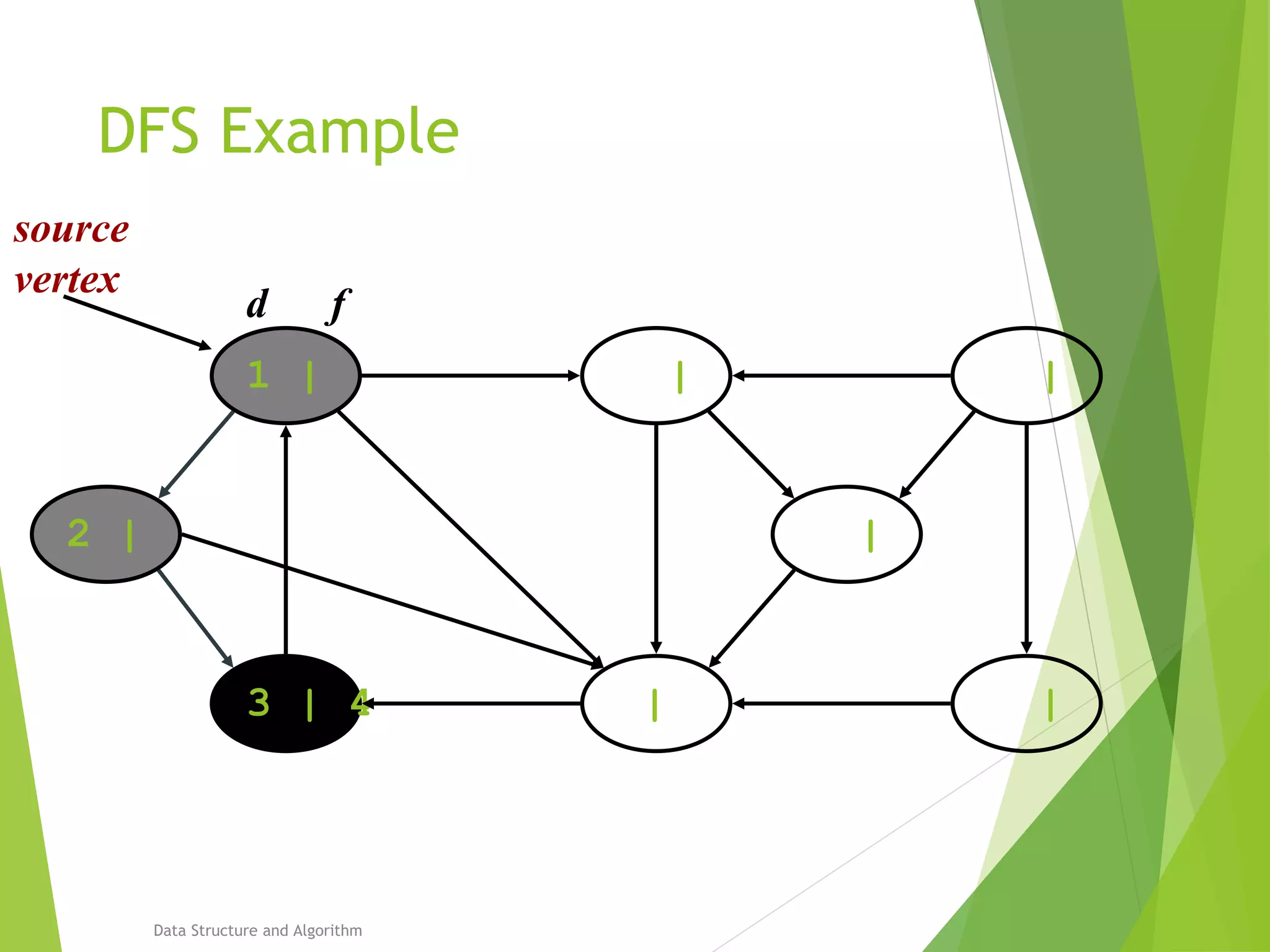
DFS Example
Data Structure and Algorithm
1 | | |
||3 | 4
2 | |
source
vertex
d f
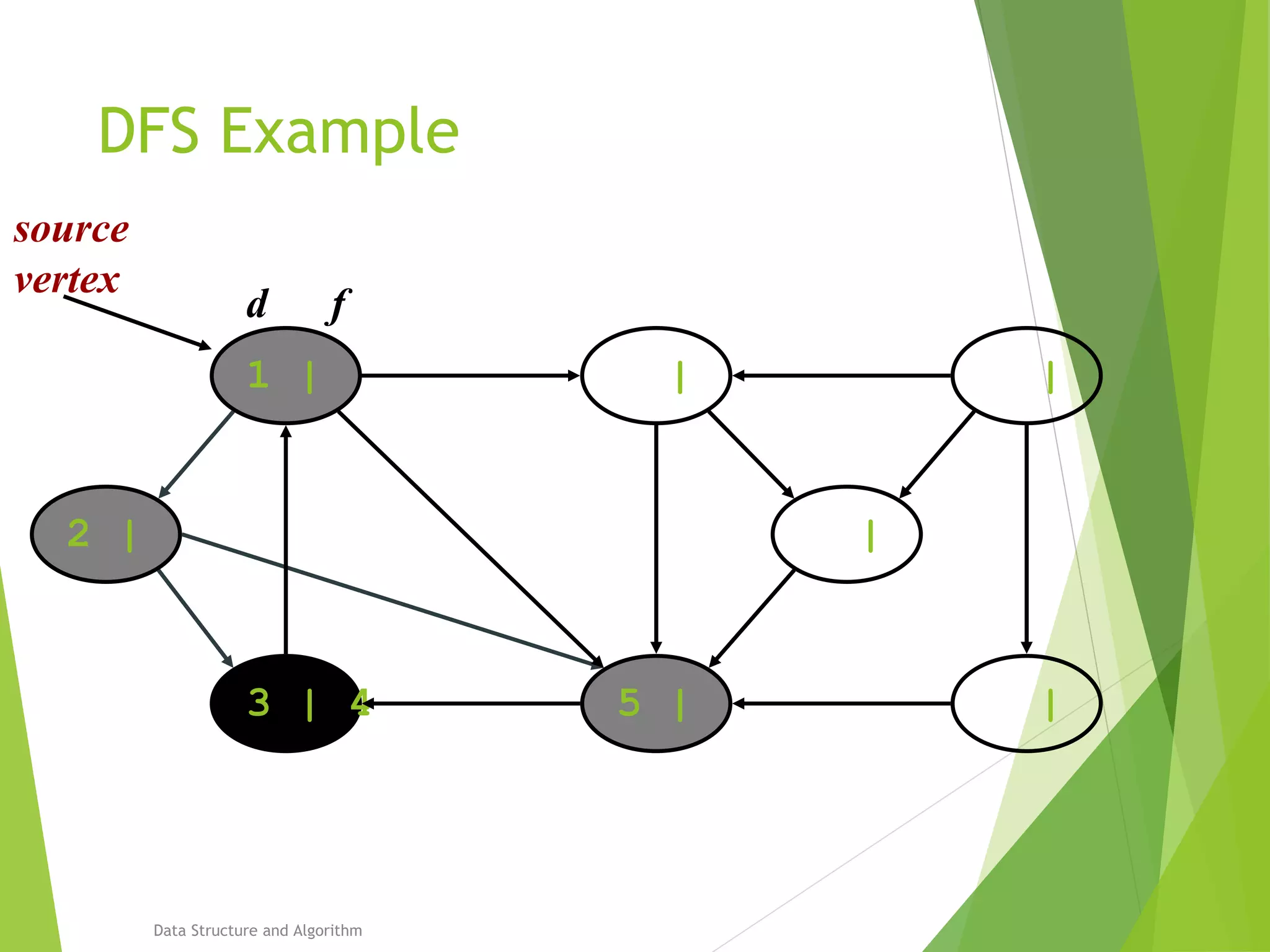
DFS Example
Data Structure and Algorithm
1 | | |
|5 |3 | 4
2 | |
source
vertex
d f
DFS Example
Data Structure and Algorithm
1 | | |
|5 | 63 | 4
2 | |
source
vertex
d f
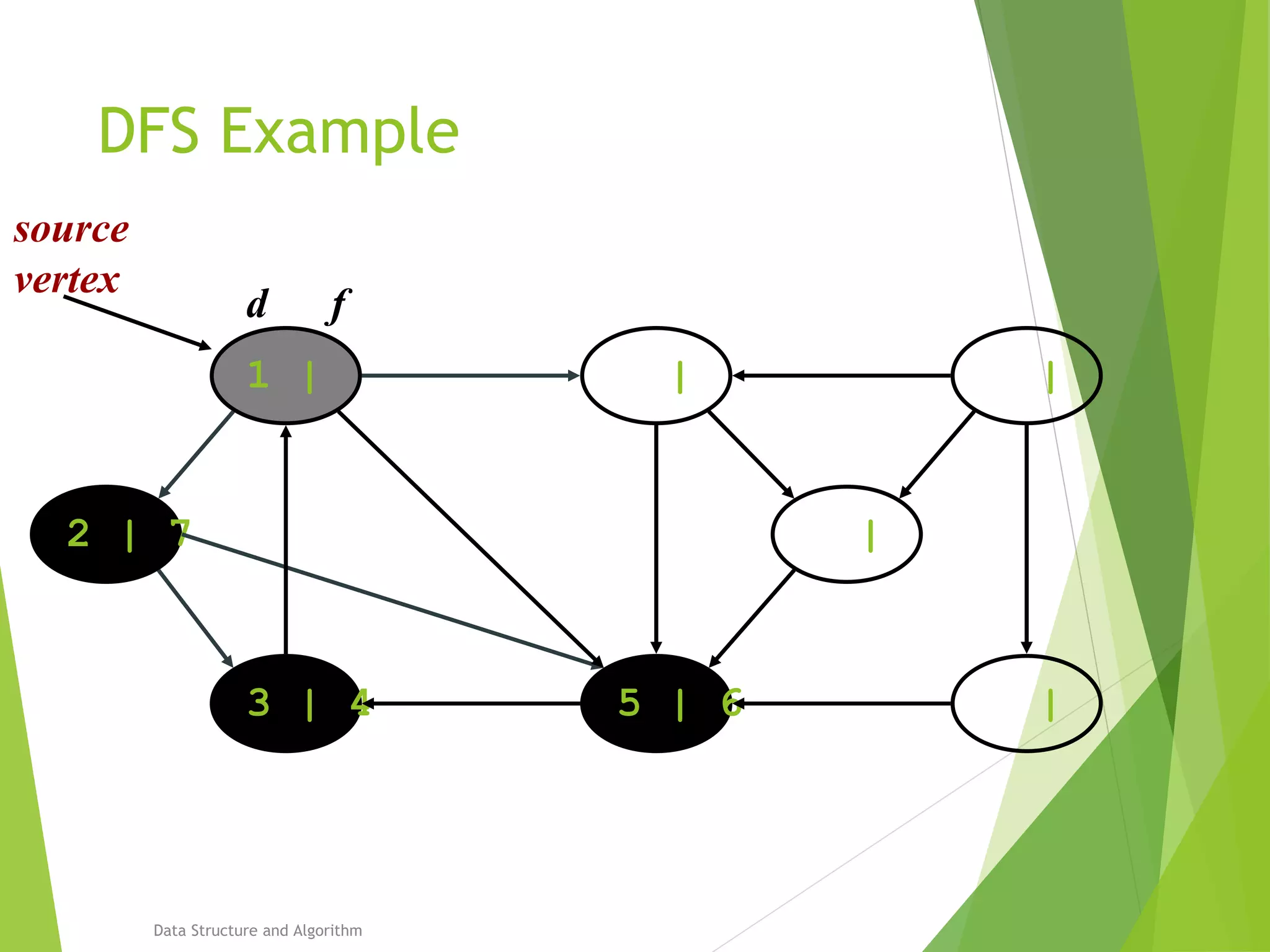
DFS Example
Data Structure and Algorithm
1 | | |
|5 | 63 | 4
2 | 7 |
source
vertex
d f
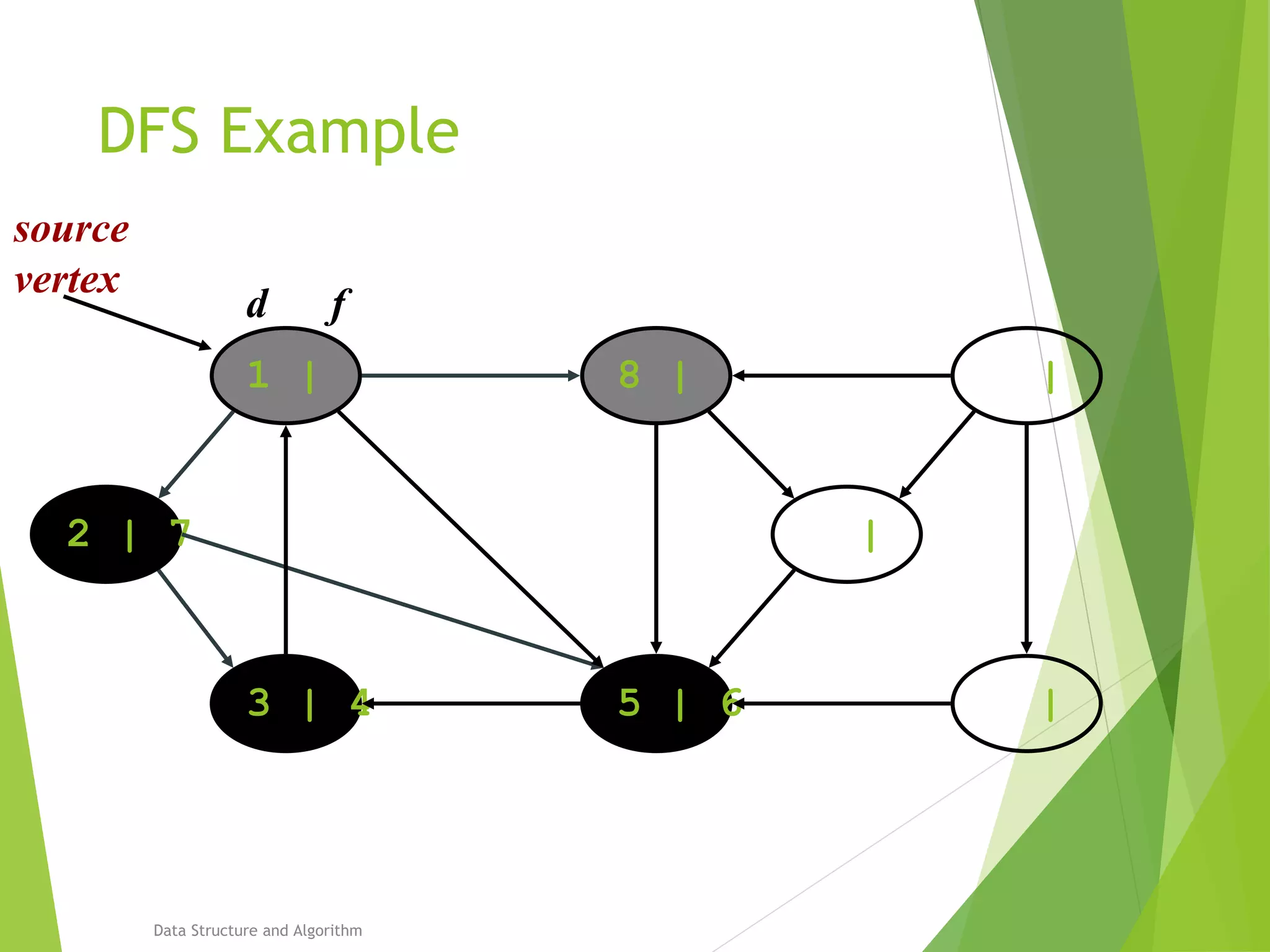
DFS Example
Data Structure and Algorithm
1 | 8 | |
|5 | 63 | 4
2 | 7 |
source
vertex
d f
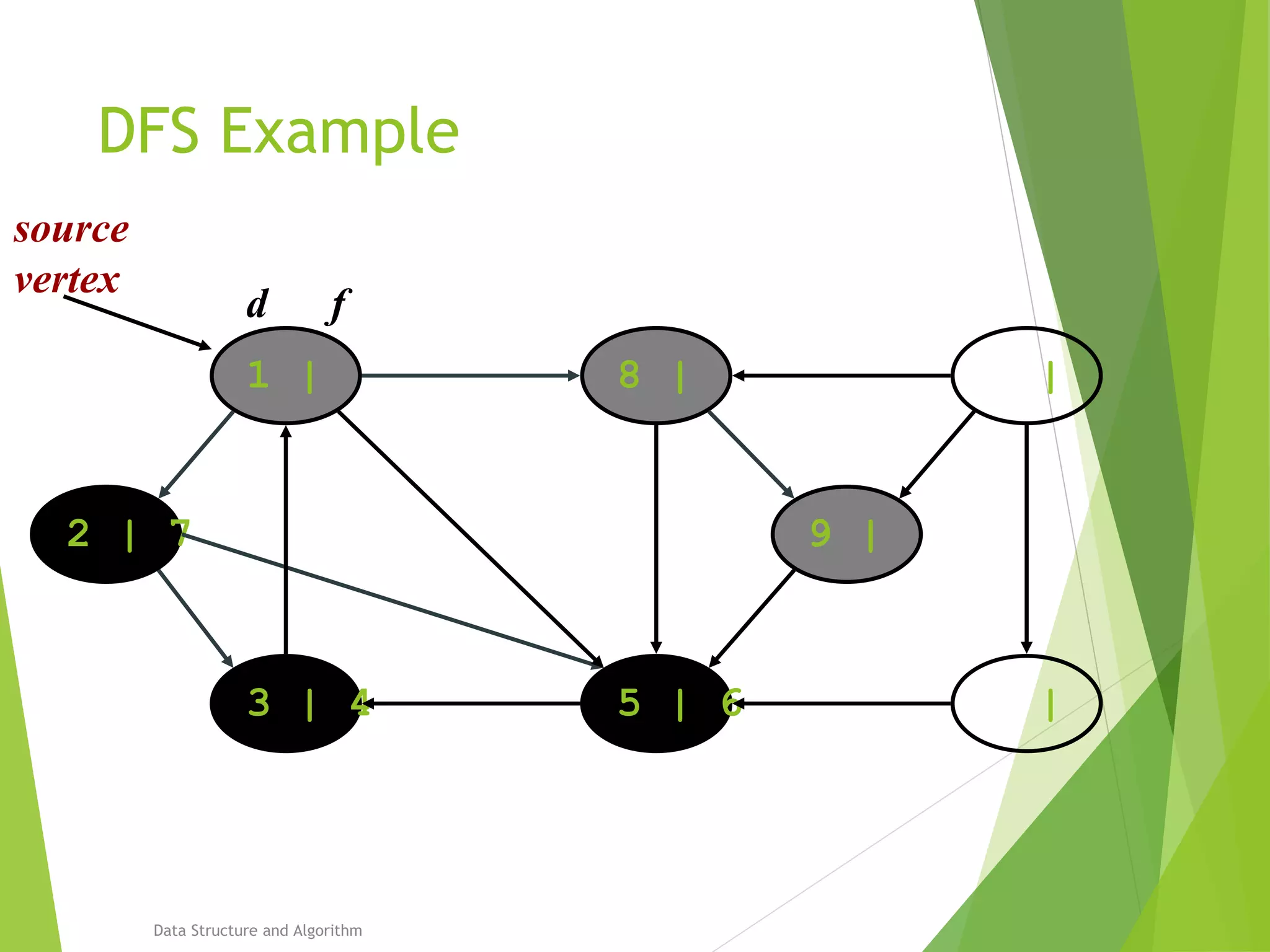
DFS Example
Data Structure and Algorithm
1 | 8 | |
|5 | 63 | 4
2 | 7 9 |
source
vertex
d f
DFS Example
Data Structure and Algorithm
1 | 8 | |
|5 | 63 | 4
2 | 7 9 |10
source
vertex
d f
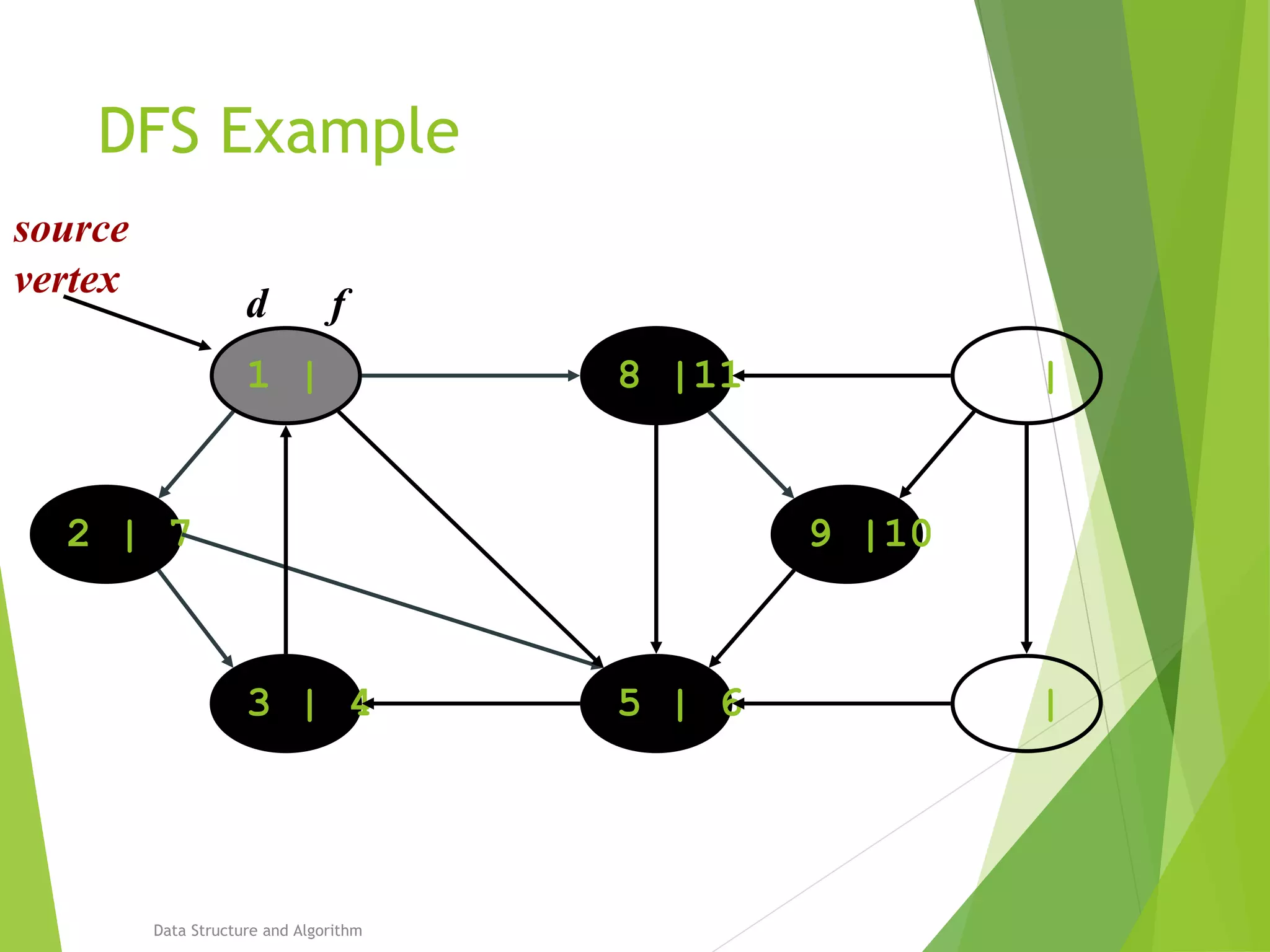
DFS Example
Data Structure and Algorithm
1 | 8 |11 |
|5 | 63 | 4
2 | 7 9 |10
source
vertex
d f
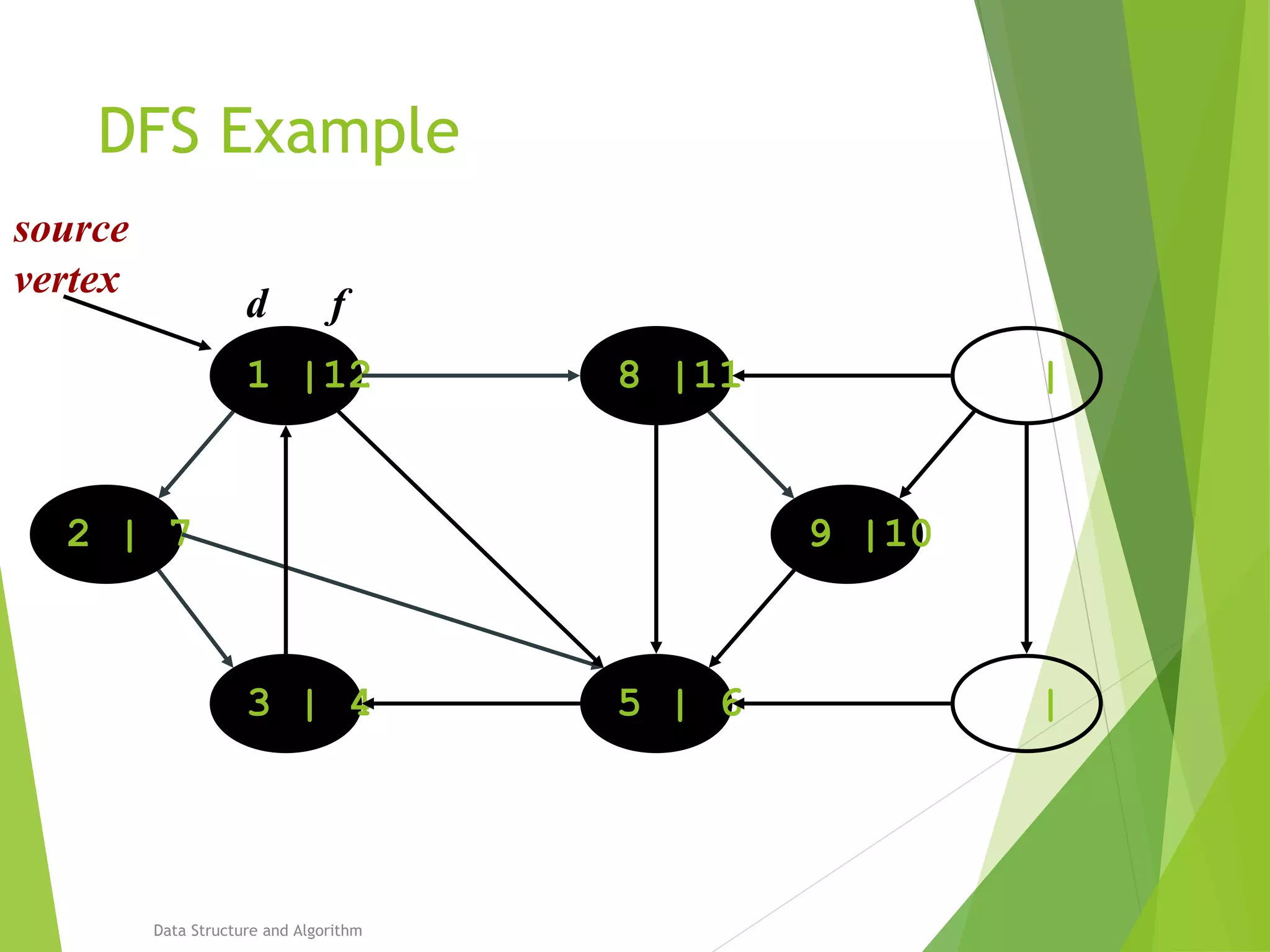
DFS Example
Data Structure and Algorithm
1 |12 8 |11 |
|5 | 63 | 4
2 | 7 9 |10
source
vertex
d f
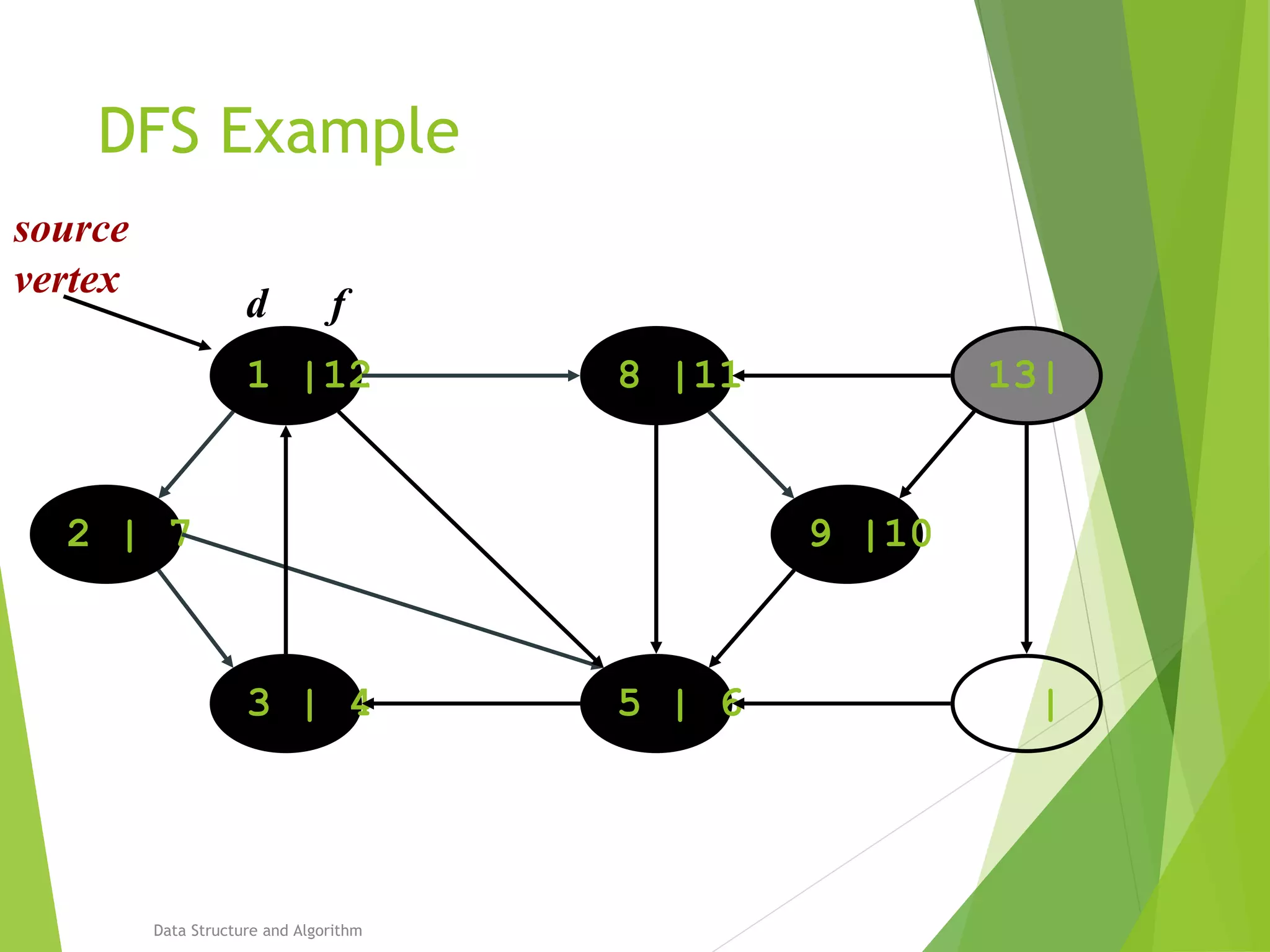
DFS Example
Data Structure and Algorithm
1 |12 8 |11 13|
|5 | 63 | 4
2 | 7 9 |10
source
vertex
d f
DFS Example
Data Structure and Algorithm
1 |12 8 |11 13|
14|5 | 63 | 4
2 | 7 9 |10
source
vertex
d f
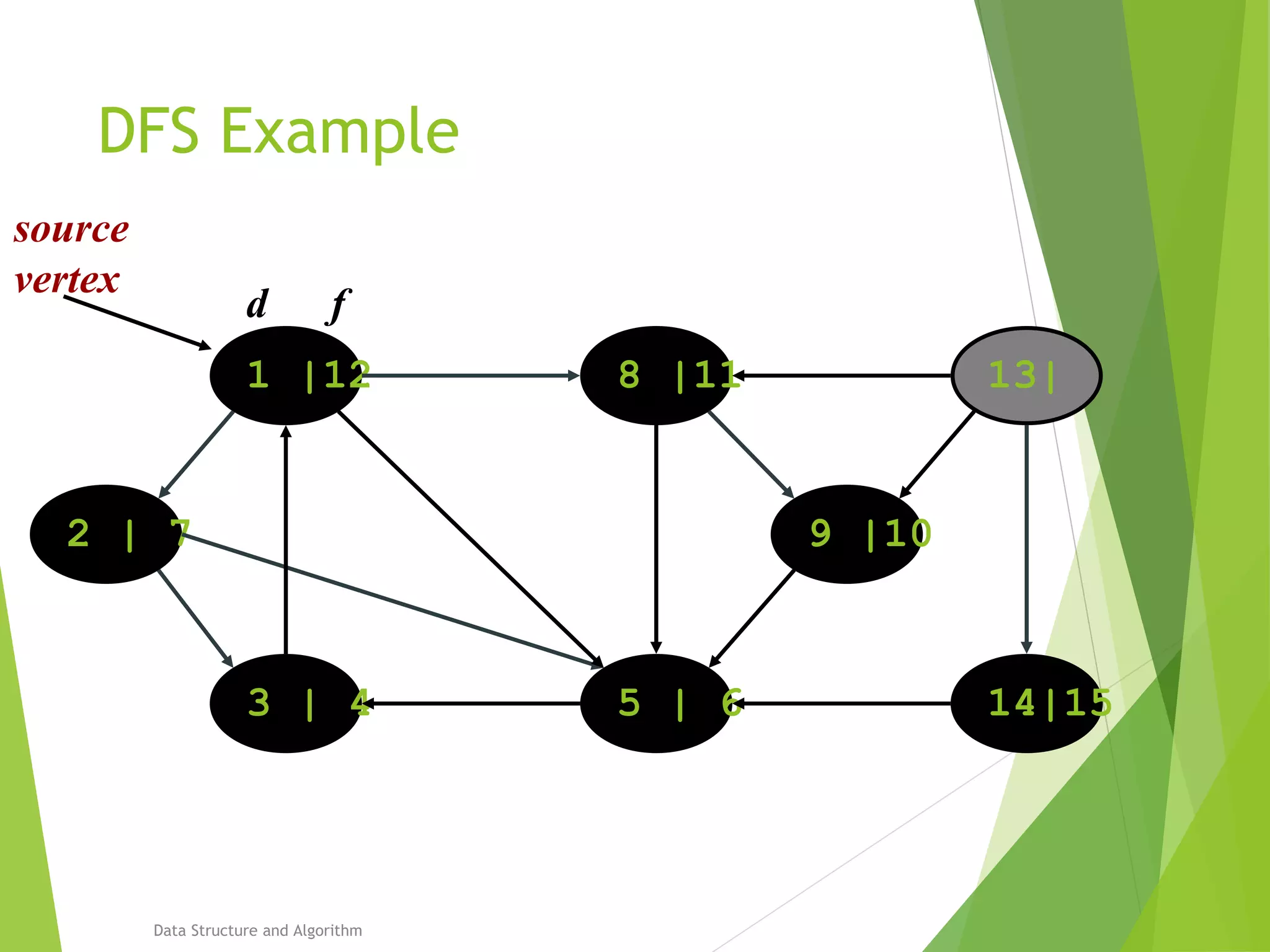
DFS Example
Data Structure and Algorithm
1 |12 8 |11 13|
14|155 | 63 | 4
2 | 7 9 |10
source
vertex
d f
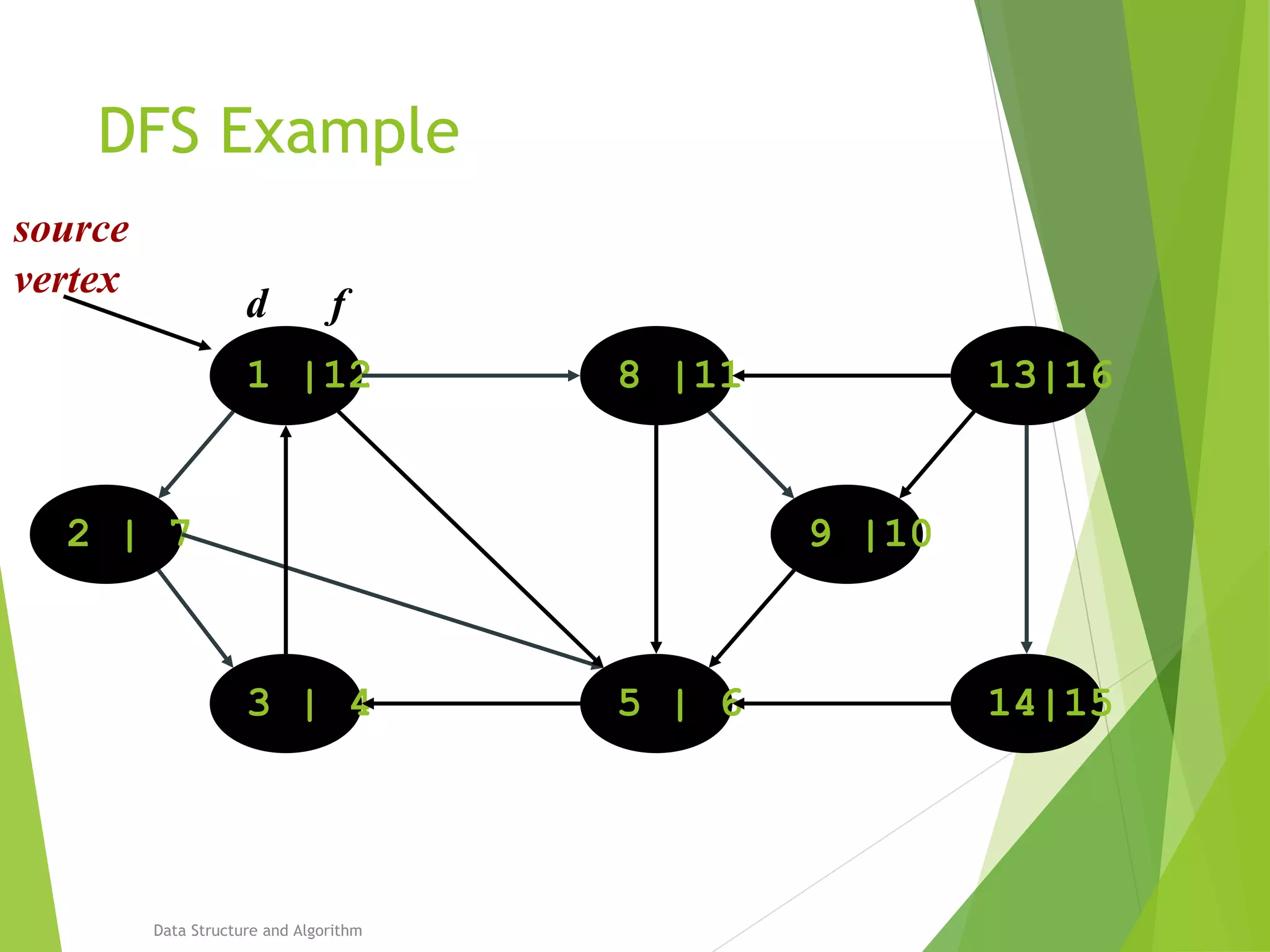
DFS Example
Data Structure and Algorithm
1 |12 8 |11 13|16
14|155 | 63 | 4
2 | 7 9 |10
source
vertex
d f
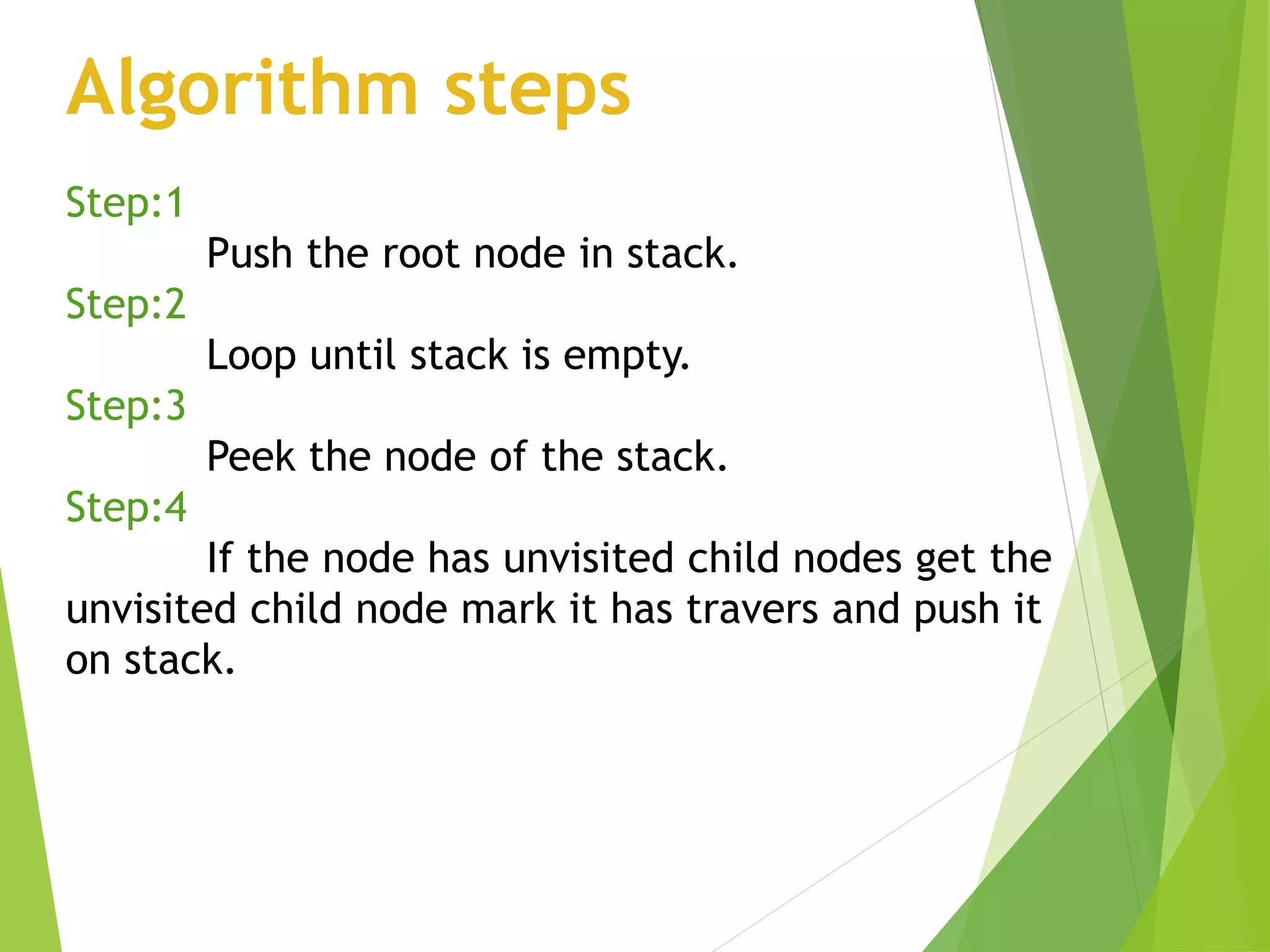
Algorithm steps
Step:1
Push the root node in stack.
Step:2
Loop until stack is empty.
Step:3
Peek the node of the stack.
Step:4
If the node has unvisited child nodes get the
unvisited child node mark it has travers and push it
on stack.
Data
Structure
and
Algorithm
DFS: Algorithm
DFS(G)
 for each vertex u in V,
 color[u]=white; p[u]=NIL
 time=0;
 for each vertex u in V
 if (color[u]=white)
 DFS-VISIT(u)
Data
Structure
and
Algorithm
DFS-VISIT(u)
 color[u]=gray;
 time = time + 1;
 d[u] = time;
 for each v in Adj(u) do
 if (color[v] = white)
 p[v] = u;
 DFS-VISIT(v);
 color[u] = black;
 time = time + 1; f[u]= time;
DFS: Algorithm (Cont.)
source
vertex
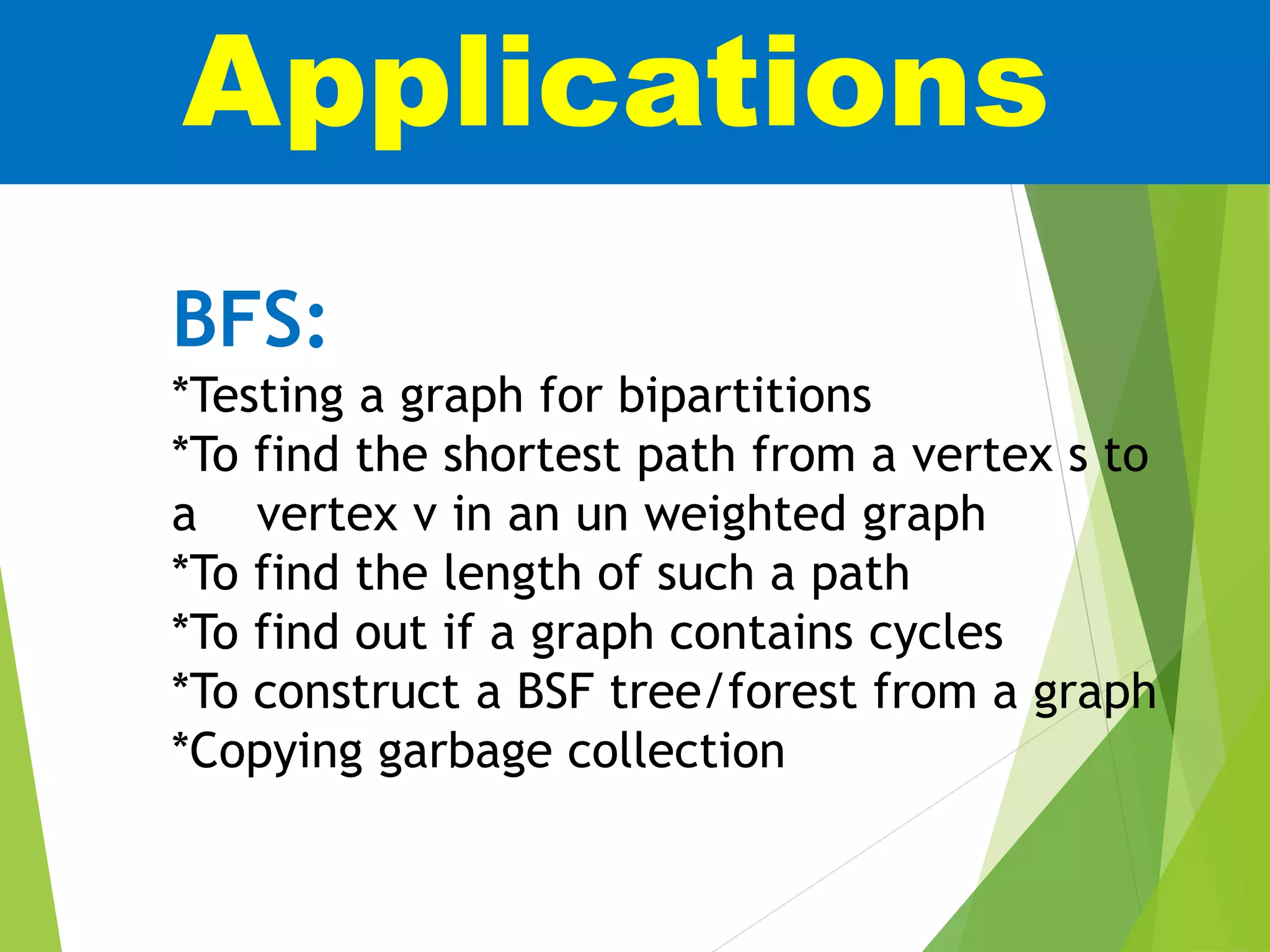
BFS:
*Testing a graph for bipartitions
*To find the shortest path from a vertex s to
a vertex v in an un weighted graph
*To find the length of such a path
*To find out if a graph contains cycles
*To construct a BSF tree/forest from a graph
*Copying garbage collection
Applications
Applications
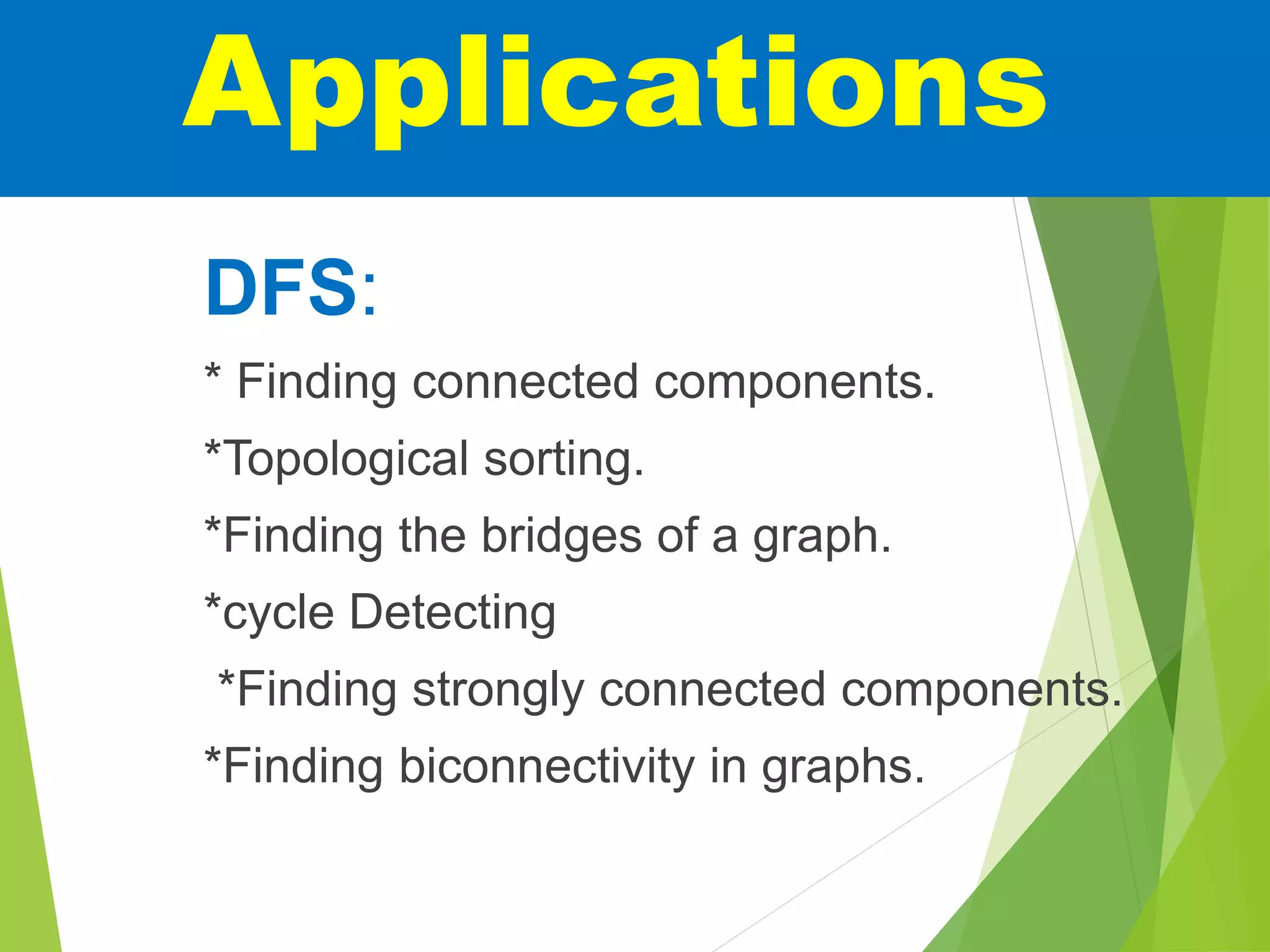
DFS:
* Finding connected components.
*Topological sorting.
*Finding the bridges of a graph.
*cycle Detecting
*Finding strongly connected components.
*Finding biconnectivity in graphs.
Bfs and Dfs
Bfs and Dfs

Bfs and Dfs

  • 1.
    Welcome To OurPresentation
  • 2.
    Group Name :Quantative
  • 3.
     Depth FirstSearch (DFS)  Breadth First Search (BFS) Topics
  • 4.
    What is agraph? 1.Directed/Undirected 2.Weighted/Unweighted 3.Cyclic/Acyclic A set of vertices and edges
  • 5.
     Breadth FirstSearch (BFS) Start several paths at a time, and advance in each one step at a time The breadth-first search uses a FIFO queue.  Depth First Search (DFS) Once a possible path is found, continue the search until the end of the path The Depth-first search uses a LIFO Stack. Graph Traversal
  • 6.
    How It Works? 1.Picka source vertex S to start. 2.Discover the vertices that are adjacent to S. Depth-first: visit all neighbors of a neighbor before visiting your other neighbors Breadth First: Pick each child of S in turn and discover their vertices adjacent to that child. Done when all children have been discovered and examined.
  • 7.
    For a GraphG=(V, E) and n = |V| and m=|E| When Adjacency List is used Complexity is O(m + n) When Adjacency Matrix is used Scanning each row for checking the connectivity of a Vertex is in order O(n). So, Complexity is O(n2 ) DFS uses space O(|V|) in the worst case to store the stack of vertices on the current search path as well as the set of already-visited vertices. Analysis of DFS
  • 8.
  • 9.
    Depth-first search: Directed graphs The algorithm is essentially the same as for undirected graphs, the difference residing in the interpretation of the word "adjacent".  In a directed graph, node w is adjacent to node v if the directed edge (v, w) exists.  If (v, w) exists but (w, v) does not, then w is adjacent to v but v is not adjacent to w.  With this change of interpretation the procedures dfs and search apply equally well in the case of a directed graph.
  • 10.
    DFS Example Data Structureand Algorithm source vertex
  • 11.
    DFS Example Data Structureand Algorithm 1 | | | ||| | | source vertex d f
  • 12.
    DFS Example Data Structureand Algorithm 1 | | | ||| 2 | | source vertex d f
  • 13.
    DFS Example Data Structureand Algorithm 1 | | | ||3 | 2 | | source vertex d f
  • 14.
    DFS Example Data Structureand Algorithm 1 | | | ||3 | 4 2 | | source vertex d f
  • 15.
    DFS Example Data Structureand Algorithm 1 | | | |5 |3 | 4 2 | | source vertex d f
  • 16.
    DFS Example Data Structureand Algorithm 1 | | | |5 | 63 | 4 2 | | source vertex d f
  • 17.
    DFS Example Data Structureand Algorithm 1 | | | |5 | 63 | 4 2 | 7 | source vertex d f
  • 18.
    DFS Example Data Structureand Algorithm 1 | 8 | | |5 | 63 | 4 2 | 7 | source vertex d f
  • 19.
    DFS Example Data Structureand Algorithm 1 | 8 | | |5 | 63 | 4 2 | 7 9 | source vertex d f
  • 20.
    DFS Example Data Structureand Algorithm 1 | 8 | | |5 | 63 | 4 2 | 7 9 |10 source vertex d f
  • 21.
    DFS Example Data Structureand Algorithm 1 | 8 |11 | |5 | 63 | 4 2 | 7 9 |10 source vertex d f
  • 22.
    DFS Example Data Structureand Algorithm 1 |12 8 |11 | |5 | 63 | 4 2 | 7 9 |10 source vertex d f
  • 23.
    DFS Example Data Structureand Algorithm 1 |12 8 |11 13| |5 | 63 | 4 2 | 7 9 |10 source vertex d f
  • 24.
    DFS Example Data Structureand Algorithm 1 |12 8 |11 13| 14|5 | 63 | 4 2 | 7 9 |10 source vertex d f
  • 25.
    DFS Example Data Structureand Algorithm 1 |12 8 |11 13| 14|155 | 63 | 4 2 | 7 9 |10 source vertex d f
  • 26.
    DFS Example Data Structureand Algorithm 1 |12 8 |11 13|16 14|155 | 63 | 4 2 | 7 9 |10 source vertex d f
  • 27.
    Algorithm steps Step:1 Push theroot node in stack. Step:2 Loop until stack is empty. Step:3 Peek the node of the stack. Step:4 If the node has unvisited child nodes get the unvisited child node mark it has travers and push it on stack.
  • 28.
    Data Structure and Algorithm DFS: Algorithm DFS(G)  foreach vertex u in V,  color[u]=white; p[u]=NIL  time=0;  for each vertex u in V  if (color[u]=white)  DFS-VISIT(u)
  • 29.
    Data Structure and Algorithm DFS-VISIT(u)  color[u]=gray;  time= time + 1;  d[u] = time;  for each v in Adj(u) do  if (color[v] = white)  p[v] = u;  DFS-VISIT(v);  color[u] = black;  time = time + 1; f[u]= time; DFS: Algorithm (Cont.) source vertex
  • 30.
    BFS: *Testing a graphfor bipartitions *To find the shortest path from a vertex s to a vertex v in an un weighted graph *To find the length of such a path *To find out if a graph contains cycles *To construct a BSF tree/forest from a graph *Copying garbage collection Applications
  • 31.
    Applications DFS: * Finding connectedcomponents. *Topological sorting. *Finding the bridges of a graph. *cycle Detecting *Finding strongly connected components. *Finding biconnectivity in graphs.