Po
1
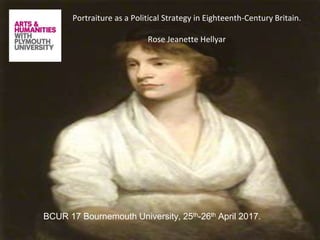
Portraiture as a Political Strategy in Eighteenth-Century Britain.
Rose Jeanette Hellyar
BCUR 17 Bournemouth University, 25th-26th April 2017.
Contents
2
Portraits can be used for political
advancement.
Portraits can re-negotiate gender roles.
Summary
The problem
3
Fig 1: Angelica Kauffmann, Angelica Kauffmann, Oil on canvas,
National Portrait Gallery, London, UK.
4
Fig 2: Queen Charlotte and her Three Eldest Sons, Johann Zoffany, 1762, Oil
on canvas, Royal Collection Trust, UK.
5
Explore the
countryside
Fresh air
Good form
of exercise
Health
benefits
Very
Rewarding
Enjoyable
Fig 3: “The Rainbow Portrait” Queen Elizabeth I, Isaac Oliver, 1600-1603, Oil on Canvas,
Hatfield House, UK.
6
Fig 4: Sir Joshua Reynolds, Sir Joshua Reynolds, 1747-49, Oil on
canvas, National Portrait Gallery, London, UK.
7
Fig 5: Ann Ford, Thomas Gainsborough, 1760, Oil on Canvas.
Fig 6: Lady Cockburn and her Three Eldest Sons, Sir Joshua Reynolds, 1762, Oil on Canvas,
The National Gallery, UK.
8
Summary
Portraits have been used politically in the
past, so why not again?
It challenges portraiture’s functions, by
looking from a different perspective.
They influence public
decision- making through
social engagement and
psychology.
Thanks
Any Questions?
9
Bibliography
•Barrell, J. The Political Theory of Painting, from Reynolds to Hazlitt,( Yale
University Press, 1982.)
•Fischlin, D. Political Ideology, Absolutist Ideology and the “Rainbow
Portrait” of Queen Elizabeth I, Renaissance Quarterly, Vol. 50, No. 1, (The
University of Chicago Press, 1997) 175-78.
• Parkin, A. Essential Cognitive Psychology,( Psychology Press, 2000.)
•Pointon, M. Hanging the Head; Portraiture and Social Formation in
Eighteenth-Century England,( Yale University Press, 1993.)
• Leca, B. “Gainsborough; Reynolds and The Gender Dynamics of
Portraiture” from Leca, B. Thomas Gainsborough and The Modern
Woman, (Giles Publishing Ltd, 2010.).
10

BCUR 17 presentation

  • 1.
    Po 1 Portraiture as aPolitical Strategy in Eighteenth-Century Britain. Rose Jeanette Hellyar BCUR 17 Bournemouth University, 25th-26th April 2017.
  • 2.
    Contents 2 Portraits can beused for political advancement. Portraits can re-negotiate gender roles. Summary The problem
  • 3.
    3 Fig 1: AngelicaKauffmann, Angelica Kauffmann, Oil on canvas, National Portrait Gallery, London, UK.
  • 4.
    4 Fig 2: QueenCharlotte and her Three Eldest Sons, Johann Zoffany, 1762, Oil on canvas, Royal Collection Trust, UK.
  • 5.
    5 Explore the countryside Fresh air Goodform of exercise Health benefits Very Rewarding Enjoyable Fig 3: “The Rainbow Portrait” Queen Elizabeth I, Isaac Oliver, 1600-1603, Oil on Canvas, Hatfield House, UK.
  • 6.
    6 Fig 4: SirJoshua Reynolds, Sir Joshua Reynolds, 1747-49, Oil on canvas, National Portrait Gallery, London, UK.
  • 7.
    7 Fig 5: AnnFord, Thomas Gainsborough, 1760, Oil on Canvas. Fig 6: Lady Cockburn and her Three Eldest Sons, Sir Joshua Reynolds, 1762, Oil on Canvas, The National Gallery, UK.
  • 8.
    8 Summary Portraits have beenused politically in the past, so why not again? It challenges portraiture’s functions, by looking from a different perspective. They influence public decision- making through social engagement and psychology.
  • 9.
  • 10.
    Bibliography •Barrell, J. ThePolitical Theory of Painting, from Reynolds to Hazlitt,( Yale University Press, 1982.) •Fischlin, D. Political Ideology, Absolutist Ideology and the “Rainbow Portrait” of Queen Elizabeth I, Renaissance Quarterly, Vol. 50, No. 1, (The University of Chicago Press, 1997) 175-78. • Parkin, A. Essential Cognitive Psychology,( Psychology Press, 2000.) •Pointon, M. Hanging the Head; Portraiture and Social Formation in Eighteenth-Century England,( Yale University Press, 1993.) • Leca, B. “Gainsborough; Reynolds and The Gender Dynamics of Portraiture” from Leca, B. Thomas Gainsborough and The Modern Woman, (Giles Publishing Ltd, 2010.). 10