BBIM510 - Business Innovation 
in Digital Economies 
Cloud computing 
Lecturer: Arjun Shivraj
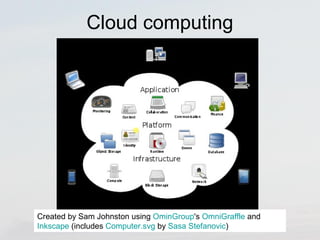
Cloud computing 
Created by Sam Johnston using OminGroup's OmniGraffle and 
Inkscape (includes Computer.svg by Sasa Stefanovic)
Defining the cloud 
• “Cloud computing is a model for enabling convenient, 
on-demand network access to a shared pool of 
configurable computing resources (e.g. networks, 
servers, storage, applications and services) that can be 
rapidly provisioned and released with minimal 
management effort or service provider interaction.” (The 
US National Institute of Standards and Technologies) 
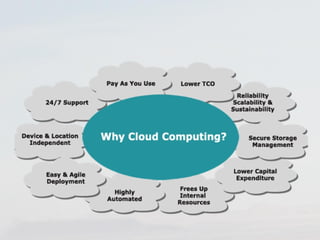
• Cloud computing is mainly a new mean of delivering IT 
resources, enabling organisations to leverage their 
innovation and competitive advantage, at the same time 
that they cut costs and gain agility for the business.
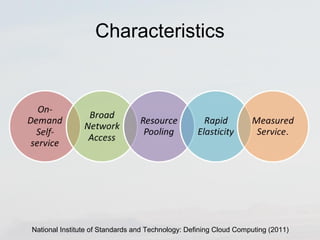
Characteristics 
National Institute of Standards and Technology: Defining Cloud Computing (2011)
Characteristics 
• On-demand self-service. A consumer can unilaterally provision computing 
capabilities, such as server time and network storage, as needed automatically 
without requiring human interaction with each service provider. 
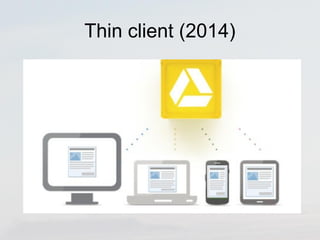
• Broad network access. Capabilities are available over the network and accessed 
through standard mechanisms that promote use by heterogeneous thin or thick client 
platforms (e.g., mobile phones, tablets, laptops, and workstations). 
• Resource pooling. The provider's computing resources are pooled to serve multiple 
consumers using a multi-tenant model, with different physical and virtual resources 
dynamically assigned and reassigned according to consumer demand. 
• Rapid elasticity. Capabilities can be elastically provisioned and released, in some 
cases automatically, to scale rapidly outward and inward commensurate with 
demand. To the consumer, the capabilities available for provisioning often appear 
unlimited and can be appropriated in any quantity at any time. 
• Measured service. Cloud systems automatically control and optimize resource use 
by leveraging a metering capability at some level of abstraction appropriate to the 
type of service (e.g., storage, processing, bandwidth, and active user accounts). 
Resource usage can be monitored, controlled, and reported, providing transparency 
for both the provider and consumer of the utilized service. 
National Institute of Standards and Technology: Defining Cloud Computing (2011)
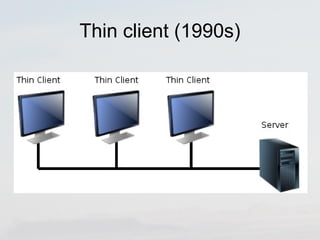
Thin client (1990s)
Thin client (2014)
Cloud services 
• Information aggregation 
• Supply Chain Services 
• Financial, accounting and insurance services 
• eRetail 
• Document management 
• Government services 
• Services integration 
• CRM and social CRM 
• Service management and brokerage 
• ID management 
• Business intelligence and analytics 
• Personalisation 
• Social media platforms
Examples on cloud services 
• Search tools: Google, Yahoo! Technorati (http://technorati.com/) 
• Create and Shared documents, collaborate (Google Documents, Microsoft Office 
365, Dropbox, Wiki tools, IBM LotusLive) 
• Share calendars (major suppliers) 
• Email management: today around 4%, but to be 50% by 2020 (Gartner, report 
September 2011): Google, Microsoft 
• Project management (Microsoft Office 365 Share Point; Manymoon, Basecamp) 
(learn: Project in a Box); http://www.attask.com/ 
• VOIP (Skype) (peer-to-peer architecture) 
• CRM Salesforce: http://www.salesforce.com/uk/?ir=1; and Sage 
http://www.sage.com/ourbusiness/newsroom/newsfromourregionalbusinesses/view/1667 
• Business Process Management (IBM Blueworks Live) 
• Cloud service security (major vendors) 
• iCloud: storage of documents, photos and songs in the cloud; access to apps in 
different devices (other companies are doing this in the cloud, start-ups, but working 
with open platforms thus any sort of programme or file could be saved in ‘personal’ 
clouds; better because it does not lock the user in particular vendors). 
• Content management: http://box.net/ 
• Business intelligence: http://www.cloudera.com/ 
• Platforms: Data base and business intelligence: Azure 
http://www.microsoft.com/windowsazure/; EC2 (Amazon: http://aws.amazon.com/ec2/ 
) and Force.com (http://www.force.com/).
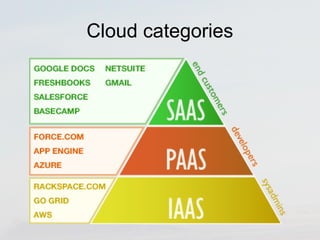
Cloud categories 
• Infrastructure as a service (IaaS): Network, computing and 
storage resources. The consumer does not control the 
infrastructure, but operating systems, storage, applications and 
network components (such as firewalls). Example: virtual machines 
at Google and Amazon. 
• Platform as a service (PaaS): Development environment, offering 
programme languages (e.g. Java; Force.com platform which 
supports the development of applications related to Sales-force. 
com) and tools for the development of applications. 
• Software as a Service (SaaS): applications used by individuals and 
organizations (social media, ERP, SCM, CRM, Analytics, Business 
Intelligence etc.).
Cloud categories
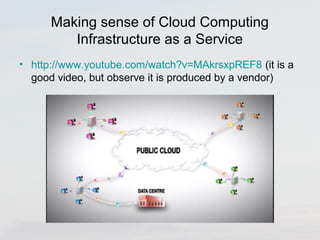
Making sense of Cloud Computing 
Infrastructure as a Service 
• http://www.youtube.com/watch?v=MAkrsxpREF8 (it is a 
good video, but observe it is produced by a vendor)
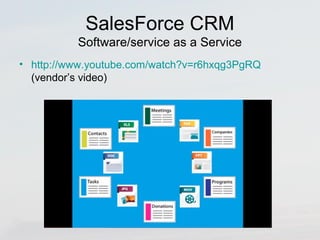
SalesForce CRM 
Software/service as a Service 
• http://www.youtube.com/watch?v=r6hxqg3PgRQ 
(vendor’s video)
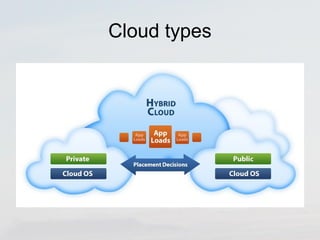
Cloud types
Cloud types 
• Public cloud: Public clouds are intended to be used by multiple parties at 
once and are designed to provide maximum value for money through a 
standardised and hi-scale approach. Many public clouds operate 
internationally for scale or geographic resilience, but this gives rise to some 
concerns for some businesses over where their data is being stored at any 
given time. 
• Private cloud: Private clouds are intended to be restricted to a single 
customer or trusted community. These are popular among organisations 
looking to access the benefits of cloud computing but retain higher control 
and flexibility of configuration compared with a public cloud. Private clouds 
can be run inside a company data centre or hosted by a third party. This is 
an ideal solution where data sovereignty is a key issue. 
• Hybrid cloud: A hybrid cloud, as the name infers, is a cloud capability that 
joins either on-premise infrastructure to private or public clouds, or clouds to 
each other, to provide a customer with a bespoke environment to meet their 
specific operational needs. 
http://www.guardian.co.uk/cloud-technology/cloud-computing-terms-jargon-buster
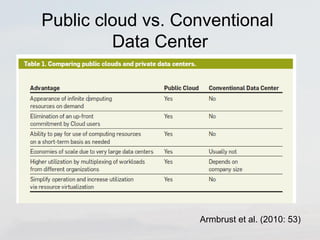
Public cloud vs. Conventional 
Data Center 
Armbrust et al. (2010: 53)
Data Centres 
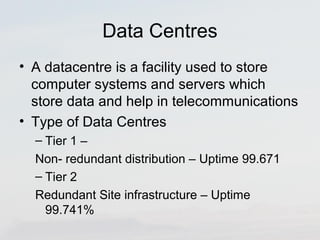
• A datacentre is a facility used to store 
computer systems and servers which 
store data and help in telecommunications 
• Type of Data Centres 
– Tier 1 – 
Non- redundant distribution – Uptime 99.671 
– Tier 2 
Redundant Site infrastructure – Uptime 
99.741%
• Tier 3 
Multiple independent distribution paths 
serving the IT equipment 
Dual powered and fully compatible with 
topology of site’s architecture 
Uptime – 99.982% 
• Tier 4 
– All the cooling equipment dual powered, 
including chillers and heating equipment 
– Uptime – 99.995%
Fostering competitiveness and 
business innovation • Increase operational efficiency, create new business models, and 
establish whole new businesses. 
• Having a service infrastructure in the cloud means organisations 
need less resources to innovate and start up new projects. 
• Instead of investing upfront on hardware, and human resources, 
companies may build their business platform using mainly cloud 
resources, relying on the capacity of the cloud to offer scalability 
and flexibility (pay-as-you-use). 
• Companies may combine different tools as they need, as far as the 
communication between platforms is possible. 
• Companies may broaden their portfolio of products and services as 
they may answer more quickly to the market reaction (less time in 
market research).
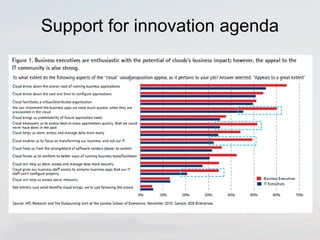
Support for innovation agenda
Key advantages 1 
– Costs is main driver 
– Capital (fix cost versus variable costs) (pay-as you-go 
model, e.g. utility computing): reduce the barrier to 
entry in new markets, and reduce the risk of 
innovating 
– Agility (save time!) 
• Ex.: NYT converted 11 million articles to PDF in 24 
hours for less than $ 300 using Amazon cloud, 
meanwhile it would need 7 weeks using own 
resources (Sun Microsystems 2009). 
– Access (local, mobile and remote access): network 
effects (all benefits of being connected to 
standardised networks, communicating and 
collaborating with more companies and professionals)
Key advantages 2 
– Usability 
– Scalability (elasticity) 
– Flexibility 
– Security (state-of-art encryption of file systems; 
resources to pay for redundant systems) 
– Collaboration and networking 
– Training and learning 
– Focus on business side not on IT 
– Convergence of technologies, platforms and services
Key shortcomings 1 
• Technical problems 
– Bandwidth (latency x real time): service depends on good and 
reliable network connection 
– Efficiency and reliability of service provider: outage and 
discontinuity of services 
– Risk management (mitigation) and business continuity 
(contingency plans): disaster/recovery of data 
– Communication standards, interoperability and integration 
– Security: Hacker attacks to cloud providers 
– Cloud sprawl (unmanage spread of public cloud services, which 
may lead to increasing costs, security issues and loss of control) 
– Auditability 
– New skills and capabilities
Key shortcomings 2 
• Contractual problems 
– Metering (hidden and unexpected costs) (testbed 
providers may help providing platforms for 
experimentation of large projects) 
– Data ownership, transferability/portability (lock-in 
positions) 
– Service Level Agreement (SLA): verify level of 
security offered by provider; verify where data is 
stored and where the backup is stored; verify the level 
of liability (competition is improving the quality of the 
SLA and the levels of liability but this is still a risky 
area)
Key shortcomings 3 
• Legal problems 
– Privacy 
– Compliance and liabilities (legal constraints for offshoring of 
data): the Data Protection Act in the UK covers data sovereignty; 
the European Union’s Data Privacy Directive is valid in Europe, 
including UK; in the US, the Patriotic Act is the relevant legal 
framework. 
• Managerial problems 
– Trust and reputation: credibility of suppliers; it is difficult to 
evaluate the quality of suppliers, especially when they are new 
providers (look for those with ISO 27000 series) 
– Company executives may wish keep control of budget (cloud 
shift power in organisations)
Contract ambiguity is a big concern 
• Just over half (52 per cent) of end user organisations currently using the 
Cloud claim to have negotiated the legal terms of their contract with their 
Cloud Service Provider. 
• A third (32 per cent) stated that their CSP can impose changes to their 
contract by posting a new version online. This figure rose to 50 per cent 
amongst resellers. 
• Just under half – 46 per cent – of end user contracts are renewed 
automatically. This becomes a greater percentage the smaller the 
organisation. The larger the organisation or indeed if it is in the public 
sector, the greater the chance these are reviewed. 
• End users are looking for far greater assurances in their contracts with 
CSPs than traditional service level agreements. This is more often about 
data and its location, security and ultimate ownership. When contracting for 
a Cloud Service almost eight in ten cloud users are looking beyond an SLA 
for comfort in the service to be provided. 
(Source: DMH Stallard, 2011)
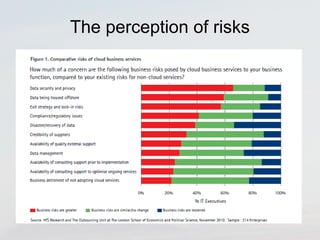
The perception of risks
Coping with disaster 
• Disaster recovery planning: Devises plans 
for restoration of disrupted services 
• Business continuity planning: Focuses on 
restoring business operations after disaster 
– Both types of plans needed to identify firm’s most 
critical systems and business processes 
• Business impact analysis to determine impact of an 
outage 
• Management must determine 
– Maximum time systems can be down 
– Which systems must be restored first
Relevant aspects for innovation 
• It is a combination of an IT infrastructure, which provides 
new forms of operations, with business process 
innovation (the way we do things in the organisation) and 
with market innovation (the sort of products and services 
the company is able to offer to the market). 
• In this environment, collaboration becomes much more 
important and throughout the value chain, as well the 
speed of change. 
• Important antecedents: the capacity the sector has of 
accepting innovation; adopters attributes and role in the 
industry; organisation readiness for innovation; how easy 
is the innovation to assimilate; quality of the organisation 
implementation process; legacy of previous IT 
investments; institutional and cultural aspects.
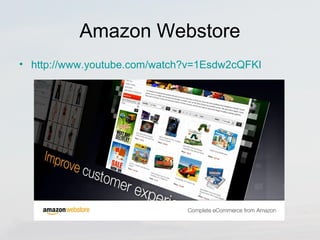
Amazon Webstore 
• http://www.youtube.com/watch?v=1Esdw2cQFKI
Case: accounting 
• http://www.youtube.com/watch?v=G6E1WkMgo50 
(observe it is also a vendor video)
Video on cloud computing 
• Nicholas Carr Big Switch 
– http://www.youtube.com/watch?v=Tt91barP0GE&feature=results_main 
• Nicholas Carr: Building a bridge to the cloud - Uptime Institute 
Symposium Speaker Series (2012) 
– http://www.youtube.com/watch?v=uoEP4qT4wDM 
Full video: 
– http://www.youtube.com/watch?v=lZf39fMl8OY
Vendors videos on cloud computing 
– Microsoft: http://www.youtube.com/watch?v=I-jmkkYiQac 
– Intel: http://www.youtube.com/watch?v=c7pVTNqtdqg&feature=related 
– IBM: http://www.youtube.com/watch?v=2Bbr4LBv1QI
References 
• http://www.cloudtweaks.com/2011/07/top-110-cloud-computing-enablers-gaining-mind-share-in- 
2q-2011/ 
• Armbrust, M. et. al (2010). A view of cloud computing. Communications of ACM, 53(4): pp.50-58. 
• Campbell-Kelly, M. (2009). Historical Reflections: The rise, fall and resurrection of Software as a 
Service. Communications of ACM, 52(5): 28-30. 
• Laudon, K.C. and Laudon, J.P. (2010, 2012). Management Information Systems, New Jersey, 
Prentice-Hall. 
• LSE Report (2011). Cloud and the Future of Business: From Costs to Innovation. Document 
elaborated by the London School of Economics and Accenture. 
http://www2.lse.ac.uk/management/news-and-events/news/outsourcingunit-cloud.aspx 
• Mulholland, A., Pyke, J., Fingar, P. (2010). Enterprise Cloud Computing: A Strategy Guide for 
Business and Technology Leaders. Tampa, Florida: Meghan-Kiffer Press. 
• Fingar, P. (2009). Dot.Cloud. The 21st Century Business Platform. Meghan-Kiffer Press. 
• Cloud Circle (2011). 1st Industry Trends Report. http://www.thecloudcircle.com/video/1st-cloud-circle- 
industry-trends-report 
• Carr, N. (2009). The Big Switch. London, New York: W.W. Norton & Company. 
• Guardian, 17th October 2011. Special report on Cloud Computing. First link: 
http://www.guardian.co.uk/cloud-technology/clud-computing-business-facebook-uk-economy 
• DMH Stallard (2011). Contracting Cloud Services: A Guide to Best Practice. Cloud UK Paper 3. 
Whitepaper Cloud Industry Forum. 
http://www.dmhstallard.com/cms/document/CIF_Paper_Three.pdf 
• Source: Gawer, A., 2009. Platform dynamics and strategies: from products to services. In A. 
Gawer, ed. Platform, Markets and Innovation. Cheltenham: Edward Elgar, pp. 45-76.
Next seminar
Next seminar 
• Please refer to last week’s “Lecture and 
Seminar 6: E-Commerce and Mobile 
Platforms” Presentation Slides 
• You should by now have formed groups 
and working on the paper and the 
Business Models Canvas for your 
presentation of the analysis of 
eCommerce Business Models as 
instructed

BBIM510 Lecture (2014)

  • 1.
    BBIM510 - BusinessInnovation in Digital Economies Cloud computing Lecturer: Arjun Shivraj
  • 2.
    Cloud computing Createdby Sam Johnston using OminGroup's OmniGraffle and Inkscape (includes Computer.svg by Sasa Stefanovic)
  • 3.
    Defining the cloud • “Cloud computing is a model for enabling convenient, on-demand network access to a shared pool of configurable computing resources (e.g. networks, servers, storage, applications and services) that can be rapidly provisioned and released with minimal management effort or service provider interaction.” (The US National Institute of Standards and Technologies) • Cloud computing is mainly a new mean of delivering IT resources, enabling organisations to leverage their innovation and competitive advantage, at the same time that they cut costs and gain agility for the business.
  • 5.
    Characteristics National Instituteof Standards and Technology: Defining Cloud Computing (2011)
  • 6.
    Characteristics • On-demandself-service. A consumer can unilaterally provision computing capabilities, such as server time and network storage, as needed automatically without requiring human interaction with each service provider. • Broad network access. Capabilities are available over the network and accessed through standard mechanisms that promote use by heterogeneous thin or thick client platforms (e.g., mobile phones, tablets, laptops, and workstations). • Resource pooling. The provider's computing resources are pooled to serve multiple consumers using a multi-tenant model, with different physical and virtual resources dynamically assigned and reassigned according to consumer demand. • Rapid elasticity. Capabilities can be elastically provisioned and released, in some cases automatically, to scale rapidly outward and inward commensurate with demand. To the consumer, the capabilities available for provisioning often appear unlimited and can be appropriated in any quantity at any time. • Measured service. Cloud systems automatically control and optimize resource use by leveraging a metering capability at some level of abstraction appropriate to the type of service (e.g., storage, processing, bandwidth, and active user accounts). Resource usage can be monitored, controlled, and reported, providing transparency for both the provider and consumer of the utilized service. National Institute of Standards and Technology: Defining Cloud Computing (2011)
  • 7.
  • 8.
  • 9.
    Cloud services •Information aggregation • Supply Chain Services • Financial, accounting and insurance services • eRetail • Document management • Government services • Services integration • CRM and social CRM • Service management and brokerage • ID management • Business intelligence and analytics • Personalisation • Social media platforms
  • 10.
    Examples on cloudservices • Search tools: Google, Yahoo! Technorati (http://technorati.com/) • Create and Shared documents, collaborate (Google Documents, Microsoft Office 365, Dropbox, Wiki tools, IBM LotusLive) • Share calendars (major suppliers) • Email management: today around 4%, but to be 50% by 2020 (Gartner, report September 2011): Google, Microsoft • Project management (Microsoft Office 365 Share Point; Manymoon, Basecamp) (learn: Project in a Box); http://www.attask.com/ • VOIP (Skype) (peer-to-peer architecture) • CRM Salesforce: http://www.salesforce.com/uk/?ir=1; and Sage http://www.sage.com/ourbusiness/newsroom/newsfromourregionalbusinesses/view/1667 • Business Process Management (IBM Blueworks Live) • Cloud service security (major vendors) • iCloud: storage of documents, photos and songs in the cloud; access to apps in different devices (other companies are doing this in the cloud, start-ups, but working with open platforms thus any sort of programme or file could be saved in ‘personal’ clouds; better because it does not lock the user in particular vendors). • Content management: http://box.net/ • Business intelligence: http://www.cloudera.com/ • Platforms: Data base and business intelligence: Azure http://www.microsoft.com/windowsazure/; EC2 (Amazon: http://aws.amazon.com/ec2/ ) and Force.com (http://www.force.com/).
  • 11.
    Cloud categories •Infrastructure as a service (IaaS): Network, computing and storage resources. The consumer does not control the infrastructure, but operating systems, storage, applications and network components (such as firewalls). Example: virtual machines at Google and Amazon. • Platform as a service (PaaS): Development environment, offering programme languages (e.g. Java; Force.com platform which supports the development of applications related to Sales-force. com) and tools for the development of applications. • Software as a Service (SaaS): applications used by individuals and organizations (social media, ERP, SCM, CRM, Analytics, Business Intelligence etc.).
  • 12.
  • 13.
    Making sense ofCloud Computing Infrastructure as a Service • http://www.youtube.com/watch?v=MAkrsxpREF8 (it is a good video, but observe it is produced by a vendor)
  • 14.
    SalesForce CRM Software/serviceas a Service • http://www.youtube.com/watch?v=r6hxqg3PgRQ (vendor’s video)
  • 15.
  • 16.
    Cloud types •Public cloud: Public clouds are intended to be used by multiple parties at once and are designed to provide maximum value for money through a standardised and hi-scale approach. Many public clouds operate internationally for scale or geographic resilience, but this gives rise to some concerns for some businesses over where their data is being stored at any given time. • Private cloud: Private clouds are intended to be restricted to a single customer or trusted community. These are popular among organisations looking to access the benefits of cloud computing but retain higher control and flexibility of configuration compared with a public cloud. Private clouds can be run inside a company data centre or hosted by a third party. This is an ideal solution where data sovereignty is a key issue. • Hybrid cloud: A hybrid cloud, as the name infers, is a cloud capability that joins either on-premise infrastructure to private or public clouds, or clouds to each other, to provide a customer with a bespoke environment to meet their specific operational needs. http://www.guardian.co.uk/cloud-technology/cloud-computing-terms-jargon-buster
  • 17.
    Public cloud vs.Conventional Data Center Armbrust et al. (2010: 53)
  • 18.
    Data Centres •A datacentre is a facility used to store computer systems and servers which store data and help in telecommunications • Type of Data Centres – Tier 1 – Non- redundant distribution – Uptime 99.671 – Tier 2 Redundant Site infrastructure – Uptime 99.741%
  • 19.
    • Tier 3 Multiple independent distribution paths serving the IT equipment Dual powered and fully compatible with topology of site’s architecture Uptime – 99.982% • Tier 4 – All the cooling equipment dual powered, including chillers and heating equipment – Uptime – 99.995%
  • 20.
    Fostering competitiveness and business innovation • Increase operational efficiency, create new business models, and establish whole new businesses. • Having a service infrastructure in the cloud means organisations need less resources to innovate and start up new projects. • Instead of investing upfront on hardware, and human resources, companies may build their business platform using mainly cloud resources, relying on the capacity of the cloud to offer scalability and flexibility (pay-as-you-use). • Companies may combine different tools as they need, as far as the communication between platforms is possible. • Companies may broaden their portfolio of products and services as they may answer more quickly to the market reaction (less time in market research).
  • 21.
  • 22.
    Key advantages 1 – Costs is main driver – Capital (fix cost versus variable costs) (pay-as you-go model, e.g. utility computing): reduce the barrier to entry in new markets, and reduce the risk of innovating – Agility (save time!) • Ex.: NYT converted 11 million articles to PDF in 24 hours for less than $ 300 using Amazon cloud, meanwhile it would need 7 weeks using own resources (Sun Microsystems 2009). – Access (local, mobile and remote access): network effects (all benefits of being connected to standardised networks, communicating and collaborating with more companies and professionals)
  • 23.
    Key advantages 2 – Usability – Scalability (elasticity) – Flexibility – Security (state-of-art encryption of file systems; resources to pay for redundant systems) – Collaboration and networking – Training and learning – Focus on business side not on IT – Convergence of technologies, platforms and services
  • 24.
    Key shortcomings 1 • Technical problems – Bandwidth (latency x real time): service depends on good and reliable network connection – Efficiency and reliability of service provider: outage and discontinuity of services – Risk management (mitigation) and business continuity (contingency plans): disaster/recovery of data – Communication standards, interoperability and integration – Security: Hacker attacks to cloud providers – Cloud sprawl (unmanage spread of public cloud services, which may lead to increasing costs, security issues and loss of control) – Auditability – New skills and capabilities
  • 25.
    Key shortcomings 2 • Contractual problems – Metering (hidden and unexpected costs) (testbed providers may help providing platforms for experimentation of large projects) – Data ownership, transferability/portability (lock-in positions) – Service Level Agreement (SLA): verify level of security offered by provider; verify where data is stored and where the backup is stored; verify the level of liability (competition is improving the quality of the SLA and the levels of liability but this is still a risky area)
  • 26.
    Key shortcomings 3 • Legal problems – Privacy – Compliance and liabilities (legal constraints for offshoring of data): the Data Protection Act in the UK covers data sovereignty; the European Union’s Data Privacy Directive is valid in Europe, including UK; in the US, the Patriotic Act is the relevant legal framework. • Managerial problems – Trust and reputation: credibility of suppliers; it is difficult to evaluate the quality of suppliers, especially when they are new providers (look for those with ISO 27000 series) – Company executives may wish keep control of budget (cloud shift power in organisations)
  • 27.
    Contract ambiguity isa big concern • Just over half (52 per cent) of end user organisations currently using the Cloud claim to have negotiated the legal terms of their contract with their Cloud Service Provider. • A third (32 per cent) stated that their CSP can impose changes to their contract by posting a new version online. This figure rose to 50 per cent amongst resellers. • Just under half – 46 per cent – of end user contracts are renewed automatically. This becomes a greater percentage the smaller the organisation. The larger the organisation or indeed if it is in the public sector, the greater the chance these are reviewed. • End users are looking for far greater assurances in their contracts with CSPs than traditional service level agreements. This is more often about data and its location, security and ultimate ownership. When contracting for a Cloud Service almost eight in ten cloud users are looking beyond an SLA for comfort in the service to be provided. (Source: DMH Stallard, 2011)
  • 28.
  • 29.
    Coping with disaster • Disaster recovery planning: Devises plans for restoration of disrupted services • Business continuity planning: Focuses on restoring business operations after disaster – Both types of plans needed to identify firm’s most critical systems and business processes • Business impact analysis to determine impact of an outage • Management must determine – Maximum time systems can be down – Which systems must be restored first
  • 30.
    Relevant aspects forinnovation • It is a combination of an IT infrastructure, which provides new forms of operations, with business process innovation (the way we do things in the organisation) and with market innovation (the sort of products and services the company is able to offer to the market). • In this environment, collaboration becomes much more important and throughout the value chain, as well the speed of change. • Important antecedents: the capacity the sector has of accepting innovation; adopters attributes and role in the industry; organisation readiness for innovation; how easy is the innovation to assimilate; quality of the organisation implementation process; legacy of previous IT investments; institutional and cultural aspects.
  • 31.
    Amazon Webstore •http://www.youtube.com/watch?v=1Esdw2cQFKI
  • 32.
    Case: accounting •http://www.youtube.com/watch?v=G6E1WkMgo50 (observe it is also a vendor video)
  • 33.
    Video on cloudcomputing • Nicholas Carr Big Switch – http://www.youtube.com/watch?v=Tt91barP0GE&feature=results_main • Nicholas Carr: Building a bridge to the cloud - Uptime Institute Symposium Speaker Series (2012) – http://www.youtube.com/watch?v=uoEP4qT4wDM Full video: – http://www.youtube.com/watch?v=lZf39fMl8OY
  • 34.
    Vendors videos oncloud computing – Microsoft: http://www.youtube.com/watch?v=I-jmkkYiQac – Intel: http://www.youtube.com/watch?v=c7pVTNqtdqg&feature=related – IBM: http://www.youtube.com/watch?v=2Bbr4LBv1QI
  • 35.
    References • http://www.cloudtweaks.com/2011/07/top-110-cloud-computing-enablers-gaining-mind-share-in- 2q-2011/ • Armbrust, M. et. al (2010). A view of cloud computing. Communications of ACM, 53(4): pp.50-58. • Campbell-Kelly, M. (2009). Historical Reflections: The rise, fall and resurrection of Software as a Service. Communications of ACM, 52(5): 28-30. • Laudon, K.C. and Laudon, J.P. (2010, 2012). Management Information Systems, New Jersey, Prentice-Hall. • LSE Report (2011). Cloud and the Future of Business: From Costs to Innovation. Document elaborated by the London School of Economics and Accenture. http://www2.lse.ac.uk/management/news-and-events/news/outsourcingunit-cloud.aspx • Mulholland, A., Pyke, J., Fingar, P. (2010). Enterprise Cloud Computing: A Strategy Guide for Business and Technology Leaders. Tampa, Florida: Meghan-Kiffer Press. • Fingar, P. (2009). Dot.Cloud. The 21st Century Business Platform. Meghan-Kiffer Press. • Cloud Circle (2011). 1st Industry Trends Report. http://www.thecloudcircle.com/video/1st-cloud-circle- industry-trends-report • Carr, N. (2009). The Big Switch. London, New York: W.W. Norton & Company. • Guardian, 17th October 2011. Special report on Cloud Computing. First link: http://www.guardian.co.uk/cloud-technology/clud-computing-business-facebook-uk-economy • DMH Stallard (2011). Contracting Cloud Services: A Guide to Best Practice. Cloud UK Paper 3. Whitepaper Cloud Industry Forum. http://www.dmhstallard.com/cms/document/CIF_Paper_Three.pdf • Source: Gawer, A., 2009. Platform dynamics and strategies: from products to services. In A. Gawer, ed. Platform, Markets and Innovation. Cheltenham: Edward Elgar, pp. 45-76.
  • 36.
  • 37.
    Next seminar •Please refer to last week’s “Lecture and Seminar 6: E-Commerce and Mobile Platforms” Presentation Slides • You should by now have formed groups and working on the paper and the Business Models Canvas for your presentation of the analysis of eCommerce Business Models as instructed