Introduction to
Cloud Computing
Presented By:
Rishabh Yadav
B.Tech.(IV)
Electronics Engineering
IIT(BHU) Varanasi
Overview
•What is Cloud Computing?
•Why Cloud Computing?
•Forms
•Services
•Models
•Disadvantages
•Conclusion
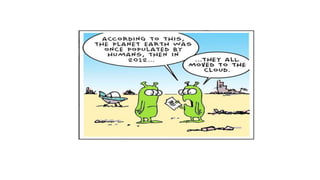
Cloud computing is the delivery of services of the computing a service rather
than a product, whereby shared resources, software, and information are
provided to computers and other devices as a utility over a network (typically
the Internet).
What is Cloud Computing?
Why Cloud Computing?
• Lower cost : there is less capital expenditure and you do not have as much equipment to
maintain, so in theory, it is cheaper.
• Easier to manage : software updates and licences are taken care of – and so is security
back-up.
• Agility and scalability : you can be much more agile and scale-up and scale-down much
more easily – and at relatively low cost
• Flexibility – the cloud makes it easier for you to access information from anywhere, any
time on any device, reflecting the changing habits of today’s IT user
• Less power requirements(My internship project)
• Reduces e-waste
• On-demand computing – makes IT a utility that can be consumed on- demand, whenever
and wherever it is needed.
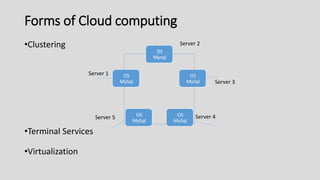
Forms of Cloud computing
•Clustering
•Terminal Services
•Virtualization
Server 2
Server 5 Server 4
Server 3
Server 1
OS
Mysql
OS
MySql
OS
MySql
OS
MySql
OS
MySql
Cloud Computing Services
•Software as a Service (SaaS)
•Platform as a Service (PaaS)
•Infrastructure as a Service (IaaS)
•and many more
Software as a Service(SaaS)
•On-demand Service
•Service that can be accessed from anywhere in the world from a
computer with an internet connection.
•No additional hardware/software is required except some third-party
plugins that too only in few cases.
•Examples: Gmail, Yahoo mail, Youtube , Facebook, Online Games ,etc.
Platform as a Service(PaaS)
• Generally used by application developers.
• Providers of PaaS model offers the computing platform and/or
solution stack typically including operating system, programming
language execution environment ,development tools , database and
web server.
• Analogous to “venv” in python
•Ex.: Heroku , Microsoft Azure , Google App Engine ,etc.
Infrastructure as a Service(IaaS)
•Hardware as a Service
•IaaS offer physical or virtual machines and other resources such as
raw storage,firewalls,load balancers and networks.
•Example: Oracle Virtualbox ,Xen
Models of Cloud Computing
•Public Cloud
Services are rendered over a network and available for public use. These services may be free or offered
on a pay-per-usage model.
Ex.: Amazon , Google , Microsoft
•Private Cloud
Computing infrastructure is dedicated to a particular organization and shared with limited or no
other organizations.
Ex.: Google Data Center,Oracle,3tera
•Hybrid Cloud
It combines the advantages of both the private and public cloud.
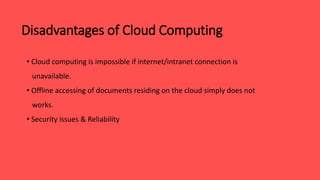
Disadvantages of Cloud Computing
• Cloud computing is impossible if internet/intranet connection is
unavailable.
• Offline accessing of documents residing on the cloud simply does not
works.
• Security issues & Reliability
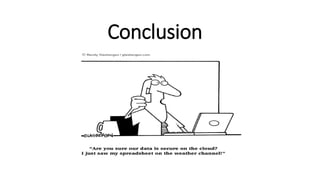
Conclusion
Thank You

Cloud computing

  • 1.
    Introduction to Cloud Computing PresentedBy: Rishabh Yadav B.Tech.(IV) Electronics Engineering IIT(BHU) Varanasi
  • 2.
    Overview •What is CloudComputing? •Why Cloud Computing? •Forms •Services •Models •Disadvantages •Conclusion
  • 3.
    Cloud computing isthe delivery of services of the computing a service rather than a product, whereby shared resources, software, and information are provided to computers and other devices as a utility over a network (typically the Internet). What is Cloud Computing?
  • 5.
    Why Cloud Computing? •Lower cost : there is less capital expenditure and you do not have as much equipment to maintain, so in theory, it is cheaper. • Easier to manage : software updates and licences are taken care of – and so is security back-up. • Agility and scalability : you can be much more agile and scale-up and scale-down much more easily – and at relatively low cost • Flexibility – the cloud makes it easier for you to access information from anywhere, any time on any device, reflecting the changing habits of today’s IT user • Less power requirements(My internship project) • Reduces e-waste • On-demand computing – makes IT a utility that can be consumed on- demand, whenever and wherever it is needed.
  • 6.
    Forms of Cloudcomputing •Clustering •Terminal Services •Virtualization Server 2 Server 5 Server 4 Server 3 Server 1 OS Mysql OS MySql OS MySql OS MySql OS MySql
  • 7.
    Cloud Computing Services •Softwareas a Service (SaaS) •Platform as a Service (PaaS) •Infrastructure as a Service (IaaS) •and many more
  • 8.
    Software as aService(SaaS) •On-demand Service •Service that can be accessed from anywhere in the world from a computer with an internet connection. •No additional hardware/software is required except some third-party plugins that too only in few cases. •Examples: Gmail, Yahoo mail, Youtube , Facebook, Online Games ,etc.
  • 9.
    Platform as aService(PaaS) • Generally used by application developers. • Providers of PaaS model offers the computing platform and/or solution stack typically including operating system, programming language execution environment ,development tools , database and web server. • Analogous to “venv” in python •Ex.: Heroku , Microsoft Azure , Google App Engine ,etc.
  • 10.
    Infrastructure as aService(IaaS) •Hardware as a Service •IaaS offer physical or virtual machines and other resources such as raw storage,firewalls,load balancers and networks. •Example: Oracle Virtualbox ,Xen
  • 11.
    Models of CloudComputing •Public Cloud Services are rendered over a network and available for public use. These services may be free or offered on a pay-per-usage model. Ex.: Amazon , Google , Microsoft •Private Cloud Computing infrastructure is dedicated to a particular organization and shared with limited or no other organizations. Ex.: Google Data Center,Oracle,3tera •Hybrid Cloud It combines the advantages of both the private and public cloud.
  • 12.
    Disadvantages of CloudComputing • Cloud computing is impossible if internet/intranet connection is unavailable. • Offline accessing of documents residing on the cloud simply does not works. • Security issues & Reliability
  • 13.
  • 15.