What is Cloud Computing?
 In computer networking, cloud computing is computing that
involves a large number of computers connected through a
communication network such as the Internet, similar to
utility computing. In science, cloud computing is a synonym
for distributed computing over a network, and means the
ability to run a program or application on many connected
computers at the same time.
In simple Cloud computing is using the internet to access
someone else's software running on someone else's hardware
in someone else's data center.
An environment created in a user’s machine from an on-line
application stored on the cloud and run through a web
browser.
Cloud Computing (Cont.)
• Features
– Use of internet-based services to support business process
– Rent IT-services on a utility-like basis
• Attributes
– Rapid deployment
– Low startup costs/ capital investments
– Costs based on usage or subscription
– Multi-tenant sharing of services/ resources
• Essential characteristics
– On demand self-service
– Ubiquitous network access
– Location independent resource pooling
– Rapid elasticity
– Measured service
Cloud Computing: who should use it?
• Cloud computing definitely makes sense if
your own security is weak, missing features,
or below average.
• Ultimately, if
– the cloud provider’s security people are
“better” than yours (and leveraged at least
as efficiently),
– the web-services interfaces don’t
introduce too many new vulnerabilities, and
– the cloud provider aims at least as high as
you do, at security goals, then cloud
computing has better security.
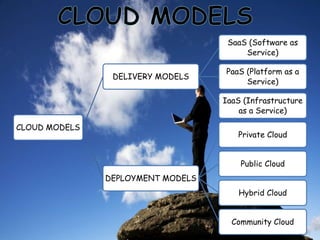
CLOUD MODELS
DELIVERY MODELS
SaaS (Software as
Service)
PaaS (Platform as a
Service)
IaaS (Infrastructure
as a Service)
DEPLOYMENT MODELS
Private Cloud
Public Cloud
Hybrid Cloud
Community Cloud
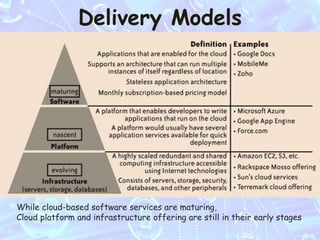
Delivery Models
While cloud-based software services are maturing,
Cloud platform and infrastructure offering are still in their early stages
Deployment Models
Public cloud (off-site and remote) describes cloud computing where
resources are dynamically provisioned on an on-demand, self-service basis
over the Internet, via web applications/web services, open API, from a
third-party provider who bills on a utility computing basis.
Private cloud environment is often the first step for a corporation prior
to adopting a public cloud initiative. Corporations have discovered the
benefits of consolidating shared services on virtualized hardware
deployed from a primary datacenter to serve local and remote users.
Hybrid cloud environment consists of some portion of computing
resources on-site (on premise) and off-site (public cloud). By integrating
public cloud services, users can leverage cloud solutions for specific
functions that are too costly to maintain on-premise such as virtual server
disaster recovery, backups and test/development environments.
Community cloud is formed when several organizations with similar
requirements share common infrastructure. Costs are spread over fewer
users than a public cloud but more than a single tenant.
If cloud computing is so great,
why isn’t everyone doing it?
 The cloud acts as a big black box, nothing inside
the cloud is visible to the clients.
 Clients have no idea or control over what
happens inside a cloud.
 Even if the cloud provider is honest, it can have
malicious system admins who can tamper with
the VMs and violate confidentiality and
integrity.
 Clouds are still subject to traditional data
confidentiality, integrity, availability, and privacy
issues, plus some additional attacks.
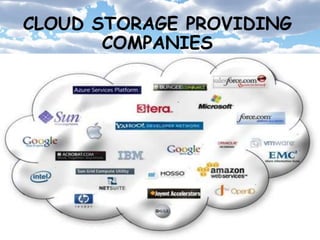
CLOUD STORAGE PROVIDING
COMPANIES
The use of the cloud provides a number
of opportunities:
– It enables services to be used without any
understanding of their infrastructure.
– Cloud computing works using economies of scale:
• It potentially lowers the outlay expense for start up
companies, as they would no longer need to buy their own
software or servers.
• Cost would be by on-demand pricing.
• Vendors and Service providers claim costs by establishing
an ongoing revenue stream.
– Data and services are stored remotely but
accessible from “anywhere”.
In parallel there has been backlash
against cloud computing:
 Use of cloud computing means dependence on others and that
could possibly limit flexibility and innovation:
The others are likely become the bigger Internet
companies like Google and IBM, who may monopolise the
market.
Some argue that this use of supercomputers is a return
to the time of mainframe computing that the PC was a
reaction against.
 Security could prove to be a big issue:
It is still unclear how safe out-sourced data is and when
using these services ownership of data is not always clear.
 There are also issues relating to policy and access:
If your data is stored abroad whose policy do you adhere
to?
What happens if the remote server goes down?
How will you then access files?
There have been cases of users being locked out of
accounts and losing access to data.
ADVANTAGES
• Lower computer costs
• Improved performance
• Reduced software costs
• Instant software updates
• Improved document format compatibility
• Unlimited storage capacity
• Increased data reliability
• Universal document access
• Latest version availability
• Easier group collaboration
• Device independence
DISADVANTAGES
• Requires a constant Internet connection
• Does not work well with low-speed connection
• Features might be limited
• Can be slow
• Stored data might not be secure
• Stored data can be lost
CONCLUSION
 Cloud Computing is outpacing the IT industry
 Real business value can be realized by customers of all
sizes
 Cloud solutions are simple to acquire, don’t require long
term contracts and are easier to scale up and down as
needed
 Proper planning and migration services are needed to
ensure a successful implementation
 Public and Private Clouds can be deployed together to
leverage the best of both
 Third party monitoring services ensure customer are
getting the most out of their cloud environment
 Security Compliance and Monitoring is achievable with
careful planning and analysis
Cloud computing

Cloud computing

  • 2.
    What is CloudComputing?  In computer networking, cloud computing is computing that involves a large number of computers connected through a communication network such as the Internet, similar to utility computing. In science, cloud computing is a synonym for distributed computing over a network, and means the ability to run a program or application on many connected computers at the same time. In simple Cloud computing is using the internet to access someone else's software running on someone else's hardware in someone else's data center. An environment created in a user’s machine from an on-line application stored on the cloud and run through a web browser.
  • 3.
    Cloud Computing (Cont.) •Features – Use of internet-based services to support business process – Rent IT-services on a utility-like basis • Attributes – Rapid deployment – Low startup costs/ capital investments – Costs based on usage or subscription – Multi-tenant sharing of services/ resources • Essential characteristics – On demand self-service – Ubiquitous network access – Location independent resource pooling – Rapid elasticity – Measured service
  • 4.
    Cloud Computing: whoshould use it? • Cloud computing definitely makes sense if your own security is weak, missing features, or below average. • Ultimately, if – the cloud provider’s security people are “better” than yours (and leveraged at least as efficiently), – the web-services interfaces don’t introduce too many new vulnerabilities, and – the cloud provider aims at least as high as you do, at security goals, then cloud computing has better security.
  • 5.
    CLOUD MODELS DELIVERY MODELS SaaS(Software as Service) PaaS (Platform as a Service) IaaS (Infrastructure as a Service) DEPLOYMENT MODELS Private Cloud Public Cloud Hybrid Cloud Community Cloud
  • 6.
    Delivery Models While cloud-basedsoftware services are maturing, Cloud platform and infrastructure offering are still in their early stages
  • 7.
    Deployment Models Public cloud(off-site and remote) describes cloud computing where resources are dynamically provisioned on an on-demand, self-service basis over the Internet, via web applications/web services, open API, from a third-party provider who bills on a utility computing basis. Private cloud environment is often the first step for a corporation prior to adopting a public cloud initiative. Corporations have discovered the benefits of consolidating shared services on virtualized hardware deployed from a primary datacenter to serve local and remote users. Hybrid cloud environment consists of some portion of computing resources on-site (on premise) and off-site (public cloud). By integrating public cloud services, users can leverage cloud solutions for specific functions that are too costly to maintain on-premise such as virtual server disaster recovery, backups and test/development environments. Community cloud is formed when several organizations with similar requirements share common infrastructure. Costs are spread over fewer users than a public cloud but more than a single tenant.
  • 8.
    If cloud computingis so great, why isn’t everyone doing it?  The cloud acts as a big black box, nothing inside the cloud is visible to the clients.  Clients have no idea or control over what happens inside a cloud.  Even if the cloud provider is honest, it can have malicious system admins who can tamper with the VMs and violate confidentiality and integrity.  Clouds are still subject to traditional data confidentiality, integrity, availability, and privacy issues, plus some additional attacks.
  • 9.
  • 10.
    The use ofthe cloud provides a number of opportunities: – It enables services to be used without any understanding of their infrastructure. – Cloud computing works using economies of scale: • It potentially lowers the outlay expense for start up companies, as they would no longer need to buy their own software or servers. • Cost would be by on-demand pricing. • Vendors and Service providers claim costs by establishing an ongoing revenue stream. – Data and services are stored remotely but accessible from “anywhere”.
  • 11.
    In parallel therehas been backlash against cloud computing:  Use of cloud computing means dependence on others and that could possibly limit flexibility and innovation: The others are likely become the bigger Internet companies like Google and IBM, who may monopolise the market. Some argue that this use of supercomputers is a return to the time of mainframe computing that the PC was a reaction against.  Security could prove to be a big issue: It is still unclear how safe out-sourced data is and when using these services ownership of data is not always clear.  There are also issues relating to policy and access: If your data is stored abroad whose policy do you adhere to? What happens if the remote server goes down? How will you then access files? There have been cases of users being locked out of accounts and losing access to data.
  • 12.
    ADVANTAGES • Lower computercosts • Improved performance • Reduced software costs • Instant software updates • Improved document format compatibility • Unlimited storage capacity • Increased data reliability • Universal document access • Latest version availability • Easier group collaboration • Device independence
  • 13.
    DISADVANTAGES • Requires aconstant Internet connection • Does not work well with low-speed connection • Features might be limited • Can be slow • Stored data might not be secure • Stored data can be lost
  • 14.
    CONCLUSION  Cloud Computingis outpacing the IT industry  Real business value can be realized by customers of all sizes  Cloud solutions are simple to acquire, don’t require long term contracts and are easier to scale up and down as needed  Proper planning and migration services are needed to ensure a successful implementation  Public and Private Clouds can be deployed together to leverage the best of both  Third party monitoring services ensure customer are getting the most out of their cloud environment  Security Compliance and Monitoring is achievable with careful planning and analysis