BASKETBALL HAND SIGNAL
PREPARED BY: JACINTO V. MABINI
TEACHER III
BANGUI NATIONAL HIGH SCHOOL
1. INTRODUCTION:
In a basketball game, basketball referees who have the
responsibility to enforce the rules and maintain the order of the
basketball game has only a brief moment to determine if an
infraction has occurred, later they communicate with the
scoring table using hand signals. In this topic, we are going to
learn, analyze and execute the different types of HAND SIGNALS
in BASKETBALL.
FOUL VS. VIOLATION
• Foul
1. A foul is an infraction of the
rules more serious than
violations
2. A foul occur as a result of
illegal contact with an
opponent and or
unsportsmanlike behaviour.
• Violation
1. A violation is a minor class
of illegal action in basketball.
2. Most of the violations are
committed by the team in
possession of the ball
KINDS OF FOULS
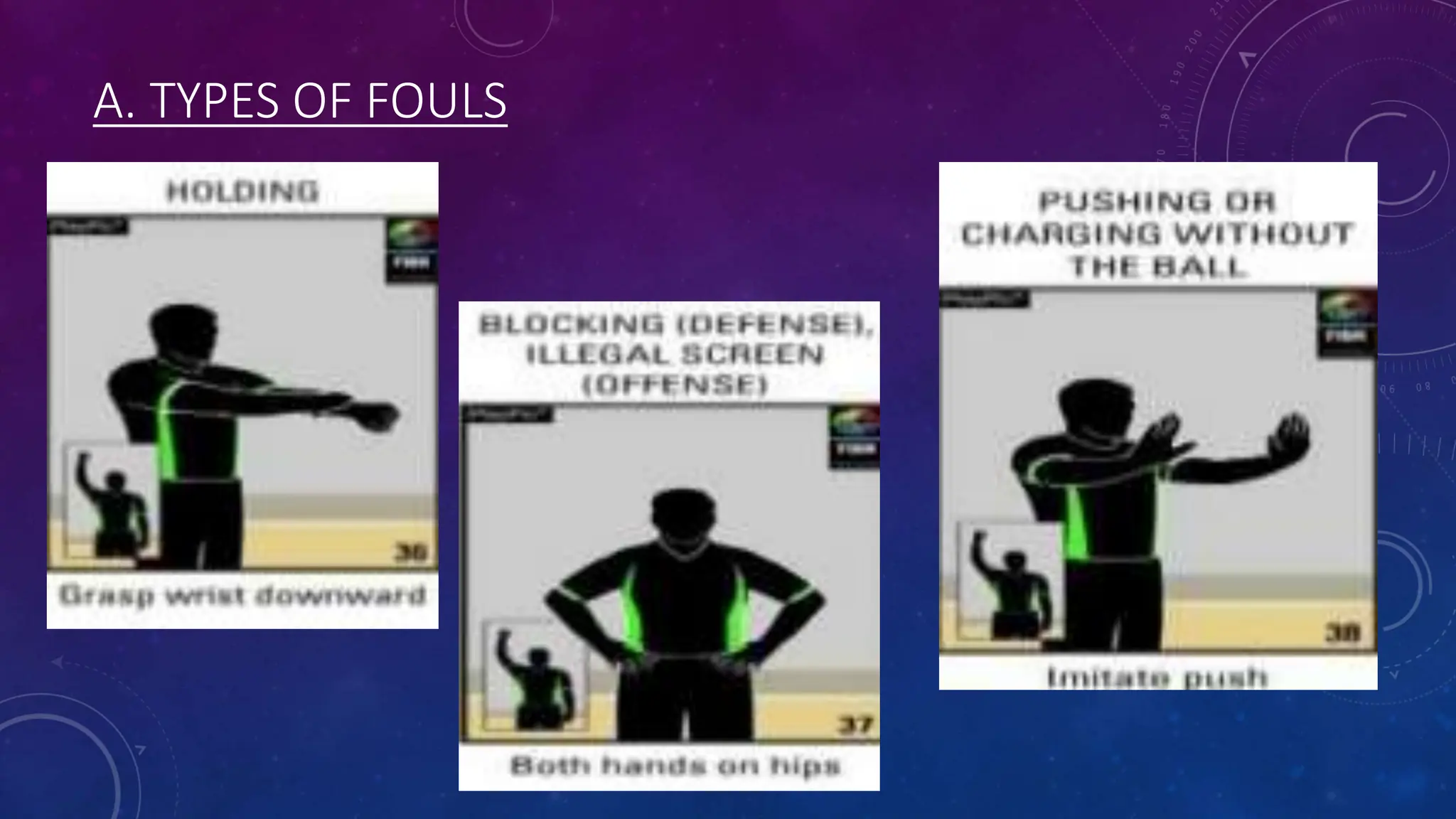
• Pushing — Contact that displaces an opponent (for example, pushing a
player away from the basket, or using body weight to affect a player's
movement).
• Holding — Contact that interferes with a player's freedom of movement
(for example, physically grabbing a player driving to the basket).
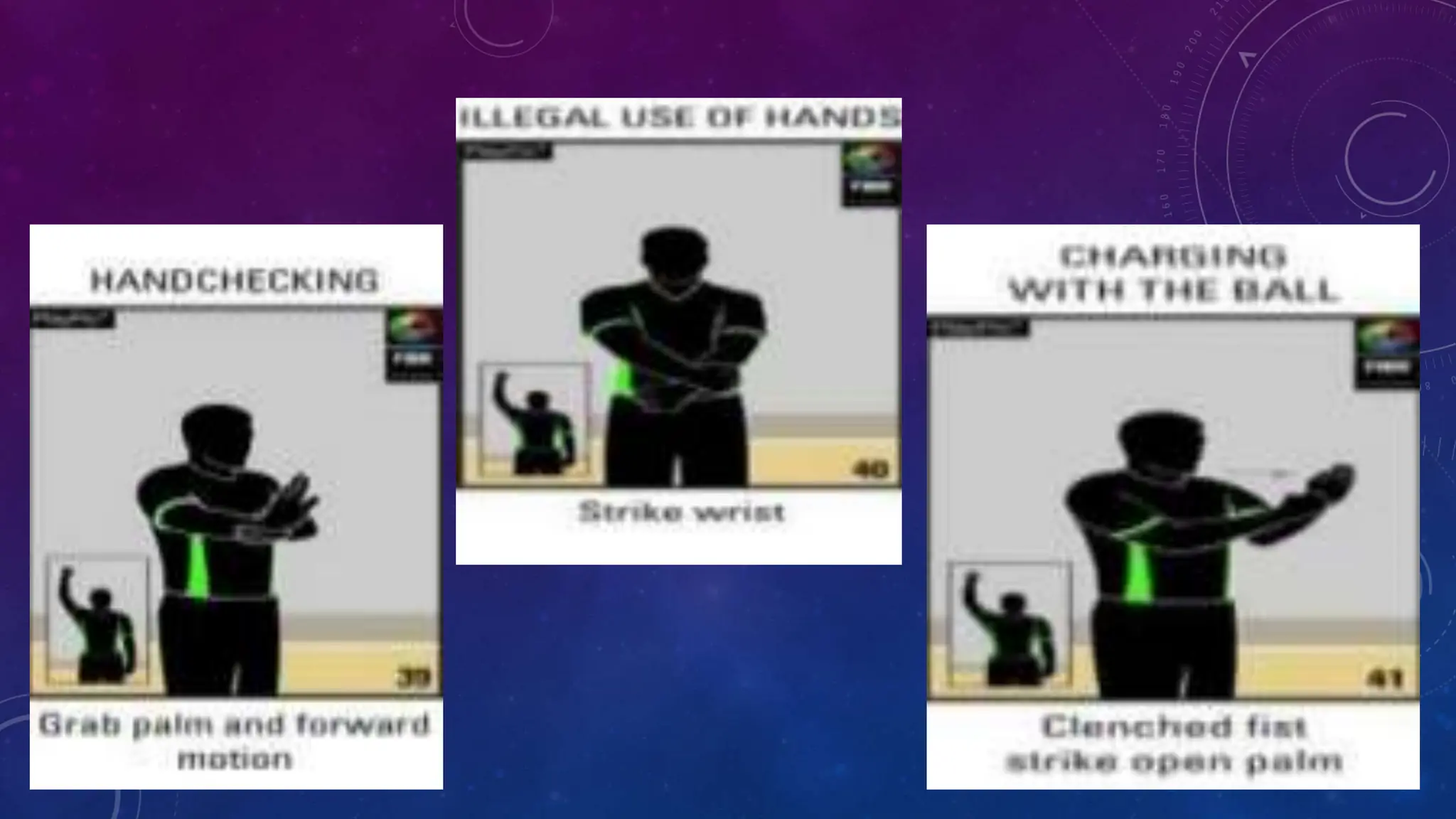
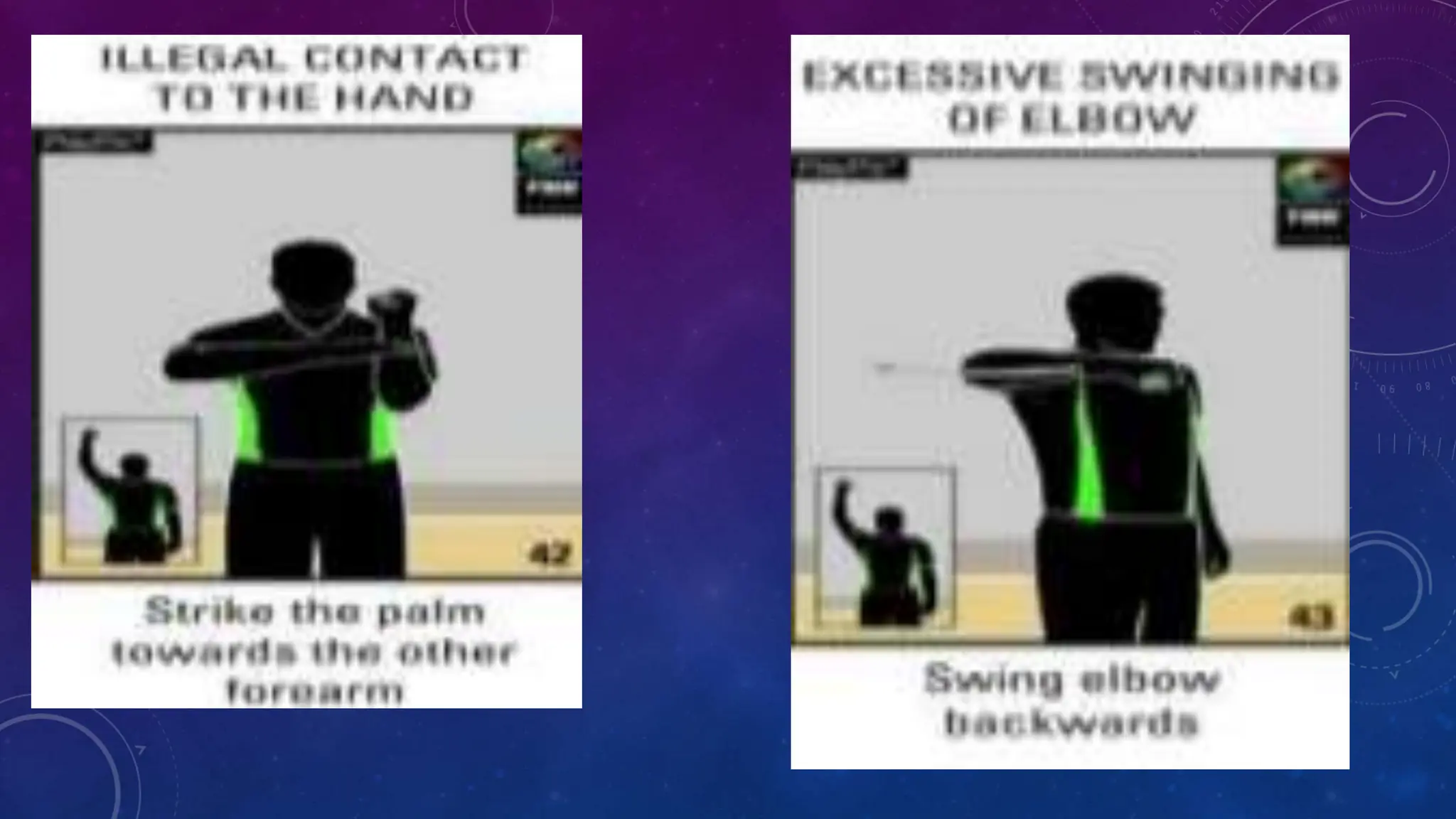
• Illegal use of hands — Extending the hands outside the cylinder and
causing illegal contact (for example, going for a steal but hitting the
player's hand or arm, or hitting the arm of a shooter).
• Hand-checking — Contact by the defense on a ball handler that impedes a
player's speed, quickness, rhythm, and/or balance.
• Illegal use of elbow — Moving one's elbow outside the cylinder to
disadvantage an opponent. This mostly occurs during a post-up play situation,
where either offense or defense attempt to gain a better position.
• Illegal use of legs or knees (on the dunk): Jumping up with one knee forward
as to intentionally hit the defender.
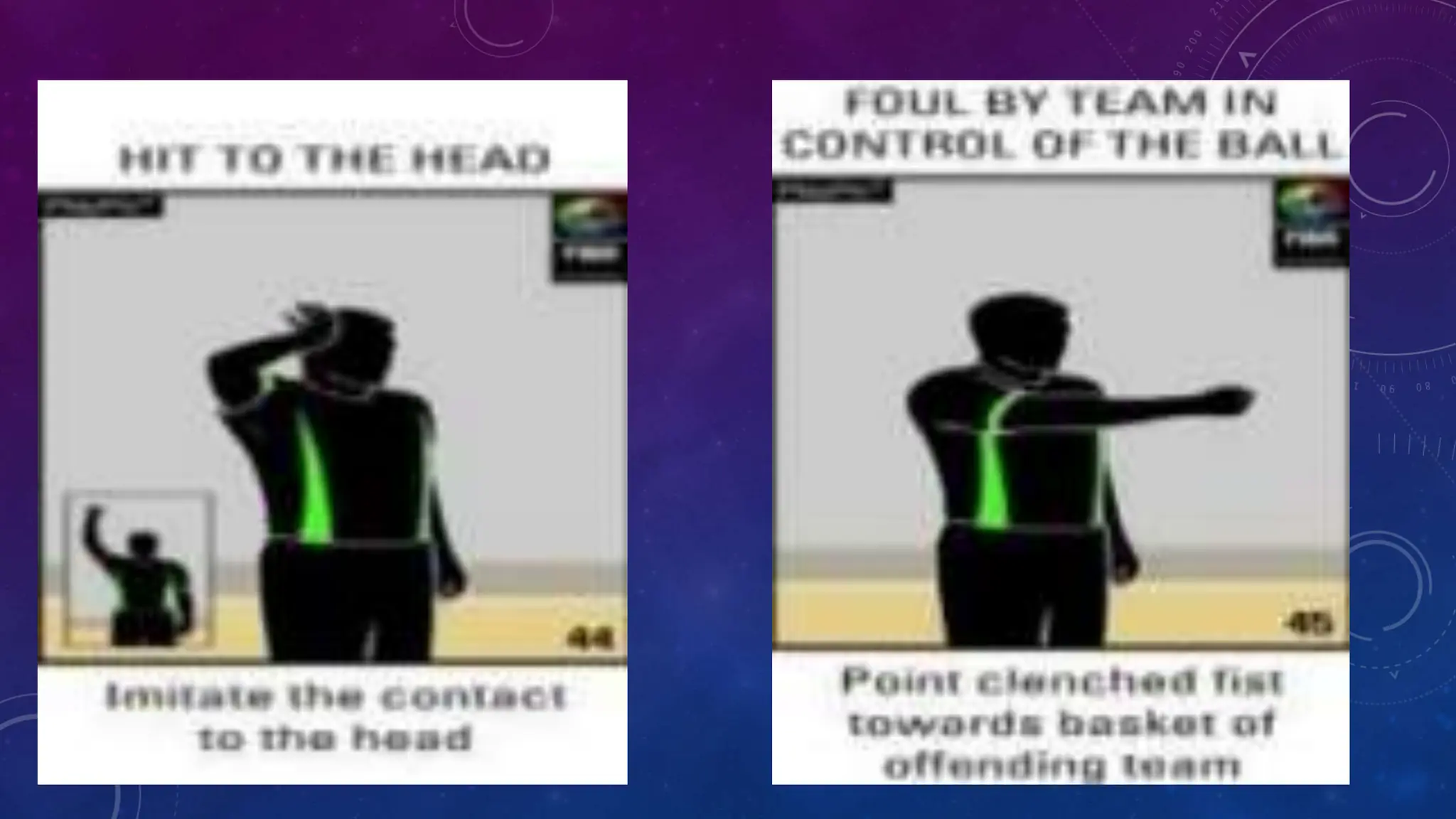
• Flagrant foul – a violent player contact that the official believes is not a
legitimate attempt to directly play the ball within the rules.
• Technical foul – a foul unrelated to physical contact during the game. (Player,
Coach, or against team in general)
• Double Foul – If two players have committed a foul at the same time, the
referee will put both hands, in fists, extended out towards the sides.
BASKETBALL VIOLATION HAND SIGNALS
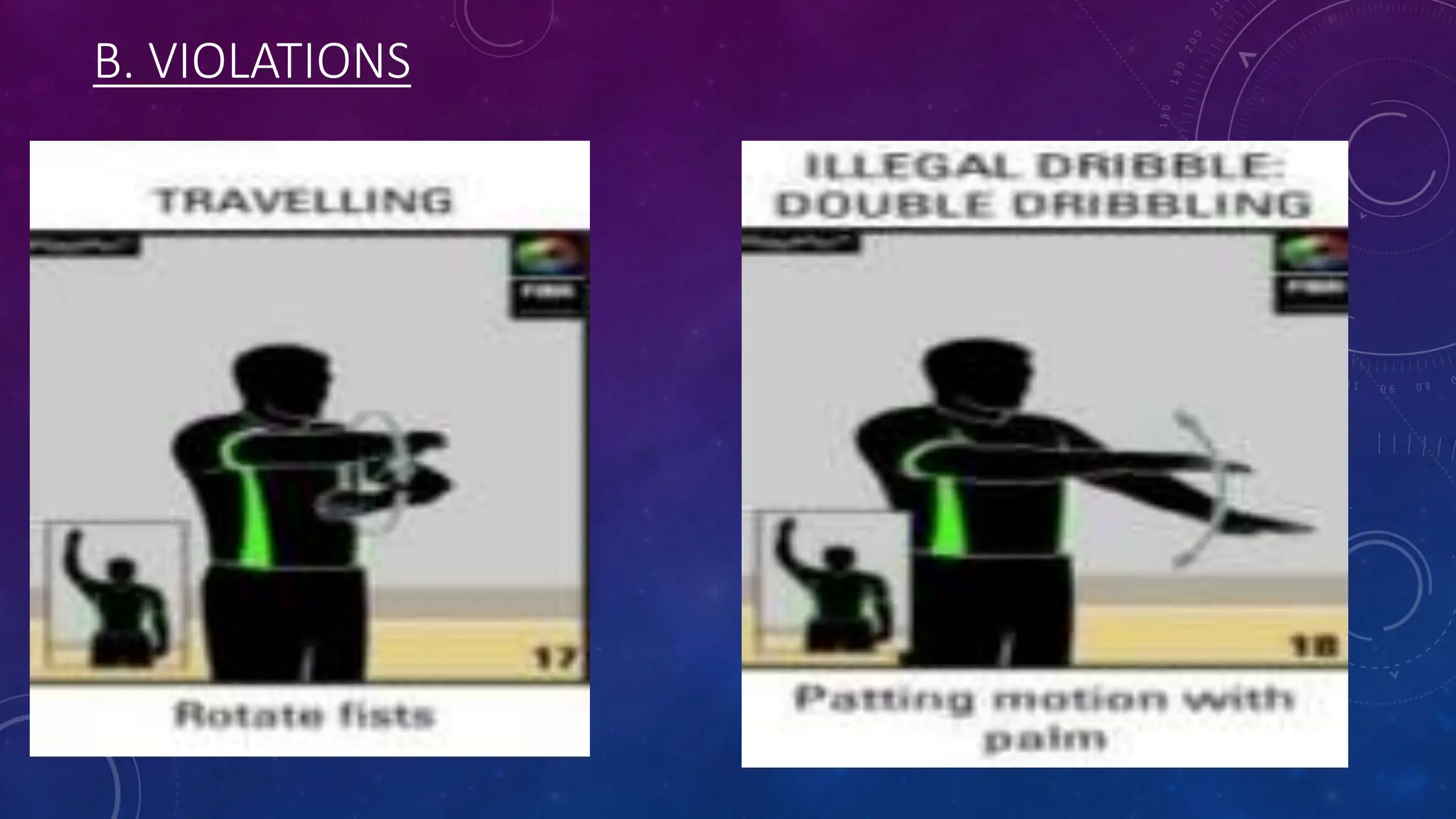
• Traveling – When a player has committed a traveling violation, the official
will signal it by placing both of his hands in front of him and moving them in
a circle.
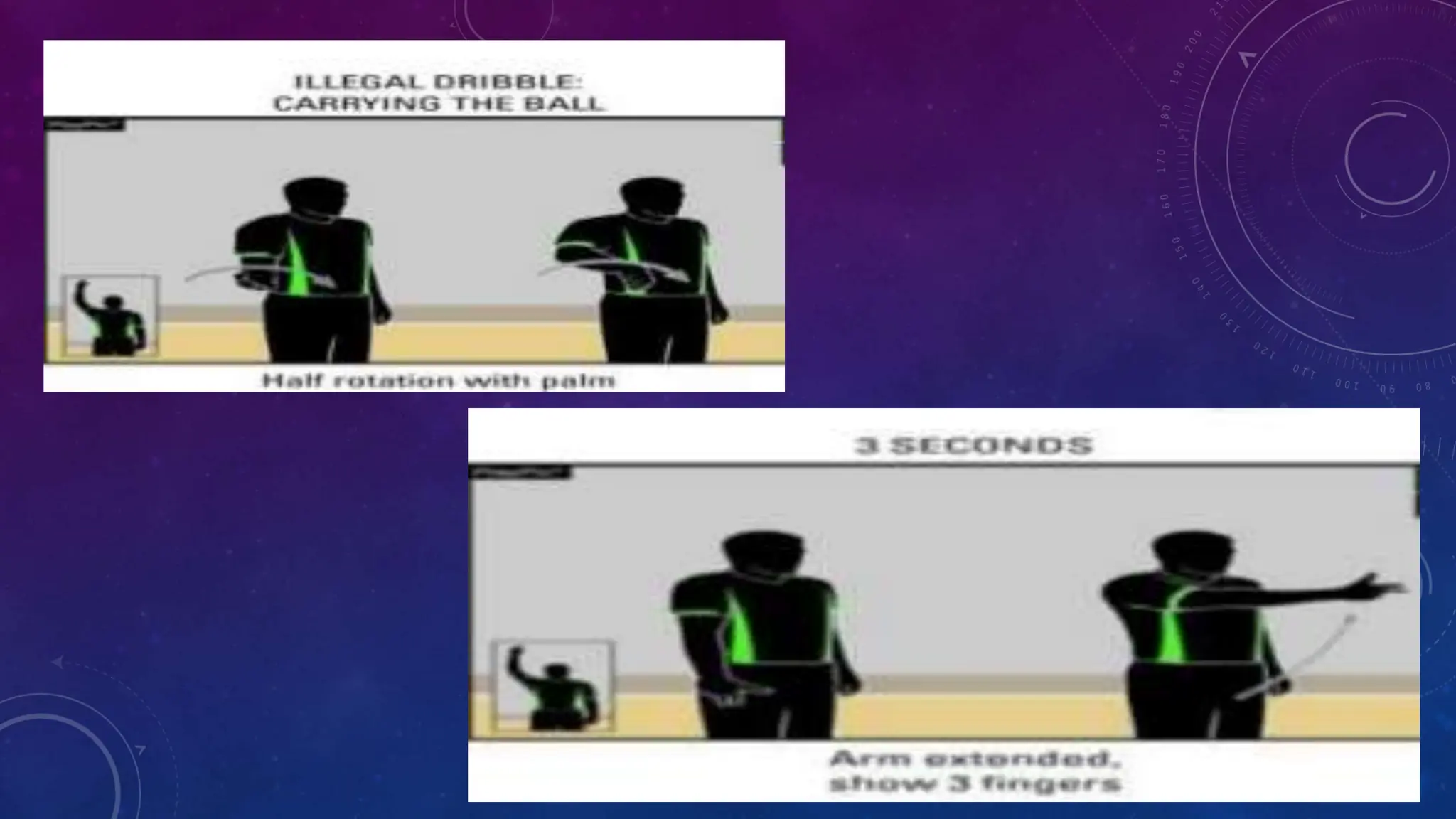
• Carrying or Palming – In order to signal a palming or carrying violation, the
referee will have one hand at the side, flipped over from palm up to palm
down.
• Double Dribble – The official will signal a double dribble violation has been
committed by putting both of his hands in front of him, with palms down,
and alternating them up and down, as if dribbling a basketball.
• Three Seconds – The official will indicate that a player has committed a
three second violation by having three fingers raised, and the hand makes
a swiping motion back and forth at the side.
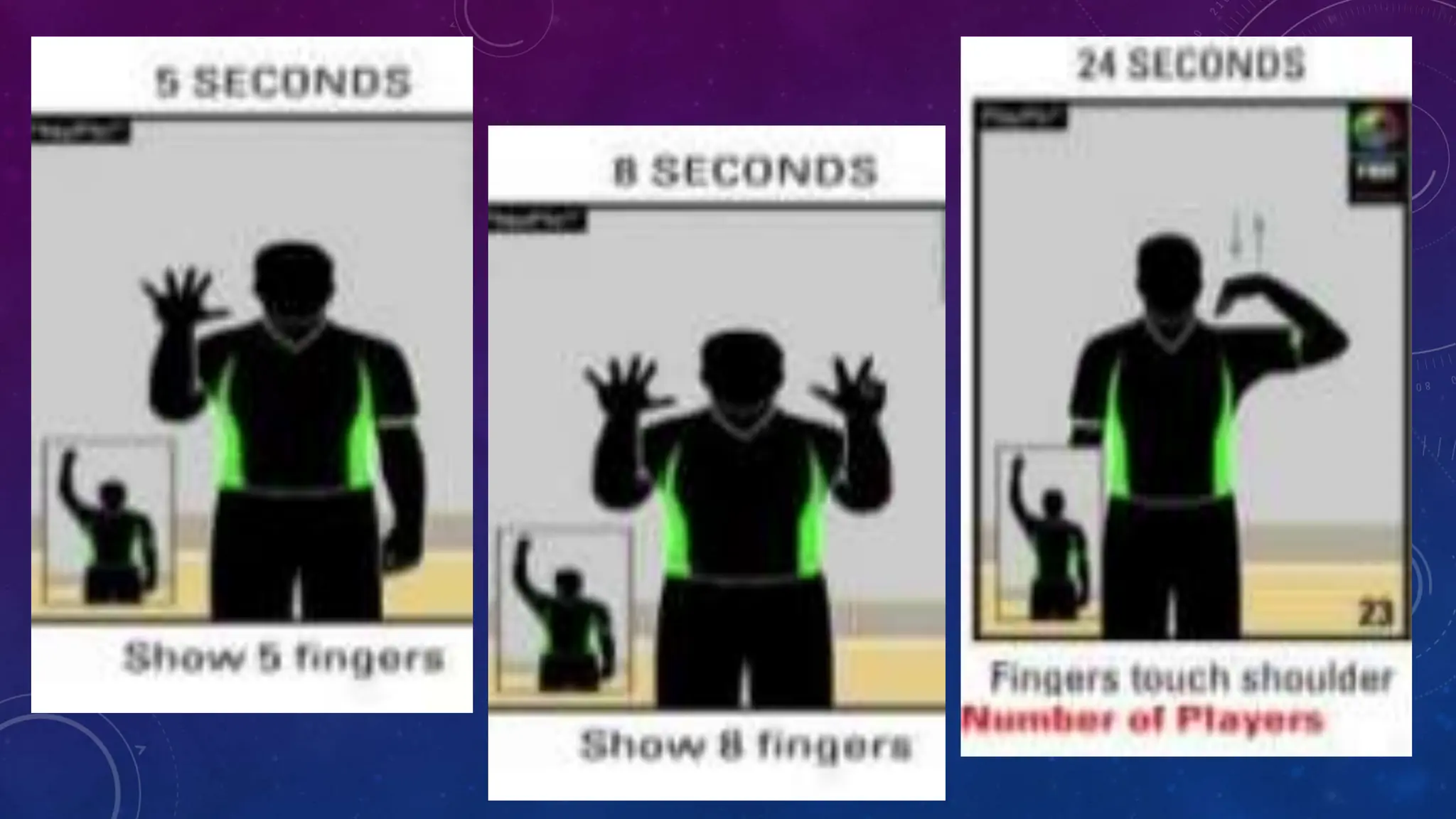
• Five Seconds – In order to signal a five second violation the official will
have five fingers raised with arm extended upward.
• Ten Seconds – The ten second violation is shown when the official has ten
fingers raised with both arms extended upwards.
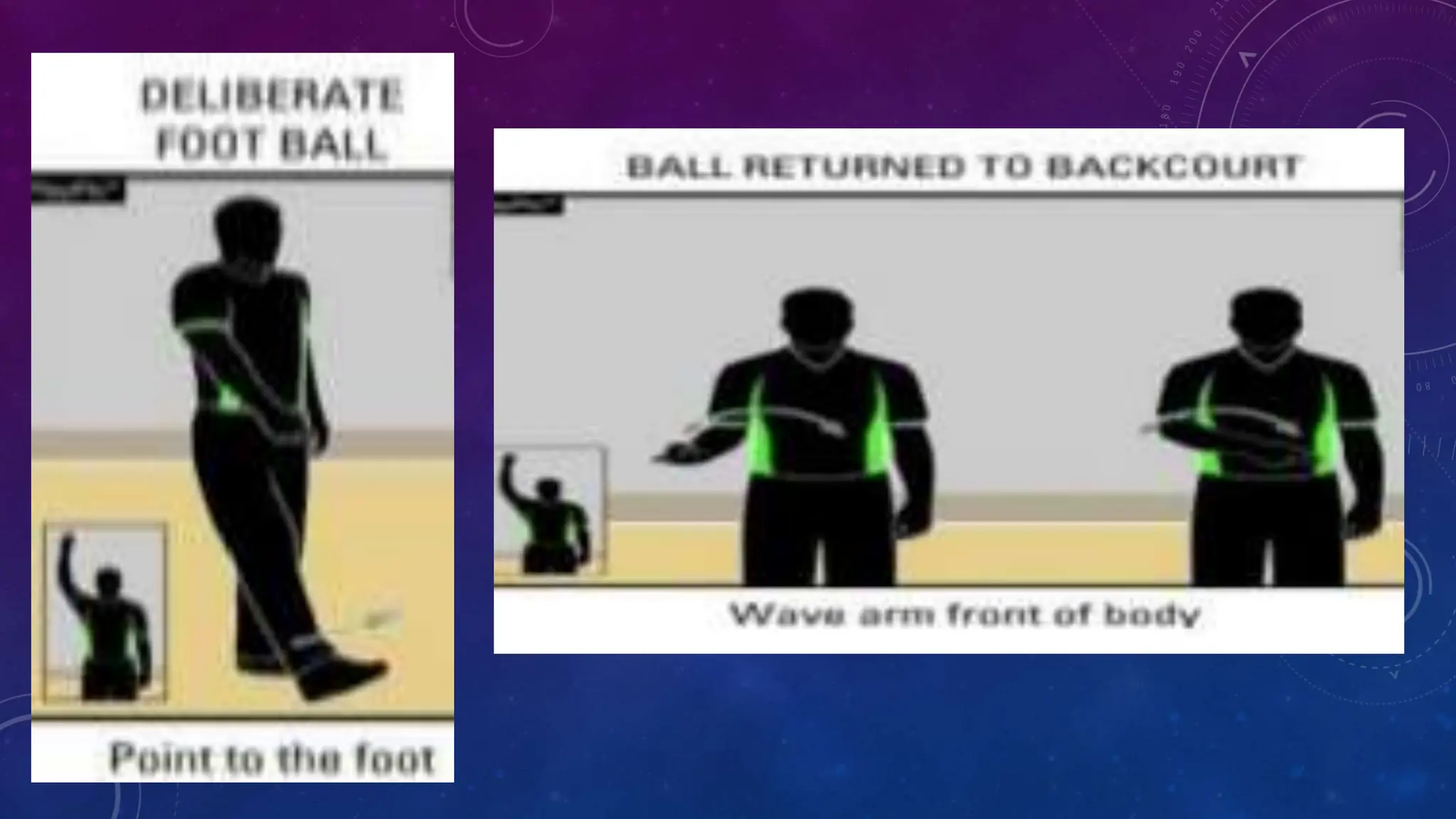
• Kicking the Ball – When a player kicks the ball, the referee will have one
foot raised in front.
2: ENRICHMENT
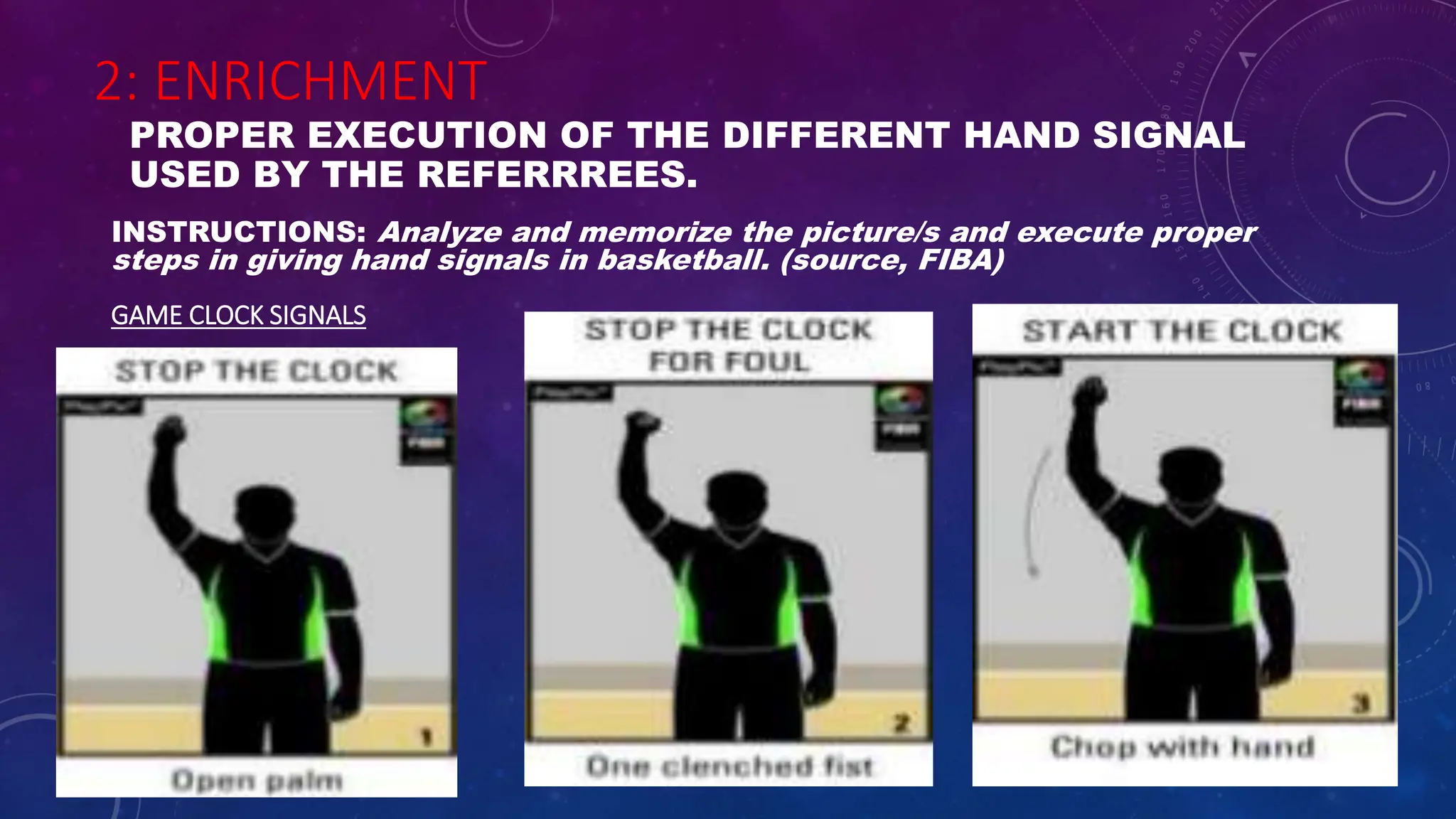
GAME CLOCK SIGNALS
INSTRUCTIONS: Analyze and memorize the picture/s and execute proper
steps in giving hand signals in basketball. (source, FIBA)
PROPER EXECUTION OF THE DIFFERENT HAND SIGNAL
USED BY THE REFERRREES.
A. TYPES OF FOULS
B. VIOLATIONS
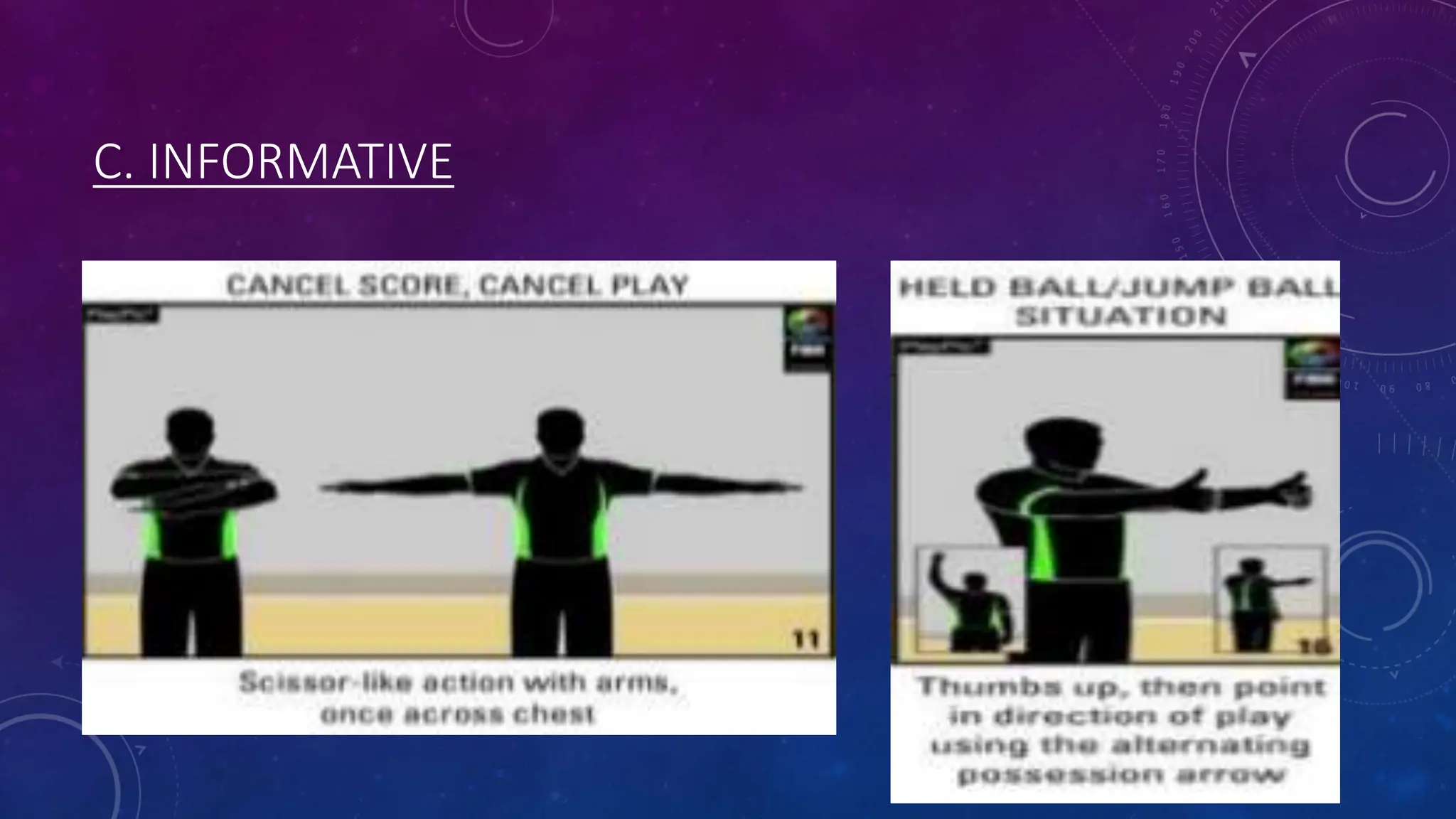
C. INFORMATIVE
QUESTIONS?
Ask me…..
3. EVALUATION
Bring out ½ sheet of paper then number it 1-15.
From those numbers, I will only give 10 hand
signals and put your answer only on the number
that I am going to execute. I will only execute
the hand signals once and strictly NO
ERASURES.
Take note: I will execute the hand signals N0T in their
CHRONOLOGICAL ORDER.
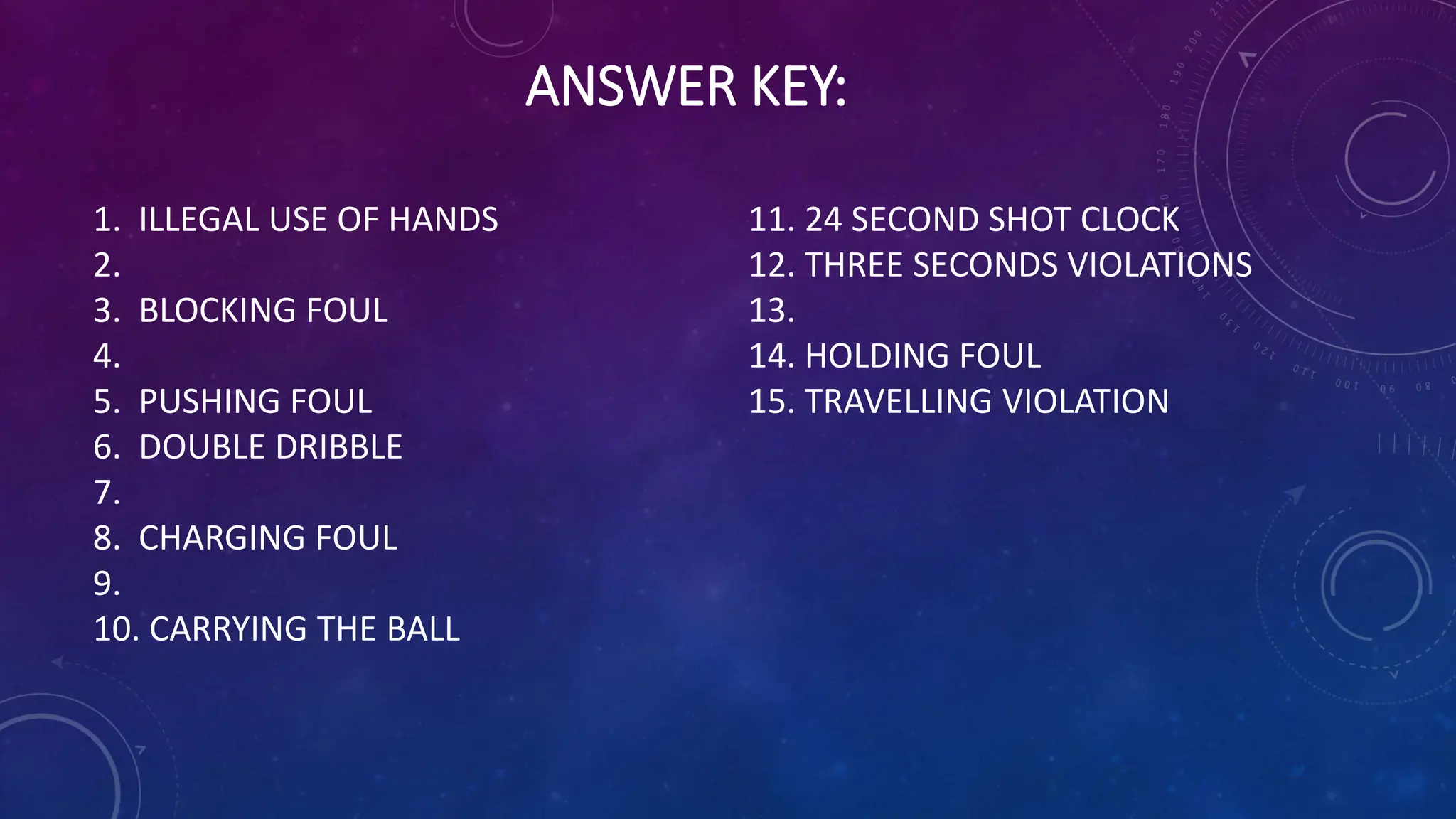
ANSWER KEY:
1. ILLEGAL USE OF HANDS 11. 24 SECOND SHOT CLOCK
2. 12. THREE SECONDS VIOLATIONS
3. BLOCKING FOUL 13.
4. 14. HOLDING FOUL
5. PUSHING FOUL 15. TRAVELLING VIOLATION
6. DOUBLE DRIBBLE
7.
8. CHARGING FOUL
9.
10. CARRYING THE BALL
4. REFERENCES
• P.E and Health 9 page.
• https://inspirationalbasketball.com/understanding-basketball-referee-signals/

Basketball hand signals.pptx

  • 1.
    BASKETBALL HAND SIGNAL PREPAREDBY: JACINTO V. MABINI TEACHER III BANGUI NATIONAL HIGH SCHOOL
  • 2.
    1. INTRODUCTION: In abasketball game, basketball referees who have the responsibility to enforce the rules and maintain the order of the basketball game has only a brief moment to determine if an infraction has occurred, later they communicate with the scoring table using hand signals. In this topic, we are going to learn, analyze and execute the different types of HAND SIGNALS in BASKETBALL.
  • 3.
    FOUL VS. VIOLATION •Foul 1. A foul is an infraction of the rules more serious than violations 2. A foul occur as a result of illegal contact with an opponent and or unsportsmanlike behaviour. • Violation 1. A violation is a minor class of illegal action in basketball. 2. Most of the violations are committed by the team in possession of the ball
  • 4.
    KINDS OF FOULS •Pushing — Contact that displaces an opponent (for example, pushing a player away from the basket, or using body weight to affect a player's movement). • Holding — Contact that interferes with a player's freedom of movement (for example, physically grabbing a player driving to the basket). • Illegal use of hands — Extending the hands outside the cylinder and causing illegal contact (for example, going for a steal but hitting the player's hand or arm, or hitting the arm of a shooter). • Hand-checking — Contact by the defense on a ball handler that impedes a player's speed, quickness, rhythm, and/or balance.
  • 5.
    • Illegal useof elbow — Moving one's elbow outside the cylinder to disadvantage an opponent. This mostly occurs during a post-up play situation, where either offense or defense attempt to gain a better position. • Illegal use of legs or knees (on the dunk): Jumping up with one knee forward as to intentionally hit the defender. • Flagrant foul – a violent player contact that the official believes is not a legitimate attempt to directly play the ball within the rules. • Technical foul – a foul unrelated to physical contact during the game. (Player, Coach, or against team in general) • Double Foul – If two players have committed a foul at the same time, the referee will put both hands, in fists, extended out towards the sides.
  • 6.
    BASKETBALL VIOLATION HANDSIGNALS • Traveling – When a player has committed a traveling violation, the official will signal it by placing both of his hands in front of him and moving them in a circle. • Carrying or Palming – In order to signal a palming or carrying violation, the referee will have one hand at the side, flipped over from palm up to palm down. • Double Dribble – The official will signal a double dribble violation has been committed by putting both of his hands in front of him, with palms down, and alternating them up and down, as if dribbling a basketball.
  • 7.
    • Three Seconds– The official will indicate that a player has committed a three second violation by having three fingers raised, and the hand makes a swiping motion back and forth at the side. • Five Seconds – In order to signal a five second violation the official will have five fingers raised with arm extended upward. • Ten Seconds – The ten second violation is shown when the official has ten fingers raised with both arms extended upwards. • Kicking the Ball – When a player kicks the ball, the referee will have one foot raised in front.
  • 8.
    2: ENRICHMENT GAME CLOCKSIGNALS INSTRUCTIONS: Analyze and memorize the picture/s and execute proper steps in giving hand signals in basketball. (source, FIBA) PROPER EXECUTION OF THE DIFFERENT HAND SIGNAL USED BY THE REFERRREES.
  • 9.
  • 13.
  • 17.
  • 18.
  • 19.
    3. EVALUATION Bring out½ sheet of paper then number it 1-15. From those numbers, I will only give 10 hand signals and put your answer only on the number that I am going to execute. I will only execute the hand signals once and strictly NO ERASURES. Take note: I will execute the hand signals N0T in their CHRONOLOGICAL ORDER.
  • 20.
    ANSWER KEY: 1. ILLEGALUSE OF HANDS 11. 24 SECOND SHOT CLOCK 2. 12. THREE SECONDS VIOLATIONS 3. BLOCKING FOUL 13. 4. 14. HOLDING FOUL 5. PUSHING FOUL 15. TRAVELLING VIOLATION 6. DOUBLE DRIBBLE 7. 8. CHARGING FOUL 9. 10. CARRYING THE BALL
  • 21.
    4. REFERENCES • P.Eand Health 9 page. • https://inspirationalbasketball.com/understanding-basketball-referee-signals/