8-1
Is
Process
Capable
?
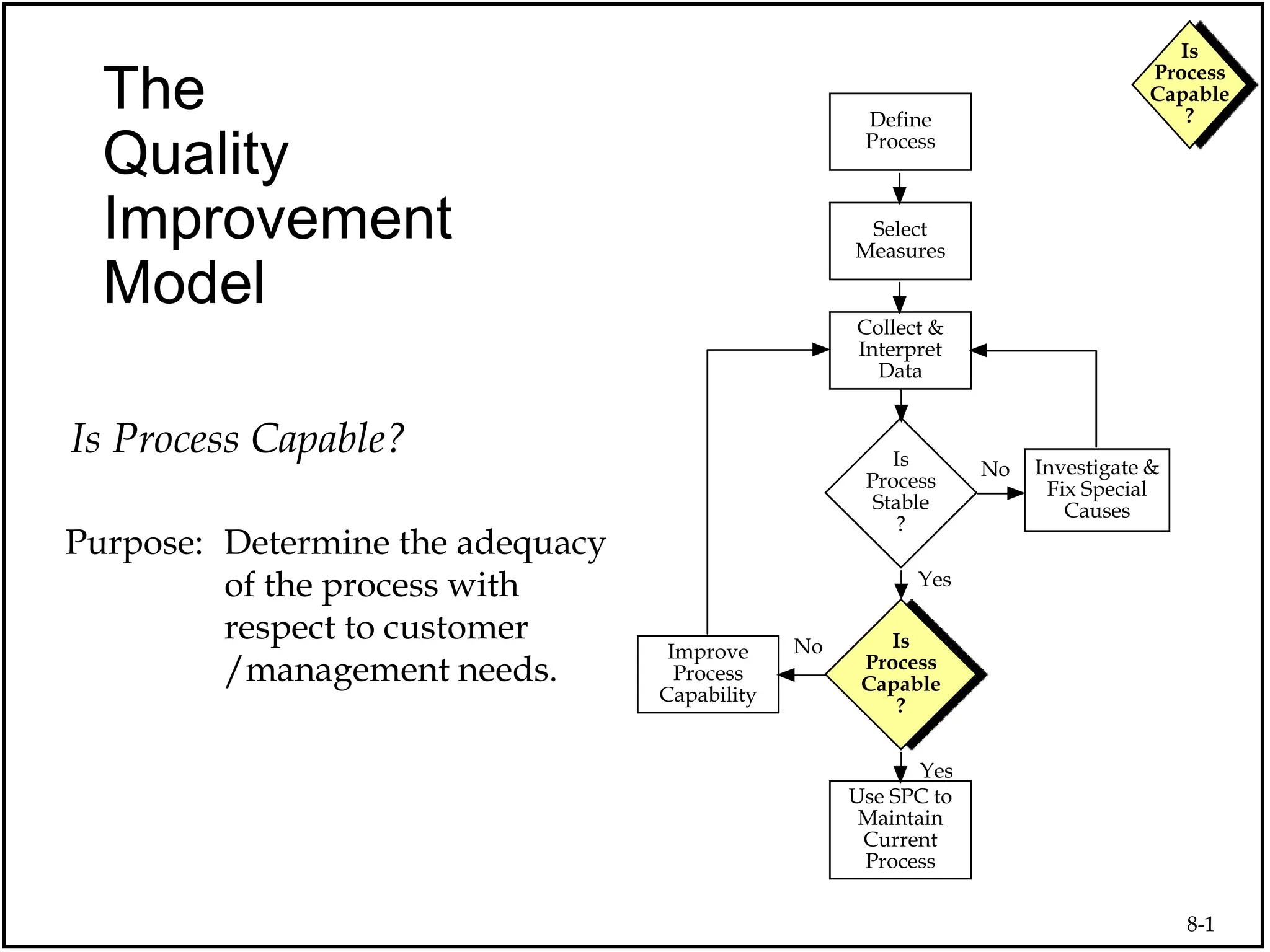
The
Quality
Improvement
Model
Use SPC to
Maintain
Current
Process
Collect &
Interpret
Data
Select
Measures
Define
Process
Is
Process
Capable
?
Improve
Process
Capability
Is
Process
Stable
?
Investigate &
Fix Special
Causes
No
Yes
No
Yes
Is Process Capable?
Purpose: Determine the adequacy
of the process with
respect to customer
/management needs.
8-2
Is
Process
Capable
?
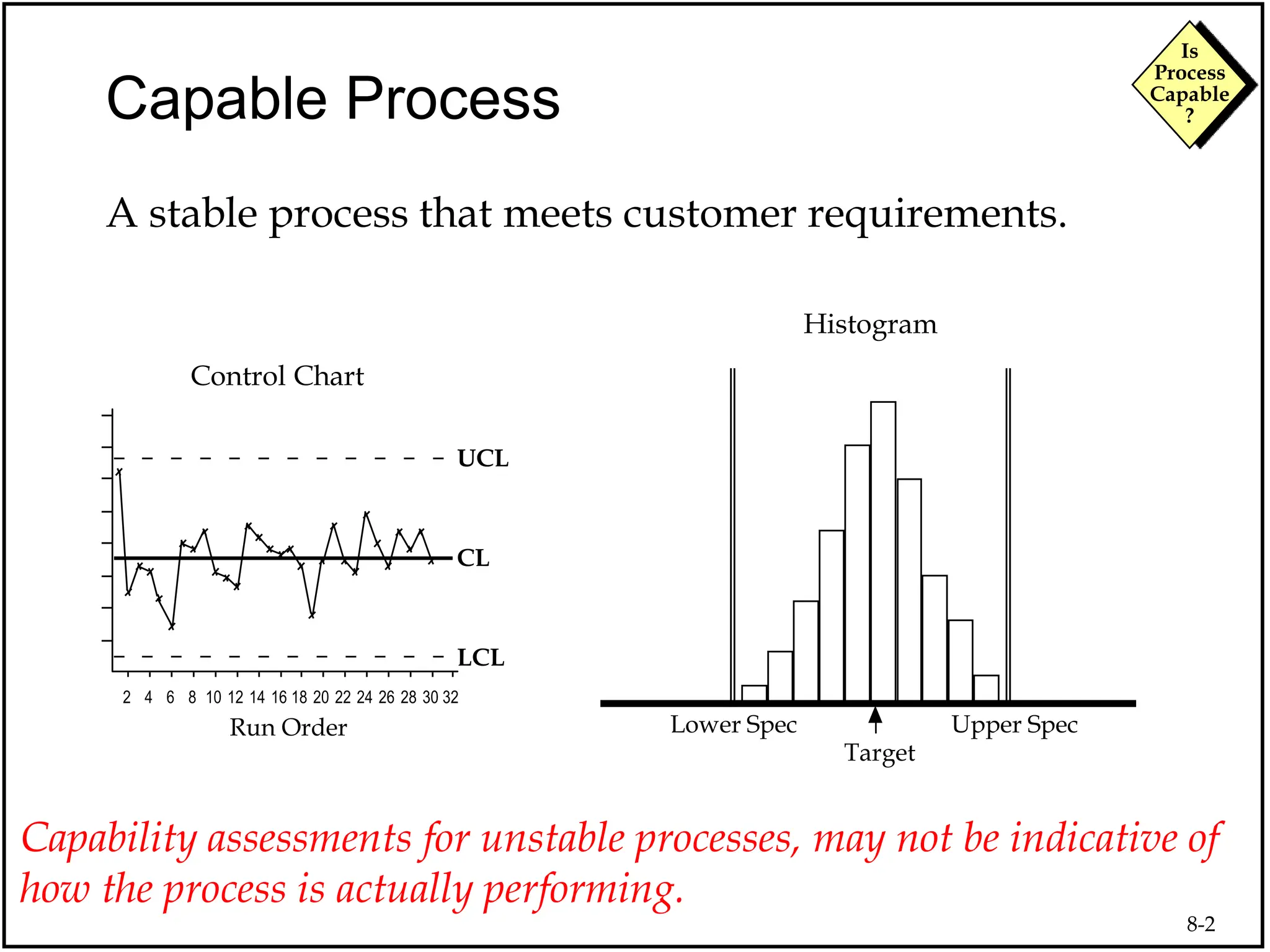
Capable Process
A stable process that meets customer requirements.
8 22 24
2 4 6 10 12 14 16 18 20 26 28 30 32
Run Order
UCL
CL
LCL
Control Chart
Lower Spec Upper Spec
Target
Histogram
Capability assessments for unstable processes, may not be indicative of
how the process is actually performing.
8-3
Is
Process
Capable
?
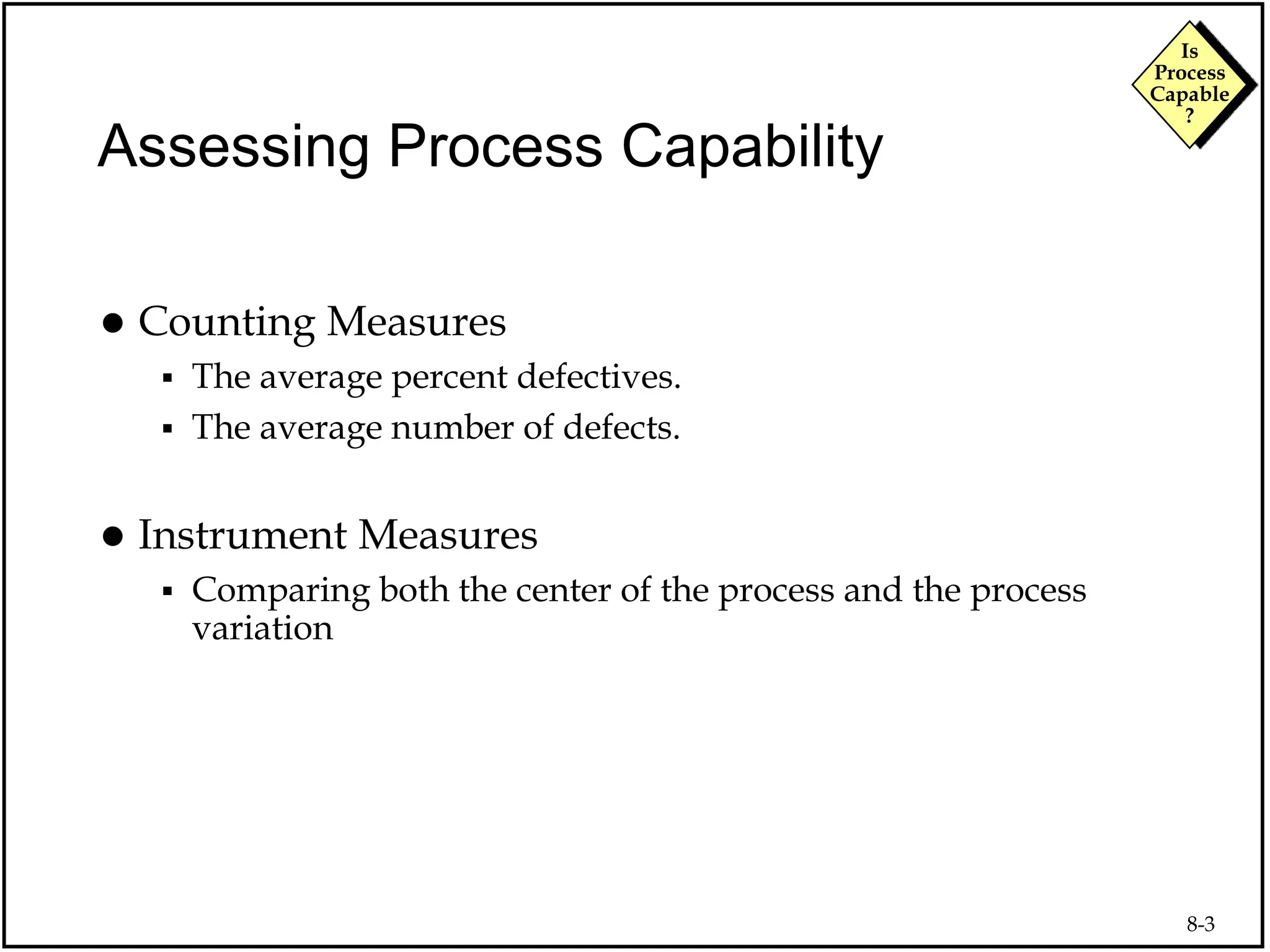
Assessing Process Capability
 Counting Measures
 The average percent defectives.
 The average number of defects.
 Instrument Measures
 Comparing both the center of the process and the process
variation
8-4
Is
Process
Capable
?
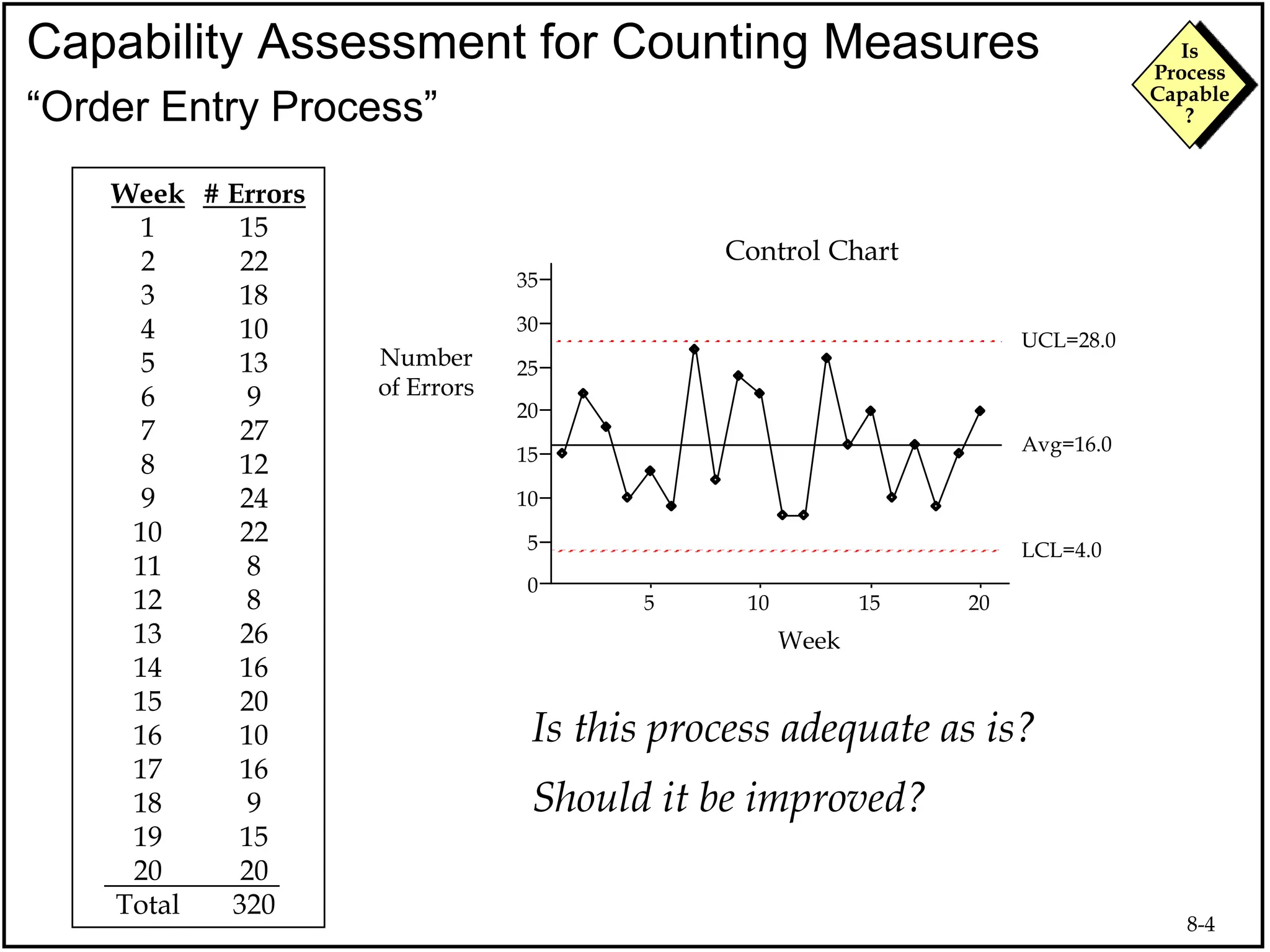
Capability Assessment for Counting Measures
“Order Entry Process”
Is this process adequate as is?
Should it be improved?
Week
1
2
3
4
5
6
7
8
9
10
11
12
13
14
15
16
17
18
19
20
Total
# Errors
15
22
18
10
13
9
27
12
24
22
8
8
26
16
20
10
16
9
15
20
320
0
5
10
15
20
25
30
35
5 10 15 20
Avg=16.0
LCL=4.0
UCL=28.0
Week
Number
of Errors
Control Chart
8-5
Is
Process
Capable
?
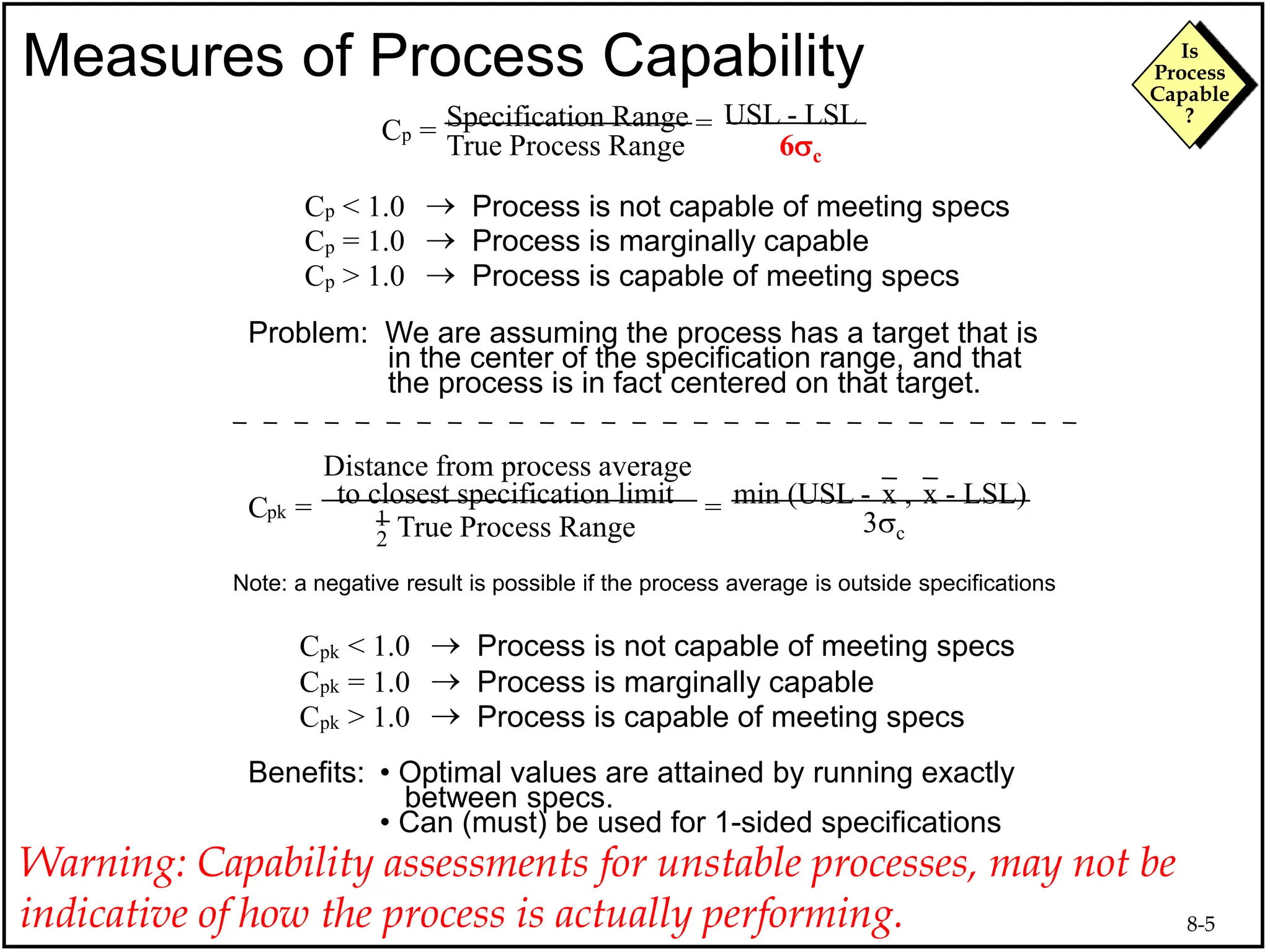
Measures of Process Capability
Cp = Specification Range
True Process Range
= USL - LSL
6sc
Cpk =
Distance from process average
to closest specification limit
1
2 True Process Range
= min (USL - x , x - LSL)
3sc
Problem: We are assuming the process has a target that is
in the center of the specification range, and that
the process is in fact centered on that target.
Note: a negative result is possible if the process average is outside specifications
Benefits: • Optimal values are attained by running exactly
between specs.
• Can (must) be used for 1-sided specifications
Cp < 1.0  Process is not capable of meeting specs
Cp = 1.0  Process is marginally capable
Cp > 1.0  Process is capable of meeting specs
Cpk < 1.0  Process is not capable of meeting specs
Cpk = 1.0  Process is marginally capable
Cpk > 1.0  Process is capable of meeting specs
Warning: Capability assessments for unstable processes, may not be
indicative of how the process is actually performing.
8-6
Is
Process
Capable
?
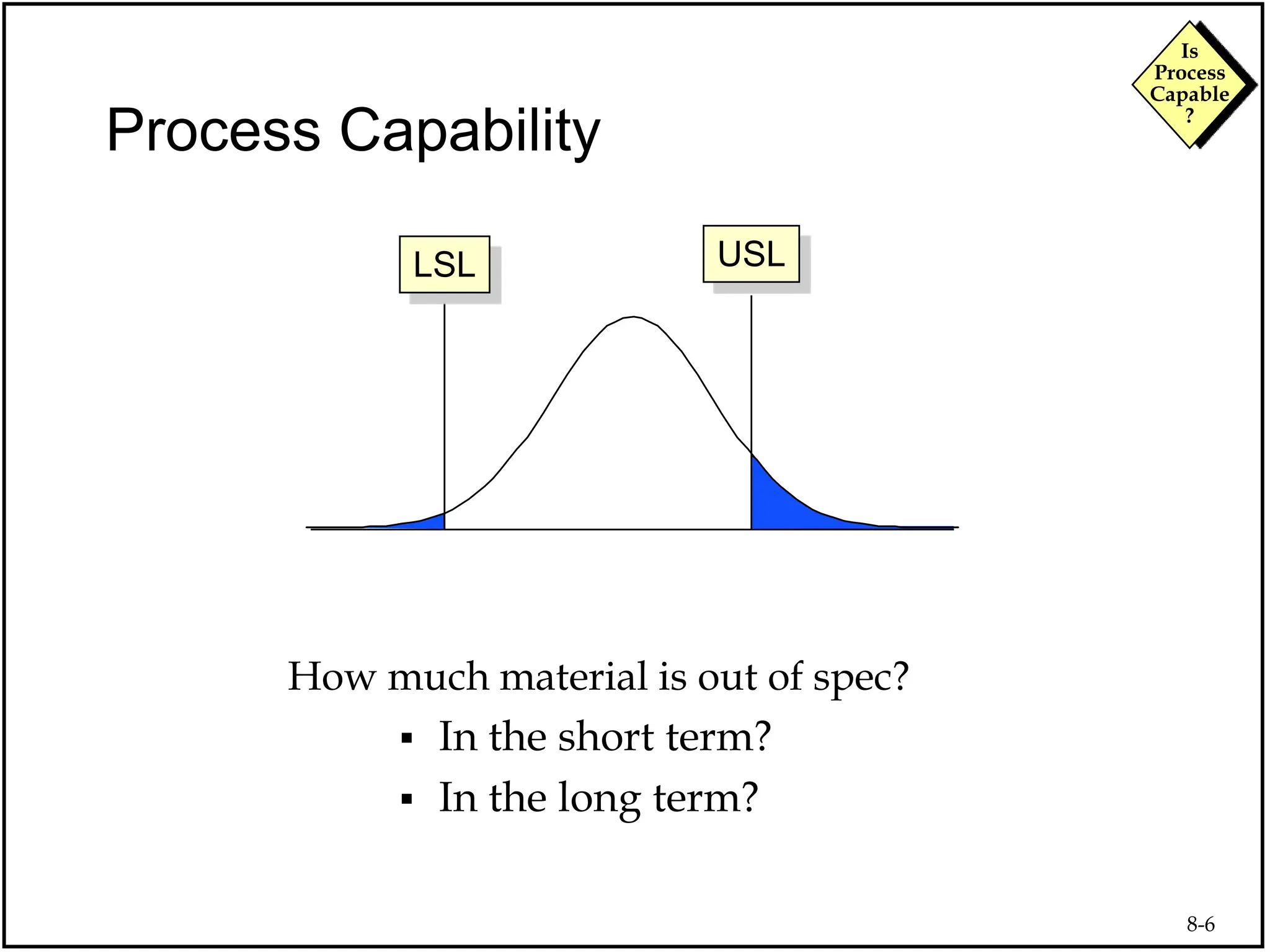
How much material is out of spec?
 In the short term?
 In the long term?
USL
LSL
Process Capability
8-7
Is
Process
Capable
?
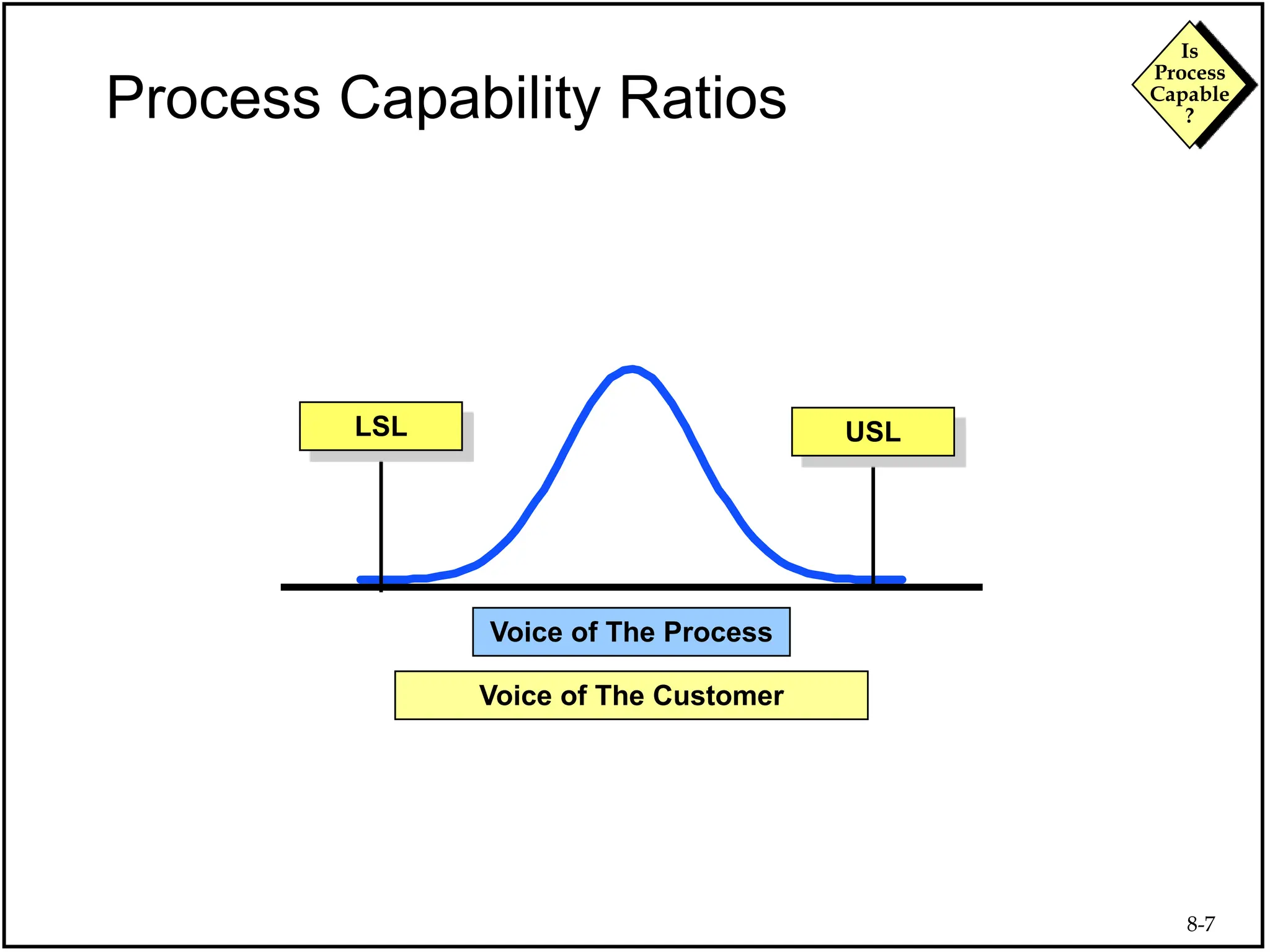
Process Capability Ratios
Voice of The Customer
Voice of The Process
USL
LSL
8-8
Is
Process
Capable
?
8-9
Is
Process
Capable
?
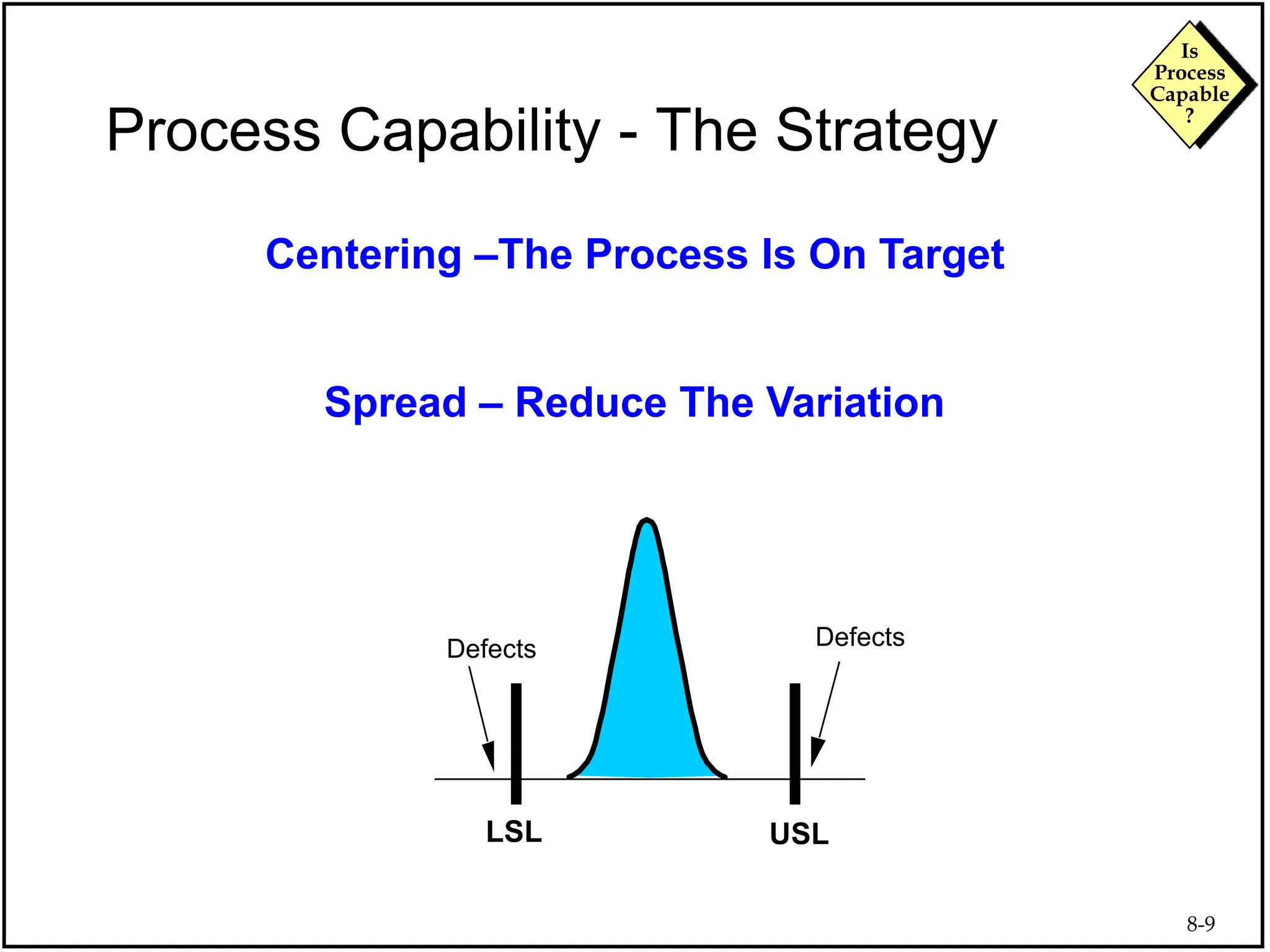
Process Capability - The Strategy
Centering –The Process Is On Target
Spread – Reduce The Variation
LSL USL
Defects
Defects
8-10
Is
Process
Capable
?
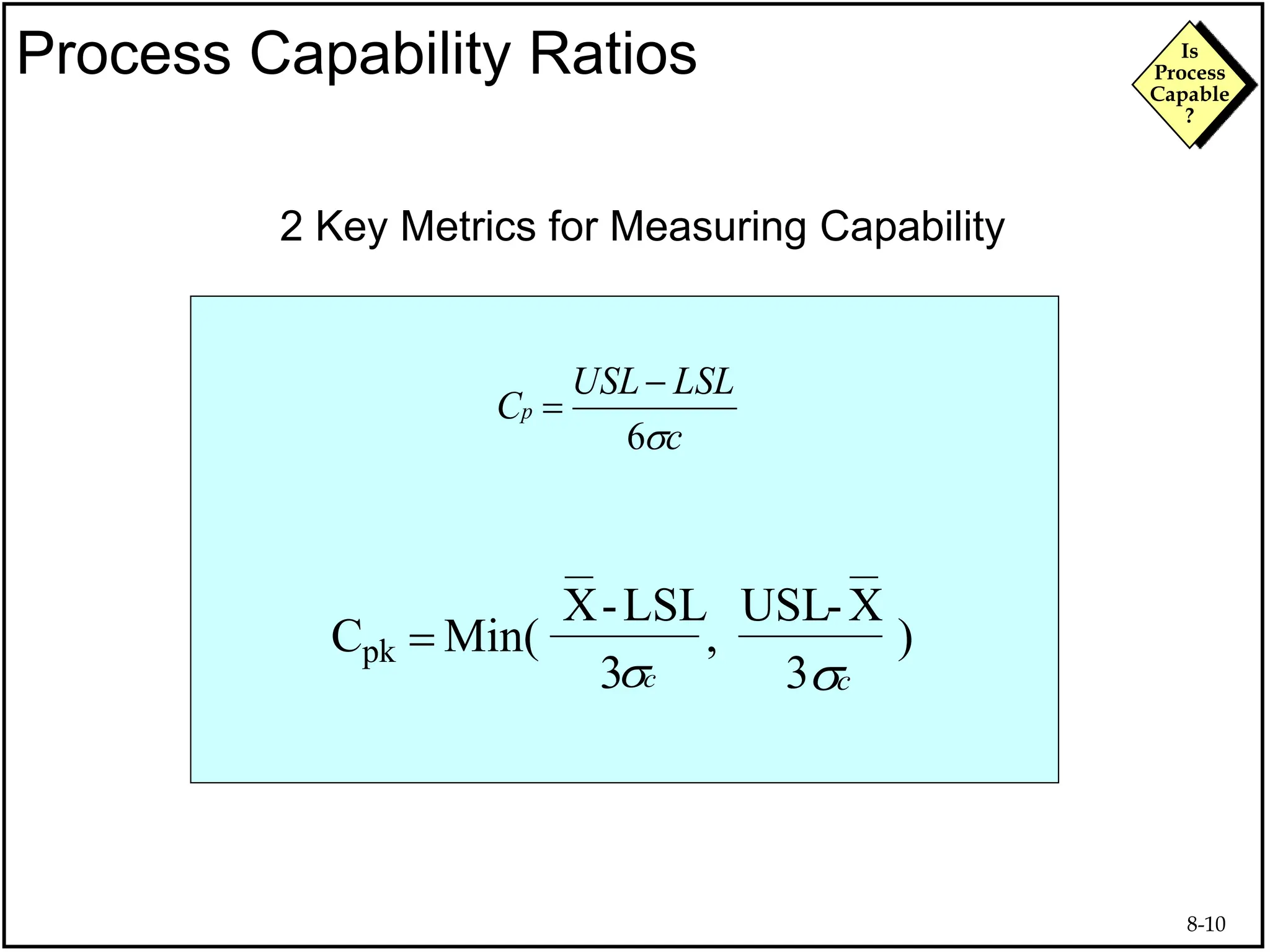
2 Key Metrics for Measuring Capability
C Min(
X-LSL
3
USL-X
3
pk  , )
c
LSL
USL
Cp
s
6


c
s c
s
Process Capability Ratios
8-11
Is
Process
Capable
?
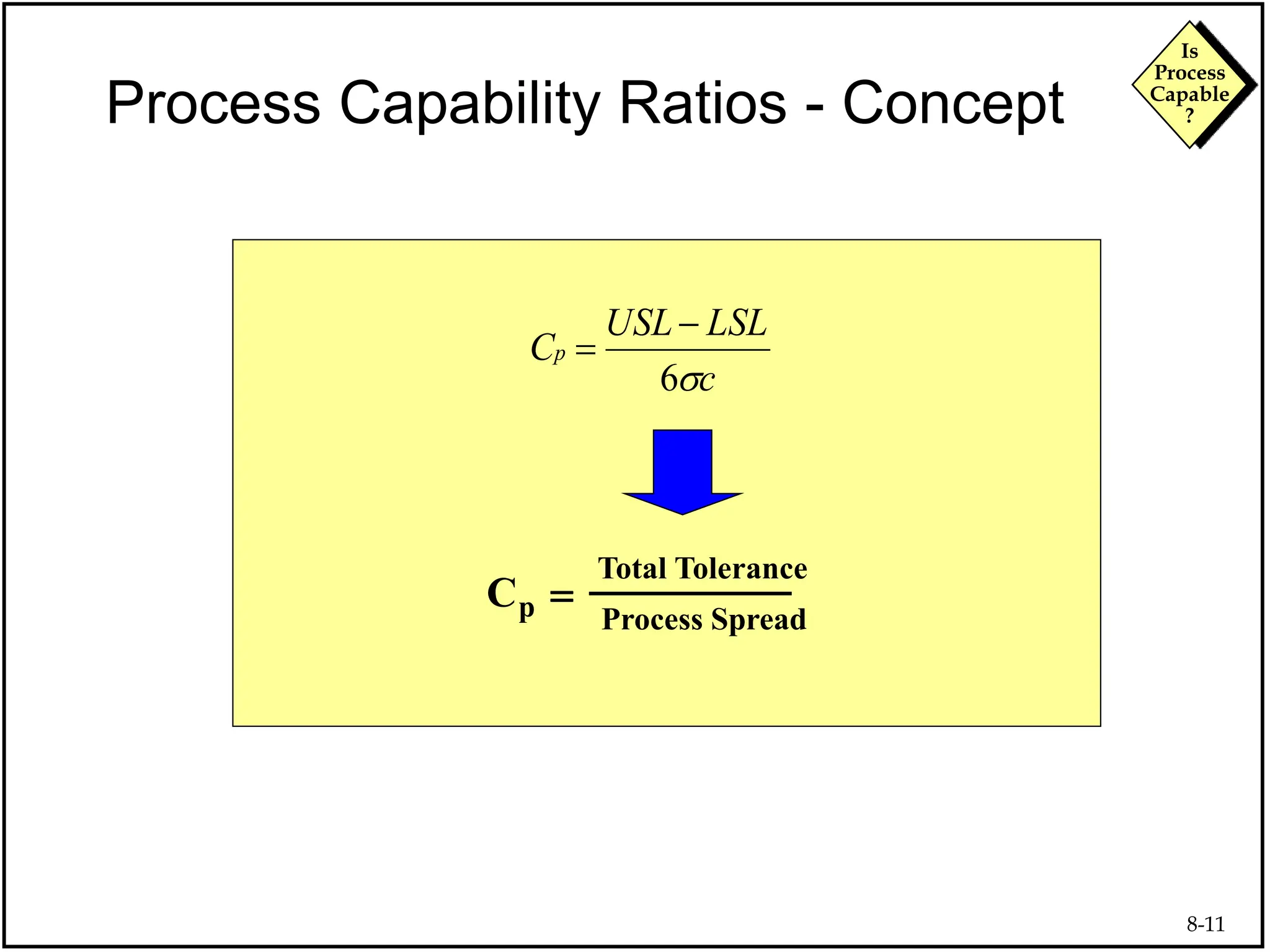
Process Capability Ratios - Concept
Total Tolerance
C
Process Spread
p 
c
LSL
USL
Cp
s
6


8-12
Is
Process
Capable
?
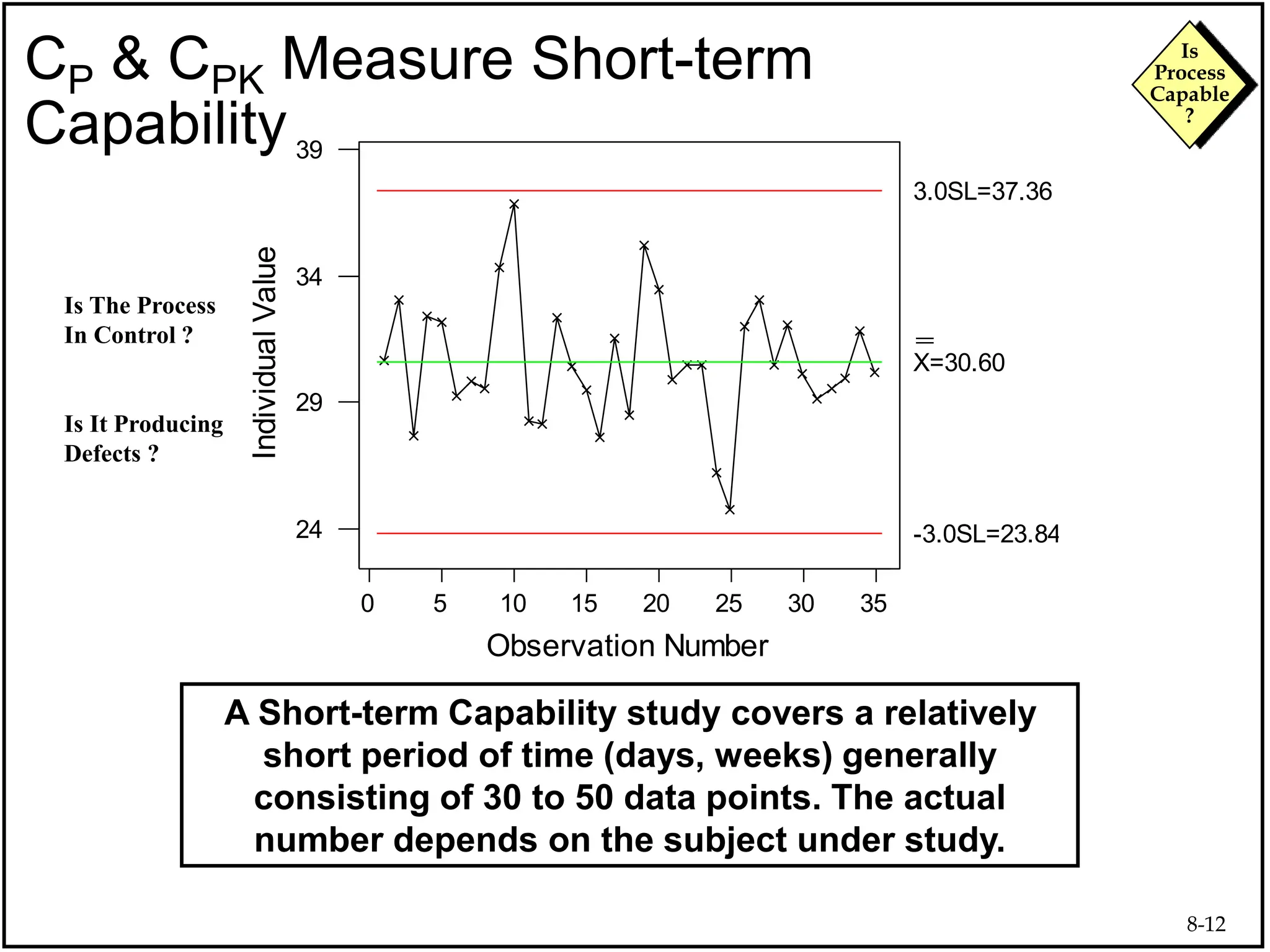
A Short-term Capability study covers a relatively
short period of time (days, weeks) generally
consisting of 30 to 50 data points. The actual
number depends on the subject under study.
Is The Process
In Control ?
Is It Producing
Defects ?
35
30
25
20
15
10
5
0
39
34
29
24
Observation Number
Individual
Value
I Chart for C1
X=30.60
3.0SL=37.36
-3.0SL=23.84
CP & CPK Measure Short-term
Capability
8-13
Is
Process
Capable
?
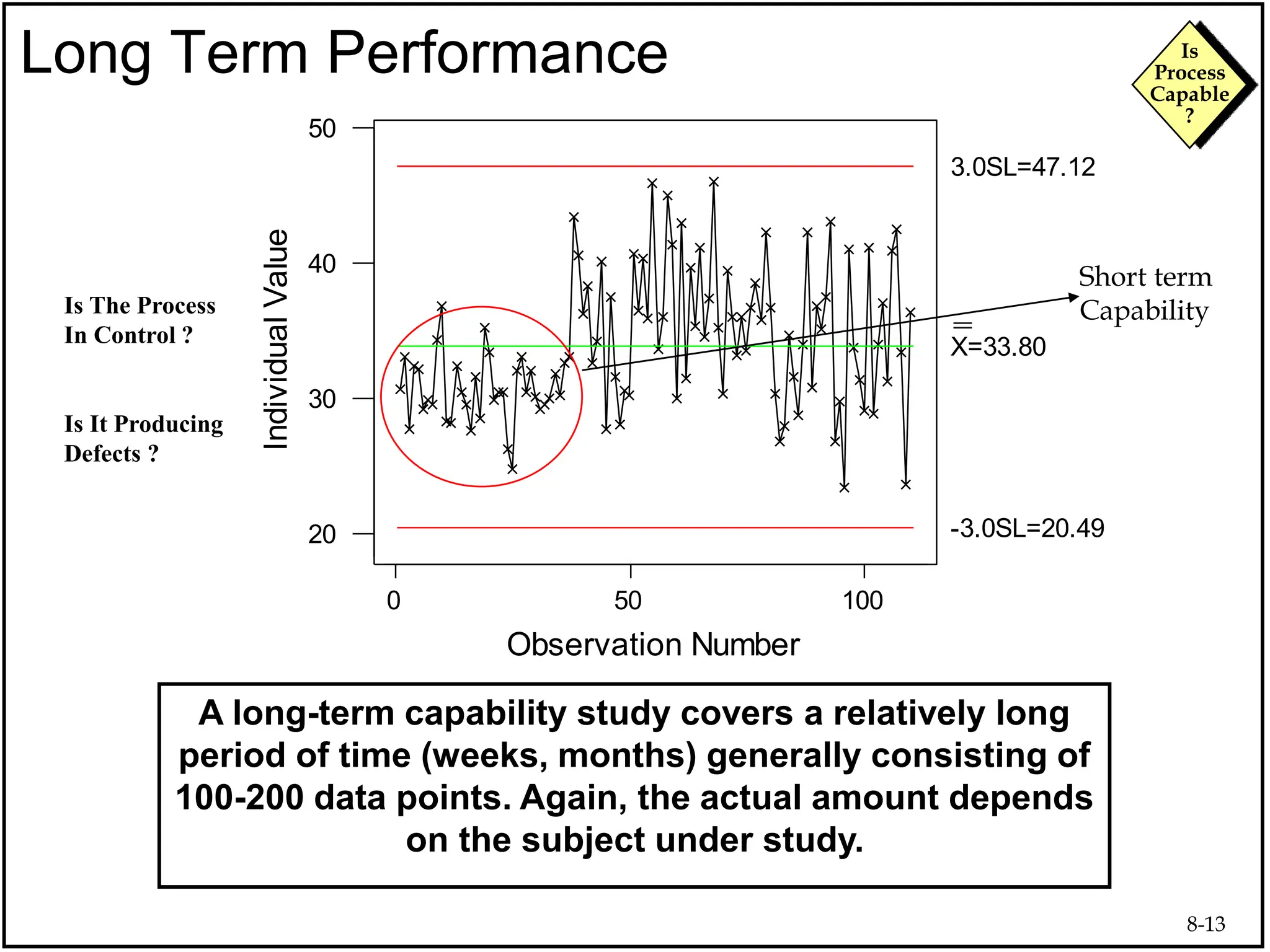
A long-term capability study covers a relatively long
period of time (weeks, months) generally consisting of
100-200 data points. Again, the actual amount depends
on the subject under study.
Is The Process
In Control ?
Is It Producing
Defects ?
100
50
0
50
40
30
20
Observation Number
Individual
Value
I Chart for C3
X=33.80
3.0SL=47.12
-3.0SL=20.49
Long Term Performance
Short term
Capability
8-14
Is
Process
Capable
?
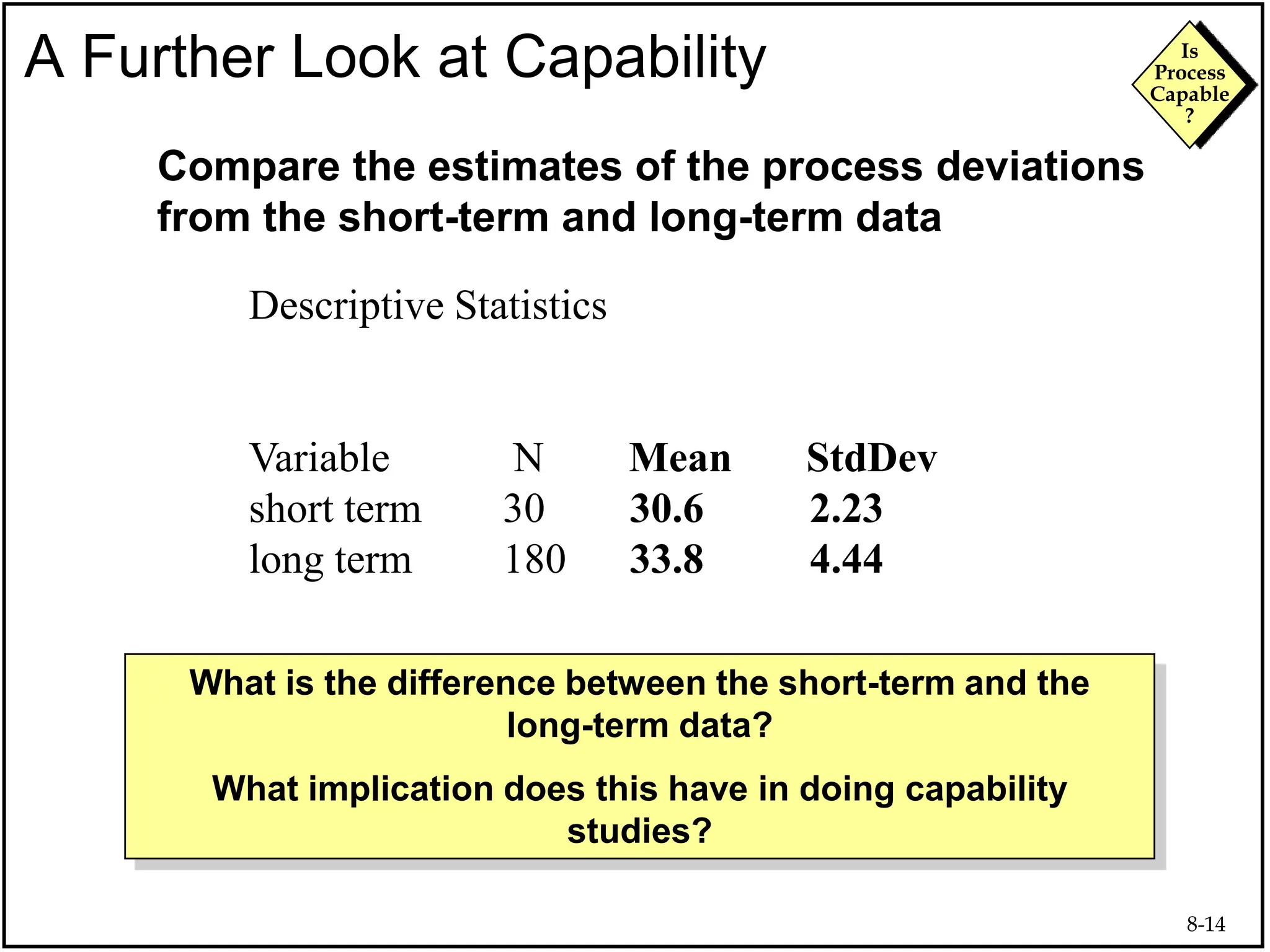
A Further Look at Capability
Compare the estimates of the process deviations
from the short-term and long-term data
What is the difference between the short-term and the
long-term data?
What implication does this have in doing capability
studies?
Descriptive Statistics
Variable N Mean StdDev
short term 30 30.6 2.23
long term 180 33.8 4.44
8-15
Is
Process
Capable
?
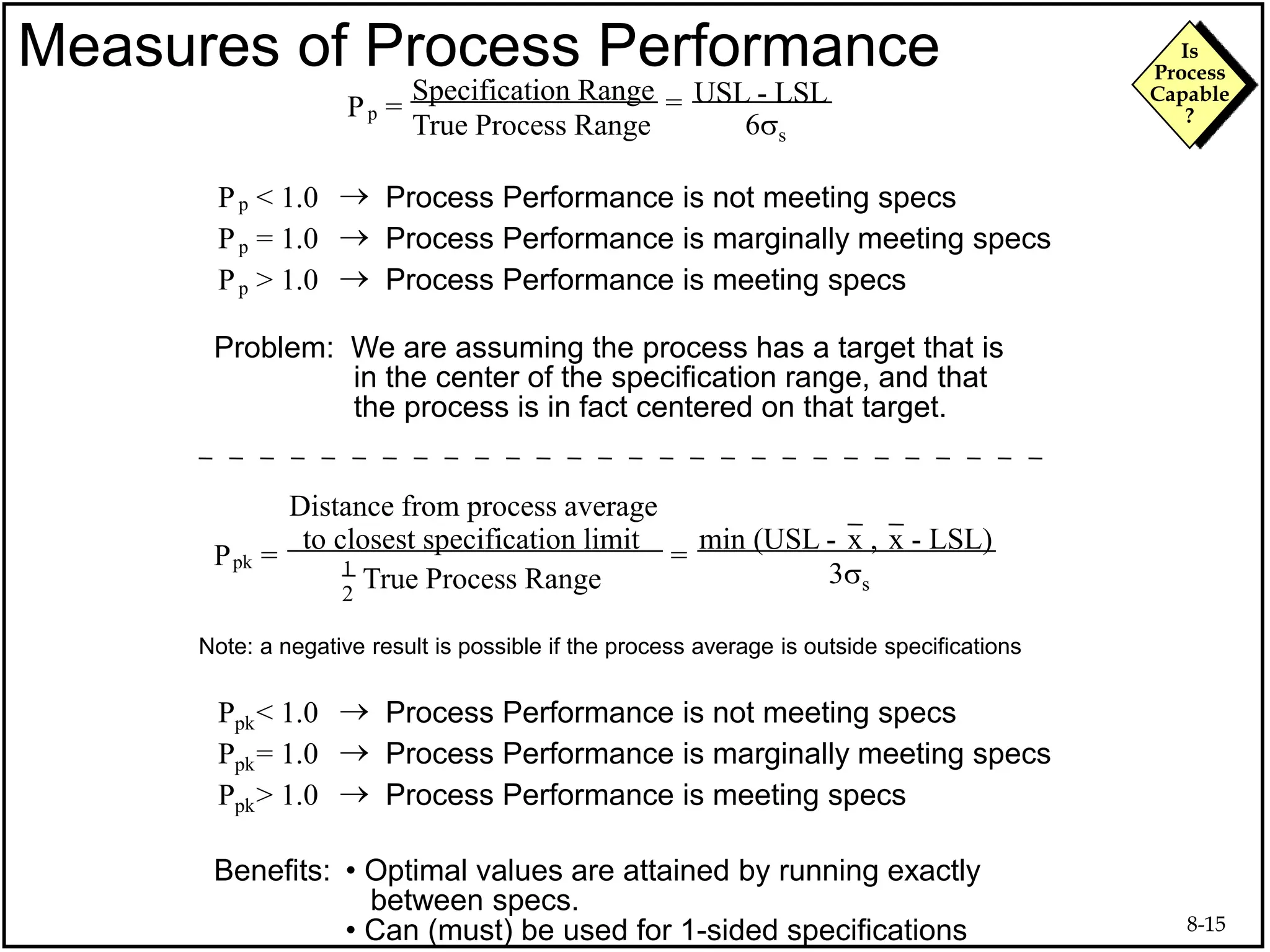
Measures of Process Performance
Pp =
Specification Range
True Process Range
= USL - LSL
6ss
Ppk =
Distance from process average
to closest specification limit
1
2
True Process Range
=
min (USL - x , x - LSL)
3ss
Problem: We are assuming the process has a target that is
in the center of the specification range, and that
the process is in fact centered on that target.
Note: a negative result is possible if the process average is outside specifications
Benefits: • Optimal values are attained by running exactly
between specs.
• Can (must) be used for 1-sided specifications
Pp < 1.0  Process Performance is not meeting specs
Pp = 1.0  Process Performance is marginally meeting specs
Pp > 1.0  Process Performance is meeting specs
Ppk< 1.0  Process Performance is not meeting specs
Ppk= 1.0  Process Performance is marginally meeting specs
Ppk> 1.0  Process Performance is meeting specs
8-16
Is
Process
Capable
?
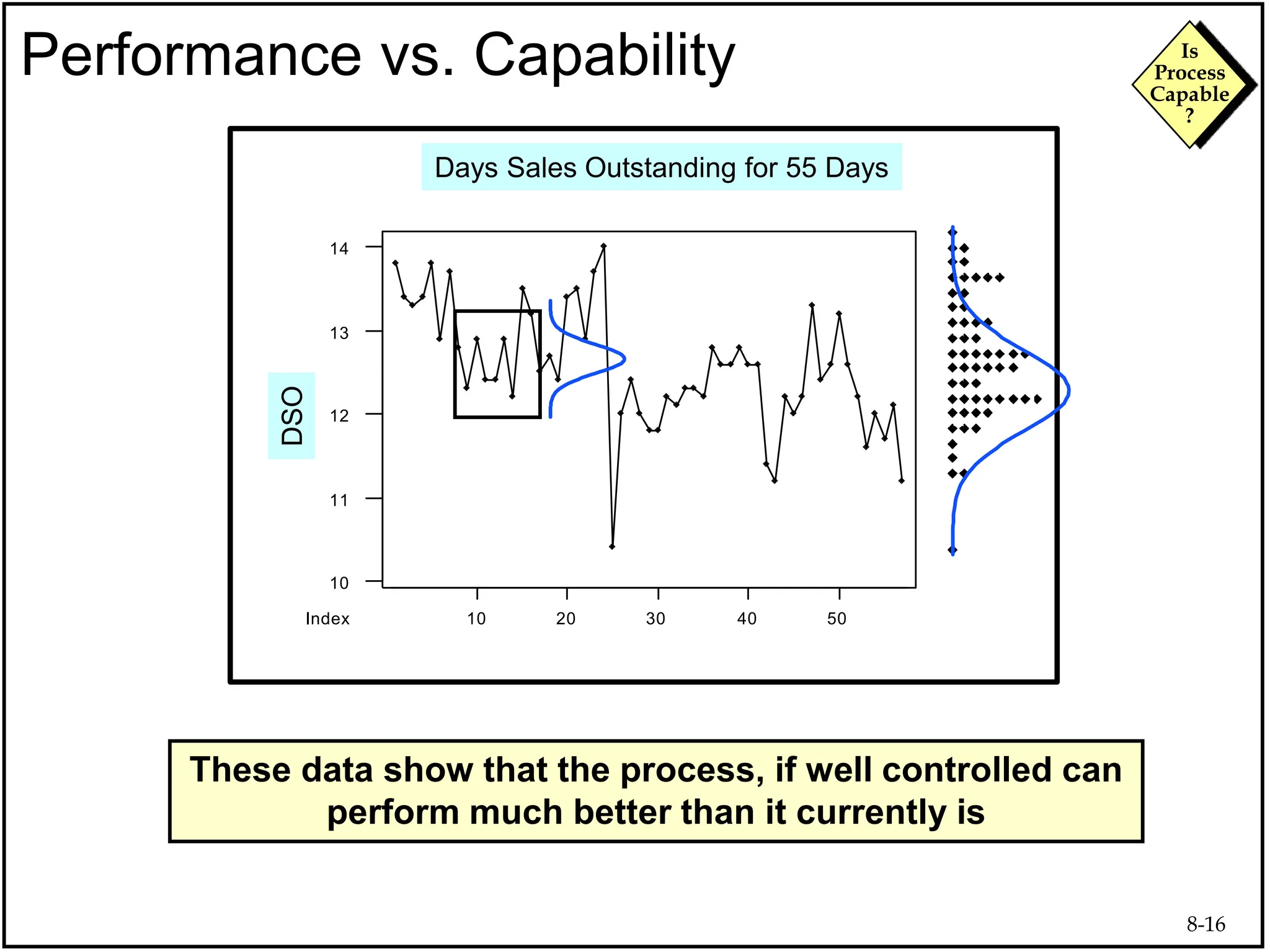
Performance vs. Capability
These data show that the process, if well controlled can
perform much better than it currently is
50
40
30
20
10
14
13
12
11
10
Index
CO2-Shrt
CO2 Levels for 55 Time Points
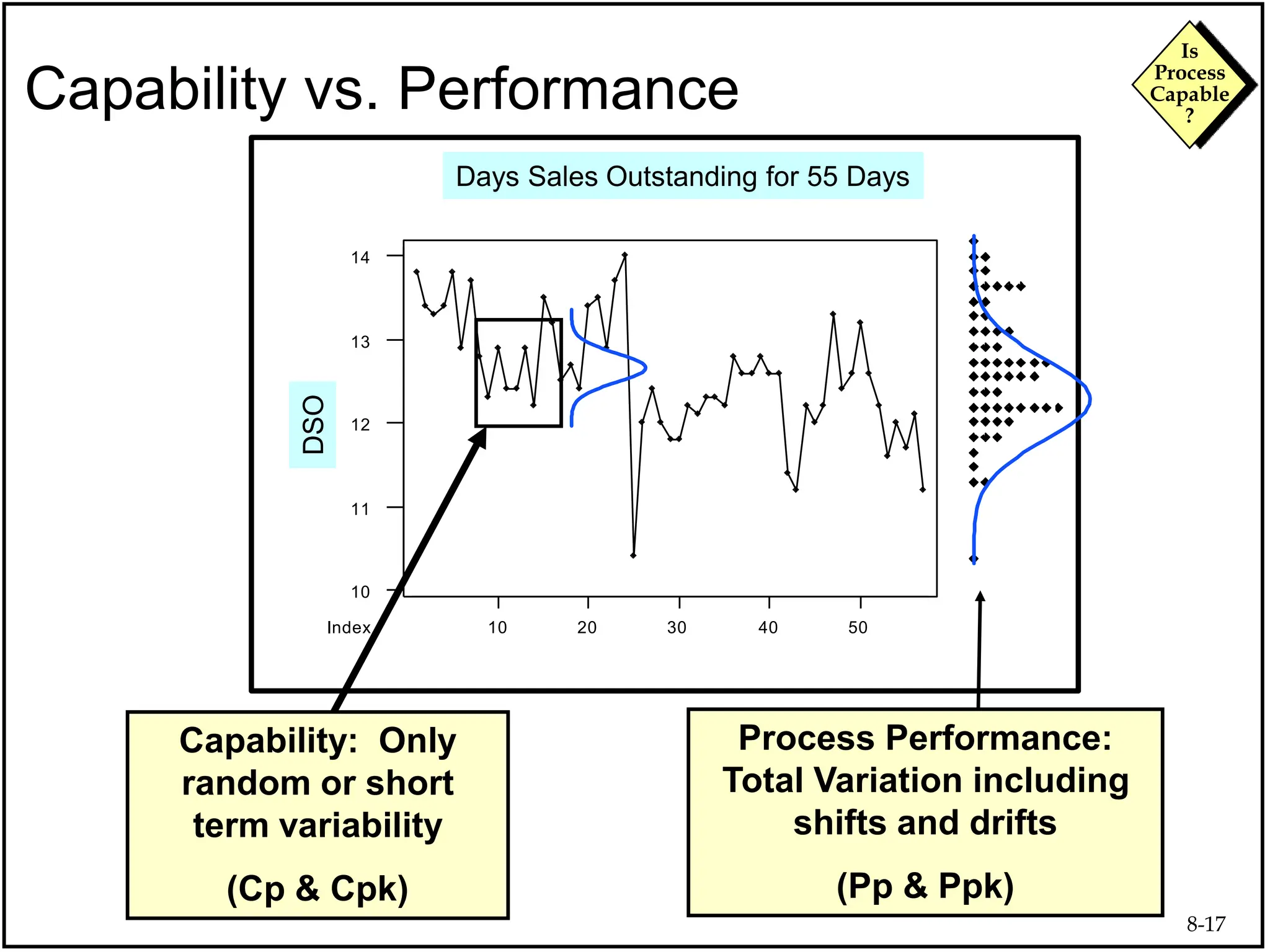
Days Sales Outstanding for 55 Days
DSO
8-17
Is
Process
Capable
?
Capability vs. Performance
50
40
30
20
10
14
13
12
11
10
Index
CO2-Shrt
CO2 Levels for 55 Time Points
Days Sales Outstanding for 55 Days
DSO
Process Performance:
Total Variation including
shifts and drifts
(Pp & Ppk)
Capability: Only
random or short
term variability
(Cp & Cpk)
8-18
Is
Process
Capable
?
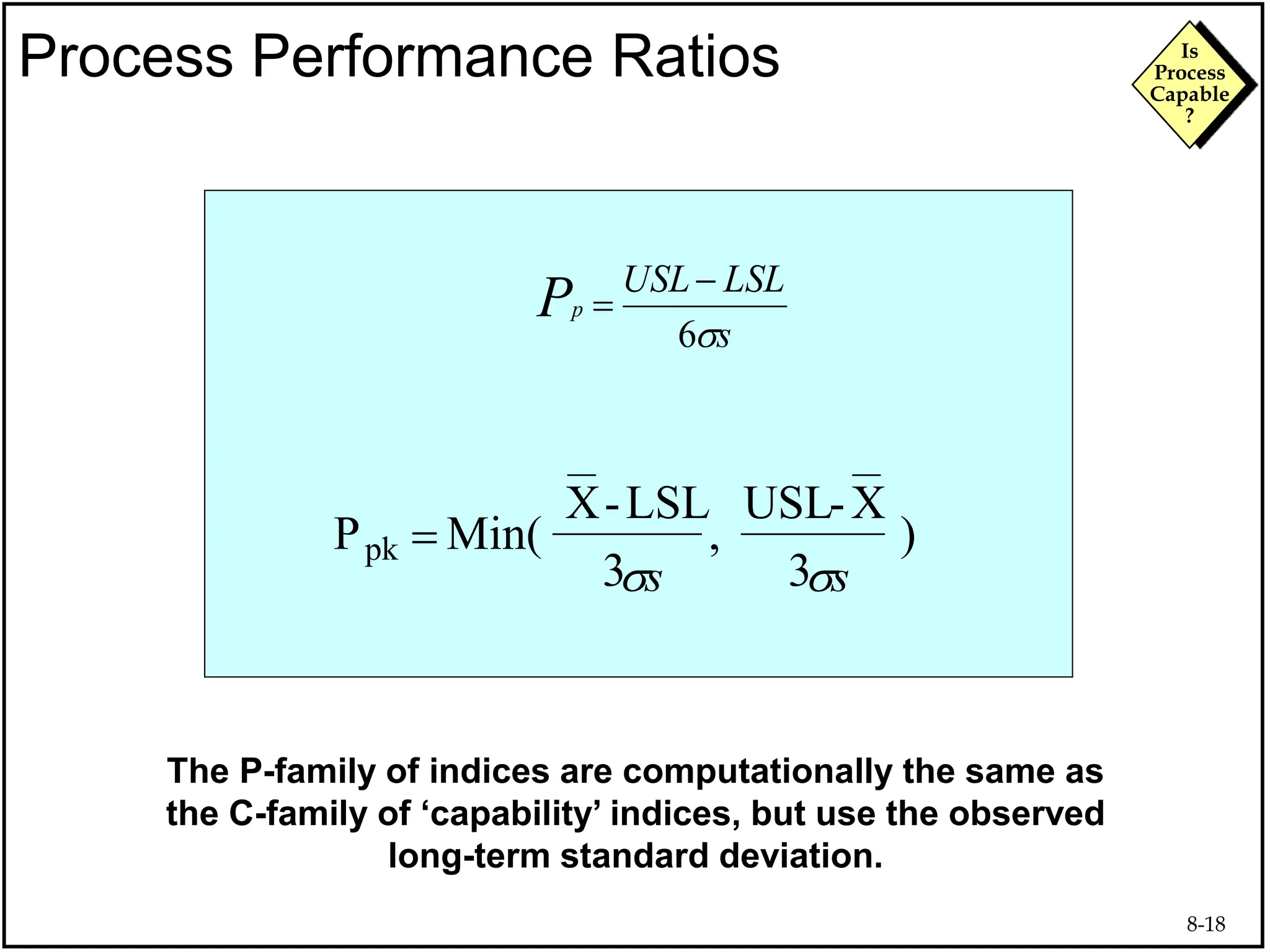
Process Performance Ratios
The P-family of indices are computationally the same as
the C-family of ‘capability’ indices, but use the observed
long-term standard deviation.
P Min(
X-LSL
3
USL-X
3
pk  , )
s
LSL
USL
p
P
s
6


s
s s
s
8-19
Is
Process
Capable
?
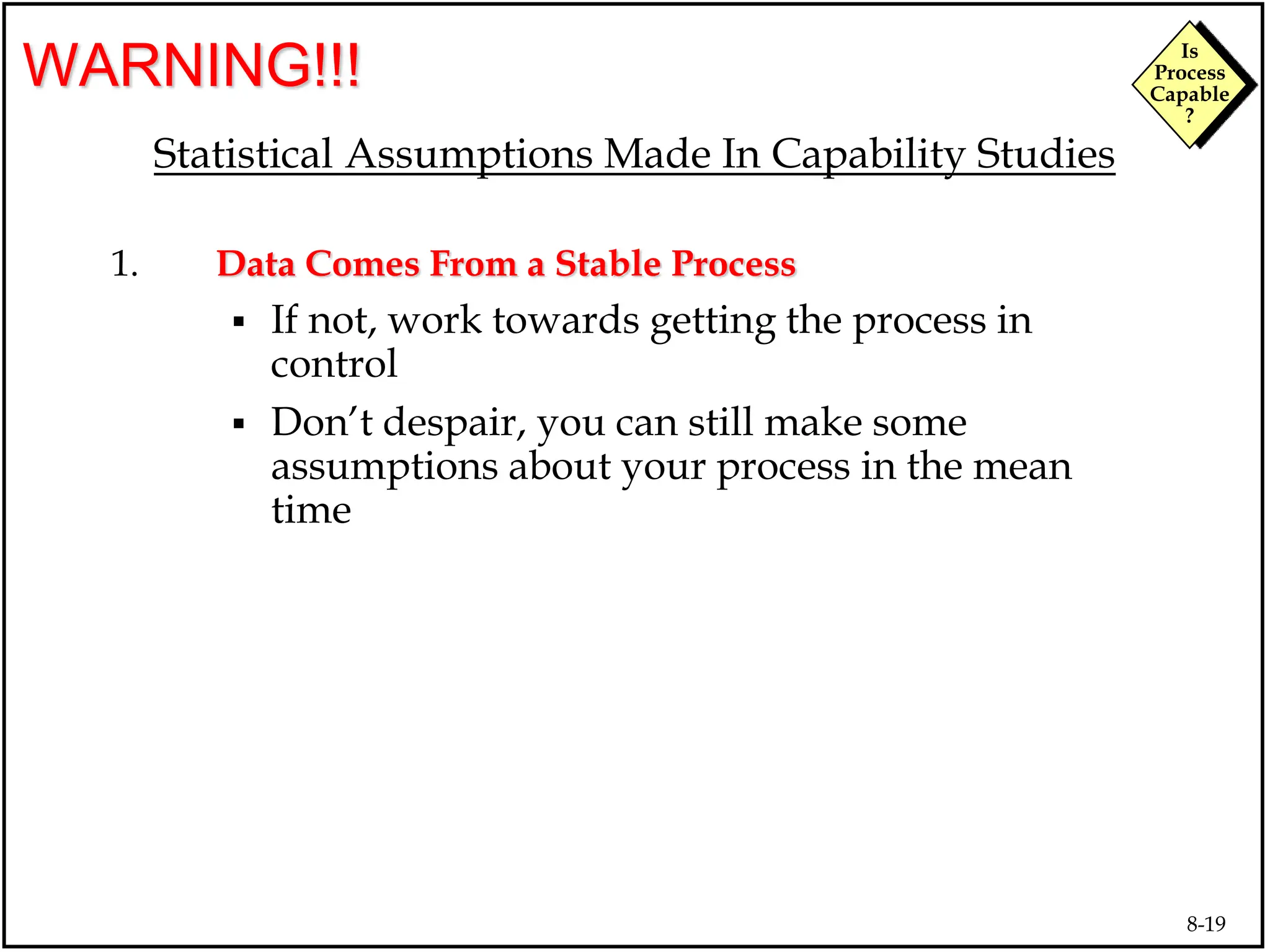
WARNING!!!
Statistical Assumptions Made In Capability Studies
1. Data Comes From a Stable Process
 If not, work towards getting the process in
control
 Don’t despair, you can still make some
assumptions about your process in the mean
time

Basics of Capability in total quality management.ppt

  • 1.
    8-1 Is Process Capable ? The Quality Improvement Model Use SPC to Maintain Current Process Collect& Interpret Data Select Measures Define Process Is Process Capable ? Improve Process Capability Is Process Stable ? Investigate & Fix Special Causes No Yes No Yes Is Process Capable? Purpose: Determine the adequacy of the process with respect to customer /management needs.
  • 2.
    8-2 Is Process Capable ? Capable Process A stableprocess that meets customer requirements. 8 22 24 2 4 6 10 12 14 16 18 20 26 28 30 32 Run Order UCL CL LCL Control Chart Lower Spec Upper Spec Target Histogram Capability assessments for unstable processes, may not be indicative of how the process is actually performing.
  • 3.
    8-3 Is Process Capable ? Assessing Process Capability Counting Measures  The average percent defectives.  The average number of defects.  Instrument Measures  Comparing both the center of the process and the process variation
  • 4.
    8-4 Is Process Capable ? Capability Assessment forCounting Measures “Order Entry Process” Is this process adequate as is? Should it be improved? Week 1 2 3 4 5 6 7 8 9 10 11 12 13 14 15 16 17 18 19 20 Total # Errors 15 22 18 10 13 9 27 12 24 22 8 8 26 16 20 10 16 9 15 20 320 0 5 10 15 20 25 30 35 5 10 15 20 Avg=16.0 LCL=4.0 UCL=28.0 Week Number of Errors Control Chart
  • 5.
    8-5 Is Process Capable ? Measures of ProcessCapability Cp = Specification Range True Process Range = USL - LSL 6sc Cpk = Distance from process average to closest specification limit 1 2 True Process Range = min (USL - x , x - LSL) 3sc Problem: We are assuming the process has a target that is in the center of the specification range, and that the process is in fact centered on that target. Note: a negative result is possible if the process average is outside specifications Benefits: • Optimal values are attained by running exactly between specs. • Can (must) be used for 1-sided specifications Cp < 1.0  Process is not capable of meeting specs Cp = 1.0  Process is marginally capable Cp > 1.0  Process is capable of meeting specs Cpk < 1.0  Process is not capable of meeting specs Cpk = 1.0  Process is marginally capable Cpk > 1.0  Process is capable of meeting specs Warning: Capability assessments for unstable processes, may not be indicative of how the process is actually performing.
  • 6.
    8-6 Is Process Capable ? How much materialis out of spec?  In the short term?  In the long term? USL LSL Process Capability
  • 7.
    8-7 Is Process Capable ? Process Capability Ratios Voiceof The Customer Voice of The Process USL LSL
  • 8.
  • 9.
    8-9 Is Process Capable ? Process Capability -The Strategy Centering –The Process Is On Target Spread – Reduce The Variation LSL USL Defects Defects
  • 10.
    8-10 Is Process Capable ? 2 Key Metricsfor Measuring Capability C Min( X-LSL 3 USL-X 3 pk  , ) c LSL USL Cp s 6   c s c s Process Capability Ratios
  • 11.
    8-11 Is Process Capable ? Process Capability Ratios- Concept Total Tolerance C Process Spread p  c LSL USL Cp s 6  
  • 12.
    8-12 Is Process Capable ? A Short-term Capabilitystudy covers a relatively short period of time (days, weeks) generally consisting of 30 to 50 data points. The actual number depends on the subject under study. Is The Process In Control ? Is It Producing Defects ? 35 30 25 20 15 10 5 0 39 34 29 24 Observation Number Individual Value I Chart for C1 X=30.60 3.0SL=37.36 -3.0SL=23.84 CP & CPK Measure Short-term Capability
  • 13.
    8-13 Is Process Capable ? A long-term capabilitystudy covers a relatively long period of time (weeks, months) generally consisting of 100-200 data points. Again, the actual amount depends on the subject under study. Is The Process In Control ? Is It Producing Defects ? 100 50 0 50 40 30 20 Observation Number Individual Value I Chart for C3 X=33.80 3.0SL=47.12 -3.0SL=20.49 Long Term Performance Short term Capability
  • 14.
    8-14 Is Process Capable ? A Further Lookat Capability Compare the estimates of the process deviations from the short-term and long-term data What is the difference between the short-term and the long-term data? What implication does this have in doing capability studies? Descriptive Statistics Variable N Mean StdDev short term 30 30.6 2.23 long term 180 33.8 4.44
  • 15.
    8-15 Is Process Capable ? Measures of ProcessPerformance Pp = Specification Range True Process Range = USL - LSL 6ss Ppk = Distance from process average to closest specification limit 1 2 True Process Range = min (USL - x , x - LSL) 3ss Problem: We are assuming the process has a target that is in the center of the specification range, and that the process is in fact centered on that target. Note: a negative result is possible if the process average is outside specifications Benefits: • Optimal values are attained by running exactly between specs. • Can (must) be used for 1-sided specifications Pp < 1.0  Process Performance is not meeting specs Pp = 1.0  Process Performance is marginally meeting specs Pp > 1.0  Process Performance is meeting specs Ppk< 1.0  Process Performance is not meeting specs Ppk= 1.0  Process Performance is marginally meeting specs Ppk> 1.0  Process Performance is meeting specs
  • 16.
    8-16 Is Process Capable ? Performance vs. Capability Thesedata show that the process, if well controlled can perform much better than it currently is 50 40 30 20 10 14 13 12 11 10 Index CO2-Shrt CO2 Levels for 55 Time Points Days Sales Outstanding for 55 Days DSO
  • 17.
    8-17 Is Process Capable ? Capability vs. Performance 50 40 30 20 10 14 13 12 11 10 Index CO2-Shrt CO2Levels for 55 Time Points Days Sales Outstanding for 55 Days DSO Process Performance: Total Variation including shifts and drifts (Pp & Ppk) Capability: Only random or short term variability (Cp & Cpk)
  • 18.
    8-18 Is Process Capable ? Process Performance Ratios TheP-family of indices are computationally the same as the C-family of ‘capability’ indices, but use the observed long-term standard deviation. P Min( X-LSL 3 USL-X 3 pk  , ) s LSL USL p P s 6   s s s s
  • 19.
    8-19 Is Process Capable ? WARNING!!! Statistical Assumptions MadeIn Capability Studies 1. Data Comes From a Stable Process  If not, work towards getting the process in control  Don’t despair, you can still make some assumptions about your process in the mean time