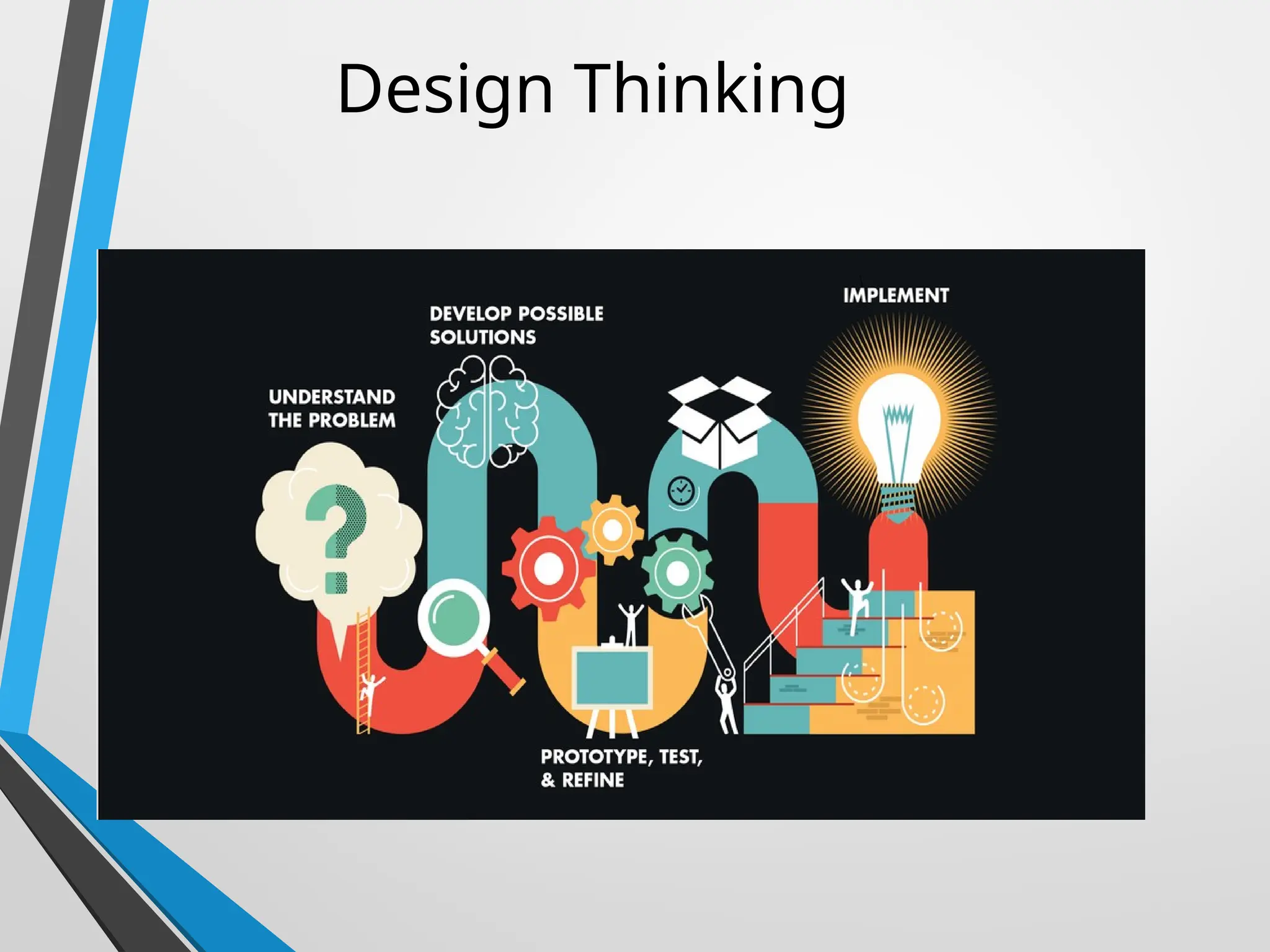
Design Thinking
Why is Design Thinking important for business?
Successful businesses are making billions by recognizing
the value of integrating “design thinking” into their
process.
Great design is simple, beautiful, and easy to use. It creates
a sense of purpose and place. It responds to user needs, and
it just works.
Aside from these characteristics, how can we know whether
a design is “good”?
Moreover, how can a business know whether the investment
of time and money into a design was worth it?
Why is Design Thinking important
for business? Continue…
In a highly competitive business environment,
design thinking can allow you to utilize your
resources in the best possible way.
By keeping an open mind, thinking creatively, and
testing every step of the way,
this technique helps businesses achieve
unprecedented levels of innovation and overcome
any issue that comes their way.
Why is Design Thinking important for
you?
• Design thinking helps understand ill-
defined problems.
• By re-thinking the problem in
various human-centric ways,
• we can create ideas through brainstorming
sessions and adopt a hands-on approach
in prototyping and testing.
What is design thinking?
General Introduction of DT
• Non-Linear
• Solution based framework
• Iterative process that teams use to
understand users, challenge assumptions,
redefine problems an create innovative
solutions to prototype and test.
Design Thinking
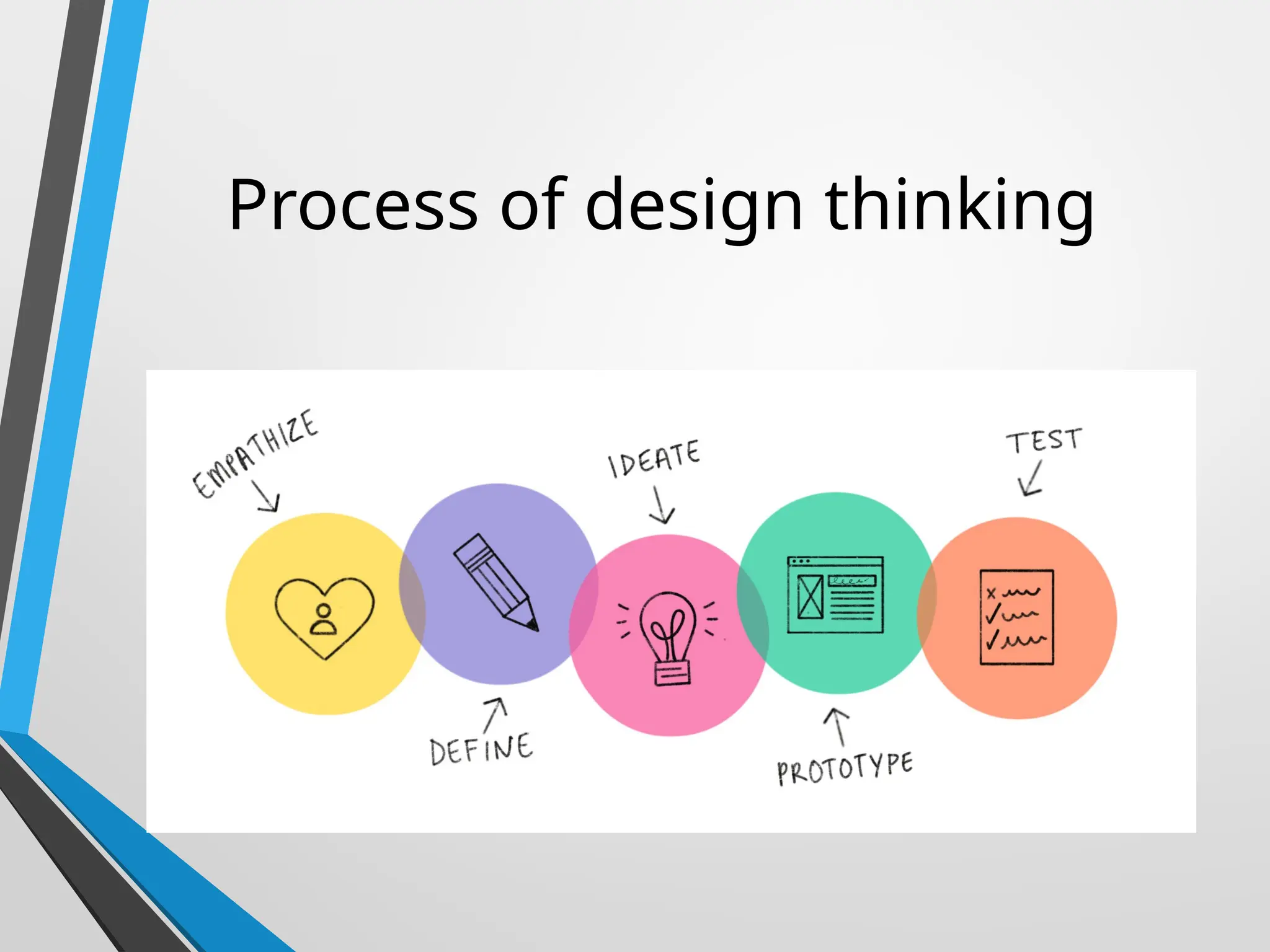
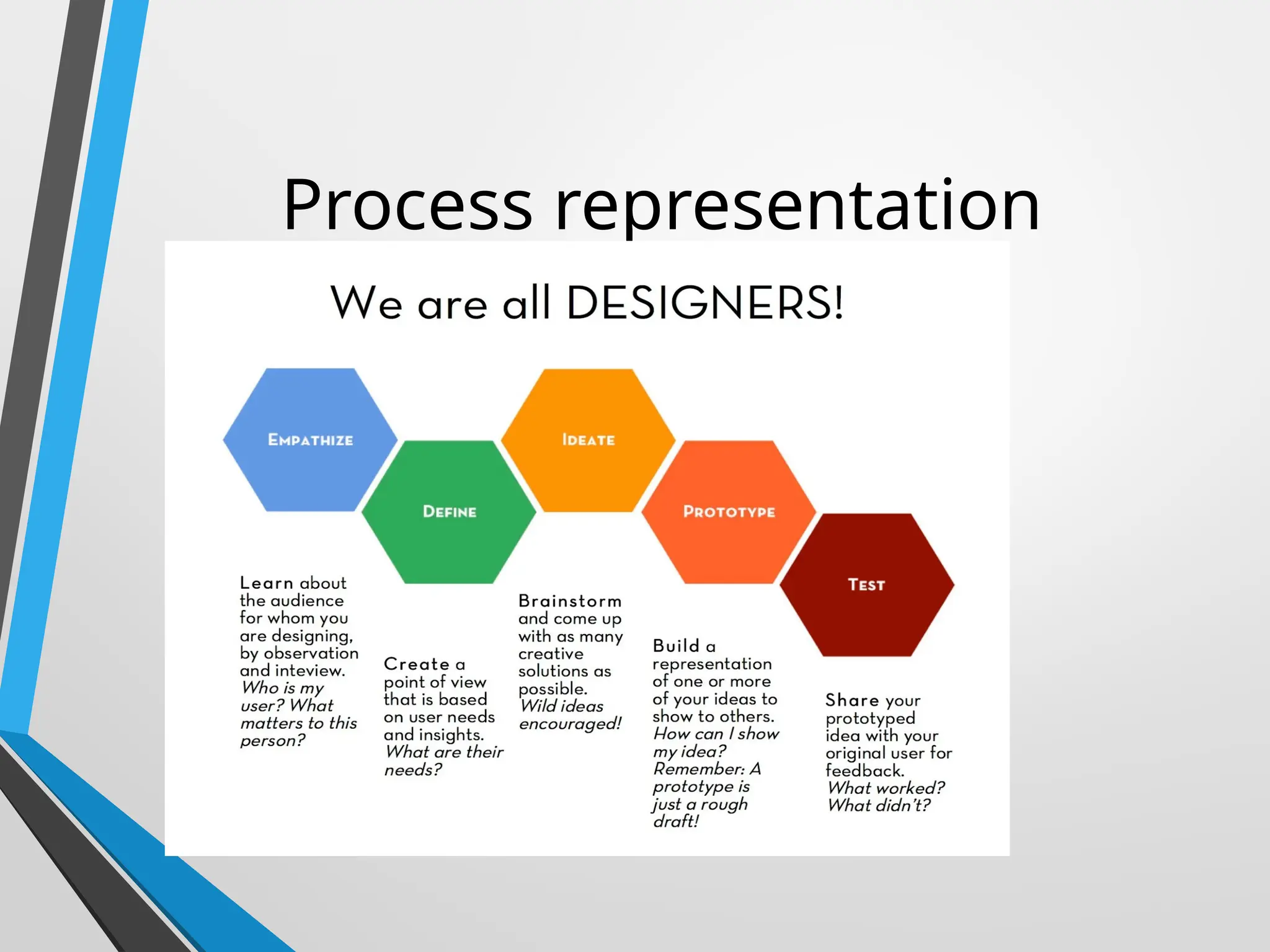
Process of design thinking
Empathize
It is the first step of the design thinking
process.
The designer spends time getting to know
the users and understanding their need,
wants and objectives.
Observing and engaging with people in-
order to understand them on a
psychological and emotional level.
Define
It is the second stage of the design
thinking process.
Specify and articulate the problem based
on the feedback from the empathize phase
Identify and define the issues that your
users are facing.
Ideate
• It is the third stage of the design thinking
process.
• Challenge assumptions and create ideas.
• Process where you generate ideas and
solutions through sessions such as
Sketching
Prototyping
Brain storming
And other ideation techniques.
Prototype
It is the fourth phase of design thinking process.
Helps to understand the users through the
implementation of experimental ideas and
design.
It is the vital process in design thinking.
It is the experimental stage in which design
teams look to implement test design on users
before reaching the final testing stage.
Test
Most important stages in the design
thinking process.
Where you discover whether your idea(s)
solve the user problem uncovered during the
empathize stage.
Testing should provide new insights to
inform your understanding and to help you
define (or) redefine the various problems that
the users might face.
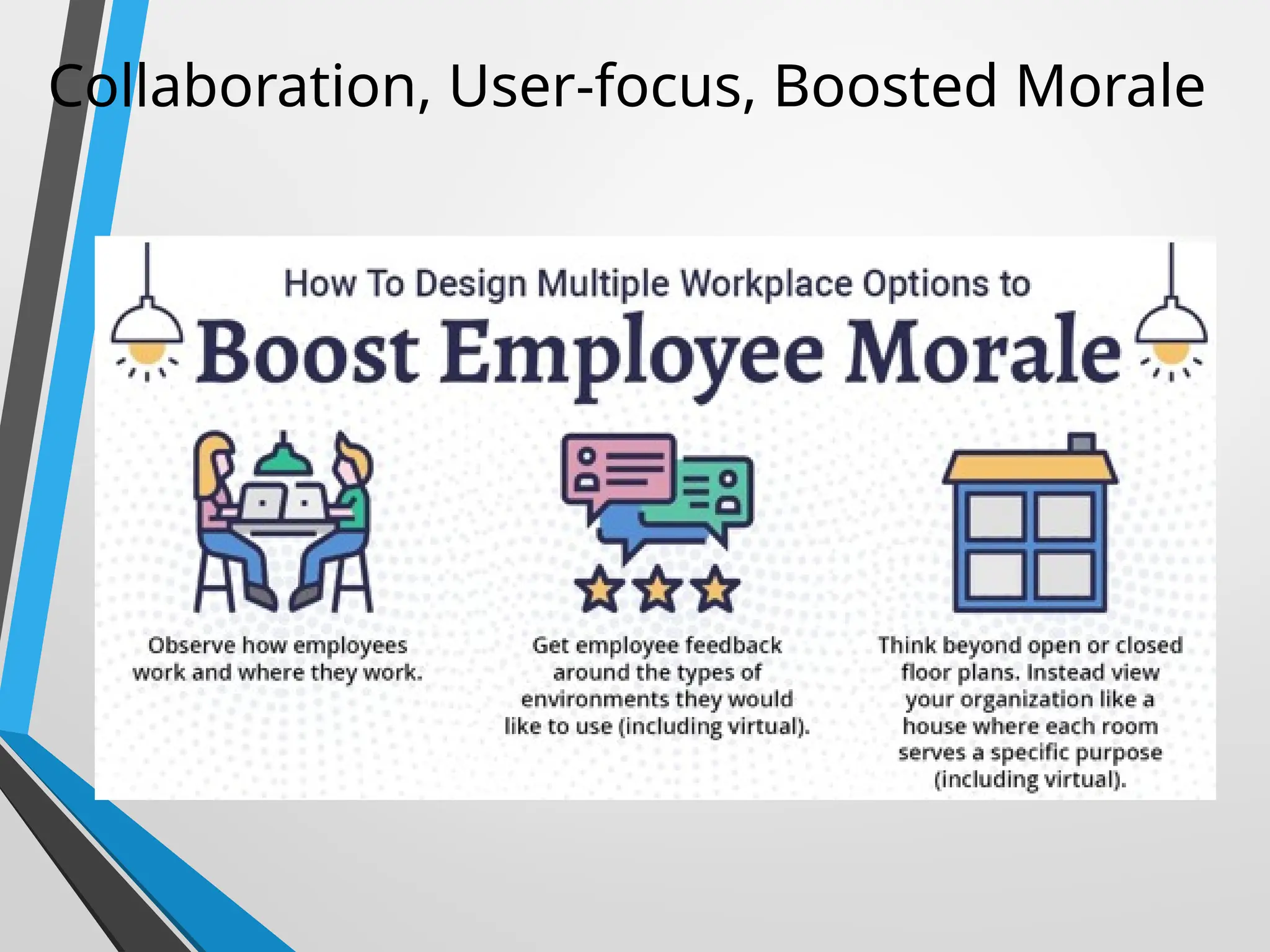
Collaboration
Through the collaboration of individuals from many
disciplines, ideas are generated which then can be tested
through rapid prototyping.
When different team members work on a design together, the
result is often more holistic, making for a better end product.
Collaboration, User-focus, Boosted Morale
Process representation
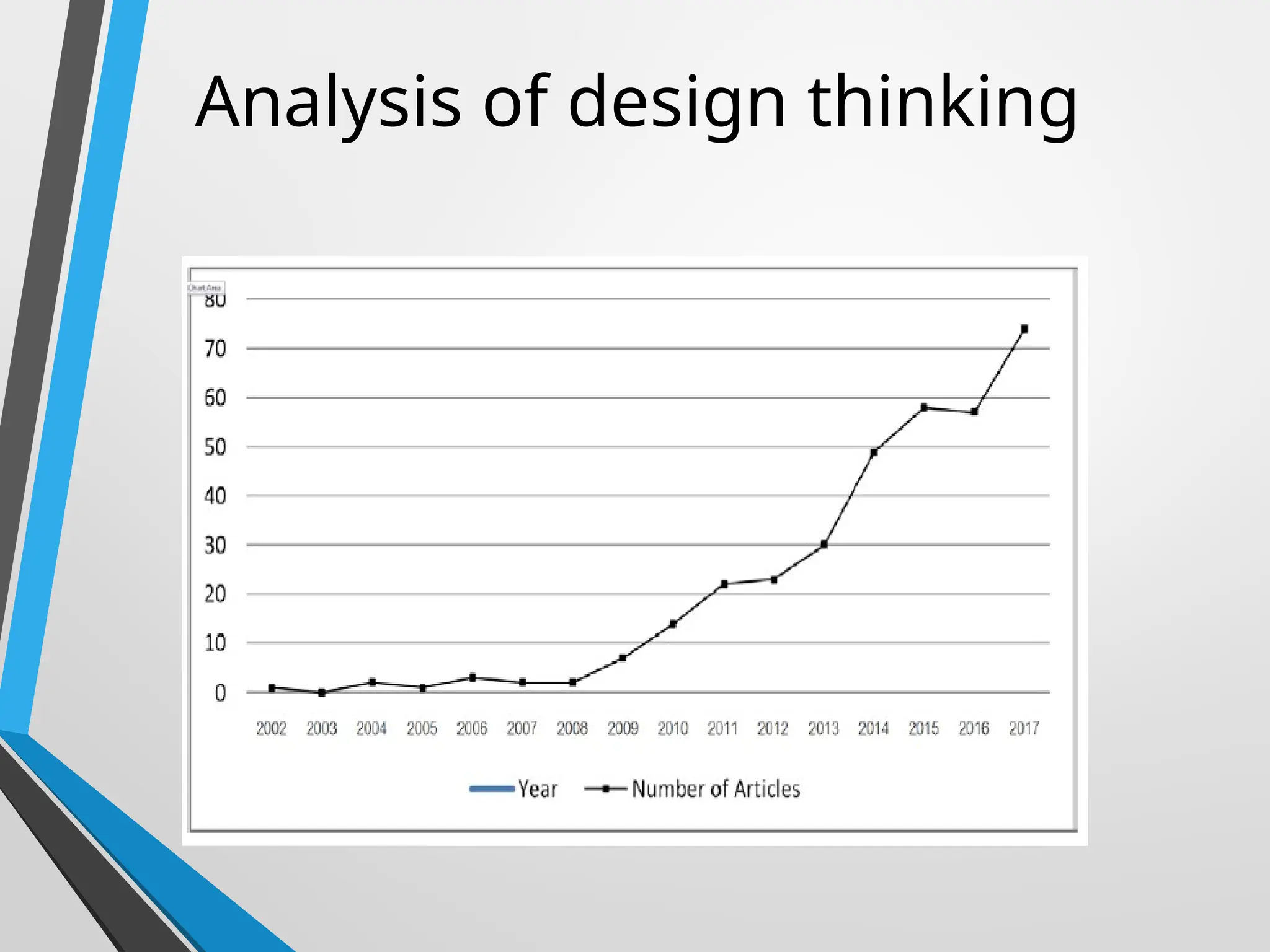
Analysis of design thinking
Where design thinking is used?
• Design thinking skills are generally occupying
in,
Marketing managers
Industrial engineers
Graphic designers
Software developers
Computer and information system managers.
Design thinking principle
•“Just as with learning how to swim, the
best way to practise is to jump in &try”
History John E.Arnold-1959
•L .Bruce Archer- 1965 By 190 DT
combined human resources and now
become innovative methodologies today.
Recognize the importance of DT
It helps to overcome the creative challenge.
It helps to effectively meet the customers
requirements.
It helps to broaden your knowledge with
design thinking.
It helps organisations to run faster with
more efficiency.
The main aim of DT is that it is aimed at
end user.
Importance of Design thinking

It is completely Solution based approach, to solving problems,

it is not about generating solutions(or) alternative solutions,

but more about understanding the users to know his part of
problem.
Design thinking and business
• Design thinking is a shorthand that the
business world has adopted to describe the
combination of creativity that design
mindset brings to the development of new
products and services.
• Design thinking consistently used to solution
that are,
Useful (full-fill a need)
Useable (accessible to all)
Desirable (inherently engaging)
How its different?
Design thinking is a toolbox of resource and
methods that teams can use to
systematically recognise opportunities and
solve problems they have never seen before.
Unlike business thinking where
understanding is derived from a more
aggregate view of stakeholders.
Why its essential?
Design thinking fundamentals were being
defined and redefined as the world went
digital and users asked for more control.
Why it works?
Design thinking is a perfect agile tool. It leads
towards the solutions that bring value to any
initiative where a company needs to better
understand and relate to their customers.
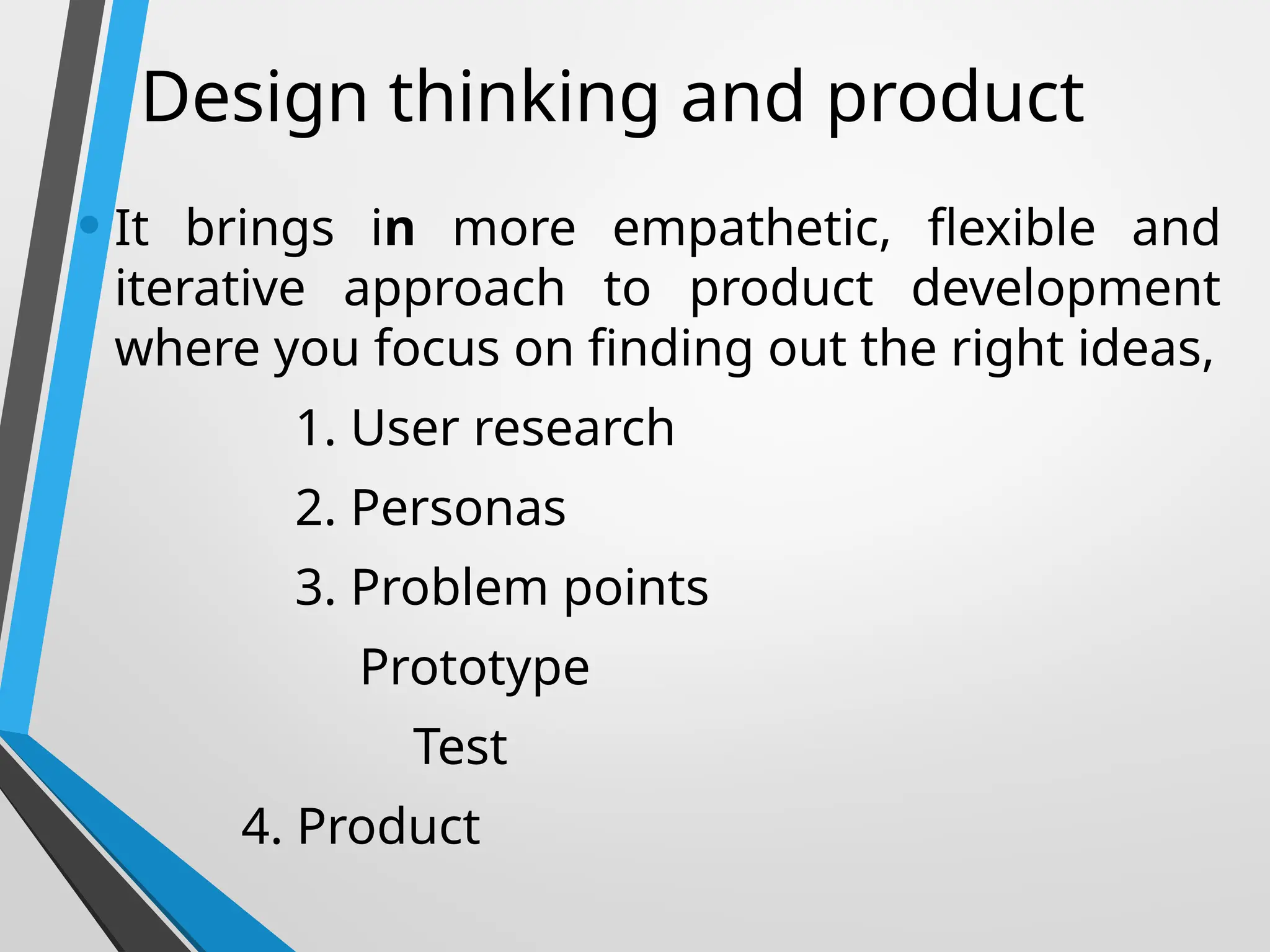
Design thinking and product
• It brings in more empathetic, flexible and
iterative approach to product development
where you focus on finding out the right ideas,
1. User research
2. Personas
3. Problem points
Prototype
Test
4. Product
Products(con.)
User research:
Important steps in design thinking for
product management.
Personas:
Carefully generates users that match user
needs.
Problem points:
Issues associated with products from each
point of view.
Product (cont.)
Test
•Two steps go hand in hand as it is
necessary to test the solution.
Product
•Minimum scalable product that you
are able to hand off
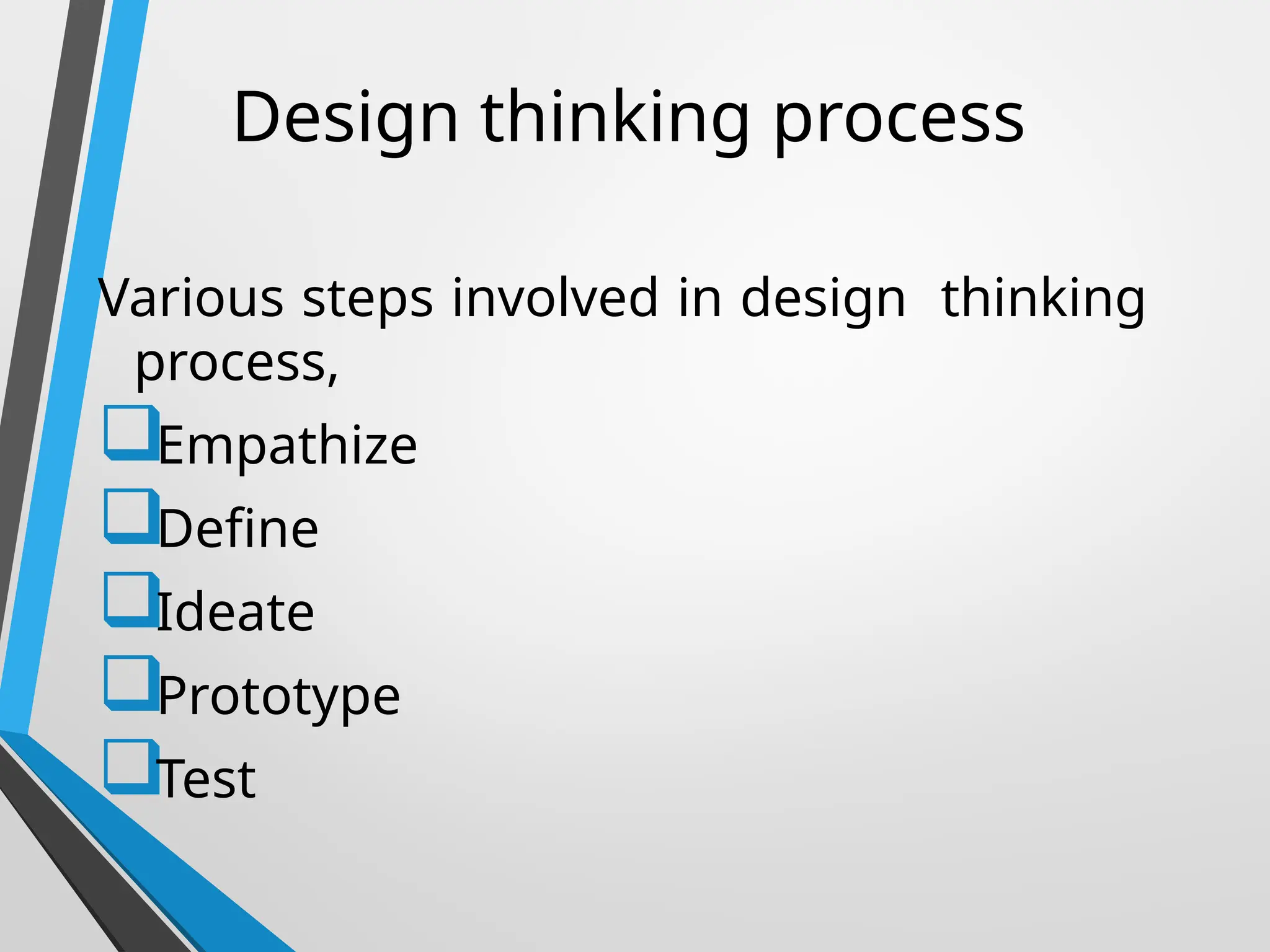
Design thinking process
Various steps involved in design thinking
process,
Empathize
Define
Ideate
Prototype
Test
Immersion
The first stage of the Design Thinking process is called Immersion.
It is at this moment that the project team identifies and approaches the
context of the problem, approaching it from different standpoints.
Immersion is divided into two sub-stages, called Preliminary and In-
depth.
The Preliminary Immersion aims to define the scope of the project and
the limits of action. Here, a survey of the subjects of interest whose
inputs can be explored in the in-depth part can be carried out.
The In-depth Immersion begins with the development of research
protocols, the list of users that will be recruited for the interviews,
as well as the identification of needs and opportunities that will guide
the next stages.
During the immersion stage, several techniques of the
anthropological field are used in the collection of information helping
break down the different contexts of the problems,
such as Interviews, Generative Sessions and Sensitization Notebooks.
Analysis and Synthesis
After the data collection stage, the next step is to carry out the
analysis and synthesis of the information collected. .
To do this, insights must be organized in order to obtain
standards and create challenges to assist in understanding the
problem.
Ideation
Ideation is the third stage of the Design Thinking process and
aims to generate innovative ideas for the project theme.
At this stage, it is common to have meetings in which the
actors involved in the project are divided into multidisciplinary
teams to carry out activities that stimulate creativity.
These meetings with people from different backgrounds and
perspectives are fundamental to the ideation of the best
solutions to the problem.
One of the most common paths in the Ideation stage is to use
the Co-creation Workshops to bring together different
perspectives and generate complete ideas, taking into account
multiple standpoints.
Prototyping
Prototyping is the validation and verification stage of the
effectiveness of the ideas generated in the previous stage
of Ideation.
The prototypes help make the idea tangible, bringing a
concept to reality. The representations are divided into
low, medium and high fidelity prototypes ranging from
conceptual versions of the product, service or functionality
to mock-ups that are very close to the final result.
Implementation
Once the prototypes have been tested and validated, the
solutions best suited to the business reality that best meet the
users’ needs are improved for implementation.
This is the ultimate moment to take on the innovative mindset,
allowing values like empathy and collaboration to take root in
the day to day.
Design Thinking projects are the kick-off for cultural change in
corporations, fostering the necessary conditions for innovation
and positively impacting business.
It is very common for the volume of ideas of value generated in
the Ideation phase and validated in the Prototyping stage is too
great to be implemented soon after the end of the project.
Introduction about DesignThinking Notes.pptx

  • 1.
  • 2.
    Why is DesignThinking important for business? Successful businesses are making billions by recognizing the value of integrating “design thinking” into their process. Great design is simple, beautiful, and easy to use. It creates a sense of purpose and place. It responds to user needs, and it just works. Aside from these characteristics, how can we know whether a design is “good”? Moreover, how can a business know whether the investment of time and money into a design was worth it?
  • 3.
    Why is DesignThinking important for business? Continue… In a highly competitive business environment, design thinking can allow you to utilize your resources in the best possible way. By keeping an open mind, thinking creatively, and testing every step of the way, this technique helps businesses achieve unprecedented levels of innovation and overcome any issue that comes their way.
  • 4.
    Why is DesignThinking important for you? • Design thinking helps understand ill- defined problems. • By re-thinking the problem in various human-centric ways, • we can create ideas through brainstorming sessions and adopt a hands-on approach in prototyping and testing.
  • 5.
    What is designthinking?
  • 6.
    General Introduction ofDT • Non-Linear • Solution based framework • Iterative process that teams use to understand users, challenge assumptions, redefine problems an create innovative solutions to prototype and test.
  • 7.
  • 8.
  • 9.
    Empathize It is thefirst step of the design thinking process. The designer spends time getting to know the users and understanding their need, wants and objectives. Observing and engaging with people in- order to understand them on a psychological and emotional level.
  • 10.
    Define It is thesecond stage of the design thinking process. Specify and articulate the problem based on the feedback from the empathize phase Identify and define the issues that your users are facing.
  • 11.
    Ideate • It isthe third stage of the design thinking process. • Challenge assumptions and create ideas. • Process where you generate ideas and solutions through sessions such as Sketching Prototyping Brain storming And other ideation techniques.
  • 12.
    Prototype It is thefourth phase of design thinking process. Helps to understand the users through the implementation of experimental ideas and design. It is the vital process in design thinking. It is the experimental stage in which design teams look to implement test design on users before reaching the final testing stage.
  • 13.
    Test Most important stagesin the design thinking process. Where you discover whether your idea(s) solve the user problem uncovered during the empathize stage. Testing should provide new insights to inform your understanding and to help you define (or) redefine the various problems that the users might face.
  • 14.
    Collaboration Through the collaborationof individuals from many disciplines, ideas are generated which then can be tested through rapid prototyping. When different team members work on a design together, the result is often more holistic, making for a better end product.
  • 15.
  • 16.
  • 17.
  • 18.
    Where design thinkingis used? • Design thinking skills are generally occupying in, Marketing managers Industrial engineers Graphic designers Software developers Computer and information system managers.
  • 19.
    Design thinking principle •“Justas with learning how to swim, the best way to practise is to jump in &try” History John E.Arnold-1959 •L .Bruce Archer- 1965 By 190 DT combined human resources and now become innovative methodologies today.
  • 20.
    Recognize the importanceof DT It helps to overcome the creative challenge. It helps to effectively meet the customers requirements. It helps to broaden your knowledge with design thinking. It helps organisations to run faster with more efficiency. The main aim of DT is that it is aimed at end user.
  • 21.
    Importance of Designthinking  It is completely Solution based approach, to solving problems,  it is not about generating solutions(or) alternative solutions,  but more about understanding the users to know his part of problem.
  • 22.
    Design thinking andbusiness • Design thinking is a shorthand that the business world has adopted to describe the combination of creativity that design mindset brings to the development of new products and services. • Design thinking consistently used to solution that are, Useful (full-fill a need) Useable (accessible to all) Desirable (inherently engaging)
  • 23.
    How its different? Designthinking is a toolbox of resource and methods that teams can use to systematically recognise opportunities and solve problems they have never seen before. Unlike business thinking where understanding is derived from a more aggregate view of stakeholders.
  • 24.
    Why its essential? Designthinking fundamentals were being defined and redefined as the world went digital and users asked for more control. Why it works? Design thinking is a perfect agile tool. It leads towards the solutions that bring value to any initiative where a company needs to better understand and relate to their customers.
  • 25.
    Design thinking andproduct • It brings in more empathetic, flexible and iterative approach to product development where you focus on finding out the right ideas, 1. User research 2. Personas 3. Problem points Prototype Test 4. Product
  • 26.
    Products(con.) User research: Important stepsin design thinking for product management. Personas: Carefully generates users that match user needs. Problem points: Issues associated with products from each point of view.
  • 27.
    Product (cont.) Test •Two stepsgo hand in hand as it is necessary to test the solution. Product •Minimum scalable product that you are able to hand off
  • 28.
    Design thinking process Varioussteps involved in design thinking process, Empathize Define Ideate Prototype Test
  • 29.
    Immersion The first stageof the Design Thinking process is called Immersion. It is at this moment that the project team identifies and approaches the context of the problem, approaching it from different standpoints. Immersion is divided into two sub-stages, called Preliminary and In- depth. The Preliminary Immersion aims to define the scope of the project and the limits of action. Here, a survey of the subjects of interest whose inputs can be explored in the in-depth part can be carried out.
  • 30.
    The In-depth Immersionbegins with the development of research protocols, the list of users that will be recruited for the interviews, as well as the identification of needs and opportunities that will guide the next stages. During the immersion stage, several techniques of the anthropological field are used in the collection of information helping break down the different contexts of the problems, such as Interviews, Generative Sessions and Sensitization Notebooks.
  • 31.
    Analysis and Synthesis Afterthe data collection stage, the next step is to carry out the analysis and synthesis of the information collected. . To do this, insights must be organized in order to obtain standards and create challenges to assist in understanding the problem.
  • 32.
    Ideation Ideation is thethird stage of the Design Thinking process and aims to generate innovative ideas for the project theme. At this stage, it is common to have meetings in which the actors involved in the project are divided into multidisciplinary teams to carry out activities that stimulate creativity. These meetings with people from different backgrounds and perspectives are fundamental to the ideation of the best solutions to the problem. One of the most common paths in the Ideation stage is to use the Co-creation Workshops to bring together different perspectives and generate complete ideas, taking into account multiple standpoints.
  • 33.
    Prototyping Prototyping is thevalidation and verification stage of the effectiveness of the ideas generated in the previous stage of Ideation. The prototypes help make the idea tangible, bringing a concept to reality. The representations are divided into low, medium and high fidelity prototypes ranging from conceptual versions of the product, service or functionality to mock-ups that are very close to the final result.
  • 34.
    Implementation Once the prototypeshave been tested and validated, the solutions best suited to the business reality that best meet the users’ needs are improved for implementation. This is the ultimate moment to take on the innovative mindset, allowing values like empathy and collaboration to take root in the day to day. Design Thinking projects are the kick-off for cultural change in corporations, fostering the necessary conditions for innovation and positively impacting business. It is very common for the volume of ideas of value generated in the Ideation phase and validated in the Prototyping stage is too great to be implemented soon after the end of the project.